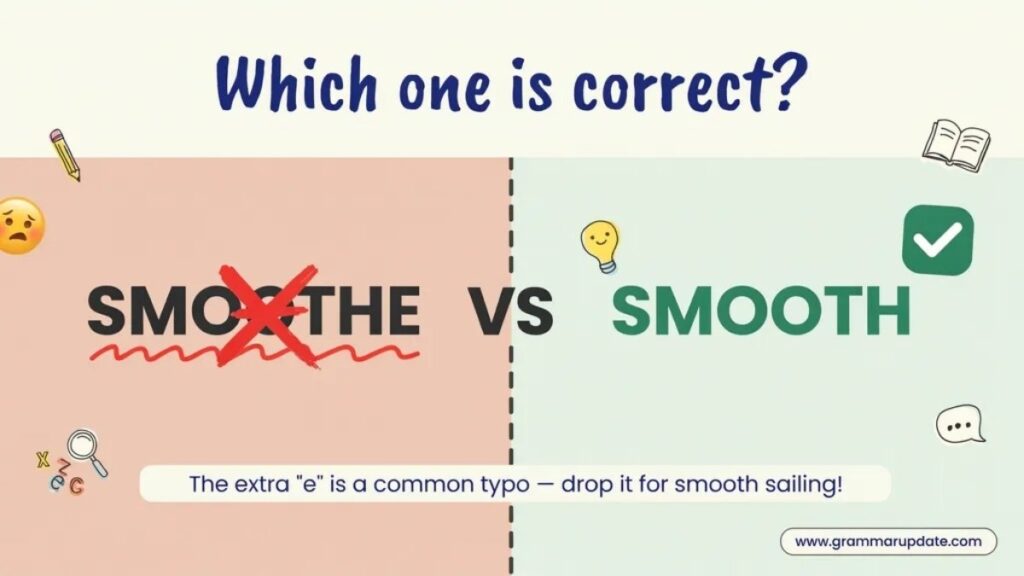
Many people stop and wonder whether it’s smoothe vs smooth. The two words look almost the same, which makes the confusion easy to understand. After all, English has plenty of words that end with a silent e, so adding one here feels like the right choice. But this is one of those times when English plays a little trick on us. The good news is that the rule is simple once you know it. In this guide, you’ll learn which spelling is correct, why people mix them up, how to use the word with confidence, and easy examples that will help you avoid this common mistake every time you write.
Smoothe vs Smooth Quick Answer
If you’re looking for the quick answer, here it is.
| Feature | Smooth | Smoothe |
|---|---|---|
| Correct spelling | Yes | No (Modern English) |
| Found in modern dictionaries | Yes | Generally no as a standard spelling |
| Used in everyday English | Yes | No |
| Accepted in academic writing | Yes | No |
| Used in business writing | Yes | No |
The easiest rule to remember is simple:
- Use smooth whenever you’re talking about something even, soft, polished, effortless, or making something even.
- Avoid smoothe because it is not the accepted spelling in modern English.
If someone asks, “smooth vs smoothe which is correct?” the answer is always smooth in modern standard English.
Learn the difference between commonly mixed-up more words
Noisy vs Noisey Which is Correct and Usage?
Is It “Smoothe vs Smooth”?
The question appears surprisingly often in search engines because the two spellings look believable. However, only one follows modern English spelling conventions.
The Short Answer
The correct spelling is smooth.
Whether you’re using the word as an adjective or as a verb, the spelling stays exactly the same.
Correct examples:
- The road became smooth after repairs.
- She tried to smooth the wrinkles.
- His presentation was smooth and confident.
- We need to smooth the surface before painting.
Incorrect examples:
- The road became smoothe.
- Please smoothe the fabric.
- She has a smoothe voice.
These examples contain a common spelling mistake.
Learn the difference between commonly mixed-up more words
Bailer vs Baler the Difference and Usage
Why “Smooth” Is the Standard English Spelling
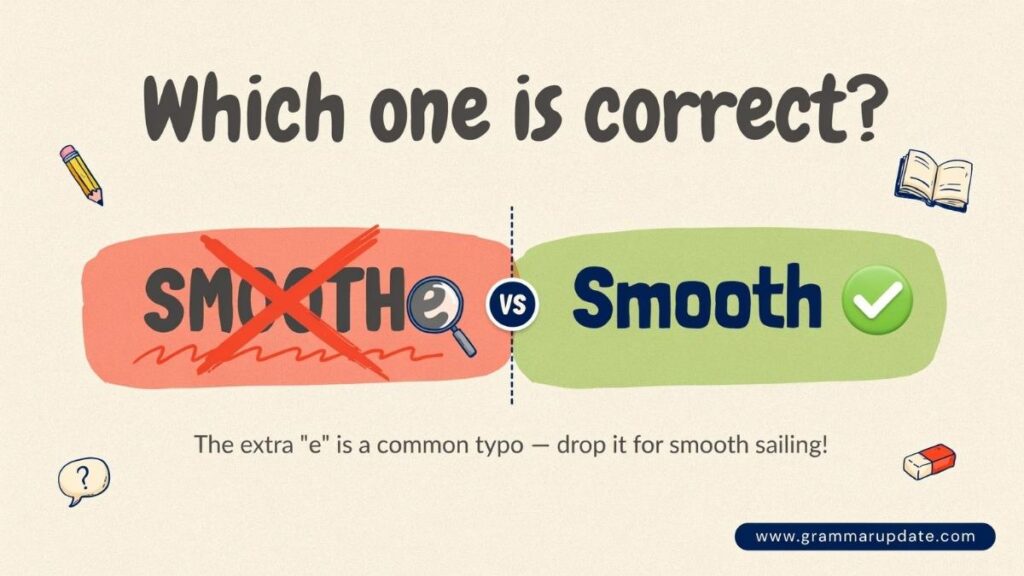
Modern English dictionaries recognize smooth as the proper spelling. You’ll find it listed in major references because it has remained the accepted form for centuries.
The spelling follows historical English development rather than modern pronunciation patterns. Even though adding an “e” may seem logical, English preserves many traditional spellings that don’t always match expectations.
This explains why questions like “is smooth correct” or “is smoothe incorrect” appear so often among English learners.
The answer remains straightforward.
- Smooth is correct.
- Smoothe is considered an incorrect spelling in modern English writing.
What Does “Smooth” Mean?
Understanding the word’s meaning makes it much easier to use correctly.
The smooth meaning changes slightly depending on whether it functions as an adjective or a verb, but the central idea stays the same.
At its core, smooth describes something that is even, free from roughness, easy to move across, or free from difficulties.
The smooth definition can apply to physical objects, people, conversations, technology, writing, and countless other situations.
Smooth as an Adjective
The most common use of smooth is as an adjective.
A smooth adjective describes a person, object, experience, or process that feels even, polished, soft, uninterrupted, or effortless.
Examples include:
- a smooth surface
- smooth skin
- smooth texture
- smooth finish
- smooth operation
- smooth music
- smooth writing
- smooth communication
Smooth adjective meaning
Depending on the context, smooth may describe:
| Meaning | Example |
|---|---|
| Even without bumps | The table has a smooth surface. |
| Soft to the touch | The fabric feels smooth. |
| Easy and effortless | The project had a smooth start. |
| Calm and confident | She gave a smooth presentation. |
| Pleasant sounding | He has a smooth voice. |
Notice how the word extends beyond physical objects.
A negotiation can be smooth.
A conversation can be smooth.
Even software can provide a smooth user experience.
That flexibility explains why smooth appears so frequently in everyday English.
Smooth adjective examples
Here are more smooth examples:
- The marble floor feels smooth beneath your feet.
- Everything went smoothly after the update.
- His handwriting looks smooth and consistent.
- The pilot made a smooth landing.
- The lotion leaves your skin smooth.
- They completed the transition with a smooth process.
- Her explanation made the difficult topic seem smooth and simple.
Smooth as a Verb
Many people know smooth as an adjective but forget that it also functions as a verb.
The smooth verb means to make something even, flat, softer, or less rough.
1 You smooth wrinkles.
2 You smooth fabric.
3 You smooth hair.
4 You smooth concrete.
5 You can even smooth relationships after a disagreement.
Smooth verb meaning and examples
Here are several common situations where the verb appears.
Physical actions:
- Smooth the blanket before folding it.
- He smoothed the paper with his hand.
- They smoothed the wet cement.
Figurative actions:
- The manager tried to smooth tensions between departments.
- She smoothed over the misunderstanding.
- Good planning helped smooth the transition.
Notice that the idea remains consistent.
Something rough, difficult, or uneven becomes easier or more orderly.
Smooth verb examples
These sentences show different verb uses.
- She smoothed her dress before entering the room.
- He carefully smoothed the wallpaper.
- The company smoothed the onboarding process.
- We need to smooth the edges before painting.
- They smoothed the road after construction.
- He smoothed his hair using a brush.
- Experience helped smooth communication among the teams.
Because the verb is common in both literal and figurative language, you’ll encounter it regularly in books, newspapers, business writing, and conversations.
Smooth as a Noun
Although uncommon, smooth occasionally appears as a noun in specialized fields.
For example, in geology or manufacturing, professionals sometimes use the word to describe a smooth area or finish.
These uses are relatively rare compared with the adjective and verb forms.
For everyday English, you’ll almost always encounter smooth as either:
- an adjective
- a verb
Is “Smoothe” a Real Word?
This is one of the most searched questions related to the topic.
People often ask:
- Is smoothe a real word?
- Can you use smoothe?
- Is smoothe a correct spelling?
- What is smoothe meaning?
- What is the smoothe word meaning?
The short answer is that smoothe is not the accepted spelling in modern standard English.
If you’re writing for school, work, publishing, or professional communication, you should always use smooth.
Dictionary Status
Major English dictionaries recognize smooth as the standard spelling.
If you search for smoothe, you’ll typically find one of three situations.
- It redirects you to “smooth.”
- It appears only as a historical or obsolete form.
- It isn’t listed as a standard modern spelling at all.
This is why spell checkers usually mark smoothe as a spelling error.
Modern English spelling favors consistency, and smooth has become the universally accepted form.
Learn the difference between commonly mixed-up more words
Coaches vs Coach’s Difference and Usage
Why Many People Think It Needs an Extra “E”
This mistake is surprisingly understandable.
English contains many words ending in silent “e.”
Consider these examples:
- breathe
- soothe
- lathe
- bathe
Since these words exist, many writers assume that smooth should become smoothe.
However, English spelling rules contain many historical exceptions.
Not every similar-looking word follows the same pattern.
That’s one reason English remains challenging for learners around the world.
The mistake becomes even more common because people often pronounce the word quickly. Since the ending sound isn’t strongly emphasized, many assume an extra letter belongs there.
This creates one of today’s most common spelling mistakes.
Has “Smoothe” Ever Been Correct?
Historically, English spelling wasn’t always standardized.
Centuries ago, writers often spelled words differently because dictionaries had not yet established consistent forms.
Some very old texts contain spellings that resemble smoothe, but those spellings belong to earlier stages of the English language.
Modern English no longer treats them as correct.
Today, publishers, educators, dictionaries, universities, newspapers, and professional editors all use smooth.
So while smoothe may occasionally appear in historical documents or archived texts, it isn’t considered correct English usage today.
Learn the difference between commonly mixed-up more words
To Fast vs Too Fast What’s the Difference,and Correct Usage?
Why People Misspell “Smooth” as “Smoothe”
Every year, thousands of writers search for “smooth vs smoothe” because the incorrect spelling looks convincing.
Several factors contribute to this confusion.
Silent-Letter Assumptions
English contains countless silent letters.
As a result, writers sometimes add letters where they don’t belong.
The extra “e” feels natural even though it isn’t correct.
Similar-Looking Words
Words like these influence people’s expectations:
- breathe
- soothe
- lathe
- clothe
Because these words end in “e,” many assume smooth follows the same spelling rule.
It doesn’t.
Pronunciation Confusion
The smooth pronunciation doesn’t clearly signal whether the word ends with an extra letter.
English pronunciation often differs from spelling, making this another example of confusing English words.
This explains why both native speakers and English learners occasionally make the same mistake.
Auto-Correct and Fast Typing
Typing quickly can introduce accidental errors.
Although most spelling checkers recognize smoothe as incorrect, writers sometimes overlook the warning before publishing.
Careful proofreading remains one of the easiest ways to catch this spelling mistake before it reaches readers.
Smooth Grammar Explained
Understanding smooth grammar is easier once you recognize that the same spelling works in multiple grammatical roles.
Unlike many English words, smooth doesn’t change its base spelling when it shifts from adjective to verb.
Its function depends entirely on the sentence.
Smooth as an Adjective
As an adjective, smooth describes a noun.
Examples:
- The road is smooth.
- She has smooth skin.
- We admired the smooth finish.
- The machine runs with smooth precision.
Here, the word answers the question, “What is it like?”
Smooth as a Verb
As a verb, smooth expresses an action.
Examples:
- Smooth the icing before serving.
- She smoothed the blanket.
- Workers smooth the concrete every morning.
- Engineers smooth the software experience with regular updates.
The action involves making something more even, polished, or easier.
Smooth After Helping Verbs
When smooth follows helping verbs, it remains in its base form.
Examples:
- We can smooth the surface.
- They will smooth the road tomorrow.
- You should smooth the fabric first.
- We must smooth the process before launch.
Notice that the spelling never changes.
Learn the difference between often confused words
Gluing vs Glueing Which Spelling Is Correct?
Common Grammar Patterns
Here are some of the most common sentence patterns you’ll encounter.
| Pattern | Example |
|---|---|
| 1 Smooth + noun | smooth surface |
| 2 Smooth + skin | smooth skin |
| 3 Smooth + operation | smooth operation |
| 4 Smooth + finish | smooth finish |
| 5 Smooth + transition | smooth transition |
| 6 Smooth + verb | smooth the paper |
| 7 Smooth + over | smooth over a disagreement |
These patterns appear regularly in business communication, journalism, technical writing, and everyday conversation.
Learn the difference between often confused words
Due To vs Do To What’s the Difference and Which One Is Correct?
Verb Forms of “Smooth”
If you’re learning English grammar, understanding verb forms is essential.
Fortunately, the verb follows regular conjugation rules.
| Verb Form | Correct Form |
|---|---|
| Base verb | smooth |
| Third-person singular | smooths |
| Present participle | smoothing |
| Past tense | smoothed |
| Past participle | smoothed |
These forms appear naturally in everyday English.
Examples:
- She smooths the fabric every morning.
- They are smoothing the road today.
- He smoothed the pages before scanning them.
- The technician has smoothed the rough edges.
Learn the difference between often confused words
Weak vs Week Difference which one is correct?
Smooths vs Smoothes Which Is Correct?
Many writers become confident once they learn that smooth is the correct spelling. Then another question appears:
Should the verb become smooths or smoothes?
The answer depends on how English forms verbs.
The correct third-person singular form of smooth is smooths.
Examples:
- She smooths the tablecloth before dinner.
- He smooths the wrinkles out of his shirt.
- The software smooths the editing process.
- The machine smooths rough edges automatically.
These sentences follow standard English grammar because the base verb is smooth.
So why do some people write smoothes?
The confusion usually comes from other English verbs that naturally end with the letter e, such as:
- bake → bakes
- smile → smiles
- breathe → breathes
- soothe → soothes
Since smooth looks similar to soothe, many writers mistakenly assume the same spelling rule applies. It doesn’t.
The base word already ends in h, not e, so you simply add -s.
This is one of the easiest ways to remember the difference between smooths vs smoothes.
When Is “Smoothes” Correct?
Interestingly, smoothes does exist but not because the base word is smoothe.
It is simply another accepted third-person singular spelling of the verb smooth found in some dictionaries, although it is much less common in modern writing. Today, you’ll overwhelmingly see smooths in newspapers, books, business documents, and everyday English because it is shorter and more natural.
For modern writing, smooths is the preferred choice.
| Form | Modern Usage |
|---|---|
| 1 smooths | Preferred and most common |
| 2 smoothes | Correct but uncommon |
| 3 smoothe | Incorrect spelling |
If your goal is clear, natural English, choose smooths.
Learn the difference between commonly mixed-up more words
Eventhough vs Even Though Which Is Correct?
How to Spell Smooth Correctly Every Time
If you’ve ever searched “how to spell smooth” or “how to spell smooth correctly,” you’re certainly not alone.
Because smoothe looks believable, many people hesitate before writing the word. Fortunately, a few simple memory tricks can eliminate that uncertainty.
Remember That the Dictionary Uses “Smooth”
Whenever you’re unsure, think about the version you’ll find in every modern English dictionary.
That spelling is:
smooth
No extra “e.”
If you remember that dictionaries, schools, publishers, and professional writers all use the same spelling, you’ll rarely make this mistake again.
Think About the Word “Rough”
English often pairs opposite words.
- rough
- smooth
Notice that neither word ends with an extra e.
Remembering the pair makes the smooth spelling much easier to recall.
Learn the difference between commonly mixed-up more words
Persue vs Pursue Which Spelling Is Correct?
Don’t Trust Similar-Looking Words
Many spelling mistakes happen because writers compare unrelated words.
For example:
- soothe
- breathe
- clothe
These words legitimately end with e.
Smooth does not.
English spelling rules contain many exceptions, so avoid assuming that similar pronunciation means identical spelling.
Proofread Before You Publish
Whether you’re writing an email, essay, or social media post, take a few extra seconds to proofread.
Spell check catches many errors, but careful editing helps you spot mistakes that automated tools occasionally miss.
Developing this habit improves your overall writing accuracy, not just your smooth spelling in English.
Smoothe vs Smooth Examples
Seeing words in context is one of the fastest ways to master them.
The following examples show both correct and incorrect usage.
Correct Examples
- The carpenter sanded the wood until it became smooth.
- Please smooth the paper before making copies.
- Her voice remained smooth throughout the presentation.
- The lotion made my hands feel smooth.
- Engineers continue to smooth the user experience.
- The road has a smooth finish after resurfacing.
- She smoothed her jacket before entering the meeting.
These examples demonstrate how smooth works naturally as both an adjective and a verb.
Incorrect Examples
- Please smoothe the blanket.
- The wall feels smoothe.
- He has a smoothe voice.
- We need to smoothe the edges.
- The report describes a smoothe process.
Each sentence contains the same spelling error.
Simply replacing smoothe with smooth fixes every example.
Smooth in Everyday English
You’ll hear and read smooth in countless situations.
Examples include:
- The coffee has a smooth flavor.
- We had a smooth flight.
- She gave a smooth performance.
- The software update created a smoother experience.
- The conversation remained smooth despite disagreements.
- He handled the interview with smooth confidence.
Because the word has both literal and figurative meanings, it appears in almost every kind of writing.
Smooth in Professional Writing
Business communication frequently uses smooth to describe efficiency.
Examples include:
- The migration was smooth from start to finish.
- Good planning ensured a smooth transition.
- Our team created a smooth onboarding experience.
- The redesign produced a smooth customer journey.
These phrases appear regularly in reports, presentations, and corporate communication.
Understand confusing English more words simply
Socialise vs Socialize Which One Is Correct?
Common Mistakes with “Smooth”
Even experienced writers occasionally make mistakes with this word.
Fortunately, each error is easy to correct once you understand the rules.
Mistake 1 Writing “Smoothe”
Incorrect:
- The countertop feels smoothe.
Correct:
- The countertop feels smooth.
This remains the most common misspelling.
Mistake 2 Confusing the Verb Forms
Incorrect:
- She smooth the blanket every morning.
Correct:
- She smooths the blanket every morning.
Subject-verb agreement still matters.
Singular subjects require the appropriate verb form.
Mistake 3 Using “Smooth” Instead of “Smoothly”
Another frequent grammar mistake involves confusing adjectives and adverbs.
Incorrect:
- The engine runs smooth.
Correct:
- The engine runs smoothly.
Smooth vs Smoothly
The difference is simple.
Use smooth when describing a noun.
Examples:
- smooth surface
- smooth finish
- smooth texture
Use smoothly when describing how an action happens.
Examples:
- The meeting went smoothly.
- The machine operates smoothly.
- Everything worked smoothly after the update.
Remember this distinction because it appears often in English grammar.
Smooth Adverb Form
The adverb form of smooth is smoothly.
Examples:
- She spoke smoothly.
- The project progressed smoothly.
- The printer worked smoothly all day.
- Traffic moved smoothly after the accident was cleared.
Learning adjective and adverb forms makes your writing more precise.
Understand confusing English more words simply
Trouper vs Trooper Which One Is Correct?
Smooth vs Smoothen What’s the Difference?
Another question that frequently appears is whether smooth and smoothen mean the same thing.
The answer is yes mostly but they differ in popularity and style.
Is Smoothen a Real Word?
Yes.
Unlike smoothe, smoothen is a genuine English word.
However, it appears far less often than smooth.
Most native speakers simply use the verb smooth instead.
Examples:
- Please smooth the fabric.
- Please smoothen the fabric.
Both are grammatically correct, but the first sentence sounds much more natural.
Why Smooth Is Preferred
Modern English favors shorter, simpler expressions whenever possible.
That’s why you’ll usually hear:
- smooth the surface
- smooth the road
- smooth the process
instead of using smoothen.
This preference has made smooth the dominant verb in everyday English.
Smooth vs Smoothen Differences
| Smooth | Smoothen |
|---|---|
| Very common | Less common |
| Preferred in modern English | Usually sounds more formal or old-fashioned |
| Used in everyday conversation | Rare in casual speech |
| Accepted worldwide | Accepted but less frequent |
For most situations, choosing smooth will sound more natural.
Smooth vs Smoove
Some people also search for smooth vs smoove.
The two words are not interchangeable.
Is “Smoove” a Real Word?
Smoove is not a standard English spelling.
Instead, it appears as:
- informal slang
- artistic spelling
- brand names
- nicknames
- usernames
It should not replace smooth in formal writing.
Examples of incorrect usage:
- The road is smoove.
- She has a smoove voice.
Correct versions:
- The road is smooth.
- She has a smooth voice.
Unless you’re intentionally using slang or a brand name, always choose smooth.
Understand confusing English more words simply
Targetted vs Targeted Which Spelling Is Correct?
UK vs US English Does the Spelling Change?
Many English learners wonder whether British and American English spell the word differently.
The answer is simple.
No.
Whether you’re writing in the United States, the United Kingdom, Canada, Australia, or New Zealand, the accepted spelling remains:
smooth
This means:
- smooth vs smoothe in UK English → smooth
- smooth vs smoothe in American English → smooth
There is no regional spelling difference.
Unlike words such as colour/color or centre/center, this word keeps the same spelling across major English-speaking countries.
If you’re writing for an international audience, you can confidently use smooth everywhere.
Understand confusing English more words simply
Swap vs Swop Difference which one is coorrect ?
What Dictionaries and Style Guides Say
One of the easiest ways to settle a spelling debate is to consult trusted dictionaries and grammar authorities.
They consistently support the same conclusion.
Merriam-Webster
The Merriam-Webster spelling entry recognizes smooth as the standard word and defines it as both an adjective and a verb.
It does not recognize smoothe as the accepted modern spelling.
Oxford English Dictionary
The Oxford English Dictionary also lists smooth as the standard spelling used in modern English.
Historical spellings may appear in older records, but they are not recommended for current writing.
Cambridge Dictionary
Cambridge defines smooth using its familiar meanings, including even, soft, polished, and free from difficulties.
Its examples show both adjective and verb usage.
Collins Dictionary
Collins likewise recognizes smooth as the correct modern form used throughout British and international English.
Grammar and Editing Tools
Popular writing tools consistently identify smoothe as a spelling error.
These include:
- Grammarly
- Microsoft Editor
- ProWritingAid
- LanguageTool
If you accidentally type smoothe, these editors will usually recommend replacing it with smooth.
When multiple dictionaries, style guides, and grammar tools all agree, the conclusion is clear.
For modern English writing, smooth is the correct spelling, while smoothe should be avoided.
Understand confusing English more words simply
Togather vs Together Which Is the Correct Word to Use?
Quick Comparison Smoothe vs Smooth
If you only remember one thing from this guide, remember this: smooth is the correct spelling in modern English. Whether you’re writing an essay, an email, a report, or a social media post, smooth is the form you should use.
The table below summarizes the key differences.
| Feature | Smooth | Smoothe |
|---|---|---|
| Correct spelling | Yes | No |
| Modern English | Yes | No |
| Standard English | Yes | No |
| Found in dictionaries | Yes | Only as an obsolete or historical form in some references |
| Adjective | Yes | No |
| Verb | Yes | No |
| Accepted in academic writing | Yes | No |
| Accepted in business writing | Yes | No |
| Recommended for everyday English | Yes | No |
The comparison leaves little room for confusion. If you’re wondering about the difference between smooth and smoothe, the answer is straightforward. Use smooth in every modern writing situation.
Understand confusing English more words simply
Cheer vs Chear difference and Usage Guide
Tips for Remembering the Correct Spelling
English contains many commonly misspelled words, but this one is easy to master once you know a few tricks.
- Think of the opposite pair: rough and smooth. Neither word ends with an extra “e.”
- Remember that every major English dictionary uses smooth.
- If your spell checker underlines smoothe, don’t ignore it.
- Read your writing aloud during proofreading. Many spelling mistakes become easier to spot.
- Practice writing the word in different sentences until it feels natural.
Over time, the correct spelling becomes automatic.
Why Correct Spelling Matters
A single extra letter may not seem important, yet spelling affects how readers judge your writing.
Correct spelling helps you:
- Communicate ideas clearly.
- Build credibility with readers.
- Avoid misunderstandings.
- Improve academic and professional writing.
- Make a better first impression.
Whether you’re writing for school, work, or personal communication, accuracy reflects attention to detail.
Imagine submitting a résumé, business proposal, or research paper with repeated spelling errors. Even if your ideas are excellent, mistakes can distract readers and reduce confidence in your work.
That’s why learning proper English usage is worth the effort.
A Quick Grammar Reminder Smoothe vs Smooth
Before moving to the frequently asked questions, here’s a simple summary of how the word functions in English grammar.
| Form | Example |
|---|---|
| Adjective | The table is smooth. |
| Verb | Please smooth the blanket. |
| Adverb | The machine runs smoothly. |
| Present participle | They are smoothing the road. |
| Past tense | She smoothed the fabric. |
| Past participle | He has smoothed the surface. |
Understanding these word forms helps you avoid many common grammar mistakes.
Understand confusing English more words simply
Placque vs Plaque Difference and Correct Usage
Practice Session Smoothe vs Smooth
Choose the correct answer for each sentence. Select either smooth, smoothe, smoothly, smooths, smoothed and smoothing where appropriate.
Questions
- The new highway has a ________ surface.
- Please ________ the wrinkles out of the tablecloth.
- The meeting went ________ without any interruptions.
- She ________ her hair before taking the photo.
- The technician is ________ the rough edges of the wooden table.
- His voice was calm and ________.
- We need to ________ the transition between these two paragraphs.
- The software update made the application run ________.
- Which spelling is correct?
- A. smoothe
- B. smooth
- The machine ________ metal sheets during production.
- The painter ________ the fresh coat of paint with a brush.
- The baby has ________ skin.
- Is “smoothe” the correct spelling in modern English?
- Yes
- No
- The river looked perfectly ________ at sunrise.
- She spoke ________ during the presentation.
- We have ________ the concrete to prepare it for painting.
- He always ________ his tie before an interview.
- Choose the correct sentence.
- A. Please smoothe the blanket.
- B. Please smooth the blanket.
- The chocolate has a rich, ________ texture.
- Workers are ________ the road before reopening it.
- Which word is the adverb form of smooth?
- A. smooth
- B. smoothly
- C. smoothe
- The editor helped ________ the flow of the article.
- The company’s careful planning ensured a ________ launch.
- Which word is accepted in both American and British English?
- A. smooth
- B. smoothe
- The customer service team handled every complaint ________.
Answers
| No. | Answer |
|---|---|
| 1 | smooth |
| 2 | smooth |
| 3 | smoothly |
| 4 | smoothed |
| 5 | smoothing |
| 6 | smooth |
| 7 | smooth |
| 8 | smoothly |
| 9 | B. smooth |
| 10 | smooths |
| 11 | smoothed |
| 12 | smooth |
| 13 | No |
| 14 | smooth |
| 15 | smoothly |
| 16 | smoothed |
| 17 | smooths |
| 18 | B. Please smooth the blanket. |
| 19 | smooth |
| 20 | smoothing |
| 21 | B. smoothly |
| 22 | smooth |
| 23 | smooth |
| 24 | A. smooth |
| 25 | smoothly |
Here’s a trusted source for clear word meanings:
FAQs
Is it spelled smooth vs smoothe?
The correct spelling is smooth. In modern English, smoothe is considered an incorrect spelling and should not be used in academic, professional, or everyday writing.
When should you use smooth?
Use smooth when describing something that is even, soft, polished, or free from difficulties. It also functions as a verb meaning “to make something even or less rough.”
Is it “smooth out” or “smoothen out”?
Smooth out is the preferred and far more common expression in modern English. While smoothen out is grammatically correct, it sounds less natural and appears much less frequently in everyday speech and writing.
What does smoother mean?
Smoother is the comparative form of smooth. It describes something that is more even, softer, or less rough than something else.
Example: This road is smoother than the old one.
How do you spell smooth?
The correct spelling is S-M-O-O-T-H. There is no extra e at the end.
Is it “I hope everything goes smooth” or “I hope everything goes smoothly”?
The correct phrase is I hope everything goes smoothly because smoothly is the adverb that describes how something happens.
What is another word for smooth?
Depending on the context, you can use words such as sleek, even, soft, polished, flat, silky, glossy, refined, effortless, or seamless.
When did smoothen become a word?
Smoothen has existed in English for several centuries. Although it is a legitimate word, modern speakers usually prefer the shorter verb smooth.
Is smoother grammatically correct?
Yes. Smoother is the correct comparative adjective used when comparing two or more things.
Example: Silk feels smoother than cotton.
What does smooth mean in slang?
In informal English, smooth often describes someone who is charming, confident, or socially skilled, especially when talking to other people.
Example: He’s a smooth talker.
What is a synonym for smoother?
Depending on the context, synonyms include softer, sleeker, more polished, more even, more refined, and more seamless.
Is it “run smooth” or “run smoothly”?
The correct expression is run smoothly because an adverb is needed to describe the verb run.
Example: The engine runs smoothly.
Is the verb smooth vs smoothe?
The correct verb is smooth.
Examples:
- Please smooth the fabric.
- She smoothed the blanket.
Does the word smoothen exist?
Yes. Smoothen is a real English word meaning “to make smooth.” However, smooth is much more common and preferred in modern English.
Does smooth mean soft?
Sometimes. Smooth can describe something soft to the touch, but it mainly means even, flat, polished, or free from roughness. The exact meaning depends on the context.
What does smoothen mean?
Smoothen means to make something smoother, flatter, or less rough. Although correct, it is less common than simply using the verb smooth.
How do you use smooth in a sentence?
Here are a few examples:
- The table has a smooth surface.
- Please smooth the wrinkles before ironing.
- We enjoyed a smooth flight home.
How do you pronounce smooth?
Smooth is pronounced /smuːð/. It rhymes with words like soothe but is spelled without a final e.
How do you say smooth professionally?
In professional writing, alternatives include seamless, efficient, well-organized, refined, streamlined, polished, or well-executed, depending on the context.
What is another name for smooth?
Other words include sleek, silky, polished, even, uniform, glossy, refined, and seamless.
Is it “went smooth” or “went smoothly”?
The correct phrase is went smoothly because the word describes how the action happened.
Example: The interview went smoothly.
Is smoother a real word?
Yes. Smoother is the standard comparative form of smooth and is widely used in both spoken and written English.
What does smoother mean?
Smoother describes something that is more even, softer, or more polished than another object or situation.
How do you use smoother in a sentence?
Here are some examples:
- This keyboard feels smoother than my old one.
- The new software offers a smoother experience.
- The fresh pavement provides a smoother ride.
What can I say instead of smoothly?
Depending on the situation, you can use seamlessly, efficiently, easily, effortlessly, successfully, fluently, comfortably, or without difficulty.
Is smoother an adjective?
Yes. Smoother is a comparative adjective used to compare two things.
Example: This fabric is smoother than linen.
What’s a fancy word for smooth?
Formal alternatives include sleek, polished, refined, streamlined, seamless, silken, flawless, and well-finished.
What is the opposite of smooth?
Common opposites include rough, uneven, coarse, bumpy, jagged, rugged, and textured.
How do you use smooth as a verb?
As a verb, smooth means to make something even, flat, or less rough.
Examples:
- Smooth the wallpaper before it dries.
- She smoothed her jacket with both hands.
- The manager worked to smooth the transition between teams.
What is the past tense of smooth?
The past tense of smooth is smoothed.
Example: She smoothed the paper before copying it.
What is the plural of smooth?
As an adjective and a verb, smooth does not have a plural form. In the rare cases where it is used as a noun, the plural is smooths.
When should you use smooth vs smoothly?
Use smooth as an adjective to describe a noun.
Example: The glass is smooth.
Use smoothly as an adverb to describe a verb.
Example: The meeting ended smoothly.
What idiom means things are going smoothly?
Common English idioms include:
- Everything is sailing smoothly.
- It’s plain sailing.
- Things are running like clockwork.
- Everything is on track.
Is it “I hope all goes smooth” or “I hope all goes smoothly”?
The correct expression is I hope all goes smoothly because smoothly modifies the verb goes.
What is a synonym for smoothen?
Common alternatives include smooth, flatten, polish, level, refine, even out, and iron out.
Understand confusing English more words simply
Trauma vs Trama Difference and Correct Usage
Conclusion
English can be tricky. Just when you think you’ve learned a spelling rule, it surprises you with an exception. That’s exactly why smooth vs smoothe confuses so many people. The extra e may look right, but in modern English, it simply doesn’t belong.
The good news is that this is one of the easiest spelling mistakes to fix. Once you understand the difference between smooth vs smoothe, you’ll never have to second-guess yourself again. If you’re describing something soft, even, polished, or free from roughness, or you’re talking about making something less rough, the correct word is always smooth.
Here’s a simple trick to remember it: think of the extra e as an uninvited guest at a party. It may show up, but it doesn’t belong there. The next time you wonder about smooth vs smoothe, you’ll know exactly which word to choose. Stick with smooth every time, and your writing will look just as polished as the word itself.

Jhon AJS, the creative mind behind Grammar Update, is an experienced blogger passionate about simplifying English grammar. He focuses on explaining confusing word vs word differences, grammar rules, punctuation, and sentence structure in a clear and practical way. Through easy to understand guides and examples, Jhon helps readers improve their writing and communicate with confidence. With years of blogging experience, he continues to share helpful insights that make learning grammar simple, useful, and accessible for everyone.