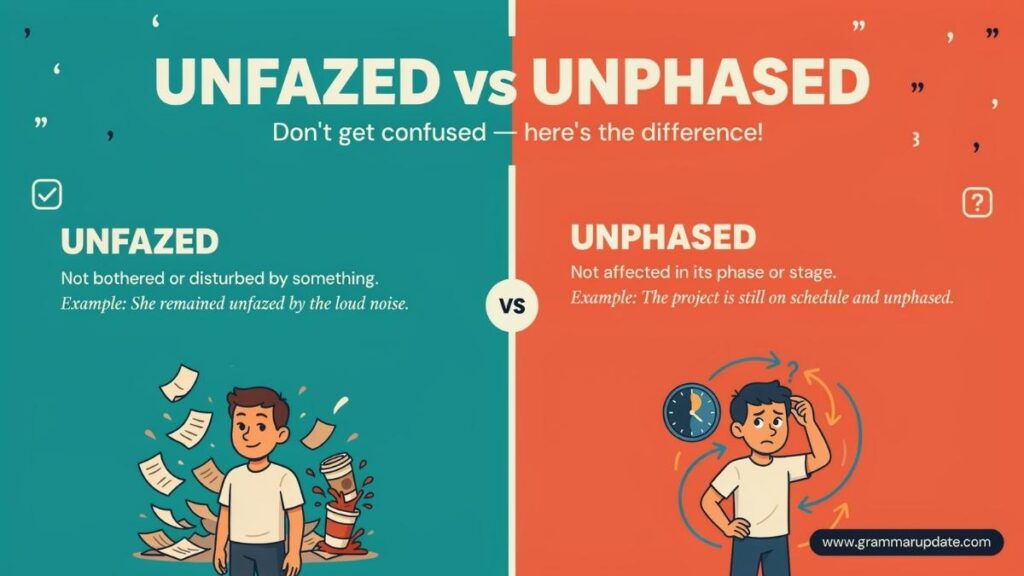
English has a talent for making simple words surprisingly confusing. Unfazed vs unphased is a perfect example. They sound almost identical, so it’s easy to pick the wrong spelling and never notice the mistake. The good news? The difference is actually simple. If you mean calm, relaxed, or not bothered by something, use unfazed. Unphased has a different meaning and relates to phases or stages. The key is understanding the words behind them: faze means to disturb, while phase means a stage. Once you know that small difference, the spelling becomes much easier. Let’s clear up the confusion and make sure you always choose the right word with confidence.
Unfazed vs Unphased Quick Answer
When you mean that someone isn’t worried, surprised, upset, or disturbed by something, use unfazed.
For example:
She was unfazed by the criticism.
He remained unfazed when the plan suddenly changed.
The goalkeeper looked unfazed after conceding an early goal.
In each sentence, the word describes a reaction. Something happened, but it didn’t visibly disturb the person.
Unphased can also appear in English, but it has a different and less common role. It can relate to phase, particularly when something happens without being divided into stages. In some dictionaries, unphased also appears as an uncommon variant of unfazed. That doesn’t mean the two spellings work interchangeably in ordinary writing.
The easiest distinction is simple. If you mean not bothered, think unfazed. If you mean something connected to phases or stages, unphased may be appropriate.
| Word | Main meaning | Common context | Example |
|---|---|---|---|
| Unfazed | Not worried, disturbed, or surprised | Everyday English and emotional reactions | She was unfazed by the criticism. |
| Unphased | Not divided or carried out in phases | Specialized or phase-related contexts | The policy used an unphased approach. |
That small difference explains most of the confusion surrounding unfazed vs unphased.
Learn the difference between often confused words
Of vs Off difference and which one is correct?
Unfazed Meaning What Does Unfazed Mean?
The unfazed meaning is closely connected to remaining calm when something unexpected, difficult, or unpleasant happens. If an event doesn’t seem to worry or disturb you, you can describe yourself as unfazed.
The word usually focuses on a person’s reaction rather than the event itself.
Imagine that you’re sitting in an important interview. The interviewer suddenly asks a difficult question that you didn’t expect. Instead of panicking, you take a breath, think for a moment, and answer confidently. Someone watching might say:
She remained unfazed by the difficult question.
The sentence doesn’t necessarily mean she felt absolutely nothing. She may have felt some pressure. It simply tells the reader that the pressure didn’t visibly shake her or stop her from responding effectively.
That distinction gives unfazed a useful place in everyday English.
The unfazed definition can be expressed in plain language as “not worried, surprised, or disturbed by something.”
You can use it for many situations, including criticism, pressure, unexpected problems, competition, bad news, difficult questions, sudden changes, or stressful events.
Consider these examples:
The manager was unfazed by the unexpected complaint.
She looked unfazed when the schedule changed.
He remained unfazed despite the difficult circumstances.
The student was unfazed by the challenging question.
The athlete appeared unfazed after falling behind.
Each example describes someone who manages to remain calm or unaffected when circumstances could easily cause a stronger emotional reaction.
Unfazed Meaning in English
The unfazed meaning in English becomes clearer when you compare it with related words such as calm, composed, relaxed, and confident.
For example, saying someone is calm describes their state of mind or behavior. Saying someone is confident describes their belief in their abilities. Saying someone is unfazed tells you that something hasn’t disturbed them.
These meanings can overlap, but they aren’t identical.
Consider this sentence:
Maria is confident.
It tells you something about Maria’s general attitude.
Now compare it with:
Maria was unfazed by the difficult question.
This sentence focuses on a particular situation and Maria’s reaction to it.
Someone can be confident without being unfazed. Someone can also be nervous internally yet appear unfazed on the outside. The word doesn’t promise complete emotional emptiness. Instead, it emphasizes the absence of a noticeable disturbance.
That makes unfazed especially useful when you want to describe composure during a difficult situation.
The word often appears with by:
She was unfazed by the criticism.
He remained unfazed by the unexpected problem.
They seemed unfazed by the sudden change.
It can also appear after verbs such as remain, seem, look, and appear:
She remained unfazed.
He seemed unfazed.
The manager looked unfazed.
The team appeared unfazed.
These structures sound natural because they connect the word directly to a person’s response.
Is Unphased a Word?
This question deserves a careful answer because saying that unphased is simply “wrong” would oversimplify the issue.
Yes, unphased appears as a real English word in certain contexts. However, its meaning doesn’t always match the everyday meaning people intend when they write unfazed.
The word unphased connects with phase. A phase can mean a stage or period in a process. When something happens in phases, it happens through separate stages rather than all at once.
For example, a company might introduce a new system gradually. It could first test the system with one department, then expand it to another, and finally introduce it across the entire organization. That’s a phased approach.
If the company introduces the entire system at once, a writer may describe that approach as unphased.
The meaning therefore concerns stages or phases rather than someone’s emotional response.
This distinction matters because many writers use unphased when they actually mean calm or unaffected.
For example:
She was unphased by the criticism.
If the writer means that the criticism didn’t bother her, unfazed is the standard everyday choice:
She was unfazed by the criticism.
The first sentence may appear in real-world writing, but familiarity doesn’t automatically make it the best word for the intended meaning.
Learn the difference between confusing word pairs
Poopie vs Poopy difference and Which Is Correct?
Unphased Meaning What Does Unphased Mean?
The unphased meaning depends heavily on context.
When it relates to phase, unphased can describe something that isn’t divided into stages or isn’t carried out gradually through separate phases.
Imagine a company planning a price increase. It has two choices. It can raise prices by small amounts over several years, or it can make the entire increase at once.
The first approach is phased.
The second can be described as unphased.
In that context, unphased has nothing to do with being calm or emotionally unaffected.
This is where the word pair becomes much easier to understand. Unfazed describes a reaction. Unphased can describe how something is organized or carried out in relation to stages.
The unphased meaning in English therefore depends on whether phase genuinely belongs in the sentence.
Consider:
The company used a phased rollout.
The company used an unphased rollout.
The contrast makes sense because both sentences concern the stages of implementation.
Now compare:
The company was unfazed by the criticism.
Here, phase has no role. The sentence describes an emotional response, so faze is the relevant root.
Unfazed vs Unphased Meaning The Main Difference
The unfazed vs unphased meaning becomes much easier to remember when you trace each word back to its root.
Unfazed comes from faze.
Unphased comes from phase.
Those roots sound similar, but their meanings are different.
Faze means to disturb, unsettle, worry, or confuse someone.
Phase refers to a stage, period, or part of a process.
That gives you a simple comparison:
| Root word | Meaning | Related word |
|---|---|---|
| Faze | Disturb or unsettle | Unfazed |
| Phase | A stage or period | Unphased |
Now look at the sentences:
The criticism didn’t faze her.
She was unfazed by the criticism.
The project entered a new phase.
The company used an unphased approach.
The spelling isn’t random. Each adjective carries the meaning of its root.
Once you understand that relationship, the unfazed spelling becomes much easier to remember.
Faze Meaning Why the Correct Spelling Is Unfazed
The faze meaning is the key to understanding why unfazed contains an f rather than a p.
To faze someone means to disturb, worry, unsettle, or confuse them.
For example:
The difficult question didn’t faze him.
The criticism fazed her.
Nothing seems to faze the experienced teacher.
These sentences all deal with emotional reactions.
Now turn faze into unfazed:
He wasn’t fazed by the difficult question.
He was unfazed by the difficult question.
The meaning remains connected to the same root.
This relationship is worth remembering because it solves the spelling problem naturally. Instead of trying to memorize unfazed as an isolated word, remember the family:
faze
fazed
unfazed
If something doesn’t faze you, you’re unfazed by it.
That is the simplest explanation for the correct spelling unfazed.
Phase Meaning Why Unphased Has a Different Meaning
The phase meaning has nothing to do with being bothered or emotionally disturbed.
A phase is a stage in a process or a distinct period.
For example:
The project has entered its final phase.
The company will phase in the new system gradually.
The old equipment will be phased out next year.
In these examples, phase describes progression through stages.
That’s why unphased can sometimes appear in writing when a writer wants to describe something that isn’t divided into phases.
The distinction is especially useful in business, technical, scientific, and organizational contexts where people often talk about phases, stages, implementation schedules, and gradual changes.
The important point is that phase does not mean “disturb.”
Faze does.
Once that difference clicks, the spelling becomes far less mysterious.
Learn the difference between confusing word pairs
Sleeve vs Sleave difference and Which Is Correct?
The Difference Between Faze and Phase
The difference between faze and phase is one of the main reasons writers struggle with unfazed and unphased.
The two words sound alike, but their meanings and grammatical uses differ.
Faze is a verb.
Phase can function as a noun or a verb.
Compare these sentences:
The criticism didn’t faze her.
The project entered a new phase.
The first sentence describes an emotional reaction. The second describes a stage in a process.
Now look at their related forms:
She was unfazed by the criticism.
The project followed a phased schedule.
The first word describes someone who isn’t disturbed. The second describes something arranged in stages.
This is a classic example of commonly confused words. Pronunciation alone can’t tell you which spelling belongs in a sentence. Context has to do the heavy lifting.
Why Do People Confuse Unfazed vs Unphased?
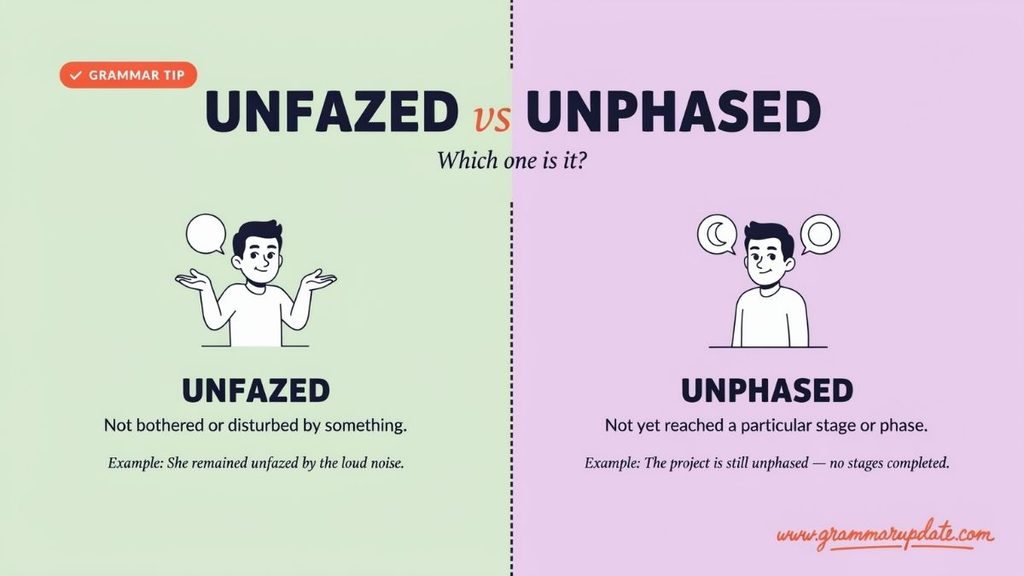
The confusion isn’t surprising.
The two words sound almost identical, and phase is much more familiar to many English speakers than faze. Most people encounter phase regularly in school, science, business, technology, and ordinary conversation.
Faze appears less often.
That familiarity can influence spelling. When a person hears “unfazed,” the brain may automatically connect the sound with the familiar spelling “phase.” The result is unphased.
English contains many similar traps. Words such as affect and effect, their and they’re, and principle and principal cause confusion because pronunciation, spelling, or meaning overlaps in complicated ways.
Unfazed and unphased follow the same general pattern.
The sound points one way.
The meaning points another.
That’s why understanding the root word works better than relying on pronunciation.
Why People Spell Unfazed as Unphased
Several factors make the unphased spelling mistake especially common.
First, faze isn’t as familiar as phase. A writer who knows the word phase may naturally assume that the P spelling belongs in unfazed.
Second, pronunciation doesn’t provide a useful clue. Faze and phase are pronounced the same, so hearing the word doesn’t reveal the spelling.
Third, unphased looks perfectly logical. If someone knows phased and wants its opposite, adding un- seems to produce unphased. The construction looks reasonable even when the intended meaning is emotional.
Finally, repeated exposure can reinforce the mistake. If you see unphased used to mean “unbothered” often enough, the spelling can start to look normal.
However, good English word usage depends on meaning rather than appearance.
When you mean “not bothered,” use unfazed.
Learn the difference between confusing word pairs
Height vs Hight difference and Which one Is Correct?
Unfazed vs Unphased Examples
The clearest way to understand the difference is to see the words in context.
| Sentence | Correct word | Reason |
|---|---|---|
| She was unfazed by the criticism. | Unfazed | The sentence describes her reaction. |
| He remained unfazed during the interview. | Unfazed | He stayed calm under pressure. |
| The athlete was unfazed by the early setback. | Unfazed | The setback didn’t disturb him. |
| The project entered a new phase. | Phase | The sentence describes a stage. |
| The company used a phased rollout. | Phased | The rollout occurred in stages. |
| The company chose an unphased approach. | Unphased | The approach wasn’t divided into stages. |
The pattern is consistent. Emotional reaction points toward unfazed. Stages and processes point toward phase.
Unfazed in a Sentence
Learning how to use unfazed in a sentence becomes easier when you place it next to the event that could have caused a reaction.
For example:
She was unfazed by the negative comments.
The phrase by the negative comments identifies what could have bothered her.
He remained unfazed despite the unexpected problem.
Here, despite introduces the difficult circumstance.
The manager looked unfazed during the tense meeting.
This sentence focuses on appearance and behavior.
The student seemed unfazed by the difficult exam.
Again, the word describes a response to a challenging situation.
These examples show why unfazed works naturally with words such as criticism, pressure, surprise, difficulty, failure, change, and uncertainty.
It often communicates quiet composure without suggesting that the person is emotionless.
Unphased in a Sentence
Using unphased in a sentence requires a different kind of context.
Consider:
The company introduced the new policy through an unphased rollout.
Here, the word relates to how the rollout occurred. The policy wasn’t introduced through several stages.
Another example is:
The project used an unphased implementation strategy.
Again, the subject is a process rather than an emotional reaction.
Now compare that with:
The manager was unfazed by the policy change.
The subject is the manager’s reaction, so unfazed is the natural choice.
This contrast provides a useful test. If you can replace the word with “unbothered” or “not worried,” you probably need unfazed. If you can replace it with “not divided into stages,” unphased may fit.
Unfazed Spelling How Do You Spell Unfazed?
If you have ever typed unfazed and paused to wonder whether it should contain a p, the answer is straightforward.
The correct everyday spelling is:
Unfazed
The word contains f because it comes from faze.
The structure is:
un + faze + d
That connection matters more than memorizing the spelling letter by letter.
Think about this sentence:
Nothing could faze her.
Now transform it:
She was unfazed.
The f remains in both forms.
By contrast, phase belongs to a completely different word family:
phase
phased
phasing
unphased
That simple word-family comparison makes the distinction much easier to remember.
Unfazed Pronunciation
The unfazed pronunciation is commonly represented as /ʌnˈfeɪzd/.
In simple terms, it sounds like “un-FAYZD.”
The pronunciation is one reason the spelling causes trouble. Faze and phase sound alike, so you can’t reliably distinguish them by ear.
For example:
He wasn’t fazed.
He wasn’t phased.
The sentences sound similar when spoken. Yet the meanings are different.
That makes pronunciation useful for speaking but unreliable for spelling.
The same issue applies to unfazed pronunciation and unphased pronunciation. Both can sound like “un-FAYZD.”
When writing, focus on the meaning and the root word.
If the word means “not disturbed,” remember faze.
If it refers to a stage or phase, think phase.
Learn the difference between confusing word pairs
To Small vs Too Small Which one Is Correct?
Unfazed Synonym Words With Similar Meanings
An unfazed synonym can help you understand the word’s meaning more clearly.
Common synonyms for unfazed include calm, composed, unbothered, unaffected, unconcerned, undisturbed, relaxed, unruffled, and unperturbed.
However, these words aren’t exact replacements in every sentence.
Calm emphasizes a peaceful state.
Composed suggests control over one’s emotions and behavior.
Unbothered sounds more casual and often suggests that something simply doesn’t matter to the person.
Unaffected emphasizes that something hasn’t changed or influenced someone.
Unconcerned focuses on a lack of worry.
For example:
She remained unfazed by the criticism.
You could write:
She remained calm despite the criticism.
Or:
She seemed unbothered by the criticism.
Each version creates a slightly different impression.
Unfazed sits somewhere between these ideas. It specifically highlights the fact that an event failed to disturb or unsettle someone.
Opposite of Unfazed
The most direct opposite of unfazed is fazed.
If someone is unfazed, something doesn’t disturb them.
If someone is fazed, something does disturb them.
For example:
The criticism didn’t faze her.
She was unfazed by the criticism.
Now reverse the situation:
The criticism fazed her.
She was visibly shaken by the criticism.
Other possible opposites include worried, disturbed, unsettled, troubled, anxious, nervous, shaken, rattled, and perturbed.
The best choice depends on how strong the reaction is.
“Fazed” provides the closest direct contrast. “Shaken” suggests a stronger emotional effect. “Anxious” focuses more specifically on worry or nervousness.
Learn the difference between confusing word pairs
Buoyant vs Bouyant Which one Is Correct?
Unfazed Person What Does It Mean to Be Unfazed?
An unfazed person is someone who remains calm or appears unaffected when something unexpected or difficult happens.
That doesn’t mean the person never experiences fear, stress, or uncertainty. Human reactions are rarely that simple.
Someone can feel nervous while still responding in a composed way. Someone can also care deeply about a situation without becoming visibly disturbed by it.
For example, an experienced emergency worker may encounter an unexpected problem and immediately focus on solving it. A new employee might panic under the same circumstances.
The experienced worker may appear unfazed.
The important feature is the response, not the absence of emotion.
This makes unfazed a useful word for describing composure, especially when circumstances could easily throw someone off balance.
Unfazed vs Unphased in Everyday English
In everyday English, unfazed is overwhelmingly the useful choice when you describe a person’s reaction.
Suppose someone receives an unexpected criticism. They listen carefully, consider the comment, and continue with their work without becoming upset. You could say:
She remained unfazed by the criticism.
The word tells the reader that the criticism didn’t disturb her.
Now imagine a different situation. A company introduces a new computer system. Instead of rolling it out department by department, management switches everyone to the new system on the same day.
Here, the focus isn’t anyone’s emotional reaction. The focus is the process. An unphased approach may describe a system that wasn’t introduced in separate stages.
These examples show why replacing one word with the other can create confusion.
Unfazed concerns reaction.
Unphased can concern phases.
That distinction should guide your word choice every time.
Unfazed Usage in Professional Writing
Unfazed works naturally in professional writing when you need to describe composure under pressure.
Consider a manager handling an unexpected complaint:
The manager remained unfazed by the customer’s criticism and focused on solving the problem.
The sentence paints a clear picture. The criticism created a difficult situation, but the manager didn’t lose focus.
You can use the word in business reports, interviews, articles, biographies, workplace conversations, and professional profiles.
For example:
The candidate appeared unfazed by the difficult interview questions.
The sales team remained unfazed after losing an important client.
The director was unfazed by the sudden change in the project schedule.
The engineer remained unfazed when the first solution failed.
These sentences don’t claim that the people felt no pressure. Instead, they describe how they responded to it.
That subtle distinction gives unfazed a stronger meaning than simply saying “calm.”
Unfazed Usage in Academic Writing
Although unfazed sounds conversational, it can also appear in academic or analytical writing when the tone allows it.
For example:
The researcher remained unfazed by criticism from opposing scholars.
The student appeared unfazed by the complexity of the problem.
The author was unfazed by repeated objections to the theory.
However, formal academic writing may sometimes benefit from a more precise alternative such as unaffected, undisturbed, or unconcerned.
The right choice depends on the style of the document.
If the goal is to describe a person’s visible reaction in a natural way, unfazed works well. If the writing needs a highly technical tone, a more specific term may communicate the idea more precisely.
Learn the difference between confusing word pairs
Taylored vs Tailored Which one Is Correct?
Unfazed in a Sentence More Practical Examples
The best way to understand word usage is to see how the word behaves in different situations.
During an Unexpected Problem
The technician remained unfazed when the system suddenly stopped working.
The problem was unexpected, but the technician stayed focused.
During Criticism
She was unfazed by the negative comments.
The comments failed to disturb her.
During a Difficult Conversation
He remained unfazed when his colleague challenged the proposal.
The sentence emphasizes his calm response.
During Competition
The player looked unfazed after making an early mistake.
The mistake didn’t appear to affect the player’s confidence or concentration.
During Public Speaking
She seemed unfazed when the microphone stopped working.
Instead of panicking, she continued speaking.
During a Sudden Change
The team remained unfazed after the deadline moved forward.
The new deadline created pressure, but the team didn’t appear overwhelmed.
These examples demonstrate a useful pattern. Unfazed often appears when an event could reasonably cause stress, surprise, or concern.
Unphased Usage in Technical and Specialized Contexts
Unphased requires more attention because its meaning depends heavily on the field and sentence.
In process-based writing, unphased can describe something that isn’t divided into phases.
Imagine a project scheduled to run for three years.
A phased plan might introduce one part in the first year, another in the second, and the final part in the third.
An unphased plan could introduce the entire change at once.
For example:
The organization chose an unphased implementation rather than a gradual rollout.
Here, unphased relates to the structure of the implementation.
That is very different from:
The organization was unfazed by the criticism.
The first sentence concerns a process. The second concerns an emotional response.
This distinction becomes especially important in technical writing because specialized vocabulary often carries meanings that differ from everyday conversation.
Can You Say “Unphased”?
Yes, but context matters.
If you ask, “Can you say unphased?” the answer depends on what you want to communicate.
You can encounter unphased in legitimate writing where it relates to phases or stages. You may also encounter it as a variant form of unfazed.
However, if you’re writing:
He was unphased by the criticism.
and you mean that the criticism didn’t bother him, unfazed is the clearer and more widely accepted everyday choice.
A useful test is to replace the word mentally with “unbothered.”
If the sentence still makes sense, you’re probably talking about unfazed.
For example:
She was unbothered by the criticism.
That works naturally.
Therefore:
She was unfazed by the criticism.
is the appropriate choice.
Now try:
The project was unbothered by the first stage.
That makes little sense because the sentence isn’t describing an emotional reaction. The context points toward phase instead.
Is Unphased Grammatically Correct?
The question “is unphased grammatically correct?” needs two separate answers.
First, can unphased function grammatically as an adjective? Yes.
Second, is it the right word when you mean “not bothered”? Usually no.
Grammar determines whether a word fits the structure of a sentence. Vocabulary determines whether that word expresses the intended meaning.
For example:
The manager was unphased by the criticism.
The sentence structure is grammatical. The problem is the word choice if the writer intends “not bothered.”
A clearer sentence is:
The manager was unfazed by the criticism.
The difference illustrates an important point about English grammar. A sentence can follow grammatical rules and still use the wrong word.
That happens frequently with commonly confused words.
The Unfazed Spelling Mistake
The most common unfazed spelling mistake is replacing the f with ph.
A writer may type:
She was unphased by the news.
The intended meaning is usually:
She was unfazed by the news.
The mistake happens because phase is familiar and faze is less familiar.
Another reason is the spelling pattern. “Phased” is a perfectly normal word, so “unphased” looks as though it should be its opposite.
But if the intended meaning is “not disturbed,” the word doesn’t come from phase.
It comes from faze.
That is why the correct spelling is unfazed.
The Unphased Spelling Mistake
The opposite mistake happens when a writer uses unfazed for something that actually concerns phases.
Imagine a sentence about a project:
The company adopted an unfazed rollout.
If the writer means that the rollout happened all at once rather than in stages, the sentence may need unphased instead.
The issue here isn’t simply spelling. It’s meaning.
The writer must identify the root idea first.
Is the sentence about disturbance?
Use faze.
Is the sentence about stages?
Use phase.
Once that question becomes automatic, both spelling mistakes become easier to avoid.
Unfazed vs Unphased A Context Test
When you’re unsure which word belongs in a sentence, ask one question:
What is the sentence actually describing?
If the sentence describes a person’s emotional reaction, unfazed is probably correct.
If it describes how a process is divided into stages, unphased may be correct.
Consider these examples:
She was ___ by the criticism.
The answer is unfazed because the sentence describes a person’s reaction.
The company introduced the policy through an ___ process.
If the intended meaning is that the policy wasn’t introduced in stages, unphased may work.
He remained ___ when the interview became difficult.
The answer is unfazed.
The program followed a ___ implementation strategy.
The answer may be unphased if the strategy was not divided into phases.
Context does most of the work.
Unfazed vs Unphased in US English
American English uses unfazed as the standard everyday spelling when the meaning is “not disturbed,” “not worried,” or “not surprised.”
For example:
She was unfazed by the criticism.
He remained unfazed during the difficult interview.
Nothing seemed to faze the experienced manager.
American English doesn’t normally change unfazed to unphased simply because the writer prefers a different spelling.
The distinction comes from the roots of the words rather than from an American spelling rule.
Unfazed vs Unphased UK English
The same basic distinction applies in British English.
If you mean calm or unaffected, use unfazed.
The idea that British English uses unphased instead of unfazed for this meaning is incorrect.
Differences between US and UK spelling do exist in English. Words such as color and colour, center and centre, and organize and organise can vary by variety.
Unfazed isn’t one of those cases.
The word remains unfazed when it means “not worried or surprised.”
That makes the answer to “unfazed vs unphased UK English” straightforward. British English doesn’t require the P spelling for this emotional meaning.
Learn the difference between confusing more English words
Camouflage Vs Camoflage Which one Is Correct?
Unfazed vs Unphased Common Sentence Patterns
Unfazed often appears in a few familiar structures.
One common pattern is:
Subject + be + unfazed + by + noun.
For example:
She was unfazed by the criticism.
He was unfazed by the unexpected question.
Another common pattern uses remain:
Subject + remain + unfazed.
For example:
She remained unfazed throughout the discussion.
The team remained unfazed despite the setback.
You can also use seem, look, or appear:
He seemed unfazed.
She looked unfazed.
The manager appeared unfazed.
These structures allow you to describe visible composure without claiming that you know exactly what someone feels internally.
Unfazed vs Unbothered
Unfazed and unbothered often overlap, but their tone differs.
Unbothered sounds more casual and conversational.
For example:
He was completely unbothered by the criticism.
Unfazed can sound slightly more polished:
He was completely unfazed by the criticism.
Both sentences communicate a lack of disturbance.
However, unbothered can sometimes suggest indifference. Unfazed more often emphasizes composure in the face of something potentially difficult.
That distinction can matter in professional or formal writing.
Unfazed vs Unaffected
Unaffected is another close synonym, but it has a broader meaning.
If you say:
She was unaffected by the criticism.
you might mean that the criticism had no emotional or practical effect on her.
If you say:
She was unfazed by the criticism.
you emphasize her lack of disturbance or visible worry.
Unaffected can also describe physical or measurable things:
The building remained unaffected by the storm.
You wouldn’t normally say:
The building remained unfazed by the storm.
Unless you’re using personification for a stylistic effect.
This example shows why synonyms aren’t interchangeable in every situation.
Unfazed vs Composed
Composed describes controlled behavior and emotional self-control.
For example:
The speaker remained composed during the debate.
Unfazed focuses more specifically on the fact that something failed to disturb the speaker.
You could write:
The speaker remained composed despite the criticism.
Or:
The speaker remained unfazed by the criticism.
The first emphasizes self-control. The second emphasizes the lack of disturbance caused by the criticism.
Both can work, but they create slightly different pictures.
Unfazed vs Unconcerned
Unconcerned focuses on a lack of worry or concern.
For example:
He seemed unconcerned about the delay.
Unfazed can express a similar idea:
He seemed unfazed by the delay.
However, unconcerned can sometimes suggest that a person doesn’t care about something. Unfazed doesn’t necessarily imply indifference.
Someone can care deeply about a problem while remaining unfazed as they work through it.
That distinction makes unfazed particularly useful when describing people who handle pressure well.
Opposite of Unfazed Understanding the Contrast
The opposite of unfazed is most directly fazed.
Consider:
The criticism didn’t faze her.
She was unfazed by the criticism.
Now change the situation:
The criticism fazed her.
She was visibly shaken by the criticism.
The word fazed tells us that the event had an emotional effect.
Other opposites can express stronger or more specific reactions.
Someone might become nervous before an interview.
Someone might become anxious after receiving bad news.
Someone might feel unsettled after an unexpected event.
Someone might feel shaken after a traumatic experience.
Someone might become rattled during a difficult conversation.
The best opposite depends on the strength and type of emotional reaction.
Unfazed Synonym and Antonym
When readers search for an unfazed synonym and antonym, they usually want a quick vocabulary comparison.
| Word type | Examples |
|---|---|
| Synonyms | Calm, composed, unbothered, unaffected, unconcerned, undisturbed, unperturbed |
| Direct antonym | Fazed |
| Other antonyms | Worried, disturbed, unsettled, shaken, anxious, nervous, rattled |
These alternatives shouldn’t be treated as exact substitutes in every context.
Word choice depends on the specific meaning and tone of the sentence.
For example, “relaxed” suggests freedom from tension, while “unfazed” specifically suggests that something hasn’t disturbed you.
A Practical Case Study The Difficult Interview
Imagine two candidates applying for the same job.
The interviewer asks both candidates an unexpected technical question.
The first candidate becomes visibly nervous and struggles to answer.
The second candidate pauses, thinks carefully, and gives a thoughtful response without appearing disturbed.
You could describe the second candidate as unfazed by the difficult question.
That doesn’t mean the candidate knew the answer immediately. It doesn’t mean the candidate felt zero anxiety. It means the difficult question didn’t visibly throw the candidate off balance.
Now imagine the company itself changes its hiring process.
It can interview candidates in three stages, or it can conduct all interviews in one session.
The company might describe the first approach as phased and the second as unphased.
The same general scenario therefore demonstrates the difference between the words.
Unfazed describes a reaction.
Unphased describes a process.
A Practical Case Study A Sudden Project Change
Imagine a team has spent months preparing a product launch. Two days before launch, management moves the deadline forward.
Everyone is surprised.
One team member immediately starts reorganizing the schedule. She doesn’t complain, panic, or lose focus.
You might write:
She remained unfazed by the sudden change.
Now consider the launch plan itself.
If management introduces every change at once instead of gradually introducing them in separate stages, you might describe the implementation as unphased.
Again, the distinction has nothing to do with one letter being “more correct” than the other.
The meaning determines the spelling.
How to Remember Unfazed vs Unphased
A good memory trick should connect spelling to meaning rather than force you to memorize an arbitrary phrase.
Remember this:
Faze means disturb.
Phase means stage.
Therefore:
Unfazed means not disturbed.
Unphased can mean not divided into phases.
You can test yourself with a simple substitution.
If you can replace the word with “unbothered,” choose unfazed.
If you can replace it with “not divided into stages,” unphased may be the right choice.
For example:
She was unfazed by the criticism.
Replace unfazed with unbothered:
She was unbothered by the criticism.
The sentence still works.
Now try:
The project used an unphased rollout.
Replace unphased with unbothered:
The project used an unbothered rollout.
The meaning collapses.
That tells you the sentence concerns phases rather than emotions.
Learn the difference between confusing more English words
Tomorrow vs Tommorow Which one Is Correct?
Is It Unfazed vs Unphased? A Quick Decision Guide
When you are stuck between unfazed vs unphased, follow the meaning rather than the sound.
If the sentence describes someone who stays calm, choose unfazed.
If the sentence describes someone who isn’t bothered by criticism, choose unfazed.
If it describes someone who isn’t surprised by an unexpected event, choose unfazed.
If it describes a process that isn’t divided into stages, unphased may be appropriate.
If it describes something connected to technical phases, examine the context carefully before choosing.
A simple mental test can help:
Does “not bothered” fit?
If yes, use unfazed.
Does “not divided into phases” fit?
If yes, unphased may fit.
This method is much more reliable than trying to remember which spelling “looks right.”
Is Unphased a Real Word?
Yes, but the answer needs context.
Unphased has documented uses connected with phase, particularly when something isn’t implemented gradually through separate stages. Some dictionaries also record it as an uncommon variant of unfazed.
That means the statement “unphased isn’t a word” is too absolute.
However, the opposite statement is also misleading:
“Unphased is always correct.”
It isn’t.
When you want to describe someone as calm or unaffected, unfazed remains the clear everyday choice.
This is an important lesson in English vocabulary. A word can exist in the language without being the right word for every situation.
Is Unphased a Word in Standard English?
The phrase “standard English” requires a little care because English contains many specialized terms, regional forms, historical words, and uncommon variants.
Unphased can appear in legitimate English writing, particularly in contexts involving phases or stages. Its existence doesn’t make it the standard everyday replacement for unfazed.
For ordinary writing, especially when describing a person’s emotional reaction, unfazed is the safer and clearer choice.
If the context is technical, specialized, or process-related, look at the meaning before making a judgment.
The goal isn’t to label unusual vocabulary as automatically wrong. The goal is to choose the word that communicates the intended idea precisely.
Unfazed vs Unphased Common Writing Errors
One common error is writing:
He was unphased by the criticism.
when the intended meaning is:
He was unfazed by the criticism.
Another mistake is assuming that because unphased appears in dictionaries, it can replace unfazed everywhere.
That’s not how vocabulary works.
Words can have multiple meanings, limited meanings, technical meanings, or uncommon uses. Good writing depends on choosing the word that fits the context.
A third mistake is assuming that pronunciation determines spelling.
It doesn’t.
Faze and phase sound alike, but their meanings are different.
The same applies to unfazed vs unphased.
How to Use Unfazed Correctly
If you’re learning English grammar and vocabulary, focus on the sentence pattern.
Use unfazed when someone isn’t disturbed by something.
The most common structure is:
Subject + be + unfazed + by + something.
For example:
She was unfazed by the criticism.
He was unfazed by the difficult question.
They were unfazed by the sudden delay.
You can also use:
Subject + remain + unfazed.
For example:
She remained unfazed throughout the meeting.
The players remained unfazed despite the pressure.
These patterns make the word easy to use naturally.
How to Use Unphased Correctly
Use unphased only when the context supports its meaning.
For example:
The organization chose an unphased implementation.
The policy involved an unphased increase rather than a gradual rise.
The project followed an unphased approach.
These sentences focus on stages or implementation.
If you’re describing someone’s emotional response, change the spelling:
The manager was unfazed by the change.
That one-letter difference reflects a different root and a different meaning.
Learn the difference between confusing more English words
Awful vs Awfull Which one Is Correct?
Practice Session Unfazed vs Unphased
Fill in each blank with unfazed vs unphased. Use the context to choose the correct word.
- Sarah remained __________ when the interviewer asked her a difficult question.
- The athlete looked __________ after making an early mistake in the competition.
- The manager was __________ by the customer’s harsh criticism.
- The company decided to use an __________ approach instead of introducing the changes in separate stages.
- Nothing seemed to __________ the experienced teacher during the chaotic class.
- He remained __________ despite the unexpected problem.
- The organization chose an __________ implementation strategy for the new system.
- She appeared completely __________ when everyone else started to panic.
- The criticism didn’t __________ him because he had already considered the same concerns.
- The project followed an __________ schedule rather than a phased rollout.
- The student was __________ by the challenging examination.
- The team remained __________ after losing its lead.
- The company introduced the changes through several phases rather than using an __________ approach.
- He seemed __________ by the sudden change in plans.
- The speaker was __________ by the unexpected question from the audience.
- The organization rejected the phased model and adopted an __________ process.
- Despite the stressful situation, Maria stayed __________ and continued working.
- The unexpected delay left the other employees frustrated, but James remained __________.
- The new policy wasn’t introduced gradually. Instead, management used an __________ implementation.
- The experienced pilot remained __________ when the flight encountered unexpected turbulence.
- The negative review didn’t __________ the restaurant owner.
- The project was designed around separate stages rather than an __________ process.
- She was __________ by the pressure of speaking in front of hundreds of people.
- The director remained __________ when the original plan suddenly failed.
- The company chose an __________ rollout instead of introducing the product in several phases.
Answers
- unfazed
- unfazed
- unfazed
- unphased
- faze
- unfazed
- unphased
- unfazed
- faze
- unphased
- unfazed
- unfazed
- unphased
- unfazed
- unfazed
- unphased
- unfazed
- unfazed
- unphased
- unfazed
- faze
- unphased
- unfazed
- unfazed
- unphased
Here’s a trusted source for clear word meanings:
FAQs
Is it unfazed vs unphased?
Use unfazed when you mean calm, unbothered, or unaffected by something. For example, “She was unfazed by the criticism” means the criticism didn’t disturb her. Unphased has a different, less common use related to phases or stages.
What does unfazed mean?
Unfazed means not worried, disturbed, surprised, or upset by something. An unfazed person can face a difficult or unexpected situation without losing composure.
What does unphased mean?
Unphased can describe something that isn’t divided into separate phases or stages. It can also appear as an uncommon variant of unfazed. The correct interpretation depends on the context.
Why do people confuse unfazed and unphased?
The two words sound almost identical, so pronunciation doesn’t help much with spelling. Their roots provide the clue: unfazed comes from faze, meaning to disturb, while unphased relates to phase, meaning a stage or period.
Which word should you use for someone’s emotional reaction?
Use unfazed. For example, “The student was unfazed by the difficult question.” The sentence describes the student’s calm response to something challenging.
Can unphased mean “not bothered”?
You may see unphased used with that meaning, but unfazed remains the clearer and more widely accepted choice in standard everyday English when you mean “not bothered” or “not disturbed.”
What does faze mean?
Faze means to disturb, unsettle, worry, or intimidate someone. If something doesn’t faze you, it doesn’t cause you to become noticeably worried or upset.
What does phase mean?
Phase can mean a distinct stage or period in a process. As a verb, phase can also mean to introduce or arrange something in stages, as in “The company will phase in the new system.”
How can you remember the difference between faze and phase?
Connect each word with its meaning. Faze means to disturb, while phase refers to a stage. Therefore, if something doesn’t disturb you, you’re unfazed by it.
Is “don’t faze me” correct?
Yes. “Don’t faze me” is correct when you mean “don’t bother, worry, or intimidate me.” “Don’t phase me” doesn’t express that standard meaning.
Should you say “I wasn’t fazed” or “I wasn’t phased”?
Use “I wasn’t fazed” when you mean that something didn’t bother or disturb you. “I wasn’t phased” would only make sense in a context involving phases or stages.
Is “to be phased” or “to be fazed” correct?
Both can be correct, but they have different meanings. To be fazed means to be disturbed or unsettled. To be phased relates to something being arranged, introduced, or divided into stages.
Is unfazed appropriate in formal English?
Yes. Unfazed works well in both formal and everyday English when you want to describe someone who remains calm or unaffected by a situation.
Is unfazed spelled the same way in British English?
Yes. Unfazed is the standard spelling in British English when you mean calm or unaffected. It isn’t a US-versus-UK spelling difference.
How do you pronounce unfazed?
Unfazed is pronounced “un-FAYZD.” Its pronunciation is very similar to unphased, which explains why the two spellings often cause confusion.
What is an unfazed person?
An unfazed person remains calm and composed when facing something that might normally cause worry, surprise, or stress. Being unfazed doesn’t mean the person has no emotions. It describes how they respond to the situation.
Can unfazed describe a group?
Yes. You can describe a group as unfazed when its members collectively remain calm or unaffected. For example, “The team remained unfazed after the unexpected setback.”
What is a good synonym for unfazed?
Depending on the context, useful synonyms include calm, composed, unbothered, unaffected, unconcerned, undisturbed, unperturbed, and relaxed. These words overlap in meaning but aren’t always interchangeable.
What is the opposite of unfazed?
The closest direct opposite is fazed. Other possible opposites include disturbed, unsettled, worried, shaken, rattled, nervous, and anxious. The best choice depends on the type and intensity of the reaction.
Is unfazed the same as emotionless?
No. Unfazed means that something hasn’t noticeably disturbed or unsettled someone. Emotionless suggests little or no visible emotion more generally. A person can care deeply about an issue and still remain unfazed by it.
Can someone be unfazed and still feel nervous?
Yes. Unfazed describes how someone handles or appears to handle a situation. A person may feel some internal pressure while remaining calm, focused, and composed on the outside.
What is the difference between unfazed and unbothered?
Both words can describe someone who isn’t disturbed by something. Unbothered sounds more casual and can sometimes suggest indifference. Unfazed more often emphasizes composure when facing pressure, criticism, or an unexpected event.
What is the difference between unfazed and unaffected?
Unaffected means that something hasn’t changed or influenced someone or something. Unfazed focuses specifically on a lack of disturbance or emotional disruption. For example, a person may remain unfazed by criticism, while a building may remain unaffected by a storm.
Can unphased be used in technical writing?
Yes, when the context genuinely involves phases or stages. For example, an unphased implementation could describe a process that isn’t divided into separate stages. In technical writing, the intended meaning should determine the word.
How can you quickly choose between unfazed and unphased?
Look at the meaning rather than the pronunciation. If you mean “not bothered,” “not worried,” or “not disturbed,” use unfazed. If the sentence concerns stages, phases, or phased implementation, consider whether unphased fits the context.
Is unfazed a common spelling mistake?
The spelling itself isn’t a mistake. The common mistake is writing unphased when the intended meaning is “not bothered” or “not disturbed.” Remembering the root word faze can help prevent this error.
Why is unfazed spelled with an “f”?
Unfazed comes from the verb faze, which means to disturb or unsettle. The spelling keeps the original root: faze becomes unfazed. Phase is a separate word with a different meaning and origin.
Can “unphased” replace “unfazed” in every sentence?
No. The two words shouldn’t be treated as interchangeable. When you describe someone’s reaction to criticism, pressure, or an unexpected event, unfazed is the appropriate choice. Unphased belongs to contexts where phase or stages are relevant.
Learn the difference between confusing more English words
Ingenuine vs Ungenuine Which one Is Correct?
Conclusion
The difference between unfazed vs unphased is much easier once you stop focusing on how the words sound and focus on what they mean. They may sound almost the same, but they don’t always serve the same purpose.
Use unfazed when you mean calm, unbothered, unaffected, or not worried. For example, “She was unfazed by the criticism” means the criticism didn’t bother her. Unphased has a different use when you’re talking about phases, stages, or a process that isn’t divided into stages.
Here’s the easiest trick to remember it: faze means to disturb, so unfazed means not disturbed. Phase means a stage, so unphased connects with phases.
Once you remember that simple difference, the confusion disappears. When something doesn’t bother you, you’re unfazed. When you’re talking about stages, think phase. One little letter can cause a big grammar headache, but this one doesn’t have to.

Jhon AJS, the creative mind behind Grammar Update, is an experienced blogger passionate about simplifying English grammar. He focuses on explaining confusing word vs word differences, grammar rules, punctuation, and sentence structure in a clear and practical way. Through easy to understand guides and examples, Jhon helps readers improve their writing and communicate with confidence. With years of blogging experience, he continues to share helpful insights that make learning grammar simple, useful, and accessible for everyone.