If “of” and “off” keep causing grammar confusion, you’re certainly not alone. These two small words look almost identical, yet they can completely change the meaning of a sentence. The of vs off difference becomes much easier once you understand what each word actually does. Of usually shows a connection, relationship, quantity, or part of something, as in “a glass of water.” Off often shows separation, removal, movement, or an inactive state, as in “turn off the light.” Using the wrong one can create an awkward sentence or even change its meaning. This guide will clear up the confusion with simple rules, examples, and practical explanations.
Of vs Off quick answer
The meaning of of vs off becomes clearer when you look at their function in a sentence.
Of mainly works as a preposition. It connects one word or phrase to another and often expresses a relationship between them.
Off can work as a preposition, adverb, adjective, or part of a phrasal verb. Its meaning often involves separation, removal, movement away, inactivity, or departure.
| Word | Main idea | Common use | Example |
|---|---|---|---|
| Of | Connection or relationship | Belonging | the name of the student |
| Of | Part of a whole | Portion | a piece of cake |
| Of | Amount or quantity | Measurement | a cup of tea |
| Of | Contents | What something contains | a glass of water |
| Off | Separation | Removing something | Take your shoes off |
| Off | Movement away | Leaving a position | She walked off the stage |
| Off | Inactive state | Not operating | The light is off |
| Off | Departure | Starting or leaving | The plane took off |
| Off | Cancellation | Ending a planned event | The game was called off |
This quick comparison explains the basic of versus off difference. However, both words have several uses that become clearer when you see them in real sentences.
Learn the difference between confusing word pairs
Poopie vs Poopy difference and Which Is Correct?
What Does “Of” Mean?
What does of mean?
Of usually creates a connection between two words, phrases, or ideas. It can tell you who or what something belongs to, what something contains, how much there is, or how two things relate.
For example:
The cover of the book is blue.
Here, of connects cover with book. It tells you which book the cover belongs to.
This connecting role appears in many common English expressions.
“Of” Shows a Possessive Relationship
English often uses an apostrophe to show possession, but of can also express possession or association.
For example:
- the roof of the house
- the name of the school
- the owner of the restaurant
- the capital of France
- the history of the city
The relationship doesn’t always mean literal ownership.
For example, the history of the city doesn’t mean the city owns its history. Instead, of tells you which history you’re talking about.
“Of” Shows Belonging or Association
The meaning of of can also involve a relationship between people.
Consider this sentence:
She is a friend of mine.
The word of connects friend with mine and shows association.
You can use the same structure in several everyday expressions:
- a colleague of mine
- a neighbor of ours
- a relative of hers
- a former teacher of his
- a close friend of theirs
The phrase friend of mine is especially common in everyday English.
Learn the difference between confusing word pairs
Buoyant vs Bouyant Which one Is Correct?
“Of” Shows a Part of a Whole
Another important use of of appears when you describe one part of something larger.
Examples include:
- a piece of cake
- a slice of bread
- a part of the machine
- one side of the building
- the middle of the road
- the top of the page
Consider this sentence:
The handle of the door is broken.
The handle forms part of the door, so of establishes the relationship between the two nouns.
“Of” Shows Amount or Quantity
English frequently uses of after words that express quantity or measurement.
Examples include:
- a lot of people
- a cup of coffee
- a bottle of water
- a group of students
- a number of questions
- a pair of shoes
- a piece of paper
This explains why we say:
She drank a glass of water.
The word of connects the container with its contents.
We don’t say “a glass off water” because off doesn’t express quantity or contents.
“Of” Shows What Something Contains
Of can also tell you what a container or collection contains.
For example:
- a bowl of soup
- a box of chocolates
- a bottle of juice
- a basket of apples
- a plate of food
In each example, of connects the container with what is inside it.
“Of” Appears in Fixed Expressions
Many common English expressions require of.
Some examples include:
- because of
- instead of
- out of
- in front of
- afraid of
- full of
- proud of
- tired of
- made of
For example:
The picnic was canceled because of the rain.
Here, because of is a fixed expression. Replacing of with off would make the phrase incorrect.
Learn the difference between confusing word pairs
Drily vs Dryly Which One Is Correct?
What Does “Off” Mean?
What does off mean?
Off commonly expresses separation, removal, movement away, departure, or a change from an active state to an inactive one.
It can also appear in many phrasal verbs where it adds a specific meaning to another verb.
You’ll see off in everyday expressions such as:
- take off
- turn off
- step off
- get off
- cut off
- call off
- put off
- go off
- set off
The exact meaning depends on the context.
“Off” Shows Separation
One of the clearest uses of off involves removing something from a surface or position.
For example:
Take the book off the table.
She pulled the sticker off the wall.
He took his jacket off.
In each sentence, off shows that something moves away from where it was attached or positioned.
Compare these two sentences:
The cover of the book is damaged.
Take the cover off the book.
The first sentence describes a relationship. The second describes removal.
That small distinction explains a large part of the grammar difference between of vs off.
“Off” Shows Movement Away
Off can describe movement away from a surface, place, or position.
Examples include:
- The cat jumped off the chair.
- She stepped off the bus.
- He walked off the stage.
- The ball rolled off the table.
- The bird flew off the roof.
The expression step off the bus means to leave the bus by moving away from it.
Compare that with:
The door of the bus is open.
Here, of simply connects door and bus.
The first sentence describes movement. The second describes a relationship.
“Off” Means Inactive
Off can describe something that isn’t operating.
In this sense, off is often the opposite of on.
Examples include:
- The TV is off.
- The computer is off.
- The light is off.
- The oven is off.
- The phone is off.
You can also use off in commands:
Turn off the light.
Switch off the fan.
Please turn off your computer.
Here, off describes a change from an active state to an inactive state.
“Off” Shows Departure
English also uses off to describe someone leaving or beginning a journey.
For example:
- We’re off to the airport.
- She went off to college.
- He set off early in the morning.
- The hikers headed off down the trail.
- They drove off before sunset.
In these examples, off carries the idea of leaving or moving onward.
“Off” Can Indicate Cancellation
Off can also describe something that will no longer happen.
For example:
The meeting is off.
The game was called off because of the weather.
They called off the event.
In these sentences, off doesn’t mean physical movement. Instead, it indicates cancellation.
This is an important part of off usage because the word can develop different meanings depending on the expression around it.
Learn the difference between confusing more English words
Sleeve vs Sleave difference and Which Is Correct?
What Is the Difference Between Of vs Off?
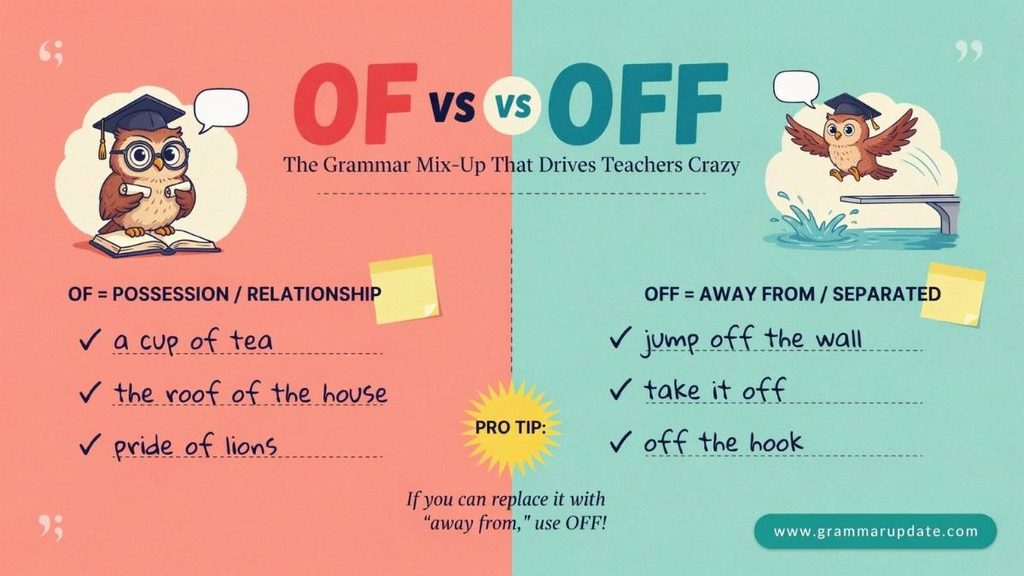
The difference between of vs off becomes much easier when you focus on their central ideas.
Of generally creates a connection.
Off generally creates separation, movement away, or a change from an active state.
Think of of as a bridge between two ideas:
the roof of the house
The word connects roof and house.
Now think of off as movement away:
Take the roof off the model.
Here, off describes removal.
Another useful comparison looks like this:
| With of | With off |
| a picture of the house | take the picture off the wall |
| the top of the box | take the lid off the box |
| a bottle of juice | wipe the juice off the table |
| the end of the road | drive off the road |
| a member of the team | get off the team bus |
This is the core of the of vs off difference.
Of tells you how things relate.
Off often tells you that something moves away, gets removed, stops operating, or doesn’t happen.
When to Use Of and Off
Knowing when to use of vs off becomes easier if you first identify what the sentence means.
Use of when you’re expressing:
- a relationship
- belonging
- association
- a part of a whole
- contents
- amount or quantity
- composition
- certain fixed expressions
Use off when you’re expressing:
- separation
- removal
- movement away
- departure
- inactivity
- cancellation
- a phrasal verb containing off
When you’re unsure, ask yourself one simple question:
Am I connecting things, or am I describing separation or movement away?
If you’re connecting two ideas, of often fits.
If you’re describing something moving away, being removed, or becoming inactive, off often fits.
Learn the difference between confusing more English words
Height vs Hight difference and Which one Is Correct?
Practice Session Of vs Off
Fill in each blank with Of vs Off.
- I drank a glass ___ water.
- Please turn ___ the light.
- The cover ___ the book is blue.
- Take your shoes ___.
- She is a friend ___ mine.
- The cat jumped ___ the table.
- We need a piece ___ paper.
- The television is ___.
- He stepped ___ the bus.
- The color ___ the car is beautiful.
- Please take the jacket ___.
- A bottle ___ juice was on the table.
- The top ___ the box is missing.
- Turn ___ your phone before the meeting.
- She bought a bag ___ rice.
- The bird flew ___ the roof.
- He is a member ___ the team.
- The alarm went ___ at midnight.
- The end ___ the road is nearby.
- Please switch ___ the fan.
- I need a cup ___ coffee.
- The meeting was called ___.
- The handle ___ the door is broken.
- She walked ___ the stage.
- He gave me a piece ___ cake.
Answers
- of
- off
- of
- off
- of
- off
- of
- off
- off
- of
- off
- of
- of
- off
- of
- off
- of
- off
- of
- off
- of
- off
- of
- off
- of
Here’s a trusted source for clear word meanings:
FAQs
What does “of” mean?
Of is mainly a preposition that shows a relationship between people, things, or ideas. It can express belonging, connection, quantity, contents, or a part of a whole. For example, “the cover of the book” connects the cover with the book.
What does “off” mean?
Off can describe separation, removal, movement away, departure, cancellation, or an inactive state. For example, “The lights are off” means the lights aren’t operating, while “She stepped off the bus” describes movement away from the bus.
Which is correct: “Of vs Off”?
Both words are correct, but they have different meanings. Use of for relationships, quantities, contents, and parts of a whole. Use off for separation, removal, movement away, inactivity, and many phrasal verbs.
How do I use “of” in a sentence?
Use of to connect nouns or show a relationship between things. For example, “a bottle of water,” “the name of the school,” and “a friend of mine” all use of correctly.
When should I use “off”?
Use off when you mean away from something, removed from something, inactive, or leaving. For example, “Take your coat off,” “The computer is off,” and “She walked off the stage.”
How do you use “off” in a sentence?
Off can describe removal, movement, inactivity, or departure. For example, “He took the book off the table,” “Turn off the fan,” and “The plane took off.”
Can “of” and “off” be used interchangeably?
No. They have different meanings and grammatical functions. For example, “a glass of water” is correct because of connects the glass with its contents. “A glass off water” is incorrect.
What is the easiest way to remember “Of vs Off”?
Think of of as a connector and off as a separator. Of often connects two things, while off often shows something moving away, being removed, or becoming inactive.
Is “off of” grammatically correct?
Yes. “Off of” occurs in American English, especially in informal speech. However, “off” alone is usually shorter and more direct. For example, “She jumped off the table” is generally cleaner than “She jumped off of the table.”
What does “off of” mean?
Off of generally means away from a surface, position, or object. For example, “Take the cup off of the table” means to remove the cup from the table.
Should I say “off of” or “off”?
In most situations, off is the simpler choice. For example, “Take your feet off the chair” is concise and natural. “Take your feet off of the chair” is also used in American English, especially in conversation.
Is it “off me” or “off of me”?
Both forms can occur, but the natural choice depends on the sentence. “Get off me” is a common expression used when telling someone to stop holding or touching you. “Get off of me” also occurs in informal American English.
Is it “off you” or “off of you”?
The correct expression depends on the intended meaning. “Off you” isn’t normally used by itself to tell someone to move away from you. In some contexts, “off of you” can be correct, but the complete sentence determines the natural choice.
Is it “off work” or “of work”?
Use off work when you mean that you aren’t working. For example, “I’m off work today.” Of work belongs to different grammatical structures, such as “the nature of work.”
Is it “day off” or “day of”?
The correct expression is day off when you mean a day away from work or your usual duties. For example, “Friday is my day off.”
Can I say “Today is my day off”?
Yes. “Today is my day off” is natural and correct when you mean that you don’t have to work or perform your usual duties today.
Is it correct to say “I am off today”?
Yes. “I’m off today” is a natural way to say that you aren’t working today. The exact meaning depends on the context.
Is “off day” correct?
Yes, but off day and day off have different meanings.
Day off means a day when you don’t have to work or perform your usual duties.
Off day can describe a day when someone performs below their usual standard or doesn’t feel at their best.
For example:
- “Saturday is my day off.”
- “The player had an off day.”
Do we say “off day” or “day off”?
Use day off when you mean a break from work or regular duties. Use off day when you mean a day when someone’s performance, mood, or condition isn’t as good as usual.
Is it correct to say “one of” or “one-off”?
Both expressions are correct, but they have different meanings. “One of” identifies one person or thing within a group, as in “She is one of my friends.” “One-off” describes something that happens only once and is especially common in British English.
Is “2 of” or “2 off” correct?
Use “two of” when you identify two people or things from a group, as in “Two of the students were absent.” “Two off” doesn’t normally replace “two of” in standard everyday English.
Why do some Americans use “off of”?
Off of has a long history in American English and remains common in informal speech. It usually describes movement away from a surface or object. American speakers also commonly use the shorter form off.
Is “off of” common in American English?
Yes. Off of appears frequently in informal American speech. However, off without of is also very common and is usually more concise, especially in edited writing.
What can I say instead of “off of”?
In many sentences, simply use off.
For example:
- “Take it off of the table” → “Take it off the table.”
- “Get the book off of the desk” → “Get the book off the desk.”
The shorter versions are usually cleaner.
What is the difference between “Of vs Off” in English grammar?
Of generally expresses a relationship, such as belonging, quantity, contents, association, or a part of a whole. Off commonly expresses separation, removal, movement away, inactivity, departure, or cancellation.
Does “off” have more than one meaning?
Yes. Off can mean away, removed, inactive, canceled, or departing, depending on the context. It also appears in many phrasal verbs, including take off, turn off, call off, and put off.
What is the difference between “leave” and “off”?
Leave is usually a verb meaning to go away or depart. Off can describe the state or direction connected with leaving. For example, “She left work” describes an action, while “She is off work today” means she isn’t working today.
Is “call off from work” correct?
Usually, no. Call off means to cancel something. If you mean that you won’t work, natural alternatives include “call in sick,” “take the day off,” or “be off work.”
Is “off from work” correct?
Yes. “Off from work” is used in American English, particularly in casual speech. However, “I’m off work today” or “I’m taking the day off” often sounds more natural and concise.
Learn the difference between confusing more English words
To Small vs Too Small Which one Is Correct?
Conclusion
Of vs off may look almost identical, but they do very different jobs. That one extra letter can make a big difference in meaning.
Use of when you want to show a connection, relationship, belonging, quantity, or part of something. For example, “a glass of water” and “a friend of mine.”
Use off when you mean separation, removal, movement away, or a change to an inactive state. For example, “Take your shoes off” or “Turn off the light.”
Here’s an easy way to remember it: of connects, while off separates.
So, don’t let one little f trip you up. If you’re talking about a connection, choose of. If something is moving away, coming off, or switching off, choose off. Once you understand the meaning behind each word, the confusion becomes much easier to clear up.

Jhon AJS, the creative mind behind Grammar Update, is an experienced blogger passionate about simplifying English grammar. He focuses on explaining confusing word vs word differences, grammar rules, punctuation, and sentence structure in a clear and practical way. Through easy to understand guides and examples, Jhon helps readers improve their writing and communicate with confidence. With years of blogging experience, he continues to share helpful insights that make learning grammar simple, useful, and accessible for everyone.