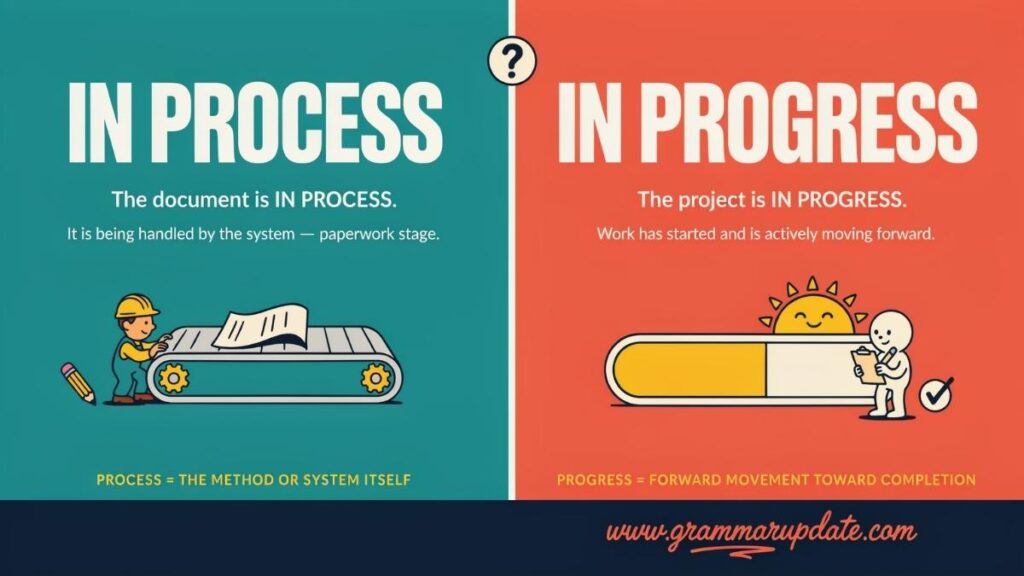
English can turn two nearly identical phrases into a surprisingly stubborn grammar puzzle. “In Process vs In Progress” often appear when something hasn’t finished, so it’s easy to assume they’re interchangeable. That’s where the trouble begins. If you’ve ever stared at a sentence and wondered whether to write “in process vs in progress,” you’ve encountered one of those small language traps that can make even confident writers hesitate. Fortunately, the difference isn’t as mysterious as it looks. Once you understand what each phrase emphasizes, choosing the right one becomes much easier. Let’s clear up the confusion, fix the common mistakes, and make your English sound natural.
In Process vs In Progress Quick Answer
Both expressions can be correct, but they serve different purposes.
“In progress” is the more natural choice when you mean that something is currently happening or continuing.
For example:
“The meeting is in progress.”
“The repairs are in progress.”
“The project is in progress.”
“In process” can work when you are talking about something that is going through a particular procedure, workflow, or production stage.
For example:
“The materials are in process.”
“The order is in process.”
“The application is in process.”
However, the last example can sound less natural in ordinary conversation. In many cases, “The application is being processed” gives the reader a clearer idea of what is happening.
A simple way to remember the distinction is this:
In progress focuses on what is happening.
In process focuses on the process something is going through.
Learn the difference between confusing word pairs
Practice vs Practise Which one Is Correct?
What Does “In Progress” Mean?
“In progress” means that something has started but has not finished.
The phrase describes an ongoing activity, event, project, task, or development. In other words, something is underway and still moving toward completion.
For example:
“The investigation is in progress.”
This tells you that investigators are still working on the investigation.
Likewise:
“The renovation is in progress.”
The renovation has started, but the work isn’t finished yet.
The phrase works especially well when you want to tell someone about the current status of an activity without explaining every step involved.
In Progress Definition
A simple definition is:
In progress means currently happening, continuing, or developing.
It can describe both physical and abstract activities. A building project can be in progress. So can a discussion, investigation, repair, examination, or software update.
For example:
“The software update is in progress.”
“The discussion is still in progress.”
“The road construction is in progress.”
“The review is in progress.”
Each sentence tells the reader that the activity continues.
When to Use “In Progress”
Use “in progress” when you want to emphasize an ongoing activity.
It works naturally with words such as project, work, task, meeting, investigation, construction, repair, discussion, development, and review.
For example:
“The project is still in progress.”
“The repairs are currently in progress.”
“The investigation remains in progress.”
“The meeting is already in progress.”
The expression also works when something has been delayed but hasn’t stopped permanently.
For example:
“The project is still in progress despite the delay.”
Here, “in progress” makes it clear that the project continues even though completion has taken longer than expected.
Learn the difference between confusing word pairs
Kaftan vs Caftan Difference and Which one Is Correct?
What Does “In Process” Mean?
“In process” has a slightly different focus.
Rather than simply saying that something is happening, the phrase can suggest that something is going through a particular process, procedure, system, or series of steps.
Imagine a factory where materials enter one end of a production line and leave as finished products. While those materials move through different production stages, you could describe them as being in process.
Similarly, an application might move through several stages before an organization makes a final decision. Those stages could include submission, verification, review, approval, and completion.
In that setting, the idea of a process becomes important.
In Process Definition
A useful definition is:
In process means undergoing or moving through a particular process, procedure, workflow, or stage.
For example:
“The materials are in process at the factory.”
The sentence suggests that the materials are somewhere within the production operation.
Likewise:
“The request is in process.”
This can suggest that the request has entered a formal procedure and has not yet reached its final stage.
However, context matters. In everyday American English, “in progress” often sounds more natural when the only intended meaning is that something is continuing.
Learn the difference between confusing word pairs
Solicited vs Unsolicited Differences and Usage
The Difference Between In Process vs In Progress
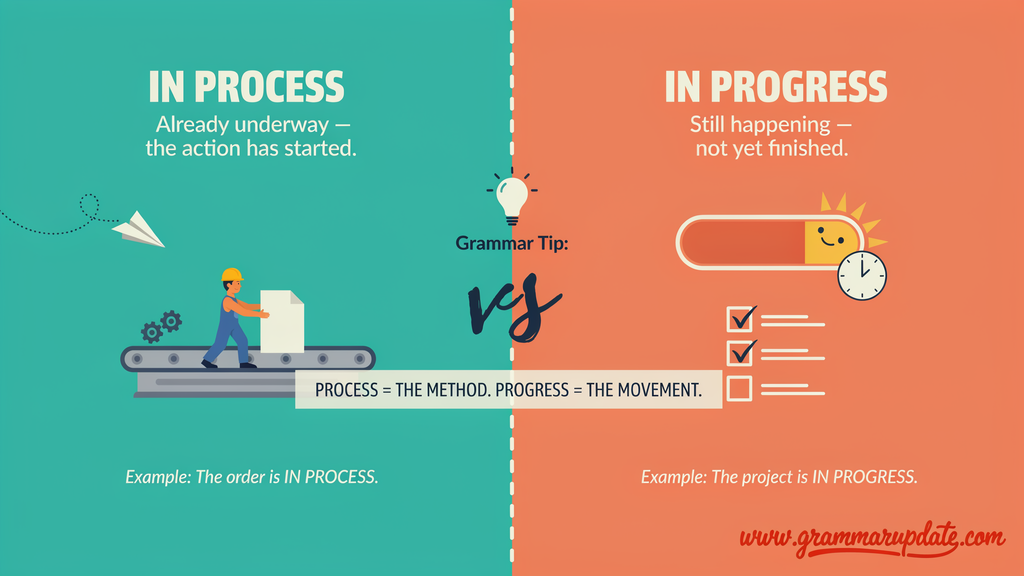
The main difference comes down to emphasis.
“In progress” emphasizes an activity that is currently happening.
“In process” emphasizes the process, procedure, or stages involved.
Consider a website redesign.
“The website redesign is in progress.”
This tells you that people are still working on the redesign.
Now consider this sentence:
“The design is moving through the approval process.”
This gives you more information about the procedure. The design has reached a particular stage and must pass through additional steps before completion.
The distinction becomes clearer when you think about movement versus method.
Progress is about something moving forward.
Process is about how something moves through a series of steps.
That’s why the phrases can overlap without being exact substitutes.
A Simple Comparison
| Phrase | Main idea | Typical context |
|---|---|---|
| In progress | Something is currently happening | Projects, meetings, repairs, investigations |
| In process | Something is moving through a process | Procedures, manufacturing, workflows |
| Being processed | Someone or a system is handling something | Applications, payments, orders, requests |
| Underway | Something has started and continues | Projects, activities, operations |
| Ongoing | Something continues over time | Work, discussions, projects, situations |
The table shows why choosing the right phrase depends on the meaning you want to communicate.
1.If the reader simply needs to know that something is happening, “in progress” is usually the clearest option.
2.If the reader needs to know that something is moving through a defined procedure, “in process” may fit.
3.If you want to say that a person, company, or system is actively handling something, “being processed” may be even clearer.
Learn the difference between confusing word pairs
Cocoon vs Cacoon Which one Is Correct?
In Process vs In Progress in Everyday English
In everyday American English, “in progress” is much more natural for ordinary activities.
For example:
“The meeting is in progress.”
“The repairs are in progress.”
“The game is in progress.”
“The project is in progress.”
“The investigation is in progress.”
These sentences sound natural because each one describes an activity that is currently happening.
Now consider:
“The meeting is in process.”
Although a reader can understand the sentence, it doesn’t sound as natural. A meeting is normally described as an ongoing event rather than something moving through a formal process.
That’s an important clue.
When a phrase feels technically understandable but awkward, ask what the noun represents. If it represents an activity or event, “in progress” will often work better.
In Process vs In Progress in Professional Writing
Professional communication often makes the distinction more noticeable.
A project manager might write:
“The software update is in progress.”
That tells the team that the update is currently happening.
A company might instead use:
“The application is being processed.”
That tells a customer that the organization is actively handling the application.
Meanwhile, a manufacturing report might use:
“The components are in process.”
That sentence can refer to components somewhere within the production system.
Each expression has a job.
Good professional writing doesn’t choose the most complicated phrase. It chooses the phrase that tells the reader exactly what they need to know.
In Process vs In Progress for Applications
Applications create plenty of confusion because they often move through formal systems.
Suppose you submit an application to an organization.
You might see:
“Your application is in progress.”
This generally suggests that the application or related activity has not reached completion.
You might also see:
“Your application is in process.”
This can suggest that the application has entered a formal administrative process.
However, another expression often communicates the situation more directly:
“Your application is being processed.”
That wording tells you that an organization or system is actively handling the application.
Job Application in Process vs In Progress
The same distinction applies to a job application.
“My job application is in progress.”
This can mean that the application is still moving forward or has not reached completion.
“My job application is in process.”
This can suggest that the application has entered the hiring or recruitment procedure.
“My job application is being processed.”
This emphasizes the action being performed by the employer or recruitment system.
In everyday communication, the last two sentences may need additional context. A company’s application system may also use its own status labels, so the exact meaning can vary from one organization to another.
Learn the difference between confusing word pairs
Covenant vs Contract What’s the Difference?
Visa Application in Process vs In Progress
A visa application provides another useful example because it normally involves several formal stages.
The application may be submitted, checked, reviewed, assessed, and eventually approved or rejected.
If you say:
“My visa application is in progress.”
you’re giving a general update. The application process has not finished.
If you say:
“My visa application is in process.”
you may be emphasizing that the application has entered the formal procedure.
If you say:
“My visa application is being processed.”
you’re emphasizing that the relevant authority is handling it.
These expressions are close, but they aren’t identical in emphasis.
When discussing an official application, it’s also important to remember that the status wording used by the relevant organization may have a specific administrative meaning.
Learn the difference between confusing word pairs
Judgment vs Judgement Which one Is Correct?
Work in Process vs Work in Progress
This distinction deserves special attention because the two expressions appear frequently in business and manufacturing.
“Work in progress” is the familiar general expression for unfinished work.
For example:
“This painting is a work in progress.”
“The website remains a work in progress.”
“The novel is still a work in progress.”
In each case, the work has started but isn’t finished.
“Work in process,” however, can have a more specialized meaning.
In manufacturing, it can refer to goods that have entered production but haven’t become finished products yet.
For example:
“The factory tracks its work in process inventory.”
Here, the phrase has a technical meaning connected with production.
That’s why replacing “work in process” with “work in progress” isn’t always appropriate in a specialized business context.
Work in Process Meaning
“Work in process” can refer to products or materials that are somewhere between the beginning and end of a manufacturing process.
Think of a factory making furniture.
The wood hasn’t yet become a finished table. Workers may have cut it, shaped it, assembled parts of it, or started finishing it. The partially completed product remains within the production process.
That is where “work in process” can become useful.
Work in Progress Meaning
“Work in progress” has a broader meaning.
It describes something that remains unfinished while work continues.
A student’s research paper can be a work in progress.
A building renovation can be a work in progress.
A novel can be a work in progress.
A personal project can be a work in progress.
The phrase doesn’t require a manufacturing setting.
Learn the difference between confusing word pairs
Holistic vs Wholistic Which one Is Correct?
In Process vs In Progress in Manufacturing
Manufacturing gives “in process” a particularly clear role.
A production operation usually contains several stages. Raw materials enter the system, machines and workers transform them, quality checks take place, and finished products eventually leave the production line.
A product somewhere between those stages may be considered in process.
For example:
“The parts are currently in process.”
The sentence can indicate that the parts are undergoing production.
By contrast:
“Production is in progress.”
This sentence describes the activity itself.
Notice the difference:
The parts are in process.
Production is in progress.
The first focuses on items moving through production. The second focuses on the production activity.
That small change in perspective explains why both phrases can appear in the same workplace without meaning exactly the same thing.
In Process vs Being Processed
Another common source of confusion is the difference between “in process” and “being processed.”
They can express related ideas, but their grammatical structure gives them different emphasis.
“In process” describes a state.
“Being processed” describes an action that someone or something is carrying out.
Compare:
“The application is in process.”
“The application is being processed.”
The second sentence directly tells you that the application is undergoing processing.
That makes “being processed” especially useful for:
- Applications
- Payments
- Orders
- Claims
- Requests
- Documents
- Transactions
- Forms
For example:
“Your payment is being processed.”
“The insurance claim is being processed.”
“Your order is being processed.”
These sentences are direct and easy to understand.
Process in Progress Meaning
The expression “process in progress” can sound repetitive, but it can still make sense.
For example:
“The approval process is in progress.”
Here, “process” identifies the procedure, while “in progress” tells the reader that the procedure is currently happening.
The sentence works because each part contributes something different.
“Approval process” tells us what kind of process is happening.
“In progress” tells us its current status.
By contrast:
“The approval process is in process.”
This can sound awkward because the two words are closely related and create unnecessary repetition.
When possible, “The approval process is in progress” or “The approval process is underway” will usually sound smoother.
In Progress vs Ongoing and Underway
English gives you several ways to describe something that continues.
“In progress” means that something is currently happening.
“Ongoing” means that something continues over a period of time.
“Underway” means that something has started and is now happening.
For example:
1.“The negotiations are in progress.”
2.The negotiations are ongoing.”
3.The negotiations are underway.”
All three sentences can work. However, each one has a slightly different feel.
“In progress” works especially well as a status description.
“Ongoing” emphasizes continuation.
“Underway” emphasizes that the activity has already begun.
Using these alternatives can also make your writing sound less repetitive.
Learn the difference between confusing more English words
Yea vs Yeah Which Word Is Correct?
Common Mistakes With In Process vs In Progress
One common mistake is assuming that the two phrases are always interchangeable.
They aren’t.
Another mistake is declaring “in process” incorrect in every situation. That ignores legitimate uses in manufacturing and other procedural contexts.
A third mistake is using “in process” whenever something remains unfinished.
For example:
“The renovation is in process.”
A reader can understand the sentence, but “The renovation is in progress” sounds much more natural if you simply mean that workers are still renovating the building.
Another mistake involves applications.
“The application is in process” may appear in administrative communication. However, “The application is being processed” can be clearer when you mean that an organization is actively handling it.
Finally, avoid assuming that a status label used by a company, website, or software system represents a universal rule of English. Organizations sometimes create their own terminology.
How to Decide Which Phrase to Use
When you’re unsure, ask yourself what the sentence needs to emphasize.
1.If you mean that an activity is happening right now, use “in progress.”
2.If you mean that something is moving through a particular procedure, “in process” may fit.
3.If you mean that someone or a system is actively handling something, consider “being processed.”
Here’s a quick mental test:
Is the activity happening?
Use “in progress.”
Is something moving through a defined series of steps?
“In process” may fit.
Is a person or system actively handling it?
“Being processed” may be clearer.
This simple approach works in most ordinary situations.
More Examples in Context
Consider how the meaning changes across different situations.
“The construction is in progress.”
The construction work is currently happening.
“The application is being processed.”
An organization or system is handling the application.
“The components are in process.”
The components are moving through a production operation.
“The investigation is in progress.”
Investigators are still conducting the investigation.
“The payment is being processed.”
A financial system or provider is handling the payment.
“The project is in progress.”
The project has started but hasn’t finished.
“The approval process is in progress.”
The formal approval procedure is currently underway.
These examples show why context matters more than simply memorizing a rule.
A Practical Comparison
| Situation | Natural choice | Reason |
|---|---|---|
| A meeting is happening | In progress | It describes an ongoing event |
| A project is unfinished | In progress | It describes continuing work |
| Construction continues | In progress | The activity is underway |
| An investigation continues | In progress | The activity hasn’t finished |
| Materials are undergoing production | In process | The materials are within a production process |
| Goods remain unfinished during manufacturing | Work in process | Specialized production meaning |
| An application is being handled | Being processed | It describes active processing |
| A payment is being handled | Being processed | It identifies the action |
| An approval procedure has started | In progress | It describes the procedure as ongoing |
| A specific manufacturing stage matters | In process | It emphasizes the production stage |
Learn the difference between confusing more English words
Digraph vs Diphthong What’s the Difference?
Practice Session In Process vs In Progress
Choose the correct phrase: in process, in progress, or being processed.
- The construction work is still __________.
- The meeting is currently __________.
- Your application is __________ by the admissions office.
- The factory has several batches of materials __________.
- The investigation is still __________.
- The website redesign is __________.
- Your payment is currently __________ by the bank.
- The components are __________ on the production line.
- The approval process is __________.
- The repair work remains __________.
- The order is currently __________ by the company’s system.
- The manufacturing team is checking products that are __________.
- The research project is still __________.
- The visa application is __________ by the relevant authority.
- The factory tracks its work __________ inventory.
- The interview process is still __________.
- The software update is __________.
- The insurance claim is currently __________ by the company.
- The office renovation is __________.
- Several unfinished products remain __________ at the factory.
- The review of the submitted documents is __________.
- The request is currently __________.
- The materials are now __________ in the next production stage.
- The project is still __________.
- The customer’s refund is __________ by the payment system.
Answers
- In progress
- In progress
- Being processed
- In process
- In progress
- In progress
- Being processed
- In process
- In progress
- In progress
- Being processed
- In process
- In progress
- Being processed
- In process
- In progress
- In progress
- Being processed
- In progress
- In process
- In progress
- In progress
- In process
- In progress
- Being processed
FAQs
Is “in process” correct English?
Yes, “in process” is correct in certain contexts. It can describe something moving through a defined procedure, workflow, or production stage. However, it isn’t the usual choice when you simply mean that something is happening or continuing. In those situations, “in progress” usually sounds more natural.
Is “in progress” correct English?
Yes. “In progress” is a standard English expression that means something has started and is still happening. You can use it for projects, meetings, repairs, investigations, construction, discussions, and many other activities.
What is the difference between “in process” VS “in progress”?
The main difference lies in what you emphasize. “In progress” focuses on an activity that is currently happening or moving toward completion. “In process” focuses more on something going through a particular process, procedure, or series of stages.
Which one should you use in everyday writing?
Use “in progress” when you simply want to say that something is currently happening or unfinished. For example, “The renovation is in progress” sounds natural and immediately tells the reader that workers are still completing the renovation.
When should you use “in process”?
Use “in process” when the sentence specifically refers to a process or stage through which something is moving. It can work particularly well in manufacturing, production, technical operations, and certain administrative settings.
Can “in process” and “in progress” mean the same thing?
They can overlap in meaning, especially when both refer to something unfinished. However, they aren’t perfect substitutes. “In progress” generally describes ongoing activity, while “in process” can emphasize the procedure or system involved.
Why does “in process” sound awkward in some sentences?
“In process” can sound awkward when no particular process exists in the context. For example, “The meeting is in process” feels unusual because a meeting is normally described as an event that is happening. “The meeting is in progress” is much more natural.
Is “in progress” better than “in process” for a project?
Usually, yes. If you mean that work on a project has started and hasn’t finished, “in progress” is the clearer expression. For example, “The website redesign is in progress” tells the reader exactly what is happening.
Can a project be “in process”?
Yes, but the context needs to support that wording. If you’re referring to a project moving through a defined workflow or formal procedure, “in process” may make sense. Otherwise, “in progress” will usually sound more natural.
Should you say “work in progress” or “work in process”?
For general unfinished work, use “work in progress.” The phrase applies to writing, art, construction, software, research, and many other activities. “Work in process” has a more specialized meaning and commonly refers to partially completed goods within a manufacturing process.
What does “work in process” mean?
“Work in process” can refer to materials or products that have entered manufacturing but haven’t become finished goods. For example, a factory may track work in process while products move through assembly, testing, and finishing stages.
What does “work in progress” mean?
“Work in progress” means work that has started but remains unfinished. For example, “The report is still a work in progress” means the report needs more work before someone can consider it finished.
Is an application “in process” or “in progress”?
Either expression may appear, but the best choice depends on what you want to communicate. “In progress” gives a general indication that the application hasn’t reached completion. “In process” can emphasize that the application has entered a formal procedure. When an organization is actively handling it, “being processed” is often clearer.
Is “application in process” natural American English?
It can appear in administrative or business language, but it may sound less natural in ordinary American English. Depending on the situation, “The application is being processed,” “The application is under review,” or “The application is in progress” may communicate the status more clearly.
What does “job application in process” mean?
It generally means that a job application has entered the employer’s recruitment or administrative workflow and hasn’t reached its final stage. However, employers may assign their own meanings to application-status labels, so the exact interpretation depends on the hiring system.
What does “visa application in process” mean?
It generally indicates that the visa application has entered the relevant administrative procedure and remains unresolved. The exact status can vary by authority, so the wording shown in an official application system should take priority over a general interpretation.
Is “being processed” the same as “in process”?
Not exactly. “In process” describes something as being within a process, while “being processed” emphasizes the action of handling it. For example, “The application is being processed” clearly suggests that an organization or system is currently handling the application.
Which phrase works better for an application status?
The clearest phrase depends on the actual stage. “In progress” is a broad status. “Being processed” indicates active handling. “Under review” indicates evaluation. If the system uses “in process” as an official status label, its specific definition should guide your interpretation.
Can “in progress” describe a formal procedure?
Yes. A formal procedure can be “in progress” once it has started and continues toward completion. For example, “The approval process is in progress” clearly communicates that the approval procedure is underway.
Can “in process” describe an ongoing activity?
It can, but it may not sound natural if the activity doesn’t involve a defined process. For a general activity, “in progress” usually works better. “In process” becomes more appropriate when the activity involves identifiable steps, stages, or procedures.
What does “process in progress” mean?
“Process in progress” means that a particular process has started and is still continuing. For example, “The approval process is in progress” tells you that the approval procedure has begun but hasn’t finished.
Is “process in progress” repetitive?
It can sound repetitive because “process” vs “progress” are closely related words. However, the phrase isn’t automatically wrong. In “The application process is in progress,” the first phrase identifies the type of process while the second describes its current status.
What is the easiest way to remember the difference?
Think about the focus of the sentence. “In progress” emphasizes something that is happening or continuing. “In process” emphasizes something moving through a defined process or set of stages. When an organization or system actively handles something, “being processed” often gives the clearest description.
Which phrase is safest when you’re unsure?
If you simply mean “currently happening,” choose “in progress.” It works naturally in a wide range of everyday and professional situations. If the sentence involves a specific procedure, production stage, or workflow, consider whether “in process” vs “being processed” communicates that idea more accurately.
Learn the difference between confusing more English words
Farther vs Further Differences, Rules and Examples
Conclusion
The difference between “in process vs in progress” might seem like a small grammar puzzle, but it becomes much easier once you focus on the meaning. Use “in progress” when an activity, project, event, or task is currently happening or moving toward completion. Use “in process” when something is moving through a specific procedure, workflow, or production stage. When a person, company, or system is actively handling something, “being processed” may be the clearest choice.
Before you pick a phrase, pause for a second and ask what you’re actually describing. Is something happening, or is it moving through a process? Answer that question and the choice becomes clear. One tiny distinction can save your sentence from a surprisingly big grammar stumble.

Jhon AJS, the creative mind behind Grammar Update, is an experienced blogger passionate about simplifying English grammar. He focuses on explaining confusing word vs word differences, grammar rules, punctuation, and sentence structure in a clear and practical way. Through easy to understand guides and examples, Jhon helps readers improve their writing and communicate with confidence. With years of blogging experience, he continues to share helpful insights that make learning grammar simple, useful, and accessible for everyone.