Have you ever seen the terms investor vs investee and wondered if they mean the same thing? You’re not alone. These words look and sound similar, so it’s easy to mix them up. Think of it like confusing the person who pays for the pizza with the one who eats it. One provides the money, and the other receives it. That’s exactly how an investor and an investee work in business. Once you understand this simple difference, topics like startup funding, company ownership, and investing become much easier to understand. In this guide, you’ll learn investor vs investee through clear definitions, simple examples, and real-life business situations.
Investor vs Investee quick Comparison
Before diving into the details, here’s the quickest way to understand investor vs investee.
| Investor | Investee |
|---|---|
| Provides capital | Receives capital |
| Buys an ownership interest or another investment | Issues shares or accepts funding |
| Seeks financial returns | Uses investment to grow the business |
| Takes investment risk | Uses funds for operations and expansion |
| Can be an individual or organization | Usually a company, startup, or business |
A simple memory trick is this:
- Investor = Invests money.
- Investee = Is invested in.
That’s the easiest way to remember who provides capital, investor or investee.
Understand confusing English more words simply
Flatform vs Platform Difference which is correct?
What Is an Investor?
If you’ve ever purchased company shares, invested in a startup, or funded a business, you’ve acted as an investor.
The investor meaning is straightforward. An investor is a person, company, or institution that provides capital with the expectation of earning a financial return in the future.
The investor definition includes anyone who commits money, assets, or resources into an investment opportunity. Their goal may be capital appreciation, dividend income, interest payments, or strategic business growth.
Simply put, investors provide capital today with the hope of earning more tomorrow.
Who Is an Investor?
A business investor can take many forms depending on the type of investment.
Common types of investors include:
- Individual investors
- Angel investors
- Venture capital investors
- Institutional investors
- Private equity firms
- Corporate investors
- Government investment funds
- Mutual funds and pension funds
Each investor has different goals, but all share one thing in common. They are providing capital to another business or investment opportunity.
Investor Definition in Business
In business, an investor contributes financial resources to help a company achieve its goals.
That investment may support:
- Product development
- Business expansion
- Hiring employees
- Marketing campaigns
- Research and innovation
- International growth
- Equipment purchases
In return, the investor may receive:
- Company shares
- Voting rights
- Dividend income
- Profit sharing
- Future capital gains
This ownership interest gives investors a financial stake in the company’s success.
Investor Example
Imagine Sarah invests $200,000 in a technology startup for a 15% ownership stake.
Sarah becomes the investor.
The startup receives the funding and uses it to hire software engineers, develop its product, and launch marketing campaigns.
If the company’s value increases, Sarah’s ownership becomes more valuable.
This investor example shows how providing capital supports business growth while creating an opportunity for future returns.
Understand confusing English more words simply
Stopping vs Stoping Which Spelling Is Correct?
What Is an Investee?
Now let’s look at the other side of the investment relationship.
The investee meaning refers to the company or organization receiving investment from another party.
The investee definition is a business that accepts capital from an investor in exchange for equity, ownership, or another agreed arrangement.
Unlike the investor, the investee receives funding instead of providing it.
This funding helps businesses expand faster than they could using their own cash alone.
Who Is an Investee?
An investee company may include:
- Startups
- Small businesses
- Public companies
- Private companies
- Joint ventures
- Growing technology companies
In each case, the investee receives funding that supports business operations and future growth.
Investee Company Meaning
The investee company meaning is simply the organization receiving investment.
For example:
A startup raises $5 million during a Series A funding round.
The startup is the investee.
The venture capital firm contributing the money is the investor.
This relationship exists whether the investment is large or small.
Why Companies Become Investees
Growing businesses often need additional funding beyond their own profits.
Receiving investment allows companies to:
- Expand into new markets
- Hire experienced employees
- Build new products
- Purchase equipment
- Increase production
- Improve technology
- Strengthen operations
Instead of borrowing money through loans, many businesses choose equity financing because it doesn’t require fixed loan repayments.
However, issuing shares means sharing ownership with investors.
Understand confusing English more words simply
Focuses vs Focusses Which Spelling Is Correct?
Investor vs Investee Definition Explained
The investor vs investee definition becomes much easier once you understand the flow of capital.
The investor provides money.
The investee receives money.
Everything else builds on that simple concept.
Think of it like planting a tree.
The investor supplies the seed, water, and fertilizer.
The investee is the tree that uses those resources to grow.
If the tree becomes healthy and productive, both benefit.
Businesses work much the same way.
Without investment capital, many companies struggle to expand. Without investees, investors have nowhere to place their money for potential returns.
This creates an investment relationship where both parties depend on one another.
Investor vs Investee Comparison
The following table highlights the most important differences.
| Feature | Investor | Investee |
|---|---|---|
| Main purpose | Earn returns | Raise funding |
| Capital flow | Provides capital | Receives funding |
| Ownership | Purchases ownership | Issues ownership |
| Financial goal | Increase investment value | Grow the business |
| Risk | Investment may lose value | Business may fail to meet expectations |
| Decision-making | May gain voting rights | Operates the business |
| Accounting role | Records investment asset | Records equity or funding received |
This comparison answers one of the most common questions: What is the difference between investor and investee?
The difference between investor and investee is simply the direction of the investment.
One supplies the capital.
The other receives it.
Understand confusing English more words simply
Anual vs Annual Which Spelling Is Correct?
How the Investor and Investee Relationship Works
Every investment creates a partnership between two parties.
The investor contributes capital.
The investee uses that capital to achieve business goals.
Both expect to benefit from the arrangement, although their objectives differ.
The investor hopes to earn a return on investment through higher company value, dividends, or future profits.
The investee hopes to grow faster, enter new markets, develop products, or improve operations using the new funding.
This investor and investee relationship is built on trust, financial planning, and clearly defined agreements.
A successful investment relationship usually follows four stages.
Planning the Investment
Before investing, both parties evaluate whether the opportunity makes sense.
The investor reviews:
- Business model
- Market opportunity
- Financial performance
- Company valuation
- Management team
- Future growth potential
At the same time, the investee evaluates whether the investor can provide more than just money.
Many startup investors also bring industry knowledge, business connections, and strategic advice.
Making the Investment
Once both sides agree, they sign an investment agreement.
The investor transfers funds.
The investee issues shares or ownership interests according to the agreed terms.
This marks the beginning of their formal investment partnership.
Growing Together
After the investment, the company begins using the funding.
The money may support:
- Product development
- Business expansion
- Customer acquisition
- New facilities
- International growth
- Technology improvements
Meanwhile, investors monitor financial performance and business progress.
Some investors remain passive.
Others take active roles by joining the board of directors or providing strategic guidance.
Generating Returns
If the business succeeds, everyone benefits.
The company becomes more valuable.
Investors may earn returns through:
- Dividend income
- Selling shares at a higher value
- Company acquisition
- Initial public offering (IPO)
This long-term approach explains why investment decisions focus on future growth rather than immediate profits.
Understand confusing English more words simply
Presentor vs Presenter Which Spelling Is Correct?
Real-World Investor vs Investee Examples
Examples make these concepts much easier to understand.
Startup Investor Example
A venture capital investor provides $3 million to an artificial intelligence startup.
The venture capital firm becomes the investor.
The startup becomes the investee company.
The startup uses the funding to hire engineers, improve its software, and attract customers.
Public Company Example
An individual buys shares of a publicly traded company.
The shareholder investor becomes an investor.
The public company becomes the investee.
If the company’s share price rises or dividends increase, the investor benefits.
Corporate Investment Example
A large manufacturing corporation acquires a 25% ownership stake in a smaller supplier.
The manufacturing company becomes the investor.
The supplier becomes the investee.
Besides earning financial returns, the investor also strengthens its supply chain through strategic investment.
These investor vs investee examples show that the same relationship applies to startups, corporations, and stock market investments alike.
Key Takeaways
The easiest way to understand investor vs investee is to remember where the money goes.
An investor provides capital to create future financial returns.
An investee receives funding to support business growth and expansion.
Understand confusing English more words simply
Fourteen vs Forteen Which Spelling Is Correct?
Investor vs Investee in Accounting
Accounting is where many people first encounter the terms investor and investee. The accounting treatment depends on how much influence or control the investor has over the investee. Simply owning shares doesn’t always mean the investor controls the company.
The level of ownership determines how the investment appears in financial statements and which accounting rules apply.
Investor vs Investee in Accounting Explained
The phrase investor vs investee accounting refers to how both parties record and report an investment in their financial statements.
From the investor’s perspective, the investment is recorded as an asset because it represents future economic benefits.
From the investee’s perspective, the funds received increase equity if shares are issued. The company may also recognize additional paid-in capital depending on the terms of the investment.
This accounting treatment ensures that both businesses present a fair picture of their financial position.
Levels of Investor Influence
Ownership percentage often provides a starting point, although actual influence matters more than ownership alone.
| Ownership Level | Typical Influence | Common Accounting Treatment |
|---|---|---|
| Less than 20% | Little or no significant influence | Fair value accounting |
| Around 20%–50% | Significant influence | Equity method accounting |
| More than 50% | Control | Consolidation accounting |
These percentages serve as general guidelines rather than strict rules. Voting rights, board representation, and contractual agreements may also affect the accounting treatment.
Equity Method Accounting
When an investor has significant influence over an investee, the equity method usually applies.
Instead of recognizing only dividends as income, the investor records its share of the investee’s profits or losses.
For example, imagine an investor owns 30% of a company’s shares.
If the investee earns $1 million during the year, the investor recognizes approximately $300,000 as its share of earnings under the equity method.
This approach reflects the ongoing investment relationship rather than treating the investment as a simple financial asset.
Consolidation Accounting
When an investor controls another company, the relationship changes completely.
The investee becomes a subsidiary.
Instead of preparing separate investment records, the parent company combines the subsidiary’s assets, liabilities, income, and expenses into consolidated financial statements.
This provides investors and regulators with a complete picture of the entire corporate group.
Consolidation accounting is common among multinational corporations that own several subsidiaries.
Learn how to use confusing more words correctly
Favs vs Faves Difference Which Is Correct?
Investor vs Investee in IFRS
Investor vs investee in IFRS is an important topic because International Financial Reporting Standards provide guidance for companies around the world.
Rather than focusing only on ownership percentages, IFRS emphasizes control and significant influence.
An investor controls an investee when it has:
- Power over the investee’s activities
- Exposure to variable returns
- The ability to influence those returns
If all three conditions exist, the investee is generally treated as a subsidiary.
If the investor has significant influence but not control, the investment is usually accounted for using the equity method.
These principles help ensure that financial reporting remains consistent across different countries and industries.
Learn how to use confusing more words correctly
Cognisant vs Cognizant difference which is correct ?
Investor vs Investee in Financial Reporting
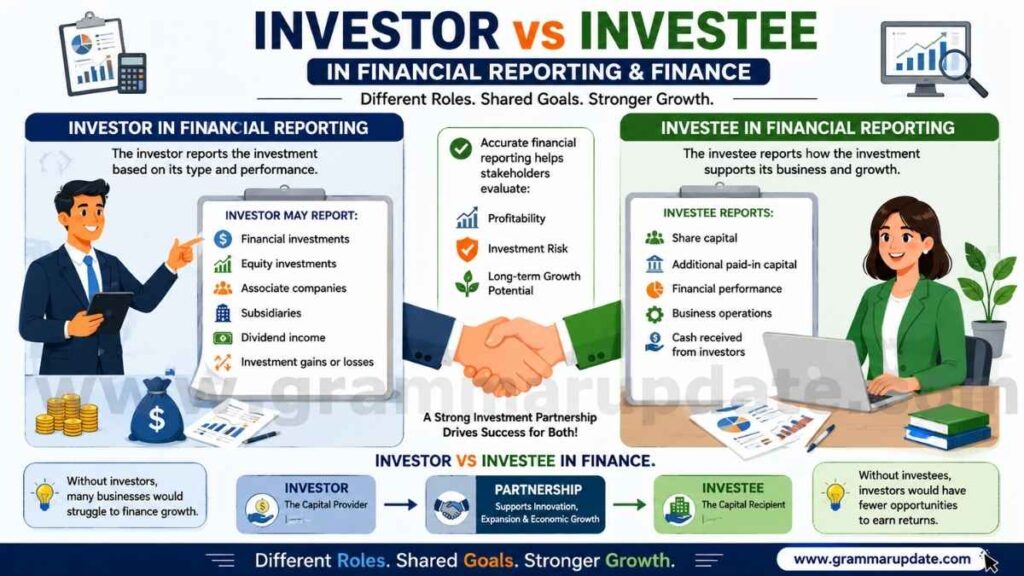
Financial reporting helps shareholders, lenders, regulators, and other stakeholders understand a company’s financial health.
The investor and investee each report the investment differently.
An investor may report:
- Financial investments
- Equity investments
- Associate companies
- Subsidiaries
- Dividend income
- Investment gains or losses
An investee reports:
- Share capital
- Additional paid-in capital
- Financial performance
- Business operations
- Cash received from investors
Accurate financial reporting allows stakeholders to evaluate profitability, investment risk, and long-term growth potential.
Learn how to use confusing more words correctly
Openned vs Opened Which Spelling Is Correct?
Investor vs Investee in Finance
Investor vs investee finance focuses on how businesses obtain funding and how investors allocate capital.
The investor acts as the capital provider.
The investee becomes the capital recipient.
Together, they create an investment partnership that supports innovation, expansion, and economic growth.
Without investors, many businesses would struggle to finance growth.
Without investees, investors would have fewer opportunities to earn returns.
This balance keeps financial markets moving.
Common Sources of Business Funding
Businesses can raise capital through several methods.
- Equity financing
- Debt financing
- Venture capital
- Angel investment
- Private equity
- Public stock offerings
- Strategic corporate investment
Each funding source serves different business needs depending on the company’s size and stage of development.
Learn how to use confusing more words correctly
Targetted vs Targeted Which Spelling Is Correct?
Investor vs Investee in Startups
Startup funding provides one of the clearest examples of the investor and investee relationship.
Most startups begin with a strong idea but limited financial resources.
To grow quickly, they seek outside investment.
The founders remain responsible for running the company while investors provide growth capital.
Seed Funding
Seed funding is usually the first major investment a startup receives.
Funding often comes from:
- Angel investors
- Family members
- Friends
- Seed venture capital funds
The investment supports activities such as:
- Product development
- Market research
- Building a prototype
- Hiring the first employees
At this stage, investors accept significant risk because many startups are still proving their business models.
Series A Funding
Once the company demonstrates market demand, it may seek Series A funding.
Series A funding helps businesses:
- Expand operations
- Increase production
- Hire experienced managers
- Scale marketing efforts
- Improve technology
The company’s valuation becomes increasingly important during this stage because it determines how much ownership investors receive.
Startup Investor vs Startup Investee
Consider this example.
A software startup raises $8 million from a venture capital investor.
The venture capital firm becomes the startup investor.
The software company becomes the investee company receiving investment.
The startup uses the funding to expand internationally while the investor hopes the company’s value will multiply over the next several years.
This is one of the most common investor and investee examples in today’s technology sector.
Learn how to use confusing more words correctly
Thats vs That’s diffrance and Which Is Correct?
Investor vs Investee in the Stock Market
Public companies also participate in investor and investee relationships.
Every time someone buys company shares through a stock exchange, they become an investor.
The company whose shares are purchased acts as the investee.
Unlike startup investing, stock market investors usually buy existing shares from other investors rather than purchasing newly issued shares.
Still, shareholders own part of the company and benefit if its value grows.
Types of Stock Market Investors
The stock market includes many kinds of investors.
- Retail investors
- Institutional investors
- Mutual funds
- Pension funds
- Exchange-traded funds
- Insurance companies
- Sovereign wealth funds
Institutional investors often own large ownership stakes in major corporations.
Their investment decisions can influence corporate governance, voting outcomes, and long-term business strategy.
Learn how to use confusing more words correctly
Workday vs Work Day Which One Is Correct?
Investor vs Investee in Private Equity and Venture Capital
Private equity and venture capital involve larger investments than most individual investors can make.
Although both provide capital, their goals often differ.
Venture Capital Investor
A venture capital investor focuses on businesses with high growth potential.
These companies often operate in industries such as:
- Artificial intelligence
- Biotechnology
- Financial technology
- Software
- Clean energy
Venture capital firms understand that some investments will fail, but one successful investment can generate exceptional returns.
Private Equity Investor
Private equity firms usually invest in established businesses rather than early-stage startups.
They often acquire significant ownership interests or even complete control.
Private equity investments may support:
- Business restructuring
- Operational improvements
- Expansion into new markets
- Technology upgrades
- Strategic acquisitions
After improving performance, the private equity investor may sell the company at a higher valuation.
Fix common more word mistakes in English
Manor vs Manner Which One Is Correct?
Investor Rights in an Investee
Investor rights depend on the investment agreement and ownership percentage.
Common investor rights include:
- Ownership interest
- Voting rights
- Access to financial information
- Dividend rights
- Board representation
- Protection against unfair dilution
- Participation in major business decisions
Not every investor receives all these rights.
Minority shareholders generally have fewer rights than investors with controlling ownership.
Fix common more word mistakes in English
Clutz vs Klutz Which Spelling Is Correct in English?
Investee Responsibilities to Investors
Receiving investment comes with important responsibilities.
An investee company must use capital responsibly while maintaining transparency with investors.
Typical investee responsibilities include:
- Managing funds wisely
- Preparing accurate financial statements
- Meeting reporting requirements
- Following corporate governance standards
- Complying with investment agreements
- Working toward agreed business objectives
Strong communication builds investor confidence and supports long-term partnerships.
Fix common more word mistakes in English
Nitch vs Niche Difference and Which Is Correct?
Case Study From Investment to Growth
Imagine a renewable energy startup developing advanced solar technology.
The founders have an innovative product but lack the money needed for manufacturing and expansion.
An institutional investor contributes $15 million in exchange for a 25% ownership interest.
The startup becomes the investee.
The institutional investor becomes the capital provider.
Over the next four years, the company expands into several countries, doubles its workforce, and increases annual revenue.
As the business grows, the investor’s ownership stake also becomes more valuable.
Both parties achieve their objectives.
The investor earns a higher return on investment.
The investee secures the funding needed to accelerate growth.
This example illustrates why investor and investee relationships play such an important role in corporate finance. Successful partnerships combine capital, strategy, and long-term planning to create value for everyone involved.
Fix common more word mistakes in English
Cancellation vs Cancelation Which Spelling Is Correct?
Roles and Responsibilities of an Investor and Investee
Every successful investment begins with clearly defined responsibilities. Although the investor and investee share the same goal of creating value, they contribute in different ways.
The investor provides financial resources, while the investee uses those resources to grow the business. When both parties understand their roles, the investment relationship becomes stronger and more productive.
Investor Role
The investor role goes beyond simply writing a check. Many investors actively help businesses succeed by sharing experience, industry knowledge, and professional networks.
An investor may:
- Provide capital for business growth
- Evaluate investment opportunities
- Monitor financial performance
- Review business strategy
- Participate in major business decisions
- Offer mentorship and industry expertise
- Support future funding rounds
- Help increase company value
A venture capital investor or private equity firm often takes a more active role than an individual shareholder investor.
Investee Role
The investee role focuses on building a successful business while using investment funds responsibly.
An investee company is expected to:
- Use investment capital efficiently
- Grow revenue and profitability
- Meet agreed business milestones
- Maintain accurate financial reporting
- Communicate regularly with investors
- Follow the investment agreement
- Protect shareholder interests
- Create long-term business value
Strong management builds investor confidence and increases the likelihood of future investment.
Learn the difference between commonly mixed-up more words
Summarize vs Summarise Which Spelling Is Correct?
Benefits and Risks for Investors
Every investment involves opportunities as well as uncertainty.
Benefits for Investors
Investors may receive several financial and strategic advantages.
- Capital appreciation as the business grows
- Dividend income from profitable companies
- Portfolio diversification
- Voting rights in company decisions
- Long-term wealth creation
- Access to innovative industries
- Strategic partnerships
Successful investments can produce significant returns over many years.
Risks for Investors
Investment always involves risk.
Common risks include:
- Business failure
- Market downturns
- Poor management decisions
- Declining company valuation
- Reduced profitability
- Liquidity challenges
- Economic uncertainty
Because of these risks, experienced investors carefully evaluate every investment opportunity before providing capital.
Learn the difference between commonly mixed-up more words
Spicey vs Spicy Which Spelling Is Correct?
Benefits and Risks for Investees
Receiving investment creates new opportunities, but it also brings new responsibilities.
Benefits for Investees
Business funding allows companies to grow much faster than relying only on internal profits.
Benefits include:
- Faster business expansion
- Hiring skilled employees
- Research and product development
- Marketing and customer acquisition
- International growth
- Technology improvements
- Greater competitive advantage
Many successful companies reached global markets because they secured investment during their early stages.
Risks for Investees
Accepting outside investment also involves trade-offs.
Potential challenges include:
- Reduced ownership percentage
- Investor expectations
- Increased reporting requirements
- Pressure to meet growth targets
- Shared decision-making
- Possible board oversight
Business owners should carefully evaluate investment terms before accepting funding.
Learn the difference between commonly mixed-up more words
Noisy vs Noisey Which is Correct and Usage?
Investor-Investee Agreement Explained
An investor and investee relationship is usually governed by a written agreement.
This document protects both parties by defining their rights, obligations, and expectations.
The agreement helps reduce misunderstandings and provides a framework for resolving disputes if they arise.
Common Sections in an Investor-Investee Agreement
A typical investment agreement may include:
- Investment amount
- Company valuation
- Ownership percentage
- Equity issued
- Voting rights
- Board representation
- Information and reporting rights
- Dividend policy
- Anti-dilution provisions
- Confidentiality obligations
- Exit strategy
- Dispute resolution procedures
Although every agreement is different, these provisions form the foundation of most investment contracts.
Can a Company Be Both an Investor and an Investee?
Yes. A company can be both an investor and an investee at the same time.
Large corporations often invest in smaller businesses while also receiving investment from larger organizations or institutional investors.
For example:
- Company A owns 30% of Company B.
- Company B owns 25% of Company C.
- Company A also receives investment from Company D.
In this situation:
- Company A is an investee of Company D.
- Company A is also an investor in Company B.
- Company B becomes both an investee and an investor.
- Company C is the investee of Company B.
Corporate ownership structures can become quite complex, especially in multinational business groups.
Investor vs Shareholder
Many people use these terms interchangeably, but they are not always identical.
An investor is anyone who commits money or resources with the expectation of earning a return.
A shareholder is someone who owns shares in a company.
Every shareholder is generally an investor, but not every investor is necessarily a shareholder.
For example, someone who provides debt financing through bonds is an investor without being a shareholder.
Investee vs Subsidiary
Another common source of confusion involves subsidiaries.
An investee is any company receiving investment.
A subsidiary is a company controlled by another company, usually through ownership of more than 50% of its voting shares.
Every subsidiary is an investee.
However, not every investee becomes a subsidiary.
Some investments involve only a small ownership stake that does not give the investor control.
Common Investor vs Investee Mistakes
Understanding the correct terminology helps avoid confusion in finance and business discussions.
Here are some common mistakes.
Assuming the Investor Receives Funding
This is incorrect.
The investor provides capital.
The investee receives funding.
Confusing Ownership with Control
Owning shares does not automatically mean controlling a company.
Control depends on ownership percentage, voting rights, and contractual arrangements.
Treating Every Investee as a Subsidiary
An investee only becomes a subsidiary when the investor has control.
Many investees remain independent companies.
Ignoring the Investment Agreement
The rights and responsibilities of both parties depend largely on the investment agreement.
Always review contractual terms instead of making assumptions based on ownership alone.
Learn the difference between confusing more English words
Learn the difference between confusing more English words
In Tact vs Intact Which Spelling Is Correct in English?
Investor Synonyms and Investee Synonyms
Although these terms have specific meanings, you may encounter related words in business documents.
Investor Synonyms
- Capital provider
- Business investor
- Equity investor
- Strategic investor
- Venture capital investor
- Angel investor
- Institutional investor
- Financial backer
- Investment partner
Investee Synonyms
- Investment recipient
- Funding recipient
- Investee company
- Portfolio company
- Company receiving investment
- Capital recipient
- Invested entity
The exact term depends on the business context and the type of investment involved.
Learn the difference between confusing more English words
Chris’s vs Chris’ Complete Grammar Guide and Explanations
Practice Session Investor vs Investee
Test your understanding of investor vs investee by completing the sentences below.
Fill in the Blanks
- An __________ provides capital to a business expecting a future return.
- A company receiving investment is called the __________.
- In an investment relationship, the __________ receives funding.
- A venture capital firm is an example of an __________.
- A startup raising seed funding is the __________.
- The main goal of an investor is to earn a __________ on investment.
- An investee may issue __________ in exchange for funding.
- An angel __________ typically invests in early-stage startups.
- The __________ uses investment to expand business operations.
- A company that provides business funding is known as a capital __________.
- The company receiving investment is the capital __________.
- Buying shares in a public company makes you an __________.
- A startup seeking Series A funding is the __________ company.
- The relationship between an investor and an investee begins with an investment __________.
- In most cases, an investor purchases an ownership __________.
- A business receiving funding should provide accurate financial __________.
- Under the equity method, the investor recognizes its share of the investee’s __________.
- When an investor controls another company, the investee usually becomes a __________.
- A shareholder with significant influence may use the __________ method of accounting.
- An institutional investor often manages a large investment __________.
- The investor hopes the company will increase in __________ over time.
- An investee may use investment capital to hire employees and develop new __________.
- The board of directors may include representatives of the __________.
- Both the investor and investee benefit from a successful investment __________.
- Understanding the difference between investor and investee helps you better understand corporate __________.
Answers
- investor
- investee
- investee
- investor
- investee
- return
- shares
- investor
- investee
- provider
- recipient
- investor
- investee
- agreement
- stake
- statements
- profits
- subsidiary
- equity
- portfolio
- value
- products
- investor
- relationship
- finance
Here’s a trusted source for clear word meanings:
FAQs
What is an investee and investor?
An investor is a person or organization that provides money to a business or investment opportunity with the expectation of earning a return. An investee is the company or organization that receives the investment and uses it to grow, expand, or finance its operations.
What is investment and investor?
An investment is money, property, or another asset committed with the goal of generating future income or increasing in value. An investor is the individual or organization that makes that investment.
Who is considered an investor?
Anyone who puts money into assets such as stocks, bonds, mutual funds, startups, real estate, or private businesses with the expectation of earning a financial return is considered an investor.
What are the four main types of investors?
The four common types of investors are:
- Individual investors
- Angel investors
- Venture capital investors
- Institutional investors
Each type has different investment goals, risk tolerance, and funding capacity.
What does investee mean?
An investee is the business, startup, or organization that receives funding from an investor in exchange for equity, ownership, or another agreed financial arrangement.
What are the four major types of investments?
The four primary investment categories are:
- Stocks
- Bonds
- Real estate
- Cash and cash equivalents
Many investors also include mutual funds and exchange-traded funds (ETFs) as common investment options.
What is an investee vs investor?
The difference is simple. An investor provides capital to earn a return, while an investee receives that capital to grow its business or finance its operations.
What is another word for investee?
Depending on the context, an investee may also be called a:
- Portfolio company
- Investment recipient
- Funding recipient
- Investee company
- Capital recipient
What do you call a person who invests money?
A person who invests money is called an investor. Other terms include shareholder, equity investor, angel investor, venture capitalist, or private investor, depending on the type of investment.
What is a private investor called?
A private investor is often referred to as an individual investor, accredited investor, angel investor, or private equity investor, depending on the investment structure and financial qualifications.
What are the seven common types of investments?
The most common investment types include:
- Stocks
- Bonds
- Mutual funds
- Exchange-traded funds (ETFs)
- Real estate
- Commodities
- Cash equivalents
Each offers a different balance of risk and potential return.
Do investors make money?
Yes. Investors can make money through capital gains, dividends, interest income, rental income, or profit-sharing, depending on the investment they choose. However, all investments involve some level of risk, and profits are never guaranteed.
What is the best investment for beginners?
For many beginners, diversified index funds or ETFs are often recommended because they provide broad market exposure, lower costs, and reduced risk compared to investing in individual stocks. The best choice depends on your financial goals, risk tolerance, and investment timeline.
What is the riskiest investment?
Highly speculative assets such as early-stage startups, cryptocurrencies, leveraged products, penny stocks, and options trading are generally considered among the riskiest investments because they can experience significant price swings and substantial losses.
Is investing $25 a month worth it?
Yes. Investing $25 each month can build meaningful wealth over time through consistent contributions and compound growth. Starting early is often more important than starting with a large amount.
Should I pay off debt or invest?
It depends on the interest rate and your financial situation. Paying off high-interest debt usually provides a guaranteed financial benefit. If your debt has a low interest rate, you may choose to invest while making regular debt payments. Many people use a balanced approach by doing both.
Is investing in stocks better than savings?
Stocks generally offer higher long-term growth potential but come with greater risk. Savings accounts provide stability and easier access to cash but typically earn lower returns. The better choice depends on your financial goals, time horizon, and tolerance for risk.
What is the average income of an investor?
There is no standard average income for investors because investment earnings vary widely based on portfolio size, investment strategy, market performance, and asset selection. Some investors earn modest returns, while professional and institutional investors may generate substantially higher income.
Conclusion
If you are ever confused investor vs investee, you are not alone. The two words sound similar, so it’s easy to mix them up. The good news is that the difference is actually simple. An investor provides the money, and an investee receives it. Thats the key idea to remember. Once you understand who gives the capital and who uses it, the confusion quickly disappears. Whether you’re learning about startups, business funding, accounting, or corporate finance, knowing the difference between an investor and an investee helps you understand how businesses grow and how investments work. It also makes financial terms and investment agreements much easier to follow. The next time you see these terms, you won’t have to stop and think. You will know exactly who is providing the funding, who is receiving it, and how both work together to create long term business success.

Jhon AJS, the creative mind behind Grammar Update, is an experienced blogger passionate about simplifying English grammar. He focuses on explaining confusing word vs word differences, grammar rules, punctuation, and sentence structure in a clear and practical way. Through easy to understand guides and examples, Jhon helps readers improve their writing and communicate with confidence. With years of blogging experience, he continues to share helpful insights that make learning grammar simple, useful, and accessible for everyone.