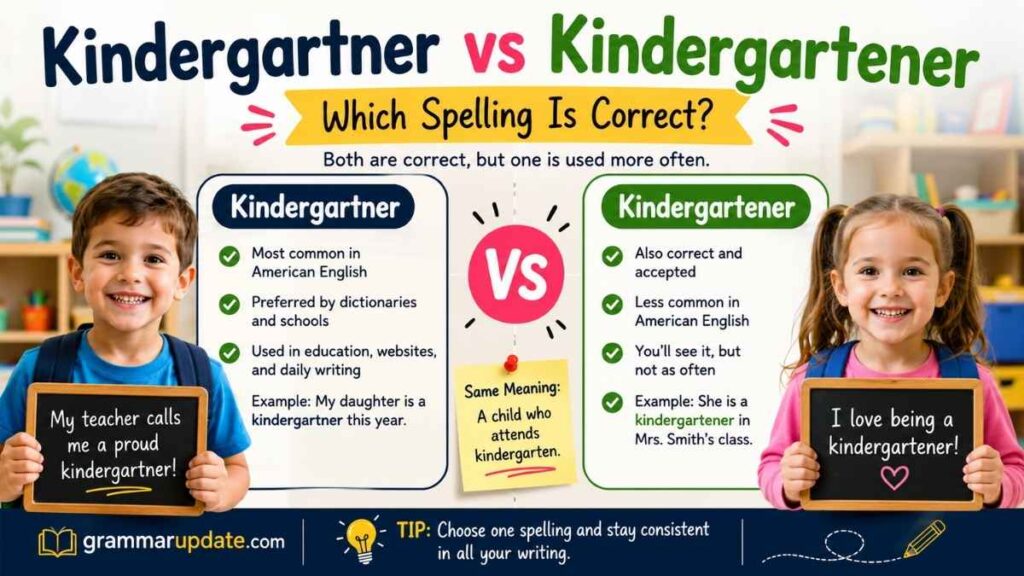
Have you ever written “kindergartner” and stopped to wonder if it should be “kindergartener” instead? You’re not alone. This is one of those small spelling questions that can make even confident writers pause. The good news is that the confusion is easier to solve than you might think. In the kindergartner vs kindergartener debate, both words are correct and both mean a child who attends kindergarten. However, one spelling is much more common in American English. In this guide, you’ll learn which spelling is preferred, why two versions exist, and how to use the right word with confidence every time.
Kindergartner vs Kindergartener The Quick Answer
If you’re looking for a quick answer, here it is.
| Question | Answer |
|---|---|
| Is kindergartner correct? | Yes |
| Is kindergartener correct? | Yes |
| Which spelling is more common? | Kindergartner |
| Which spelling should you use in American English? | Kindergartner |
| Do both words have the same meaning? | Yes |
| Are both accepted by dictionaries? | Yes |
The difference between kindergartner and kindergartener isn’t about right versus wrong. Instead, it’s about preferred spelling.
Most American writers, teachers, editors, and publishers use “kindergartner.” Although “kindergartener” appears in respected dictionaries, it is much less common in everyday writing.
If you’re unsure which version to choose, “kindergartner” is usually the safest option.
Understand confusing English more words simply
Focuses vs Focusses Which Spelling Is Correct?
Kindergartner vs Kindergartener What’s the Difference?
At first glance, these words look different because one ends with “-er” while the other ends with “-ener.” That extra syllable makes many people wonder whether one word is outdated or incorrect.
The truth is much simpler.
Both words describe exactly the same person: a child attending kindergarten.
There is no difference in age, education level, or meaning. Whether you write “kindergartner” or “kindergartener,” your reader will understand that you’re talking about a kindergarten student.
Here’s a quick comparison.
| Feature | Kindergartner | Kindergartener |
|---|---|---|
| Meaning | Child in kindergarten | Child in kindergarten |
| Accepted spelling | Yes | Yes |
| Dictionary spelling | Yes | Yes |
| Common in American English | Very common | Less common |
| Recommended for most writing | Yes | Acceptable |
Think of it this way. English often accepts more than one spelling for the same word. Sometimes one version simply becomes more popular over time. That’s exactly what happened here.
Understand confusing English more words simply
Investor vs Investee What’s the Difference and usage ?
What Does “Kindergartner” Mean?
The kindergartner meaning is straightforward.
A kindergartner is a child enrolled in kindergarten, which is typically the first year of formal schooling before first grade.
Kindergartner definition:
“A child who attends kindergarten.”
In the United States, most children begin kindergarten when they are about five years old, although the exact age requirement depends on state and local school district rules.
You might hear the word in conversations like these:
- My daughter is a kindergartner this year.
- Every kindergartner received a welcome package on the first day of school.
- The teacher introduced each kindergartner to the classroom rules.
- Our neighborhood has more than fifty kindergartners attending the local elementary school.
The word appears frequently in discussions about kindergarten education, early childhood education, school readiness, and elementary education.
Parents, teachers, principals, and education professionals commonly use it because it’s short, clear, and easy to understand.
Learn the difference between confusing more English words
Flatform vs Platform Difference which is correct?
What Does “Kindergartener” Mean?
The kindergartener meaning is exactly the same.
A kindergartener is also a child attending kindergarten.
Although the word contains one extra syllable, it does not describe a different type of student. It simply represents another accepted spelling.
Examples include:
- The kindergartener proudly showed her artwork to her family.
- Every kindergartener participated in the reading activity.
- The school welcomed each kindergartener with a special ceremony.
- A kindergartener learns important social and academic skills during the school year.
If you compare the two definitions side by side, you’ll notice there is no meaningful distinction.
| Word | Definition |
|---|---|
| Kindergartner | A child attending kindergarten |
| Kindergartener | A child attending kindergarten |
This is why many grammar guides describe them as variant spellings rather than different words.
Learn the difference between confusing more English words
Stopping vs Stoping Which Spelling Is Correct?
Is Kindergartner vs Kindergartener More Common?
One of the most common grammar questions is:
Which spelling is correct?
Technically, both are.
A better question is:
Which spelling do people actually use?
The answer is “kindergartner.”
In modern American English spelling, the shorter version appears much more frequently in newspapers, educational publications, parenting websites, classroom resources, and professional writing.
Several factors explain why kindergartner is preferred.
- It is shorter.
- It sounds more natural to many native speakers.
- It follows a common English pattern for naming people.
- It has become the standard choice in educational writing.
That doesn’t mean kindergartener is wrong.
It simply means that readers are more accustomed to seeing “kindergartner.”
If your goal is writing consistency, choosing the more common spelling makes your content feel familiar and professional.
Learn the difference between confusing more English words
Anual vs Annual Which Spelling Is Correct?
Kindergartner vs Kindergartener in American English and British English
Many spelling differences come from the distinction between American English and British English.
Examples include:
| American English | British English |
|---|---|
| Color | Colour |
| Center | Centre |
| Favorite | Favourite |
| Organize | Organise |
However, kindergartner vs kindergartener grammar is different.
This is not an American English spelling versus British English spelling issue.
Instead, both spellings belong primarily to American English because the word “kindergarten” itself is used much more often in North America than in the United States’ British counterparts.
In the United Kingdom, schools usually use different educational terminology.
Instead of saying “kindergartner,” people are more likely to say:
- Reception pupil
- Reception student
- Child in Reception
- Young learner
Likewise, other English-speaking countries may use terms such as:
- Prep student
- Foundation student
- Early years pupil
Because educational systems vary around the world, the exact vocabulary also changes.
If you’re writing for an American audience, “kindergartner” remains the preferred spelling.
If you’re writing for an international audience, make sure the school terminology matches the country’s education system rather than simply translating the word.
Why Do Both Words Exist?
To understand why there are two accepted spellings, it helps to look at the history of the word.
The term “kindergarten” comes from the German language.
It combines two German words:
- Kinder = children
- Garten = garden
The word literally means “children’s garden.”
German educator Friedrich Froebel introduced the kindergarten concept in the nineteenth century. His educational philosophy emphasized learning through play, creativity, songs, movement, and hands-on activities. As the idea spread across Europe and North America, English adopted the German word “kindergarten.”
Once English speakers began referring to children who attended kindergarten, two natural word forms developed.
One group shortened the word and created “kindergartner.”
Another group added an extra syllable and used “kindergartener.”
Because English language evolution often allows more than one accepted spelling, both forms remained in use.
Over time, however, one version became more popular.
Today, “kindergartner” is the preferred spelling in most American English writing, while “kindergartener” survives as a recognized but less common variant.
Which Word Should You Use?
Now that you know both spellings are correct, the next question is obvious: which one should you actually use?
For most writers, the answer is simple. Use “kindergartner.”
It is the preferred spelling in American English and the version most readers expect to see. Whether you’re writing a school newsletter, a parenting blog, a newspaper article, or a classroom handout, “kindergartner” is the safest and most natural choice.
That said, “kindergartener” isn’t incorrect. If you’ve already used it throughout a document, there’s no need to replace every instance. The most important rule is consistency. Switching between both spellings in the same piece of writing can distract readers and make your work look unedited.
Here’s a quick guide.
| Writing Situation | Recommended Word |
|---|---|
| School assignments | Kindergartner |
| Educational articles | Kindergartner |
| Parenting blogs | Kindergartner |
| News articles | Kindergartner |
| Professional writing | Kindergartner |
| Informal writing | Either, but stay consistent |
If you’re asking, “Should I use kindergartner or kindergartener?” the answer is clear. Choose “kindergartner” unless you have a specific reason to use the longer variant.
Learn how to use confusing more words correctly
Presentor vs Presenter Which Spelling Is Correct?
Kindergartner vs Kindergartener in Formal and Informal Writing
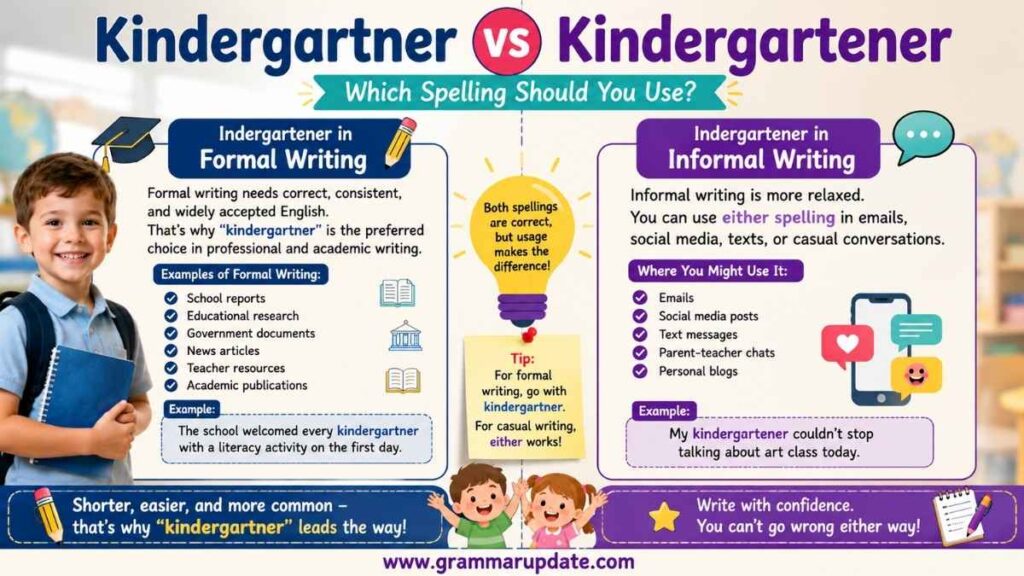
Choosing the right word often depends on your audience.
In formal writing, readers expect consistent language that follows standard English usage. Editors also prefer words that appear most often in trusted dictionaries and professional publications.
That’s one reason why “kindergartner” appears more frequently in formal English grammar and educational writing.
Examples of formal writing include:
- School reports
- Educational research
- Government documents
- News articles
- Teacher resources
- Academic publications
Example:
The school welcomed every kindergartner with a literacy activity on the first day.
In informal writing, the rules are more relaxed.
Parents, students, and teachers may use either spelling in emails, social media posts, or text messages.
Example:
My kindergartener couldn’t stop talking about art class today.
Even in casual writing, many people naturally choose “kindergartner” because it feels shorter and easier to read.
Kindergartner vs Kindergartener Examples
The easiest way to understand correct English usage is by seeing real examples.
Here are sentences using “kindergartner.”
Correct examples:
- Every kindergartner received a new backpack.
- My son is a kindergartner this year.
- The teacher greeted each kindergartner at the classroom door.
- A kindergartner learns important reading and social skills.
- Every kindergartner participated in the science activity.
Now look at examples using “kindergartener.”
Also correct:
- The kindergartener proudly read her first story aloud.
- Every kindergartener completed the art project.
- The school celebrated each kindergartener during graduation.
- A kindergartener often develops stronger communication skills throughout the year.
- The teacher praised every kindergartener for working together.
Notice something?
Nothing changes except the spelling. The meaning stays exactly the same.
Learn how to use confusing more words correctly
Fourteen vs Forteen Which Spelling Is Correct?
Common Mistakes People Make
Although this word pair isn’t especially difficult, several mistakes appear regularly in school papers and online writing.
Assuming One Word Is Wrong
Many people believe only one spelling exists.
That’s incorrect.
Both words are accepted spelling forms in modern English.
Mixing Both Spellings
Some writers start with “kindergartner” and later switch to “kindergartener.”
Example:
Incorrect:
My kindergartner loves reading. Every kindergartener also enjoys story time.
While both words are correct, mixing them in the same document creates inconsistency.
Better:
My kindergartner loves reading. Every kindergartner also enjoys story time.
Misspelling the Word
This long word often leads to spelling mistakes.
Common incorrect spellings include:
- kindergarden
- kindergardener
- kindergartenner
- kindergardner
- kindergartnor
Learning how to spell kindergartner correctly becomes much easier when you remember that the base word is “kindergarten.”
Thinking the Longer Word Is More Formal
Some writers assume that adding more letters makes a word sound more professional.
English doesn’t work that way.
The shorter spelling is actually the preferred spelling in most professional writing.
Learn how to use confusing more words correctly
Favs vs Faves Difference Which Is Correct?
How to Spell the Plural Correctly
Another common question involves plural forms.
Fortunately, they’re easy to remember.
Kindergartners
If you use the preferred spelling, simply add “s.”
Examples:
- The kindergartners visited the school library.
- All kindergartners received certificates.
- The teacher photographed the kindergartners on graduation day.
Kindergarteners
If you choose the longer spelling, also add “s.”
Examples:
- The kindergarteners sang during the school concert.
- Several kindergarteners volunteered to help.
- The kindergarteners enjoyed the outdoor activities.
Both plural forms are grammatically correct.
Again, consistency matters more than anything else.
| Singular | Plural |
|---|---|
| Kindergartner | Kindergartners |
| Kindergartener | Kindergarteners |
Is “Kindergarten” Capitalized?
This question appears frequently because school names and grade levels sometimes follow different capitalization rules.
In most cases, “kindergarten” is not capitalized.
Correct:
- My daughter starts kindergarten next month.
- He teaches kindergarten at a public elementary school.
- The kindergarten classroom has twenty students.
However, capitalize it when it begins a sentence.
Example:
Kindergarten is an exciting milestone for many children.
You should also capitalize it if it is part of an official name.
Examples:
- Lincoln Elementary Kindergarten Program
- Sunshine Kindergarten Center
According to AP Style spelling guidance, grade levels and educational terms are generally lowercase unless they are part of a proper noun.
Examples:
Correct:
- kindergarten classroom
- kindergarten education
- kindergarten learner
Also correct:
- Oak Hill Kindergarten Academy
Learn how to use confusing more words correctly
Wait vs Weight Difference and usage?
Easy Trick to Remember the Correct Word
Still wondering how to remember the preferred spelling?
Here’s a simple trick.
Think about other common English words that describe people.
Examples include:
- Partner
- Painter
- Teacher
- Writer
- Farmer
Notice that many end naturally with “-er.”
“Kindergartner” follows that familiar pattern, making it easier for most English speakers to recognize and remember.
Another helpful tip is to focus on the base word.
Kindergarten
↓
Kindergartner
The shorter version removes unnecessary letters while keeping the meaning clear.
Whenever you’re unsure, ask yourself this question:
“Which spelling have I seen more often in books, newspapers, and school materials?”
The answer is almost always “kindergartner.”
Learn the difference between tricky more English words
To Many vs Too Many Difference and Which is Correct?
Kindergartner vs Kindergartener Usage Trends
Language changes over time, and some spellings become more popular than others.
That’s exactly what happened here.
Both words remain accepted spelling forms, but “kindergartner” has become the dominant choice in modern American English.
Several factors contributed to this trend.
- Simpler words are often easier to read.
- Editors prefer consistency.
- Educational publishers favor shorter spellings.
- Readers recognize “kindergartner” more quickly.
You’ll commonly find “kindergartner” in:
- School district websites
- Education magazines
- Parenting articles
- Children’s books
- Classroom resources
- Local newspapers
- National news publications
Meanwhile, “kindergartener” still appears in dictionaries and occasional publications. Its continued use shows that English allows spelling variation when both forms have a long history of accepted usage.
Learn the difference between tricky more English words
Requester vs Requestor Which Is Correct and usage?
Practice Section kindergartner vs kindergartener
Choose the correct word to complete each sentence: kindergartner vs kindergartener.
- My younger sister is a __________ this year.
- Every __________ received a new backpack on the first day of school.
- The teacher greeted each __________ with a smile.
- A __________ learns basic reading and math skills in kindergarten.
- The school invited every __________ to the spring concert.
- Emma is excited because she is now a __________.
- The principal congratulated every __________ during the graduation ceremony.
- My neighbor has a __________ who loves drawing pictures.
- Each __________ planted a flower in the school garden.
- The __________ proudly showed their artwork to their parents.
- Our __________ enjoys story time every afternoon.
- Every __________ practiced writing the alphabet.
- The __________ lined up quietly before entering the classroom.
- A __________ usually begins school around the age of five.
- The teacher gave every __________ a participation certificate.
- The __________ learned how to count to one hundred.
- My cousin became a __________ this fall.
- Every __________ participated in the reading challenge.
- The __________ smiled proudly after finishing the puzzle.
- A __________ spends much of the day learning through play.
- The __________ listened carefully during science class.
- Every __________ received a healthy snack before recess.
- The __________ worked together to build a tower with blocks.
- Parents celebrated each __________ at the end-of-year program.
- The teacher encouraged every __________ to ask questions and explore new ideas.
Answers
- kindergartner
- kindergartner
- kindergartner
- kindergartner
- kindergartner
- kindergartner
- kindergartner
- kindergartner
- kindergartner
- kindergartener (also acceptable: kindergartner)
- kindergartner
- kindergartner
- kindergartners
- kindergartner
- kindergartner
- kindergartener (also acceptable: kindergartner)
- kindergartner
- kindergartners
- kindergartener (also acceptable: kindergartner)
- kindergartner
- kindergartners
- kindergartner
- kindergartners
- kindergartner
- kindergartner
Here’s a trusted source for clear word meanings:
FAQs
Which is correct, kindergartener or kindergartner?
Both spellings are correct and accepted in standard English. However, “kindergartner” is the preferred spelling in American English and appears more often in dictionaries, educational materials, and professional writing.
Who is a kindergartner?
A kindergartner is a child enrolled in kindergarten, which is typically the first year of formal education before first grade.
What are kids in kindergarten called?
Children attending kindergarten are commonly called kindergartners. The less common but still correct term is kindergarteners.
Why do Americans call kindergarten “kindergarten”?
The word “kindergarten” comes from German and means “children’s garden.” American schools adopted both the educational concept and its original German name during the 19th century.
Is kindergartener a word?
Yes. Kindergartener is a real word recognized by major English dictionaries. Although it is less common than “kindergartner,” it is still an accepted spelling.
How do British people say kindergarten?
In the United Kingdom, the term “kindergarten” is rarely used for the state school system. Children of a similar age usually attend Reception, Nursery, or Preschool, depending on their age and school type.
What are 3- to 5-year-olds called?
Children between the ages of 3 and 5 are generally referred to as preschoolers. Once they begin kindergarten, they are called kindergartners.
Is a kindergartener a baby?
No. A kindergartener is not a baby. Kindergarten students are typically around five years old and are considered young children beginning formal education.
How do Americans say kindergarten?
Americans pronounce kindergarten as “KIN-der-gar-ten.” The “t” is clearly pronounced, and the word has four syllables.
Is a kindergartner a toddler?
No. Toddlers are usually between one and three years old. A kindergartner is generally around five years old and has moved beyond the toddler stage.
What is the average age of a kindergartner?
In the United States, the average kindergartner is five years old when starting school. Some children begin at age six if they miss the enrollment cutoff date or delay entry.
What is the golden rule in kindergarten?
The golden rule in kindergarten is to treat others the way you want to be treated. Teachers use this principle to encourage kindness, sharing, respect, and cooperation.
Why isn’t kindergarten called first grade?
Kindergarten is designed as a transition between preschool and elementary school. It focuses on building foundational academic, social, and emotional skills before students enter first grade.
How old are kindergarteners in the USA?
Most kindergarteners in the United States are between five and six years old, depending on state enrollment requirements and birthdate cutoffs.
What do German kids call their teachers?
German children typically use titles such as “Lehrer” for a male teacher and “Lehrerin” for a female teacher, often followed by the teacher’s last name.
Is it kindergartner or kindergarten?
The correct word depends on what you mean. “Kindergarten” refers to the grade or educational program, while “kindergartner” refers to the child attending kindergarten.
Are there 6-year-old kindergarteners?
Yes. Some children start kindergarten at age six because of local enrollment rules, delayed school entry, or personal educational decisions.
Why do Americans use the German word “kindergarten”?
American educators adopted the German term because the kindergarten system introduced by Friedrich Froebel became popular in the United States during the 1800s.
Is the T silent in kindergarten?
No. The “t” is pronounced in standard American English pronunciation.
What do Brits call daycare?
In the United Kingdom, daycare is commonly called nursery, nursery school, or childcare, depending on the child’s age and the type of program.
Why is kindergarten sometimes pronounced “kindergarden”?
Many people mistakenly pronounce the final “t” as a “d” because of connected speech. However, the correct spelling remains “kindergarten.”
What is a 7-year-old called?
A seven-year-old is generally referred to as a child or a school-age child. Most seven-year-olds are in first or second grade.
What is the first color a baby sees?
Research suggests that red is one of the first colors babies can distinguish after black, white, and shades of gray because it has a long wavelength that is easier for developing eyes to detect.
Which sibling gets the least attention?
There is no universal answer. Family dynamics differ, although some psychological studies suggest middle children may sometimes receive less individual attention than firstborns or youngest siblings.
What is the hardest age to teach?
The answer varies by teacher and classroom. Many educators find kindergarten challenging because children are developing academic skills, emotional regulation, and classroom routines at the same time.
Can you skip pre-K and go to kindergarten?
Yes. In most U.S. school districts, pre-K is optional. Children who meet the age requirements and are developmentally ready can enroll directly in kindergarten.
Is 7 still a little kid?
Yes. A seven-year-old is still considered a young child and continues developing socially, emotionally, and academically.
What do British people call kindergarten?
British schools generally use terms such as Reception, Nursery, or Preschool instead of kindergarten.
What does Japan call kindergarten?
In Japan, kindergarten is called “Yōchien.” It serves children before they begin compulsory elementary school.
Do Canadians call it kindergarten?
Yes. Canada also uses the term “kindergarten,” although school systems and starting ages vary by province.
Can most 2-year-olds count to 10?
Some two-year-olds can recite numbers to ten from memory, but many do not fully understand the numerical concepts until they are older.
What grade are most 5-year-olds in?
Most five-year-olds in the United States attend kindergarten, although enrollment depends on local age cutoff dates.
How long is a typical kindergarten day?
A full-day kindergarten program typically lasts between five and seven hours, while half-day programs usually run for about two and a half to three hours.
What is a 5-year-old called?
A five-year-old is generally called a child. If enrolled in kindergarten, the child is also called a kindergartner.
At what age do kids start kindergarten in the USA?
Most children start kindergarten at five years old, although the required age depends on each state’s enrollment deadline.
What should my child know before kindergarten?
Before starting kindergarten, children are usually expected to:
- Recognize some letters and numbers.
- Follow simple directions.
- Communicate basic needs.
- Use the restroom independently.
- Hold a pencil or crayon.
- Share and cooperate with others.
- Recognize their name.
What’s another name for kindergarten?
Depending on the country, similar terms include Reception, Preschool, Foundation Year, or Prep. In the United States, however, “kindergarten” is the standard name for the first year of formal schooling.
Do most kids start kindergarten at 5 or 6?
Most children begin kindergarten at age five. Some start at six because of enrollment cutoffs or delayed entry based on family or educational decisions.
Learn the difference between tricky more English words
Unorganized vs Disorganized Difference and Use?
Conclusion
The confusion between kindergartner and kindergartener is easier to solve than it looks. The good news is that both words are correct, so you don’t have to worry about making a major grammar mistake. If you want the safest and most natural choice, go with “kindergartner.” It’s the spelling you’ll see most often in American English, school documents, parenting blogs, and educational websites. While “kindergartener” is also a real and accepted word, it’s simply used less often. The biggest mistake isn’t choosing one spelling over the other. It’s switching between both in the same piece of writing. Pick one, stay consistent, and your writing will look clean and professional. English is full of confusing word pairs, but this doesn’t have to be one of them anymore. Now you know which spelling is preferred, why both exist, and when to use each one. The next time someone asks, “Is it kindergartner or kindergartener?” you wll have the answer ready. And unlike your first day of kindergarten, you can leave this lesson feeling confident instead of nervous.

Jhon AJS, the creative mind behind Grammar Update, is an experienced blogger passionate about simplifying English grammar. He focuses on explaining confusing word vs word differences, grammar rules, punctuation, and sentence structure in a clear and practical way. Through easy to understand guides and examples, Jhon helps readers improve their writing and communicate with confidence. With years of blogging experience, he continues to share helpful insights that make learning grammar simple, useful, and accessible for everyone.