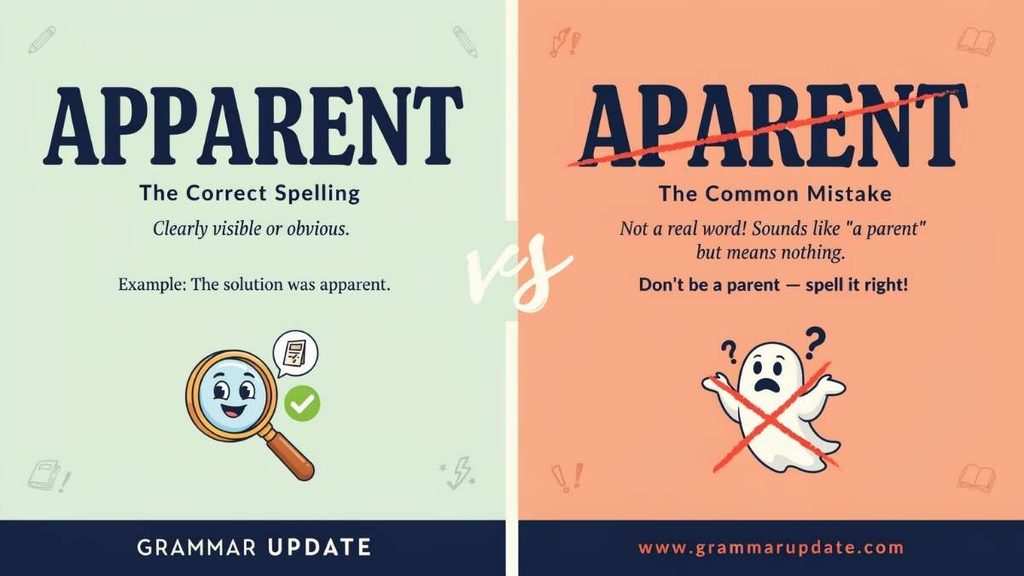
The spelling confusion between apparent vs aparent is easy to fix once you know the correct form. If you’re wondering whether to write “apparent vs aparent,” the answer is apparent. It has two p’s, while “aparent” is a common spelling mistake. But there’s more to this word than its spelling. Apparent can mean clear, noticeable, or easy to understand. It can also describe something that seems to be true without being fully confirmed. Knowing these meanings will help you use the word correctly in everyday and professional writing. Let’s clear up the confusion, correct the common mistakes, and make apparent simple to remember.
quick answer
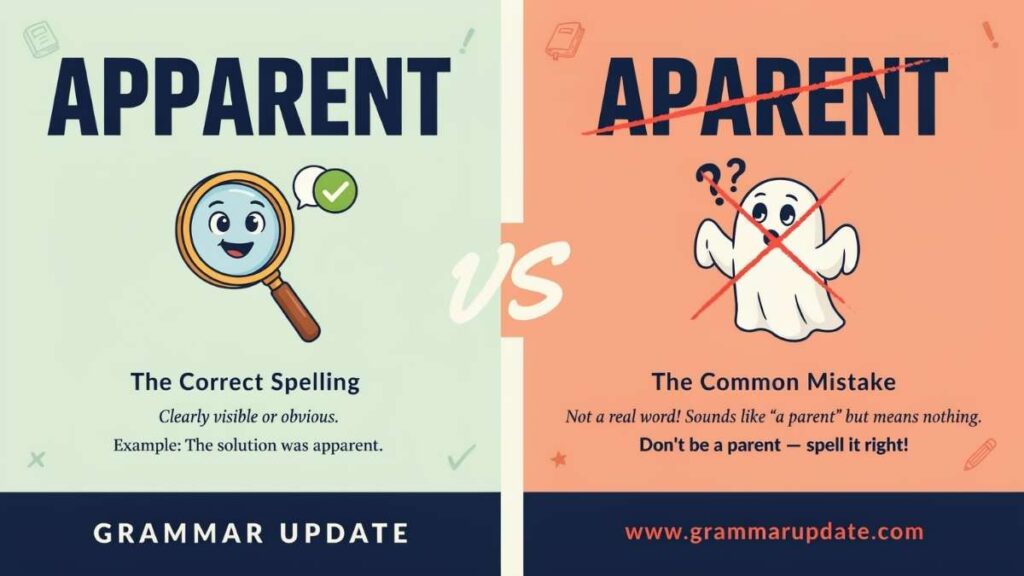
The answer is simple apparent is correct, while aparent is incorrect.
| Word | Correct? | Part of speech | Meaning | Example |
|---|---|---|---|---|
| Apparent | Yes | Adjective | Clear, noticeable, or seeming to be true | Her disappointment was apparent. |
| Aparent | No | Not applicable | Misspelling of apparent | Aparent is incorrect in standard English. |
1.If you are asking “apparent vs aparent,” choose apparent.
2.If you are searching for “is aparent a word,” the answer is no in standard English.
3.If you want the “correct spelling of apparent,” write it as apparent.
The spelling is A-P-P-A-R-E-N-T.
The two p’s are the detail that writers most often miss.
Learn the difference between confusing more English words
Conscious vs Conscience Difference and which is correct?
What Does Apparent Mean?
The apparent meaning can be understood in two main ways.
First, apparent can mean that something is clear, noticeable, or easy to understand. If someone’s disappointment is apparent, for example, you can easily recognize that the person feels disappointed.
Consider this sentence:
Her disappointment was apparent.
The sentence tells you that her disappointment was easy to notice.
The second meaning is a little more subtle. Apparent can also mean that something seems to be true based on what you currently know, although it may not have been completely proved.
For example:
The apparent cause of the problem was a faulty connection.
This sentence doesn’t necessarily say that the faulty connection was definitely responsible. It says that the connection seemed to be the cause.
That small difference can matter a lot.
When you understand both meanings, the apparent word meaning becomes much easier to use correctly.
Apparent Meaning in English Clear or Noticeable
In one common sense, apparent describes something that stands out or becomes easy to recognize.
For example:
Her excitement was apparent from the moment she entered the room.
The damage was apparent after the storm.
The difference between the two products was apparent.
His disappointment was apparent to everyone.
In each sentence, apparent means something close to clear, noticeable, or easy to recognize.
The word doesn’t have to describe something you can physically see. An emotion, problem, change, or pattern can also be apparent.
That is why you can say that someone’s anger was apparent even though anger isn’t a physical object.
Apparent Meaning Something That Seems True
The second meaning deserves a little more attention because it can easily cause confusion.
Suppose a company experiences a sudden drop in sales. After looking at the available information, someone might say:
The apparent cause of the decline was a change in customer demand.
This statement doesn’t necessarily mean that the cause has been proved beyond doubt. It means that the evidence currently points toward that explanation.
You could later discover another reason.
This use of apparent is common when people want to describe an explanation without presenting it as an established fact.
That makes the word useful in reports, research, journalism, business writing, and everyday explanations.
Is Aparent a Word?
If you are asking “is aparent a word,” the answer is no in standard English.
Aparent is not an accepted alternative spelling of apparent. It is simply a spelling mistake.
The correct word is apparent.
This also answers the question “is aparent correct?” No. If you mean the adjective that describes something as clear, noticeable, or seemingly true, you should write apparent.
It is also worth clearing up another common misunderstanding. Aparent is not a British English spelling while apparent is an American English spelling. English does have many genuine differences between American and British spelling, but this isn’t one of them.
The standard spelling remains apparent in both varieties of English.
So whether you’re writing an American English essay, a business email, a school assignment, or a general article, use apparent.
Learn the difference between confusing more English words
Category vs Catagory Which one Is Correct?
Why Is Apparent Spelled With Two P’s?
The spelling of apparent comes from a long history involving Latin and French. The English word is related to the Latin verb apparere, which means “to appear” or “come into sight.”
That connection helps explain the spelling.
The beginning of the word is app rather than ap.
You can think of the spelling this way:
APP + ARENT
Another useful connection is the word appear.
Appear and apparent are related words, and both begin with app.
This doesn’t mean every related word in English follows exactly the same spelling pattern. However, making that connection can help you remember the correct form.
The most common mistake is removing one of those p’s and writing aparent.
That is why remembering the double p is more useful than trying to memorize a complicated spelling rule.
The Apparent Double P
The apparent double p is easy to remember when you focus on the first three letters.
APPARENT
The word starts with APP.
A quick visual check can save you from a spelling mistake:
APPARENT
not
APARENT
The difference is only one letter, but that one letter determines whether the spelling is correct.
How to Remember Apparent Spelling
One of the easiest ways to remember the spelling is to connect apparent with appear.
Appear begins with two p’s.
Apparent also begins with two p’s.
You can also break the word into a simple visual pattern:
APP + ARENT
Another useful trick is to use the word regularly in sentences. When you see and write apparent several times, the correct spelling becomes familiar.
For example:
The reason soon became apparent.
Her concern was apparent.
The difference was apparent immediately.
Repeated exposure helps turn a spelling question into something you recognize automatically.
How to Pronounce Apparent
The apparent pronunciation can vary slightly between American and British English.
In American English, the word is commonly pronounced with the main stress on the second syllable. The beginning sounds relatively light, which may partly explain why some people forget the second p when writing it.
The important point is that pronunciation and spelling don’t always match letter for letter.
You may not strongly hear every written letter when a word is spoken naturally. That doesn’t make the letter unnecessary.
This is exactly what happens with many English spelling patterns. If you write only what you think you hear, you can easily create a spelling mistake.
So don’t use pronunciation as your only guide when deciding how to spell apparent.
Remember the written form:
APPARENT
Learn the difference between confusing more English words
Diverse vs Divers Difference and which is correct?
When Should You Use Apparent?
Use apparent when something is clearly noticeable or understandable, or when something seems to be true based on the available information.
The word works naturally in many situations.
You can talk about an apparent emotion:
Her disappointment was apparent.
You can describe an apparent problem:
The apparent problem was a lack of communication.
You can describe an apparent cause:
The apparent cause of the failure was a software error.
You can describe an apparent change:
The improvement became apparent after several weeks.
You can also use the common structure “it became apparent that” when something gradually becomes clear.
For example:
It became apparent that the original plan would not work.
This structure is extremely common because it naturally describes a situation in which information becomes clear over time.
Apparent for Noticeable Things
When apparent means noticeable, it can describe physical conditions, emotions, behavior, differences, and problems.
Consider these examples:
The damage was apparent after the inspection.
His excitement was apparent.
The difference in quality was apparent.
Her concern was apparent from her expression.
The change became apparent within a few days.
In these examples, apparent is close to clear or noticeable.
Apparent for Conclusions Based on Evidence
Apparent is especially useful when you are describing a conclusion based on what you currently know.
For example:
The apparent cause of the delay was a technical problem.
The word apparent leaves some room for uncertainty.
Perhaps the technical problem really was responsible. Perhaps further investigation will reveal another cause.
That is why apparent is often more careful than confirmed.
If you write “the confirmed cause,” you are saying that the cause has been verified.
If you write “the apparent cause,” you’re saying that the cause seems to be responsible based on the available evidence.
Apparent for Something That Only Seems True
Apparent can also describe something that looks true from the outside but may not actually be true.
For example:
His apparent confidence disappeared when the interview became difficult.
Here, apparent confidence means confidence that seemed to exist. The sentence doesn’t guarantee that he truly felt confident.
This meaning is useful when appearances and reality may differ.
That’s one reason apparent is such a useful word in English. It can describe what you can clearly recognize while also leaving room for another explanation.
Learn the difference between tricky grammar more words
Caribbean vs Carribean Which one Is Correct?
Apparent Can Mean Clear or Only Seeming
At first, these two meanings might seem confusing.
How can apparent mean something is clear while also suggesting that something only seems to be true?
The answer is context.
Look at these two sentences:
The problem was apparent.
Here, apparent means the problem was clear or easy to recognize.
Now consider:
The apparent problem was caused by a misunderstanding.
Here, apparent means the problem seemed to exist in a particular form. The writer may not be saying that the initial impression was completely accurate.
The noun that follows apparent often helps you understand which meaning is intended.
| Meaning | Explanation | Example |
|---|---|---|
| Clear | Easy to notice or understand | Her disappointment was apparent. |
| Seeming | Appears to be true but may not be fully confirmed | The apparent cause was human error. |
Understanding this distinction will improve both your vocabulary and your writing accuracy.
Learn the difference between tricky grammar more words
Digraph vs Diphthong What’s the Difference?
Apparent Vs Obvious Vs Confirmed
The Apparent, obvious, and confirmed can overlap, but they don’t mean exactly the same thing.
| Word | Main idea | Certainty | Example |
|---|---|---|---|
| Apparent | Clear or seeming | Depends on context | The cause became apparent. |
| Obvious | Easy to recognize | Usually strong | The answer was obvious. |
| Confirmed | Verified as true | Strong | The results were confirmed. |
Apparent Vs Obvious
The apparent vs obvious comparison is especially useful in everyday writing.
If something is obvious, it is usually easy for people to recognize.
For example:
The answer was obvious.
Apparent can sometimes work in the same situation:
The answer was apparent.
However, apparent has another meaning that obvious doesn’t usually carry.
Consider:
The apparent cause turned out to be incorrect.
This means the cause seemed to be correct at first, but later information showed otherwise.
“Obvious cause” doesn’t communicate that same idea as naturally.
Apparent Vs Evident
Apparent and evident are often close in meaning when they describe something clear or noticeable.
For example:
Her concern was apparent.
Her concern was evident.
Both sentences suggest that her concern was easy to recognize.
However, apparent can also mean seeming rather than fully established. That additional sense makes it a little more flexible.
The best choice depends on the context and the level of certainty you want to communicate.
Apparent Vs Visible
Visible has a stronger connection with sight.
For example:
The damage was visible from the road.
Apparent can also describe visible things:
The damage was apparent from the road.
But apparent can go beyond physical sight.
You can say:
The problem was apparent.
You can’t always replace apparent with visible because a problem isn’t necessarily something you can literally see.
This is an important part of apparent usage. The word can describe something you recognize mentally as well as something you observe with your eyes.
Apparent as an Adjective
From a grammar perspective, apparent is an adjective.
An adjective describes a noun or gives information about a subject.
For example:
The apparent problem was resolved quickly.
Here, apparent describes the noun problem.
The word can also appear after a linking verb.
The problem became apparent.
Her concern was apparent.
The difference was apparent.
These are straightforward examples of apparent grammar.
The word isn’t normally used as a noun. If you need a noun, the surrounding vocabulary will usually change depending on what you want to say.
For example, appearance is a noun related to appear and apparent.
Learn the difference between tricky grammar more words
Deceive vs Decieve Which one Is Correct?
Apparent Vs Apparently
The Apparent and apparently are closely related, but they perform different grammatical jobs.
Apparent is an adjective:
The problem was apparent.
Apparently is an adverb:
Apparently, the problem was more serious than expected.
The adjective describes something. The adverb modifies the statement and often signals that the information seems to be true or comes from available reports or evidence.
This distinction matters when building a sentence.
You wouldn’t normally write:
Apparently problem was serious.
Instead, you could write:
The problem was apparent.
Or:
Apparently, the problem was serious.
Knowing the difference between these forms can prevent a small spelling or grammar issue from turning into an awkward sentence.
Apparent Vs Appear
The apparent vs appear comparison is another useful way to understand the word.
Appear is a verb.
Apparent is an adjective.
Apparently is an adverb.
| Word | Part of speech | Example |
|---|---|---|
| Appear | Verb | The problem appeared suddenly. |
| Apparent | Adjective | The problem was apparent. |
| Apparently | Adverb | Apparently, the problem was serious. |
The words are related, but they aren’t interchangeable.
For example:
The problem appeared suddenly.
This tells you that the problem came into view or became noticeable.
The problem was apparent.
This tells you that the problem was clear or noticeable.
The difference is small but important.
Learn the difference between often confused words
HAVC vs HVAC? Which one Is Correct?
Common Phrases With Apparent
Some phrases with apparent appear so often that they are worth learning as complete patterns.
It Became Apparent
This phrase means that something became clear or noticeable.
For example:
It became apparent that the team needed more time.
The reason for the delay became apparent later.
It Was Apparent That
This structure introduces something that was clear from the situation.
For example:
It was apparent that the plan needed revision.
It was apparent that the two sides disagreed.
For No Apparent Reason
This phrase means that no clear reason was known.
For example:
The computer shut down for no apparent reason.
He left the meeting for no apparent reason.
Notice that the phrase doesn’t necessarily mean there was no reason. It means that no reason was obvious or known.
Apparent Cause
An apparent cause is a cause that seems responsible based on the information available.
For example:
The apparent cause of the failure was an overloaded system.
The word keeps the statement cautious.
Apparent Difference
An apparent difference is a difference that seems clear or noticeable.
For example:
There was an apparent difference between the two versions.
The meaning depends on context, but the phrase is common in both everyday and professional writing.
Learn the difference between often confused words
Practice vs Practise Which one Is Correct?
Common Apparent Vs Aparent Mistakes
The most common mistake is dropping the second p.
Incorrect:
The problem became aparant.
Correct:
The problem became apparent.
Another common mistake is assuming that aparent might be a regional spelling.
It isn’t.
There is no standard American or British spelling difference that changes apparent to aparent.
A third mistake involves meaning.
Some writers use apparent when they actually mean confirmed. That’s not always correct.
Compare these sentences:
The apparent cause was a software error.
The confirmed cause was a software error.
The first sentence leaves room for uncertainty. The second presents the cause as established.
Finally, some writers use apparent when a simpler word would make the sentence clearer.
For example:
The reason was apparent.
The reason was clear.
Both can work. In a casual conversation, “clear” may sound more natural. In a formal explanation, “apparent” may fit better.
The best word is the one that communicates the intended meaning without making the sentence heavier than necessary.
Learn the difference between often confused words
Judgment vs Judgement Which one Is Correct?
Apparent Synonyms and Antonyms
The best apparent synonym depends on which sense of the word you’re using.
When apparent means clear or noticeable, possible synonyms include obvious, clear, evident, noticeable, visible, plain, and conspicuous.
For example:
1.Her concern was apparent.
2.Her concern was evident.
3.Her concern was obvious.
The meaning remains similar, although the tone and strength can change slightly.
When apparent means seeming to be true, related words include seeming, supposed, presumed, and ostensible.
The antonym also depends on the context.
For the meaning of clear or noticeable, possible opposites include hidden, concealed, obscure, invisible, and unclear.
For the meaning of seemingly true, possible opposites include doubtful, unlikely, or improbable.
There isn’t one perfect synonym or antonym that works in every sentence.
Apparent Word Origin
The apparent word origin goes back through Old French to Latin.
The word is connected to Latin apparere, meaning “to appear” or “come into sight.” The English adjective developed from this family of words and has been part of English for centuries.
That history fits the modern meaning rather well.
Something appears, and therefore it becomes apparent.
The connection also helps explain why apparent and appear look similar.
The spelling isn’t random. It reflects the word’s linguistic history.
Understanding word origins isn’t necessary to spell apparent correctly, but it can make the vocabulary easier to remember.
Apparent in a Sentence
Seeing apparent in different contexts is one of the easiest ways to understand its usage.
Here are examples where it means clear or noticeable:
Her disappointment was apparent after the announcement.
The damage was apparent as soon as the inspection began.
His enthusiasm was apparent from the start.
The difference between the two designs was apparent.
The change became apparent over time.
Here are examples where apparent means seeming to be true:
The apparent cause of the problem was a technical failure.
Her apparent lack of interest surprised everyone.
The apparent solution created another problem.
The report contained several apparent inconsistencies.
The apparent reason for the delay was never confirmed.
These examples show why context matters when interpreting the apparent definition.
Fix common more word mistakes in English
Farther vs Further Differences, Rules and Examples
Apparent Vs Aparent Examples
| Incorrect | Correct |
|---|---|
| The error was aparant. | The error was apparent. |
| It became aparant that the plan had failed. | It became apparent that the plan had failed. |
| Her concern was aparant. | Her concern was apparent. |
| The aparant cause was unknown. | The apparent cause was unknown. |
| The difference was aparant. | The difference was apparent. |
The pattern is simple. Every correct example uses two p’s.
That is the main point to remember when checking an apparent spelling mistake or aparant spelling mistake.
How to Spell Apparent Correctly
If you’re wondering how to spell apparent, remember:
A-P-P-A-R-E-N-T
The first three letters are APP.
That gives you a simple visual checkpoint.
APPARENT
If you see APARENT, something is missing.
This is also why searching for “apparent spelling” or “apparent spelling in American English” should lead you to the same form. American English uses apparent.
The correct English spelling doesn’t change based on whether you’re writing an email, article, school paper, report, or social media post.
Apparent Vs Aparent spelling guide
The correct word is apparent.
Aparent is an incorrect spelling.
Apparent is an adjective that can mean clear, noticeable, or seemingly true.
The correct spelling is A-P-P-A-R-E-N-T.
The word contains a double p.
For example:
It became apparent that the meeting would need to be rescheduled.
If you’re searching “apparent vs aparent which is correct,” “apparent vs aparent which is correct,” or “correct word apparent vs aparent,” the answer is always apparent.
Fix common more word mistakes in English
Towards vs Toward Which One Is Correct?
Practice Session Apparent Vs Aparent
Fill in each blank with the correct word: apparent vs aparent.
- It became ________ that we had taken the wrong road.
- The reason for her sudden departure was not ________.
- His ________ confidence disappeared when the interview began.
- There was no ________ damage to the building after the storm.
- It soon became ________ that the project would take longer than expected.
- The mistake was ________ to everyone in the room.
- She left the meeting for no ________ reason.
- The ________ cause of the problem was a faulty connection.
- His ________ interest in the subject surprised his teacher.
- The difference between the two products was barely ________.
- It was ________ from his expression that he was upset.
- The animal showed no ________ signs of injury.
- Her ________ success came after years of hard work.
- The two explanations seemed reasonable, but the ________ answer was incorrect.
- It became ________ that someone had forgotten to lock the door.
- There was no ________ explanation for the unusual noise.
- The ________ change in temperature worried the farmers.
- His ________ lack of concern did not mean he was actually unconcerned.
- The problem seemed ________ after the technician examined the machine.
- The ________ similarity between the two paintings was easy to notice.
- For no ________ reason, the computer suddenly shut down.
- It was ________ that the team needed more time to finish the work.
- The ________ solution worked, but it did not solve the underlying problem.
- The error became ________ when we checked the original document.
- If you are unsure about the spelling, remember that the correct word is ________, with two p’s.
Answers
- apparent
- apparent
- apparent
- apparent
- apparent
- apparent
- apparent
- apparent
- apparent
- apparent
- apparent
- apparent
- apparent
- apparent
- apparent
- apparent
- apparent
- apparent
- apparent
- apparent
- apparent
- apparent
- apparent
- apparent
- apparent
Here’s a trusted source for clear word meanings:
FAQs
Is “aparent” ever an acceptable spelling?
No. “Aparent” is not an accepted spelling in standard English. If you’re referring to something that is clear, noticeable, or seemingly true, the correct spelling is “apparent.”
Why does “apparent” have two p’s?
The standard spelling is “apparent,” with two p’s after the initial “a.” Remembering the beginning as “app” can make the spelling easier to recall: a-p-p-a-r-e-n-t.
Can “apparent” describe an idea or situation?
Yes. “Apparent” can describe an idea, situation, problem, or conclusion that has become clear. For example, “The reason for the delay soon became apparent.”
Does “apparent” indicate certainty?
Not always. When “apparent” means “seeming,” it can actually leave some uncertainty. “The apparent cause of the accident” means the cause seems clear based on the information available, but it may not have been completely confirmed.
Can I use “apparent” with abstract nouns?
Yes. “Apparent” works naturally with abstract nouns such as reason, cause, difference, change, problem, contradiction, and lack. For example, “There was an apparent contradiction in the report.”
What does “apparent lack” mean?
“Apparent lack” means that something seems to be missing or insufficient. For example, “The apparent lack of communication caused confusion” means that the available information suggested there wasn’t enough communication.
What does “apparent change” mean?
“Apparent change” refers to a change that seems noticeable or clear. The phrase can describe a visible change or one that becomes clear from circumstances or evidence.
What does “apparent contradiction” mean?
An “apparent contradiction” is a situation in which two statements or facts seem to conflict. The contradiction may be real, or further explanation may show that the two ideas actually fit together.
Can “apparent” mean “easy to understand”?
Yes. In the right context, “apparent” can mean clear or easy to understand. For example, “The solution became apparent after we reviewed the data.”
What does “apparent evidence” mean?
“Apparent evidence” refers to information that seems to provide support for a particular conclusion. The word “apparent” can signal that the evidence appears convincing but may still require closer examination.
Can “apparent” be followed by “that”?
Yes. A common structure is “it became apparent that.” For example, “It became apparent that the original plan would not work.”
Is “apparent” common in professional writing?
Yes. You’ll often see “apparent” in reports, emails, academic writing, news articles, and business communication. It is especially useful when you want to describe something as clear or seemingly true without overstating your claim.
Can “apparent” be used with “reason”?
Yes. “Apparent reason” is a natural phrase in English. For example, “The employee resigned for no apparent reason.” This means no clear or known reason was evident.
Does “apparent” have a negative meaning?
No. “Apparent” is neutral by itself. Its meaning depends on the noun and the context. It can describe something positive, negative, or simply noticeable.
Can “apparent” describe something that later turns out to be false?
Yes. This is one of the important features of the word. If something is “apparently true,” it seems true based on what you know, but later information could prove otherwise.
What is the difference between an apparent fact and a confirmed fact?
An apparent fact seems true based on the available information, while a confirmed fact has been established with sufficient evidence or verification. Therefore, “apparent” can be more cautious than “confirmed.”
Can “apparent” modify a person’s behavior?
Yes. You can describe behavior as apparent when it is noticeable or seems to indicate something. For example, “Her apparent reluctance made the manager reconsider the proposal.”
Is “apparent” appropriate in academic writing?
Yes. Academic writers often use “apparent” when the evidence points toward a conclusion but does not justify presenting that conclusion as absolute fact. It can therefore help you express ideas with appropriate caution.
How can I avoid misspelling “apparent”?
The easiest method is to remember the two p’s: “apparent.” If you write “aparent,” you’ve dropped one of the letters that belongs in the standard spelling. A simple memory trick is to connect it with “appear,” which also begins with “app.”
What sentence pattern commonly uses “apparent”?
One useful pattern is “It became apparent that + clause.” For example, “It became apparent that the machine needed repair.” Another common pattern is “for no apparent + noun,” as in “for no apparent reason.”
Can “apparent” appear after a linking verb?
Yes. You can use it after verbs such as “become,” “seem,” or “remain.” For example, “The problem became apparent” and “The difference was apparent.”
Is “apparently” simply another spelling of “apparent”?
No. “Apparently” is the adverb form, while “apparent” is an adjective. They are related words, but they perform different grammatical jobs in a sentence.
What should I remember about “apparent vs aparent”?
The key point is simple: “apparent” is the correct English spelling, while “aparent” is a misspelling. “Apparent” can mean clearly noticeable or seemingly true, so you should consider the context when interpreting its meaning.
Conclusion
The confusion between “Apparent Vs Aparent ” is easy to fix once you remember one simple rule: the correct spelling is “apparent” with two p’s. “Aparent” is simply a misspelling.
You can use “apparent” when something is clear, noticeable, or easy to understand. It can also mean that something seems to be true, even if it hasn’t been fully confirmed. For example, you might say, “It became apparent that we needed more time.”
The tricky part is that the second p is easy to forget. It may look like a small letter, but it makes a big difference. Think of “apparent” as a word that refuses to travel without its two p’s.
So, when you’re stuck between “apparent vs aparent,” don’t overthink it. Choose “apparent.” Keep both p’s, and you’ll avoid one of those tiny spelling mistakes that can make an otherwise polished sentence stumble.
Now the confusion is clear: apparent is correct, aparent is not. Remember the double p, use the word according to the context, and you’ll have one less spelling problem to worry about.

Jhon AJS, the creative mind behind Grammar Update, is an experienced blogger passionate about simplifying English grammar. He focuses on explaining confusing word vs word differences, grammar rules, punctuation, and sentence structure in a clear and practical way. Through easy to understand guides and examples, Jhon helps readers improve their writing and communicate with confidence. With years of blogging experience, he continues to share helpful insights that make learning grammar simple, useful, and accessible for everyone.