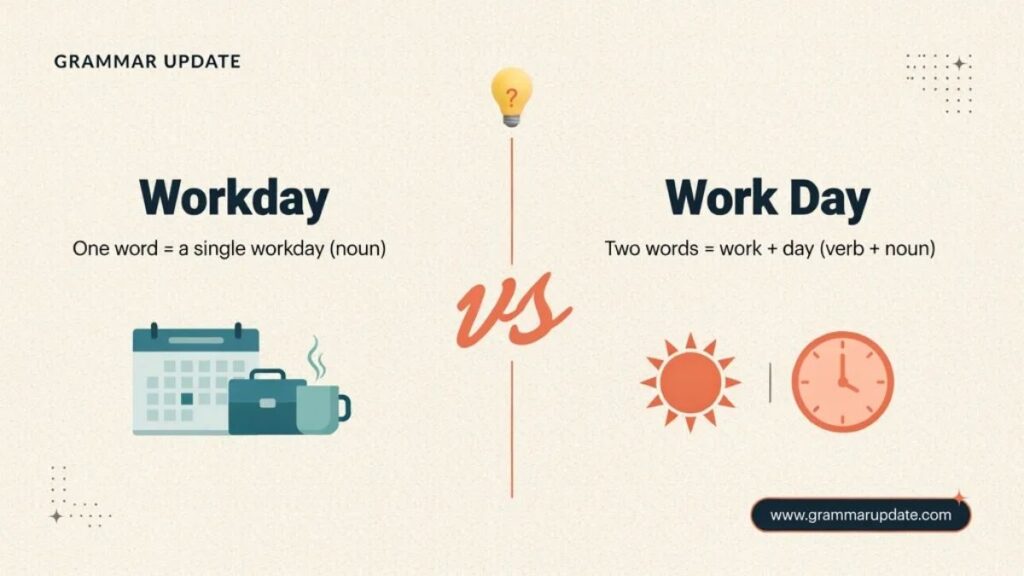
The workday vs work day debate is more common than you might think. Since the difference comes down to a single space, it’s easy to assume both spellings mean exactly the same thing. In reality, they don’t always. Using the wrong form can make your writing look inconsistent, especially in business emails, workplace documents, and academic papers. The good news is that the rule isn’t complicated. Once you understand how each term functions, choosing the correct spelling becomes second nature. This guide clears up the confusion, explains the key differences with practical examples, and highlights the common mistakes to avoid so you can write with confidence every time.
The Short Answer Workday vs Work Day?
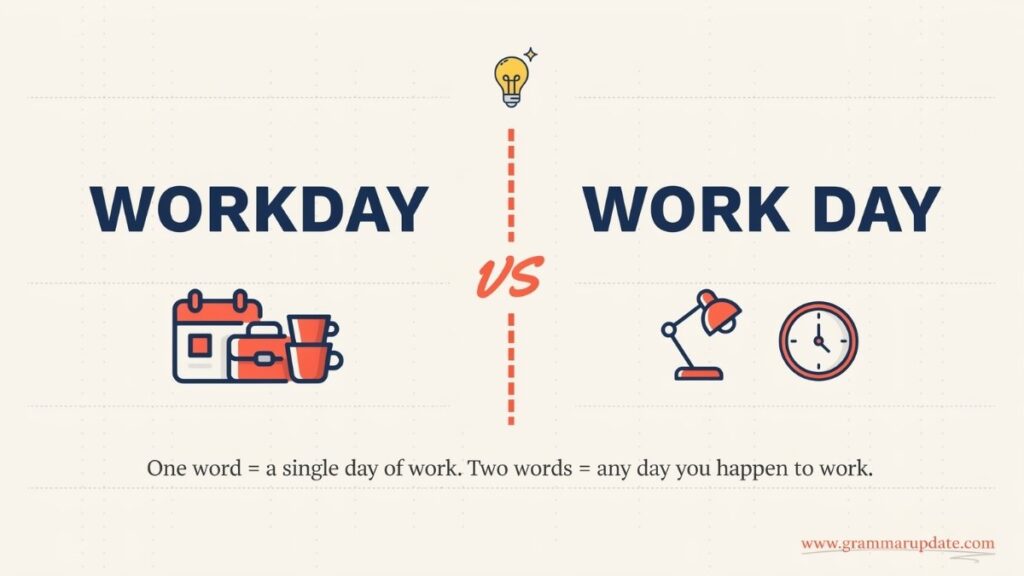
Here’s the rule most writers need.
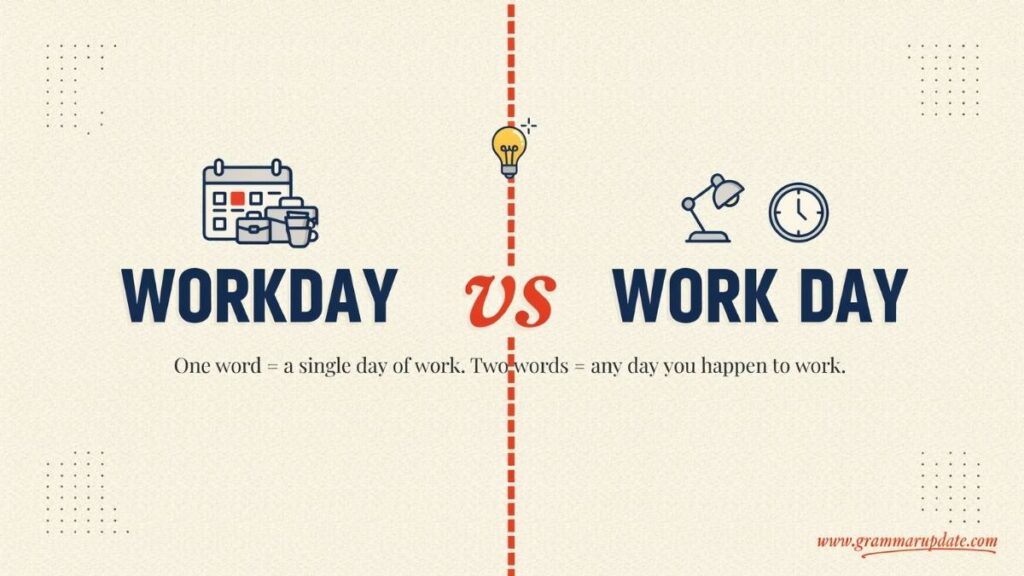
- Use workday when referring to a regular day on which work is performed or to the hours that make up a normal working schedule.
- Use work day when you want to emphasize a particular day’s work rather than the concept of a standard working day.
Most of the time, workday is the preferred spelling.
| If you mean… | Write… | Example |
|---|---|---|
| A business or working day | workday | Monday is a workday. |
| The hours employees normally work | workday | My workday begins at 8:30 a.m. |
| One specific day’s experience at work | work day | Yesterday was a long work day. |
If you’re ever unsure, workday will be correct in the overwhelming majority of professional and business writing.
Quick tip: Think of workday as a single idea. Think of work day as describing one particular day.
Fix common more word mistakes in English
Payed vs Paid Difference and Which One is Correct?
What Does “Workday” Mean?
The workday definition is surprisingly straightforward.
A workday is a day during which work is normally performed or the period of time someone spends working during that day.
For most office employees, a workday might run from 9:00 a.m. to 5:00 p.m. For healthcare workers, factory employees, or emergency responders, the hours may differ. The definition doesn’t depend on the schedule. It simply refers to the day’s normal period of work.
Why “Workday” Is One Word
English constantly combines words that people use together so frequently that they eventually become a single unit.
Linguists call these closed compound words.
For example:
| Open Form | Modern Closed Compound |
|---|---|
| any thing | anything |
| every day (adverb) | everyday (adjective) |
| class room | classroom |
| work week | workweek |
| work day | workday |
This process is completely normal. As usage becomes standardized, dictionaries recognize the compound as a single word.
That’s exactly what happened with workday.
Today, major dictionaries including Merriam-Webster Dictionary and Cambridge Dictionary list workday as the standard spelling.
Workday Meaning in Business
In business writing, workday usually refers to the company’s normal operating schedule rather than the amount of work completed.
For example:
- A project may require five workdays to finish.
- Payroll is processed every workday.
- Customer support responds within one workday.
- Employees follow the same workday schedule.
Notice what’s happening in each sentence. The word refers to a unit of time, much like week, month, or business day. It isn’t describing the workload itself.
That distinction becomes important when calculating project timelines, estimated work days, payroll periods, or service-level agreements.
Workday Meaning in HR
Human resources professionals use workday constantly.
You’ll encounter the term in documents covering:
- Employee schedules
- Workday hours
- Attendance policies
- Paid leave
- Payroll processing
- Overtime calculations
- Flexible work arrangements
For instance:
Employees who work beyond their standard eight-hour workday qualify for overtime pay.
Here, workday refers to the scheduled working period rather than to the tasks completed during that day.
This is also why you’ll often hear phrases such as standard workday, full workday, and typical workday.
Yes. I’d also remove the separate Merriam-Webster section entirely. It doesn’t deserve its own heading because it adds little value and interrupts the article’s flow. Instead, I’d naturally mention dictionary consensus in one or two sentences where it’s relevant.
Fix common more word mistakes in English
Check-in vs Check In Explained and Usage
When Should You Use Work Day?
Although workday is the standard spelling in modern English, work day still has a place. The difference isn’t about right versus wrong. It’s about emphasis.
Use work day when you’re talking about one particular day at work rather than the general idea of a working day. Here, work simply describes the noun day, much like school day or vacation day. The focus shifts from a recurring schedule to an individual experience.
For example:
- Yesterday was a long work day.
- Her first work day at the new company went smoothly.
- Friday turned into an unexpectedly busy work day.
In each sentence, the writer is describing a specific day rather than referring to the standard working schedule.
That said, many professional editors would still choose workday in these examples because the closed compound has become the dominant spelling in modern American English. Unless you have a stylistic reason to separate the words, workday is usually the better choice.
Comparing the Two Forms
The easiest way to remember the difference is to think about what you’re describing.
| If you’re referring to… | Use | Example |
|---|---|---|
| A regular working schedule | workday | My workday starts at 8:30 a.m. |
| The hours someone normally works | workday | We shortened the workday during the summer. |
| A particular day’s experience | work day | It was a stressful work day after the system outage. |
The distinction is subtle. In everyday writing, readers rarely notice it. In professional writing, however, choosing the more conventional form helps your work look polished and consistent.
Fix common more word mistakes in English
Presant vs Present which is Correct Spelling and Usage?
Is Workday One Word or Two?
This is one of the most frequently searched grammar questions, and the answer is straightforward.
In almost every professional, academic, and business context, workday is written as one word.
That’s because workday is a closed compound noun. Over time, English naturally combines words that people use together frequently. The same pattern explains why we now write workplace, workforce, workbook, and workweek as single words.
Consider these examples.
| Compound Type | Example |
|---|---|
| Closed compound | workday, workplace, workbook |
| Open compound | post office, high school |
| Hyphenated compound | editor-in-chief, mother-in-law |
Since workday functions as one complete idea, writing it as a single word is the accepted convention in modern English.
If you’re writing a report, preparing business documentation, or following a professional writing style guide, workday should almost always be your default choice.
Learn how to use confusing more words correctly
Coma vs Comma which is Difference?
What Do AP Style and Other Style Guides Recommend?
If you write for work, school, or publication, style guides matter just as much as grammar rules.
While different guides have their own preferences for punctuation, capitalization, and formatting, they generally agree on one point: follow established dictionary spellings for compound words.
As a result, workday is the preferred spelling in professional writing because it’s widely recognized as a standard closed compound word.
Whether you’re drafting:
- business emails,
- employee handbooks,
- HR documentation,
- academic papers,
- marketing content, or
- news articles,
workday is the form you’ll encounter most often.
Workday vs Work Day AP Style
A common question is whether there’s an official workday or work day AP Style rule.
The AP Stylebook doesn’t include a dedicated entry telling writers to choose one spelling over the other. Instead, AP generally follows established English usage for compound nouns.
That means workday is the form most writers should use.
The same principle applies to many similar words. As compounds become standard in English, style guides adopt the spelling readers recognize most readily.
The goal isn’t simply to follow a rule. It’s to produce writing that feels consistent, natural, and easy to read.
Learn how to use confusing more words correctly
Copyright vs Copywrite Differences, Usage and Mistakes
Common Mistakes Writers Make
Most mistakes happen because the two spellings look almost identical. Once you understand the role each one plays, they’re easy to avoid.
Splitting Workday Without a Reason
The most common mistake is writing work day whenever the sentence refers to a normal business day.
For example:
❌ Our office is open every work day.
✅ Our office is open every workday.
Because the sentence refers to recurring business days, the compound noun is the natural choice.
Treating the Two Forms as Perfect Synonyms
Although you’ll often see both spellings used interchangeably, they aren’t always identical.
Compare these examples.
- Monday is a workday.
- Monday was a difficult work day.
The first identifies Monday as part of the normal work schedule.
The second emphasizes what happened during that particular day.
The difference is subtle, but it’s one experienced editors recognize.
Confusing Workday with Working Day
These expressions overlap, yet they don’t always mean the same thing.
A working day usually refers to a day when work takes place or a business day used for scheduling and deadlines.
A workday, on the other hand, often refers to an employee’s regular schedule or the hours that make up a typical day of work.
For example:
- Delivery takes three working days.
- My workday ends at 5:00 p.m.
The first sentence measures time. The second describes a schedule.
Learn how to use confusing more words correctly
Carat vs Caret vs Karat Which is Differences?
Workday vs Work Day in Business and Professional Writing
In professional writing, consistency matters almost as much as correctness. Whether you’re drafting an employee handbook, writing an HR policy, preparing a project proposal, or sending a company-wide email, readers expect terminology to remain consistent throughout the document.
That’s one reason workday has become the preferred spelling in business communication. It functions as a single concept that represents a scheduled period of work rather than simply combining the words work and day.
You’ll regularly encounter phrases such as:
- standard workday
- eight-hour workday
- full workday
- typical workday
- workday hours
- workday schedule
- employee workday
Each expression refers to a recurring period within a person’s regular work schedule, not to the events of one particular day.
For example:
Employees are expected to complete a standard eight-hour workday unless their employment agreement states otherwise.
The flexible scheduling policy allows staff to adjust their workday while remaining available during core office hours.
Customer support operates throughout the normal workday on business days.
Notice how the word describes time, not workload. That’s why the one-word spelling feels natural in business writing, professional writing, and workplace communication.
Fix common more word mistakes in English
Faring vs Fairing, What’s the Difference?
Why Project Managers Prefer “Workday”
Outside grammar discussions, workday appears frequently in project planning and resource management.
Teams rarely estimate projects in calendar days because weekends, public holidays, and company closures affect delivery dates. Instead, they calculate work based on workdays or business days.
Consider the difference.
| Less Precise | More Precise |
|---|---|
| The project will take five days. | The project will take five workdays. |
| Delivery takes one week. | Delivery requires five workdays. |
| The report will be ready in two days. | The report will be ready in two workdays. |
That small distinction makes project timelines far more accurate.
When discussing project estimation, effort estimation, or time estimation, using workdays helps everyone understand the actual amount of working time involved.
Learn the difference between tricky more English words
Nitch vs Niche Difference and Which Is Correct?
Don’t Confuse Workday with the Work day Software Platform
Grammar discussions often overlap with technology because Workday is also the name of a well-known enterprise software company.
Although the spelling is identical, the meanings are completely different.
- workday (lowercase) refers to a normal day of work.
- Workday (capitalized) refers to the software platform.
For example:
- My workday begins at 8:30 each morning.
- Our company uses Workday to manage payroll and employee records.
The difference comes down to capitalization.
Whenever you’re referring to the software, treat Workday as a proper noun.
You may also encounter related searches such as:
- Workday login
- Workday employee login
- Workday HR
- Workday HCM
- Workday ERP
- Workday payroll
- Workday application
These phrases relate to the software platform rather than the grammar question. If your article focuses on English usage, mentioning the distinction briefly is enough to prevent confusion.
Learn the difference between tricky more English words
Clutz vs Klutz Which Spelling Is Correct in English?
Similar Compound Words That Follow the Same Pattern
Once you understand why workday is written as one word, many other spelling questions become easier to answer.
English contains hundreds of compound words, and they generally fall into three categories.
| Type | Description | Examples |
|---|---|---|
| Closed compound | Written as one word | workday, workplace, notebook, workweek |
| Open compound | Written as two words | post office, high school, coffee table |
| Hyphenated compound | Joined with a hyphen | editor-in-chief, mother-in-law |
Many closed compounds began life as two separate words. As people used them more frequently, they gradually merged into a single word.
That’s exactly what happened with workday.
Understanding this pattern helps answer questions like is workday one word or two without memorizing individual rules.
Everyday vs. Every Day
This pair confuses writers for the same reason.
| Word | Function | Example |
|---|---|---|
| everyday | Adjective | These are my everyday shoes. |
| every day | Adverbial phrase | I walk to work every day. |
Although only one space separates the spellings, the meanings are completely different.
Work Week or Workweek?
Another common question is is workweek one word or two.
Just like workday, the preferred modern spelling is workweek.
A workweek refers to the number of days or hours an employee is expected to work during a week.
For example:
- Our company follows a four-day workweek.
- The standard workweek consists of forty hours.
- Her workweek runs from Tuesday through Saturday.
Using the one-word spelling keeps your writing consistent with current language conventions.
Workday vs Working Day
Although these expressions overlap, they aren’t always interchangeable.
A working day usually refers to a day when business is conducted. You’ll often see the term in shipping policies, contracts, and legal documents.
For example:
Orders ship within three working days.
Your application will be processed within five working days.
A workday, by contrast, usually refers to a person’s scheduled working hours or a normal day of employment.
For example:
My workday starts at 9:00 a.m.
The standard workday lasts eight hours.
The distinction is subtle, but choosing the right term improves clarity especially in formal writing.
Learn the difference between tricky more English words
Manor vs Manner Which One Is Correct?
Workday vs Weekday They are Not the Same
Another misconception is that workday and weekday mean the same thing.
They often overlap, but they describe different ideas.
A weekday is simply a day of the week from Monday through Friday.
A workday is any day a person is scheduled to work.
For someone with a traditional office job, Monday through Friday may be both weekdays and workdays.
For someone who works rotating shifts, however, the schedule may look very different.
| Schedule | Weekday | Workday |
|---|---|---|
| Office employee | Monday–Friday | Monday–Friday |
| Retail employee | Monday–Friday | Tuesday–Saturday |
| Hospital nurse | Monday–Friday | Varies each week |
That’s why workday depends on a person’s work schedule, while weekday depends on the calendar.
Learn the difference between tricky more English words
Totaled vs Totalled Which Spelling Is Correct?
Practice Exercise workday vs work day
Complete each sentence with the correct form: workday vs work day.
- My __________ starts at 8:30 every morning.
- Yesterday was a long __________ after three back-to-back meetings.
- The project should take five __________ to complete.
- We shortened the __________ during the summer months.
- Her first __________ at the new company went smoothly.
- Customer support responds within one __________.
- It turned into a stressful __________ because the network crashed.
- Every __________ begins with a team briefing.
- Monday is the first __________ of the week for most office employees.
- After a demanding __________, everyone was ready to head home.
- Employees are expected to complete a full __________ unless approved for flexible hours.
- The repair will require two additional __________.
- My __________ usually ends around 5:00 p.m.
- Friday was the busiest __________ we’ve had all month.
- Most employees follow the same __________ schedule.
- We estimate delivery within three __________.
- Her final __________ before retirement was filled with celebrations.
- The standard __________ lasts eight hours.
- It wasn’t an ordinary __________ because the entire team worked remotely.
- Every __________ presents a new challenge.
- The manager approved a shorter __________ for employees during the holiday season.
- Their first __________ included orientation and training.
- The contract specifies a five-__________ turnaround for document processing.
- My __________ becomes much quieter after lunch.
- It was the most productive __________ of the entire project.
Answers
- workday
- work day
- workdays
- workday
- work day
- workday
- work day
- workday
- workday
- work day
- workday
- workdays
- workday
- work day
- workday
- workdays
- work day
- workday
- work day
- workday
- workday
- work day
- workday
- workday
- work day
Here’s a trusted source for clear word meanings:
FAQs
Is workday one word or two?
Workday is typically written as one word. It’s a closed compound noun that refers to a regular day of work or the hours someone normally works. While work day is also grammatically correct, it’s less common and usually emphasizes a specific day’s work rather than a recurring work schedule.
What is the difference between workday Vs work day?
The difference lies in emphasis.
- Workday refers to a regular working day or an employee’s normal working hours.
- Work day emphasizes a particular day’s work or experience.
For example:
- My workday starts at 8:00 a.m.
- Yesterday was a long work day.
In most business and professional writing, workday is the preferred spelling.
Is work day grammatically correct?
Yes. Work day is grammatically correct. However, modern English generally favors workday as the standard spelling. Unless you’re intentionally highlighting a specific day’s work, the one-word form is usually the better choice.
When should I use workday?
Use workday when referring to:
- A regular day of work
- Standard working hours
- An employee’s work schedule
- Business operations
- Project timelines measured in working days
For example:
- The office is open every workday.
- The project will take five workdays to complete.
When should I use work day?
Use work day when you want to emphasize one particular day at work instead of a recurring schedule.
For example:
- Her first work day was both exciting and challenging.
- It turned into a very productive work day despite several unexpected meetings.
Although this usage is acceptable, many editors would still choose workday unless the context specifically calls for the distinction.
Is workday a compound word?
Yes. Workday is a closed compound word, meaning two separate words have combined over time to form a single word with its own meaning. Other examples include workplace, workforce, and workweek.
What does workday mean?
A workday is a day when work is normally performed or the period of time someone spends working during that day. It can refer to a standard business day, an employee’s scheduled hours, or a typical day at work.
How do you use workday in a sentence?
Here are a few examples:
- My workday begins at 8:30 every morning.
- The repair should take three workdays.
- She shortened her workday to attend a medical appointment.
Is workdays the correct plural form?
Yes. Workdays is the correct plural of workday.
For example:
- The software update will be completed within two workdays.
- Employees work five workdays each week.
Is workweek one word or two?
Workweek is generally written as one word. Like workday, it has become a standard closed compound noun in modern English and is the preferred spelling in professional writing.
What does workweek mean?
A workweek is the total number of days or hours an employee is expected to work during one week. A standard workweek is often 40 hours spread across five days, although schedules vary by employer and industry.
What’s the difference between workday and working day?
Although they’re closely related, the terms aren’t always interchangeable.
A workday usually refers to an employee’s scheduled working hours or a normal day of work.
A working day refers to any day when a business or organization is open for operations. That’s why you’ll often see working day used in contracts, shipping policies, and legal documents.
For example:
- Processing takes five working days.
- My workday ends at 5:00 p.m.
What’s the difference between workday and weekday?
A weekday is a calendar day from Monday through Friday.
A workday is any day a person is scheduled to work. Depending on the job, a workday may fall on a weekend.
For example, a retail employee who works on Saturday has a workday, even though Saturday isn’t a weekday.
Does workday have a hyphen?
No. Workday is written as one word without a hyphen. The hyphenated form work-day is not the standard spelling in modern English.
Is workday the preferred spelling in professional writing?
Yes. Workday is the preferred spelling in business writing, workplace communication, HR documentation, academic writing, and most professional publications. Using the one-word form keeps your writing consistent with modern English conventions.
Is workweek the preferred spelling in professional writing?
Yes. Workweek is the standard spelling in professional writing. Although work week may occasionally appear, the one-word form is far more common and is the preferred choice for reports, policies, contracts, and other formal documents.
Learn the difference between tricky more English words
Abley vs Ably Which Spelling Is Correct in English?
Conclusion
The workday vs work day question may seem like a minor grammar detail, but as you’ve seen, one small space can change both meaning and style. While both forms are correct in certain contexts, workday is the standard spelling for most professional, academic, and everyday writing. Work day is better reserved for the rare occasions when you want to emphasize a specific day’s work or experience.
The easiest way to avoid mistakes is to think about what you’re describing. If you’re referring to a regular working day, business hours, or an employee’s schedule, workday is almost always the right choice. If your focus is on what happened during one particular day at work, work day can add a subtle layer of emphasis.
Grammar doesn’t have to be complicated. Sometimes the biggest writing mistakes come from the smallest detailsand in this case, it’s just one little space. Now that you know the difference, you can leave the confusion behind and let your workday focus on writing with confidence instead of second-guessing your spelling.

Jhon AJS, the creative mind behind Grammar Update, is an experienced blogger passionate about simplifying English grammar. He focuses on explaining confusing word vs word differences, grammar rules, punctuation, and sentence structure in a clear and practical way. Through easy to understand guides and examples, Jhon helps readers improve their writing and communicate with confidence. With years of blogging experience, he continues to share helpful insights that make learning grammar simple, useful, and accessible for everyone.