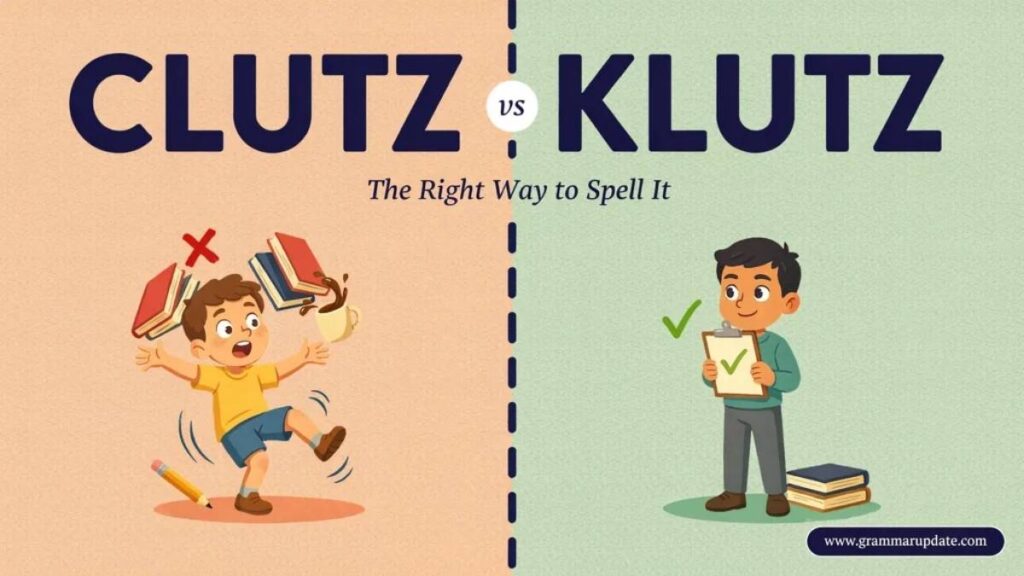
The Clutz vs Klutz debate confuses many English learners, students, writers, and even native speakers because both spellings sound exactly alike. It’s easy to assume they’re interchangeable, but only one is correct. If you’ve ever paused while typing clutz and wondered whether your spellchecker was judging you, you’re certainly not alone! Fortunately, this is one spelling mistake that’s easy to fix. In this guide, you’ll discover the correct spelling, its meaning, pronunciation, origin, and proper usage. By the end, you’ll confidently know when to use klutz, avoid common spelling mistakes, and write with greater accuracy in every situation.
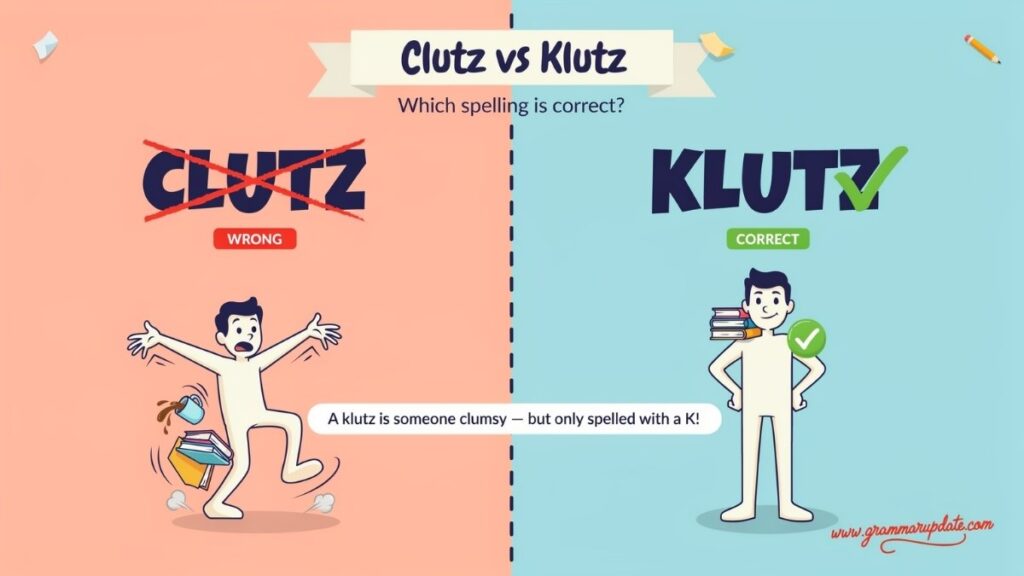
Clutz vs Klutz Which Spelling Is Correct?
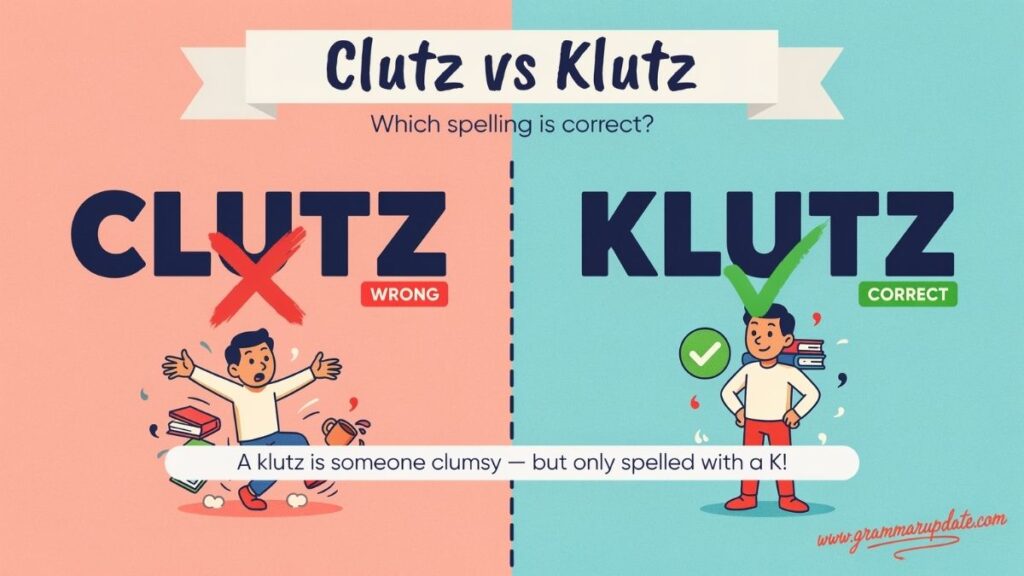
If you want the short answer, here it is:
Klutz is the correct spelling. Clutz is incorrect.
Every major dictionary, including Merriam-Webster, Cambridge Dictionary, Oxford English Dictionary, and Collins Dictionary, recognizes klutz as the standard English spelling.
The spelling clutz is not accepted as the standard form. It appears mainly because people spell the word the way it sounds.
Although both spellings are pronounced the same way, pronunciation does not change the spelling. Whenever you’re writing in English, always use klutz.
Quick Comparison
| Feature | Klutz | Clutz |
|---|---|---|
| Correct English spelling | Yes | No |
| Listed in major dictionaries | Yes | No |
| Standard English word | Yes | No |
| Appropriate for professional writing | Yes | No |
| Accepted in academic writing | Yes | No |
| Common spelling mistake | No | Yes |
The rule couldn’t be simpler:
If you’re writing, always spell it “klutz.”
What Does Klutz Mean?
Understanding the klutz meaning makes it easier to use the word correctly.
A klutz is an informal noun that describes someone who is naturally clumsy, awkward, or accident-prone. A klutz often drops things, bumps into furniture, trips over small objects, or accidentally breaks items because of poor coordination.
The word usually describes physical clumsiness rather than carelessness or lack of intelligence.
In everyday conversations, people often use klutz in a humorous or affectionate way rather than as a serious insult.
Klutz Definition
Klutz (noun): A person who frequently has minor accidents because they are physically awkward or poorly coordinated.
Most dictionaries define klutz as an informal word for a clumsy person.
Klutz Meaning in Simple Words
Simply put, a klutz is someone who has a habit of doing things like:
- Dropping their keys.
- Knocking over a drink.
- Walking into a doorframe.
- Tripping on a flat surface.
- Breaking something by accident.
Everyone has clumsy moments from time to time. A klutz is simply someone who seems to have those moments more often than most people.
Examples
- Emma laughed and called herself a klutz after dropping her groceries.
- Ben is such a klutz that he somehow spills coffee almost every morning.
Learn how to use confusing more words correctly
Mobil vs Mobile Which Is Correct and Usage?
Is Klutz an Insult?
Not usually.
In most situations, klutz is a lighthearted and humorous word. Friends, family members, and coworkers often use it after someone makes a harmless mistake or has a funny accident.
For example, someone who accidentally drops their phone might smile and say:
“I’m such a klutz today.”
Here, the speaker is joking about themselves, so the word sounds friendly rather than offensive.
However, context matters. Repeatedly calling someone a klutz to embarrass or criticize them could be hurtful. Like many informal expressions, the meaning depends on the relationship between the speakers and the tone of the conversation.
When Should You Use the Word Klutz?
Because klutz is an informal noun, it works best in casual conversations and informal writing.
It is appropriate when:
- Talking with friends or family.
- Sharing funny personal experiences.
- Describing harmless accidents.
- Writing humorous stories.
- Referring to yourself after making a clumsy mistake.
It is generally better to avoid using klutz in academic essays, legal documents, formal reports, or professional evaluations unless the context specifically calls for informal language.
Examples
- After dropping her shopping bags, Mia laughed and said, “I’m such a klutz.”
- Everyone smiled when Jake tripped over absolutely nothing and admitted he was a klutz.
Fix common more word mistakes in English
Straight vs Strait Difference and Which Is Correct and Usage?
Is Clutz a Real Word?
One of the most common questions people ask is:
“Is it clutz or klutz?”
The answer is simple.
Klutz is the only correct spelling in Standard English.
The spelling clutz is generally treated as a misspelling rather than a separate English word. Although it appears in online searches and informal writing, it is not recognized as the standard spelling by major English dictionaries.
If you type clutz into many grammar or spelling tools, they will usually suggest replacing it with klutz.
Fix common more word mistakes in English
Payed vs Paid Difference and Which One is Correct?
Why Do People Spell It “Clutz”?
Several factors explain why this mistake is so common.
The Pronunciation Is Identical
Both clutz and klutz are pronounced exactly the same way.
Because English speakers often spell unfamiliar words according to their pronunciation, many people naturally replace the K with a C.
Words Beginning with “Kl” Are Uncommon
The letter combination “kl” appears at the beginning of relatively few English words. Since words beginning with C are much more common, writers often assume the spelling should begin with C instead.
Online Misspellings Reinforce the Error
Search engines, forums, and social media contain thousands of examples of the incorrect spelling clutz.
Seeing the mistake repeatedly can make it seem correct, but popularity does not make a spelling standard. Dictionaries, grammar experts, and style guides continue to recognize only klutz.
Examples
Incorrect: She’s such a clutz whenever she carries glass dishes.
Correct: She’s such a klutz whenever she carries glass dishes.
Incorrect: My brother is a total clutz.
Correct: My brother is a total klutz.
Clutz vs Klutz Side-by-Side Comparison
Comparing the two spellings makes the difference easy to remember.
| Feature | Klutz | Clutz |
|---|---|---|
| Correct spelling | Yes | No |
| Listed in major dictionaries | Yes | No |
| Standard English word | Yes | No |
| Used in professional writing | Yes | No |
| Accepted in academic writing | Yes | No |
| Refers to a clumsy or awkward person | Yes | No |
| Common misspelling | No | Yes |
The comparison highlights one important rule:
No matter how you pronounce the word, always spell it “klutz.” It is the only spelling accepted in Standard English. Using klutz instead of clutz makes your writing more accurate, professional, and credible.
Why Do People Confuse Clutz vs Klutz?
The confusion between clutz and klutz is completely understandable. Since both words have the same pronunciation, many people assume they are simply two acceptable spellings of the same word. However, that assumption is incorrect.
In Standard English, klutz is the only correct spelling. The spelling clutz is a common mistake that usually happens because people write the word exactly as they hear it.
This confusion affects native English speakers, students, professional writers, and English learners alike. Fortunately, once you understand why the mistake happens, it becomes much easier to remember the correct spelling.
The Pronunciation Is Identical
The most common reason people confuse clutz and klutz is that they sound exactly alike.
Both words are pronounced /klʌts/, so there is no pronunciation clue to tell you which spelling is correct. As a result, many people rely on phonetic spelling and write clutz because it looks more familiar.
English is full of words whose spelling does not perfectly match their pronunciation, especially words borrowed from other languages. Klutz is one of those words.
Examples
Incorrect: He’s such a clutz that he drops his phone almost every day.
Correct: He’s such a klutz that he drops his phone almost every day.
Incorrect: Everyone laughed when the clutz spilled juice on the table.
Correct: Everyone laughed when the klutz spilled juice on the table.
The Letter Combination “Kl” Looks Unusual
Another reason for the confusion is that words beginning with “kl” are relatively rare in English.
Most familiar English words that begin with the “kl” sound are actually spelled with “cl,” including:
- class
- clean
- clear
- climb
- clerk
- clock
Because these spellings are much more common, many writers automatically replace the K with a C when writing klutz.
However, klutz follows different spelling rules because it did not originate in English.
The Word Comes from Another Language
Unlike most everyday English vocabulary, klutz is a Yiddish loanword.
When English borrowed the word, it kept its original spelling with the letter K. Although the spelling may look unusual compared with native English words, it reflects the word’s historical origin.
Borrowed words often preserve their original spelling even when it seems unfamiliar. This is why changing klutz to clutz creates a spelling mistake.
The Internet Reinforces the Mistake
Another reason the confusion continues is that the incorrect spelling clutz appears thousands of times online.
People often see the misspelling on:
- Blogs
- Social media posts
- Discussion forums
- Comments
- User-generated websites
When readers encounter the same mistake repeatedly, they may assume it is an accepted alternative.
However, popularity does not make a spelling correct. Major dictionaries, grammar guides, editors, and style manuals all recognize klutz as the only standard spelling.
Fix common more word mistakes in English
Presant vs Present which is Correct Spelling and Usage?
The Origin and History of Klutz
Learning a word’s history often makes it much easier to remember both its spelling and its meaning.
Klutz Is a Yiddish Loanword
The word klutz entered English from Yiddish, a language historically spoken by Ashkenazi Jewish communities in Central and Eastern Europe.
It comes from the Yiddish word klots, meaning “wooden block,” “log,” or “chunk of wood.”
Originally, the word referred to something stiff, heavy, or awkward. Over time, it became a humorous way to describe a person who moved awkwardly or lacked physical coordination.
As the word became popular in American English, it kept its original spelling with the letter K.
How the Meaning Changed
Like many borrowed words, klutz developed a broader meaning after becoming part of everyday English.
Today, it refers to someone who is:
- Clumsy
- Awkward
- Accident-prone
- Uncoordinated
- Frequently dropping or breaking things
Although the original meaning has changed over time, the spelling has remained exactly the same.
Why the Original Spelling Matters
Understanding the word’s origin helps explain why klutz is spelled differently from many English words.
Because it is borrowed from Yiddish, the spelling reflects its linguistic history rather than modern English spelling patterns.
A simple memory tip is:
If the word came from Yiddish, keep the “K.” Always write “klutz,” never “clutz.”
Learn the difference between tricky more English words
Comment vs Coment Correct Spelling and Usage
Klutz Pronunciation
Many people search for Klutz pronunciation because they wonder whether pronunciation affects spelling.
It doesn’t.
Whether you’re speaking American English, British English, or another variety of English, the spelling is always klutz.
Klutz Pronunciation in American English
In American English, klutz is pronounced:
IPA: /klʌts/
It rhymes with common one-syllable words such as:
- cuts
- nuts
- huts
- struts
The pronunciation is straightforward, with a short vowel sound followed by -ts.
Klutz Pronunciation in British English
British English uses almost the same pronunciation:
IPA: /klʌts/
Although regional accents may sound slightly different, the pronunciation remains virtually identical.
Does Pronunciation Change the Spelling?
No.
Many English words have spellings that cannot be guessed from pronunciation alone, particularly words borrowed from other languages.
Klutz is one of them.
Even if you pronounce the word exactly like clutz, you should always write klutz.
Examples
- You pronounce it “kluts,” but you spell it klutz.
- The pronunciation stays the same, but the spelling never changes.
Learn the difference between tricky more English words
Coma vs Comma which is Difference?
How to Use Klutz Correctly
Knowing the correct spelling is important, but knowing how to use the word naturally is just as valuable.
A klutz is an informal noun used to describe someone who is physically clumsy or frequently has small accidents.
The word usually refers to harmless behavior rather than serious incompetence.
Klutz in Everyday Conversation
In everyday English, klutz is often used affectionately or humorously.
People may call themselves a klutz after:
- Dropping their phone.
- Spilling coffee.
- Tripping over a step.
- Knocking over a glass.
- Walking into a doorframe.
- Breaking something by accident.
The word usually creates a friendly, humorous tone rather than sounding offensive.
Examples
- I’m such a klutz I dropped my keys three times today.
- Ryan spilled his drink again. He’s such a klutz!
Klutz in Informal Writing
Because klutz is informal, it appears naturally in:
- Blog posts
- Novels
- Humorous articles
- Social media posts
- Personal emails
- Online conversations
Writers often use the word to create relatable and entertaining characters.
Examples
- The novel’s main character is a lovable klutz whose accidents lead to hilarious situations.
- I always feel like a klutz when I try carrying every grocery bag in one trip.
When Should You Avoid the Word?
Although klutz is a perfectly correct English word, it is not suitable for every situation.
It is generally better to avoid it in:
- Academic essays
- Scientific research
- Medical reports
- Legal documents
- Formal business writing
In these contexts, more neutral words such as clumsy, awkward, uncoordinated, or physically unsteady are usually more appropriate.
Learn how to use confusing more words correctly
Copyright vs Copywrite Differences, Usage and Mistakes
Klutz in a Sentence
One of the best ways to remember a new word is to see it used in real sentences.
Everyday Examples
- Sarah is such a klutz that she drops her keys almost every morning.
- I felt like a klutz after spilling coffee on my laptop before an important meeting.
Humorous Examples
- The birthday cake survived the trip, but the klutz carrying it almost didn’t.
- He’s such a klutz that even automatic doors seem worried when they see him coming.
Professional and Creative Writing Examples
- The author created a charming klutz whose awkward mistakes made readers laugh throughout the story.
- Although she often described herself as a klutz, years of practice helped her become a confident gymnast.
These examples show that klutz is most commonly used in a friendly, humorous, and informal way. It describes someone who is naturally clumsy or accident-prone without suggesting they are unintelligent or incapable. Used appropriately, it adds personality, humor, and vivid description to everyday English.
Learn the difference between tricky more English words
Nitch vs Niche Difference and Which Is Correct?
Klutz Synonyms and Related Words
Although klutz is a widely used English word, it isn’t always the best choice in every situation. Depending on the context, several other words can describe someone who is clumsy, awkward, or prone to accidents.
Each synonym carries a slightly different meaning and tone. Understanding these differences helps you choose the most appropriate word for your writing or conversation.
Common Synonyms for Klutz
| Word | Meaning | Typical Use |
|---|---|---|
| Clumsy | Lacking coordination or grace | General description |
| Awkward | Physically or socially uncoordinated | Everyday English |
| Butterfingers | Someone who frequently drops things | Humorous and informal |
| Bumbler | A person who often makes careless mistakes | Informal |
| Goof | Someone who behaves in a silly or foolish way | Casual conversation |
| Oaf | A clumsy or awkward person | Stronger, less friendly |
| Uncoordinated | Lacking physical control or balance | Formal writing |
| Accident-prone | Frequently involved in minor accidents | Neutral description |
Although these words share similar meanings, klutz usually refers to someone whose physical clumsiness leads to amusing everyday accidents rather than serious problems.
Klutz vs. Clumsy
People often use klutz and clumsy interchangeably, but they are not exactly the same.
A clumsy person simply lacks coordination or balance. A klutz, however, is someone whose clumsiness regularly results in funny or harmless mishaps.
For example, a beginner learning to ice skate may appear clumsy because they’re still developing their skills. Someone who trips over a flat sidewalk, spills coffee on their shirt, and drops their phone on the same day might jokingly be called a klutz.
In other words, every klutz is clumsy, but not every clumsy person is necessarily a klutz.
Learn how to use confusing more words correctly
To Bad vs Too Bad Which is correct and usage?
What Is the Plural of Klutz?
Another common question is:
What is the plural of klutz?
The answer is straightforward.
The plural form of klutz is klutzes.
Like many English nouns ending in -z, the word forms its plural by adding -es.
Examples of Klutzes
- The comedy follows three lovable klutzes who accidentally solve a mystery.
- Our hiking group included a few klutzes who kept stumbling over tree roots.
- Even experienced athletes can have moments that make them feel like klutzes.
Singular and Plural Forms
| Form | Example |
|---|---|
| Singular: klutz | He’s a complete klutz. |
| Plural: klutzes | They are all klutzes. |
Avoid incorrect forms such as:
- klutzs
- clutzes
- klutz’s (unless showing possession)
The standard plural is always klutzes.
Learn how to use confusing more words correctly
Requester vs Requestor Which Is Correct and usage?
How to Remember the Correct Spelling of Klutz
Since clutz looks believable, many people continue making the same spelling mistake.
Fortunately, a few simple memory tricks can help you remember the correct spelling for good.
Remember the Word’s Origin
One of the easiest ways to remember the spelling is to recall that klutz comes from Yiddish.
Because English borrowed the word from another language, it kept the original spelling with the letter K.
If you remember its origin, you’ll be much less likely to replace the K with a C.
Think of the Phrase “Keep the K”
A simple memory trick is:
Keep the K in klutz.
This short phrase reminds you that the word always begins with K, regardless of how it’s pronounced.
Read the Word Frequently
The more often you see the correct spelling, the more familiar it becomes.
Reading books, newspapers, magazines, and reliable websites naturally reinforces the spelling klutz, making the incorrect form clutz look unusual over time.
Practice Writing It
Spelling improves through repetition.
Writing the word correctly in sentences helps build long-term memory much faster than simply reading it.
For example:
- I’m such a klutz when I try carrying too many things at once.
- Everyone laughed because the lovable klutz accidentally wore mismatched shoes.
Learn how to use confusing more words correctly
Unorganized vs Disorganized Difference and Use?
Common Mistakes to Avoid Clutz vs Klutz
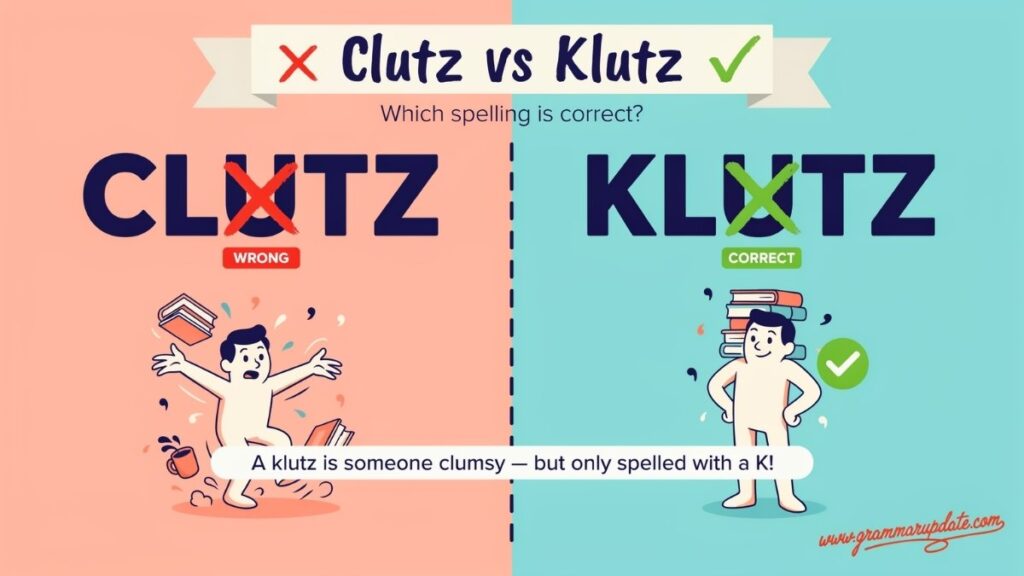
Even experienced writers occasionally misuse klutz. Knowing the most common mistakes can help you avoid them.
Writing Clutz Instead of Klutz
This is by far the most common mistake.
Because the pronunciation doesn’t reveal the spelling, many people automatically write clutz.
Incorrect: She’s such a clutz.
Correct: She’s such a klutz.
Whenever you write the word, remember that klutz is the only spelling recognized by major English dictionaries.
Assuming Both Spellings Are Correct
Some words in English have accepted spelling variations, such as gray/grey or advisor/adviser.
Klutz is not one of them.
Unlike those examples, clutz is not an accepted alternative spelling. Only klutz is correct.
Using Klutz in Formal Writing
Although klutz is a legitimate English word, it remains informal.
In academic papers, business reports, legal documents, or scientific writing, more neutral words are usually better choices.
Depending on the context, consider using:
- clumsy
- awkward
- uncoordinated
- physically unsteady
Choosing language that matches the level of formality makes your writing more professional.
Confusing Physical Clumsiness with Intelligence
Another misconception is that klutz refers to someone’s intelligence.
It doesn’t.
A klutz is simply someone who is physically awkward or accident-prone. A person can be highly intelligent, talented, and successful while still being a klutz.
The word describes coordination not ability, knowledge, or character.
Fix common more word mistakes in English
Scoup vs Scoop Differences and Usage
Clutz vs Klutz in Professional and Academic Writing
Correct spelling matters, especially in professional and academic settings.
Using clutz instead of klutz may seem like a small mistake, but it can affect how readers judge your writing. Teachers, editors, employers, and clients often notice spelling errors because they reflect attention to detail.
Whether you’re writing an essay, blog post, business report, article, or professional email, using the correct spelling demonstrates accuracy and credibility.
Although klutz is informal, spelling it correctly shows that you understand standard English conventions.
Quick Recap Clutz vs Klutz
Before moving on, here’s a quick summary of the most important points.
| Question | Answer |
|---|---|
| Which spelling is correct? | Klutz |
| Is clutz correct? | No. It is a common misspelling. |
| What does klutz mean? | A clumsy or accident-prone person. |
| Is klutz an informal word? | Yes. |
| Where did the word come from? | Yiddish. |
| What is the plural of klutz? | Klutzes |
| Should I use klutz in formal writing? | Only if an informal tone is appropriate. |
The rule is easy to remember:
Always spell the word “klutz.” Although clutz sounds identical, it is not the correct spelling. Choosing klutz ensures your writing follows standard English, matches dictionary usage, and communicates clearly and professionally.
Learn the difference between tricky more English words
Accross vs Across, Which Is the Correct Spelling?
Practice Session Clutz vs Klutz
Choose the correct word to complete each sentence.
- Sarah is such a ________ that she dropped her phone twice today.
- The correct spelling is ________, not clutz.
- Jake laughed after calling himself a ________ for spilling his coffee.
- A ________ often has harmless accidents.
- The word ________ comes from Yiddish.
- Emma felt like a ________ after tripping over the doorstep.
- Only ________ is recognized by major English dictionaries.
- My brother is a complete ________ whenever he carries glass dishes.
- The plural of klutz is ________.
- A ________ is someone who is clumsy or awkward.
- Don’t write “clutz”; write ________ instead.
- Even skilled athletes can feel like a ________ sometimes.
- The opposite of a klutz is someone who is ________.
- The word klutz is commonly used in ________ English.
- A klutz often ________ things by accident.
- Teachers expect students to use the correct ________ of words.
- The word klutz is a ________, not an adjective.
- The adjective formed from klutz is ________.
- The word klutz is pronounced to rhyme with ________.
- The spelling ________ is considered incorrect in Standard English.
- A ________ person moves smoothly and rarely has accidents.
- Klutz is more common in ________ English than British English.
- Someone who frequently trips or drops things may be called a ________.
- Knowing the difference between clutz and klutz improves your ________.
- Remember the ________ in klutz to avoid this common spelling mistake.
Answers
- klutz
- klutz
- klutz
- klutz
- klutz
- klutz
- klutz
- klutz
- klutzes
- klutz
- klutz
- klutz
- graceful
- informal
- drops
- spelling
- noun
- clutzy
- cuts
- clutz
- graceful
- American
- klutz
- spelling
- K
Here’s a trusted source for clear word meanings:
FAQs
What Is a Klutz?
A klutz is a person who is naturally clumsy or accident-prone. The word describes someone who frequently drops things, trips, bumps into objects, or has small, harmless accidents. It is commonly used in informal English and usually has a humorous tone.
Is Klutz a Derogatory Word?
Not usually. Klutz is generally a lighthearted, informal word rather than a harsh insult. However, repeatedly calling someone a klutz in a mocking or hurtful way can be considered rude, depending on the context and tone.
Is Clutzy a Real Word?
Yes. Clutzy is an informal adjective that means clumsy or behaving like a klutz. While it is widely used in everyday conversation, it is more casual than words such as clumsy or awkward.
Is Klutz a Yiddish Word?
Yes. Klutz comes from Yiddish and is derived from the word klots, meaning “wooden block” or “log.” The word was later adopted into English and now refers to someone who is physically clumsy or awkward.
What Is the Opposite of a Klutz?
The opposite of a klutz is someone who is graceful, coordinated, agile, nimble, or skillful. These words describe people who move confidently and rarely have accidental mishaps.
How Do You Pronounce Klutz?
klutz (kluts)
Klutz is pronounced /klʌts/. It rhymes with words such as cuts, nuts, and huts.
Do British People Use the Word Klutz?
Yes. Klutz is understood in British English, although it is used less frequently than in American English. British speakers may also use words such as clumsy person, bungler, or butterfingers, depending on the situation.
Learn how to use confusing more words correctly
Nonresponsive vs Unresponsive Differences and Usage
Conclusion
The Clutz vs Klutz confusion is common because both spellings sound identical, making the mistake easy to understand. However, only klutz is the correct spelling recognized in Standard English, while clutz is simply a misspelling. Knowing the difference helps you write with greater accuracy, confidence, and professionalism in academic, business, and everyday communication. And here’s one final tip: it’s perfectly okay to be a klutz who occasionally drops their phone or spills their coffee but don’t be a clutz who misspells the word! Remember the K, trust the dictionary, and you’ll never stumble over this spelling again, even if you occasionally stumble over your own feet.

Jhon AJS, the creative mind behind Grammar Update, is an experienced blogger passionate about simplifying English grammar. He focuses on explaining confusing word vs word differences, grammar rules, punctuation, and sentence structure in a clear and practical way. Through easy to understand guides and examples, Jhon helps readers improve their writing and communicate with confidence. With years of blogging experience, he continues to share helpful insights that make learning grammar simple, useful, and accessible for everyone.