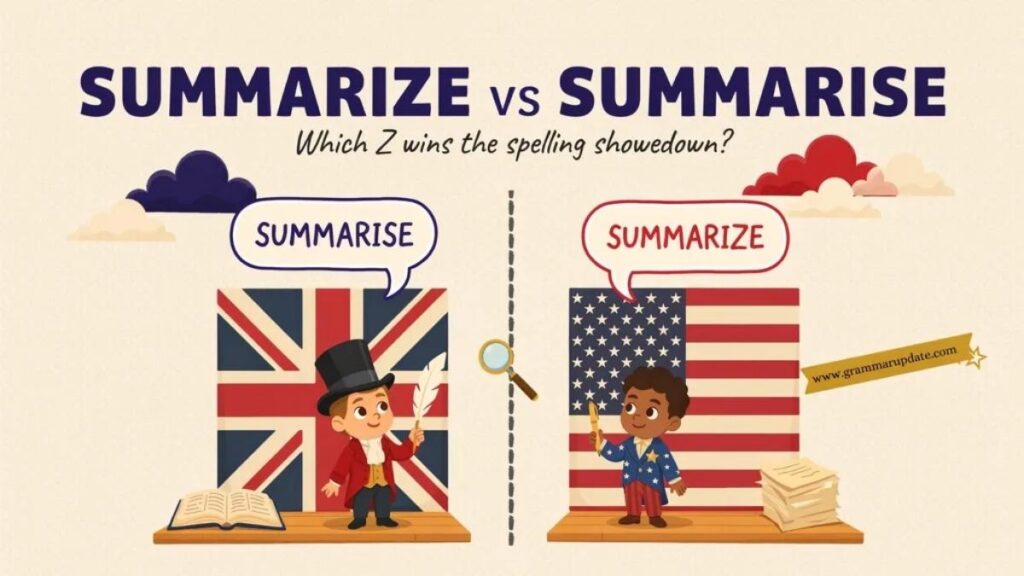
The discussion around summarize vs summarise has confused writers for years, and even careful editors sometimes pause mid-sentence over it. One letter changes, yet it feels like the meaning might secretly change too. Is it a strict grammar rule, a regional quirk, or just English being unnecessarily tricky again? The truth is far simpler, and far less dramatic. Both forms are correct, and the difference depends on where your reader lives. Still, mixing them in the same document can quietly make writing look inconsistent. This guide clears the confusion, fixes common mistakes, and helps you confidently use summarize vs summarise without second-guessing yourself.
Summarize vs Summarise Quick Answer
If you’re looking for a straightforward answer, here it is:
Summarize is the preferred spelling in American English, while summarise is the preferred spelling in British English and much of the English-speaking world outside the United States.
Both words mean exactly the same thing. Neither spelling is more correct than the other. The only difference is regional preference.
Summarize vs Summarise at a Glance
| Feature | Summarize | Summarise |
|---|---|---|
| Meaning | Express the main points briefly | Express the main points briefly |
| Pronunciation | Same | Same |
| Part of Speech | Verb | Verb |
| Primary Usage | United States | United Kingdom and many Commonwealth countries |
| Grammar | Correct | Correct |
| Academic Use | Common in US institutions | Common in UK institutions |
| Professional Use | Standard in US English | Standard in UK English |
The simplest rule to remember is this:
Write summarize for a US audience and summarise for a UK audience.
What Does Summarize Mean?
Understanding the summarize meaning makes it easier to understand why the spelling difference exists in the first place.
Summarize Definition
The summarize definition is straightforward:
To summarize means to express the main ideas, key points, or essential information of something in a shorter form.
A summary reduces length without losing the central message.
In other words, summarizing takes a large amount of information and turns it into a clear, concise explanation.
What Does Summarize Mean in Everyday Life?
People summarize information constantly.
You might summarize:
- A report for your manager
- A chapter before an exam
- A meeting for colleagues
- An article for a friend
- A speech for an audience
- Research findings for a presentation
Every time you highlight the most important information while removing unnecessary details, you are summarizing.
Why Summarization Matters
Modern life is full of information.
Books, emails, reports, articles, research papers, presentations, and meetings all compete for attention. Because people rarely have time to review everything in detail, summaries help communicate essential information quickly.
A strong summary helps readers:
- Save time
- Understand key ideas faster
- Identify important facts
- Make informed decisions
- Process complex information efficiently
That is why text summarization, content summarization, and information synthesis are valuable skills in education, business, journalism, and research.
Summarize Meaning With Examples
Consider this original passage:
The company launched several new products during the first quarter. Sales increased by 18 percent, customer satisfaction scores improved significantly, and the business expanded into two new markets.
A summary could be:
The company experienced strong growth through successful product launches, increased sales, improved customer satisfaction, and market expansion.
The summary captures the main ideas without repeating every detail.
That is the essence of summarizing.
Characteristics of an Effective Summary
A high-quality summary should:
- Focus on the main ideas
- Include essential information
- Remain accurate
- Be concise
- Eliminate unnecessary details
- Preserve the original meaning
A good summary is like a movie trailer. It reveals the most important points without replaying the entire story.
What Does Summarise Mean?
The summarise meaning is exactly the same as the meaning of summarize.
There is no difference in definition, usage, or purpose.
Summarise Definition
The summarise definition is:
To provide a brief and accurate account of the most important points of a text, discussion, report, event, or piece of information.
Whether someone writes summarize or summarise, the action remains identical.
The writer is presenting a shorter version of the original content while retaining its key ideas.
Why Does Summarise Exist?
The spelling summarise reflects British spelling conventions.
Many British English verbs traditionally use the ending -ise, while American English typically favors -ize.
This pattern appears in many familiar word pairs.
| American English | British English |
|---|---|
| Organize | Organise |
| Recognize | Recognise |
| Realize | Realise |
| Civilize | Civilise |
| Summarize | Summarise |
This is why British readers often consider summarise the more familiar spelling.
Summarise Meaning With Examples
Original text:
The project involved multiple teams and lasted more than a year. All objectives were completed ahead of schedule while remaining within budget.
Summary:
The project finished successfully ahead of schedule and within budget.
Whether you describe the action as summarizing or summarising, the result is the same: a concise explanation of the most important information.
Fix common more word mistakes in English
Emigrate vs Immigrate Difference and usage
Summarize vs Summarise What Is the Difference?
One of the most common questions people ask is:
What is the difference between summarize and summarise?
The answer is surprisingly simple.
The Meaning Is Identical
Both words mean:
- To express the main points
- To provide a brief overview
- To condense information
- To highlight important facts
- To create a shorter version of a text
The meaning never changes.
The Pronunciation Is Identical
Whether you write summarize or summarise, you pronounce the word the same way.
Readers hear no difference in speech.
The Function Is Identical
Both words function as verbs.
Examples:
- Please summarize the report.
- Please summarise the report.
Both sentences are grammatically correct.
The Difference Is Regional
The only meaningful distinction is spelling preference.
| Aspect | Summarize | Summarise |
|---|---|---|
| Meaning | Same | Same |
| Pronunciation | Same | Same |
| Grammar | Same | Same |
| Function | Verb | Verb |
| Region | US English | UK English |
For this reason, the summarize or summarise difference is best understood as a spelling convention rather than a language rule.
Why American English Prefers Summarize
To understand modern spelling preferences, it helps to look at history.
American English developed its own spelling standards during the late eighteenth and early nineteenth centuries. One of the most influential figures in that movement was Noah Webster.
Webster advocated for spelling consistency and helped shape many modern American spelling conventions.
As a result, American English generally favors -ize endings.
Examples include:
- organize
- recognize
- realize
- summarize
Today, these forms dominate American education, publishing, journalism, and professional writing.
Summarize in American English
In the United States, you will commonly see:
- summarize a report
- summarize an article
- summarize a document
- summarize information
- summarize findings
- summarize meeting notes
The spelling summarize is considered the standard form throughout American English.
Fix common more word mistakes in English
Muscle vs Mussel Which is Difference and usage?
Why British English Prefers Summarise
British English developed along a different path.
Over time, many verbs adopted -ise endings in common usage.
Examples include:
- organise
- recognise
- realise
- summarise
As a result, most UK schools, businesses, newspapers, and everyday writers use summarise.
Summarise in British English
Common examples include:
- summarise a report
- summarise research findings
- summarise a discussion
- summarise meeting notes
- summarise an article
For most British readers, summarise looks natural because it matches other familiar British spellings.
Can British English Use Summarize?
Yes, and this is where the story becomes more interesting.
Many people assume British English exclusively uses -ise endings. That assumption is not entirely accurate.
The Oxford Exception
The Oxford Style Guide traditionally supports many -ize spellings.
As a result, some respected British publications use:
- organize
- recognize
- realize
- summarize
This preference reflects the historical origins of these words rather than modern regional habits.
Why This Creates Confusion
Many writers learn a simplified rule:
American English = -ize
British English = -ise
While that guideline works most of the time, exceptions exist.
This is one reason the summarize vs summarise discussion continues to confuse writers around the world.
Learn the difference between tricky more English words
Molding vs Moulding Which Spelling Is Correct and Usage?
Can American English Use Summarise?
Technically, yes.
Practically, it is uncommon.
American readers overwhelmingly expect:
- summarize
- summarized
- summarizing
Using summarise in a document intended for a US audience may appear inconsistent or out of place.
For that reason, professional writers usually match their spelling to audience expectations.
Audience-Based Spelling Guide
| Audience | Preferred Spelling |
|---|---|
| United States | Summarize |
| United Kingdom | Summarise |
| Australia | Summarise |
| New Zealand | Summarise |
| International Audience | Either, but remain consistent |
Summarized or Summarised: Which One Is Correct?
After understanding the difference between summarize vs summarise, many writers encounter another question:
Should you write summarized or summarised?
The answer follows the same regional spelling pattern as the base verb.
- Summarized is the preferred past tense and past participle form in American English.
- Summarised is the preferred past tense and past participle form in British English.
Both spellings are correct. Neither changes the meaning of the word. The choice depends entirely on the spelling standard you are following.
Understanding Summarized and Summarised
The verb changes naturally according to the spelling system being used.
| Base Form | Past Tense | Present Participle |
|---|---|---|
| Summarize | Summarized | Summarizing |
| Summarise | Summarised | Summarising |
Whether a writer chooses the American spelling or the British spelling, the action remains exactly the same: presenting the main ideas in a shorter and clearer form.
For example:
The analyst summarized the report for senior management.
and
The analyst summarised the report for senior management.
Both sentences communicate the same message. Only the spelling differs.
Summarized Examples
In American English, you will commonly see sentences such as:
- The researcher summarized the study’s findings.
- She summarized the meeting in a concise report.
- The consultant summarized the data for executives.
- The article summarized recent economic developments.
- The teacher summarized the chapter before the examination.
Summarised Examples
In British English, similar sentences appear with the alternative spelling:
- The researcher summarised the study’s findings.
- She summarised the meeting for the management team.
- The consultant summarised the data clearly.
- The article summarised recent economic developments.
- The teacher summarised the chapter before the examination.
The meaning never changes. The only difference is regional spelling preference.
Fix common more word mistakes in English
Girlie vs Girly Which Spelling Is Correct?
Summarizing vs Summarising Which Spelling Is Right
The same principle applies to present participles and gerunds.
One of the most common questions writers ask is:
“Summarizing or summarising which spelling is right?”
The answer depends on the variety of English being used.
Summarizing in American English
American English prefers:
summarizing
Examples include:
- We are summarizing the report before publication.
- She is summarizing the research findings.
- The software helps users summarize content efficiently.
- He spent the afternoon summarizing meeting notes.
- The editor is summarizing the article for publication.
Summarising in British English
British English generally prefers:
summarising
Examples include:
- We are summarising the report before publication.
- She is summarising the research findings.
- The editor is summarising the article.
- They are summarising the discussion for stakeholders.
- The student is summarising the chapter for revision.
Quick Reference Table
| American English | British English |
|---|---|
| Summarize | Summarise |
| Summarized | Summarised |
| Summarizing | Summarising |
Once you understand the base spelling, the related forms become easy to remember.
Learn the difference between tricky more English words
Spicey vs Spicy Which Spelling Is Correct?
Summarize vs Summarise UK Which Spelling Is Preferred?
Among all spelling-related searches, “summarize or summarise UK” remains one of the most common.
Many writers want to know which version British readers expect.
The Traditional British Preference
In modern British English, summarise is generally the preferred spelling.
You will frequently find it in:
- Schools
- Universities
- Newspapers
- Business reports
- Government publications
- Everyday communication
The spelling aligns with many other common British verbs, including:
- organise
- recognise
- realise
- apologise
Because of this pattern, summarise feels natural to many UK readers.
The Oxford Style Guide Exception
This is where things become interesting.
The Oxford Style Guide traditionally supports many -ize spellings, including:
- organize
- recognize
- realize
- summarize
As a result, some British publishers, editors, and academic institutions use summarize rather than summarise.
This surprises many writers because they assume -ize endings belong exclusively to American English.
Historically, however, many -ize spellings existed in British English long before modern American spelling standards developed.
Which Spelling Should UK Writers Use?
For most situations, summarise remains the safer and more widely recognized choice for a British audience.
However, if a publication, employer, university, or style guide specifically requires summarize, that spelling is equally acceptable.
The important thing is consistency.
Learn the difference between tricky more English words
Alot vs A Lot vs allot Which is Correct and Usage
Summarize in American English
The spelling summarize dominates professional, academic, and everyday writing throughout the United States.
Why American English Prefers Summarize
American spelling standards were heavily influenced by Noah Webster, whose efforts helped standardize many forms used in modern US English.
As a result, American English generally favors -ize endings.
Examples include:
- organize
- recognize
- realize
- capitalize
- summarize
Today, these spellings appear in nearly every major American publication.
Where You Will Commonly See Summarize
The spelling summarize appears regularly in:
- Academic papers
- Research reports
- Newspapers
- Business communication
- Government documents
- Professional emails
- Educational materials
Examples include:
- Please summarize the report before Friday.
- The article summarizes recent developments.
- Can you summarize the meeting notes?
- Researchers summarize their findings in the conclusion section.
- The consultant summarized the data for senior leadership.
For American readers, summarize is the expected and standard form.
Summarise in British English
The spelling summarise plays a similar role in British English.
Why British English Prefers Summarise
British spelling conventions traditionally favor -ise endings in many verbs.
This pattern influences words such as:
- organise
- recognise
- realise
- civilise
- summarise
Because these forms are deeply rooted in British writing conventions, summarise remains highly common throughout the United Kingdom.
Where You Will Commonly See Summarise
The spelling summarise frequently appears in:
- UK newspapers
- Educational resources
- University coursework
- Corporate reports
- Government publications
- Professional correspondence
Examples include:
- Please summarise the report before the meeting.
- The article summarises recent policy changes.
- The manager summarised the discussion clearly.
- Researchers summarise their conclusions at the end of the report.
- The student summarised the chapter accurately.
For British readers, this spelling often feels more familiar and natural.
Why Do People Confuse Summarize and Summarise?
The confusion surrounding summarize or summarise has little to do with grammar and everything to do with exposure.
Modern writers encounter both spellings regularly.
Global Communication Creates Overlap
A writer in Canada might read an American business report in the morning, a British newspaper at lunch, and an Australian research article later in the day.
As a result, different spelling systems constantly appear side by side.
This exposure makes it difficult to remember which version belongs to which region.
Spell Checkers Often Add to the Confusion
Many spelling tools follow the language setting selected on a device.
For example:
- US English settings may flag summarise.
- UK English settings may flag summarize.
This causes many writers to assume one version is incorrect when both are actually accepted within their respective language systems.
International Businesses Use Mixed English Standards
Global organizations frequently employ teams across multiple countries.
One employee may write:
Please summarize the findings.
Another may write:
Please summarise the findings.
Both forms are correct, but mixed spellings within the same document can create inconsistency.
Online Content Blends Regional Styles
The internet does not separate content by country.
Students, professionals, and researchers regularly consume information from:
- American websites
- British publications
- Australian resources
- Canadian institutions
As a result, writers often absorb both spelling systems without realizing it.
That constant exposure is one of the biggest reasons people struggle with summarize vs summarise.
When to Use Summarize vs Summarise
Fortunately, choosing the correct spelling is usually straightforward.
Use Summarize When:
You are writing for an American audience, following American style guides, creating content for US businesses, or submitting work to American educational institutions.
Use Summarise When:
You are writing for a British audience, following UK style guides, creating content for British organizations, or submitting work to British educational institutions.
The Most Important Rule: Stay Consistent
Writers sometimes mix spellings without noticing.
For example:
The report summarizes market trends and later summarises future opportunities.
Although both spellings are correct individually, combining them in the same document can look inconsistent and unprofessional.
Instead, choose one spelling style and use it throughout the entire piece.
Consistency strengthens credibility and improves readability.
Summarize vs Summarise Examples in Sentences
Seeing both forms in context helps reinforce the difference.
Summarize Examples
- Please summarize the article before tomorrow’s class.
- The manager asked her team to summarize the meeting notes.
- The report summarizes current industry trends.
- Researchers summarize their findings in the final section.
- Can you summarize the presentation in three key points?
Summarise Examples
- Please summarise the article before tomorrow’s lesson.
- The manager asked her team to summarise the meeting notes.
- The report summarises current industry trends.
- Researchers summarise their findings in the final section.
- Can you summarise the presentation in three key points?
The message remains exactly the same. Only the spelling changes to match the audience.
Summarize vs Summarise in Academic Writing
Academic writing values clarity, precision, and consistency. While the difference between summarize vs summarise may seem minor, choosing the appropriate spelling can help your work align with institutional standards and professional expectations.
Many students assume one spelling is academically correct and the other is wrong. In reality, both forms are accepted. The preferred version depends on the variety of English required by your school, university, journal, or style guide.
Should Students Use Summarize or Summarise?
The answer depends on the audience and writing standard.
If you are writing for an American institution, summarize is usually the preferred spelling. If you are writing for a British institution, summarise is generally expected.
For example:
American English:
The student summarized the article before writing the essay.
British English:
The student summarised the article before writing the essay.
Both sentences are correct. The spelling simply reflects different language conventions.
Academic Style Guides and Spelling Preferences
Several widely used style guides influence spelling choices in academic writing.
The APA Style follows American English conventions, which means writers typically use summarize, summarized, and summarizing.
The MLA Style also follows American spelling standards in most cases.
Likewise, the Chicago Manual of Style generally favors American English spellings.
In the United Kingdom, universities often follow institutional style guides that prefer summarise, summarised, and summarising.
Why Consistency Matters More Than the Spelling
One of the most common mistakes in academic writing is mixing spelling systems.
For example:
This chapter summarizes previous research. The next section summarises recent developments.
Although both spellings are technically correct, switching between them creates inconsistency and can make writing appear less polished.
Strong academic writing follows a single language standard from beginning to end. Readers may never notice whether you chose summarize or summarise, but they will notice if you alternate between both.
Summarize or Summarise in Academic Writing
When deciding between summarize or summarise in academic writing, ask yourself three questions:
- Who is the audience?
- Which style guide am I following?
- Which spelling standard does my institution prefer?
Once you have the answer, use that spelling consistently throughout your work.
How to Summarize Text Effectively
Understanding the spelling difference is useful. Knowing how to summarize text effectively is even more valuable.
Summarization is one of the most important communication skills in education, research, journalism, and business. A strong summary allows readers to understand complex information quickly without reading every detail.
Identify the Main Idea First
Every effective summary starts with a simple question:
What is the central message?
Before writing anything, determine the author’s primary point.
Ask yourself:
- What is the text mainly about?
- What information matters most?
- What should readers remember?
Once you identify the main idea, the rest of the summary becomes much easier.
Focus on Key Information
A summary should contain only the most important points.
This often includes:
- Main arguments
- Major findings
- Important conclusions
- Essential facts
Supporting details can help explain a topic, but they do not always belong in a summary.
Think of a summary as the backbone of the content. It includes the structure without every small detail.
Use Your Own Words
One of the most important summarization skills is paraphrasing.
Instead of copying sentences directly, explain the information in a fresh and concise way.
This approach improves understanding and demonstrates that you have processed the material rather than simply repeated it.
Keep It Short and Clear
A summary should always be significantly shorter than the original content.
The goal is not to rewrite everything. The goal is to communicate the same message using fewer words.
A concise explanation often has more impact than a lengthy one.
Check for Accuracy
Before finalizing a summary, compare it with the original source.
Make sure you have:
- Preserved the author’s meaning
- Included the most important information
- Avoided adding personal opinions
- Removed unnecessary details
A short summary is useful only if it remains accurate.
How to Summarize an Article
One of the most common academic and professional tasks is learning how to summarize an article.
Articles often contain extensive information, examples, statistics, and supporting evidence. A summary helps readers understand the main message without reading the entire piece.
Read the Article Completely
Many people start writing a summary after reading only part of an article.
This often leads to missing important context.
Before summarizing, read the entire article carefully.
Identify the Core Message
Look for:
- The author’s main argument
- Key findings
- Major conclusions
- Significant insights
These elements form the foundation of an effective summary.
Create a Concise Explanation
For example:
Original text:
Researchers examined remote work practices across several industries. Their findings showed increased flexibility, higher employee satisfaction, and improved work-life balance.
Summary:
Researchers found that remote work improved flexibility, job satisfaction, and work-life balance.
The summary captures the central message while eliminating unnecessary detail.
How to Summarize a Report
Professionals frequently need to summarize a report for executives, clients, or stakeholders.
Reports often contain extensive data, analysis, and supporting documentation. Decision-makers rarely have time to read every page.
A strong summary helps them understand the most important information quickly.
Focus on Results and Recommendations
When summarizing a report, prioritize:
- Key findings
- Major trends
- Important recommendations
- Significant conclusions
Readers should be able to understand the report’s value within a few minutes.
Example
Original report:
Annual revenue increased by 14 percent. Customer retention improved by 9 percent, while operational costs decreased by 6 percent due to process improvements.
Summary:
The company achieved strong financial growth through higher revenue, improved customer retention, and lower operating costs.
The summary highlights the essential information without overwhelming the reader.
How to Summarize a Document
The ability to summarize a document is valuable in nearly every profession.
Whether the document is a proposal, policy paper, research study, legal brief, or technical report, the goal remains the same: communicate the most important information efficiently.
Determine the Purpose
Start by asking:
- Why was the document created?
- What issue does it address?
- What conclusions does it reach?
Understanding the purpose helps identify what belongs in the summary.
Highlight Essential Information
Focus on:
- Main objectives
- Key arguments
- Critical findings
- Important recommendations
Everything else should support those points rather than dominate the summary.
Create a Clear Overview
A reader should be able to understand the document’s purpose and conclusions without reading the entire text.
That is the essence of effective content summarization and information synthesis.
How to Summarize a Meeting
Professionals often need to summarize a meeting for colleagues, managers, clients, or stakeholders.
Meeting summaries improve communication and help teams stay aligned.
Focus on What Matters Most
An effective meeting summary includes:
- Major discussion points
- Decisions made
- Action items
- Deadlines
- Assigned responsibilities
Readers should immediately understand what happened and what comes next.
Example
Less effective:
The team discussed marketing, budgeting, staffing, scheduling, customer feedback, project timelines, and several operational concerns.
More effective:
The team approved the marketing budget, finalized project deadlines, and assigned hiring responsibilities for the next quarter.
The second version delivers the same value in a much clearer and more concise format.
Learn the difference between tricky more English words
Enable vs Inable Difference and Correct Usage
Summarize vs Summarise in Business Communication
In business communication, clarity often matters more than length.
Leaders, clients, and stakeholders frequently rely on summaries to understand complex information and make decisions quickly.
That is why the ability to summarize information effectively is one of the most valuable workplace skills.
Why Summaries Matter in Business
Well-written summaries help professionals:
- Save time
- Communicate clearly
- Highlight important findings
- Support decision-making
- Improve productivity
A strong summary transforms large amounts of information into something readers can immediately understand and act upon.
Summarize or Summarise in Business Communication
The correct spelling depends on the organization and audience.
American companies generally use:
- summarize
- summarized
- summarizing
British organizations generally use:
- summarise
- summarised
- summarising
Neither version is more professional than the other. The key is matching your audience and maintaining consistency.
Business Communication Example
American English:
Please summarize the client’s feedback and distribute it to the team.
British English:
Please summarise the client’s feedback and distribute it to the team.
Both sentences are equally professional.
Fix common more word mistakes in English
Triple Vs Tripple Which Is the Correct One to Use?
Real-Life Examples of Summarize and Summarise
The verbs summarize and summarise appear in countless industries and everyday situations.
Education
Teachers regularly ask students to summarize chapters, lectures, articles, and research papers.
Example:
Students were asked to summarize the main themes of the novel.
Journalism
Journalists summarize events so readers can quickly understand complex developments.
Example:
The article summarizes the key outcomes of the election.
Research
Researchers summarize findings to help readers identify major conclusions.
Example:
The conclusion summarizes the most important results of the study.
Law
Legal professionals often summarize lengthy contracts, court documents, and case materials.
Example:
The attorney summarized the contract’s key provisions for the client.
Healthcare
Medical professionals summarize patient histories, diagnoses, and treatment plans.
Example:
The physician summarized the patient’s condition and recommended next steps.
A Global Company Writing for US and UK Audiences
Imagine a multinational technology company that serves customers in both the United States and the United Kingdom.
The company maintains separate websites for each audience.
Its US content uses:
- summarize
- organize
- recognize
Its UK content uses:
- summarise
- organise
- recognise
The information remains identical. Only the spelling changes to match reader expectations.
What This Example Teaches
Professional writers do not choose between summarize or summarise based solely on personal preference.
Instead, they consider:
- Audience location
- Style guide requirements
- Brand consistency
- Reader expectations
Summary vs Summarize What’s the Difference?
While learning about summarize vs summarise, many writers encounter another common question: What is the difference between summary and summarize?
The words are closely related and share the same root, but they perform different jobs in a sentence. Understanding this distinction can improve both your grammar and writing clarity.
Summary Is a Noun
A summary is the finished result. It refers to a brief version of a longer piece of information.
A summary can describe:
- An article
- A report
- A book chapter
- A meeting
- A speech
- A research paper
- A presentation
Examples:
The summary provided a clear overview of the report.
Please read the summary before the meeting.
The executive summary highlighted the company’s key achievements.
In each example, summary is a thing. It is the final condensed version of the original content.
Summarize Is a Verb
Summarize is an action. It means creating a summary by identifying and presenting the most important information.
Examples:
Please summarize the article.
The manager summarized the discussion.
Researchers summarize their findings in the conclusion section.
Here, summarize describes what someone does rather than what they produce.
Quick Comparison
| Word | Part of Speech | Meaning | Example |
|---|---|---|---|
| Summary | Noun | A shortened version of information | The summary was easy to understand. |
| Summarize | Verb | To create a summary | Please summarize the report. |
| Summarise | Verb | British spelling of summarize | Please summarise the report. |
A simple way to remember the difference is this:
A summary is the product. To summarize is the process.
Common Mistakes With Summarize and Summarise
Even experienced writers occasionally make mistakes when using these words. Most errors stem from spelling inconsistency rather than grammar.
Mixing American and British Spellings
The most common mistake is switching between spelling systems within the same document.
Incorrect:
This report summarizes current trends and later summarises future opportunities.
Correct American English:
This report summarizes current trends and highlights future opportunities.
Correct British English:
This report summarises current trends and highlights future opportunities.
A document should follow one spelling standard from beginning to end.
Assuming One Version Is Wrong
Many writers believe only one spelling is correct.
That assumption creates unnecessary confusion.
The truth is simple:
- Summarize is correct in American English.
- Summarise is correct in British English.
Neither spelling is superior. Both are accepted by dictionaries and professional publications.
Ignoring Your Audience
Audience expectations matter.
An American reader generally expects:
- summarize
- organized
- recognized
A British reader usually expects:
- summarise
- organised
- recognised
Choosing the spelling your audience recognizes creates a smoother reading experience.
Letting Spell Check Decide Everything
Spell-checking software follows language settings.
A US English setting may flag summarise.
A UK English setting may flag summarize.
This does not mean one spelling is wrong. It simply means the software is enforcing a particular language standard.
Always consider context rather than relying solely on automated corrections.
Fix common more word mistakes in English
Tonite vs Tonight Difference and Which is Correct?
A Simple Memory Trick
If you frequently forget which spelling belongs to which variety of English, a quick memory trick can help.
Think of Z for the United States
American English strongly favors -ize endings.
Examples include:
- organize
- recognize
- realize
- summarize
When you see the letter Z, think of American English.
Think of S for the United Kingdom
British English commonly uses -ise endings.
Examples include:
- organise
- recognise
- realise
- summarise
When you see the letter S, think of British English.
The Rule in One Line
Z usually signals American English. S usually signals British English.
It is not a perfect rule for every English word, but it works well for summarize and summarise.
Fix common more word mistakes in English
Descision vs Decision Which Spelling Is Correct?
The Word Origin of Summarize and Summarise
The history behind these spellings explains why both versions exist today.
The Origin of Summary
The word summary traces its roots to the Latin word summarium, which referred to a concise statement or abstract.
As the term entered English, it became widely used in education, law, business, and literature.
Over time, English speakers needed a verb form that described the act of creating a summary.
That need led to the development of summarize and summarise.
Why Two Spellings Exist
The difference emerged as American English and British English developed separate spelling conventions.
American English increasingly adopted -ize endings.
British English generally favored -ise endings.
As a result, both spellings survived and became standard within their respective language systems.
This is why the summarize or summarise difference is purely regional rather than grammatical.
Summarize and Summarise in Professional Writing
Professional writing places a premium on clarity, consistency, and audience awareness.
Whether you are drafting reports, proposals, presentations, emails, or research papers, the spelling you choose should align with your audience and organizational standards.
Business Reports
American organizations typically write:
The report summarizes quarterly performance and identifies growth opportunities.
British organizations typically write:
The report summarises quarterly performance and identifies growth opportunities.
Both versions communicate exactly the same message.
Executive Summaries
Senior leaders often rely on concise summaries to make decisions quickly.
An effective summary helps readers:
- Understand major findings
- Identify opportunities
- Evaluate risks
- Review recommendations
- Make informed decisions
Strong summarization skills are valuable in nearly every profession.
Professional Emails
Modern workplaces depend on efficient communication.
Instead of sending lengthy explanations, professionals often summarize information to save time and improve clarity.
Example:
Please summarize the client’s feedback and share the key recommendations with the team.
This approach keeps communication focused and actionable.
Fix common more word mistakes in English
Currier vs Courier Differences and Correct Usage
Summarize Examples in Sentences
Seeing the word used in real-world contexts can reinforce correct usage.
Summarize in a Sentence
Please summarize the article before tomorrow’s meeting.
The researcher summarized the study’s conclusions.
The report summarizes current market trends.
Can you summarize the discussion in a few sentences?
The teacher asked students to summarize the chapter.
Summarise in a Sentence
Please summarise the article before tomorrow’s lesson.
The researcher summarised the study’s conclusions.
The report summarises current market trends.
Can you summarise the discussion in a few sentences?
The teacher asked students to summarise the chapter.
These examples demonstrate that the meaning remains identical regardless of spelling.
Fix common more word mistakes in English
Genius vs Genious Correct Spelling and Usage
Practice Session Summarize vs Summarise
Complete each sentence using the correct form of the verb: summarize / summarise / summarized / summarised / summarizing / summarising
- Please ______ the article in two paragraphs.
- The teacher asked us to ______ the chapter before class.
- She is ______ the meeting notes for the team.
- The report was ______ by the analyst yesterday.
- Can you ______ the main idea of this story?
- The researcher is ______ the findings of the study.
- He ______ the discussion during the presentation.
- We are ______ the results for better understanding.
- The manager ______ the project updates clearly.
- Please ______ what you learned in today’s lesson.
- The data was ______ into a short report.
- They are ______ customer feedback for analysis.
- She ______ the entire document in five minutes.
- I will ______ the speech for my classmates.
- The article ______ recent changes in the market.
- Students were asked to ______ the poem.
- The editor is ______ the news report.
- The scientist ______ the experiment results.
- Please ______ your thoughts in one paragraph.
- The meeting was ______ in a short memo.
- He is good at ______ complex information.
- The professor ______ the lecture at the end.
- We ______ the interview for future reference.
- She ______ the case study for publication.
- Can you ______ this text without losing meaning?
Answers
- summarize / summarise
- summarize / summarise
- summarizing / summarising
- summarized / summarised
- summarize / summarise
- summarizing / summarising
- summarized / summarised
- summarizing / summarising
- summarized / summarised
- summarize / summarise
- summarized / summarised
- summarizing / summarising
- summarized / summarised
- summarize / summarise
- summarizes / summarises
- summarize / summarise
- summarizing / summarising
- summarized / summarised
- summarize / summarise
- summarized / summarised
- summarizing / summarising
- summarized / summarised
- summarized / summarised
- summarized / summarised
- summarize / summarise
Here’s a trusted source for clear word meanings:
FAQs
Is it summarize or summarise?
Both are correct. Summarize is used in American English, while summarise is used in British English. The meaning is identical.
Which is correct summarize or summarise?
Both are correct. The correct choice depends on your audience and whether you are following US or UK English spelling rules.
What does summarize mean?
To summarize means to express the main ideas of a text, report, discussion, or document in a shorter and clearer form.
What does summarise mean?
Summarise has the same meaning as summarize. It is simply the British English spelling of the same verb.
Is summarise British English?
Yes. Summarise is the standard spelling in British English and many Commonwealth countries.
Is summarize American English?
Yes. Summarize is the standard spelling used in American English.
Can I use summarize in the UK?
Yes, but summarise is more commonly used in UK writing. Some style guides may still accept summarize.
Can I use summarise in the US?
Yes, but it is less common. American English typically prefers summarize.
How do you use summarise in a sentence?
Example: The teacher asked students to summarise the main points of the chapter.
How do you summarize a paragraph?
Identify the main idea, remove unnecessary details, and rewrite the key points in a short and clear form using your own words.
What is the noun form of summarize?
The noun form is summary, which means a short version of a longer text or discussion.
Is summary related to summarize?
Yes. Summary is the result, while summarize is the action of creating it.
What is the difference between summarize and summarise?
There is no difference in meaning. The only difference is spelling based on regional English usage.
Is summarizing or summarising correct?
Both are correct. Summarizing is American English, while summarising is British English.
Can I mix summarize and summarise in one document?
It is not recommended. Mixing both can make writing look inconsistent and less professional.
What is the easiest way to remember summarize vs summarise?
Think: “ize = American English” and “ise = British English.”
Conclusion
The discussion around summarize vs summarise may seem confusing at first, but it is far simpler than it looks. This is not a grammar issue but a regional spelling difference. One form follows American English, while the other follows British English, yet both carry the exact same meaning without any change in function or clarity. Confusion usually appears only when writers mix both spellings within the same text, which can make writing feel inconsistent. Once this rule is clear, the uncertainty quickly fades. So instead of overthinking the choice, focus on consistency, audience, and clarity. English is not complicated here it simply reflects regional variation.

Jhon AJS, the creative mind behind Grammar Update, is an experienced blogger passionate about simplifying English grammar. He focuses on explaining confusing word vs word differences, grammar rules, punctuation, and sentence structure in a clear and practical way. Through easy to understand guides and examples, Jhon helps readers improve their writing and communicate with confidence. With years of blogging experience, he continues to share helpful insights that make learning grammar simple, useful, and accessible for everyone.