
The confusion between noisy vs noisey is a frequent spelling mistake in English that usually comes from how the word sounds when spoken. Since “noisy” is pronounced as “NOY-zee,” many writers naturally assume an extra “e” should be included at the end, forming “noisey.” This feels logical when writing based on sound, but English spelling does not always follow pronunciation. Instead, it follows fixed grammatical patterns, which is why this error appears so often among learners.
In correct English usage, “noisy” is the only accepted and standard spelling, while “noisey” is incorrect and not recognized in dictionaries, academic writing, or professional communication. The word “noisy” is used to describe situations, environments, or people that produce a lot of sound or disturbance. For example, it is correct to say “the noisy street made it hard to sleep,” while the alternative spelling is considered wrong. Understanding this distinction helps eliminate one of the most common and easily avoidable spelling errors in English writing.
The Clear and Correct Answer
The confusion between noisy or noisey is very common in English learning because both versions sound exactly the same when spoken. This creates a natural assumption that both spellings might be correct. However, English spelling is not based only on pronunciation. It follows structural and historical rules.
The correct spelling is noisy. The form noisey is incorrect and is not accepted in standard English grammar, academic writing, or professional communication. It does not appear in recognized dictionaries and is considered a spelling error caused by phonetic guessing.
The simplest way to understand it is this: noisy is the adjective that describes sound-filled situations, while noisey is an incorrect variation that should always be avoided.
- Noisy is the correct spelling used in English grammar and communication
Example: The noisy classroom made it difficult to concentrate during the lesson. - Noisey is incorrect and should never be used in formal or informal writing
Example: The noisey classroom made it difficult to concentrate during the lesson.
Learn the difference between more words people mix up
Midday vs Mid Day Which Spelling Is Correct in Modern English?
Noisy Definition and Meaning in English Vocabulary
The noisy definition refers to something that produces a large amount of sound, often in a way that is disturbing, distracting, or difficult to ignore. It is one of the most frequently used adjectives in everyday English because it applies to many real-life situations.
When we talk about noisy meaning in English, we are describing environments, people, objects, or situations that create excessive or continuous sound. This sound may come from traffic, human activity, machinery, or crowds.
The word is widely used in both spoken and written English because noise is a common part of daily life, especially in cities and public spaces.
- Noisy describes environments filled with unwanted or excessive sound
Example: The noisy street outside made it hard to sleep at night. - Noisy can describe situations where sound is constant or overwhelming
Example: The noisy classroom disrupted the teacher’s explanation.
Is Noisey a Word? Why It Is Incorrect in English
A frequently searched question is whether noisey is a valid English word. The answer is clear: it is not.
The form noisey is not included in major language references such as Cambridge Dictionary or Merriam-Webster Dictionary. It is not recognized in standard English vocabulary.
The reason this mistake happens is because learners rely on pronunciation instead of spelling rules. English spelling is not fully phonetic, so words often look different from how they sound.
- Noisey is not accepted in English grammar or dictionaries
Example: The noisey crowd filled the stadium with confusion. - Noisy is the correct and standardized form used in all English writing
Example: The noisy crowd filled the stadium with excitement.
Learn the difference between more words people mix up
Waring vs Wearing Differences and Usage with Examples
Difference Between Noisy vs Noisey in English Usage
The difference between noisy and noisey is not related to meaning but to correctness. Only one form is valid in English grammar.
“Noisy” is used across all forms of communication, including academic writing, business communication, and daily speech. It is a standard adjective in English vocabulary. “Noisey” has no grammatical value and is considered a spelling error.
This distinction is important because even though the words look similar, only one is accepted in professional and educational contexts.
- Noisy is the correct adjective used in English grammar and communication
Example: The noisy environment made it difficult to focus on work. - Noisey is a spelling mistake caused by incorrect pronunciation-based writing
Example: The noisey environment made it difficult to focus on work.
Noisy Word Origin, Etymology, and Grammar Formation
The word noisy originates from the noun noise, which refers to sound or disturbance. In English grammar, many adjectives are formed by adding the suffix “-y” to nouns.
This is a common linguistic pattern that helps create descriptive words in a consistent way.
The transformation from noise to noisy follows a standard rule in English word formation. It does not require additional letters or alterations beyond the suffix.
- Noisy is formed by adding “y” to the noun noise according to English rules
Example: The noisy traffic made travel difficult during rush hour. - English often forms adjectives using noun + y structure for description
Example: The sunny weather made the day enjoyable.
Learn the difference between more words people mix up
Bailer vs Baler the Difference and Usage
How to Spell Noisy Correctly and Remember It Easily
The correct spelling of noisy is simple once the rule is understood. Many learners struggle because they try to match spelling with pronunciation, but English relies on consistent structural patterns instead.
The correct spelling always ends with “y” and does not include an additional “e” before it. This is one of the most important rules for avoiding mistakes in similar English words.
A helpful way to remember it is to connect it directly to its root word, “noise,” and then simply add “y.”
- Noisy is spelled N-O-I-S-Y according to English spelling rules
Example: The noisy machine interrupted the meeting. - The correct structure follows noise + y = noisy without extra letters
Example: The noisy classroom was filled with activity.
Noisy Pronunciation in UK and US English
The pronunciation of noisy is consistent across both British and American English. It is pronounced as “NOY-zee” in both variations. While accents may slightly change tone or emphasis, the phonetic structure remains the same.
This makes noisy one of the easier English adjectives for learners in terms of pronunciation consistency.
- Noisy is pronounced as NOY-zee in both UK and US English
Example: The noisy crowd gathered outside the stadium. - There is no difference in pronunciation between British and American English
Example: The noisy street made conversation difficult.
A Common English Vocabulary Confusion Noisy vs Noisey
One of the most frequent mistakes among English learners is confusing noisy vs nosy. This happens because the words sound similar but have completely different meanings.
“Noisy” refers to sound or disturbance, while “nosy” refers to curiosity about other people’s private matters. Mixing these two words can completely change the meaning of a sentence.
Understanding this difference is important for clear communication in English.
- Noisy refers to sound, noise, and disturbance in an environment
Example: The noisy neighbors played loud music late at night. - Nosy refers to someone who interferes in private matters
Example: The nosy neighbor always asks personal questions.
Learn how to use confusing more words correctly
Laid vs Layed Difference and Usage in English Grammar
Comparison Table Noisy vs Noisey vs Nosy
| Word | Status | Meaning Description | Usage Context | Example |
|---|---|---|---|---|
| Noisy | Correct | Full of loud or disturbing sound | Everyday English usage | The noisy street was crowded |
| Noisey | Incorrect | Not a valid English word | Not used in English | ❌ The noisey street was crowded |
| Nosy | Correct | Curious about others’ private matters | Behavior description | The nosy friend asked questions |
Noisy Person Meaning in English Communication
A noisy person is someone who creates excessive sound through speech or behavior. This can include speaking loudly, interrupting conversations, or behaving in a way that disturbs others in a group or environment.
The phrase is often used informally, but it can carry a slightly negative tone depending on context. It is commonly used in classrooms, workplaces, and social situations.
- A noisy person speaks or behaves in a loud and disruptive way
Example: The noisy student interrupted the entire lecture. - Noisy behavior affects others in shared environments
Example: The noisy guest made the room uncomfortable.
Learn how to use confusing more words correctly
Vender vs Vendor Which Spelling Is Correct?
Usage of Noisy in English Sentences
The word noisy is widely used in everyday communication because sound is a constant part of human environments. It appears in descriptions of cities, homes, schools, and workplaces.
It is especially common in urban life, where traffic, crowds, and machines create continuous sound.
- Noisy is used to describe environments filled with constant sound activity
Example: The noisy street was full of cars, horns, and people. - Noisy also describes machines, crowds, and daily life situations
Example: The noisy factory operated throughout the day.
Understand confusing English more words simply
Writing vs Writting which is Correct Spelling
Synonyms, Antonyms, and Related Vocabulary of Noisy
The word noisy has many synonyms that describe similar sound-related situations. These words help express different tones depending on intensity and context.
Antonyms describe calm, silent, or peaceful conditions where little or no sound exists.
- Synonyms of noisy include loud, rowdy, boisterous, chaotic, and disruptive
Example: The noisy celebration lasted until midnight. - Antonyms of noisy include quiet, calm, peaceful, silent, and still
Example: The quiet library provided a peaceful environment for study.
Learn how to use confusing more words correctly
In Tact vs Intact Which Spelling Is Correct in English?
Technical Meaning of Noisy in Modern English Usage
In technical and scientific contexts, the word noisy is used to describe interference or distortion in systems such as signals or data. This usage is common in engineering, data science, and communication fields.
A noisy signal refers to a signal that contains unwanted interference, while noisy data refers to data that includes errors or irregular patterns.
- Noisy signal means a signal affected by interference or distortion
Example: The noisy signal disrupted communication between systems. - Noisy data refers to information containing errors or inconsistencies
Example: The dataset was noisy and required cleaning before analysis.
Learn how to use confusing more words correctly
Contractor vs Contractee Usage and Differences Explained
Common Spelling Mistakes and Why Noisey Happens
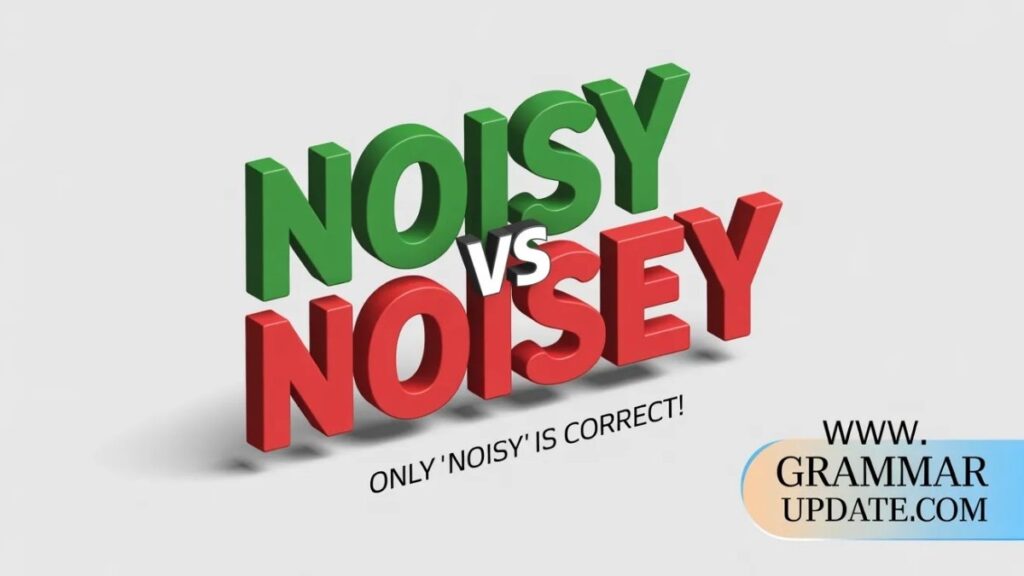
The spelling mistake noisey is part of a broader category of English errors caused by pronunciation-based spelling. Learners often assume that words should be written exactly as they sound, but English does not always follow phonetic rules.
This leads to incorrect versions of otherwise simple and common words.
- Noisy is correct because it follows English spelling structure rules
Example: The noisy environment made concentration difficult. - Noisey is incorrect because it is based on sound, not grammar rules
Example: The noisey environment made concentration difficult.
Here’s a trusted source for clear word meanings:
FAQs
Is it spelled noisey vs noisy?
The correct spelling is noisy. “Noisey” is a common misspelling and is not accepted in standard English grammar or dictionaries.
What is the meaning of Noisey?
“Noisey” has no official meaning because it is not a valid English word. People usually write it by mistake instead of “noisy.”
Is it noisey vs noisy?
Both words exist but mean different things. “Noisy” refers to loud sound or disturbance, while “nosy” (not nosey) means someone who is too curious about other people’s private life.
What is the meaning of noiser?
“Noiser” is not a standard English word in modern usage. The correct comparative form is usually not used; instead, we say “more noisy” or “louder.”
Is noisy a correct word?
Yes, noisy is a correct English adjective used to describe something that produces a lot of sound or disturbance.
Is noisey a Scrabble word?
No, noisey is not a valid Scrabble word because it is not recognized in official English dictionaries.
What is the opposite of noisey?
The opposite of “noisy” is quiet, silent, calm, or peaceful depending on the context.
Is Noisey biased?
“Noisey” is not a word, so it cannot be described as biased or unbiased. If you mean “noisy,” it is a neutral adjective depending on usage context.
What does nosy mean?
“Nosy” means a person who is too interested in other people’s private life or business. It is unrelated to sound.
How do you spell noiser?
The word “noiser” is not commonly used in English. Instead, we say “more noisy” or “louder” for comparison.
Which is correct, noisy vs noisey?
The correct form is noisy. “Noisey” is incorrect and should be avoided in all formal and informal writing.
What does “noisey” mean?
“Noisey” has no meaning in standard English. It is simply a spelling error of “noisy.”
What’s a better word for noisy?
Better alternatives include loud, rowdy, boisterous, chaotic, or disruptive, depending on context.
Is it noisy Vs nosy?
Both are correct but mean different things. Noisy relates to sound, while nosy relates to curiosity about others.
How do you say “noisy” in a nice way?
You can use softer or polite alternatives like lively, energetic, active, or bustling, depending on context.
What is the correct way to spell nosey?
The correct spelling is nosy, not “nosey.” It refers to someone who is overly curious about others’ private matters.
Conclusion
Ultimately, the confusion between noisy vs noisey comes down to a simple spelling trap that often misleads writers who rely on pronunciation rather than structure. The word sounds exactly the same in speech, which makes the incorrect form appear visually acceptable at first glance. However, English spelling follows fixed grammatical patterns, not phonetic assumptions, and this is where the mistake occurs.
The correct and only accepted form is noisy, while noisey is an incorrect spelling with no recognition in standard English usage. Once the rule “noise + y = noisy” is understood, the confusion becomes easy to avoid in both writing and communication.
In practical terms, this is not a complex grammar issue but a consistency rule in English vocabulary. Paying attention to this small detail helps ensure clearer, more accurate, and more professional writing across everyday and formal contexts.

Jhon AJS, the creative mind behind Grammar Update, is an experienced blogger passionate about simplifying English grammar. He focuses on explaining confusing word vs word differences, grammar rules, punctuation, and sentence structure in a clear and practical way. Through easy to understand guides and examples, Jhon helps readers improve their writing and communicate with confidence. With years of blogging experience, he continues to share helpful insights that make learning grammar simple, useful, and accessible for everyone.