Argument vs arguement can be confusing because both spellings look almost identical. However, only argument is correct. Arguement is a common spelling mistake, often caused by the word argue, which makes the extra e feel like it belongs. It doesn’t. When argue becomes the noun argument, the final e disappears. This small spelling change causes plenty of unnecessary confusion, but it’s easy to remember once you see the pattern. In this article, you’ll learn why argument is correct, why arguement is wrong, how to use argument properly, and simple ways to avoid this common spelling mistake.
Quick Answer
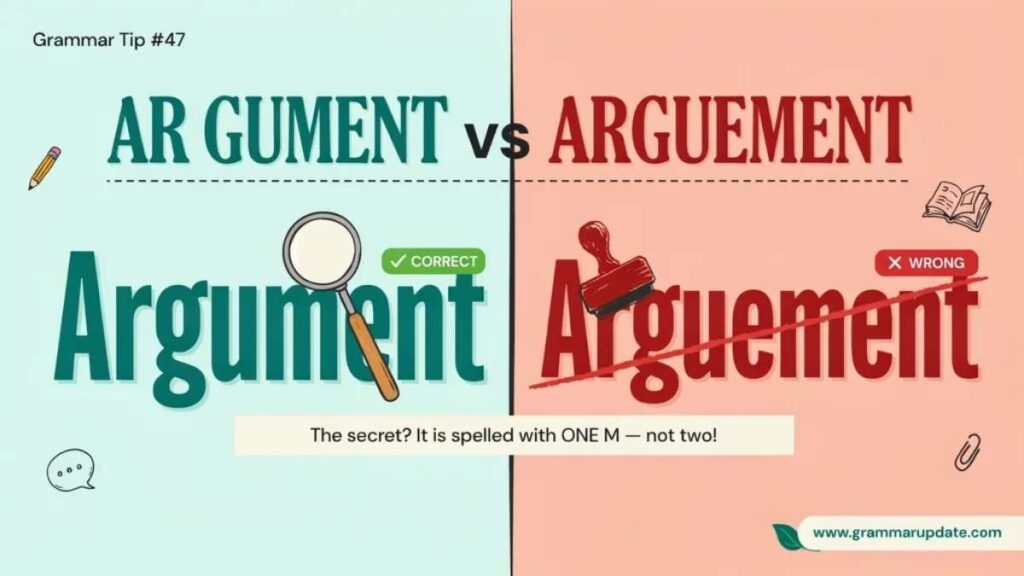
If you’re wondering whether to write argument vs arguement, choose argument.
Argument is the correct spelling. Arguement is incorrect.
The word argument has several meanings. It can describe a disagreement between people, a reason used to support an opinion, a formal case presented in law or academics, or even a value supplied to a function in programming.
For example:
They had an argument about where to go for dinner.
The writer presents a strong argument supported by evidence.
In both sentences, argument is spelled exactly the same way.
Learn the difference between confusing more English words
Farther vs Further Differences, Rules and Examples
Why People Confuse Argument vs Arguement
The main reason for this mistake is the word argue.
When you know that argue is the verb, it may feel natural to form the noun by simply adding -ment. That thought can lead to this incorrect spelling:
argue + ment = arguement
English doesn’t always work that neatly. The standard noun is argument.
The final e in argue doesn’t appear in argument. Instead, the word uses the form argu- before the suffix -ment.
The easiest relationship to remember is:
argue → argument
Not:
argue → arguement
This is one of those English spelling patterns that looks strange only until you become familiar with it. Once you have seen argument often enough, the incorrect version starts to stand out.
Argument: Meaning and Definition
The argument definition depends on the context. The word has two major meanings in everyday and formal English.
The first meaning refers to a disagreement between people. When two people express opposing views and the conversation becomes tense or confrontational, you can describe the exchange as an argument.
For example:
The neighbors had an argument about the fence.
In this sentence, argument means a verbal disagreement.
An argument doesn’t always involve shouting or anger. Two people can disagree calmly and still have an argument. The intensity depends on the situation.
The second major argument meaning involves reasoning. In this sense, an argument is a reason or group of reasons used to support a particular claim, opinion, or position.
For example:
The researcher presented a convincing argument for changing the policy.
Here, argument doesn’t mean a fight. It means a reasoned case supported by evidence and explanation.
This second meaning appears frequently in academic writing, journalism, law, business, philosophy, and public discussions.
Arguement Is It Ever Correct?
No. Arguement is not the standard spelling of the English word.
If you’re searching for the arguement spelling, you’re looking at a common misspelling rather than an accepted alternative.
The correct spelling is argument.
For example:
Incorrect: The lawyer presented a strong arguement.
Correct: The lawyer presented a strong argument.
The same mistake can appear in the plural form.
Incorrect: They exchanged several arguements.
Correct: They exchanged several arguments.
So, if you see arguement in a piece of writing, treat it as a spelling error.
Learn the difference between confusing more English words
Towards vs Toward Which One Is Correct?
Argument Spelling Why Does the E Disappear?
One of the most common questions about argument spelling is why the word doesn’t keep the final e from argue.
The answer becomes easier when you look at the words as established forms rather than trying to build the noun letter by letter.
The verb is argue.
The noun is argument.
The spelling of the noun does not simply preserve every letter of the verb. English has many words whose spelling changes when they take a different grammatical form or suffix.
Consider these examples:
1.They argue about the decision.
2.They argued about the decision yesterday.
3.They are arguing about the decision now.
Their argument lasted for an hour.
The words are closely related, but each has its own established spelling.
That’s why the best way to learn the argument correct spelling is to remember the pair argue and argument rather than treating argument as a simple mechanical combination of argue and ment.
Argument vs Arguement Spelling Explained
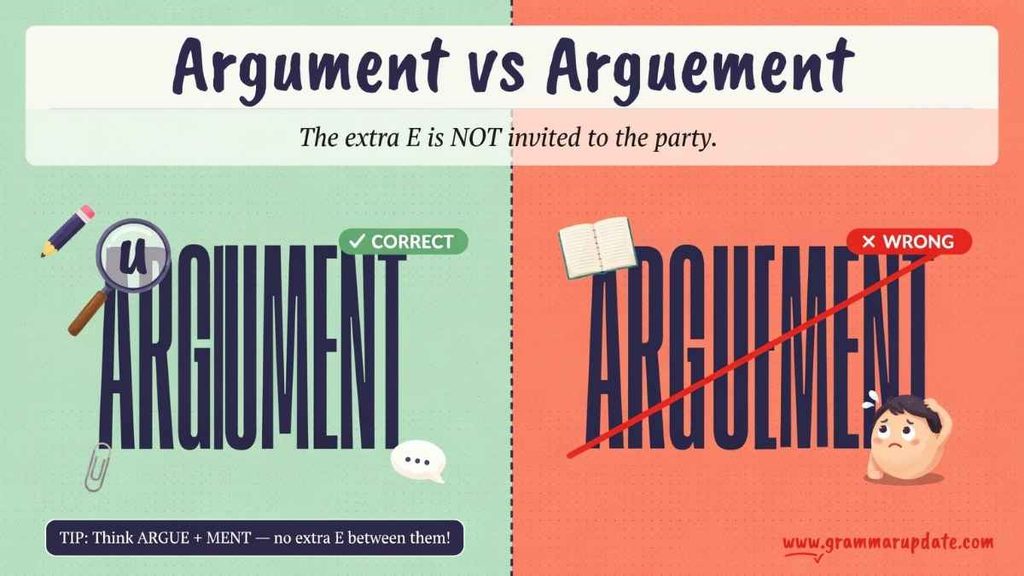
The key difference in argument vs arguement spelling is one extra e.
The correct form is:
argument
The incorrect form is:
arguement
Look closely at the middle of each word. The incorrect version carries the e from argue into the noun. Standard English doesn’t do that here.
This gives you a simple correction:
arguement → argument
The plural follows the same pattern:
arguements → arguments
Once you learn the singular form, the plural becomes straightforward.
How to Spell Argument
If you’re wondering how to spell argument, the letters are:
A-R-G-U-M-E-N-T
The word contains an e, but it does not have an e immediately after the u.
That detail causes much of the confusion.
If someone asks, “How do you spell argument?” the easiest answer is simply argument.
A useful memory trick is to connect the verb and noun:
argue → argument
The final e in argue doesn’t carry over into argument.
Another way to remember it is to say the correct word to yourself while writing it. The more often you see and use the correct spelling, the less likely you are to insert the extra e.
Does Argument Have an E?
Yes, argument does contain the letter e.
The important point is where that e appears.
The correct spelling is:
a-r-g-u-m-e-n-t
The e comes after the m.
The incorrect spelling is:
a-r-g-u-e-m-e-n-t
That version adds an unnecessary e between the u and m.
So, if you’re asking, “Is argument spelled with an e?” the answer is yes, but not in the position that creates arguement.
Argument and the Suffix -ment
The confusion becomes clearer when you consider the suffix -ment.
The suffix -ment appears in many English nouns. It can help form words related to actions, results, states, or processes.
Examples include development, improvement, arrangement, achievement, and government.
Because of this pattern, someone familiar with argue might assume that adding -ment gives arguement.
That assumption doesn’t produce the standard English word.
Argument is the established noun form.
This is an important lesson in English word formation. You can’t always create a correct noun simply by attaching a suffix to the complete spelling of a verb. English spelling contains many patterns that developed over time, and individual words don’t always behave in exactly the same way.
For language learners, memorizing common word families can be much more reliable than trying to apply one spelling rule to every word.
Learn the difference between confusing more English words
Digraph vs Diphthong What’s the Difference?
Argument vs Arguing What’s the Difference?
The Argument and arguing come from the same verb, but they have different grammatical roles.
Argument is a noun. Arguing is the present participle or gerund form of argue.
For example:
Their argument lasted all evening.
They were arguing about the decision.
The first sentence names the disagreement. The second describes the action taking place.
This distinction is useful because people sometimes confuse argue, arguing, and argument.
The basic relationship is simple:
Argue is the verb.
Arguing is a form of the verb.
Argument is the noun.
You can argue with someone. And You can be arguing with someone. You can also have an argument with someone.
Argument vs Discussion
Argument vs discussion is an important distinction because the two words can sometimes describe similar situations.
A discussion usually involves people exchanging information, ideas, or opinions. It doesn’t necessarily involve disagreement.
For example:
We had a discussion about the new schedule.
The sentence doesn’t suggest conflict.
Now consider:
We had an argument about the new schedule.
This version suggests that the people involved disagreed.
The difference becomes even clearer in academic writing. A discussion can explore different ideas, while an argument usually develops a particular position and supports it with reasoning or evidence.
A discussion can be neutral. An argument often has a specific position behind it.
Learn the difference between confusing word pairs
Apparent Vs Aparent Which one Is Correct?
Argument vs Debate
Argument and debate also overlap, but they aren’t interchangeable in every situation.
A debate usually involves opposing viewpoints presented in a structured or organized way. Schools, universities, political organizations, and public events often hold debates.
An argument can happen anywhere.
Two friends can have an argument. A lawyer can make an argument in court. A student can develop an argument in an essay.
A debate may contain several arguments from different sides. An argument doesn’t need a formal debate around it.
For example:
The candidates participated in a televised debate.
The candidate made a strong argument about the economy.
Both sentences concern opposing ideas, but the words serve different purposes.
Argument vs Disagreement
Argument vs disagreement can be confusing because both words involve opposing views.
A disagreement simply means that two or more people don’t share the same opinion.
For example:
They had a disagreement about the project.
Argument can describe a disagreement that becomes an active verbal exchange.
They had an argument about the project.
The second sentence often sounds stronger or more emotional.
However, argument has another meaning that disagreement doesn’t have. An academic argument, for example, is a reasoned case rather than a personal conflict.
That’s why context matters.
Argument vs Dispute
Argument and dispute both describe conflict, but dispute often sounds more formal.
For example:
The two neighbors had an argument about the driveway.
The two companies became involved in a contract dispute.
Dispute is especially common in legal, business, financial, and formal contexts.
Argument tends to work more naturally in everyday conversation, although it also has an important formal meaning.
The two words can overlap, but they aren’t exact substitutes in every sentence.
Learn the difference between confusing word pairs
Yea vs Yeah Which Word Is Correct?
Argument vs Opinion
An opinion is what someone thinks or believes. An argument gives reasons for a position.
For example:
My opinion is that the company should change its policy.
That tells us what the person thinks.
Now consider:
My argument is that the company should change its policy because the current system costs more and produces poorer results.
The second sentence goes beyond an opinion. It gives reasoning that supports the position.
An opinion can be part of an argument, but an opinion alone doesn’t necessarily form a complete argument.
Argument vs Claim
A claim is a statement that someone presents as true or worth considering.
An argument usually provides reasons or evidence to support that claim.
For example:
Claim: Remote work can improve productivity.
Argument: Remote work can improve productivity because employees may face fewer interruptions and can create work environments suited to focused tasks.
The claim gives the position. The argument explains why someone should accept it.
This distinction matters in academic English because strong writing doesn’t simply state a claim. It develops an argument around that claim.
Argument vs Reasoning
Reasoning refers to the process of thinking through information and connecting ideas to reach a conclusion.
An argument is the case presented through that reasoning.
In simple terms, reasoning is the thinking process, while an argument is the structured position that comes out of it.
For example, a writer may examine several pieces of evidence, compare different explanations, and reach a conclusion. The writer can then present those ideas as an argument.
Good reasoning usually helps produce a strong argument.
Argument in Programming
Argument has a technical meaning in programming.
In many programming languages, an argument is a value supplied to a function or method when the program calls it.
For example, imagine a function that displays a person’s name. The name supplied to that function can be an argument.
This meaning has nothing to do with a verbal disagreement, but the spelling remains exactly the same.
The word argument therefore appears in several very different fields.
You may encounter it in everyday conversations, academic essays, legal documents, philosophy, journalism, business writing, and programming.
Context tells you which meaning applies.
Argument Pronunciation
The standard US argument pronunciation is commonly represented as /ˈɑːrɡjəmənt/.
The first syllable receives the main stress.
Pronunciation can contribute to the spelling problem because spoken English doesn’t always reveal every letter clearly. English spelling and pronunciation often have a complicated relationship.
That’s why trying to spell a word only by listening to it can sometimes lead you astray.
Learning argument as a complete word is more reliable than trying to reconstruct its spelling from its pronunciation.
Learn the difference between confusing word pairs
Holistic vs Wholistic Which one Is Correct?
Argument Spelling US and UK
The argument spelling UK and argument spelling US are identical.
American English uses argument.
British English also uses argument.
There is no US-versus-UK spelling difference in this word.
This makes argument different from words such as color and colour or center and centre.
The correct spelling remains argument in both major varieties of English.
So, whether you’re writing for an American audience or a British audience, you don’t need to change the spelling.
Argument vs Arguement Examples
Looking at argument vs arguement examples makes the difference easier to remember.
Consider this sentence:
The teacher asked the students to develop a strong argument.
That sentence uses the correct spelling.
Now compare:
The teacher asked the students to develop a strong arguement.
That sentence contains the common spelling error.
Here are several more examples.
She presented a convincing argument during the meeting.
Their argument began over a minor misunderstanding.
The article makes a strong argument for renewable energy.
The lawyer’s argument relied on clear evidence.
His argument was difficult to challenge.
The students learned how to build a logical argument.
In every example, the correct form is argument.
Learn the difference between confusing word pairs
Covenant vs Contract What’s the Difference?
Common Argument Spelling Mistakes
The most common argument spelling mistake is adding an extra e after the u.
Writers often produce arguement because they remember the spelling of argue and carry its final e into the noun.
Another common error is writing arguements instead of arguments.
For example:
Incorrect: The writer presented several arguements.
Correct: The writer presented several arguments.
The problem is the same in both cases. The extra e doesn’t belong there.
These errors fall into the larger group of commonly misspelled words and common English spelling errors that occur when writers rely too heavily on pronunciation or try to form new words mechanically.
Argument as a Noun
Argument is a noun.
It can name a disagreement, a reasoned case, a legal position, or a programming value.
The related verb is argue.
For example:
They argue about politics.
Their argument concerns politics.
The first sentence uses a verb. The second uses a noun.
This simple grammatical difference can help you understand the word family.
The related forms include argue, argued, arguing, argument, argumentative, and arguably. Each form has its own meaning and grammatical function.
Strong, Weak, Valid, and Compelling Arguments
When argument means a reasoned case, different adjectives can describe its quality.
A strong argument provides relevant reasoning and convincing supporting evidence.
A weak argument may rely on poor evidence, unsupported assumptions, or unclear reasoning.
A compelling argument is especially persuasive because the evidence and reasoning make the position difficult to dismiss.
A valid argument has a more specific meaning in formal logic. In logic, validity concerns whether the conclusion follows correctly from the premises.
These expressions show how widely argument is used in English.
The word isn’t limited to personal disagreements. It plays an important role in reasoning, persuasion, education, law, philosophy, and many other areas.
Learn the difference between confusing word pairs
Cocoon vs Cacoon Which one Is Correct?
Argumentation and Formal Arguments
Argument vs arguement
Argumentation refers to the process of developing and presenting arguments.
You may encounter the term in academic writing, rhetoric, philosophy, law, and communication studies.
A formal argument often contains a clear claim, supporting reasons, relevant evidence, and a logical connection between the evidence and conclusion.
A strong writer may also address an opposing viewpoint rather than ignoring it.
For example, an essay might argue that a particular policy should change. The writer could present evidence, explain how the evidence supports the position, acknowledge an opposing viewpoint, and then explain why the original position remains stronger.
That is formal argumentation in the context of Argument vs arguement.
It is quite different from simply having a heated conversation with someone. Understanding Argument vs arguement makes this distinction clearer.
Argument Synonyms
The best argument synonym depends on the meaning of the word.
When argument means a disagreement, possible alternatives include disagreement, dispute, quarrel, conflict, and verbal disagreement.
When argument means a reasoned case, words such as case, reasoning, rationale, justification, position, and contention may work depending on the sentence.
These words aren’t perfect substitutes.
For example, quarrel usually suggests interpersonal conflict. Rationale refers to the reasoning behind a decision. A claim identifies a position but doesn’t necessarily include all the reasoning that supports it.
Choosing the right synonym therefore depends on the context.
Argument in Academic Writing
Argument has a particularly important role in academic writing.
An academic argument isn’t simply a personal opinion. It usually presents a position and supports that position with evidence and reasoning.
A strong academic argument should make its central position clear. It should then explain why that position deserves consideration.
For example, an essay about public transportation might argue that expanding bus networks can improve access to employment.
The writer would need more than a simple statement such as “Public transportation is important.”
A developed argument would explain the position, present relevant evidence, consider other viewpoints, and connect the evidence back to the central claim.
This is why the word argument appears so frequently in discussions of essays, research papers, critical thinking, and academic writing.
Learn the difference between commonly mixed-up more words
Solicited vs Unsolicited Differences and Usage
Argument in Everyday English
In everyday conversation, argument often refers to a disagreement.
You might say:
We had an argument last night.
I don’t want to start an argument.
They got into an argument over the parking space.
The word can describe anything from a minor disagreement to a much more serious verbal conflict.
However, everyday speakers also use argument in the reasoning sense.
For example:
That’s a good argument.
You have a strong argument there.
Her argument makes sense.
The surrounding words help determine the intended meaning.
Argument in Legal Writing
Lawyers frequently use argument to describe the reasoning they present in support of a legal position.
For example:
The attorney presented an argument based on previous court decisions.
Here, argument means a structured legal case or line of reasoning.
Legal arguments often rely on statutes, court decisions, evidence, and interpretations of the law.
This formal meaning has nothing to do with people simply losing their tempers. A legal argument can be carefully planned, researched, and presented in a calm professional setting.
Argument in Professional Communication
In business and professional writing, argument often describes the reasoning behind a recommendation or decision.
For example:
The report makes a strong argument for expanding the customer service team.
The writer isn’t describing a disagreement. Instead, the report explains why expansion makes sense.
This usage appears in proposals, reports, presentations, policy documents, and strategic plans.
Using the correct spelling matters in these settings because a small spelling error can distract readers from otherwise strong content.
Learn the difference between commonly mixed-up more words
Kaftan vs Caftan Difference and Which one Is Correct?
Practice sesstion Argument vs Arguement
Fill in each blank with the correct word: argument vs arguement.
- She presented a strong ________ in favor of the new policy.
- Their ________ started over a simple misunderstanding.
- The lawyer made a convincing ________ before the judge.
- He had a heated ________ with his neighbor.
- Can you explain your ________ more clearly?
- The student supported her ________ with several facts.
- They had an ________ about where to eat dinner.
- His main ________ was that the plan would save money.
- A well-reasoned ________ can change someone’s point of view.
- The professor asked us to write an ________ based on evidence.
- Their ________ became more intense as the conversation continued.
- She gave a logical ________ during the discussion.
- The article presents a strong ________ for protecting the environment.
- He couldn’t remember how to spell ________ correctly.
- The two coworkers had an ________ about the project deadline.
- A good ________ should include clear reasoning and supporting evidence.
- Her ________ was based on facts rather than personal feelings.
- The writer developed a compelling ________ in the final paragraph.
- They ended the ________ after realizing they had misunderstood each other.
- His ________ against the proposal was easy to understand.
- The teacher explained that “arguement” is a common spelling mistake for ________.
- The politician defended his ________ with statistics and examples.
- The two sides presented different ________ during the debate.
- She made a persuasive ________ during the meeting.
- Remember that the correct spelling is ________, not “arguement.”
Answers
- argument
- argument
- argument
- argument
- argument
- argument
- argument
- argument
- argument
- argument
- argument
- argument
- argument
- argument
- argument
- argument
- argument
- argument
- argument
- argument
- argument
- argument
- arguments
- argument
- argument
Here’s a trusted source for clear word meanings:
FAQs
Why is “arguement” a common spelling mistake?
“Arguement” is a common spelling mistake because the word comes from “argue.” It’s easy to assume that the final e stays when you add “-ment.” However, the correct spelling is “argument.”
Does “argument” come from “argue”?
Yes. “Argument” comes from the verb “argue.” Although the two words are closely related, their spellings are different. The correct noun is “argument,” not “arguement.”
Does “argument” have more than one meaning?
Yes. “Argument” commonly has two meanings. It can describe a disagreement between people, or it can refer to a reason or set of reasons used to support a particular position.
Can an argument be peaceful?
Yes. An argument doesn’t always involve anger or shouting. In academic, legal, and professional contexts, an argument can simply be a carefully explained position supported by reasoning and evidence.
Can “argument” mean a reason?
Yes. When someone says, “Her strongest argument was the cost,” the word “argument” means a reason that supports her position.
Can “argument” be used as a verb?
No. “Argument” is a noun. The related verb is “argue.” For example, you can say, “They argue about the issue,” but you cannot use “argument” as the verb in that sentence.
What is the verb form of “argument”?
The related verb is “argue.” Its common forms include “argued” and “arguing.” For example, “They argued about the decision” and “They are arguing about the decision.”
Why does “argue” become “argument”?
English word formation sometimes changes the spelling of a base word when a suffix is added. In this case, “argue” forms the noun “argument.” The spelling does not retain the final e from “argue.”
Is “arguement” ever correct?
No. “Arguement” is a misspelling. The standard English spelling is “argument,” whether you are writing casually, academically, or professionally.
Can an argument happen without shouting?
Yes. People can have an argument while speaking calmly. The word can describe a disagreement between different viewpoints without suggesting that anyone is angry or aggressive.
What is the plural of “argument”?
The plural form is “arguments.” For example, “The writer presented several strong arguments to support the proposal.”
How can you use “argument” as a noun?
You can use “argument” to describe either a disagreement or a reasoned position. For example, “His argument convinced the committee to reconsider the plan.”
How can you remember the spelling of “argument”?
A simple trick is to remember “argu” followed by “ment”: argument. Don’t insert an extra e between the u and m. Think “argu + ment,” not “argue + ment.”
Is “arguement” a common spelling error?
Yes. Many writers mistakenly add an e because they associate the noun with “argue.” However, the correct spelling removes that final e: argument.
Does the pronunciation of “argument” affect its spelling?
No. Although English pronunciation can sometimes make spelling difficult, the correct spelling remains “argument.” The word does not need an extra e in written English.
Is “argument” used in academic writing?
Yes. Academic writers frequently use “argument” to describe a position supported by evidence, analysis, and logical reasoning.
Can an argument be based on evidence?
Yes. A formal argument often combines a claim with supporting evidence and reasoning. The stronger the supporting evidence and logic, the more convincing the argument can be.
Is “argument” appropriate in professional writing?
Yes. “Argument” is appropriate in professional writing when you need to describe a position, case, or disagreement. The intended meaning depends on the context.
What is the difference between “argument” and “argumentation”?
“Argument” usually refers to a specific reasoned position or disagreement. “Argumentation” refers to the broader process of developing, presenting, and evaluating arguments.
What does “argument” mean in logic?
In logic, an argument is a group of statements in which some statements provide support for a conclusion. In this context, the word describes a reasoning structure rather than a personal disagreement.
Learn the difference between commonly mixed-up more words
Cemetery vs Cemetary Which one Is Correct?
Conclusion
The argument vs arguement confusion is easy to clear up: argument is correct, and arguement is incorrect. Although argument comes from the verb argue, it does not keep the final e. That extra e is the little troublemaker that turns a correct word into a spelling mistake.
Use argument when you mean a disagreement, a reason, or a position supported by evidence. Remember the simple spelling: argue → argument.
Once you remember that pattern, there’s no need to second-guess the word. Just write argument and leave the extra e out of the conversation.

Jhon AJS, the creative mind behind Grammar Update, is an experienced blogger passionate about simplifying English grammar. He focuses on explaining confusing word vs word differences, grammar rules, punctuation, and sentence structure in a clear and practical way. Through easy to understand guides and examples, Jhon helps readers improve their writing and communicate with confidence. With years of blogging experience, he continues to share helpful insights that make learning grammar simple, useful, and accessible for everyone.