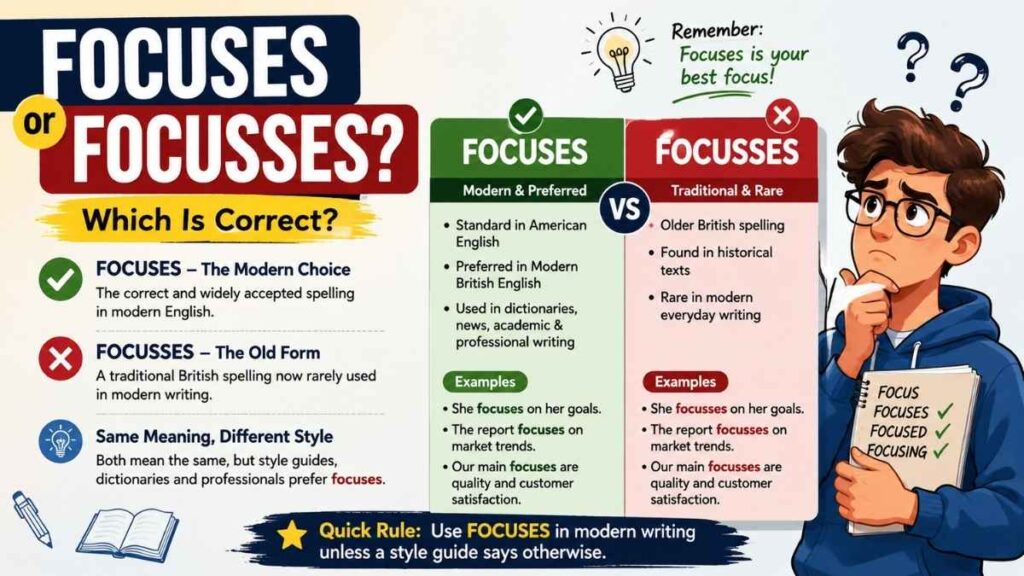
Have you ever typed focuses vs focusses, paused for a second and wondered, “Wait… which one is actually right?” Don’t worry you are just joined a club with millions of English writers. This tiny spelling difference has sparked countless debates, confused students, puzzled professionals and even made experienced editors do a double take. The good news? You dont need to memorize complicated grammar rules or second-guess every sentence. This guide breaks everything down in plain English with clear explanations, practical examples and expert backed advice. By the time you finish reading, you will confidently choose the correct spelling every single time and write with far greater confidence.
Focuses vs Focusses The Quick Answer
If you’re looking for the short version, here it is.
| Question | Answer |
|---|---|
| Is focuses correct? | Yes. It is the standard modern spelling. |
| Is focusses correct? | Yes, but only as a rare alternative, mainly in older British English. |
| Which spelling should you use? | Use focuses in almost every situation. |
| Is focuses correct in British English? | Yes. Modern British publishers widely prefer it. |
| Is focuses correct in American English? | Yes. It is the only standard spelling. |
The correct spelling of focuses is the preferred choice in schools, universities, newspapers, businesses and professional writing across the English-speaking world.
If you’re wondering how to spell focuses correctly, remember one simple rule:
Use focuses unless you’re intentionally following an older British style that prefers focusses.
For nearly every writer today, that rule will keep your spelling accurate.
Learn how to use confusing more words correctly
Favs vs Faves Difference Which Is Correct?
What Does “Focuses” Mean?
Understanding the word’s meaning makes it much easier to use correctly. One reason people search for focuses vs focusses meaning is that the word serves two different grammatical functions. It can work as both a verb and a noun.
Focuses as a Verb
As a verb, focuses is the third-person singular form of the verb focus.
That means it describes what one person, animal or thing does.
Examples include:
- She focuses on quality instead of quantity.
- The teacher focuses every lesson on practical skills.
- The camera automatically focuses on nearby objects.
- Our company focuses on customer satisfaction.
- He focuses better after taking a short break.
In each example, focuses functions as a verb because it describes an action.
This usage follows standard English grammar rules for third-person singular verbs.
| Subject | Verb |
|---|---|
| I | focus |
| You | focus |
| We | focus |
| They | focus |
| He | focuses |
| She | focuses |
| It | focuses |
If you’re asking when to use focuses, this is one of the most common situations.
Focuses as a Noun
The word focuses also works as the plural noun of focus.
In this case, it refers to multiple points of attention, objectives or areas of concentration.
Examples include:
- The project’s main focuses are safety and innovation.
- The conference has three focuses this year.
- Their research focuses include climate change and renewable energy.
- Our team’s focuses changed after customer feedback.
Although many people also know the Latin plural foci, focuses has become the standard English plural in everyday writing.
Here’s a quick comparison.
| Singular | Standard English Plural | Latin Plural |
|---|---|---|
| Focus | Focuses | Foci |
The plural of focus depends on your audience.
- Academic and scientific writing sometimes uses foci.
- General English almost always prefers focuses.
- Business writing nearly always uses focuses because it’s clearer for most readers.
If you’re writing for a broad audience, focuses plural is usually the safest choice.
Learn how to use confusing more words correctly
Anual vs Annual Which Spelling Is Correct?
Is “Focusses” a Correct Spelling?
One of the most common online questions is, “Is focusses correct?”
Technically, yes.
Practically, almost never.
The focusses spelling developed because English once doubled the final consonant before adding certain endings. Older British publications occasionally followed that convention, producing spellings such as:
- focusses
- focussed
- focussing
Over time, English spelling evolved. Modern dictionaries, newspapers and publishing houses gradually adopted simpler spellings.
Today, the preferred forms are:
- focuses
- focused
- focusing
That shift makes modern writing more consistent and easier to read.
You may still encounter focusses in:
- Older British books
- Historical documents
- Archived newspaper articles
- Older educational materials
- Some Commonwealth publications using traditional house styles
However, seeing the spelling doesn’t mean it’s the best choice today.
Most grammar experts now recommend using focuses instead.
Learn how to use confusing more words correctly
Presentor vs Presenter Which Spelling Is Correct?
Focuses vs Focusses What’s the Difference?
The debate over focuses vs focusses isn’t about meaning.
Both spellings communicate exactly the same idea.
The difference lies almost entirely in spelling tradition.
| Feature | Focuses | Focusses |
|---|---|---|
| Meaning | Identical | Identical |
| Grammar | Correct | Historically accepted |
| Modern usage | Very common | Rare |
| American English | Standard | Not used |
| Modern British English | Preferred | Occasionally seen |
| Professional writing | Recommended | Usually avoided |
Think of it this way.
Focuses represents modern standard English.
Focusses represents an older spelling convention that survives in only a few contexts.
That’s why language experts usually explain that focuses is the standard spelling while focusses is a rare spelling variant.
If you’re comparing focuses vs focusses British English, modern British publishers increasingly favor focuses.
Likewise, focuses vs focusses American English isn’t really a competition because American English recognizes focuses as the accepted standard.
Learn the difference between confusing more English words
Fourteen vs Forteen Which Spelling Is Correct?
British English vs American English
Many spelling debates come down to regional differences.
Words like colour and color or organise and organize follow different conventions depending on the country.
The word focus follows a slightly different pattern.
Unlike many British and American spelling differences, both regions increasingly agree on the same spelling.
American English Preference
American English strongly prefers focuses.
Major style guides including the AP Stylebook and the Chicago Manual of Style recommend:
- focus
- focuses
- focused
- focusing
Spellings such as focusses or focussing are considered incorrect in standard American English.
Major dictionaries such as Merriam-Webster also list focuses as the accepted spelling.
If you’re writing for an American audience, always choose focuses.
British English Preference
British English once accepted both focuses and focusses.
However, modern usage has shifted.
Today, respected publishers, universities and newspapers overwhelmingly use focuses.
Traditional spellings still appear occasionally, particularly in older publications, but they have become much less common.
This explains why people continue searching for focuses vs focusses UK even though the modern answer is increasingly clear.
Current British English generally favors focuses.
Oxford, Cambridge and Major Dictionary Guidance
One of the easiest ways to settle spelling questions is to check respected dictionaries.
Here’s what today’s major references recommend.
| Dictionary | Preferred Form | Notes |
|---|---|---|
| Oxford Dictionary | focuses | Lists historical variants where relevant. |
| Cambridge Dictionary | focuses | Uses modern standard spelling. |
| Merriam-Webster | focuses | American standard spelling. |
| Collins Dictionary | focuses | Preferred in current English. |
These references also support the modern forms:
- focused instead of focussed
- focusing instead of focussing
Although historical variants remain documented for reference purposes, the overwhelming trend favors simpler spellings.
That consistency helps explain why focuses is preferred worldwide.
Learn the difference between confusing more English words
Cognisant vs Cognizant difference which is correct ?
Why Did “Focusses” Exist?
To understand why focusses appeared in older writing, it helps to look at the history of the word itself.
The word focus comes from Latin, where it originally meant “hearth” or “fireplace.” Over time, scholars borrowed it into English and expanded its meaning to describe a central point of attention, concentration or activity.
As the word became part of everyday English, writers followed different spelling patterns when adding endings.
Older British spelling often doubled the final consonant before adding suffixes. That practice produced forms such as:
- travelled
- labelled
- focussed
- focussing
- focusses
Eventually, editors and dictionary publishers began simplifying many spellings to improve consistency. As a result, focuses, focused and focusing became the dominant forms across newspapers, universities, businesses and digital publications.
This gradual change reflects how English naturally evolves. Many spellings that once seemed normal eventually become less common as usage shifts toward simpler, more standardized forms.
Today, most grammar checkers, spelling checkers and professional style guides recognize focuses as the accepted spelling for modern English.
Learn the difference between confusing more English words
Enquiries vs Inquiries Which Spelling Is Correct?
Verb Forms of “Focus” Explained
Learning the complete verb conjugation helps eliminate many spelling mistakes. Whether you’re writing an email, report or research paper, these forms follow standard English grammar.
| Verb Form | Correct Form | Example |
|---|---|---|
| Base Form | focus | Please focus on the instructions. |
| Third-Person Singular | focuses | She focuses on customer service every day. |
| Present Participle | focusing | They are focusing on new goals. |
| Past Tense | focused | We focused on the main issue yesterday. |
| Past Participle | focused | The team has focused on improving quality. |
Some traditional British publications may still use focussed and focussing, but focused and focusing are now the preferred spellings in most professional writing.
Remember this simple pattern:
- Focus is the base verb.
- Focuses is the third-person singular verb.
- Focusing is the present participle.
- Focused is the standard past tense and past participle.
Learn the difference between confusing more English words
Crain vs Crane difference Which one Is Correct?
Focused vs Focussed Which Is Correct?
After understanding the difference between focuses and focusses, the next question naturally follows.
Should you write focused or focussed?
Just like the present-tense forms, both spellings have existed in English. However, modern usage strongly favors one over the other.
If you’re writing for a general audience, professional publication or academic setting, focused is almost always the best choice.
Modern Usage
Today, focused is the standard spelling across most English-speaking countries.
You’ll see it in:
- Newspapers
- Business reports
- Academic journals
- Government publications
- Websites
- Marketing content
- Professional emails
Modern editors prefer focused because it matches current spelling conventions and creates consistency with other verb forms such as focuses and focusing.
Examples include:
- She stayed focused throughout the meeting.
- The company remained focused on customer satisfaction.
- Our team focused on solving the problem quickly.
- He focused his attention on the final exam.
These examples sound natural because they follow modern English usage.
If you’re writing for SEO, blogging or digital publishing, focused is almost always the recommended spelling.
Traditional British Usage
Historically, British English often doubled the final consonant before adding certain endings.
That practice created spellings such as:
- focussed
- focussing
- focusses
You can still find these forms in:
- Older British books
- Archived newspapers
- Historical documents
- Older educational materials
Some organizations also continue using them because of long-established house style guides.
Even so, modern British English has steadily shifted toward the simpler spellings.
Many respected publishers now prefer:
- focused
- focusing
- focuses
This gradual change mirrors the evolution of many other English words whose spellings have become simpler over time.
Which One Should You Write?
If you’re unsure, choose focused.
That recommendation works for almost every writing situation.
Here’s a simple guide.
| Audience | Recommended Spelling |
|---|---|
| American English | focused |
| Modern British English | focused |
| Australian English | focused |
| Canadian English | focused |
| Academic Writing | focused |
| Business Writing | focused |
Traditional spellings like focussed may still appear occasionally, but they rarely offer any advantage in modern communication.
Unless you’re following a publisher’s specific style guide, focused is the safest option.
Focuses in Real Sentences
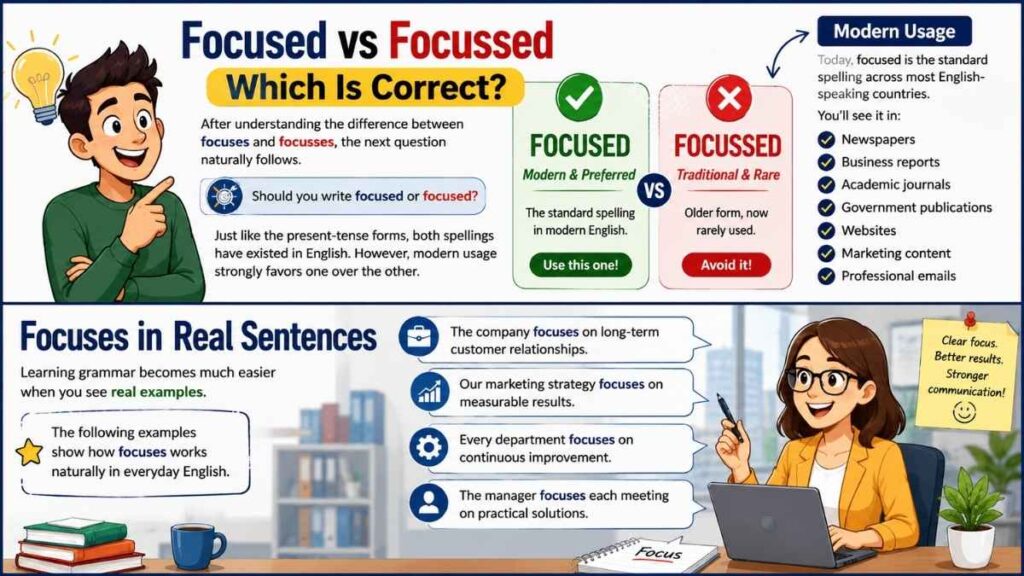
Learning grammar becomes much easier when you see real examples.
The following examples show how focuses works naturally in everyday English.
Business Examples
Professional communication values clarity and consistency.
Examples include:
- The company focuses on long-term customer relationships.
- Our marketing strategy focuses on measurable results.
- Every department focuses on continuous improvement.
- The manager focuses each meeting on practical solutions.
These examples demonstrate the correct spelling of focuses in workplace writing.
Academic Writing
Universities and research institutions commonly use focuses when describing subjects, research areas and objectives.
Examples include:
- The study focuses on renewable energy technologies.
- Her dissertation focuses on language development.
- The article focuses on modern grammar rules.
- This research focuses on climate adaptation strategies.
Academic editors generally recommend focuses because it follows standard English usage.
Everyday Conversation
You probably hear this word every day without noticing it.
Examples include:
- She focuses better in a quiet room.
- My brother focuses on one task at a time.
- The movie focuses on family relationships.
- The camera focuses automatically.
These examples show how naturally focuses fits into everyday English.
Professional Emails
Business emails should always use standard spelling.
Examples include:
- Our presentation focuses on quarterly results.
- This proposal focuses on reducing costs.
- The report focuses on customer feedback.
- Today’s meeting focuses on project deadlines.
Using consistent spelling creates a more professional impression.
Learn the difference between tricky grammar more words
Visiter vs Visitor Difference Which One Is Correct?
When Should You Use “Focuses”?
Many writers ask when to use focuses.
The answer depends on grammar rather than location.
Use focuses whenever you’re writing:
- The third-person singular form of the verb focus.
- The plural noun form of focus.
Here are common situations.
In Academic Writing
Examples:
- The lecture focuses on medieval history.
- The textbook focuses on grammar fundamentals.
In Business Writing
Examples:
- The company focuses on innovation.
- Our strategy focuses on customer retention.
In Journalism
Examples:
- The article focuses on economic growth.
- Today’s report focuses on healthcare reform.
In Digital Content
Examples:
- The guide focuses on beginner-friendly tips.
- The blog focuses on practical advice.
In Everyday Writing
Examples:
- She focuses well under pressure.
- The discussion focuses on future plans.
Whenever you’re unsure how to use focuses in a sentence, remember that it functions exactly like other third-person singular verbs such as:
- works
- drives
- studies
- learns
The same grammar rule applies.
Learn the difference between tricky grammar more words
Persue vs Pursue Which Spelling Is Correct?
Common Grammar Mistakes
Although the word seems simple, writers often make the same mistakes.
Recognizing them helps improve both grammar and proofreading.
Mixing British and American Spellings
One of the biggest mistakes is combining spelling systems in the same document.
For example:
Incorrect:
- The report focusses on customer service and later focuses on employee training.
Correct:
- The report focuses on customer service and later focuses on employee training.
Consistency always improves readability.
Using Focusses in American English
American English recognizes focuses as the accepted spelling.
Using focusses may confuse readers or trigger spelling checkers.
If your audience is American, always choose focuses.
Confusing the Verb and the Noun
Remember that focuses serves two grammatical roles.
Verb example:
- She focuses on accuracy.
Noun example:
- Their main focuses are education and healthcare.
Understanding the sentence structure makes the correct meaning clear.
Incorrect Subject-Verb Agreement
The verb must agree with the subject.
Correct:
- He focuses on quality.
- She focuses on teamwork.
- The company focuses on innovation.
Incorrect:
- He focus on quality.
- She focus on teamwork.
Always add the final “es” when using the third-person singular verb.
Misspelling Related Word Forms
Many writers accidentally mix different spellings.
Modern preferred forms include:
- focus
- focuses
- focused
- focusing
Traditional variants include:
- focusses
- focussed
- focussing
Staying with one spelling style throughout your document creates a cleaner, more professional result.
Learn the difference between tricky grammar more words
Socialise vs Socialize Which One Is Correct?
Similar Words That Cause the Same Confusion
Focus isn’t the only English word with multiple spelling variations.
Several related forms often create similar questions.
Focused vs Focussed
Modern English strongly prefers focused.
Focussed remains an older spelling that still appears in limited British usage.
Focusing vs Focussing
Most publishers now recommend focusing.
Focussing survives mainly in older British texts and a few traditional house styles.
Focuses vs Focus’s
These forms serve completely different purposes.
- Focuses is the plural noun or third-person singular verb.
- Focus’s is the possessive form.
Examples:
- The company’s focuses include innovation and sustainability.
- The focus’s importance cannot be ignored.
Focuses vs Focus
These words have different grammatical functions.
| Word | Grammar Role | Example |
|---|---|---|
| Focus | Singular noun or base verb | Please focus on your work. |
| Focuses | Plural noun or third-person singular verb | She focuses on quality every day. |
Understanding these word forms makes editing much easier.
Learn the difference between often confused words
Clutz vs Klutz Which Spelling Is Correct in English?
Quick Case Study Why Modern Style Guides Prefer “Focuses”
Imagine two companies publishing annual reports.
Company A writes:
- The organization focusses on customer satisfaction.
- Every department is focussed on continuous improvement.
Company B writes:
- The organization focuses on customer satisfaction.
- Every department is focused on continuous improvement.
Both reports communicate the same message.
However, Company B aligns with modern dictionary recommendations, professional editing standards and widely accepted spelling conventions.
That consistency improves readability and reduces the chance that spelling checkers or readers will question the writing.
For businesses, schools and online publishers, choosing the modern spelling helps build credibility without distracting the audience.
Writing Tip
When proofreading your work, search for these word forms together:
| Preferred Modern Forms | Older Variants |
|---|---|
| focus | focus |
| focuses | focusses |
| focused | focussed |
| focusing | focussing |
Learn the difference between often confused words
Nitch vs Niche Difference and Which Is Correct?
Focuses vs Focusses Comparison Table
If you only remember one section from this guide, make it this one. The table below summarizes the most important differences between the two spellings and helps you choose the right form with confidence.
| Feature | Focuses | Focusses |
|---|---|---|
| Meaning | Same meaning | Same meaning |
| Grammar | Correct modern form | Historical variant |
| Modern English | Standard spelling | Rarely used |
| American English | Standard | Not accepted in standard usage |
| Modern British English | Preferred | Occasionally found in older sources |
| Academic Writing | Recommended | Generally avoided |
| Business Writing | Recommended | Rarely used |
| Newspapers and Media | Preferred | Uncommon |
| Professional Documents | Recommended | Not recommended |
| SEO and Online Content | Best choice | Avoid unless required |
The comparison makes one point very clear. Although both spellings have existed, focuses has become the accepted spelling for nearly every modern writing situation.
Learn the difference between often confused words
In Line vs Inline Which One Is Correct and Usage
Pronunciation of Focuses
Another common question concerns pronunciation.
Fortunately, pronunciation does not change based on spelling.
The word focuses is pronounced:
/ˈfoʊ.kə.sɪz/
It sounds like:
FOH-kuh-siz
Examples:
- She focuses on quality.
- The company focuses on customer service.
- Our discussion focuses on practical solutions.
Whether you encounter focuses or the older spelling focusses, both are pronounced exactly the same way.
Focuses Meaning in English
Understanding the meaning of the word helps prevent grammar mistakes.
As a verb, focuses means:
- Concentrates attention on something.
- Directs effort toward a goal.
- Gives special importance to a subject.
Examples include:
- She focuses on accuracy.
- The coach focuses on teamwork.
- The report focuses on recent market trends.
As a plural noun, focuses refers to multiple centers of attention, interests or objectives.
Examples include:
- The project’s main focuses are safety and efficiency.
- Our research focuses have expanded this year.
- Their business focuses include education and healthcare.
Although the Latin plural is foci, most everyday English writing uses focuses because it sounds more natural to modern readers.
Focuses vs Focusses Grammar Rules
English spelling sometimes changes as words develop over time. The word focus is a good example.
Here are the grammar rules that matter most.
- Use focuses as the third-person singular form of the verb.
- Use focuses as the standard English plural noun.
- Use focused as the preferred past tense.
- Use focusing as the preferred present participle.
- Reserve focusses, focussed and focussing only for historical or publisher-specific styles.
If you remember those five rules, you’ll avoid nearly every common spelling mistake.
Learn the difference between often confused words
Copyright vs Copywrite Differences, Usage and Mistakes
Dictionary and Style Guide Recommendations
Professional writers rarely rely on guesswork. Instead, they follow trusted dictionaries and editorial style guides.
The following references support modern spellings.
| Reference | Preferred Form |
|---|---|
| Oxford Dictionary | focuses |
| Cambridge Dictionary | focuses |
| Merriam-Webster | focuses |
| Collins Dictionary | focuses |
| AP Stylebook | focuses |
| Chicago Manual of Style | focuses |
These references also favor:
- focused instead of focussed
- focusing instead of focussing
The consistent recommendations explain why focuses is now preferred worldwide.
Learn the difference between often confused words
Coma vs Comma which is Difference?
Common Online Searches Explained
Many people search for spelling questions using slightly different wording. Here’s what those searches actually mean.
Focuses vs Focusses Oxford
Oxford recognizes focuses as the preferred modern spelling while documenting older variants for historical reference.
Focuses vs Focusses Cambridge
Cambridge Dictionary uses focuses throughout its examples and definitions.
Focuses vs Focusses Merriam-Webster
Merriam-Webster follows American English standards and recommends focuses.
Focused or Focussed UK
Modern British English increasingly prefers focused, although focussed still appears occasionally in older publications.
Focused or Focussed Australia
Australian English generally follows the same modern trend and favors focused.
Focused vs Focussed Grammar
Both spellings represent the past tense of focus, but focused has become the dominant spelling in professional writing.
Focusing or Focussing
Most publishers now recommend focusing.
Plural of Focus Grammar
The standard English plural is focuses.
The Latin plural foci appears mainly in scientific, technical or academic contexts.
Learn the difference between tricky grammar more words
One Third vs One-Third Which Is Correct?
Editing and Proofreading Tips
Even experienced writers occasionally miss spelling inconsistencies.
Before publishing your work, use this checklist.
- Choose either American or British English and stay consistent.
- Use focuses instead of focusses unless a publisher requests otherwise.
- Use focused instead of focussed.
- Use focusing instead of focussing.
- Check subject-verb agreement.
- Confirm whether focus is acting as a noun or a verb.
- Run a spelling checker before publishing.
- Read the article aloud to catch awkward wording.
A few extra minutes of proofreading can dramatically improve the quality of your writing.
Learn the difference between tricky grammar more words
Goodmorning vs Good Morning Which Is Correct?
Quick Reference Cheat Sheet
If you’re in a hurry, this summary covers the most important rules.
| Question | Answer |
|---|---|
| Which is correct, focuses vs focusses? | Focuses |
| Is focuses correct? | Yes |
| Is focusses correct? | Historically yes, but rarely used today |
| Which spelling is best for US English? | Focuses |
| Which spelling is best for modern UK English? | Focuses |
| What is the plural of focus? | Focuses |
| What is the third-person singular verb? | Focuses |
| Preferred past tense | Focused |
| Preferred present participle | Focusing |
Learn the difference between tricky grammar more words
Half Day vs Half-Day Which is correct and Usage
Practice Section Focuses vs Focusses
Test your understanding of Focuses vs Focusses and related word forms by completing each sentence with the correct answer.
- The teacher ________ on helping every student succeed.
- Our company ________ on delivering excellent customer service.
- The scientist ________ on renewable energy research.
- The camera automatically ________ when you press the shutter button halfway.
- Her main ________ this year are health and career growth.
- The discussion ________ on practical solutions instead of complaints.
- Every successful athlete ________ on consistent practice.
- The documentary ________ on the history of space exploration.
- The research team’s primary ________ include climate change and biodiversity.
- He ________ better after taking short breaks.
- The report ________ on recent market trends.
- The coach ________ every training session on teamwork.
- Our marketing strategy ________ on long-term growth.
- The lesson ________ on English grammar rules.
- She remained ________ throughout the final exam.
- We ________ on improving customer satisfaction last quarter.
- They are ________ on completing the project before Friday.
- The company has ________ on expanding its online services.
- Please ________ on one task at a time.
- The meeting will ________ on next year’s business goals.
- The author’s main ________ are leadership and communication.
- Every chapter ________ on a different historical event.
- The students are ________ on preparing for the final presentation.
- He quickly ________ his attention on solving the problem.
- The organization’s key ________ include education, healthcare and sustainability.
Answers
| No. | Correct Answer |
|---|---|
| 1 | focuses |
| 2 | focuses |
| 3 | focuses |
| 4 | focuses |
| 5 | focuses |
| 6 | focuses |
| 7 | focuses |
| 8 | focuses |
| 9 | focuses |
| 10 | focuses |
| 11 | focuses |
| 12 | focuses |
| 13 | focuses |
| 14 | focuses |
| 15 | focused |
| 16 | focused |
| 17 | focusing |
| 18 | focused |
| 19 | focus |
| 20 | focus |
| 21 | focuses |
| 22 | focuses |
| 23 | focusing |
| 24 | focused |
| 25 | focuses |
Here’s a trusted source for clear word meanings:
FAQs
Which is correct focuses vs focusses?
Focuses is the correct and preferred spelling in modern English. While focusses is a historical British variant, it is now rare and appears mainly in older publications or documents that follow traditional house styles.
Is it correct to say “focuses”?
Yes. Focuses is grammatically correct. It serves as both the third-person singular form of the verb focus and the standard plural of the noun focus.
Is focusses the UK spelling?
Not anymore in most cases. Modern British English generally prefers focuses. Although focusses may still appear in older British texts, most UK dictionaries, publishers and style guides now recommend focuses.
Is focuses the plural of focus?
Yes. Focuses is the standard English plural of focus. In scientific or technical fields, you may also see the Latin plural foci, but focuses is more common in everyday writing.
What does focuses mean?
The word focuses has two meanings:
- As a verb, it means directs attention or concentrates on something.
- As a noun, it means multiple areas of attention, interest or activity.
Can focus be used as a plural?
Yes. The regular English plural is focuses. The Latin plural foci is also correct in specialized academic or scientific contexts.
How do you use focuses in a sentence?
Here are a few examples:
- The teacher focuses on practical learning.
- Our company focuses on customer satisfaction.
- Her research focuses include climate science and renewable energy.
What is the past tense of focus?
The standard past tense is focused. Although focussed exists as an older British variant, focused is the preferred spelling in modern English.
What can I say instead of “focuses on”?
Depending on the context, you can use:
- Concentrates on
- Emphasizes
- Highlights
- Prioritizes
- Targets
- Centers on
- Deals with
- Addresses
- Examines
- Explores
Is focussed grammatically correct?
Yes. Focussed is grammatically correct as a traditional British spelling. However, focused is now the preferred form in modern British English as well as American English.
What is correct: focus or fucos?
Focus is the correct spelling. Fucos is not an English word in this context and is simply a misspelling.
Can we say focuses?
Absolutely. Focuses is correct and widely used in spoken and written English.
Example:
- She focuses on completing one task at a time.
When should I use foci instead of focuses?
Use foci mainly in scientific, mathematical or technical writing where Latin terminology is common. For everyday English, business writing and education, focuses is the better choice.
Is “focussed” an outdated spelling?
Not completely, but it is becoming uncommon. Most modern dictionaries and professional style guides recommend focused instead of focussed.
What is another word for focuses?
Common alternatives include:
- Concentrates
- Emphasizes
- Targets
- Prioritizes
- Directs attention to
- Highlights
- Stresses
- Examines
- Centers on
- Addresses
Is it focus or focuses?
Use focus as the base verb or singular noun.
Examples:
- Please focus on your homework.
- The camera is out of focus.
Use focuses as the third-person singular verb or plural noun.
Examples:
- She focuses on quality.
- The project’s main focuses are education and healthcare.
Does focussed have two S’s?
Yes. The traditional spelling focussed contains two s’s. However, modern English usually prefers focused with one s.
What is the difference between focusing and concentrating?
Both words involve paying attention, but there is a slight difference. Focusing means directing your attention toward a specific target, while concentrating often emphasizes maintaining that attention for a period of time. In many situations, the two words can be used interchangeably.
What preposition is commonly used with focus?
The most common prepositions are:
- Focus on
- Focus upon (more formal)
- Focus around (less common and often discouraged in formal writing)
Example:
- The presentation focuses on customer experience.
What is the easiest way to remember the correct spelling?
A simple rule works almost every time:
Use focus, focuses, focused and focusing in modern writing. Reserve focusses, focussed vs focussing only if you are following an older British style guide or a publisher that specifically requires those spellings.
Conclusion
At first glance, the debate over focuses vs focusses may seem like a tiny spelling issue, but it’s one that catches countless writers off guard. Fortunately, you now know the difference and the rule is refreshingly simple. In modern English, focuses is the spelling you’ll see in trusted dictionaries, professional writing and everyday communication. While focusses isn’t completely wrong, it has largely faded from current usage and is rarely the best choice. The next time that extra “s” tries to sneak into your sentence, let your keyboard win the argument. Stick with focus, focuses, focused and focusing, and you’ll write with greater clarity, stronger grammar and the confidence of someone who knows exactly which spelling belongs on the page.

Jhon AJS, the creative mind behind Grammar Update, is an experienced blogger passionate about simplifying English grammar. He focuses on explaining confusing word vs word differences, grammar rules, punctuation, and sentence structure in a clear and practical way. Through easy to understand guides and examples, Jhon helps readers improve their writing and communicate with confidence. With years of blogging experience, he continues to share helpful insights that make learning grammar simple, useful, and accessible for everyone.