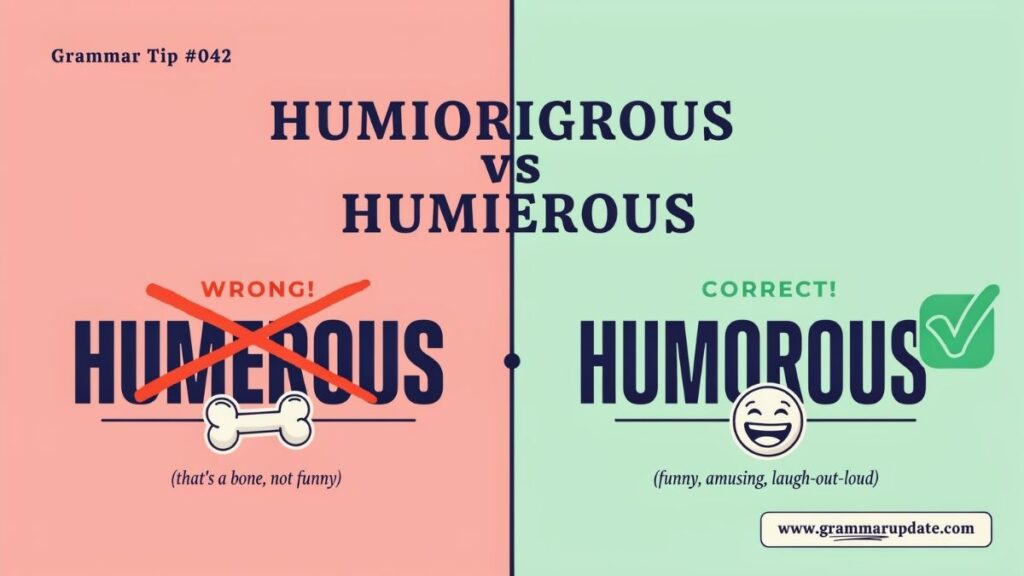
When two words look almost identical, its easy to mix them up. Humorous and humerous are a perfect example. One is the correct spelling for something funny or amusing, while the other is a common spelling mistake. The confusion becomes even greater because humorous sounds similar to humerus, the long bone in your upper arm. In this guide to Humorous vs Humerous, you’ll learn the correct spelling, understand the meaning and pronunciation, and see how to use the word naturally in everyday writing. With clear examples, simple explanations, and practical tips, you’ll know exactly which word to choose and avoid this common grammar mistake in the future.
Quick Answer Humorous vs Humerous?
Humorous is the correct spelling.
The word humorous is an adjective. It describes something that is funny, amusing, playful, or characterized by humor. You can use it to describe a person, story, comment, article, conversation, situation, or writing style.
Humerous is not the standard spelling of this adjective in US English.
For example:
- Correct: She told a humorous story.
- Incorrect: She told a humerous story.
- Correct: His humorous comment made everyone laugh.
- Incorrect: His humerous comment made everyone laugh.
- Correct: The article has a humorous tone.
- Incorrect: The article has a humerous tone.
This isn’t a situation where both spellings have different meanings, like affect and effect. In ordinary English usage, humorous is the word you want when you’re talking about something funny.
A useful spelling check is to work backward:
humorous → humor → funny or amusing
That small connection can save you from repeatedly making the same spelling mistake.
Learn the difference between basic English word mistakes
Tomorrow vs Tommorow Which one Is Correct?
Why Do People Confuse Humorous and Humerous?
The confusion mostly comes from pronunciation and appearance.
When people say humorous, they don’t pronounce every letter with equal emphasis. The middle part of the word can sound relatively weak, which makes it difficult to reconstruct the spelling from sound alone.
For many US English speakers, a simple pronunciation guide is:
HYOO-muh-rus
That doesn’t sound exactly like the written form looks. As a result, someone may hear the word, remember the general sound, and later write humerous instead of humorous.
The visual similarity doesn’t help either.
Compare the two:
humorous
humerous
Only one letter separates them. When you’re writing quickly, that missing o can slip away almost unnoticed.
There’s also a third word that adds to the confusion: humerus.
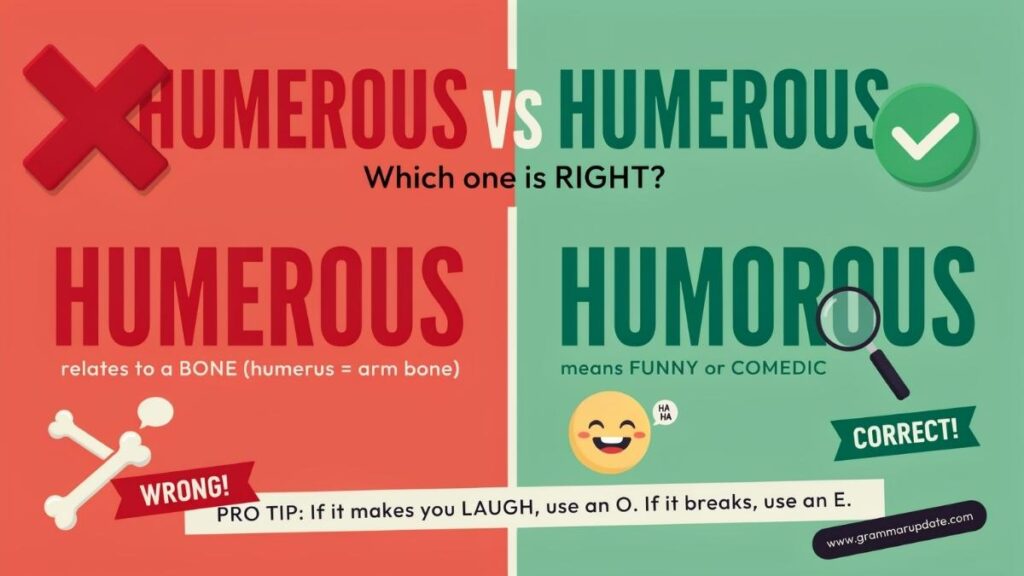
The word humerus is a legitimate anatomical term. It refers to the long bone in the upper arm. Because humerus and humorous look and sound somewhat alike, they can become mixed up in memory.
The result is often humerous, which looks plausible but doesn’t work as the standard adjective meaning funny.
A simple way to remember the spelling
Think of humorous as:
humor + ous = humorous
The word starts with humor. If you’re describing something funny, keep that base word intact.
That gives you a simple rule:
If you mean funny, use humorous.
Humorous Meaning What Does Humorous Mean?
The basic humorous meaning is funny, amusing, or related to humor.
The word can describe something that makes people laugh, but it doesn’t always mean something is extremely funny. That’s an important distinction.
A humorous story might make you laugh out loud. It might also simply make you smile. A humorous comment might be clever rather than laugh-out-loud funny. A humorous person might have a playful way of looking at everyday situations without constantly telling jokes.
For example:
The teacher used a humorous example to explain the difficult grammar rule.
The example doesn’t have to be hilarious. It simply uses humor to make the explanation more engaging.
Humorous can describe:
- Something intended to amuse
- Something that contains humor
- A person who expresses humor
- A playful style of communication
- A story with funny elements
- A lighthearted observation
- A writing style that uses humor
- A conversation with a playful tone
This broader meaning explains why humorous appears in many different types of writing.
Humorous definition in simple English
If you want a plain-English humorous definition, think of the word this way:
Humorous describes someone or something that uses, shows, contains, or creates humor.
For example:
The comedian gave a humorous speech.
The speech contained humor.
She has a humorous personality.
Her personality tends to be playful or funny.
The writer took a humorous approach.
The writer used humor as part of the style.
These examples show that humorous doesn’t always describe a joke. It can describe the overall character of something.
What Does Humerous Mean?
When people write humerous, they usually intend to write humorous.
In that context, humerous is a spelling mistake rather than a useful alternative.
For example:
Incorrect: The teacher gave a humerous explanation.
Correct: The teacher gave a humorous explanation.
Incorrect: We watched a humerous video.
Correct: We watched a humorous video.
Incorrect: His humerous personality made everyone comfortable.
Correct: His humorous personality made everyone comfortable.
The mistake is understandable because humerous looks like it could be a legitimate English word. English has plenty of unusual spellings, so a reader might not immediately notice the problem.
Still, standard US English uses humorous for this meaning.
Learn the difference between confusing word pairs
Awful vs Awfull Which one Is Correct?
Humorous vs Humerous Key Differences at a Glance
The difference is easier to understand when you put the two spellings side by side.
| Feature | Humorous | Humerous |
| Standard spelling | Yes | No, when intended to mean funny |
| Part of speech | Adjective | Common misspelling |
| Meaning | Funny, amusing, or characterized by humor | No standard meaning corresponding to humorous |
| Related word | Humor | None |
| Example | It was a humorous story. | It was a humerous story. |
| Appropriate in formal writing | Yes | No |
The important thing to notice is that this isn’t really a vocabulary battle between two valid words.
Humorous is the standard word.
Humerous is generally the error.
That makes this spelling question much simpler than many word-choice questions that involve two legitimate terms.
How to Spell Humorous Correctly
The best way to remember the humorous spelling is to start with the word humor.
The relationship is straightforward:
humor → humorous
The spelling of humorous is:
H-U-M-O-R-O-U-S
The common mistake looks like this:
H-U-M-E-R-O-U-S
The second version replaces the o with an e.
That small change creates the problem.
Use the base-word method
Instead of memorizing the entire word as a random collection of letters, remember its family:
- Humor
- Humorous
- Humorously
- Humorless
- Humorousness
The base word gives you a reliable clue.
If you know how to spell humor, you already have most of humorous.
A quick memory trick
Try this:
Humor makes you laugh, and humorous keeps the o.
It’s simple, but simple spelling tricks tend to stick.
Another useful check is to ask yourself:
Can I replace this word with funny?
If yes, humorous may be the word you’re looking for.
For example:
She wrote a humorous article.
She wrote a funny article.
The two sentences have similar meanings, although humorous can sound slightly more descriptive or formal.
Learn the difference between confusing word pairs
Ingenuine vs Ungenuine Which one Is Correct?
Humorous Pronunciation How Do You Say It?
Humorous pronunciation can contribute to the spelling problem.
A common US English pronunciation is represented as:
/ˈhjuː.mə.rəs/
For everyday readers, a useful approximation is:
HYOO-muh-rus
The middle syllable is relatively light. That’s one reason the spelling isn’t always obvious when you hear the word.
This is an important lesson about English spelling: pronunciation doesn’t always tell you exactly how to spell a word.
You can hear humorous clearly and still be unsure whether the middle contains an o or an e.
That’s why connecting the word to humor works better than trying to spell it entirely from sound.
Humorous pronunciation and humerus pronunciation
The Humorous and humerus can sound similar enough to cause confusion, but their meanings are completely different.
Humorous relates to humor.
Humerus relates to anatomy.
Consider these two sentences:
The speaker gave a humorous presentation.
The X-ray showed damage to the humerus.
The first sentence describes something funny or amusing. The second refers to a bone.
That distinction becomes much easier once you connect each word to its subject.
Learn the difference between confusing word pairs
Ironic vs Unironic which one is correct and usage?
What Is the Difference Between Humorous vs Humerus?
This is where the spelling gets particularly interesting.
Humorous means funny or amusing.
Humerus refers to the long bone in the upper arm.
The humerus extends from the shoulder to the elbow. It’s one of the major bones of the upper limb.
For example:
The comedian gave a humorous speech.
The doctor examined the patient’s humerus.
The words may look similar, but their meanings have nothing to do with each other.
One belongs to language and humor. The other belongs to anatomy.
What is the funny bone called?
The expression funny bone can make the whole situation even more confusing.
Despite the name, the funny bone isn’t actually a bone called the funny bone. The expression commonly refers to the area around the ulnar nerve at the back of the elbow, where the nerve passes close to the humerus.
That’s why hitting your funny bone produces that familiar sharp, tingling sensation.
So you can remember the three terms this way:
- Humorous = funny or amusing
- Humerus = upper-arm bone
- Funny bone = common expression involving the ulnar nerve near the elbow
There’s the spelling lesson hiding inside an anatomy lesson.
Learn the difference between confusing word pairs
Rehireable vs Rehirable Which Spelling Is Correct?
Humorous in a Sentence Practical Examples
The best humorous examples show how the word works naturally in real sentences.
Humorous person
A humorous person is someone who tends to express, notice, appreciate, or create humor.
For example:
Jordan is a humorous person who can make an ordinary meeting feel much lighter.
This doesn’t mean Jordan works as a comedian. A person can be humorous without telling jokes all day.
Someone may simply have a playful personality or a habit of making clever observations.
Humorous story
A humorous story contains amusing events, descriptions, observations, or characters.
For example:
Grandpa told a humorous story about getting lost during his first road trip.
The story might be funny because of what happened, how it was told, or both.
Humorous comment
A humorous comment can change the mood of a conversation.
For example:
Her humorous comment broke the tension in the room.
The comment doesn’t need to be hilarious. Sometimes a small joke is enough to make people relax.
Humorous writing
Humorous writing uses humor as part of its style.
For example:
The columnist uses humorous writing to explain everyday workplace problems.
The subject can still be serious. Humor simply becomes part of the way the writer presents the subject.
Humorous expression
A humorous expression can communicate amusement, irony, playfulness, or a joke.
For example:
His humorous expression made the otherwise serious photograph feel playful.
Humorous tone
A humorous tone means the writing or conversation contains a noticeable element of humor.
For example:
The article uses a humorous tone without making light of the underlying issue.
That’s an important distinction. A humorous tone doesn’t mean the writer treats every subject as a joke.
Humorous Examples in a Sentence
Here are several natural examples showing how humorous works in different situations:
- The professor gave a humorous explanation of a difficult concept.
- Her humorous response made everyone smile.
- The documentary includes several humorous moments.
- His humorous personality helped him connect with the audience.
- The writer uses a humorous tone throughout the article.
- The advertisement takes a humorous approach to a familiar problem.
- The children created several humorous stories during the writing exercise.
- His humorous observation revealed an awkward truth.
- The novel combines serious themes with humorous scenes.
- The speaker included a few humorous anecdotes in the presentation.
Notice how the word changes slightly depending on what it describes.
1.A humorous story contains humor.
2.A humorous person expresses humor.
3.A humorous tone creates a particular feeling.
4.A humorous article uses humor as part of its writing style.
The core idea stays the same.
Learn the difference between confusing word pairs
Cancell vs Cancel Which One Is Correct?
Humorous vs Funny Are They the Same?
Humorous and funny overlap, but they aren’t interchangeable in every situation.
Funny is more common in everyday conversation. It’s short, natural, and flexible.
For example:
That movie was funny.
That joke was funny.
He’s a funny guy.
Humorous can sound slightly more descriptive.
For example:
The movie has a humorous tone.
The article takes a humorous approach.
The character has a humorous personality.
There’s another important difference: funny has meanings that don’t relate to humor.
Consider:
There’s something funny about this receipt.
Here, funny might mean suspicious, unusual, or strange.
Humorous doesn’t normally carry that meaning.
That’s why the two words aren’t perfect substitutes.
| Word | Main idea | Example |
| Funny | Amusing, strange, or unusual depending on context | That was a funny joke. |
| Humorous | Characterized by or expressing humor | The article has a humorous tone. |
| Amusing | Pleasantly entertaining | The story was amusing. |
| Hilarious | Extremely funny | The scene was hilarious. |
| Witty | Clever and humorous | She gave a witty reply. |
Learn the difference between confusing word pairs
Favour vs Favor Which Spelling Is Correct?
Humorous vs Hilarious vs Amusing vs Witty
These words often appear together, but each carries a slightly different shade of meaning.
Humorous
Humorous is broad. It describes something that contains or expresses humor.
A humorous story may make you laugh, smile, or simply recognize the writer’s playful intent.
Funny
Funny is the everyday choice for something that makes you laugh.
It also has several other meanings, including strange or suspicious.
Hilarious
Hilarious is much stronger.
If you call something hilarious, you’re saying it is extremely funny or produces a strong reaction.
For example:
The comedian’s opening story was humorous.
The comedian’s final story was hilarious.
The first sentence gives a general description. The second suggests a much stronger reaction.
Amusing
Amusing often suggests lighter entertainment.
Something amusing might make you smile without causing a major burst of laughter.
Witty
Witty emphasizes cleverness.
A witty remark isn’t simply funny. It usually has some cleverness, quick thinking, wordplay, or sharp observation behind it.
Compare:
She made a humorous comment.
This tells you the comment was funny.
She made a witty comment.
This suggests the humor came partly from cleverness.
Humorous Synonyms and Their Differences
There are plenty of humorous synonyms, but choosing one depends on what you want to emphasize.
Useful alternatives include:
- Funny
- Amusing
- Comical
- Comic
- Comedic
- Entertaining
- Witty
- Jocular
- Jocose
- Facetious
These words aren’t identical.
Funny is the most natural everyday option.
Amusing suggests mild enjoyment.
Hilarious suggests intense humor.
Witty emphasizes cleverness.
Comedic relates more directly to comedy.
Jocular often describes someone who enjoys joking.
Facetious can describe humor that is deliberately inappropriate, flippant, or not meant to be taken seriously.
That last distinction matters. Calling someone facetious isn’t necessarily a compliment.
The best synonym isn’t simply the one that appears first in a thesaurus. It’s the one that matches the exact meaning and tone you need.
Is Humerous a Real Word?
If you’re asking whether humerous is a correct alternative to humorous, the practical answer is no.
When you want to describe something as funny or amusing, use humorous.
Don’t write:
The article has a humerous tone.
Write:
The article has a humorous tone.
The spelling humerous can look convincing because English contains many unusual word forms. It also resembles humerus, which is a legitimate anatomical word.
But appearance isn’t enough to establish a word as standard English.
When you’re unsure, check the spelling against the base word:
humor → humorous
That gives you the answer.
Is Humourous a Real Word?
This question can be confusing because American and British English use different spellings for some words.
American English generally uses humor.
British English generally uses humour.
The US form is:
humor → humorous
So for US English, the spelling to use is humorous.
Don’t turn the American spelling into humerous. That isn’t the correct US form.
The important distinction is:
US English: humor
US English adjective: humorous
The extra o remains part of the standard spelling.
Learn the difference between often confused words
Invokes vs Evokes which one is correct?
Humorous Word Forms You Should Know
Learning related forms can make the spelling much easier to remember.
| Word | Part of speech | Meaning | Example |
| Humor | Noun/verb | Amusing quality or the act of indulging someone | His humor was subtle. |
| Humorous | Adjective | Funny or characterized by humor | She wrote a humorous article. |
| Humorously | Adverb | In a humorous way | He spoke humorously about the mistake. |
| Humorousness | Noun | The quality of being humorous | The humorousness of the scene was obvious. |
| Humorless | Adjective | Lacking humor | The presentation felt humorless. |
The base word humor has a long history. Its earlier meanings were connected to bodily fluids and temperament before the modern association with amusement and comedy developed.
That history isn’t necessary for spelling the word, but it does explain why humor has such a broad range of meanings today.
Learn the difference between often confused words
Chief vs Chef difference and Which One Is Correct?
Humor and Humorous How the Words Connect
The spelling becomes much easier when you see the relationship between the words.
Start with:
humor
Then:
humorous
Then:
humorously
The adjective humorous is built from the base word humor.
That makes the spelling much more logical than it first appears.
You don’t need to memorize humorous as a completely separate word. Think of it as a member of the humor word family.
This approach also helps when proofreading. If you see humerous on the page, compare it with the word family:
humor
humorous
humorously
The missing o becomes obvious.
What Is a Humorous Body Part?
The phrase humorous body part can cause an amusing search mix-up.
There isn’t a body part called the humorous.
If you’re thinking about the upper-arm bone, the word is humerus.
The humerus is the long bone that connects the shoulder region to the elbow.
If you’re thinking about the funny bone, you’re talking about the area near the elbow where the ulnar nerve passes close to the humerus.
So the correct terms are:
- Humorous: funny or amusing
- Humerus: upper-arm bone
- Funny bone: common name for the area involving the ulnar nerve near the elbow
The similarity between these words explains why spelling mistakes can happen. They look related even though their meanings are very different.
What Does a Humorous Person Mean?
The humorous person meaning is someone who tends to express or appreciate humor.
A humorous person might:
- Make clever observations
- Tell amusing stories
- Use playful language
- Find humor in ordinary situations
- Make conversations feel lighter
- Use jokes appropriately
- See unexpected or absurd sides of everyday events
However, humorous doesn’t automatically mean comedian.
A teacher can be humorous.
A manager can be humorous.
A writer can be humorous.
A friend can be humorous.
The word describes a quality or style, not a profession.
For example:
The humorous teacher explained the complicated lesson through funny everyday examples.
The teacher’s humor becomes part of the teaching style.
What Is a Humorous Tone in Writing?
A humorous tone means the writer uses humor to shape how the reader experiences the subject.
That might involve:
- Wordplay
- Irony
- Exaggeration
- Understatement
- Unexpected comparisons
- Playful descriptions
- Clever observations
- Comic timing
- Light sarcasm
- Personal anecdotes
A humorous tone doesn’t require a joke in every paragraph.
In fact, strong humorous writing often works because the humor appears naturally.
For example:
The printer worked perfectly until the exact moment someone actually needed it.
That’s humorous because it captures a familiar frustration in an exaggerated, playful way.
The sentence doesn’t tell a formal joke. It turns an ordinary experience into a recognizable observation.
Humorous writing can make information easier to remember
Humor can also make educational writing more engaging.
Suppose a grammar lesson explains a complicated rule. A dry explanation may be accurate but forgettable.
A humorous example can give the same rule a little personality.
For example:
The comma has many jobs, but apparently it didn’t apply for the position of “pause wherever I feel like it.”
The humor doesn’t replace the lesson. It makes the lesson easier to remember.
Learn the difference between often confused words
Drily vs Dryly Which One Is Correct?
A Practical Case Study Humorous, Humerous, and Humerus
Imagine you’re writing about an athlete who recently appeared in an interview after an injury.
You might write:
The athlete gave a humorous interview after the game.
Here, humorous means funny or amusing.
Later, you might write:
Doctors examined the athlete’s humerus after the fall.
Now the subject is anatomy.
Then you could write:
He joked about hitting his funny bone during the accident.
This refers to the familiar area around the ulnar nerve near the elbow.
Three similar expressions appear in the same story:
Humorous = funny
Humerus = upper-arm bone
Funny bone = common term connected with the ulnar nerve near the elbow
Once you separate their meanings, the spelling becomes much less confusing.
How Search Results Can Add to the Confusion
Search engines can help you research spelling, but search results aren’t dictionaries.
If you search Google USA search, Google search USA, or American Google search, you’ll find pages based on the search engine’s interpretation of your query. You may even encounter pages that contain the same spelling mistake you’re trying to investigate.
That doesn’t make the spelling correct.
The same idea applies to searches involving:
- USA Google search engine
- Google US version
- Google United States
- Google USA homepage
- Google search in English
- Google US English
- Search Google in America
- Google web search
- Google search platform
- Google tools in the USA
- Google services in the USA
- Google products and services
These terms relate to search platforms, regional settings, or Google services. They don’t determine whether humorous or humerous is the correct spelling.
Reliable dictionaries and established English references are better sources for spelling questions.
Search popularity can tell you what people type. It can’t automatically tell you what standard English recommends.
Google USA English and the Correct Spelling
Someone searching Google USA English or Google search in English may want results that reflect American English.
For this word, the standard US form is clear:
humor → humorous
American English uses humor rather than the British spelling humour.
That doesn’t mean every English-speaking country uses exactly the same spelling conventions. English varies by region.
However, this particular article follows US English, so humorous is the appropriate form.
When Should You Use Humorous?
Use humorous when you want to describe something as funny, amusing, playful, or characterized by humor.
It works well in:
- Everyday writing
- Articles
- Essays
- Reviews
- Professional writing
- Educational content
- Creative writing
- Conversations
- Descriptions of people
- Descriptions of stories
- Discussions about tone
For example:
The author uses a humorous style to discuss common workplace problems.
The documentary contains several humorous moments.
She has a humorous personality.
The speaker gave a humorous presentation.
In everyday conversation, funny may sound more natural.
In more descriptive writing, humorous can offer a little more precision.
When Might Another Word Work Better?
Humorous is correct, but correct doesn’t always mean best.
Sometimes another word expresses your meaning more precisely.
1.Use funny when you want a simple, everyday word.
2.Use hilarious when something is extremely funny.
3.Use amusing when something provides light entertainment.
4.Use witty when cleverness is central to the humor.
5.Use comedic when you’re talking specifically about comedy or a comedic style.
For example:
1.Her comment was funny.
2.Her comment was witty.
3.Her comment was hilarious.
These sentences aren’t identical. Each one gives the reader a slightly different impression.
Good writing isn’t just about avoiding mistakes. It’s about choosing the word that fits the idea.
Learn the difference between often confused words
Weighed vs Weighted Which One Is Correct?
Common Humorous vs Humerous Mistakes
The most common error is simply dropping the second o.
| Incorrect | Correct |
| She wrote a humerous article. | She wrote a humorous article. |
| He gave a humerous answer. | He gave a humorous answer. |
| It was a humerous story. | It was a humorous story. |
| The book has a humerous tone. | The book has a humorous tone. |
| His humerous personality made people laugh. | His humorous personality made people laugh. |
| The movie contains several humerous scenes. | The movie contains several humorous scenes. |
| She made a humerous observation. | She made a humorous observation. |
A quick proofreading test
Whenever you see humerous in your writing, ask:
Am I describing something funny?
If yes, use humorous.
If you’re describing the upper-arm bone, use humerus.
That simple test separates the two words immediately.
Why the Error Can Survive Spell-Checking
Spelling mistakes aren’t always obvious to the eye.
Humerous looks close enough to humorous that a reader may understand the intended meaning without noticing the error.
That’s one reason proofreading still matters.
A word can communicate the intended idea and still be spelled incorrectly.
This is especially important in:
- School assignments
- Articles
- Professional reports
- Resumes
- Business communication
- Website content
- Educational materials
- Formal documents
A single spelling error usually won’t destroy a piece of writing. Still, repeated errors can make the writing look less polished.
When the correction is as simple as remembering humor → humorous, there’s little reason to let the mistake stick around.
A Simple Memory Trick for Humorous vs Humerous
Here’s the easiest rule to remember:
Humor has an o, and humorous keeps it.
You can also remember the word family:
humor → humorous → humorously
If you can spell humor, you already know the beginning of humorous.
Another useful trick is to picture the word as:
HUMOR + OUS
That gives you:
HUMOROUS
Instead of trying to remember every letter individually, you remember the word’s structure.
That is often much easier.
Learn the difference between often confused words
Insue vs Ensue Which One Is Correct?
Practice Session Humorous vs Humerous
Fill in each blank with the correct word: humorous vs humerous.
- The teacher gave a __________ explanation that made the difficult topic easier to understand.
- She told a __________ story about her first day at college.
- His __________ comments made everyone laugh during the meeting.
- The article uses a __________ tone to discuss common grammar mistakes.
- We watched a __________ movie last night.
- Her __________ personality makes conversations more enjoyable.
- The writer added a few __________ examples to keep the article interesting.
- He gave a __________ response to a serious question.
- The comedian is known for his __________ observations about everyday life.
- The book combines serious topics with __________ stories.
- She wrote a __________ paragraph about her experience at work.
- His __________ sense of humor helped him make friends quickly.
- The presentation included several __________ anecdotes.
- The advertisement takes a __________ approach to a common problem.
- The student used a __________ example to explain the grammar rule.
- The doctor examined the patient’s __________ after the accident.
- The word __________ means funny, amusing, or characterized by humor.
- The sentence “She told a __________ story” uses the correct spelling of the adjective.
- Many writers accidentally spell humorous as __________.
- If you mean “funny,” the correct spelling is __________.
- The comedian gave a __________ speech at the event.
- His __________ response helped break the tension in the room.
- The novel has a light and __________ writing style.
- The teacher asked students to write a __________ sentence using the new vocabulary.
- Remember this spelling trick: humor → __________.
Answers
- humorous
- humorous
- humorous
- humorous
- humorous
- humorous
- humorous
- humorous
- humorous
- humorous
- humorous
- humorous
- humorous
- humorous
- humorous
- humerus
- humorous
- humorous
- humerous
- humorous
- humorous
- humorous
- humorous
- humorous
- humorous
Here’s a trusted source for clear word meanings:
FAQs
Is humorous or humerous the correct spelling?
Humorous is the correct spelling when you mean funny, amusing, or related to humor. Humerous is a common misspelling and should not be used in standard US English.
What does humorous mean?
Humorous means funny, amusing, or characterized by humor. You can use it to describe a person, story, comment, conversation, writing style, or situation.
How do you spell humorous correctly?
The correct spelling is humorous: H-U-M-O-R-O-U-S. A useful way to remember it is to connect it with the base word humor: humor → humorous.
Why is humorous sometimes spelled humerous?
People often spell humorous as humerous because the middle sound can be difficult to hear clearly. The two spellings also look very similar. However, only humorous is the standard spelling for the meaning “funny.”
Is humerous a word?
Humerous is not the standard spelling of the adjective meaning funny or amusing. If you’re describing something as funny, use humorous.
What is the difference between humorous and humerus?
Humorous means funny or amusing. Humerus is the name of the long bone in the upper arm. They look and sound similar, but they have completely different meanings.
What is the noun form of humorous?
The related noun is humor. It refers to the quality or ability to recognize and express things that are amusing. Humorous is the adjective form.
What is the abstract noun for humorous?
Humor can function as the noun associated with humorous. Another noun form is humorousness, which refers to the quality of being humorous, although humor is much more natural in everyday English.
Is humorous the same as funny?
Humorous and funny have similar meanings when they describe something amusing. However, funny has additional meanings, such as strange or unusual. Humorous specifically relates to humor.
What is the difference between humorous and hilarious?
Humorous is a broad word for something characterized by humor. Hilarious is stronger and describes something extremely funny. A story can be humorous without being hilarious.
What are some synonyms for humorous?
Common synonyms include funny, amusing, witty, comical, comic, comedic, entertaining, jocular, and facetious. The best choice depends on the exact tone and meaning you want.
How do you use humorous in a sentence?
You can use humorous before a noun to describe something funny or amusing. For example: “She wrote a humorous story about her first day at work.”
What does a humorous person mean?
A humorous person is someone who tends to express, notice, or appreciate humor. The word describes a person’s style or personality and doesn’t necessarily mean that the person is a comedian.
What is a humorous tone?
A humorous tone means that a speaker or writer uses humor, playful language, irony, exaggeration, or amusing observations while discussing a subject.
How do you pronounce humorous?
In US English, humorous is commonly pronounced approximately “HYOO-muh-rus.” The middle syllable is relatively weak, which may partly explain why people sometimes misspell the word.
How do you pronounce humerus?
Humerus is commonly pronounced approximately “HYOO-muh-rus.” Although its pronunciation resembles humorous, its meaning is completely different because humerus refers to an upper-arm bone.
Is the humerus the funny bone?
No. The humerus is the long bone of the upper arm. The expression funny bone usually refers to the area around the ulnar nerve at the back of the elbow, where the nerve passes close to the humerus.
Why is it called the funny bone?
The term funny bone is a wordplay based partly on the similar sound of humerus and “humorous.” It also describes the odd tingling or painful sensation people experience when they strike the ulnar nerve near the elbow.
What nerve do you hit when you hit your funny bone?
You usually hit or irritate the ulnar nerve when you strike the area commonly called the funny bone. The nerve runs along the inside of the elbow near the humerus.
What is another name for the humerus?
The humerus is commonly described as the upper-arm bone. It connects the shoulder region to the elbow and forms the main bone of the upper arm.
Is “humourous” the same as “humorous”?
In US English, use humorous. The spelling humor is the standard American form of the noun, while British English commonly uses humour. The spelling humerous is not the standard American form of humorous.
Which is correct in US English: humor or humour?
Humor is the standard US English spelling. Humour is the traditional British English spelling. Therefore, American English uses humor and humorous.
Why does humorous have an extra “o”?
Humorous comes from the word humor combined with the adjective-forming ending -ous. Seeing the word as humor + ous makes the spelling easier to remember.
What is the easiest way to remember humorous?
Connect the adjective to its base word: humor → humorous. If you’re describing something as funny or amusing, remember that humorous keeps the spelling of humor.
What is the most common mistake when spelling humorous?
The most common mistake is dropping the second o and writing humerous. The correct form is humorous.
Is “humorous” an adjective?
Yes. Humorous is an adjective that describes someone or something as funny, amusing, or characterized by humor.
Can humorous describe a person?
Yes. You can describe someone as humorous when they regularly express or appreciate humor. For example: “Her humorous personality made everyone feel comfortable.”
Can humorous describe writing?
Yes. Humorous writing uses humor as part of its style. It may include jokes, irony, wordplay, exaggeration, playful observations, or amusing stories.
Can humorous describe a serious subject?
Yes. A writer can use a humorous tone while discussing a serious subject. Humor can make difficult or complicated material more approachable without changing the underlying subject.
What is the difference between humorous and witty?
Humorous broadly describes something that expresses or contains humor. Witty places more emphasis on cleverness, especially clever or quick remarks.
What is the difference between humorous and amusing?
Both words can describe something that gives you pleasure or makes you smile. Humorous specifically connects to humor, while amusing often suggests something mildly entertaining.
What is the difference between humorous and comical?
Humorous means funny or characterized by humor. Comical often describes something that resembles comedy or appears amusing because of its behavior, appearance, or situation.
Can humorous and hilarious be used interchangeably?
Not always. Both can describe something funny, but hilarious is much stronger. Calling something humorous gives a general description, while calling it hilarious suggests a very strong comic effect.
Is “humerous” a synonym for humorous?
No. Humerous should not be treated as a synonym or alternative spelling of humorous in standard US English. Use humorous when you mean funny or amusing.
What should you write: “a humorous story” or “a humerous story”?
Write “a humorous story.” The spelling humerous is incorrect when you mean a story that is funny or amusing.
What should you write: “humorous person” or “humerous person”?
Write “humorous person.” It means a person who tends to express or appreciate humor.
What should you write: “humorous writing” or “humerous writing”?
The correct phrase is “humorous writing.” It describes writing that uses humor as part of its style.
What should you write: “humorous tone” or “humerous tone”?
The correct phrase is “humorous tone.” It describes a style of speaking or writing that contains humor or playful elements.
What is the difference between humorous and humorousness?
Humorous is an adjective that describes something as funny or characterized by humor. Humorousness is a noun referring to the quality of being humorous. In everyday writing, humor is usually the more natural noun.
Conclusion
The confusion between humorous vs humerous is easy to clear up once you know the simple rule: humorous is the correct spelling when you mean funny, amusing, or entertaining. Humerous is a common spelling mistake.
A quick memory trick can help. Think of the base word humor and add -ous: humor → humorous. That extra o belongs there, so don’t drop it.
Also, don’t mix up humorous with humerus. Humorous describes something funny, while the humerus is the long bone in your upper arm. They may look and sound similar, but their meanings are worlds apart.
So, if you’re writing about a funny story, a witty comment, or an amusing person, choose humorous. Once you connect the word to humor, the spelling becomes much easier to remember.
In short, keep the o, skip the confusion, and write humorous. Your grammar will thank you.

Jhon AJS, the creative mind behind Grammar Update, is an experienced blogger passionate about simplifying English grammar. He focuses on explaining confusing word vs word differences, grammar rules, punctuation, and sentence structure in a clear and practical way. Through easy to understand guides and examples, Jhon helps readers improve their writing and communicate with confidence. With years of blogging experience, he continues to share helpful insights that make learning grammar simple, useful, and accessible for everyone.