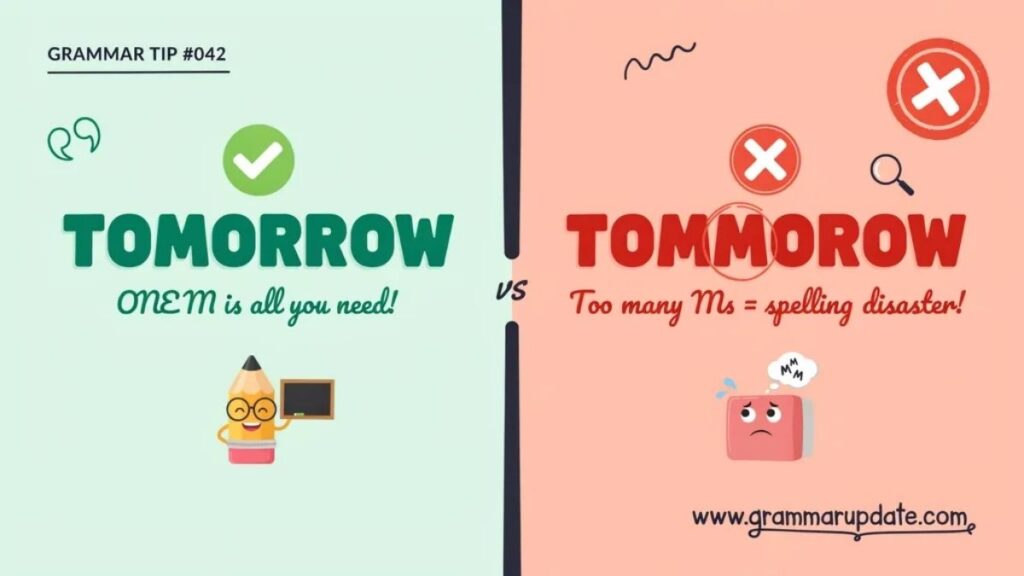
The Tomorrow vs Tommorow confusion is a small spelling problem that can cause surprising doubt. Both forms may look familiar, but only one is correct. Tomorrow is the standard spelling, while tommorow is a common mistake caused by adding an extra m and missing one r. The easiest way to remember the correct form is simple: tomorrow has one m and two r’s. This word appears everywhere, from everyday messages to school assignments and professional emails. A small spelling error can distract readers from your message. Fortunately, the fix is easy. Once you understand the pattern, spelling tomorrow correctly becomes simple and natural.
Quick Answer
The correct spelling is tomorrow.
Tommorow is a misspelling.
The easiest way to remember the difference is:
Tomorrow = one m + two r’s
Look closely at the word:
T O M O R R O W
There is only one m, but there are two r’s.
Here’s a quick comparison:
| Spelling | Correct? | Meaning |
|---|---|---|
| tomorrow | Yes | The day after today |
| tommorow | No | Incorrect spelling of tomorrow |
| tommorrow | No | Incorrect spelling of tomorrow |
| tomorow | No | Incorrect spelling of tomorrow |
So, if you’re searching for “tomorrow vs tommorow which is correct,” the answer is tomorrow.
For example:
“See you tomorrow.”
That’s the correct form.
Learn the difference between commonly misused words
Acreage vs Acrag difference and Which Spelling Is Correct?
Tomorrow vs Tommorow Clear the Confusion
The Tomorrow vs tommorow spelling confusion usually comes from one small detail: the doubled letters appear in the middle of the word, not near the beginning.
The correct spelling is:
TOMORROW
The incorrect spelling is:
TOMMOROW
Notice the difference.
Tomorrow contains one m followed by two r’s. Tommorow contains two m’s and only one r.
That’s the whole spelling problem.
| Correct | Incorrect |
| TOMORROW | TOMMOROW |
| One m | Two m’s |
| Two r’s | One r |
If you remember only one thing from this article, remember this:
One m. Two r’s.
Why Tomorrow Is the Correct Spelling
Tomorrow is the standard spelling used in modern English.
It doesn’t matter whether you’re writing a casual text, a school assignment, a business email, or a formal report. The spelling remains tomorrow.
There isn’t a US English version called “tommorow.” British English doesn’t use it either.
Both American English and British English spell the word the same way:
Tomorrow.
The confusion probably feels bigger than it really is because English spelling often doesn’t match pronunciation perfectly. You may know exactly how the word sounds while still hesitating over its letters.
That happens with many English words.
For tomorrow, the best solution isn’t to guess from pronunciation. Instead, remember its letter pattern.
TOM + ORROW = TOMORROW
Once you see that pattern a few times, the spelling becomes much easier to recognize.
Why Tommorow Is Incorrect
Tommorow is incorrect because it contains an extra m and misses one of the r’s.
Compare the two forms:
Correct: tomorrow
Incorrect: tommorow
The incorrect version often looks believable because English has many words with double consonants. Words such as running, stopped, and bigger can make a writer expect doubled letters in other places.
However, tomorrow doesn’t follow that pattern.
It has one m.
The double letters appear with r:
TOMORROW
This is why the phrase “one m, two r’s” makes such a useful memory trick.
Why do people spell tomorrow as tommorow?
People make this mistake for several ordinary reasons.
First, pronunciation doesn’t always reveal the spelling clearly. When you say tomorrow quickly, some sounds become less distinct.
Second, people often rely on how a word feels rather than how it looks. If the spelling isn’t firmly stored in memory, the brain fills in the letters using familiar patterns.
Third, fast typing can create mistakes that you wouldn’t make when writing slowly. Your fingers may add an extra m before your eyes have a chance to catch it.
Finally, tomorrow is a very common word. Ironically, familiar words can sometimes receive less attention during proofreading because your brain reads what it expects to see.
How to Spell Tomorrow Correctly
If you’re wondering how to spell tomorrow, don’t make it harder than it needs to be.
Write it this way:
T-O-M-O-R-R-O-W
You can also divide it into smaller visual parts:
TOM + ORROW
Then put them together:
TOMORROW
The most useful memory rule is:
One M, two Rs.
Here’s another way to check yourself:
- Start with TOM.
- Add ORROW.
- Make sure you have two r’s.
- Finish with OW.
You don’t need a complicated spelling formula. A simple visual pattern works better.
Learn the difference between commonly misused words
Calendar vs Calender difference and Which Spelling Is Correct?
How to Remember the Correct Spelling of Tomorrow
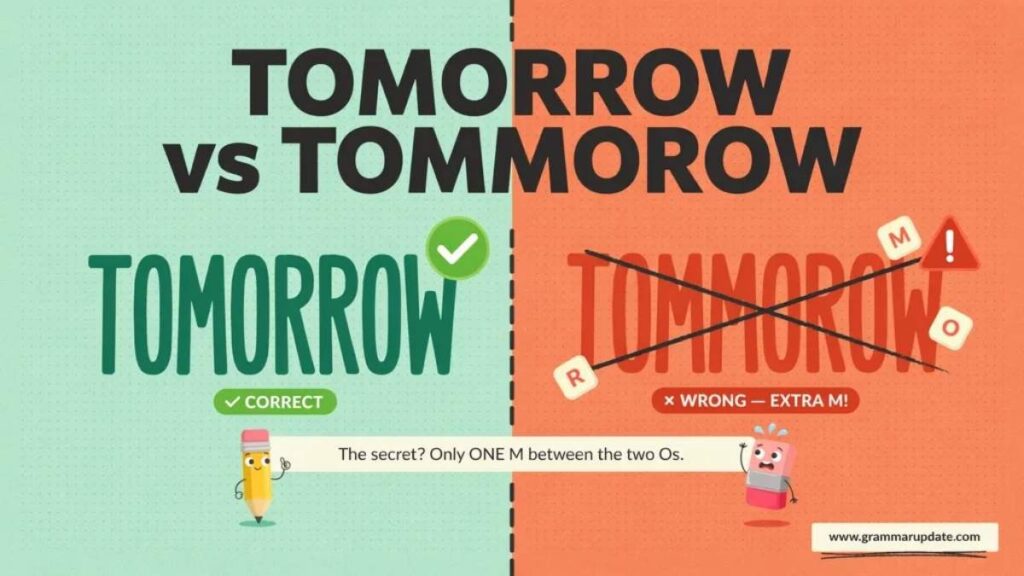
If tomorrow keeps causing trouble, use a short memory trick instead of repeatedly guessing.
Remember:
Tomorrow has one m but two r’s.
You can also compare the common mistakes:
Tommorow → too many m’s
Tomorow → not enough r’s
Tomorrow → correct
This method helps because it teaches you exactly what goes wrong.
Another useful trick is to write the word in a sentence several times:
“I’ll see you tomorrow.”
“The meeting is tomorrow.”
“I need to finish this tomorrow.”
“Tomorrow will be busy.”
Once you see and write the correct pattern repeatedly, it becomes easier to recall without thinking about every letter.
This is especially useful for students and English learners who are building their English vocabulary.
Tomorrow Meaning and Definition
The basic tomorrow meaning is “the day after today.”
For example, if today is Tuesday, tomorrow is Wednesday.
The relationship looks like this:
Yesterday → Today → Tomorrow
If today is August 18, tomorrow is August 19.
The word can also refer to the future in a broader sense.
For example:
“Today’s decisions can shape tomorrow.”
In this sentence, tomorrow doesn’t necessarily mean only the next calendar day. It represents the future.
So the tomorrow word meaning depends on context.
| Use | Meaning | Example |
| Specific day | The day after today | I’ll call you tomorrow. |
| Future | A later time or the future | We’re building a better tomorrow. |
This distinction helps explain why tomorrow appears in both ordinary conversations and more figurative expressions.
Tomorrow Day Meaning
The tomorrow day meaning is simple: tomorrow is the calendar day immediately after today.
Suppose today is Friday.
Then:
- Yesterday was Thursday.
- Today is Friday.
- Tomorrow is Saturday.
The definition never changes. What changes is the actual date.
That makes tomorrow a relative time word. Its meaning depends on when you say it.
For example, if someone says “I’ll do it tomorrow” on Monday, they mean Tuesday. If they say the same sentence on Saturday, they mean Sunday.
The word stays the same while the date changes.
Tomorrow as an Adverb
Tomorrow often works as an adverb because it tells you when an action will happen.
For example:
“I’ll call you tomorrow.”
“We’re leaving tomorrow.”
“She starts work tomorrow.”
“They arrive tomorrow.”
In each sentence, tomorrow answers the question “When?”
The word can appear at different points in a sentence.
For example:
“Tomorrow, we’ll start the project.”
“We’ll start the project tomorrow.”
Both sentences are correct.
Putting tomorrow at the beginning gives the time more emphasis. Putting it at the end sounds natural in everyday conversation.
Tomorrow as a Noun
Tomorrow can also work as a noun.
Consider this sentence:
“Tomorrow will be busy.”
Here, tomorrow acts as the subject.
Another example is:
“Tomorrow may bring new opportunities.”
In this use, tomorrow can refer to the next day or to the future more generally.
This gives the word more flexibility than you might expect from such a simple time expression.
Compare these examples:
“I’ll see you tomorrow.”
1.Tomorrow is used as an adverb because it tells us when the action will happen.
2.Tomorrow will be different.”
3.Tomorrow is used as a noun because it serves as the subject.
The spelling stays exactly the same in both sentences.
Learn the difference between commonly misused words
Awful vs Awfull Which one Is Correct?
Tomorrow’s vs Tomorrows Which Is Correct?
This question is slightly different from the Tomorrow vs Tommorow spelling issue.
Tomorrow’s and tomorrows can both be correct, but they have different uses.
Tomorrow’s usually shows possession or forms a contraction.
For example:
“Tomorrow’s meeting starts at nine.”
Here, tomorrow’s describes the meeting associated with tomorrow.
“Tomorrow’s going to be busy.”
Here, tomorrow’s means “tomorrow is.”
Tomorrows, without an apostrophe, is a plural form. It’s less common because people usually talk about one tomorrow at a time.
However, it can appear in a broader or figurative context:
“Today’s choices can shape our tomorrows.”
Here, tomorrows refers to multiple possible futures.
| Form | Use | Example |
| tomorrow | The following day | I’ll call you tomorrow. |
| tomorrow’s | Possessive or contraction | Tomorrow’s meeting starts at nine. |
| tomorrows | Plural, usually figurative | Our tomorrows depend on today. |
So don’t confuse tommorow with tomorrow’s. They are completely different issues.
Is Tomorrow Double R?
Yes. Tomorrow has two r’s.
The spelling is:
T O M O R R O W
The double r appears in the middle of the word.
This is one of the most important facts to remember about tomorrow spelling.
If you’re asking, “Does tomorrow have two r’s?” the answer is yes.
If you’re asking, “Does tomorrow have one m or two?” the answer is one.
That gives you the complete memory rule:
One M + Two R’s = TOMORROW
The mistake “tommorow” reverses the pattern. It gives you two m’s and only one r.
Learn the difference between often confused words
Ingenuine vs Ungenuine Which one Is Correct?
Tomorrow Pronunciation
Tomorrow pronunciation can vary slightly depending on the speaker’s accent.
In everyday speech, you may hear something close to:
tuh-MOR-row
The exact vowel sounds can differ between American and British speakers.
That variation helps explain why spelling the word from sound alone can be tricky. English pronunciation doesn’t always give you a perfect letter-by-letter guide.
For that reason, don’t try to spell tomorrow only by listening to it.
Remember its written pattern instead:
TOMORROW
Tomorrow pronunciation guide
| Variety | General pronunciation pattern |
| American English | tuh-MOR-row |
| British English | tuh-MOR-row, with some vowel differences |
The pronunciation may vary, but the spelling doesn’t.
Tomorrow in British English
The Tomorrow in British English spelling is tomorrow.
There’s no British spelling called tommorow.
British English and American English use the same spelling for this word.
Some expressions involving tomorrow can sound more common or natural in British English. For example, “a week tomorrow” can mean one week from tomorrow.
However, these usage differences don’t change the spelling.
So if you’re learning British English, remember:
Tomorrow = correct
Tommorow = incorrect
Tomorrow in American English
The Tomorrow in American English spelling is also tomorrow.
American English doesn’t add another m.
You can use the word in casual conversation, professional writing, academic work, and formal communication.
For example:
“I’ll send the report tomorrow.”
“The meeting starts tomorrow.”
“Tomorrow’s schedule has changed.”
The spelling remains the same in each sentence.
This is an important point when comparing American English spelling with British English spelling: not every word has a regional spelling difference. Tomorrow is one of the words that remains identical.
Learn the difference between often confused words
Rehireable vs Rehirable Which Spelling Is Correct?
Tomorrow Spelling in British English vs American English
Here’s the simple comparison:
| Feature | British English | American English |
| Spelling | tomorrow | tomorrow |
| Meaning | Day after today | Day after today |
| One m | Yes | Yes |
| Two r’s | Yes | Yes |
| Noun use | Yes | Yes |
| Adverb use | Yes | Yes |
So, if someone tells you that tommorow is the British spelling while tomorrow is the American spelling, that information is incorrect.
Tomorrow Spelling Oxford Dictionary
People often search for “Tomorrow spelling Oxford Dictionary” when they want to confirm whether a spelling is standard.
The Oxford Dictionary entry uses tomorrow as the standard spelling.
The word can function as both a noun and an adverb. Its main meaning is the day after today, while its noun use can also refer to the future.
This gives you a reliable answer to the question “Is tomorrow spelled correctly?”
Yes, if you have written:
Tomorrow.
The dictionary spelling of tomorrow does not contain a second m.
Tomorrow Word Origin
The tomorrow word origin goes back to older forms of English.
The modern word developed from an older expression involving “to” and “morrow.” Over time, those elements became joined into the single word tomorrow.
Morrow is an old-fashioned word meaning the following day or morning. You may still encounter it in older literature or deliberately poetic writing.
For example:
“On the morrow, they departed.”
Modern English would usually say:
“The next day, they left.”
The history can be summarized simply:
to + morrow → tomorrow
This explains why “to morrow” may appear in historical writing. It doesn’t mean you should use the separated form in normal modern English.
Is “To Morrow” Correct?
In modern standard English, the normal spelling is tomorrow.
“To morrow” is an older form that reflects the word’s history.
You might see it in historical texts or older literature, but it isn’t the standard form for contemporary English writing.
For modern use, write:
“I’ll see you tomorrow.”
Not:
“I’ll see you to morrow.”
Language changes over time. Older forms can help explain where words came from, but they don’t automatically remain standard today.
Is Tommorow a Word?
If you’re wondering, “Is tommorow a word?” the answer is no in standard modern English.
Tommorow is a misspelled form of tomorrow.
The same applies to several other common variations:
- tommorrow
- tomorow
- tommorow
- tomoroww
These spellings may appear in messages or online posts, but frequent use doesn’t make them correct.
A word can appear thousands of times online and still be misspelled.
That’s why a dictionary, spelling checker, or careful proofreading can help when you’re unsure.
Learn the difference between often confused words
Cancell vs Cancel Which One Is Correct?
Common Spelling Mistakes With Tomorrow
The most common spelling mistakes involving tomorrow usually involve adding, removing, or moving letters.
| Misspelled form | What went wrong | Correct form |
| tommorow | Extra m and missing r | tomorrow |
| tommorrow | Extra m | tomorrow |
| tomorow | Missing r | tomorrow |
| tomoroww | Missing r and extra w | tomorrow |
| tommoroww | Extra m and w | tomorrow |
The easiest way to avoid these mistakes is to stop trying to guess the spelling from pronunciation.
Instead, remember the structure:
TOM + ORROW
That gives you the correct spelling every time.
Tomorrow Examples in Sentences
Learning a word becomes easier when you see it in real sentences.
Everyday conversation
- “Are you free tomorrow?”
- “I’ll call you tomorrow.”
- “See you tomorrow!”
- “What are you doing tomorrow?”
- “We’re leaving tomorrow morning.”
Professional writing
- “The report is due tomorrow.”
- “The meeting will take place tomorrow.”
- “Please send the revised file by tomorrow.”
- “Tomorrow’s meeting starts at 9 a.m.”
School and academic writing
- “The assignment is due tomorrow.”
- “Tomorrow’s lesson will cover the final chapter.”
Talking about the future
- “The choices we make today can shape tomorrow.”
- “Tomorrow may bring new opportunities.”
These tomorrow examples show how naturally the word fits into everyday English.
Learn the difference between often confused words
Invokes vs Evokes which one is correct?
Tomorrow in Daily Conversation
Tomorrow appears frequently in daily conversation because people constantly talk about future plans.
You might hear:
“Are you coming tomorrow?”
“Can you finish it tomorrow?”
“Let’s talk about it tomorrow.”
“I’ll see you tomorrow morning.”
“We’re leaving tomorrow night.”
These sentences are simple, but they also show an important feature of English: tomorrow can work naturally without a preposition before it.
Say:
“I’ll see you tomorrow.”
Not:
“I’ll see you on tomorrow.”
That small difference is worth remembering.
Tomorrow vs the Next Day
Tomorrow and the next day can sometimes refer to the same day, but they don’t always work in the same situation.
Consider:
“I’m leaving tomorrow.”
Here, tomorrow means the day after today.
Now consider:
“Maria arrived Monday and left the next day.”
The next day means Tuesday because Monday establishes the reference point.
If the story later says:
“Maria said she would return the next day.”
The meaning depends on the time established by the story.
Tomorrow is tied directly to today. The next day is tied to a reference point in the context.
That distinction becomes especially useful when writing stories, reports, and explanations.
Tomorrow vs Today vs Yesterday
These three words are easy to understand when placed on a timeline:
Yesterday → Today → Tomorrow
Yesterday refers to the day before today.
Today refers to the current day.
Tomorrow refers to the day after today.
For example, if today is Monday:
- Yesterday was Sunday.
- Today is Monday.
- Tomorrow is Tuesday.
This simple relationship makes the tomorrow definition easy to remember.
When to Use a Date Instead of Tomorrow
Tomorrow is perfectly clear when everyone knows when you’re speaking or writing.
However, an exact date can be better in professional or long-lasting communication.
Compare:
“The meeting is tomorrow.”
with:
“The meeting is scheduled for August 19.”
The first sentence works well in a conversation or message sent today.
The second remains clear if someone reads the message several days later.
Exact dates are especially helpful in:
- Business emails
- Appointment notices
- Travel plans
- Project schedules
- Contracts
- Official documents
- Archived messages
Imagine opening an old email that says, “Please send the form tomorrow.”
You now have to figure out which day the sender meant.
An exact date removes that uncertainty.
This is one reason clear English writing isn’t only about grammar and spelling. Good writing also prevents confusion.
Learn the difference between confusing word pairs
Drily vs Dryly Which One Is Correct?
Tomorrow’s Correct Usage
Tomorrow appears in many common time expressions.
Tomorrow morning
“I’ll call you tomorrow morning.”
Tomorrow afternoon
“The appointment is tomorrow afternoon.”
Tomorrow evening
“We’re meeting tomorrow evening.”
Tomorrow night
“I’ll finish the work tomorrow night.”
By tomorrow
“Please send the document by tomorrow.”
This means no later than tomorrow.
The day after tomorrow
“We’re leaving the day after tomorrow.”
This means two days from today.
These expressions are common in everyday English and are useful for both English learners and native speakers.
Tomorrow Synonym and Antonym
There isn’t one perfect synonym for tomorrow in every sentence.
Depending on the context, you can sometimes use:
- the next day
- the following day
- the day after today
For example:
“I’ll call you tomorrow.”
can become:
“I’ll call you the following day.”
However, the second sentence may sound more formal and can depend on the context.
For a tomorrow antonym, yesterday provides the clearest temporal contrast:
Yesterday ↔ Today ↔ Tomorrow
These words form a simple sequence that helps learners understand basic time vocabulary.
Learn the difference between confusing word pairs
Apprised vs Appraised difference and Which One Is Correct?
How to Avoid Spelling Mistakes With Tomorrow
You don’t need a complicated system to remember tomorrow.
A few simple habits work well.
Remember the letter pattern
Think:
TOM + ORROW
Remember the double R
The word has two r’s.
Watch the M
The word has only one m.
Practice in real sentences
Instead of writing the word by itself, use it naturally:
“I’ll finish it tomorrow.”
Proofread slowly
When proofreading, pay special attention to words you type automatically. Familiar words can hide mistakes because your brain tends to read what it expects rather than what actually appears on the screen.
A spelling checker can catch many errors, but careful reading still matters.
Tomorrow Grammar Rules
Tomorrow follows ordinary English grammar patterns, but a few details are worth knowing.
You usually don’t need a preposition before it.
Correct:
“I’ll see you tomorrow.”
Incorrect:
“I’ll see you on tomorrow.”
You can place tomorrow at the beginning or end of a sentence.
“Tomorrow, we’ll start early.”
“We’ll start early tomorrow.”
Both are correct.
You can also combine it with another time expression:
“We’ll meet tomorrow morning.”
And you can use tomorrow with future forms:
“I’ll call you tomorrow.”
“We’re leaving tomorrow.”
“She’s going to start tomorrow.”
The exact tense depends on the speaker’s meaning, but the spelling of tomorrow never changes.
Tomorrow Spelling and Pronunciation Guide
The spelling is:
T-O-M-O-R-R-O-W
The pronunciation may differ slightly across accents, but the spelling remains fixed.
This is important because pronunciation can tempt you into making a spelling mistake.
If you hear someone pronounce tomorrow quickly, you might not clearly notice every sound. That doesn’t mean the written form changes.
The safest approach is to remember:
TOMORROW
One m.
Two r’s.
That’s your spelling shortcut.
Case Study A Small Spelling Error in Everyday Writing
Imagine a student writes:
“The project will be completed tommorow.”
The reader will probably understand the sentence immediately. The problem isn’t meaning. The problem is accuracy.
The corrected version is:
“The project will be completed tomorrow.”
Now imagine the same error in a business email:
“Your documents will arrive tommorow.”
Again, the meaning remains clear. However, a polished message should use the standard spelling.
This is why common spelling mistakes matter even when they don’t create complete confusion. Good English writing isn’t only about making yourself understood. It’s also about presenting information accurately and confidently.
Learn the difference between confusing word pairs
Favour vs Favor Which Spelling Is Correct?
Practice Session Tomorrow vs Tommorow
Fill in each blank with the correct form: tomorrow vs tommorow.
- I’ll call you ______ after work.
- We have a meeting ______ morning.
- Are you free ______?
- The assignment is due ______.
- She’s leaving for New York ______.
- We’ll discuss the project ______ afternoon.
- Please send me the report by ______.
- I’m going to finish the article ______.
- ______ will be another busy day.
- Can we meet ______ evening?
- The weather should improve ______.
- I’ll see you ______ at school.
- The doctor’s appointment is ______.
- We’re planning to start the work ______.
- He promised to call me ______.
- ______’s meeting starts at 10 a.m.
- I need to wake up early ______.
- They’re traveling ______ morning.
- Let’s finish this task ______.
- She said she would arrive ______.
- The event will take place ______ night.
- I’ll submit my application ______.
- What are you doing ______?
- We can talk about it ______.
- If everything goes well, the project will be finished ______.
Answers
- tomorrow
- tomorrow
- tomorrow
- tomorrow
- tomorrow
- tomorrow
- tomorrow
- tomorrow
- Tomorrow
- tomorrow
- tomorrow
- tomorrow
- tomorrow
- tomorrow
- tomorrow
- Tomorrow’s
- tomorrow
- tomorrow
- tomorrow
- tomorrow
- tomorrow
- tomorrow
- tomorrow
- tomorrow
- tomorrow
Here’s a trusted source for clear word meanings:
FAQs
Which is correct, Tommorow vs tomorrow?
Tomorrow is correct. Tommorow is a misspelling. The correct spelling contains one m and two r’s: T-O-M-O-R-R-O-W.
Is “tommorow” ever an accepted spelling?
No. Tommorow isn’t an accepted standard spelling in modern English. Use tomorrow in formal, academic, professional, and everyday writing.
How do you spell tomorrow correctly?
Spell it T-O-M-O-R-R-O-W. A simple way to remember it is “one m, two r’s.”
Why is tomorrow so easy to misspell?
Tomorrow has an unusual letter pattern that doesn’t perfectly match its pronunciation. Writers often add an extra m or leave out one of the two r’s.
Does tomorrow have one m or two?
Tomorrow has one m. The beginning of the word is “tom,” not “tomm.”
Does tomorrow have two r’s?
Yes. The correct spelling contains two consecutive r’s: tomORRow.
What is the difference between tomorrow and tommorow?
Tomorrow is the standard spelling for the day after today. Tommorow contains an extra m and is incorrect.
Is “tomorow” also a spelling mistake?
Yes. Tomorow is incorrect because it contains only one r. The correct spelling is tomorrow with two r’s.
Is “tommorrow” correct?
No. Tommorrow contains an extra m. The correct spelling is tomorrow.
Is tomorrow one word or two?
Tomorrow is normally written as one word in modern English. The older expression “to morrow” reflects an earlier form of the word.
What does tomorrow mean?
Tomorrow means the day immediately after today. It can also refer more broadly to the future, as in “a better tomorrow.”
Can tomorrow be used as both a noun and an adverb?
Yes. In “I’ll call you tomorrow,” it works as an adverb. In “Tomorrow will be busy,” it functions as a noun.
Is “tomorrow’s class” grammatically correct?
Yes. “Tomorrow’s class” is correct when you mean the class scheduled for tomorrow. For example, “Tomorrow’s class starts at 9 a.m.”
When should you use “tomorrow’s” instead of “tomorrow”?
Use tomorrow’s when you need a possessive form or a contraction. For example, “Tomorrow’s meeting is important” uses the possessive form, while “Tomorrow’s going to be busy” can mean “Tomorrow is going to be busy.”
What is the plural form of tomorrow?
Tomorrows is the plural form, although it’s uncommon in ordinary conversation. It usually appears in figurative expressions such as “Our tomorrows depend on the choices we make today.”
Is “on tomorrow” correct grammar?
Usually, no. Standard English normally uses tomorrow without “on.” Say “I’ll see you tomorrow,” not “I’ll see you on tomorrow.”
Do you say “at tomorrow morning” or “on tomorrow morning”?
Neither is normally correct. Say “tomorrow morning” without a preposition. For example, “We’ll meet tomorrow morning.”
Is “tomorrow night” correct?
Yes. “Tomorrow night” is a standard English expression for the night following today. For example, “We’re going to the movies tomorrow night.”
Is “tomorrow morning” correct English?
Yes. Tomorrow morning refers to the morning of the day after today. For example, “I’ll send the email tomorrow morning.”
Can you say “from tomorrow”?
Yes. “From tomorrow” is grammatically possible when you mean starting tomorrow. For example, “From tomorrow, the store will open earlier.” The expression is particularly common in British English.
What can you say instead of tomorrow?
Depending on the context, you can use “the next day,” “the following day,” or “the day after today.” However, these alternatives don’t always have exactly the same meaning because “tomorrow” is directly connected to today.
What is the opposite of tomorrow?
Yesterday provides the clearest opposite in everyday time expressions. The basic sequence is yesterday, today, and tomorrow.
How do you say “talk to you tomorrow”?
A natural way to say it is “Talk to you tomorrow!” You can also say “I’ll talk to you tomorrow” when you want a complete sentence.
Is tomorrow spelled differently in British and American English?
No. Both British English and American English use the spelling tomorrow. Pronunciation can vary, but the spelling stays the same.
How do British people pronounce tomorrow?
British pronunciation varies by accent, but a common pronunciation is roughly “tuh-MOR-row.” The exact vowel sounds can change between regional accents.
How do Americans pronounce tomorrow?
American pronunciation varies by region, but it commonly sounds roughly like “tuh-MOR-row.” The spelling remains tomorrow regardless of the accent.
What is a simple trick for remembering tomorrow’s spelling?
Remember this phrase: “One m, two r’s.” If you can remember that pattern, you can avoid the most common spelling errors: tommorow and tomorow.
How can you avoid making a tomorrow spelling mistake?
Learn the word visually as TOMORROW, remember that it has one m and two r’s, and check those letters when proofreading. Writing the word in several natural sentences can also reinforce the correct pattern.
Conclusion
The Tomorrow vs Tommorow confusion is easy to clear up once you know the right spelling. Tomorrow is correct, while tommorow is a common spelling mistake.
Here’s the easiest trick to remember it: tomorrow has one m and two r’s.
So, when you write an email, assignment, message, or social post, take a quick look at those letters. If you see two m’s, one of them needs to go.
Tomorrow means the day after today, and both American and British English use the same spelling.
In short, remember one simple rule: one m, two r’s, and you’ve got tomorrow right. No spelling drama required!

Jhon AJS, the creative mind behind Grammar Update, is an experienced blogger passionate about simplifying English grammar. He focuses on explaining confusing word vs word differences, grammar rules, punctuation, and sentence structure in a clear and practical way. Through easy to understand guides and examples, Jhon helps readers improve their writing and communicate with confidence. With years of blogging experience, he continues to share helpful insights that make learning grammar simple, useful, and accessible for everyone.