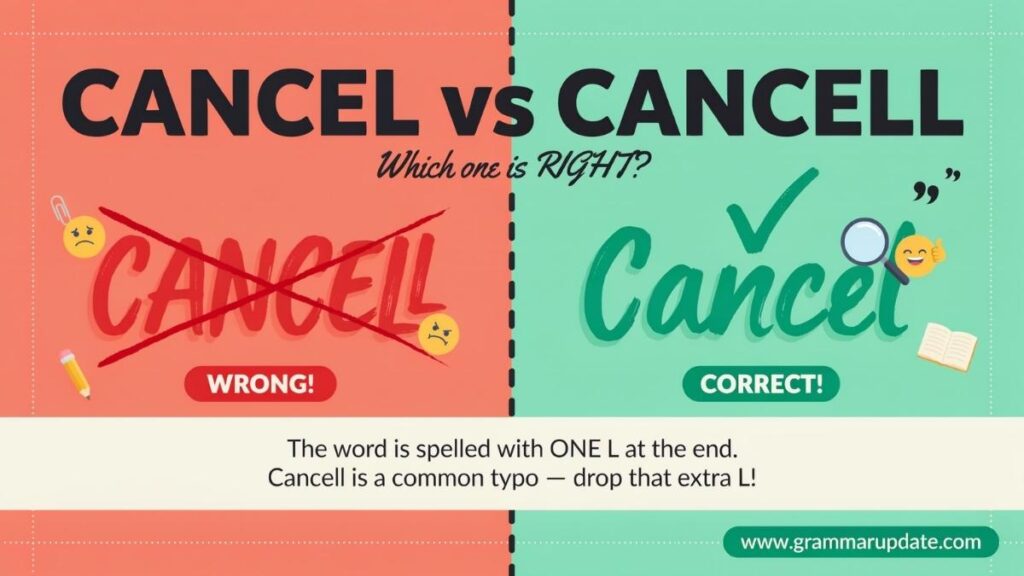
Ever stared at the word “cancel” and wondered whether it needs one L or two? You’re not alone. The confusion around cancell vs cancel often comes from words like cancelled, cancelling, and cancellation, which can use two Ls. That makes “cancell” look tempting, but it’s incorrect. The correct base form is cancel, with one L. This guide clears up the confusion in simple terms and explains the differences between cancel, canceled, cancelled, canceling, and cancelling. You’ll also learn which forms belong to American and British English, so you can avoid this common spelling mistake and write with confidence. No extra L required!
Is Cancell a Word?
No. Cancell is not the standard spelling of the English verb.
The correct form is cancel.
Correct:
“I need to cancel my appointment.”
Incorrect:
“I need to cancell my appointment.”
The word cancell sometimes appears online because people add an extra l after seeing forms such as cancelled, cancelling, or cancellation. However, that does not make cancell a valid alternative spelling.
When you need the basic verb, use cancel.
Learn the difference between often confused words
Sited vs Cited difference and Which One Is Correct?
Cancell vs Cancel Quick Comparison
| Spelling | Correct? | Use | Example |
|---|---|---|---|
| cancel | Yes | Standard base verb | “Please cancel the order.” |
| cancell | No | Incorrect spelling | “Please cancell the order.” |
So, if you’re asking “cancel vs cancell,” choose cancel.
What Does Cancel Mean?
The cancel definition is straightforward. As a verb, cancel means to stop something that was planned, arranged, scheduled, ordered, or expected to happen.
For example:
- cancel an appointment
- cancel a meeting
- cancel an order
- cancel a reservation
- cancel a subscription
- cancel a flight
- cancel an event
- cancel a class
- cancel a trip
- cancel a plan
Here are a few examples:
“I need to cancel my appointment.”
“They decided to cancel the meeting.”
“Please cancel my order before it ships.”
“The airline had to cancel the flight.”
“We may cancel the event because of the weather.”
The exact meaning depends on what you cancel. You might cancel a meeting by deciding not to hold it. And You might cancel a subscription by ending the service. You might cancel an order by asking the seller not to process it.
The central idea remains the same: something planned, arranged, or active gets stopped.
Learn the difference between often confused words
Favour vs Favor Which Spelling Is Correct?
Cancell vs Cancel Which One Is Correct?
There is no real choice between cancell vs cancel.
Cancel is the correct spelling.
Cancell is a misspelling.
This differs from a pair such as canceled and cancelled. Both of those forms have legitimate use in English. Cancell does not.
Consider these sentences:
1.“I will cancel the appointment.”
2.“I canceled the appointment.”
3.“I cancelled the appointment.”
The first sentence uses the base verb. The second follows the usual American English spelling. The third follows the usual British English spelling.
Now compare:
“I will cancell the appointment.”
That sentence contains a spelling error.
The important point is simple: regional English may change canceled to cancelled, but it does not change cancel to cancell.
Learn the difference between often confused words
Invokes vs Evokes which one is correct?
Why Do People Spell Cancel as Cancell?

The mistake makes sense once you look at the word family.
English uses these forms:
| Word | Common US Form | Common UK Form |
| Base verb | cancel | cancel |
| Past tense | canceled | cancelled |
| Present participle | canceling | cancelling |
| Noun | cancellation | cancellation |
Notice what happens.
The base verb has one l:
cancel
Some related forms have two:
cancelled
cancelling
cancellation
That pattern can fool your eyes. After seeing several words with two l’s, “cancell” starts to look reasonable.
It isn’t.
English spelling doesn’t always let you build one form simply by copying letters from another. Each form follows its established spelling pattern.
That’s why the proper spelling of cancel must be learned separately from the spelling of cancellation.
How to Spell Cancel Correctly
If you’re wondering how to spell cancel, remember this:
C-A-N-C-E-L
The base verb has one l.
So the correct spelling of cancel is:
cancel
Not:
cancell
A useful way to remember it is to start with the base form and then learn the related forms separately.
For American English:
cancel → canceled → canceling
For British English:
cancel → cancelled → cancelling
For the noun:
cancel → cancellation
This simple pattern can prevent a whole collection of common spelling mistakes in English.
Cancel With One L or Two?
If you’re asking whether cancel has one l or two, the answer depends on which form you mean.
The base verb cancel has one l.
Correct:
“I want to cancel the order.”
The spelling cancell is incorrect.
However, some related forms contain two l’s:
- cancelled
- cancelling
- cancellation
This is where many spelling errors begin.
Think of cancel as the starting point. Don’t add another l simply because another form of the word contains one.
Learn the difference between often confused words
Drily vs Dryly Which One Is Correct?
Why Does Cancellation Have Two L’s?
This question causes much of the confusion around cancel spelling.
The noun cancellation is spelled with two l’s in its common form:
cancellation
But the base verb remains:
cancel
You shouldn’t work backward from cancellation and assume that the verb must be cancell.
For example:
“The company decided to cancel the event.”
“The company announced the cancellation of the event.”
The verb and noun serve different grammatical purposes. Their spellings don’t need to match letter for letter.
There is also a US variant, cancelation, although cancellation remains the familiar spelling. The existence of that variant doesn’t affect the spelling of the base verb.
The safest rule is simple:
cancel is the verb.
cancellation is the noun.
cancell is not the standard spelling of either.
Canceling or Cancelling Which Is Correct?
Now we reach a genuine spelling difference.
Both canceling and cancelling are used in English. The preferred form depends largely on the variety of English you’re following.
American English generally uses:
canceling
British English generally uses:
cancelling
For example, American English would typically write:
“The airline is canceling several flights.”
British English would typically write:
“The airline is cancelling several flights.”
This is a legitimate regional difference.
However, neither variety uses cancell as the standard base form.
That distinction matters because people often mix up three separate questions:
- cancel or cancell
- canceling or cancelling
- canceled or cancelled
Only the last two involve a genuine US-versus-UK spelling difference.
Learn the difference between often confused words
Weighed vs Weighted Which One Is Correct?
Canceled vs Cancelled What Is the Difference?
The difference between canceled and cancelled is mainly regional.
American English generally uses:
canceled
British English generally uses:
cancelled
Both mean the same thing.
For example, an American writer might say:
“The concert was canceled because of the storm.”
A British writer might say:
“The concert was cancelled because of the storm.”
Neither sentence changes the meaning.
The difference comes from spelling conventions.
Canceled vs Cancelled at a Glance
| Form | Common usage |
| canceled | American English |
| cancelled | British English |
If you’re writing for a US audience, canceled is usually the better choice.
If you’re following British English, cancelled is usually appropriate.
The important thing is consistency. Pick the spelling system that matches your audience, publication, school, workplace, or style guide.
Is Canceled American English?
Yes. Canceled is the standard past-tense and past-participle spelling commonly used in American English.
Examples include:
- “The meeting was canceled.”
- “My flight was canceled.”
- “The appointment was canceled.”
- “The order was canceled.”
- “The event was canceled.”
American English generally uses the same one-l pattern in canceling:
canceling
So the common US pattern is:
cancel
canceled
canceling
This is especially useful if you’re writing website content, business emails, academic material, reports, or other professional documents for a US audience.
Is Cancelled British English?
Yes. Cancelled is the standard British English spelling of the past tense and past participle.
For example:
“The meeting was cancelled.”
“The flight was cancelled.”
“The event was cancelled.”
British English commonly uses the double-l form in both cancelled and cancelling:
cancel
cancelled
cancelling
The base verb still has only one l.
That last point is worth repeating because it clears up the entire cancell vs cancel issue:
British English uses cancelled, not cancell, as the past tense.
Learn the difference between often confused words
Insue vs Ensue Which One Is Correct?
What Is the Past Tense of Cancel?
The past tense depends on the variety of English.
In American English:
cancel → canceled
In British English:
cancel → cancelled
Examples:
American English:
“She canceled the appointment yesterday.”
British English:
“She cancelled the appointment yesterday.”
Both forms are grammatically correct within their respective spelling conventions.
The base form does not change:
“She will cancel the appointment.”
Not:
“She will cancell the appointment.”
After a modal or auxiliary verb such as will, can, may, or should, use the base form cancel.
Learn the difference between confusing word pairs
Chief vs Chef difference and Which One Is Correct?
How to Write Canceled in American English
If you’re following US English spelling, write:
canceled
The spelling contains one l.
Examples:
- canceled flight
- canceled meeting
- canceled appointment
- canceled order
- canceled class
- canceled event
For example:
“The manager canceled the meeting after several employees reported that they couldn’t attend.”
That sentence follows the usual American spelling convention.
Writers who follow AP style also use canceled and canceling. For US professional writing, this makes the following pattern easy to remember:
cancel
canceled
canceling
cancellation
Cancel in American English
The spelling of cancel in American English is simple.
The base form is:
cancel
The common related forms are:
- cancel
- cancels
- canceled
- canceling
- cancellation
For example:
“I need to cancel my reservation.”
“She cancels appointments only when necessary.”
“The company canceled the event.”
“They are canceling the service.”
“The cancellation surprised everyone.”
Notice that the base verb never becomes cancell.
Cancel in British English
British English also uses cancel as the base verb.
The common forms include:
- cancel
- cancels
- cancelled
- cancelling
- cancellation
Examples:
“I need to cancel my reservation.”
“She cancelled the appointment.”
“They are cancelling the event.”
“The cancellation caused confusion.”
So, although British spelling rules often use an extra l in cancelled and cancelling, they do not change cancel into cancell.
Learn the difference between confusing word pairs
Costumer vs Customer difference and Which One Is Correct?
Cancel Grammar How the Verb Works
Understanding cancel grammar helps you use the word naturally.
Cancel commonly works as a transitive verb. In simple terms, that means it can take an object.
For example:
“I canceled the appointment.”
Here, canceled is the verb and appointment is the object.
Other examples include:
“They canceled the flight.”
“She canceled her subscription.”
“We canceled the reservation.”
“The manager canceled the meeting.”
The word can also appear without a direct object when the context already makes the meaning clear:
“I can’t come tonight. I’ll have to cancel.”
The listener understands what will be canceled from the conversation.
Common Verb Forms of Cancel
| Grammatical form | US English | UK English |
| Base form | cancel | cancel |
| Third-person singular | cancels | cancels |
| Present participle | canceling | cancelling |
| Past tense | canceled | cancelled |
| Past participle | canceled | cancelled |
The incorrect form cancell does not appear anywhere in the standard conjugation.
Cancel Verb Conjugation Made Easy
Here’s the easiest way to see the pattern.
Present:
“I cancel the meeting.”
Third person:
“She cancels the meeting.”
Present continuous, US English:
“She is canceling the meeting.”
Present continuous, UK English:
“She is cancelling the meeting.”
Past, US English:
“She canceled the meeting.”
Past, UK English:
“She cancelled the meeting.”
Future:
“She will cancel the meeting.”
The base verb remains cancel whenever grammar calls for the base form.
Learn the difference between confusing word pairs
Scrapped vs Scraped difference Which One Is Correct?
Common Mistakes With Cancel
Several mistakes appear because writers confuse the base form with its related forms.
Mistake: Adding an Extra L to Cancel
Incorrect:
“Please cancell my appointment.”
Correct:
“Please cancel my appointment.”
The problem is the extra l.
Mistake: Assuming Every Form Needs Two L’s
A writer might think:
cancelled → cancell
That reasoning doesn’t work.
The correct forms are:
cancel → canceled/cancelled
The base form has one l.
Mistake: Treating Canceled and Cancelled as Different Words
They aren’t different in meaning.
They are different spelling conventions for the same grammatical form.
Mistake: Mixing Regional Spellings Without a Reason
A sentence such as:
“The company canceled the meeting and is cancelling the next one.”
may be understandable, but it mixes the common US and UK patterns.
For consistent US English, write:
“The company canceled the meeting and is canceling the next one.”
For consistent British English, write:
“The company cancelled the meeting and is cancelling the next one.”
Consistency makes writing look more polished.
Cancel Examples in Everyday English
The best way to understand cancel usage in English is to see the word in natural situations.
Appointments
“I need to cancel my dentist appointment.”
Meetings
“The manager decided to cancel the meeting.”
Orders
“Please cancel my order before it ships.”
Reservations
“We had to cancel our hotel reservation.”
Flights
“The airline canceled the flight because of severe weather.”
Events
“The organizers canceled the concert.”
Subscriptions
“You can cancel your subscription before the next billing date.”
Classes
“The school canceled classes because of the storm.”
Plans
“We had to cancel our weekend plans.”
Each example uses the same base verb. The object changes, but the basic idea remains: something planned or arranged will no longer continue.
Learn the difference between confusing word pairs
Bases vs Basis difference and Which One Is Correct?
How to Use Cancel in a Sentence
If you’re asking how to use cancel in a sentence, the basic structure is easy:
subject + cancel + object
For example:
“I will cancel the appointment.”
“They canceled the order.”
“She wants to cancel the subscription.”
“We decided to cancel the trip.”
You can also use cancel after modal verbs:
“I can cancel the reservation.”
“You should cancel the order.”
“They may cancel the event.”
“We might cancel the meeting.”
In all these examples, the base form remains cancel.
Cancel in Professional Writing
Spelling matters more in professional writing than many people realize.
A single extra letter can make an email look rushed, especially when the word appears in an important request.
Compare:
“Please cancell my appointment.”
with:
“Please cancel my appointment.”
The second sentence looks cleaner and more professional.
You may need cancel in:
- business emails
- customer-service messages
- workplace communication
- appointment requests
- order instructions
- contracts
- reports
- academic writing
- website content
- company policies
For example:
“Please cancel the reservation scheduled for August 20.”
That sentence is clear, direct, and grammatically sound.
Cancel in Academic Writing
Academic writing follows the same basic spelling rule.
Use cancel as the base verb:
“The researchers decided to cancel the second trial.”
For American English:
“The experiment was canceled because the sample size was insufficient.”
For British English:
“The experiment was cancelled because the sample size was insufficient.”
The choice between canceled and cancelled depends on the spelling convention required by the institution or publication.
The base form, however, remains unchanged.
American English Spelling Rules and Cancel
American spelling rules often favor a single l in forms such as canceled and canceling.
That gives you this common US English pattern:
cancel
canceled
canceling
The pattern differs from British English:
cancel
cancelled
cancelling
This is one example of broader spelling differences in English.
Other words show similar regional differences:
| American English | British English |
| canceled | cancelled |
| canceling | cancelling |
| traveling | travelling |
| traveled | travelled |
| labeled | labelled |
These differences don’t mean one variety is more correct than the other. They reflect established spelling conventions.
The important thing is to know which convention you’re using.
British English Spelling Rules and Cancel
British English commonly doubles the final l before certain endings in words such as cancel.
That produces:
cancelled
and:
cancelling
However, the base word remains:
cancel
This is why the statement “British English spells cancel with two l’s” is misleading.
British English does not normally spell the base verb as cancell.
Instead, the double l appears in particular forms.
Correct English Spelling The Full Comparison
Here is the clearest way to settle the issue:
| Form | US English | UK English |
| Base verb | cancel | cancel |
| Third person | cancels | cancels |
| Present participle | canceling | cancelling |
| Past tense | canceled | cancelled |
| Past participle | canceled | cancelled |
| Noun | cancellation | cancellation |
The word cancell does not belong in this table.
That makes the answer to “which is correct cancel or cancell” completely clear.
A Simple Memory Trick for Cancel Spelling
Here’s a quick trick that works:
Remember that cancel starts with one l.
Then learn the related forms as separate spellings.
US English:
cancel → canceled → canceling
UK English:
cancel → cancelled → cancelling
Noun:
cancellation
If you remember only one thing, remember this:
Cancel has one l.
That rule will prevent the most common error.
Is Cancell Ever Correct?
In ordinary English writing, no.
Cancell may appear as a deliberately created name, username, brand name, product name, or other proper name. A name can use unusual spelling without changing the standard spelling of the English verb.
For normal writing, however, use cancel.
If a sentence means “stop,” “call off,” or “withdraw,” the standard verb is cancel.
What About Cancelation?
There is another spelling worth knowing.
Cancellation is the familiar form:
“the cancellation of the event”
However, cancelation also exists as a US variant.
This can make the spelling landscape look even more confusing, but it doesn’t affect the central rule.
The base verb is still:
cancel
Not:
cancell
So don’t let the noun forms distract from the main answer.
Learn the difference between confusing word pairs
Take Effect vs Take Affect Which one Is Correct?
Cancel Spelling in US English A Quick Guide
For US English, this is the most useful set to memorize:
| Word | Correct US form |
| Base verb | cancel |
| Third person | cancels |
| Past tense | canceled |
| Present participle | canceling |
| Noun | cancellation |
Examples:
“I will cancel the appointment.”
“She canceled the appointment.”
“She is canceling the appointment.”
“The cancellation was unexpected.”
This pattern works well for everyday writing and most standard US English contexts.
Cancel Spelling in UK English A Quick Guide
For UK English, remember:
| Word | Common UK form |
| Base verb | cancel |
| Third person | cancels |
| Past tense | cancelled |
| Present participle | cancelling |
| Noun | cancellation |
Examples:
“I will cancel the appointment.”
“She cancelled the appointment.”
“She is cancelling the appointment.”
“The cancellation was unexpected.”
Again, the base verb stays the same.
A Real-World Example of the Confusion
Imagine two newspapers reporting the same event.
An American newspaper might write:
“The festival was canceled because of heavy rain.”
A British newspaper might write:
“The festival was cancelled because of heavy rain.”
Both are correct.
Now imagine either newspaper writes:
“The organizers decided to cancell the festival.”
That spelling is incorrect.
This example highlights the difference perfectly.
Canceled and cancelled are legitimate regional forms.
Cancell is not a legitimate alternative to cancel.
Learn the difference between confusing word pairs
Then vs Than difference which one is correct ?
Practice Session Cancell vs Cancel
Fill in each blank with the correct form of the word Cancell vs Cancel. Pay attention to the difference between cancel, canceled, cancelled, canceling, cancelling, and cancellation.
- Please ______ my appointment for Monday.
- The airline ______ the flight because of bad weather.
- The British newspaper reported that the flight had been ______.
- We decided to ______ the meeting.
- She is ______ her subscription today.
- The company announced the ______ of the event.
- Please do not write “cancell.” The correct spelling is ______.
- He had to ______ his hotel reservation.
- The American company ______ the concert yesterday.
- The British company ______ the concert yesterday.
- They are ______ several flights because of the storm. (US English)
- They are ______ several flights because of the storm. (UK English)
- I need to ______ my order before it ships.
- The sudden ______ surprised all the guests.
- She will ______ the appointment if she cannot attend.
- The manager ______ the meeting at the last minute. (US English)
- The manager ______ the meeting at the last minute. (UK English)
- “Cancell” is an incorrect spelling. The correct base verb is ______.
- Why does “cancellation” have two l’s while “cancel” has only one? The correct base form is ______.
- You can ______ your subscription at any time.
- The school ______ classes because of heavy snow. (US English)
- The school ______ classes because of heavy snow. (UK English)
- The customer asked the company to ______ the order.
- American English usually uses “canceled,” while British English usually uses “______.”
- American English usually uses “canceling,” while British English usually uses “______.”
Answers
- cancel
- canceled
- cancelled
- cancel
- canceling
- cancellation
- cancel
- cancel
- canceled
- cancelled
- canceling
- cancelling
- cancel
- cancellation
- cancel
- canceled
- cancelled
- cancel
- cancel
- cancel
- canceled
- cancelled
- cancel
- cancelled
- cancelling
Here’s a trusted source for clear word meanings:
FAQs
Is “cancell” ever correct in standard English?
No. “Cancell” is not the standard spelling of the verb. The correct base form is “cancel.”
Why does “cancel” have one L?
“Cancel” is the standard base form of the verb. Its related forms can follow different spelling patterns, so you shouldn’t assume that every form needs the same number of Ls.
Is “canceling” correct in American English?
Yes. “Canceling” is the standard American English spelling of the present participle.
Example: “She is canceling the appointment.”
Is “cancelling” correct in British English?
Yes. “Cancelling” is the standard British English spelling.
Example: “She is cancelling the appointment.”
What is the third-person singular form of “cancel”?
The third-person singular form is “cancels.”
Example: “He cancels the meeting when necessary.”
What is the present participle of “cancel”?
American English generally uses “canceling,” while British English commonly uses “cancelling.”
What is the difference between “cancel” and “cancellation”?
“Cancel” is a verb, while “cancellation” is a noun.
For example:
“Please cancel the reservation.”
“The cancellation surprised everyone.”
What is the noun form of “cancel”?
The most common noun is “cancellation.”
Example: “We received a cancellation notice this morning.”
Can “cancel” be used as a noun?
Yes, although the noun use is less common in standard formal writing. “Cancellation” is usually the clearer choice when you need a noun.
What are some alternatives to “cancel”?
Depending on the situation, you can use “call off,” “withdraw,” “terminate,” “discontinue,” “revoke,” or “void.” These alternatives don’t always have exactly the same meaning, so choose one that fits the context.
Is “call off” the same as “cancel”?
Often, but not always. “Call off” usually refers to stopping something that was planned, such as a meeting, event, or activity. “Cancel” has a broader range of uses, including orders, subscriptions, reservations, and services.
Can “cancel” mean to end a subscription?
Yes. You can cancel a subscription, membership, service, or other ongoing arrangement.
Example: “I want to cancel my subscription before the next billing date.”
What does “cancel out” mean?
“Cancel out” means to offset or neutralize something so that its effect disappears or becomes weaker.
Example: “The two opposing forces canceled each other out.”
Is “cancel” appropriate in professional writing?
Yes. “Cancel” is completely acceptable in professional writing. In some formal contexts, a more specific word may work better.
For example, “terminate the contract” may be more precise than “cancel the contract” in a legal context.
Does “cancel” have a slang meaning?
Yes. In informal and online language, “cancel” can mean to reject, criticize, boycott, or stop supporting a person, brand, show, or organization.
For example: “Fans decided to cancel the brand after the controversy.”
What does “canceled” mean in modern internet language?
In online conversations, “canceled” can describe someone who has lost public support because of controversial behavior or statements. This meaning differs from the traditional sense of “canceled,” which simply means something was stopped or called off.
Is “cancel culture” connected to the word “cancel”?
Yes. “Cancel culture” uses the idea of withdrawing support from a person, group, brand, or organization. The expression has a social and cultural meaning rather than the ordinary meaning of calling off an event.
Can “cancel” describe something other than an event?
Yes. You can cancel many different things, including appointments, orders, flights, reservations, subscriptions, memberships, meetings, classes, contracts, and plans.
What is the difference between “cancel” and “terminate”?
“Cancel” generally means to stop or call off something. “Terminate” often suggests formally bringing an agreement, service, relationship, or process to an end.
For example:
“Cancel the reservation.”
“Terminate the contract.”
The best choice depends on the situation.
What is the difference between “cancel” and “postpone”?
“Cancel” means the planned activity will not take place as arranged. “Postpone” means it will happen later.
For example:
“The meeting was canceled.” means there will be no meeting as planned.
“The meeting was postponed.” means the meeting was moved to a later time.
Is “cancell” a spelling variation of “cancel”?
No. “Cancell” isn’t a standard spelling variation of “cancel.” The legitimate spelling differences appear in forms such as “canceled/cancelled” and “canceling/cancelling,” not in the base verb.
Why do people write “cancell” by mistake?
The error often comes from related words such as “cancelled,” “cancelling,” and “cancellation,” which contain two Ls. That can make “cancell” look logical even though the correct base form is “cancel.”
Conclusion
The great “cancell vs cancel” mystery doesn’t need a detective. The correct spelling is simply “cancel.” The extra L may look harmless, but it doesn’t belong there. If you’re checking the cancel spelling or wondering about the correct spelling of cancel, remember that the base verb uses one L. Save the double L for forms such as “cancelled,” “cancelling,” and “cancellation,” depending on the spelling style you follow.
For US English, remember: cancel, canceled, and canceling. In British English, cancel, cancelled, and cancelling are common. These spelling differences in English can seem tricky at first, but once you separate the base verb from its related forms, the confusion disappears.
So, if you’re wondering how to spell cancel or asking whether it’s cancel with one l or two, choose cancel. When your keyboard tempts you to type “cancell,” cancel that extra L instead. Your grammar checker will thank you, and your reader won’t have to wonder where that unnecessary letter came from.

Jhon AJS, the creative mind behind Grammar Update, is an experienced blogger passionate about simplifying English grammar. He focuses on explaining confusing word vs word differences, grammar rules, punctuation, and sentence structure in a clear and practical way. Through easy to understand guides and examples, Jhon helps readers improve their writing and communicate with confidence. With years of blogging experience, he continues to share helpful insights that make learning grammar simple, useful, and accessible for everyone.