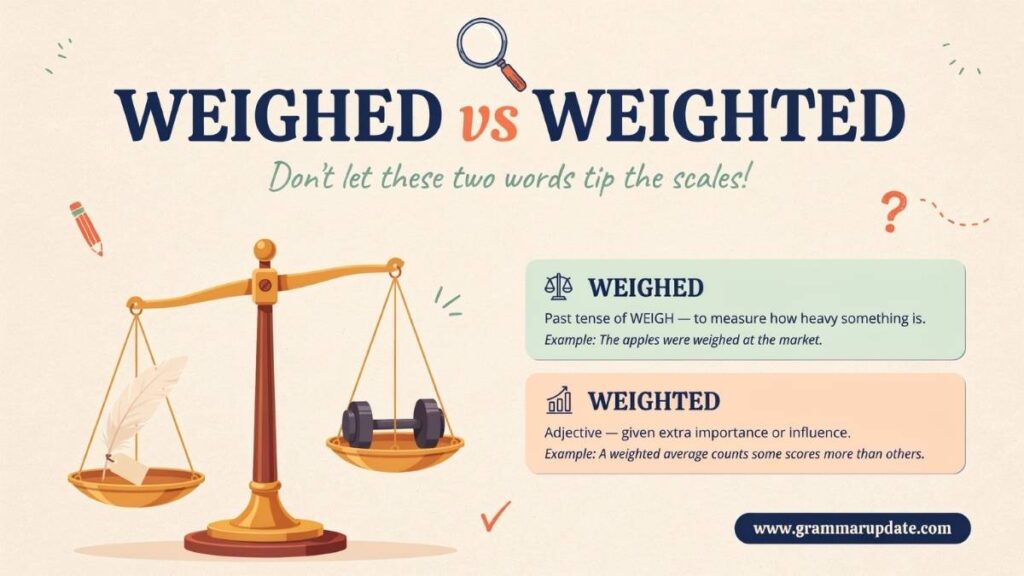
Weighed vs weighted can easily confuse you. They look almost the same, sound closely related, and both connect to the idea of weight. But they have different meanings and uses. Use weighed when you mean measured or carefully considered. Use weighted when you mean given extra weight, importance, or influence. Simple, right? Well, English likes to add a little mischief. In this guide, you’ll learn the weighed vs weighted meaning with clear examples, simple rules, and common mistakes to avoid. You’ll also see how each word works in everyday, academic, and professional writing. By the end, this confusing pair will be much easier to handle.
Weighed vs Weighted quick answer
The weighed vs weighted meaning becomes clear when you look at the two base verbs:
- weigh → weighed
- weight → weighted
Although weigh and weight are closely related, English uses them differently.
Weigh usually describes measuring weight or considering something carefully.
Weight can describe adding weight to something or assigning weight, importance, or influence to something.
| Word | Base verb | Main meaning | Example |
|---|---|---|---|
| Weighed | Weigh | Measured how heavy something is | The package was weighed. |
| Weighed | Weigh | Considered something carefully | She weighed the risks. |
| Weighted | Weight | Added physical weight | The net was weighted with stones. |
| Weighted | Weight | Assigned importance or influence | The criteria were weighted differently. |
| Weighted | Weight | Given statistical influence | The data were weighted to reflect the population. |
The difference between weighed and weighted is therefore a difference in meaning, not simply spelling.
If you’re measuring something, weighed usually fits.
If you’re assigning weight or influence, weighted usually fits.
Learn the difference between often confused words
Insue vs Ensue Which One Is Correct?
What Does Weighed Mean?
What does weighed mean?
Weighed is the past tense and past participle of weigh. In its most common physical sense, it means that someone measured the weight of a person, object, ingredient, package, animal, or another item.
For example:
- The doctor weighed the patient.
- The chef weighed the flour.
- The technician weighed the package.
- The farmer weighed the produce.
- The veterinarian weighed the dog.
Each sentence involves measuring weight.
The word also has a figurative meaning. When you weigh an idea, choice, risk, or consequence, you consider it carefully.
For example:
- She weighed her options.
- He weighed the risks.
- They weighed the evidence.
- We weighed the advantages and disadvantages.
Nobody is putting these abstract ideas on a physical scale. The expression comes from the image of a scale balancing one thing against another.
Weighed Definition
The weighed definition can therefore be summarized in two main ways:
- Measured the weight of something.
- Considered something carefully before reaching a decision.
This makes weighed a particularly flexible verb.
Consider these examples:
“The package was weighed before delivery.”
Here, weighed refers to physical measurement.
“She weighed the consequences before accepting the offer.”
Here, weighed refers to careful thought.
The surrounding words tell you which meaning applies.
Learn the difference between often confused words
Chief vs Chef difference and Which One Is Correct?
What Does Weighted Mean?
What does weighted mean?
Weighted is the past tense and past participle of weight. It can describe something that has received additional physical weight or something that has been given a particular level of importance or influence.
For example:
- The net was weighted with stones.
- The base was weighted to keep it stable.
- The final exam was weighted at 40%.
- The survey results were weighted according to population size.
- The company used weighted criteria to rank the candidates.
These examples show why weighted appears frequently in technical, academic, statistical, and professional writing.
Weighted Definition
The weighted definition includes several related ideas:
- Given additional physical weight.
- Assigned a particular numerical value.
- Given greater or lesser importance.
- Given greater or lesser influence in a calculation.
- Adjusted statistically so certain observations contribute differently.
The central idea is always some form of assigned or added weight.
That’s what separates weighted from weighed.
Learn the difference between often confused words
Costumer vs Customer difference and Which One Is Correct?
Weighed vs Weighted Side-by-Side Comparison
A direct comparison makes the distinction easier to remember.
| Meaning or context | Correct word | Example |
| Measuring an object’s weight | Weighed | The box was weighed. |
| Measuring ingredients | Weighed | She weighed the flour. |
| Measuring a person’s weight | Weighed | The nurse weighed the patient. |
| Considering a decision | Weighed | He weighed his options. |
| Considering risks | Weighed | She weighed the risks. |
| Adding physical weight | Weighted | The net was weighted with stones. |
| Assigning importance | Weighted | The criteria were weighted differently. |
| Assigning a percentage | Weighted | The exam was weighted at 40%. |
| Statistical adjustment | Weighted | The survey data were weighted. |
| Giving factors different influence | Weighted | The model uses weighted values. |
The table reveals a useful pattern.
Weighed usually tells you about an action involving measurement or thought.
Weighted usually tells you that something received weight or influence.
Learn the difference between commonly mixed-up more words
Scrapped vs Scraped difference Which One Is Correct?
Why Do People Confuse Weighed vs Weighted?
The confusion comes from the close relationship between weigh and weight.
Both words deal with the concept of weight. Their spelling also looks similar. When you add the past-tense ending, the difference can become easy to overlook.
The forms are:
- weigh → weighed
- weight → weighted
A writer may see “weight” inside “weighted” and assume that it is simply another form of “weighed.” That assumption creates many common grammar mistakes in English.
The problem becomes even more noticeable because both words can appear in similar contexts.
For example:
“The package was weighed.”
“The package was weighted.”
Both sentences are grammatically possible. However, they don’t communicate the same thing.
The first means someone measured the package’s weight.
The second suggests that someone added weight to the package or deliberately gave it weight.
The meaning changes even though only one letter separates the two forms.
The Simple Rule for Choosing Weighed vs Weighted
When you’re unsure whether to use weighed or weighted, ask one question:
What action does the sentence describe?
1.If the action involves measuring weight, use weighed.
2.If the action involves carefully considering something, use weighed.
3.If the action involves adding weight, use weighted.
4.If the action involves assigning importance or influence, use weighted.
Here’s the shortcut:
| If you mean… | Use |
| Measured how heavy something is | Weighed |
| Determined an object’s weight | Weighed |
| Considered an option | Weighed |
| Evaluated risks or consequences | Weighed |
| Added physical weight | Weighted |
| Assigned importance | Weighted |
| Assigned numerical influence | Weighted |
| Adjusted data statistically | Weighted |
| Assigned a grade percentage | Weighted |
This rule handles most everyday uses.
When to Use Weighed
Knowing when to use weighed becomes easier when you connect it with two ideas: measurement and consideration.
Use weighed when someone measures the weight of something.
For example:
- The package was weighed before shipping.
- The ingredients were weighed carefully.
- The dog was weighed at the veterinary clinic.
- The shipment was weighed at the warehouse.
- The fruit was weighed before the price was calculated.
You can also use weighed when someone considers something carefully.
For example:
- She weighed her choices.
- He weighed the risks.
- The committee weighed the evidence.
- They weighed the benefits and disadvantages.
- Weighed against the cost, the proposal seemed reasonable.
How to Use Weighed Correctly
A useful test is to replace weighed with measured.
“The package was measured.”
“The package was weighed.”
The meaning remains logical, so weighed works.
You can also replace weighed with considered carefully.
“She considered her options carefully.”
“She weighed her options.”
Again, the meaning remains clear.
This substitution test is particularly useful for English language learners because it focuses on meaning rather than spelling.
When to Use Weighted
Knowing when to use weighted requires a different test.
Ask whether something received added weight or received a particular level of importance or influence.
Use weighted for physical weight when something is deliberately made heavier.
For example:
- The net was weighted with stones.
- The curtain was weighted at the bottom.
- The base was weighted to prevent it from tipping.
- The line was weighted for stability.
Use weighted when something receives assigned importance.
For example:
- The final exam was weighted at 50%.
- The scoring criteria were weighted differently.
- The model uses weighted factors.
- The survey used weighted data.
- The company calculated a weighted average.
The word often appears whenever a system gives some factors more influence than others.
Weighed vs Weighted in Cooking
Cooking provides a straightforward example of when to use weighed.
When a recipe tells you to measure ingredients by mass, you weigh them.
For example:
“The baker weighed the flour before mixing the dough.”
The flour isn’t being given extra weight. Its existing weight is simply being measured.
You might also see:
“Weighed ingredients produce more consistent results.”
That sentence describes measuring ingredients accurately.
Weighted can appear in cooking or food preparation when something is deliberately given additional weight. However, that meaning is much less common in ordinary recipe instructions.
The distinction remains the same.
Measuring the ingredient means weighed.
Adding or assigning weight means weighted.
Weighed vs Weighted in Shipping
Shipping is another area where weighed appears frequently.
Before a package is shipped, a carrier may measure its weight to calculate shipping costs.
For example:
“The package was weighed before it was labeled.”
That sentence means the carrier measured the package.
Saying “the package was weighted” would suggest something different. It could imply that someone deliberately added weight to the package.
This distinction matters because shipping documents need precise language. A package’s measured weight and the act of adding weight are two separate concepts.
Learn the difference between commonly mixed-up more words
Bases vs Basis difference and Which One Is Correct?
Weighted Average Meaning
The weighted average meaning is an average in which individual values contribute according to assigned weights.
A common weighted average formula is:
Weighted average = Σ(value × weight) ÷ Σ(weights)
When the weights already total 1 or 100%, the calculation becomes simpler.
Weighted averages appear in many areas, including:
- academic grading
- finance
- economics
- statistics
- survey analysis
- business scoring
- performance evaluation
The word weighted tells the reader that the values don’t all carry equal influence.
Weighted Score Meaning
The weighted score meaning is closely connected to the idea of unequal importance.
A weighted score combines several factors while allowing some factors to matter more than others.
Imagine a company evaluating three job candidates.
The company might assign:
| Criterion | Weight |
| Experience | 40% |
| Technical skills | 35% |
| Communication | 25% |
The company can then calculate a score for each candidate.
Experience has the greatest influence because it receives 40% of the total weight.
This is a weighted scoring system.
The same concept appears in product comparisons, business decisions, school assessments, and statistical models.
Weighted Grade Meaning
The weighted grade meaning is especially useful in education.
A weighted grading system gives different assessments different levels of influence over the final grade.
For example:
| Assessment | Weight |
| Homework | 20% |
| Midterm | 30% |
| Final exam | 50% |
The final exam carries the greatest influence.
Therefore, you can correctly write:
“The final exam is weighted at 50% of the final grade.”
You would not normally write:
“The final exam is weighed at 50% of the final grade.”
The first sentence describes an assigned percentage. The second incorrectly treats the percentage as a physical measurement.
Weighted GPA
A weighted GPA follows the same basic principle.
Some educational systems assign different values to different levels or types of courses. Advanced courses may contribute differently from standard courses.
The exact grading system varies between schools and institutions. The important language point is that the courses receive different numerical weight.
That makes weighted the correct term.
Weighted Belt Meaning
The weighted belt meaning depends on context, but the basic idea remains consistent.
A weighted belt is a belt designed to carry additional weight or incorporate weights for a particular purpose.
For example, a weighted belt may be used during exercise to increase resistance. In water-related activities, a weight belt can help manage buoyancy.
Compare these sentences:
“The belt was weighed on a scale.”
This means someone measured the belt’s weight.
“The belt was weighted with additional material.”
This means weight was deliberately added or incorporated.
Again, the distinction is measurement versus added weight.
Learn the difference between commonly mixed-up more words
Sited vs Cited difference and Which One Is Correct?
Weighed vs Weighted in Figurative Language
The word weighed often appears in figurative language because physical scales provide a natural metaphor for decision-making.
When you weigh two choices, you mentally place them on opposite sides of an imaginary scale.
For example:
“She weighed the advantages and disadvantages.”
“He weighed the consequences.”
“They weighed the evidence.”
In each case, the person evaluates competing considerations.
Weighted works differently.
When something is weighted, it receives greater influence.
For example:
“The judge’s opinion carried considerable weight.”
A more technical version might say:
“The scoring system weighted the judge’s assessment heavily.”
The first describes importance in a general sense. The second describes a deliberate scoring system.
Learn the difference between confusing word pairs
Peice vs Piece Which Spelling Is Correct?
Weighed vs Weighted in Decision-Making
Decision-making shows the distinction particularly well.
Imagine you’re deciding whether to move to a new city.
You might weigh:
- salary
- housing costs
- commute time
- family needs
- career opportunities
- quality of life
and You are comparing choices and evaluating alternatives.
You could say:
“I weighed the pros and cons before making my decision.”
Now imagine creating a formal scoring model.
You assign:
- salary: 25%
- housing costs: 25%
- career growth: 30%
- commute: 20%
Those criteria are now weighted.
You have moved from evaluating options informally to assigning numerical importance.
That difference is useful in business, research, project management, and everyday decision-making.
Weighed vs Weighted Grammar
From a grammar perspective, weighed and weighted are forms of two different verbs.
Weighed comes from weigh.
Present tense:
“I weigh the package.”
Past tense:
“I weighed the package.”
Past participle:
“The package has been weighed.”
Weighted comes from weight.
Present tense:
“I weight the net.”
Past tense:
“I weighted the net.”
Past participle:
“The net has been weighted.”
Weighted can also function as an adjective.
Examples include:
- weighted average
- weighted score
- weighted grade
- weighted criteria
- weighted data
- weighted sample
Weighed generally appears as a verb form.
Understanding the adjective and verb forms helps explain why weighted is so common in technical phrases.
Weighed in a Sentence
If you’re asking how do you use weighed in a sentence, look for situations involving measurement or careful thought.
Here are several examples:
- The package was weighed before delivery.
- The chef weighed each ingredient.
- The veterinarian weighed the dog.
- The technician weighed the equipment.
- The farmer weighed the vegetables.
- She weighed the risks before accepting the offer.
- He weighed his options carefully.
- The committee weighed the evidence.
- They weighed the advantages and disadvantages.
- The company weighed the potential costs.
Notice how the first group involves physical measurement while the second involves evaluating options.
Both meanings belong to the verb weigh.
Weighted in a Sentence
If you’re asking how do you use weighted in a sentence, look for situations involving added weight, assigned importance, or unequal influence.
Examples include:
- The net was weighted with stones.
- The base was weighted to keep it stable.
- The final exam was weighted at 40%.
- The project was weighted more heavily than the homework.
- The survey results were weighted to reflect the target population.
- The scoring system uses weighted criteria.
- The analyst calculated a weighted average.
- The model uses weighted values.
- The company created a weighted scoring system.
Each example gives something weight in either a physical or abstract sense.
Weighed vs Weighted in Statistics
Statistical weighting deserves special attention because weighted is a standard technical term.
Suppose researchers conduct a survey. The sample doesn’t perfectly match the population. One group may appear too often while another appears too rarely.
Researchers can use statistical weighting to adjust the influence of different responses.
An observation with a lower weight contributes less to the calculation.
An observation with a higher weight contributes more.
This approach can help researchers adjust for differences between a sample and the population they want to describe.
Common terms include:
- weighted data
- weighted statistics
- statistical weighting
- weighting factors
- weighted distribution
- weighted mean
- weighted calculation
The word weighed would not normally describe this process because researchers aren’t measuring the physical heaviness of the data.
Learn the difference between confusing word pairs
Leary vs Leery Which Is Correct and Difference?
Weighed vs Weighted in Professional and Academic Writing
Precise word choice becomes especially important in professional writing because a small wording difference can change the technical meaning.
Consider research:
“The researchers weighed the samples.”
This means they measured the samples’ weight.
Now compare:
“The researchers weighted the observations.”
This means they assigned different numerical influence to the observations.
Education provides another clear example:
1.“The instructor weighed the equipment.”
2.The instructor measured its weight.
3.“The instructor weighted the final exam at 40%.”
4.The instructor assigned the exam a specific contribution to the final grade.
These sentences demonstrate why contextual word usage matters.
The correct word isn’t determined by which one sounds more formal. Meaning determines the choice.
Weighed vs Weighted Pronunciation
The pronunciation difference can also help English learners remember the words.
Weighed is pronounced like “wade” in standard American English.
It has one syllable.
Weighted normally has two syllables and sounds approximately like “WAY-tid.”
So:
- weighed → one syllable
- weighted → two syllables
The spelling reflects the underlying verbs:
- weigh → weighed
- weight → weighted
The pronunciation also makes the distinction easier to hear in conversation.
Weighed vs Weighted Usage in Writing
Good weighed vs weighted usage depends on context.
Before choosing the word, identify the action.
1.If someone measured an object’s weight, use weighed.
2.If someone considered alternatives, use weighed.
3.If someone added physical weight, use weighted.
4.If someone assigned importance, use weighted.
5.If someone adjusted data so observations contribute differently, use weighted.
6.If someone assigned a percentage to an exam or assignment, use weighted.
This approach works better than trying to memorize dozens of isolated grammar rules.
Learn the difference between confusing word pairs
Pose vs Poise Difference and Which one is correct ?
Common Mistakes With Weighed and Weighted
Incorrect:
“The package was weighted at 15 pounds.”
Better:
“The package was weighed at 15 pounds.”
The package’s weight was measured. No weight was added.
Using Weighed for a Weighted Average
Incorrect:
“The scores were combined into a weighed average.”
Correct:
“The scores were combined into a weighted average.”
The scores receive different levels of influence, so weighted is the correct term.
Using Weighted When You Mean Considered
Incorrect:
“She weighted her options before choosing.”
Correct:
“She weighed her options before choosing.”
Here, she considered the alternatives.
Using Weighed for an Assigned Percentage
Incorrect:
“The final exam was weighed at 50%.”
Correct:
“The final exam was weighted at 50%.”
The exam receives 50% of the overall grade, so weighted expresses the intended meaning.
Weighed vs Weighted Real-World Case Study
Consider a small bakery preparing for a large order.
First, the baker measures the ingredients.
“The baker weighed the flour.”
The word weighed works because the baker is measuring the flour.
Next, the bakery creates a quality-control system. The company decides that freshness will count for 50%, appearance for 30%, and packaging for 20%.
“The bakery weighted the quality criteria.”
Now the word weighted works because the criteria receive different levels of importance.
Later, the manager compares two ingredient suppliers.
“She weighed the pros and cons of each supplier.”
Again, weighed is correct because she is considering the alternatives.
Finally, the company builds a numerical supplier score:
| Factor | Weight |
| Price | 30% |
| Reliability | 40% |
| Quality | 30% |
The factors are now weighted.
This single example shows all three major uses:
- Weighing something means measuring it.
- Weighing an option means considering it.
- Weighting something means assigning or adding weight or influence.
Learn the difference between confusing word pairs
Firey vs Fiery difference Which one Is Correct?
Practice Session Weighed vs Weighted
Fill in each blank with the correct word: weighed or weighted.
- The package was __________ before it was shipped.
- She __________ the pros and cons before accepting the job.
- The final exam is __________ at 40% of the total grade.
- The chef __________ the flour before adding it to the bowl.
- The fishing net was __________ with heavy stones.
- The researchers __________ the survey results to better represent the population.
- The veterinarian __________ the dog during the examination.
- He carefully __________ the risks before making his decision.
- The company uses a __________ scoring system to evaluate applicants.
- The farmer __________ the vegetables before selling them.
- The final project is __________ more heavily than the weekly assignments.
- She __________ the evidence before reaching a conclusion.
- The base was __________ to keep it from tipping over.
- The teacher __________ the students’ final projects before recording their grades.
- The scores were __________ according to their importance in the final calculation.
- The nurse __________ the patient during the routine checkup.
- They __________ the advantages and disadvantages of moving to another city.
- The survey data were __________ to account for differences in the sample.
- The ingredients must be __________ accurately for the recipe to work properly.
- The exam questions were __________ differently because some sections were more important.
- The company __________ each package to determine the shipping cost.
- She __________ several alternatives before choosing the best option.
- The course uses a __________ grading scale in which the final exam counts for half the grade.
- The equipment was __________ before it was loaded onto the truck.
- The committee __________ the potential benefits and risks before approving the proposal.
Answers
- weighed
- weighed
- weighted
- weighed
- weighted
- weighted
- weighed
- weighed
- weighted
- weighed
- weighted
- weighed
- weighted
- weighed
- weighted
- weighed
- weighed
- weighted
- weighed
- weighted
- weighed
- weighed
- weighted
- weighed
- weighed
Here’s a trusted source for clear word meanings:
FAQs
What’s the main difference between “weighed” and “weighted”?
“Weighed” comes from the verb “weigh” and usually means measured for weight or carefully considered. “Weighted” comes from “weight” and means given additional weight or assigned a particular level of importance or influence.
What does “weighed” mean?
“Weighed” means measured to determine how heavy something is. It can also mean carefully considered or evaluated. For example, “The package was weighed before shipping” refers to measurement, while “She weighed the risks” refers to careful consideration.
Why is “weighted average” correct instead of “weighed average”?
“Weighted average” is correct because different values receive different levels of influence in the calculation. “Weighed” refers to measuring or considering something, not assigning mathematical importance to individual values.
Can “weighed” describe a decision?
Yes. “Weighed” can describe carefully considering a decision, option, risk, benefit, or consequence. For example, “The committee weighed the advantages and disadvantages before voting.”
What does “weighted” mean in statistics?
In statistics, “weighted” means that different observations or values receive different amounts of influence in a calculation. For example, a weighted average gives some values more importance than others.
What does “weighted criteria” mean?
“Weighted criteria” are factors that receive different levels of importance in a scoring or decision-making system. For example, a hiring system might give experience 50% of the total score and communication skills 20%.
Can “weighted” describe a physical object?
Yes. “Weighted” can describe something that has additional weight attached to it or built into it. For example, “The base was weighted to prevent it from tipping over.”
What does “weighed against” mean?
“Weighed against” means carefully compared or evaluated alongside another factor. For example, “The benefits were weighed against the potential risks” means both sides were considered before a decision was made.
What does “weighted toward” mean?
“Weighted toward” means that something gives greater influence or importance to a particular factor, group, or outcome. For example, “The scoring system is weighted toward experience” means experience has more influence on the final result.
Is “weighted heavily” correct?
Yes. “Weighted heavily” is correct when something receives a large amount of importance or influence. For example, “Previous experience was weighted heavily in the hiring decision.”
What does “weighed carefully” mean?
“Weighed carefully” means considered or evaluated thoughtfully before making a decision. For example, “She weighed the proposal carefully before accepting it.”
Can “weighed” and “weighted” appear in the same sentence?
Yes, when they describe different actions. For example, “The ingredients were weighed before the results were entered into a weighted scoring system.” Here, “weighed” refers to measurement, while “weighted” refers to assigned influence.
Why is “weighted” common in grading systems?
“Weighted” is common in grading because different assignments, tests, projects, or exams can contribute different percentages to the final grade. If a final exam counts for 50% of the course grade, it is weighted at 50%.
What is the difference between a weighted score and a regular score?
A regular score may give each component equal importance, while a weighted score gives different components different levels of influence. For example, a final exam worth 50% affects the overall grade more than an assignment worth 10%.
Does “weighted” always mean physically heavier?
No. “Weighted” can refer to physical weight, but it can also describe assigned importance, numerical influence, or statistical adjustment. The context determines the meaning.
What is the difference between “weighing” and “weighting”?
“Weighing” comes from “weigh” and usually means measuring weight or carefully considering something. “Weighting” comes from “weight” and usually means adding weight or assigning different levels of importance or influence.
Can “weighting” be used in statistics?
Yes. “Weighting” is a standard term in statistics and data analysis. It describes the process of assigning numerical weights to observations so some data points have more or less influence on the results.
What is a weighting factor?
A weighting factor is a numerical value that determines how much influence something has in a calculation. A higher weighting factor gives an observation or criterion greater influence than one with a lower factor.
What does “weighted data” mean?
Weighted data are data in which individual observations receive assigned weights. Researchers can use these weights to adjust how much each observation contributes to a statistical analysis.
What does “weighted mean” mean?
A weighted mean is an average in which different values contribute according to their assigned weights. A value with a larger weight has a greater effect on the final result.
Can “weighed” be used in scientific writing?
Yes. Scientists use “weighed” when they measure the weight or mass of samples, materials, or objects. For example, “The samples were weighed before the experiment.”
Can “weighted” be used in scientific writing?
Yes. “Weighted” frequently appears in scientific and statistical writing when researchers assign different levels of influence to data, variables, or observations.
What does “weighted grade” mean?
A weighted grade is a grade calculated by giving different assessments different levels of influence. For example, if a final exam accounts for 40% of a course grade, the exam has a 40% weighting.
What does “weighted score” mean?
A weighted score is a result calculated by giving different factors different levels of importance. It allows one component to have a greater effect on the final result than another.
Is “weighed” the past tense of “weigh”?
Yes. The verb forms are:
- weigh → weighed
- weight → weighted
“Weighed” is therefore the correct past tense of “weigh.”
Is “weighted” the past tense of “weight”?
Yes. “Weighted” is the past tense and past participle of the verb “weight.”
How can you quickly choose between “weighed” and “weighted”?
Use this simple test: if you mean measured or carefully considered, choose “weighed.” If you mean given additional weight or assigned importance or influence, choose “weighted.”
Why do people confuse “weighed” and “weighted”?
The two words look and sound closely related because both come from the idea of weight. However, they come from different verbs and describe different actions. Understanding the difference between “weigh” and “weight” makes the correct choice much easier.
Which word should you use for a package measured on a scale?
Use “weighed.” For example, “The package was weighed before delivery.” The sentence describes measuring the package’s weight.
Which word should you use for an exam that counts for a certain percentage?
Use “weighted.” For example, “The final exam is weighted at 40%.” The sentence describes the exam’s assigned influence on the final grade.
Which word should you use when someone considers the advantages and disadvantages?
Use “weighed.” For example, “She weighed the pros and cons before making her decision.” Here, “weighed” means carefully considered the alternatives.
Which word should you use when different factors receive different levels of importance?
Use “weighted.” For example, “The evaluation uses weighted criteria.” Each criterion has a specific level of influence on the final result.
What’s the easiest way to remember “weighed vs weighted”?
Think of “weighed” as measured or considered and “weighted” as assigned or added.
If you put something on a scale, you weighed it.
If you give something more influence in a calculation, you weighted it.
That simple distinction will help you choose the right word in most situations.
Conclusion
Weighed vs weighted may look like grammar troublemakers, but the difference is actually simple once you know what each word does.
Use weighed when you mean measured or carefully considered. You weighed a package on a scale, or you weighed the pros and cons before making a decision.
Use weighted when you mean given extra weight, importance, or influence. A net can be weighted with stones, while a final exam can be weighted at 40% of your grade.
Here’s the quick rule:
- Weighed = measured or considered
- Weighted = given weight or importance
So, when you’re stuck between weighed vs weighted, don’t let the extra letters throw you off. Ask what you mean first. If you’re measuring or considering something, choose weighed. If you’re assigning weight or influence, choose weighted.
Once you remember that simple distinction, this common grammar mixup becomes much easier to avoid.

Jhon AJS, the creative mind behind Grammar Update, is an experienced blogger passionate about simplifying English grammar. He focuses on explaining confusing word vs word differences, grammar rules, punctuation, and sentence structure in a clear and practical way. Through easy to understand guides and examples, Jhon helps readers improve their writing and communicate with confidence. With years of blogging experience, he continues to share helpful insights that make learning grammar simple, useful, and accessible for everyone.