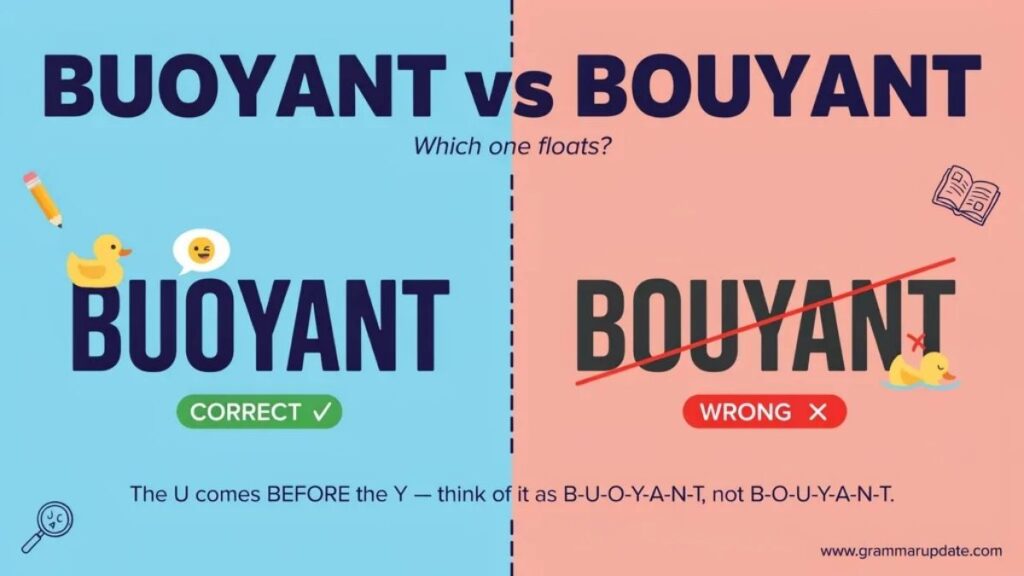
The buoyant vs bouyant confusion can make even a confident writer pause for a second. The word looks simple until those vowels start causing trouble. So, which spelling should you use? Buoyant is correct, while bouyant is a common misspelling. Once you connect buoyant with its base word, buoy, the spelling becomes much easier to remember. This guide clears up the confusion with simple explanations, practical examples, pronunciation tips, and useful grammar guidance. You’ll also learn the difference between buoyant and buoyancy, how each word works in a sentence, and why this tricky spelling often causes mistakes. By the end, you’ll know exactly which form to use.
Buoyant vs Bouyant quick answer
If you’re searching for buoyant or bouyant, use buoyant.
| Word | Correct spelling? | Part of speech | Meaning |
|---|---|---|---|
| Buoyant | Yes | Adjective | Able to float, cheerful, optimistic, strong, or active |
| Bouyant | No | — | Common misspelling of buoyant |
| Buoyancy | Yes | Noun | The quality or effect associated with floating |
| Bouyancy | No | — | Common misspelling of buoyancy |
| Buoyantly | Yes | Adverb | In a buoyant way |
| Bouyantly | No | — | Common misspelling of buoyantly |
The correct spelling of buoyant is:
B-U-O-Y-A-N-T
The incorrect form, bouyant, switches the position of the first two vowels.
The easiest way to remember the difference is to start with the base word:
buoy → buoyant → buoyancy → buoyantly
Each word keeps the same “buoy” beginning.
Learn the difference between often confused words
Humorous vs Humerous Which one Is Correct?
What Does Buoyant Mean?
The basic buoyant meaning is connected to floating. Something buoyant can stay afloat or receive enough upward support from a surrounding fluid to resist sinking.
However, that’s only one use of the word.
Buoyant can also describe someone’s mood or personality. In that context, it means cheerful, positive, confident, or lively. The word can also describe economic conditions, markets, sales, or demand when they remain strong and active.
So, the buoyant definition depends on the context in which you use it.
For example:
The cork is buoyant in water.
Here, buoyant describes a physical property.
Now consider:
She remained buoyant after receiving the disappointing news.
This sentence describes her attitude rather than her physical ability to float.
A third example shows the business meaning:
Consumer demand remained buoyant throughout the summer.
Here, buoyant means strong or active.
The word changes meaning slightly depending on the subject, but all three uses share an underlying idea of staying up, remaining strong, or maintaining positive momentum.
Buoyant as a Physical Word
In science and everyday conversation, buoyant can describe an object that floats or has the ability to float.
A cork provides a simple example. Place it in water and it stays near the surface because its average density is lower than the density of water.
Other buoyant object examples include life jackets, floating buoys, inflatable rafts, and specially designed boat hulls.
You might write:
The lightweight raft remained buoyant in the water.
The life jacket provides enough buoyant support to help keep the swimmer above the surface.
The boat stayed buoyant even after additional cargo was loaded.
In each example, buoyant relates to the physical interaction between an object and a fluid.
That brings us into the world of fluid mechanics, where buoyancy becomes more precise.
Buoyant in Physics
The buoyant definition in physics relates to the upward force that a fluid exerts on an object.
When you place an object in water, the water pushes against its surface. Fluid pressure increases as depth increases. Therefore, the pressure acting on the lower part of a submerged object can exceed the pressure acting on its upper part.
That difference produces a net upward force.
This is called the buoyant force.
The idea sounds complicated at first, but a simple example makes it easier. Hold a ball underwater and let go. You can feel the water pushing the ball upward. That upward effect is buoyancy in action.
The important point is that an object doesn’t need to float at the surface to experience buoyant force. A completely submerged object experiences buoyant force too.
1.If the object’s weight exceeds the buoyant force, it sinks.
2.If the buoyant force equals its weight, it can remain suspended.
3.If the buoyant force exceeds its weight, it accelerates upward.
So buoyancy is not simply another word for floating. Floating is one possible result of the forces involved.
What Is Buoyancy?
If you’re asking what is buoyancy, the simple answer is the upward effect produced by a fluid on an immersed object.
In everyday language, buoyancy refers to the ability or tendency to float.
In physics, the concept has a more exact meaning. Buoyancy results from differences in fluid pressure across an immersed object.
The buoyancy meaning can also extend beyond physics. In ordinary writing, buoyancy can describe positive energy, confidence, or economic strength.
For example:
The boat’s buoyancy kept it above the water.
Her natural buoyancy made everyone around her feel more relaxed.
The buoyancy of the market surprised investors.
The first sentence uses the scientific meaning. The second uses the emotional meaning. The third uses an economic meaning.
Buoyancy Definition in Physics
A practical buoyancy definition in physics is the upward force a fluid exerts on an immersed object.
This force comes from pressure differences within the fluid.
Imagine a rectangular block completely underwater. Water presses against its top, bottom, and sides. Because pressure increases with depth, the water exerts greater pressure against the bottom than the top.
The horizontal forces largely balance one another. The difference between the upward pressure on the bottom and the downward pressure on the top creates a net upward force.
That is the physical basis of buoyancy.
Learn the difference between often confused words
Tomorrow vs Tommorow Which one Is Correct?
Buoyant vs Buoyancy What’s the Difference?
The difference between buoyant and buoyancy is mainly grammatical.
Buoyant is an adjective. It describes something.
Buoyancy is a noun. It names a quality, condition, or physical effect.
Compare these sentences:
The boat is buoyant.
The boat has good buoyancy.
In the first sentence, buoyant describes the boat.
In the second, buoyancy identifies the property that allows the boat to remain supported.
| Word | Part of speech | Function | Example |
|---|---|---|---|
| Buoyant | Adjective | Describes something | The raft is buoyant. |
| Buoyancy | Noun | Names a quality or effect | The raft has good buoyancy. |
This is the basic buoyancy and buoyant difference.
A useful shortcut is:
Buoyant describes.
Buoyancy names.
Once you understand that pattern, it becomes much easier to choose between the two.
Buoyant Adjective
The buoyant adjective can describe an object, person, mood, market, economy, or other condition.
Here are a few examples:
- a buoyant boat
- a buoyant material
- a buoyant mood
- a buoyant personality
- a buoyant economy
- a buoyant market
- buoyant consumer demand
The meaning depends on what comes after or around the word.
1.A buoyant object can float.
2.A buoyant person can remain cheerful.
3.A buoyant economy can remain strong.
The grammar stays the same even though the meaning changes with context.
Buoyancy Noun
Buoyancy is the corresponding noun.
You can talk about:
- the buoyancy of a boat
- the buoyancy of a material
- the buoyancy of a swimmer
- the buoyancy of a life jacket
- the buoyancy of a market
- the buoyancy of an economy
For example:
The engineer tested the buoyancy of the material.
Here, buoyancy names the property being tested.
This distinction is especially useful in technical and academic writing.
Buoyant vs Bouyant Spelling Difference
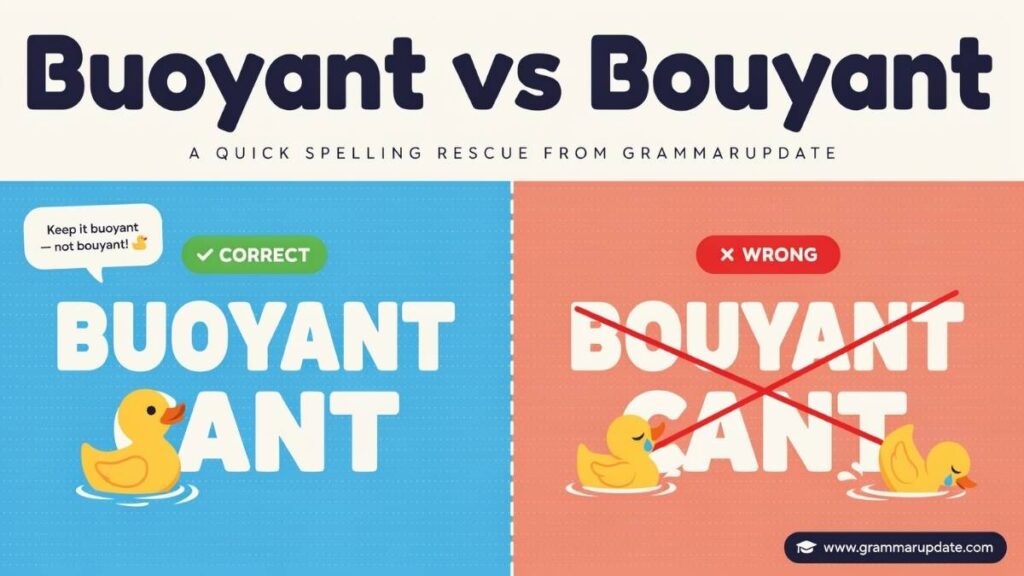
The buoyant vs bouyant spelling difference has nothing to do with meaning. One form is correct and the other is not.
Correct:
buoyant
Incorrect:
bouyant
The mistake usually comes from rearranging the vowels in buoy.
The correct sequence is:
B-U-O-Y
Not:
B-O-U-Y
That four-letter sequence is the key to the entire word family.
If you remember buoy, you can build the related words correctly:
1.buoy + ant = buoyant
2.buoy + ancy = buoyancy
3.buoy + antly = buoyantly
The unusual spelling becomes much less intimidating when you treat the base word as your anchor.
Why Is Buoyant Spelled With an A?
A common question is why is buoyant spelled with an a.
The answer is that buoyant contains the base word buoy followed by the ending “-ant.”
The spelling works like this:
buoy + ant = buoyant
The “a” belongs to the “-ant” ending.
That gives you:
b-u-o-y-a-n-t
The mistake usually happens before the “a.” Writers remember the sound of the word but rearrange the vowels in buoy.
Instead of writing buoyant, they write bouyant.
The pronunciation doesn’t make the spelling much easier either. You hear something close to “BOY-uhnt,” not every individual letter in the written form.
That’s why the best strategy isn’t to spell the word from its sound. Remember its base:
buoy.
Learn the difference between often confused words
Awful vs Awfull Which one Is Correct?
Why Do People Misspell Buoyant as Bouyant?
The question why do people misspell buoyant as bouyant has a simple answer: the spelling pattern is unfamiliar.
English has many words containing “ou,” so people may naturally expect that sequence. The word buoy, however, uses “uoy.”
When someone knows the pronunciation but hasn’t memorized the spelling, the brain may rearrange those letters into a more familiar pattern.
That’s how bouyant appears.
It looks plausible at a glance. That’s exactly what makes the mistake so persistent.
The same problem appears in related words:
bouyancy instead of buoyancy
bouyantly instead of buoyantly
The solution is to remember the complete word family rather than memorizing each word separately.
Is Bouyant a Word?
If you’re asking is bouyant a word, the answer is no in standard English.
Bouyant is a misspelling of buoyant.
It doesn’t represent a separate English word with a different definition. When you see bouyant in a sentence, the intended word is almost certainly buoyant.
For example:
Incorrect: The material is bouyant.
Correct: The material is buoyant.
Incorrect: She had a bouyant personality.
Correct: She had a buoyant personality.
Incorrect: The market remained bouyant.
Correct: The market remained buoyant.
The same correction applies to bouyancy and bouyantly.
Is Buoyant a Real Word?
Yes. Buoyant is a standard English word.
It works as an adjective and has several established meanings.
It can describe:
- Physical floating ability
- A cheerful mood
- A positive attitude
- A lively personality
- A strong market
- Active demand
- A healthy economy
That range makes buoyant a useful word when the context supports it.
How to Spell Buoyant
If you’re wondering how to spell buoyant, don’t try to reconstruct it from pronunciation.
Start with buoy.
Then add “-ant.”
buoy + ant = buoyant
The spelling is:
B-U-O-Y-A-N-T
A simple memory trick is to picture a buoy floating on water and connect that image with the word buoyant.
Buoy is the anchor.
Buoyant follows it.
That small association can prevent the common bouyant mistake.
Buoyant Pronunciation
The standard US English buoyant pronunciation is commonly represented as /ˈbɔɪ.ənt/.
An easy approximation is:
BOY-uhnt
The pronunciation sounds much simpler than the spelling looks.
That’s one reason people sometimes spell the word incorrectly. When you hear “BOY-uhnt,” you don’t automatically know that the written word contains the unusual sequence “buoy.”
The related word buoyancy is commonly pronounced approximately:
BOY-uhn-see
The pronunciation of buoy itself is approximately:
BOY
Remembering the pronunciation is useful, but it shouldn’t replace remembering the spelling.
For spelling, always return to buoy.
Buoyancy Pronunciation
The common US English buoyancy pronunciation is approximately:
BOY-uhn-see
The word has three main syllable beats:
BOY + uhn + see
The spelling remains:
B-U-O-Y-A-N-C-Y
Not:
B-O-U-Y-A-N-C-Y
That same “buoy” sequence continues through the word family.
Buoyant in a Sentence
If you’re wondering how do you use buoyant in a sentence, begin by deciding which meaning you want.
For physical meaning:
The lightweight raft remained buoyant in the rough water.
For emotional meaning:
Despite the setback, she maintained a buoyant attitude.
For personality:
His buoyant personality made the meeting more enjoyable.
For business:
Strong consumer demand kept the market buoyant.
For economics:
The region’s economy remained buoyant throughout the year.
Each sentence uses buoyant as an adjective.
Buoyancy in a Sentence
If you’re asking how do you use buoyancy in a sentence, use it as a noun.
For physical meaning:
The boat’s buoyancy allowed it to carry several passengers.
For science:
The researchers measured the buoyancy of the material.
For swimming:
Lung volume can affect a swimmer’s buoyancy.
For figurative meaning:
Her natural buoyancy helped her stay positive during difficult moments.
For business:
The buoyancy of consumer demand supported sales.
The key is simple: buoyancy names the property or condition.
Learn the difference between often confused words
Ingenuine vs Ungenuine Which one Is Correct?
Buoyant vs Floating Are They the Same?
Buoyant and floating overlap in meaning, but they’re not exact synonyms.
Floating describes an object’s state or position.
Buoyant describes its tendency or ability to receive enough upward support from a fluid.
Consider this example:
The boat is floating.
This sentence tells you what the boat is doing or where it is.
Now compare:
The boat is buoyant.
This sentence describes the boat’s ability to remain supported by the water.
In everyday conversation, the words may sometimes seem interchangeable. In technical writing, the distinction matters.
A sinking object can still experience buoyant force. It simply doesn’t experience enough upward force to overcome its weight.
What Is Buoyant Force in Physics?
The question what is buoyant force in physics has a straightforward answer.
Buoyant force is the net upward force that a fluid exerts on an immersed object.
The force comes from fluid pressure.
Because pressure increases with depth, the bottom of an immersed object can experience greater pressure than the top. That pressure difference creates an upward net force.
This is why water can support boats, swimmers, floating platforms, and other objects.
It also explains why a submerged object can feel lighter when you hold it underwater.
The water isn’t removing the object’s mass. Instead, the upward buoyant force reduces the amount of downward force you have to support.
Buoyancy vs Buoyant Force Explained
The Buoyancy and buoyant force are closely related, but they describe different things.
Buoyancy is the physical phenomenon or property associated with an object’s interaction with a fluid.
Buoyant force is the actual upward force produced by that interaction.
A useful comparison is:
Buoyancy = phenomenon or property
Buoyant force = measurable force
This answers the question what is the difference between buoyancy and buoyant force.
You can discuss the buoyancy of a ship or the buoyant force acting on the ship.
The terms belong together, but they aren’t interchangeable in every sentence.
Learn the difference between commonly misused words
Ironic vs Unironic which one is correct and usage?
Is Buoyant Force the Same as Upthrust?
Yes, in standard introductory physics, buoyant force and upthrust generally refer to the same upward force produced by a fluid.
The terminology can vary depending on the textbook, school system, or region.
In US English physics materials, buoyant force is especially common.
The concept is the same: fluid pressure produces a net upward force on an immersed object.
What Causes Buoyancy?
If you’re wondering what causes buoyancy, the answer is fluid pressure.
Pressure in a fluid increases with depth.
When an object sits inside that fluid, the pressure on its lower surfaces can be greater than the pressure on its upper surfaces.
The resulting pressure difference produces an upward force.
Displacement provides another useful way to understand the same phenomenon.
An immersed object pushes aside some amount of fluid. According to Archimedes’ principle, the buoyant force equals the weight of the displaced fluid.
So the two ideas fit together:
Fluid pressure differences create the upward force.
Fluid displacement lets us calculate the force.
Archimedes’ Principle
Archimedes’ principle is one of the foundations of buoyancy in physics.
It states that an object immersed in a fluid experiences an upward buoyant force equal to the weight of the fluid it displaces.
This principle explains several everyday observations that might otherwise seem strange.
Why can a massive ship float?
Because its hull displaces a large volume of water.
Why does a metal ball sink?
Because its weight is greater than the buoyant force generated by the water it displaces.
Why does a swimmer feel lighter in water?
Because the water produces an upward buoyant force.
The principle connects these seemingly different situations.
Density and Buoyancy
The Density vs mass and buoyancy vs density are closely related concepts, but they aren’t identical.
Density measures how much mass occupies a particular volume.
The formula is:
Density = mass ÷ volume
Buoyancy depends on the density of the surrounding fluid and the volume of fluid displaced.
For an object to float in water, its average density must be low enough relative to water for the buoyant force to balance its weight.
This explains an apparent paradox.
Steel is denser than water, yet a steel ship can float.
The key is that the ship isn’t a solid block of steel. Its hollow structure creates a large volume relative to its mass. That allows the ship to displace enough water to generate the required upward force.
Why Do Objects Float in Water?
The answer to why do objects float in water comes down to force balance.
Gravity pulls the object downward.
Water produces buoyant force upward.
When those forces balance, the object can float.
A floating object adjusts its submerged volume until it displaces enough water to create a buoyant force equal to its weight.
This is why a loaded boat sits deeper in the water than an empty boat.
Adding cargo increases the boat’s weight.
To balance that extra weight, the boat must displace more water.
It therefore sinks slightly deeper until the buoyant force increases enough to restore equilibrium.
Learn the difference between commonly misused words
Rehireable vs Rehirable Which Spelling Is Correct?
Can an Object Be Buoyant Without Floating?
Yes.
This is one of the most important distinctions in the topic.
Every immersed object experiences buoyant force.
A heavy metal sphere completely underwater experiences an upward buoyant force even though it may continue sinking.
So an object can experience buoyancy without floating at the surface.
In everyday language, people often use buoyant to mean “able to float.” In physics, however, the presence of buoyant force doesn’t guarantee floating.
The outcome depends on the relationship between buoyant force and weight.
What Factors Affect Buoyancy?
Several factors affect buoyancy.
Fluid Density
A denser fluid provides greater buoyant force for the same displaced volume.
This is why floating can feel different in seawater and freshwater.
Displaced Volume
A greater displaced volume produces a greater buoyant force when the fluid density and gravity remain constant.
This is one reason the shape of a ship matters so much.
Gravitational Acceleration
The buoyancy equation contains gravitational acceleration.
On Earth, this value is approximately 9.81 m/s².
Object Shape
Shape determines how much fluid an object can displace.
A solid steel ball has a relatively small volume for its mass.
A hollow steel hull has a much larger overall volume for the same basic material.
That difference can determine whether the structure sinks or floats.
Learn the difference between commonly misused words
Cancell vs Cancel Which One Is Correct?
Buoyant Examples in Everyday Life
Buoyancy appears all around you.
Boats
A boat’s hull displaces water. When the upward buoyant force balances the boat’s weight, the boat floats.
Life Jackets
Life jackets contain buoyant materials or trapped air that increase the wearer’s ability to stay near the surface.
Swimming
Water produces an upward force on a swimmer. Body composition, lung volume, and position can influence how easily someone floats.
Buoys
Buoys remain on the surface because their design allows them to displace enough water to support their weight.
Submarines
Submarines control buoyancy by changing their overall density and managing water in ballast tanks.
Ice
Ice floats in liquid water because solid ice has a lower density than liquid water under ordinary conditions.
Inflatable Rafts
Air-filled chambers provide substantial volume without adding as much mass as a solid structure. That combination supports floating.
Helium Balloons
Air is a fluid too. A helium balloon experiences an upward buoyant force because the surrounding air is denser than the helium-filled balloon system.
Hot-Air Balloons
A hot-air balloon also demonstrates buoyancy in a gas. Heating the air inside changes its density, allowing the balloon to experience a net upward force.
Fishing Floats
Fishing floats use buoyancy to stay near the surface and help indicate activity below the water.
These examples show that buoyancy isn’t limited to boats or classroom experiments.
Learn the difference between commonly misused words
Favour vs Favor Which Spelling Is Correct?
Examples of Buoyancy in Daily Life
Here are 10 straightforward buoyancy examples:
| Everyday example | How buoyancy helps |
|---|---|
| Boat | The hull displaces water and generates upward support |
| Life jacket | Provides additional floating support |
| Swimmer | Water produces an upward force |
| Buoy | Its shape and volume allow it to remain afloat |
| Submarine | Ballast systems help control buoyancy |
| Fishing float | Buoyant force keeps it near the surface |
| Inflatable raft | Air-filled volume helps it displace water |
| Ice | Its lower density allows it to float |
| Helium balloon | Surrounding air provides buoyant force |
| Hot-air balloon | Surrounding air provides upward support |
The details differ, but the underlying physics remains the same: fluid interaction creates an upward force.
Buoyant vs Upbeat
Buoyant and upbeat can overlap when they describe a person’s mood, but they don’t always communicate exactly the same idea.
Upbeat usually means positive, cheerful, or optimistic.
Buoyant can suggest those qualities too, but it often carries a stronger sense of resilience or confidence.
Compare:
She sounded upbeat during the interview.
She remained buoyant despite the disappointing result.
The second sentence suggests that she maintained her positive spirit despite adversity.
That subtle difference can make buoyant a useful choice when you want to emphasize emotional resilience.
Buoyant in Business and Economics
Business writers often use buoyant to describe strong economic activity.
For example:
The housing market remained buoyant.
Consumer demand was buoyant during the holiday season.
The company benefited from buoyant sales.
In these sentences, buoyant means active, strong, or healthy.
It does not mean that the market or sales literally float.
The figurative meaning comes from the physical idea of something staying up rather than sinking.
That connection makes the word particularly effective in financial writing.
Buoyant Synonyms
The best synonym for buoyant depends on the meaning.
1.When buoyant means able to float, you might use:
- Floating
- Floatable
- Able to remain afloat
2.When buoyant describes mood or personality:
- Cheerful
- Upbeat
- Optimistic
- Positive
- Lively
- Spirited
- Confident
3.When buoyant describes economic conditions:
- Strong
- Robust
- Active
- Healthy
- Thriving
- Prosperous
Context matters.
1.A buoyant economy can be called strong.
2.A buoyant personality can be called cheerful.
3.A buoyant object can be described as able to float.
Replacing the word without considering context can change the meaning.
Learn the difference between commonly misused words
Insue vs Ensue Which One Is Correct?
Common Mistakes With Buoyant
Writing Bouyant Instead of Buoyant
Incorrect:
The material is bouyant.
Correct:
The material is buoyant.
The error comes from switching the position of “o” and “u.”
Writing Bouyancy Instead of Buoyancy
Incorrect:
The boat has excellent bouyancy.
Correct:
The boat has excellent buoyancy.
Remember the base word:
buoy + ancy = buoyancy
Writing Bouyantly Instead of Buoyantly
Incorrect:
The swimmer moved bouyantly through the water.
Correct:
The swimmer moved buoyantly through the water.
Again, keep the “buoy” beginning intact.
Assuming Buoyant Only Means Floating
Buoyant also describes moods, personalities, markets, economies, sales, and demand.
For example:
Her buoyant personality made everyone feel welcome.
Here, the word has nothing to do with physical floating.
Using Buoyant When a Simpler Word Is Clearer
Sometimes another word communicates the idea more directly.
Instead of:
She had a buoyant mood.
You could write:
She felt cheerful.
Instead of:
The market was buoyant.
You could write:
The market was strong.
Buoyant isn’t automatically better. Choose it when its particular shade of meaning fits the sentence.
Buoyant vs Buoyancy in Physics
The buoyant vs buoyancy in physics distinction is worth remembering because scientific writing often depends on precise grammar.
Buoyant describes.
Buoyancy names the property.
For example:
The object is buoyant.
The object has high buoyancy.
Buoyant force describes the upward force itself.
So you have three related terms:
Buoyant = adjective
Buoyancy = noun
Buoyant force = upward force
Keeping these roles separate makes technical explanations much easier to follow.
Buoyancy and Buoyant Force Formula
The standard formula is:
Fᵦ = ρVg
The equation connects the buoyancy effect to three quantities:
- The density of the fluid
- The displaced volume
- Gravitational acceleration
1.If the fluid becomes denser, buoyant force increases for the same displaced volume.
2.If the displaced volume increases, buoyant force increases.
3.If gravitational acceleration increases, the calculated buoyant force also increases.
This formula provides a direct mathematical description of Archimedes’ principle.
Learn the difference between tricky grammar more words
Invokes vs Evokes which one is correct?
A Simple Case Study Why a Steel Ship Floats
A solid steel ball sinks in water because steel has a higher density than water.
At first glance, that seems to suggest that a steel ship should sink too.
The difference is shape.
A ship contains large hollow spaces. Its total volume is much greater than the volume of the steel alone. When the ship enters the water, its hull displaces a large amount of water.
The weight of that displaced water creates the upward buoyant force.
As the ship takes on more cargo, its total weight increases. The vessel settles lower into the water, displacing more water. Eventually, the increased buoyant force balances the additional weight.
That’s why a ship can carry enormous loads while remaining afloat.
The same basic principle applies to many floating structures.
A Simple Case Study A Life Jacket
A life jacket offers another practical example.
A person’s body can experience buoyant force in water, but that force may not always keep the person’s mouth and nose safely above the surface.
A life jacket increases the effective volume of the person-plus-jacket system without adding a comparable amount of mass.
That changes the system’s average density and increases its ability to displace water.
The result is greater floating support.
This is buoyancy being used as a practical safety feature rather than simply as a physics concept.
A Simple Case Study Why Ice Floats
Ice provides one of the most familiar buoyancy examples.
Most substances become denser when they transition from liquid to solid. Water behaves unusually because the structure of ordinary ice leaves more space between its molecules.
As a result, ice is less dense than liquid water.
When ice enters water, it displaces enough water for the buoyant force to support it before the entire piece becomes submerged.
That’s why ice cubes float in a glass of water.
Learn the difference between tricky grammar more words
Drily vs Dryly Which One Is Correct?
Buoyant Behavior and Water Displacement
Water displacement is central to understanding floating objects.
When an object enters water, it takes up space that water would otherwise occupy.
The amount of displaced water determines the buoyant force.
A small object that displaces only a small amount of water receives a relatively small buoyant force.
A large hull that displaces a large amount of water receives a much larger buoyant force.
This is why shape can matter as much as material.
The floating ability of a structure depends on how its mass and volume work together.
Floating Force and Fluid Mechanics
In fluid mechanics, buoyancy is treated as a force resulting from pressure variation within a fluid.
The surrounding fluid doesn’t need to be water.
Air is also a fluid.
That means buoyancy occurs in gases as well as liquids.
Hot-air balloons and helium balloons demonstrate this principle in the atmosphere.
The same physical idea applies:
The surrounding fluid exerts forces on the object.
The pressure distribution creates a net upward effect.
The object’s weight acts downward.
The balance between those forces determines what happens next.
Float vs Sink
The relationship between floating and sinking becomes clearer when you compare the two major forces.
| Comparison | Result |
|---|---|
| Buoyant force is greater than weight | Object moves upward |
| Buoyant force equals weight | Object can remain in equilibrium |
| Buoyant force is less than weight | Object moves downward |
This simple comparison explains a large part of the floating phenomenon.
It also answers why an object can experience buoyancy and still sink.
Buoyancy is present.
It simply isn’t strong enough to overcome the object’s weight.
Learn the difference between tricky grammar more words
Weighed vs Weighted Which One Is Correct?
Practice Session Buoyant vs Bouyant
Fill in each blank with the correct word or phrase. Use the context to choose the best answer.
- The wooden raft remained __________ even in deep water.
- The correct spelling is __________, not “bouyant.”
- The __________ of the boat allows it to remain on the surface.
- The scientist measured the __________ of the material in freshwater.
- A life jacket helps increase a person’s __________ in water.
- The market remained __________ despite concerns about inflation.
- She maintained a __________ attitude after receiving the disappointing news.
- The correct spelling of the adjective is __________.
- The upward force that a fluid exerts on an immersed object is called __________ force.
- __________ is the physical phenomenon associated with an object’s ability to float.
- The word “__________” is a common misspelling of “buoyant.”
- According to Archimedes’ principle, buoyant force equals the weight of the fluid __________ by an object.
- A completely submerged object can experience __________ force even if it continues to sink.
- The formula for buoyant force is Fᵦ = ρV__________.
- A less dense object generally has a greater tendency to __________ in a denser fluid.
- The adjective __________ can describe a cheerful and optimistic personality.
- The noun __________ refers to the quality or effect associated with floating.
- The ship’s hull displaces enough water to provide sufficient __________ force.
- Water pressure generally increases as __________ increases.
- A steel ship can float because its hollow structure allows it to displace a large volume of __________.
- The correct word in the sentence “The cork is __________ in water” is __________.
- “Buoyancy” is a __________, while “buoyant” is an adjective.
- A sinking object still experiences an upward __________ force.
- The easiest way to remember how to spell buoyant is to remember the base word __________.
- Choose the correct sentence: “The boat is buoyant” or “The boat is bouyant.” The correct sentence is: “The boat is __________.”
Answers
- buoyant
- buoyant
- buoyancy
- buoyancy
- buoyancy
- buoyant
- buoyant
- buoyant
- buoyant
- Buoyancy
- bouyant
- displaced
- buoyant
- g
- float
- buoyant
- buoyancy
- buoyant
- depth
- water
- buoyant
- noun
- buoyant
- buoy
- buoyant
Here’s a trusted source for clear word meanings:
FAQs
Is “bouyant” the correct spelling?
No. “Bouyant” is a common misspelling of “buoyant.” The correct spelling is b-u-o-y-a-n-t. If you remember the base word “buoy,” the spelling becomes much easier to get right.
Why do people misspell “buoyant” as “bouyant”?
The unusual spelling of “buoy” causes most of the confusion. Its pronunciation doesn’t clearly reveal the order of the vowels, so people often rearrange them and write “bouyant.” Remembering “buoy + ant” provides a simple spelling shortcut.
What is the difference between “Buoyant vs Bouyant”?
“Buoyant” is an adjective that describes something, while “buoyancy” is a noun that names a property or effect.
For example:
- The raft is buoyant.
- The raft has good buoyancy.
The first sentence describes the raft. The second names the property that helps it stay afloat.
Is “buoyant” an adjective or a noun?
“Buoyant” is an adjective. It can describe an object that floats or receives upward support from a fluid. It can also describe a cheerful personality, positive attitude, or strong economic conditions.
Is “buoyancy” a noun?
Yes. “Buoyancy” is a noun that refers to the upward effect a fluid produces on an immersed object. It can also describe the general ability or tendency to remain afloat.
What does “buoyant” mean outside physics?
In everyday English, “buoyant” can describe someone who remains cheerful, confident, or optimistic. It can also describe something that remains strong or active, such as a buoyant economy or buoyant consumer demand.
What does “buoyancy” mean in simple terms?
Buoyancy is the upward push a fluid gives an object. When you place something in water, the water pushes against it. That upward effect helps explain why some objects float while others sink.
How can you remember how to spell “buoyant”?
Start with the word “buoy” and add “-ant”:
buoy + ant = buoyant
The key is to keep the “buoy” spelling intact. Don’t rearrange the vowels into “bouy.”
How is “buoyant” pronounced?
In US English, “buoyant” is commonly pronounced approximately “BOY-uhnt.” The pronunciation is much simpler than the spelling, which makes the word easy to hear but surprisingly tricky to spell.
How is “buoyancy” pronounced?
“Buoyancy” is commonly pronounced approximately “BOY-uhn-see” in US English. Although the pronunciation sounds straightforward, the spelling still begins with “buoy.”
Can “buoyant” describe a person?
Yes. When “buoyant” describes a person, it usually means cheerful, optimistic, lively, or emotionally resilient.
For example:
“Despite the setback, she remained buoyant and positive.”
Can “buoyant” describe a market or economy?
Yes. In business and economic writing, “buoyant” can mean strong, active, or healthy.
For example:
“Strong consumer demand kept the market buoyant.”
Here, the word has a figurative meaning rather than a physical one.
What is the difference between Buoyant vs Bouyant force”?
Buoyancy refers to the physical phenomenon or property associated with an object’s interaction with a fluid. Buoyant force refers specifically to the upward force that the fluid exerts on the object.
A simple way to remember it is:
Buoyancy = the phenomenon or property.
Buoyant force = the actual upward force.
Does buoyancy only occur in water?
No. Buoyancy occurs in fluids, and gases are fluids too. Water provides the most familiar examples, but air also produces buoyant force. Helium balloons and hot-air balloons demonstrate buoyancy in air.
Can an object experience buoyancy while sinking?
Yes. A sinking object still experiences an upward buoyant force. It sinks when its weight exceeds the buoyant force acting against gravity.
What determines whether an object floats or sinks?
The outcome depends on the relationship between the object’s weight and the buoyant force.
- If buoyant force exceeds weight, the object moves upward.
- If buoyant force equals weight, the object can remain in equilibrium.
- If buoyant force is less than weight, the object moves downward.
Why can a heavy ship float?
A ship floats because its hull displaces a large amount of water. Although steel is denser than water, a ship contains large hollow spaces that give the entire vessel a much lower average density than solid steel. The displaced water creates enough buoyant force to support the ship’s weight.
Why does ice float on water?
Ice has a lower density than liquid water under ordinary conditions. As a result, a piece of ice can displace enough water to produce a buoyant force that supports its weight.
Does density affect buoyancy?
Yes. Fluid density directly affects buoyant force. For the same displaced volume, a denser fluid produces a greater buoyant force.
This explains why an object can feel more buoyant in saltwater than in freshwater.
What is the formula for buoyant force?
The standard formula is:
Fᵦ = ρVg
Here, ρ represents the density of the surrounding fluid, V represents the volume of displaced fluid, and g represents gravitational acceleration.
What is Archimedes’ principle?
Archimedes’ principle states that an immersed object experiences an upward buoyant force equal to the weight of the fluid it displaces.
This principle explains much of what you see with floating and sinking objects, from boats and buoys to submerged objects.
What is the difference between floating and buoyancy?
Floating describes an object’s state when it remains supported by a fluid. Buoyancy describes the upward effect produced by the surrounding fluid.
An object can experience buoyancy without floating. For example, a heavy object may sink even though water continues to exert an upward buoyant force on it.
What are some everyday examples of buoyancy?
You can see buoyancy at work in boats, life jackets, fishing floats, buoys, inflatable rafts, submarines, ice, and balloons.
Although these examples look different, they all involve an object interacting with a surrounding fluid.
Why does a life jacket help someone float?
A life jacket adds volume without adding a large amount of mass. This helps the person displace more water and receive greater buoyant support.
That extra support can help keep the person’s body higher in the water.
Can buoyancy occur in air?
Yes. Air produces buoyant force because air is a fluid. A helium balloon rises when the upward buoyant force from the surrounding air exceeds the combined weight of the balloon and its contents.
What is the easiest way to understand buoyant force?
Imagine holding a ball underwater. Water pushes against every part of the ball. However, pressure increases with depth, so the water pushes harder against the bottom than the top. That pressure difference creates a net upward force.
That upward force is buoyant force.
Conclusion
The buoyant vs bouyant confusion is easy to understand. The spelling looks unusual, and the pronunciation doesn’t give you much help. Still, only one form is correct: buoyant. Bouyant is a misspelling.
The easiest way to remember it is to look at the word inside the word: buoy. Keep those letters in the same order, then add “-ant” to get buoyant. For the related noun, add “-ancy” to get buoyancy.
There’s one more simple grammar point to keep straight. Buoyant is an adjective, while buoyancy is a noun. You can say, “The boat is buoyant,” but “The boat has strong buoyancy.”
Once you remember buoy, the whole word family becomes much easier. No more vowel juggling, no more second-guessing, and no more letting “bouyant” sneak into your writing.

Jhon AJS, the creative mind behind Grammar Update, is an experienced blogger passionate about simplifying English grammar. He focuses on explaining confusing word vs word differences, grammar rules, punctuation, and sentence structure in a clear and practical way. Through easy to understand guides and examples, Jhon helps readers improve their writing and communicate with confidence. With years of blogging experience, he continues to share helpful insights that make learning grammar simple, useful, and accessible for everyone.