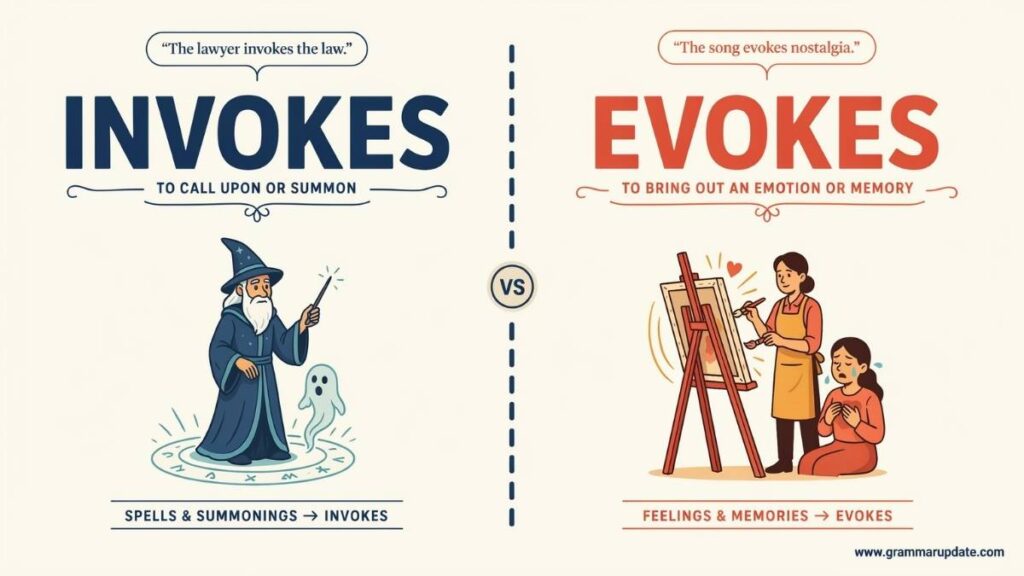
Invokes vs evokes can easily trip you up. The two words look almost identical, sound similar, and both suggest bringing something forward. That’s where the trouble starts. However, they don’t mean the same thing. You invoke something when you call upon it, rely on it, or appeal to it. You evoke something when you bring a memory, feeling, image, or emotion to mind. Think of it this way: you invoke a law, but you evoke a memory. You invoke a right, but you evoke nostalgia. Once you know this simple difference, the confusion fades fast. Let’s make invokes vs evokes easy to understand with clear examples, useful rules, and common mistakes.
Invokes vs Evokes quick answer
The easiest way to understand invokes vs evokes is to focus on what the subject is doing.
| Word | Basic meaning | Common uses | Example |
|---|---|---|---|
| Invokes | Calls upon, appeals to, relies on, or brings something into use | Laws, rights, authority, rules, principles, powers | “The defendant invokes the Fifth Amendment.” |
| Evokes | Brings something to mind or produces a feeling or response | Memories, emotions, images, associations, reactions | “The photograph evokes childhood memories.” |
A simple rule can help:
Invoke means “call upon.”
Evoke means “bring to mind.”
You invoke a law. And You invoke a right. You invoke authority.
You evoke a memory. And You evoke an emotion. You evoke nostalgia.
The distinction isn’t always absolute because the two verbs have overlapping meanings in some formal contexts. However, this basic difference will help you choose the right word in most everyday situations.
Learn the difference between often confused words
Leeched vs Leached Difference and which is correct ?
What Does “Invokes” Mean?
“Invokes” is the third-person singular form of the verb “invoke.”
Invoke Definition
The most useful invoke definition is “to call upon, appeal to, or rely on something.”
The word often suggests deliberate action. Someone invokes a law because they want to rely on that law.and Someone invokes a right because they want that right recognized. Someone invokes authority because they want to use that authority to support an action or decision.
The word can also describe calling upon a deity or higher power. In technical writing, invoke can mean to cause a program, function, or process to run.
Invoke a Law Meaning
To invoke a law means to rely on or appeal to that law for a particular purpose.
For example:
- “The attorney invokes the statute during the hearing.”
- “The agency invokes federal law to support its decision.”
- “The court invokes an established legal principle.”
In each example, someone deliberately calls upon a legal authority.
Invoke a Right Meaning
To invoke a right means to claim or rely on that right.
For example:
- “The defendant invokes the right to remain silent.”
- “The employee invokes her contractual rights.”
- “The defendant invokes constitutional rights during the proceedings.”
This explains why invoke legal rights is such a common phrase in formal English.
Invokes in Religious or Supernatural Contexts
Invoke can also mean to call upon a deity, spirit, or higher power.
For example:
- “The prayer invokes divine protection.”
- “The ceremony invokes an ancient deity.”
- “The ritual invokes a higher power.”
The central idea remains the same: someone calls upon something.
Invokes in Technical English
You may also encounter invoke in computing and software documentation.
In this context, invoke can mean to start or call a function, process, command, or program.
For example:
- “The application invokes the security routine.”
- “The system invokes the backup process automatically.”
- “The command invokes the program.”
This technical meaning still connects to the basic idea of calling something into action.
Learn the difference between often confused words
Drily vs Dryly Which One Is Correct?
What Does “Evokes” Mean?
“Evokes” is the third-person singular form of the verb “evoke.”
Evoke Definition
The most useful evoke definition is “to bring something to mind or cause a feeling, memory, image, or response to arise.”
Unlike invoke, evoke often describes an effect on someone’s mind or emotions.
A song can evoke a memory. A photograph can evoke nostalgia. A painting can evoke sadness. A story can evoke sympathy.
The subject doesn’t necessarily make a deliberate appeal. Instead, it creates an association or response.
Evoke Memories Meaning
To evoke memories means to cause someone to remember past experiences.
For example:
- “The smell of fresh bread evokes memories of childhood.”
- “The old photograph evokes memories of school.”
- “That song evokes memories of summer vacations.”
A smell, sound, image, place, or song can trigger recollection. That’s a natural use of evoke.
Evoke Emotions Meaning
To evoke emotions means to cause emotions to arise.
For example:
- “The movie evokes strong emotions.”
- “The painting evokes sadness.”
- “The speech evokes sympathy.”
- “The story evokes nostalgia.”
The subject produces an emotional effect.
Evoke an Emotional Response
The phrase evoke an emotional response means that something causes people to react emotionally.
For example:
“The documentary evokes an emotional response from viewers.”
The documentary serves as the trigger. The emotional reaction is the result.
This construction appears frequently in discussions of literature, art, film, advertising, music, and public speaking.
Learn the difference between often confused words
Ether vs Either which is correct and Difference?
Invoke and Evoke Difference Why Are They Confusing?
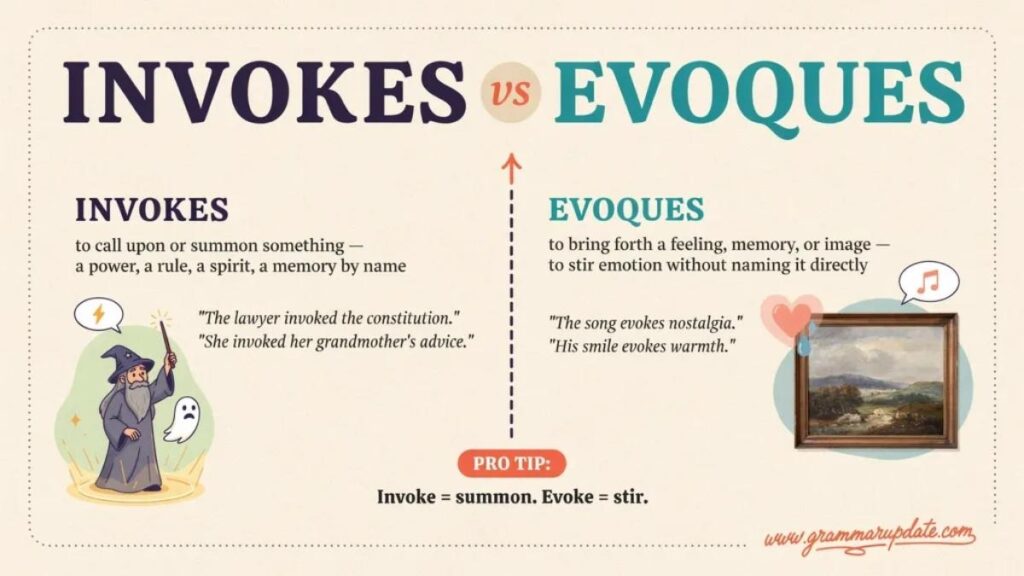
The words are easy to mix up because they look and sound similar.
Both also connect to the broader idea of bringing something forth. Their meanings have developed around related concepts of calling, bringing, appealing, and causing something to arise.
The easiest way to separate them is to think about direction.
Invoke often involves calling upon something.
Evoke often involves bringing something to mind.
Imagine a lawyer standing before a court. The lawyer invokes a law. The lawyer deliberately calls upon that law as authority.
Now imagine hearing an old song. The song evokes memories of childhood. The song brings those memories back into your mind.
The situations are different even though both involve something being brought forth.
How to Remember the Difference Between Invoke and Evoke
A simple memory trick can make the distinction stick.
Invoke means “call upon.”
Evoke means “call to mind.”
Try replacing the word in your sentence.
If “call upon” makes sense, invoke may be correct.
“She invokes her legal rights.”
“She calls upon her legal rights.”
The basic meaning remains clear.
If “bring to mind” makes sense, evoke is usually the better choice.
“The song evokes memories of childhood.”
“The song brings memories of childhood to mind.”
This gives you an easy answer to how to remember the difference between invoke and evoke:
Invoke = call upon.
Evoke = call to mind.
Learn the difference between often confused words
Take Effect vs Take Affect Which one Is Correct?
Invoke vs Evoke Grammar How They Work in Sentences
From a grammar perspective, both words function as transitive verbs. They can take a direct object.
The difference comes from meaning rather than sentence structure.
Common Patterns With Invoke
You can use invoke with:
- a law
- a right
- authority
- a rule
- a principle
- a power
- a deity
- a procedure
- a policy
Examples:
- “She invokes the law.”
- “He invokes his constitutional rights.”
- “The court invokes a legal principle.”
- “The organization invokes its emergency policy.”
Common Patterns With Evoke
You can use evoke with:
- memories
- emotions
- feelings
- images
- nostalgia
- fear
- sympathy
- responses
- associations
Examples:
- “The song evokes memories.”
- “The painting evokes sadness.”
- “The smell evokes nostalgia.”
- “The speech evokes sympathy.”
The grammatical structure may look similar, but the semantic meaning tells you which verb works.
Invokes vs Evokes in a Sentence
Seeing the two words side by side makes the distinction much easier.
| Sentence | Explanation |
| “The lawyer invokes the Constitution.” | The lawyer relies on legal authority. |
| “The painting evokes memories of home.” | The painting brings memories to mind. |
| “The defendant invokes the Fifth Amendment.” | The defendant claims a legal protection. |
| “The song evokes nostalgia.” | The song produces a feeling of nostalgia. |
| “The agency invokes emergency powers.” | The agency calls upon legal authority. |
| “The smell evokes memories of childhood.” | The smell triggers recollection. |
These invokes vs evokes examples show the central difference clearly.
Learn the difference between often confused words
Performing vs Preforming difference and Which One Is Correct?
When to Use Invoke
Use invoke when you mean call upon, appeal to, rely on, summon, or bring something into operation.
Legal Authority
Invoke works naturally with laws, statutes, rights, constitutional provisions, and regulations.
Examples:
- “The attorney invokes the statute.”
- “The defendant invokes a constitutional right.”
- “The agency invokes federal regulations.”
Rules and Principles
You can invoke a rule or principle when you use it to support an action or argument.
Examples:
- “The committee invoked its procedural rules.”
- “The researcher invoked a well-established principle.”
- “The manager invoked company policy.”
Authority and Powers
Invoke also works with authority and powers.
Examples:
- “The governor invoked emergency powers.”
- “The officer invoked departmental authority.”
Deities and Higher Powers
Use invoke when the meaning involves deliberately calling upon a deity or higher power.
Examples:
- “The prayer invokes divine protection.”
- “The ceremony invokes a higher power.”
Technical Operations
In technical English, invoke can describe calling a function or starting a process.
Examples:
- “The system invokes the backup routine.”
- “The application invokes the function automatically.”
These uses share one central idea: something is being called upon or called into action.
When to Use Evoke
Use evoke when you mean bring to mind, remind someone of, produce a feeling, create an image, or trigger a response.
Memories
Examples:
- “The old house evokes childhood memories.”
- “The smell of coffee evokes memories of early mornings.”
- “The photograph evokes memories of home.”
Feelings
Examples:
- “The music evokes sadness.”
- “The photograph evokes happiness.”
- “The novel evokes a sense of loss.”
Images
Examples:
- “The architecture evokes images of ancient Rome.”
- “The colors evoke a peaceful summer landscape.”
Nostalgia
Examples:
- “The restaurant’s decor evokes nostalgia.”
- “The old advertisement evokes memories of another era.”
Reactions
Examples:
- “The speech evokes sympathy.”
- “The announcement evokes concern.”
- “The film evokes a powerful response.”
The subject acts as a trigger that produces a mental, emotional, or sensory response.
Invoke vs Evoke Feelings?
If you’re wondering whether to say invoke or evoke feelings, “evoke feelings” is usually the natural choice when you mean that something causes feelings to arise.
For example:
- “The song evokes feelings of nostalgia.”
- “The speech evokes feelings of hope.”
- “The image evokes feelings of sadness.”
Invoke can appear in broader emotional contexts. However, evoke usually communicates this idea more clearly in everyday English.
Consider the difference:
1.The film evokes strong emotions.”
2.The film produces an emotional response.
3.The film invokes a sense of duty.”
This can suggest that the film calls upon or appeals to the concept of duty.
The intended meaning determines the better verb.
Invoke vs Evoke Fear?
When something causes fear or brings fear to mind, evoke is generally the clearer choice.
Examples:
- “The horror movie evokes fear.”
- “The abandoned building evokes a sense of fear.”
- “The photograph evokes memories of a frightening experience.”
Invoke may appear in more specialized or figurative contexts when someone deliberately calls upon fear as an idea or force.
For ordinary descriptions of something producing fear, however, evoke usually sounds more natural.
Invoke or Evoke a Response?
Both phrases can appear in English, but they can emphasize different ideas.
“Evoke a response” generally means to produce or bring out a reaction.
Examples:
- “The question evokes an emotional response.”
- “The speech evokes a strong reaction.”
- “The painting evokes sympathy.”
Invoke a response can appear in formal or procedural contexts where something calls for or activates a response.
Compare these two sentences:
“The photograph evokes a strong emotional response.”
The photograph causes an emotional reaction.
“The formal request invokes a response under the organization’s procedure.”
The request activates or relies on a formal process.
When you simply mean “cause a reaction,” evoke is usually the clearer choice.
Invoke vs Evoke Spirits
The distinction becomes especially clear when spirits enter the sentence.
Invoke spirits suggests deliberately calling upon or summoning spirits.
For example:
- “The ritual invokes spirits.”
- “The ceremony invokes a deity.”
Evoke spirits can carry a different meaning. It may suggest that something brings spirits to mind or creates an association with them rather than deliberately calling upon them.
The choice therefore depends on the intended action.
If something is being deliberately called upon, invoke fits.
If something merely creates an association or mental image, evoke may fit.
Learn the difference between often confused words
Insuring vs Ensuring Difference and which is correct?
Invoke vs Evoke Examples in Different Contexts
Context often provides the best clue.
Legal Writing
Invoke:
“The defendant invokes the constitutional right to remain silent.”
The defendant is calling upon a legal right.
Evoke:
“The testimony evokes memories of the original case.”
The testimony brings memories to mind.
Literature
Invoke:
“The poem invokes classical mythology.”
The poem deliberately calls upon mythological ideas or references.
Evoke:
“The poem evokes a sense of isolation.”
The poem creates or brings forth an emotional impression.
Art
Invoke:
“The artist invokes religious symbolism.”
The artist deliberately calls upon a symbolic tradition.
Evoke:
“The painting evokes a feeling of calm.”
The painting creates an emotional effect.
Everyday English
Invoke:
“He invoked company policy during the dispute.”
He relied on company policy.
Evoke:
“The smell of rain evokes memories of summer.”
The smell brings memories to mind.
Learn the difference between confusing word pairs
Anyway vs Any Way Difference and which is Correct?
Evoke vs Invoke vs Provoke
Another word often enters this discussion: provoke.
Understanding invoke, evoke, and provoke together makes the distinction easier.
| Word | Basic idea | Example |
| Invoke | Call upon or appeal to something | “She invokes her legal rights.” |
| Evoke | Bring to mind or produce a feeling | “The song evokes nostalgia.” |
| Provoke | Cause or stir a reaction | “His comment provokes anger.” |
Evoke vs Provoke
Evoke often focuses on an emotional or mental response that something brings forth through association, memory, imagery, or experience.
Provoke often emphasizes causing or stirring a reaction.
Compare:
“The photograph evokes sadness.”
“The insult provokes anger.”
The photograph creates an emotional association. The insult stirs a reaction.
Invoke vs Provoke
Invoke means call upon something.
Provoke means cause a reaction.
Compare:
“The lawyer invokes the law.”
“The accusation provokes an argument.”
The lawyer relies on authority. The accusation causes conflict.
That is the basic evoke vs invoke vs provoke distinction.
Common Mistakes With Invokes vs Evokes
Using Invoke for Every Memory
You may see sentences such as:
“The song invokes memories of childhood.”
The meaning is understandable. However, when you mean that the song brings memories to mind, “evokes” is generally the clearer choice.
Better:
“The song evokes memories of childhood.”
Using Evoke for a Legal Right
Consider:
“The defendant evoked the Fifth Amendment.”
That doesn’t express the usual legal meaning clearly.
Better:
“The defendant invoked the Fifth Amendment.”
The defendant is deliberately relying on a legal protection.
Treating the Words as Exact Synonyms
The words aren’t interchangeable simply because both can involve bringing something forth.
Compare:
“The attorney invokes the law.”
“The attorney evokes the law.”
The first sentence says the attorney relies on the law. The second could suggest that the attorney’s words create an association with the law.
That difference becomes important in legal, academic, technical, and professional English.
Learn the difference between confusing word pairs
Lint vs Lent Difference Which one is correct?
Invoke vs Evoke Comparison
The following invoke vs evoke comparison provides a quick reference.
| Feature | Invoke | Evoke |
| Main idea | Call upon or appeal to | Bring to mind or produce |
| Common objects | Laws, rights, rules, authority, principles | Memories, emotions, images, feelings |
| Legal use | Very common | Uncommon |
| Emotional use | Possible in certain contexts | Very common |
| Memory use | Possible in broader usage | Very common |
| Religious use | Common when calling upon a deity | Possible with a different meaning |
| Technical use | Common when calling a function or process | Not normally used in the same way |
| Typical relationship | Deliberate appeal | Mental or emotional effect |
The table highlights the core word usage without turning the distinction into an inflexible grammar rule.
Can You Invoke Emotions?
The question “can you invoke emotions?” deserves a careful answer.
Invoke can have broader meanings that overlap with causing feelings or memories to arise. English dictionaries recognize this broader usage.
However, “evoke emotions” is generally the more natural choice when a song, film, image, story, speech, or experience causes emotions to arise.
Compare:
“The movie evokes strong emotions.”
“The movie invokes a sense of duty.”
The first sentence focuses on emotional reaction.
The second emphasizes the idea of calling upon a concept.
When ordinary emotional response is the intended meaning, evoke is usually the better choice.
Does Music Evoke Feelings?
Yes. Music provides one of the clearest examples of evoke.
A song can evoke nostalgia. A melody can evoke memories. A soundtrack can evoke fear, excitement, sadness, or happiness.
For example:
- “The song evokes memories of childhood.”
- “The soundtrack evokes a feeling of suspense.”
- “The melody evokes nostalgia.”
- “The music evokes an emotional response.”
Music often works through association. A song may become connected with a person, place, event, or period of life. Hearing it years later can bring that experience back to mind.
That’s exactly the kind of relationship that evoke describes.
Learn the difference between confusing word pairs
Choose vs Chose Difference which one is correct?
Invokes vs Evokes in Professional and Academic Writing
Precision matters even more in formal writing.
Legal Writing
Use invoke for:
- laws
- rights
- constitutional provisions
- regulations
- legal powers
- procedural rules
Example:
“The defendant invoked constitutional protections.”
Academic Writing
Use invoke when an argument calls upon a theory, principle, framework, or established authority.
Example:
“The researchers invoke social learning theory to explain the findings.”
Use evoke when a subject creates an association, image, memory, or emotional response.
Example:
“The imagery evokes a sense of uncertainty.”
Literary and Cultural Analysis
Evoke frequently appears when writers explain how language, imagery, music, or art affects an audience.
Example:
“The repeated references to winter evoke isolation and loss.”
Invoke works when a writer deliberately calls upon a cultural, historical, religious, or intellectual reference.
Example:
“The novel invokes classical mythology to frame the conflict.”
Choosing the right verb makes the analysis more precise.
Learn the difference between confusing word pairs
Pose vs Poise Difference and Which one is correct ?
British English vs American English
The basic difference between invoke and evoke remains the same in American and British English.
There isn’t a major US-versus-UK grammar rule that changes which verb you should use.
In both varieties:
- You invoke a law.
- You invoke a right.
- You invoke authority.
- You evoke memories.
- You evoke emotions.
- You evoke nostalgia.
The difference comes from meaning rather than regional English.
A Simple Case Study One Letter Changes the Meaning
Consider this sentence:
“The photograph invokes memories of the war.”
A reader may understand the sentence, but if the intended meaning is that the photograph brings those memories back, “evokes” communicates the idea more naturally.
“The photograph evokes memories of the war.”
Now consider a legal example:
“The attorney invokes the law to challenge the decision.”
Replacing invoke with evoke changes the meaning:
“The attorney evokes the law to challenge the decision.”
That sentence no longer clearly says that the attorney relies on legal authority.
The lesson is straightforward: don’t choose between these words based on appearance. Identify the relationship between the subject and the object.
Is something being called upon?
Use invoke.
Is something bringing a memory, feeling, image, or association to mind?
Use evoke.
Invoke vs Evoke in English The Core Rule
The most useful invoke vs evoke in English rule isn’t really about sentence structure. It’s about meaning.
Both words can function as transitive verbs. Both can take direct objects. Their sentence structures can look almost identical.
The meaning determines the choice.
If the context contains words such as law, authority, right, regulation, rule, principle, power, or deity, invoke is often the better choice.
If the context contains words such as memory, emotion, feeling, nostalgia, image, sympathy, fear, or association, evoke is often the better choice.
Context clues make the decision much easier.
Learn the difference between confusing word pairs
Fistulogram vs Fistulagram which is correct and Difference ?
Invoke vs Evoke Sentence Examples
Here are additional examples to reinforce the distinction.
Invoke Examples in Sentences
- “The attorney invokes the constitutional right to free speech.”
- “The company invoked its emergency policy.”
- “The judge invoked an established legal principle.”
- “The researchers invoked a theoretical framework to explain the findings.”
- “The system invokes the backup process automatically.”
- “The ceremony invokes a traditional prayer.”
- “The speaker invoked the values of fairness and equality.”
Evoke Examples in Sentences
- “The photograph evokes memories of childhood.”
- “The music evokes nostalgia.”
- “The novel evokes a sense of loneliness.”
- “The painting evokes images of the countryside.”
- “The speech evokes sympathy from the audience.”
- “The smell of rain evokes memories of home.”
- “The film evokes a powerful emotional response.”
These invoke vs evoke examples demonstrate how the two verbs work in real sentences.
Learn the difference between confusing word pairs
Leary vs Leery Which Is Correct and Difference?
Practice Session Invokes vs Evokes
Fill in each blank with the correct form of invoke vs evoke.
- The old photograph ______ memories of childhood.
- The attorney ______ the defendant’s constitutional rights.
- The smell of fresh bread ______ memories of her grandmother’s kitchen.
- The judge ______ an established legal principle.
- The painting ______ a strong sense of sadness.
- The defendant ______ the right to remain silent.
- The song ______ feelings of nostalgia.
- The lawyer ______ the law to support his argument.
- The abandoned house ______ a feeling of fear.
- The company ______ its emergency policy during the crisis.
- The speech ______ sympathy among the audience.
- The researcher ______ a well-known theory to explain the results.
- The familiar melody ______ memories of summer vacations.
- The governor ______ emergency powers after the disaster.
- The novel ______ images of life in the countryside.
- The employee ______ her contractual rights during the dispute.
- The movie ______ an emotional response from viewers.
- The ceremony ______ a traditional prayer.
- The artwork ______ feelings of peace and calm.
- The court ______ a constitutional provision in its decision.
- The old neighborhood ______ memories of his childhood.
- The manager ______ company policy when explaining the decision.
- The documentary ______ concern about environmental damage.
- The ritual ______ a higher power for protection.
- The familiar scent ______ a powerful sense of nostalgia.
Answers
- evokes
- invokes
- evokes
- invokes
- evokes
- invokes
- evokes
- invokes
- evokes
- invokes
- evokes
- invokes
- evokes
- invokes
- evokes
- invokes
- evokes
- invokes
- evokes
- invokes
- evokes
- invokes
- evokes
- invokes
- evokes
Here’s a trusted source for clear word meanings:
FAQs
What is the simplest difference between “invoke” and “evoke”?
“Invoke” usually means to call upon, rely on, or appeal to something. “Evoke” usually means to bring a memory, feeling, image, or idea to mind.
For example, you invoke a legal right, but you evoke a memory.
What does “invoke” mean in simple words?
“Invoke” means to call upon or rely on something.
For example:
“The attorney invoked the law to support the argument.”
Here, the attorney relies on the law.
What does “evoke” mean in simple words?
“Evoke” means to bring something to mind or cause a feeling or memory to arise.
For example:
“The song evokes memories of childhood.”
The song brings those memories back to mind.
Do you invoke vs evoke a right?
You normally invoke a right.
For example:
“The defendant invoked her right to remain silent.”
Here, “invoke” means to claim or rely on a recognized right.
Do you invoke or evoke feelings?
You normally evoke feelings.
For example:
“The movie evokes feelings of sadness.”
“Evoke” works because the movie causes those feelings to arise.
Do you invoke vs evoke emotions?
“Evoke emotions” is the more natural choice when something causes emotions to arise.
For example:
“The speech evokes strong emotions.”
Do you invoke vs evoke memories?
You normally evoke memories.
For example:
“The old photograph evokes memories of childhood.”
The photograph brings those memories to mind.
Do you invoke vs evoke fear?
“Evoke fear” is generally the better choice when something causes fear or creates a feeling of fear.
For example:
“The abandoned house evokes fear.”
Do you invoke vs evoke a response?
“Evoke a response” usually works when something causes or brings out a reaction.
For example:
“The question evoked an emotional response.”
“Invoke” can appear in formal or procedural contexts when something calls for or activates a response.
What does “invoke” mean in legal terms?
In legal language, “invoke” usually means to rely on or formally appeal to a law, right, rule, constitutional provision, or legal principle.
For example:
“The defendant invoked the Fifth Amendment.”
The defendant relied on a constitutional protection.
What does “invoke legal rights” mean?
“Invoke legal rights” means to claim, rely on, or formally appeal to rights provided by law.
For example:
“The employee invoked her legal rights during the dispute.”
How do you use “invoke” in a sentence?
Use “invoke” when someone calls upon or relies on something.
Example:
“The lawyer invoked the statute to support the case.”
How do you use “evoke” in a sentence?
Use “evoke” when something brings a memory, feeling, image, or response to mind.
Example:
“The smell of fresh bread evokes memories of home.”
What is another word for “invoke”?
Depending on the context, you can use “call upon,” “appeal to,” “rely on,” “cite,” “use,” or “summon.”
For example:
“She invoked the rule” can become “She relied on the rule.”
The best alternative depends on the sentence.
What is another word for “evoke”?
Depending on the context, alternatives include “bring to mind,” “recall,” “trigger,” “arouse,” “produce,” and “conjure.”
For example:
“The song evokes memories” can become “The song brings memories to mind.”
What is a simpler word for “invoke”?
“Call upon” is often the simplest alternative.
For example:
“He invoked his legal rights.”
“He called upon his legal rights.”
Depending on the context, “cite” or “rely on” may sound more natural.
What is a simpler word for “evoke”?
“Remind” or “bring to mind” often provides the clearest alternative.
For example:
“The painting evokes memories of home.”
“The painting brings memories of home to mind.”
What does “invoked” mean?
“Invoked” is the past tense of “invoke.” It means called upon, relied on, appealed to, or brought into effect.
Example:
“The company invoked its emergency policy.”
What does “evoked” mean?
“Evoked” is the past tense of “evoke.” It means brought something to mind or caused a feeling, memory, image, or response to arise.
Example:
“The speech evoked strong emotions.”
What does “evoking” mean?
“Evoking” means bringing something to mind or causing a particular feeling, memory, image, or response.
Example:
“The photograph is evoking memories of childhood.”
Is “evoke” the same as “provoke”?
No. “Evoke” usually means to bring something to mind or produce a feeling or response. “Provoke” means to cause or stir a reaction.
Compare:
- “The song evokes nostalgia.”
- “The insult provokes anger.”
The song brings up an emotional association, while the insult causes a strong reaction.
What is the difference between “evoke” and “elicit”?
“Evoke” usually means to bring a feeling, memory, image, or association to mind. “Elicit” usually means to draw out a response, answer, reaction, or information.
For example:
- “The photograph evokes sadness.”
- “The question elicits a detailed answer.”
What is the difference between “invocation” and “evocation”?
“Invocation” is the act of invoking something, such as a law, authority, right, principle, or deity.
“Evocation” is the act of evoking something, such as a memory, feeling, image, or association.
In simple terms:
- Invocation = calling upon
- Evocation = bringing to mind
What is the difference between an invocation and an incantation?
An invocation is a formal act of calling upon someone or something, often in a religious, ceremonial, rhetorical, or formal setting.
An incantation is a set of words spoken or recited as part of a ritual or magical practice.
The terms can overlap in some contexts, but they aren’t interchangeable.
Can “invoke” refer to something other than a law?
Yes. “Invoke” can refer to rules, rights, authority, principles, policies, powers, deities, and technical processes.
For example:
- “The manager invoked company policy.”
- “The speaker invoked a moral principle.”
- “The system invoked a security function.”
Can “evoke” refer to something other than emotions?
Yes. “Evoke” can describe memories, images, ideas, sensations, associations, and reactions as well as emotions.
For example:
- “The smell evokes memories of summer.”
- “The architecture evokes images of ancient Rome.”
- “The painting evokes a sense of peace.”
What does it mean when someone invokes someone?
When someone invokes another person, the meaning depends on context. It can mean calling upon that person for help, appealing to their authority, referring to their name, or using their example to support an argument.
For example:
“The speaker invoked the former president’s words during the debate.”
Here, the speaker refers to those words as support for the argument.
When should you use “invoke” instead of “evoke”?
Use “invoke” when you mean call upon, appeal to, rely on, or bring something into effect.
Common combinations include:
- invoke a law
- invoke a right
- invoke authority
- invoke a rule
- invoke a principle
- invoke a policy
- invoke emergency powers
When should you use “evoke” instead of “invoke”?
Use “evoke” when you mean bring to mind, trigger a memory, produce an emotion, create an image, or cause a response.
Common combinations include:
- evoke memories
- evoke emotions
- evoke feelings
- evoke nostalgia
- evoke fear
- evoke sympathy
- evoke an image
- evoke a response
What is the easiest way to remember “Invokes vs Evokes”?
Use this simple rule:
“Invoke” means call upon.
“Evoke” means call to mind.
If you call upon a law, right, rule, or authority, you invoke it.
If something brings a memory, emotion, or image to mind, it evokes it.
Are “Invokes vs Evokes” interchangeable?
Not usually. Although their meanings can overlap in certain formal or figurative contexts, they usually serve different purposes.
“Invoke” emphasizes calling upon or relying on something.
“Evoke” emphasizes bringing something to mind or producing a response.
What is the best way to choose between “Invokes vs Evokes”?
Look at what the sentence means rather than how the words look.
Ask yourself:
“Am I calling upon something?”
If yes, use “invoke.”
“Am I bringing a memory, feeling, image, or association to mind?”
If yes, use “evoke.”
That quick test will help you choose the right word in most situations.
Conclusion
Invokes vs evokes look like they belong to the same word family, so it’s easy to mix them up. But once you understand what each word actually does, the confusion disappears. That’s the key to mastering invokes vs evokes without second-guessing every sentence.
Here’s the easiest way to remember the difference: you invoke something when you call upon it, rely on it, or appeal to it. You evoke something when you bring a memory, feeling, image, or response to mind.
For example, you invoke a law, invoke a right, or invoke authority. But you evoke memories, evoke emotions, or evoke nostalgia. That simple contrast makes invokes vs evokes much easier to remember.
Think of it this way: invoke is about calling upon something, while evoke is about bringing something out of someone’s mind or emotions.
If you’re still unsure, replace the word with a simpler phrase. Does “call upon” fit? Choose invoke. Does “bring to mind” fit? Choose evoke. This quick test can clear up most invokes vs evokes mistakes before they reach the page.
Once you understand the difference between invoke vs evoke, you’ll know exactly which word fits your sentence. Grammarly can still check your writing, of course, but it won’t have to play referee every time.

Jhon AJS, the creative mind behind Grammar Update, is an experienced blogger passionate about simplifying English grammar. He focuses on explaining confusing word vs word differences, grammar rules, punctuation, and sentence structure in a clear and practical way. Through easy to understand guides and examples, Jhon helps readers improve their writing and communicate with confidence. With years of blogging experience, he continues to share helpful insights that make learning grammar simple, useful, and accessible for everyone.