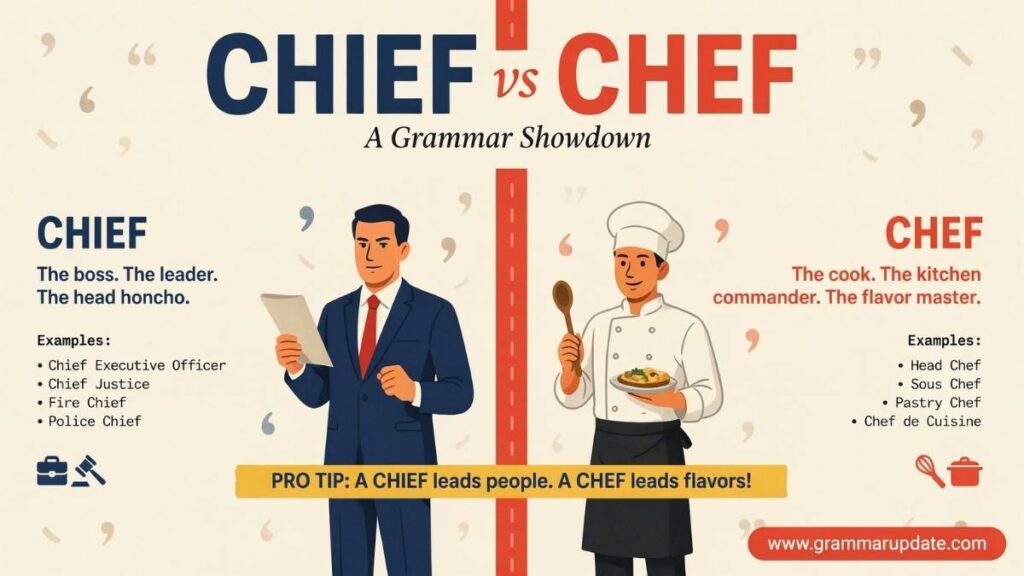
If chief and chef have ever made you stop and think, you’re not alone. These two words look almost identical, but they have completely different meanings. Call a professional cook a chief and you’ve suddenly turned a kitchen into a leadership meeting. Call a police chief a chef and you’ve made the station sound like a restaurant. The chief vs chef confusion usually comes from their similar spelling and different pronunciation. Chief means a leader, person in charge, or something most important. Chef means a professional cook. Once you understand the difference between chief and chef, the confusion disappears and choosing the right word becomes simple.
Chief vs Chef quick answer
The fastest way to understand the difference between chief and chef is to look at what each word describes.
| Word | Meaning | Common Context | Example |
|---|---|---|---|
| Chief | A leader, highest-ranking person, main, or most important | Leadership, authority, rank, importance | The police chief spoke to reporters. |
| Chef | A professional cook | Restaurants, hotels, kitchens, food preparation | The chef prepared the evening menu. |
The chief meaning centers on leadership, rank, authority, or importance.
The chef meaning centers on professional cooking.
Consider these two sentences:
The police chief announced the new policy.
The chef announced the new menu.
The first person leads a police department. The second person works in a professional kitchen and has responsibility for food or kitchen operations.
That’s the core difference between chief and chef.
Neither spelling is an alternative version of the other. If you’re writing about a professional cook, use chef. If you’re writing about a leader or something important or primary, use chief.
Learn the difference between confusing more English words
Everywhere vs Every Where Which One Is Correct ?
What Does Chief Mean?
The chief definition has several related meanings. As a noun, chief can refer to a leader or person in charge. As an adjective, it can describe something that ranks first in importance.
This gives the word two major uses.
First, chief can describe a person who leads a group or organization. Second, it can describe something that is the main or most important part of a situation.
For example:
The fire chief arrived at the scene.
Here, chief refers to a leadership position.
Now consider:
Safety was the chief concern during the project.
In this sentence, chief doesn’t describe a person at all. It means main or most important.
Understanding both uses makes chief usage much easier.
Chief as a Noun
When chief works as a noun, it generally refers to a leader or person in charge.
You may see it in titles such as:
- police chief
- fire chief
- tribal chief
- chief of staff
- department chief
- military chief
For example:
The police chief held a press conference after the investigation.
The word chief identifies the person who holds the leading position in the police department.
Likewise:
The fire chief inspected the damaged building.
The fire chief is a senior leader within the fire department. The word doesn’t describe someone who cooks food.
The same basic idea appears in other leadership contexts.
The department chief approved the new procedure.
The tribal chief addressed the community.
The chief called the members together for a meeting.
In each case, chief connects to leadership, authority, or rank.
Chief as an Adjective
Chief can also work as an adjective. In this form, it means main, primary, or most important.
For example:
Her chief concern was safety.
Cost remains the chief problem.
His chief reason for leaving was the long commute.
The chief goal of the program is to improve access.
Notice that none of these sentences involves a leader.
Here, chief simply means most important or main.
That’s an important part of the chief word meaning because many learners first encounter chief in job titles and assume it always refers to a person. It doesn’t.
Compare:
The chief arrived at the meeting.
Here, chief is a noun referring to a person.
The chief concern was cost.
Here, chief is an adjective meaning the main concern.
The spelling stays the same while the grammatical role changes.
Learn the difference between confusing more English words
Costumer vs Customer difference and Which One Is Correct?
What Does Chef Mean?
The chef definition is much more specific.
A chef is a professional cook, particularly someone who works in a professional kitchen such as a restaurant, hotel, catering business, or private dining operation.
For example:
The chef prepared a five-course dinner.
The restaurant hired an experienced chef.
The chef created a new seasonal menu.
In each sentence, chef refers to a cooking professional.
The word can also appear in more specific culinary job titles.
Common examples include:
- executive chef
- head chef
- pastry chef
- private chef
- personal chef
- sous-chef
- chef de cuisine
- commis chef
These titles can describe different levels of responsibility within a kitchen.
Chef and Professional Cooking
A chef may do much more than prepare individual dishes.
Depending on the workplace and position, a chef may handle:
- Menu planning
- Recipe development
- Food preparation
- Kitchen management
- Staff supervision
- Ingredient ordering
- Food safety
- Quality control
- Training kitchen staff
- Scheduling
- Cost control
An executive chef, for example, may oversee an entire restaurant kitchen and supervise several members of the kitchen staff.
A pastry chef focuses on baked goods, desserts, pastries, and related food preparation.
A sous-chef often works directly under the executive or head chef and helps manage daily kitchen operations.
A line cook, by contrast, may prepare specific dishes or work at a particular station without holding the title of chef.
That distinction matters because chef and cook aren’t always exact synonyms.
A chef is a professional cook, but not every person who cooks professionally necessarily holds the job title chef.
Learn the difference between confusing more English words
Crain vs Crane difference Which one Is Correct?
Chief vs Chef Side-by-Side Comparison
A direct comparison makes the chief and chef difference easier to remember.
| Feature | Chief | Chef |
|---|---|---|
| Basic meaning | Leader, highest-ranking person, main, or most important | Professional cook |
| Part of speech | Noun and adjective | Primarily a noun |
| Main association | Leadership, authority, rank, importance | Cooking, food, restaurants, kitchens |
| Common workplace | Government, business, police, military, organizations | Restaurants, hotels, catering, professional kitchens |
| Example title | Police chief | Executive chef |
| Pronunciation | /tʃiːf/ | /ʃef/ |
| Easy memory cue | Chief leads | Chef cooks |
The chef vs chief distinction becomes much easier when you focus on the context.
Think about a police station. The person in charge is the police chief.
Now picture a restaurant kitchen. The professional responsible for cooking or kitchen operations may be the chef.
The two roles can both involve leadership, but they aren’t the same profession.
A chef may lead kitchen staff. A chief may lead a department. Context tells you which word belongs in the sentence.
Learn the difference between confusing more English words
Performing vs Preforming difference and Which One Is Correct?
Chief vs Chef Pronunciation
The chief vs chef pronunciation difference is another major reason these words cause confusion.
Although the spellings look similar, the sounds are different.
Chief is pronounced:
/tʃiːf/
Chef is pronounced:
/ʃef/
An easy English approximation is:
Chief sounds like “cheef.”
Chef sounds like “shef.”
The first sound changes from “ch” to “sh.” The vowel changes too.
Chief has a long e sound. Chef has a shorter vowel sound.
| Word | IPA | Easy Guide | Opening Sound |
|---|---|---|---|
| Chief | /tʃiːf/ | cheef | ch |
| Chef | /ʃef/ | shef | sh |
This pronunciation difference becomes especially useful when you’re speaking rather than writing.
How to Pronounce Chief
If you’re wondering how to pronounce chief, start with the “ch” sound in words such as “chair,” “cheese,” or “child.”
Then add the long e sound from words such as “see” or “tree.”
Finally, add the “f” sound.
That gives you:
Chief → cheef
The standard chief pronunciation in English is /tʃiːf/.
The chief pronunciation American and chief pronunciation British forms are essentially the same in standard English:
Chief → /tʃiːf/
So there isn’t a major US-versus-UK pronunciation difference to worry about here.
How to Pronounce Chef
If you’re wondering how to pronounce chef, begin with the “sh” sound found in “ship,” “sheep,” or “shop.”
Then add the short vowel sound and finish with “f.”
That gives you:
Chef → shef
The standard chef pronunciation in English is /ʃef/.
The chef pronunciation American and chef pronunciation British forms are also essentially the same in standard English.
So:
Chief → cheef
Chef → shef
That small difference in sound can help you separate the words instantly.
Learn the difference between confusing more English words
Tomatoes vs Tomatos difference and Which Is Correct?
Chief vs Chef Pronunciation in English

The chief vs chef pronunciation in English becomes clearer when you break each word into its individual sounds.
Chief starts with a “ch” consonant sound.
Chef starts with a “sh” consonant sound.
Chief also has a long e vowel.
Chef uses a shorter vowel.
The difference can be represented like this:
Chief:
ch + ee + f
Chef:
sh + e + f
This is why the words don’t sound like rhyming variations of the same word.
If someone asks, “Is chief pronounced cheef?” the answer is yes.
If someone asks, “Is chef pronounced shef?” the answer is also yes.
The spellings may look close, but the pronunciation difference is real.
Learn the difference between confusing more English words
Sergeant vs Sargent difference and Which Is Correct?
Why Do People Confuse Chief and Chef?
The common confusion between chief and chef has several causes.
The first is visual similarity.
Both words begin with “ch.” and Both end with “f.” Both have four letters.
That makes the eye want to group them together.
The second reason is their historical relationship.
Chief and chef both have roots connected to the idea of a head or leader. Chief developed into an English word associated with leadership, rank, and importance. Chef entered English from French with a culinary meaning connected to the head of a kitchen.
That shared history makes their resemblance less surprising.
However, modern English gives them very different jobs.
Chief is used for:
- Leadership
- Rank
- Authority
- Importance
- The main part of something
Chef is used for:
- Professional cooking
- Restaurant kitchens
- Culinary work
- Food preparation
The third reason is that both words can appear in professional titles.
For example:
Police chief
and:
Executive chef
Both describe senior positions. The similarity in professional context can make the spelling easier to mix up.
The best solution isn’t to memorize dozens of isolated examples. Instead, connect each word to its central meaning.
Chief means leader or main.
Chef means professional cook.
Once that connection becomes automatic, the spelling usually follows naturally.
Is “Chief Chef” Correct?
The phrase chief chef can be understood, but it isn’t usually the most natural professional title in modern American English.
If you mean the person who leads a kitchen, the more common titles include:
- head chef
- executive chef
- chef de cuisine
For example:
She became the head chef after years of experience in the restaurant.
This sounds natural.
You could technically understand:
She became the chief chef of the restaurant.
However, the phrase sounds less conventional because English already has established culinary titles for the person in charge of a kitchen.
This distinction is important.
A phrase can be understandable without being the most natural choice for professional English.
The word chief means “main” or “highest-ranking,” so the phrase chief chef is logically understandable. But head chef and executive chef are more established expressions in modern restaurant terminology.
The historical connection between chief and chef also helps explain why people create the phrase. Chef ultimately comes from French terminology connected with the head or leader of a kitchen.
Still, modern usage matters more than historical logic when choosing a professional title.
If the official position is executive chef, write executive chef.
If the position is head chef, write head chef.
Don’t replace either title with chief chef simply because chief can mean “head.”
Learn the difference between tricky grammar more words
Insuring vs Ensuring Difference and which is correct?
Chief vs Chef in Common Expressions
The words become much easier to distinguish when you look at the expressions they commonly form.
Common Expressions With Chief
Some familiar expressions include:
- police chief
- fire chief
- chief executive officer
- chief justice
- chief engineer
- chief medical officer
- chief of staff
- commander-in-chief
- chief concern
- chief reason
- chief responsibility
- chief goal
These expressions generally involve leadership, rank, authority, or importance.
For example:
The police chief addressed the public.
The fire chief inspected the building.
The chief engineer reviewed the design.
Safety was the chief concern.
In each case, chief has a leadership or importance-related meaning.
Common Expressions With Chef
Chef appears primarily in culinary expressions and professional kitchen titles.
Common examples include:
- executive chef
- head chef
- pastry chef
- private chef
- personal chef
- sous-chef
- chef de cuisine
- commis chef
- chef’s knife
For example:
The executive chef created the new menu.
The pastry chef prepared the desserts.
The private chef cooked dinner for the family.
Here, chef always points toward professional cooking.
The contrast becomes particularly interesting in phrases such as executive chef and chief executive officer.
They contain some of the same words but describe completely different jobs.
An executive chef manages culinary operations.
A chief executive officer leads an organization.
One belongs in a restaurant kitchen. The other belongs in the executive office.
Chief vs Chef Common Mistakes and How to Fix Them
The easiest way to avoid mistakes is to look at the meaning before worrying about spelling.
Mistake Using Chef for a Police Leader
Incorrect:
The police chef announced the new policy.
Correct:
The police chief announced the new policy.
A police department’s leader is a police chief.
The word chef would suggest that the person works as a professional cook, which completely changes the meaning.
Mistake Using Chief for a Professional Cook
Incorrect:
The restaurant hired a new chief.
Correct:
The restaurant hired a new chef.
If you mean a professional cook, use chef.
The sentence becomes especially clear when you add a culinary job title:
The restaurant hired a new executive chef.
Mistake Treating Chief and Chef as Alternative Spellings
Chief and chef aren’t two spellings for the same word.
1.They have different meanings.
2.They also have different pronunciations.
3.They even play different grammatical and professional roles.
So this isn’t a situation like “color” and “colour,” where regional spelling creates two accepted forms of the same word.
Chief and chef are separate words.
Mistake Automatically Writing “Chief Chef”
Someone may reason that a chef who leads a kitchen is the “chief chef.”
That logic makes sense on the surface, but professional English usually uses head chef or executive chef.
For example:
She was promoted to head chef.
is more natural than:
She was promoted to chief chef.
The meaning is similar, but the established title matters.
Mistake Ignoring the Pronunciation Difference
Some people recognize the spelling difference but still pronounce both words alike.
That can create confusion in conversation.
Remember:
Chief = cheef
Chef = shef
The first consonant and vowel sound both change.
Learn the difference between tricky grammar more words
Leeched vs Leached Difference and which is correct ?
Chief vs Chef Examples in Sentences
Seeing the words in context is one of the best ways to understand the difference.
Chief Example Sentences
The police chief spoke to reporters after the meeting.
The fire chief inspected the damaged building.
Safety was the chief concern during the construction project.
She accepted the position of chief engineer.
His chief reason for moving was the shorter commute.
The chief called the department together for an emergency meeting.
Cost became the chief problem after the budget was reduced.
These chief example sentences demonstrate the major meanings of the word.
In some examples, chief means leader.
In others, it means main or most important.
Chef Example Sentences
The chef prepared the restaurant’s signature dish.
The executive chef redesigned the menu.
The pastry chef created the wedding cake.
The head chef trained the new kitchen staff.
The private chef prepared dinner for the guests.
The chef checked every dish before it left the kitchen.
These chef example sentences all connect the word with cooking and professional food preparation.
Chief vs Chef Examples Together
Sometimes both words can appear naturally in one sentence.
The fire chief thanked the chef for preparing meals for the emergency workers.
The police chief visited the restaurant and spoke with the chef.
The chief inspected the facility while the chef prepared lunch.
These examples make the difference between the words almost impossible to miss.
The chief leads.
The chef cooks.
That distinction remains consistent even when both people appear in the same situation.
Chief vs Chef in American English
The basic distinction between chief and chef remains stable in American English.
American English uses chief for leadership, rank, authority, and importance.
It uses chef for a professional cook.
The pronunciation difference also remains clear.
Chief is pronounced /tʃiːf/.
Chef is pronounced /ʃef/.
So the chief pronunciation American form is approximately “cheef,” while the chef pronunciation American form is approximately “shef.”
British English follows the same basic distinction.
That means there isn’t a major British-versus-American spelling issue with these words.
You don’t need to learn one spelling for the United States and another for Britain.
The words themselves remain separate in both varieties of English.
Learn the difference between tricky grammar more words
Lint vs Lent Difference Which one is correct?
Chief vs Chef Word Origins and History
The history of chief and chef explains some of their unusual similarity.
Chief entered English through French and ultimately traces back to the Latin word caput, meaning “head.” Over time, the idea of “head” developed naturally into meanings connected with leadership, rank, and importance.
That’s why chief can refer to:
- A leader
- A person in charge
- The highest-ranking person
- The main part
- The most important concern
Chef also has a French origin. In French, chef has historically carried the meaning of “head” or “leader.” English later adopted chef as a culinary term, particularly through expressions connected with the head of a kitchen.
This history explains why the two words look related.
They are historically related.
But history doesn’t determine modern usage word for word.
English often takes related words and gives them specialized meanings over time.
That’s exactly what happened here.
Chief developed into a general word for leadership and importance.
Chef developed into the English culinary term for a professional cook.
The result is two words with related roots but clearly different modern meanings.
Is a Chef a Chief?
Not in ordinary modern English.
A chef can be the person in charge of a kitchen, but that doesn’t make chef another spelling of chief.
For example:
The executive chef manages the restaurant kitchen.
The chef has a leadership role in that kitchen.
You wouldn’t normally replace chef with chief:
The executive chief manages the restaurant kitchen.
That changes the meaning and makes the job title sound incorrect.
The historical relationship is worth remembering, though. The French word chef was associated with the idea of a head or leader. English eventually adopted the word specifically for the head or skilled professional of a kitchen.
So the answer has two parts:
- Historically, chief and chef are related.
- In modern English, they are distinct words with distinct meanings.
That distinction keeps the history interesting without creating a usage mistake.
Can Chief Mean Cook?
Generally, no.
The modern chief meaning doesn’t mean “cook.”
However, you may encounter a phrase such as chief cook.
For example:
He served as the chief cook aboard the ship.
In this phrase, cook identifies the person’s occupation.
Chief simply tells you that the person was the senior or principal cook.
That’s different from saying:
He was a chief.
That sentence doesn’t normally mean “He was a cook.”
Likewise, chef itself doesn’t automatically mean leader in the general sense.
The title executive chef includes leadership responsibilities, but chef still identifies the culinary profession.
This distinction is useful because it prevents a common mistake: assuming that because someone is the head of a kitchen, chef and chief must mean the same thing.
They don’t.
Learn the difference between tricky grammar more words
Choose vs Chose Difference which one is correct?
Chief vs Chef Quick Grammar and Usage Check
Chief can function as both a noun and an adjective.
Examples:
The chief arrived at the meeting.
Noun.
Safety was the chief concern.
Adjective.
Chef functions primarily as a noun.
Example:
The chef prepared the meal.
The plural forms also differ slightly.
Chief becomes chiefs.
Chef becomes chefs.
Examples:
Several chiefs attended the conference.
Several chefs attended the culinary event.
The possessive forms are also straightforward:
The chief’s decision surprised everyone.
The chef’s recipe became popular.
For plural possession:
The chiefs’ meeting lasted two hours.
The chefs’ schedules changed after the restaurant expanded.
These grammatical forms are easy to manage once you remember that the underlying words have different meanings.
Chief vs Chef How to Remember the Difference
When you’re unsure which word to use, don’t memorize complicated rules.
Use a simple association.
Chief means leader or main.
Chef means professional cook.
Picture a chief standing in front of a group and giving instructions.
Now picture a chef standing in a kitchen preparing food.
Those two mental images create a strong distinction.
You can also use the pronunciation as a backup:
Chief = cheef
Chef = shef
The “ch” sound belongs to chief.
The “sh” sound belongs to chef.
The long e sound belongs to chief.
The shorter vowel belongs to chef.
If you remember only one sentence, remember this:
Chief leads. Chef cooks.
That rule handles most everyday cases.
When to Use Chief
Use chief when you mean:
- A leader
- A person in charge
- A person with the highest rank
- The main or most important thing
- A formal leadership position
Examples include:
police chief
fire chief
chief engineer
chief justice
chief executive officer
chief medical officer
You can also use chief as an adjective:
chief concern
chief reason
chief goal
chief responsibility
If the meaning involves “main,” “most important,” or “leader,” chief is usually the word you want.
When to Use Chef
Use chef when you mean a professional cook.
Common examples include:
executive chef
head chef
pastry chef
private chef
personal chef
sous-chef
A chef may supervise other workers, create menus, order ingredients, and manage a kitchen. However, the central meaning remains connected to professional cooking.
That’s the easiest way to keep the two words apart.
Chief vs Chef in Professional and Academic Writing
Accuracy matters when these words appear in professional titles.
A single letter can change the entire meaning.
Compare:
Chief Executive Officer
with:
Executive Chef
The first is a senior corporate leadership position.
The second is a senior culinary position.
Now compare:
Police Chief
with:
Head Chef
Again, both can describe people in charge of a team, but they belong to completely different professional settings.
This distinction matters in:
- Resumes
- Job applications
- Company biographies
- News articles
- Academic writing
- Business reports
- Professional profiles
- Restaurant websites
- Menus
- Workplace communication
When referring to someone’s official job title, use the actual title.
If someone is an executive chef, call that person an executive chef.
If someone is a police chief, call that person a police chief.
Don’t let the similarity between chief and chef turn a professional title into a completely different occupation.
Learn the difference between tricky grammar more words
Then vs Than difference which one is correct ?
Chief vs Chef Practice Session
Fill in each blank with the correct word: chief vs chef.
- The police ______ spoke to reporters after the incident.
- The restaurant hired an experienced ______ to lead the kitchen.
- Safety was the company’s ______ concern.
- The pastry ______ prepared a selection of desserts.
- The fire ______ arrived at the scene within minutes.
- The restaurant’s executive ______ created a new seasonal menu.
- Her ______ reason for leaving the company was the long commute.
- The tribal ______ addressed the community during the ceremony.
- The ______ prepared a five-course dinner for the guests.
- The ______ engineer reviewed the construction plans.
- The head ______ trained the new kitchen staff.
- Cost became the ______ problem during the project.
- The police ______ announced the department’s new policy.
- The private ______ prepared dinner for the family.
- His ______ goal was to improve customer service.
- The fire ______ inspected the building after the accident.
- The restaurant’s ______ developed a new recipe for the menu.
- The ______ executive officer presented the company’s annual report.
- The pastry ______ decorated the wedding cake.
- Her ______ concern was the safety of the children.
- The department ______ called an emergency meeting.
- The executive ______ supervised the restaurant’s kitchen staff.
- The ______ reason for the delay was a technical problem.
- The restaurant welcomed a famous professional ______ for the event.
- The ______ of staff organized the meeting with department leaders.
Answers
- chief
- chef
- chief
- chef
- chief
- chef
- chief
- chief
- chef
- chief
- chef
- chief
- chief
- chef
- chief
- chief
- chef
- chief
- chef
- chief
- chief
- chef
- chief
- chef
- chief
Here’s a trusted source for clear word meanings:
FAQs
Is a chief a cook?
No. In modern English, chief does not normally mean cook. Chief usually refers to a leader, a person in charge, someone with a high rank, or something that is most important. A professional cook is generally called a chef.
What is the difference between chief and chef?
Chief and chef are different words with different meanings. Chief relates to leadership, rank, or importance. Chef refers to a professional cook, especially one who works in a professional kitchen.
What is correct, chef or chief?
Both are correct words, but they aren’t interchangeable. Use chief for a leader or something main or most important. Use chef for a professional cook.
Who is higher than a chef?
In a kitchen hierarchy, the position above a chef depends on the type of kitchen and the specific job structure. An executive chef may oversee other chefs, while a chef de cuisine or head chef may lead a particular kitchen. Some organizations also place a corporate culinary director above individual executive chefs.
Is a female chef called a chef?
Yes. Chef is gender-neutral. A woman who works professionally as a chef is called a chef, just as a man in the same role is called a chef.
Can a cook call himself a chef?
A person can use the title chef when it accurately describes their professional role and responsibilities. A culinary degree isn’t always required to work as a chef. Experience, training, skills, and the position itself often matter more than having a specific degree.
What is the hierarchy in a kitchen?
Kitchen hierarchies vary by restaurant, but a traditional structure may include an executive chef at the top, followed by a chef de cuisine or head chef, sous-chef, chef de partie, commis chef, and kitchen assistants or other entry-level workers.
What is the lowest position in a kitchen?
There isn’t one universal lowest position. In a traditional brigade system, a commis is an entry-level culinary position. Some kitchens also use titles such as kitchen assistant, prep cook, or dishwasher for entry-level work.
What is a chief cook called?
A senior cook can be called a head chef, executive chef, or chef de cuisine depending on the kitchen and the person’s responsibilities. The phrase chief cook can also appear in specific contexts, but it isn’t the most common modern restaurant title.
What is the opposite of a chef?
There isn’t a true opposite of chef. Chef describes a type of culinary professional, so its opposite isn’t another standard occupation. A person who doesn’t work as a professional cook might simply be called a home cook, customer, diner, or nonprofessional cook depending on the context.
Can I call myself a chef without a degree?
Yes. There is no universal rule requiring a culinary degree before someone can use the title chef. Many chefs develop their careers through apprenticeships, restaurant experience, on-the-job training, culinary school, or a combination of these paths.
What do you call a woman who cooks?
If she cooks professionally, you can call her a chef. If she cooks casually or at home, cook is usually the more accurate general term. The word chef doesn’t change based on gender.
What is a fancy word for a chef?
Several professional titles can describe a chef depending on the role. Executive chef, chef de cuisine, pastry chef, and culinary director are examples. These titles aren’t exact synonyms because each can describe different responsibilities.
What do chefs call their helpers?
The title depends on the kitchen. A junior culinary worker may be called a commis, kitchen assistant, prep cook, or apprentice. In a traditional brigade system, a commis works under more experienced culinary staff.
What is a chef teacher called?
A chef who teaches culinary skills may be called a culinary instructor, chef instructor, culinary educator, or chef educator. The appropriate title depends on the institution and the person’s role.
What do we call a male cook?
A male professional cook is called a chef if he holds a chef position. Chef is a gender-neutral term, so there’s no separate male version.
What is a nickname for a chef?
There isn’t one universal nickname for chef. Depending on the setting, people may casually say cook, kitchen pro, or simply chef. In professional kitchens, chefs may also address one another by their job title.
What is the highest-paid chef position?
Compensation varies widely by restaurant, location, experience, ownership, and reputation. Senior positions such as executive chef, corporate executive chef, culinary director, and chef-owner can command higher pay than entry-level culinary roles. Celebrity status and restaurant ownership can also greatly affect income.
How many chefs can be in a kitchen?
A kitchen can have one chef or many chefs. A small restaurant might have one chef overseeing a few cooks, while a large hotel, resort, cruise ship, or high-volume restaurant may employ a much larger culinary team with several levels of chefs and cooks.
Why do chefs call each other chef?
Chef is a professional title, so kitchen staff may use it when addressing someone who holds that position. In some kitchens, using the title reflects respect, hierarchy, or professional habit.
What is a fancy title for a chef?
Executive chef, chef de cuisine, culinary director, and corporate executive chef are examples of more specific professional titles. The right title depends on the person’s actual responsibilities.
What is a fancy word for a cook?
Culinary professional is a broad formal expression. Chef is the standard professional title for many trained cooks, although not every cook holds a chef position.
What is a male cook called?
A male cook is simply called a cook. If he works professionally as a chef, he can be called a chef. Neither title changes according to gender.
What’s a funny name for a chef?
There isn’t a standard funny name for a chef. Informal nicknames can vary by workplace and personality. Terms such as kitchen wizard or food artist may appear playfully, but they aren’t formal job titles.
Why do chefs wear tall hats?
The traditional tall chef’s hat, called a toque, became associated with professional culinary dress. Its height helped distinguish the chef from other kitchen workers and became part of the traditional image of a professional kitchen. Modern kitchens don’t always require the traditional tall toque.
Is it correct to say Mr. Chef?
It isn’t the usual form of address in standard English. You would normally use the person’s name, Chef followed by their name when appropriate, or their actual professional title. “Mr. Chef” can sound unnatural or overly formal.
What is the hardest position in the kitchen?
The difficulty depends on the kitchen and the person doing the job. Executive chefs handle broad management responsibilities, while sous-chefs and line cooks may face intense physical pressure during busy service. Positions that combine leadership, speed, precision, and long hours can be especially demanding.
Is being a chef the hardest job?
Being a chef can be extremely demanding, but “hardest job” is subjective. Professional kitchens can involve long hours, heat, physical fatigue, tight deadlines, repetitive preparation, and high pressure during service.
What is the lowest salary for a chef?
There isn’t one universal lowest chef salary. Pay depends heavily on location, experience, employer, restaurant type, and whether the position is actually a chef role or an entry-level cooking position. Entry-level culinary workers generally earn less than experienced chefs.
Do chefs work 40 hours a week?
Some chefs work around 40 hours a week, but many restaurant chefs work more. Work schedules often include evenings, weekends, holidays, early preparation shifts, or extended service periods. The schedule depends heavily on the workplace.
Do chefs make a livable wage?
Some chefs earn comfortable incomes while others earn modest wages, particularly early in their careers. Pay varies substantially by experience, location, restaurant type, position, and ownership. A chef’s title alone doesn’t guarantee a particular income.
How many knives does a chef really need?
A chef doesn’t need a huge collection of knives to do professional work. A well-chosen chef’s knife, paring knife, and utility or serrated knife can handle many common kitchen tasks. Additional knives become useful for specialized work.
What is the most difficult dish to cook?
There is no single objectively hardest dish. Difficulty depends on technique, timing, precision, ingredients, equipment, and the cook’s experience. Complex dishes such as soufflés, delicate pastries, handmade pasta, and multi-component plated dishes can require considerable skill.
Chief vs chef: How do you remember the difference?
Use the simple rule: chief leads, chef cooks. Chief connects with leadership, rank, and importance. Chef connects with professional cooking.
Is chief pronounced “cheef”?
Yes. Chief is commonly pronounced /tʃiːf/. It starts with the “ch” sound and contains a long e vowel.
Is chef pronounced “shef”?
Yes. Chef is commonly pronounced /ʃef/. It begins with the “sh” sound rather than the “ch” sound in chief.
Why are chief and chef pronounced differently?
Their spellings look similar, but they developed through different linguistic paths and have different established pronunciations in modern English. Chief uses the “ch” sound and a long e vowel. Chef uses the “sh” sound and a shorter vowel.
Are chief and chef related words?
Yes. Their histories are connected through French and ultimately through the older idea of a “head” or leader. Modern English, however, gives them different meanings: chief relates to leadership or importance while chef refers to professional cooking.
Conclusion
The confusion between chief and chef is easy to clear up once you connect each word with its meaning.
Use chief when you mean a leader, a person in charge, or something most important. For example, a police chief leads a police department, while a chief concern is the main concern.
Use chef when you mean a professional cook. An executive chef manages a kitchen, a pastry chef makes desserts, and a head chef oversees the cooking team.
The pronunciation can help, too:
- Chief = “cheef” /tʃiːf/
- Chef = “shef” /ʃef/
So, if you remember only one rule, make it this:
Chief leads. Chef cooks.
That simple trick clears up the whole chief vs chef confusion. When you see chief, think leadership. When you see chef, think cooking. Once you make that connection, choosing the right word becomes almost automatic.

Jhon AJS, the creative mind behind Grammar Update, is an experienced blogger passionate about simplifying English grammar. He focuses on explaining confusing word vs word differences, grammar rules, punctuation, and sentence structure in a clear and practical way. Through easy to understand guides and examples, Jhon helps readers improve their writing and communicate with confidence. With years of blogging experience, he continues to share helpful insights that make learning grammar simple, useful, and accessible for everyone.