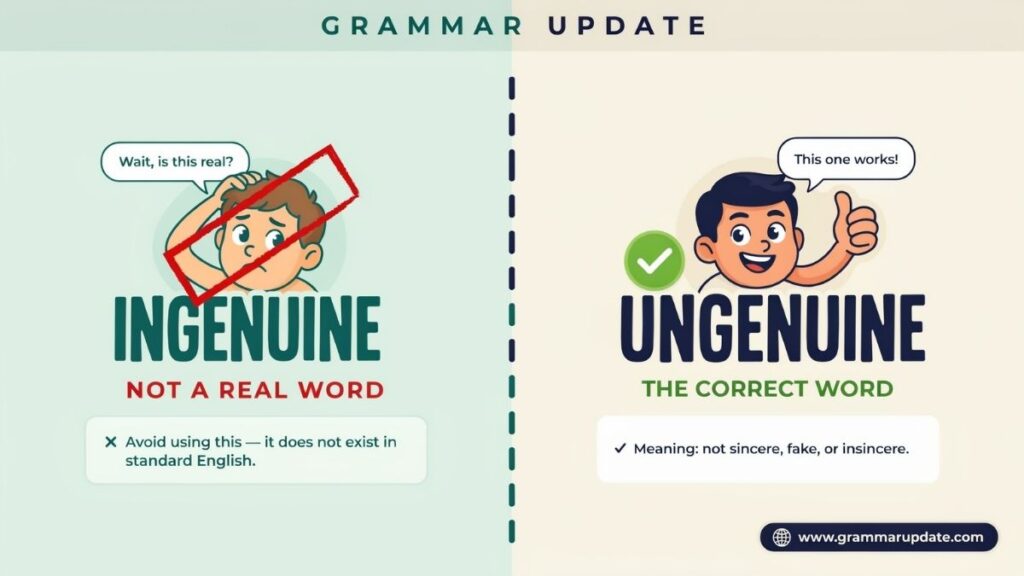
Ingenuine vs Ungenuine can turn a simple grammar choice into a surprisingly tricky puzzle. Both words relate to something that isn’t genuine, yet they aren’t equally common in modern English. Add disingenuous and ingenuous to the mix, and the confusion grows quickly. The good news? The difference is easier than it first appears. This guide clearly explains the meaning, usage, pronunciation, and correct context of ingenuine and ungenuine. You will also learn why ungenuine is usually the safer choice, how disingenuous differs from both words, and which alternatives can make your writing more precise. By the end, the confusion will be gone, and the right word will be easy to choose.
Ingenuine vs Ungenuine Quick Answer
The short answer is that ungenuine is the preferred choice in most modern writing.
Ingenuine is also documented in English and can mean “not genuine,” “false,” or “unauthentic.” However, many readers are less familiar with it. Some may even wonder whether it is a spelling mistake.
Here’s the easiest comparison:
| Word | Meaning | Part of Speech | General Use |
|---|---|---|---|
| Ungenuine | Not genuine, false, or inauthentic | Adjective | Preferred |
| Ingenuine | False, not genuine, or unauthentic | Adjective | Less common |
| Disingenuous | Lacking sincerity or candor, often in a misleading way | Adjective | Used for behavior or communication |
| Insincere | Not expressing genuine feelings or intentions | Adjective | Common and precise |
| Inauthentic | Not authentic or genuine | Adjective | Common in formal writing |
Merriam-Webster defines ungenuine as “not genuine.” Collins also recognizes ungenuine and defines it as “false.”
Ingenuine has documented usage as an adjective with essentially the same basic meaning. Therefore, it would be inaccurate to simply call ingenuine a nonexistent word.
The more useful rule is this:
Use ungenuine when you mean “not genuine” and want the clearest, most familiar choice.
Learn the difference between often confused words
Insue vs Ensue Which One Is Correct?
What Does Ungenuine Mean?
The simplest ungenuine meaning is “not genuine.”
Something genuine is real, authentic, sincere, or honestly felt. Something ungenuine lacks one or more of those qualities.
For example:
- The watch looked ungenuine.
- His apology sounded ungenuine.
- Her concern seemed ungenuine.
- The signature appeared ungenuine.
- Their enthusiasm felt ungenuine.
The exact meaning depends on context.
An ungenuine watch suggests that the watch isn’t authentic. It may be counterfeit or fake.
An ungenuine apology suggests that the speaker doesn’t appear genuinely sorry.
An ungenuine smile suggests that the expression looks forced rather than natural.
That flexibility makes ungenuine useful, but it also means you should pay attention to the noun it describes.
Ungenuine Definition in Simple English
You can remember the ungenuine definition with four simple words:
Not genuinely real.
Depending on the situation, ungenuine can mean:
- not authentic
- not real
- false
- fake
- artificial
- insincere
- forced
- not heartfelt
These words overlap, but they aren’t perfect substitutes.
For example, a counterfeit product is fake. A forced apology may be insincere. A misleading statement may be disingenuous. A document that isn’t authentic may be inauthentic.
Ungenuine sits across much of that territory because it broadly describes something that lacks genuineness.
Learn the difference between often confused words
Ironic vs Unironic which one is correct and usage?
What Does Ingenuine Mean?
The ingenuine meaning is also closely related to “not genuine,” “false,” or “unauthentic.”
Ingenuine appears in documented English usage. It can describe something that isn’t genuine or authentic.
For example:
His enthusiasm seemed ingenuine.
The sentence means that his enthusiasm did not appear genuine.
Another example:
The response sounded ingenuine.
Here, the writer suggests that the response lacked sincerity.
So, is ingenuine a word? Yes. It has documented usage.
The more important question is whether it is the best word to use.
For most readers, ungenuine will feel more familiar. Because of that, it usually communicates the idea with less friction.
This is an important distinction in writing. A word doesn’t have to be completely wrong to be a poor choice for a particular audience.
If a clearer and more familiar alternative exists, choosing it often makes the sentence stronger.
Is Ingenuine a Word?
Yes, ingenuine is a documented English adjective.
It means false, not genuine, or unauthentic. The word has appeared in published English and can be found in lexical sources.
However, its existence doesn’t mean that it is equally common or equally familiar as ungenuine.
That’s where much of the confusion comes from.
Someone may search for ingenuine in a dictionary and fail to find it in a particular source. Another person may find examples of the word in published material. Neither fact automatically settles the entire question.
A better way to judge the word is to consider three things:
- Does the word have documented usage?
- Will most readers recognize it?
- Is there a clearer alternative?
For ingenuine, the answer to the first question is yes.
The answer to the second is less certain.
For the third, ungenuine is usually the better choice.
That gives you a practical conclusion without pretending the English language is always neat and tidy.
Ingenuine vs Ungenuine Why Are They Confusing?
The confusion comes largely from English prefixes.
English uses in- to create negative meanings in words such as:
- inaccurate
- incomplete
- indirect
- inactive
- incapable
- insincere
- invalid
It also uses un- in words such as:
- unfair
- unclear
- unusual
- uncertain
- unnatural
- unknown
- unhappy
Because both prefixes can create negative meanings, ingenuine looks perfectly reasonable.
You start with genuine and think:
genuine → ingenuine
That seems logical.
However, English doesn’t work like a mathematical formula. You can’t always attach the same negative prefix to every adjective and expect the result to become the standard opposite.
That’s why genuine commonly pairs with ungenuine rather than making ingenuine the preferred everyday form.
Ingenuine vs Ingenuous
Another major source of confusion is the word ingenuous.
Ingenuine and ingenuous look similar, but their meanings are completely different.
Ingenuine means not genuine.
Ingenuous can mean innocent, candid, straightforward, or free from deception.
For example:
Her smile seemed ungenuine.
The smile appeared forced.
Compare that with:
Her ingenuous response showed that she didn’t understand the trick.
Here, ingenuous describes openness or innocence.
Then there’s disingenuous.
Disingenuous usually describes someone or something that appears sincere or straightforward but isn’t completely honest or candid.
These three words can easily become a spelling minefield:
- ingenuine = not genuine
- ingenuous = innocent or candid
- disingenuous = lacking candor or appearing sincere in a misleading way
One extra syllable can change the meaning dramatically.
Learn the difference between often confused words
Agast vs Aghast difference and Which one Is Correct?
The Simple Rule for Ingenuine vs Ungenuine
If you’re wondering which form to use, follow this rule:
Use ungenuine when you simply mean “not genuine.”
That rule works well because ungenuine is straightforward and widely recognizable.
For example:
His apology sounded ungenuine.
The product appeared ungenuine.
Her reaction seemed ungenuine.
The enthusiasm felt ungenuine.
If your meaning is more specific, choose a more precise word.
For example:
His apology was insincere.
The product was counterfeit.
The document was inauthentic.
His argument was disingenuous.
This approach gives your writing more precision without forcing one word to do every job.
Learn the difference between often confused words
Rehireable vs Rehirable Which Spelling Is Correct?
Ingenuine vs Ungenuine Side-by-Side Comparison
The meanings of ingenuine vs ungenuine overlap heavily, but their practical use differs.
| Feature | Ingenuine | Ungenuine |
|---|---|---|
| Meaning | Not genuine or authentic | Not genuine or authentic |
| Word type | Adjective | Adjective |
| Opposite | Genuine | Genuine |
| Documented usage | Yes | Yes |
| Reader familiarity | Lower | Higher |
| Best general choice | Usually not the first choice | Usually preferred |
| Can describe behavior | Yes | Yes |
| Can describe authenticity | Yes | Yes |
| Potential for confusion | Higher | Lower |
The biggest difference isn’t the basic definition.
It’s familiarity.
When you write for a broad audience, familiar language usually has an advantage. You don’t want your reader stopping to ask whether a word exists when the sentence could have been perfectly clear.
Learn the difference between often confused words
Pretty vs Prety difference and Which Spelling Is Correct ?
When to Use Ungenuine
Ungenuine works well when something lacks authenticity, sincerity, or naturalness.
Ungenuine Products and Objects
Use ungenuine when you are talking about something that isn’t authentic.
For example:
The buyer suspected that the watch was ungenuine.
The sentence suggests that the watch wasn’t an authentic product.
However, if you know that it is a counterfeit, counterfeit is more precise.
The store sold counterfeit watches.
That’s stronger because it gives the reader a specific fact instead of a broad description.
Ungenuine Apologies
Ungenuine can also describe an apology that doesn’t sound heartfelt.
His apology seemed ungenuine.
This tells the reader that the apology didn’t appear sincere.
You could also say:
His apology seemed insincere.
In this context, insincere may sound more natural because the sentence concerns a person’s feelings and intentions.
Ungenuine Smiles
An ungenuine smile is one that appears forced or artificial.
For example:
Her smile looked ungenuine during the interview.
The sentence doesn’t necessarily mean she was deliberately lying. It simply suggests that the smile didn’t appear natural.
Ungenuine Behavior
You can use ungenuine for behavior that seems forced, artificial, or insincere.
His friendliness felt ungenuine.
This tells the reader that the friendliness didn’t appear heartfelt.
When Ingenuine May Appear
Ingenuine can appear in published writing, but it is less familiar to many modern readers.
You may encounter it in:
- literary writing
- older texts
- specialized discussions
- individual writers’ usage
- descriptions of artificial or insincere behavior
For example:
The response seemed ingenuine.
The meaning is understandable.
Still, if the goal is clear contemporary writing, this version is generally smoother:
The response seemed ungenuine.
The important point is not that ingenuine has no meaning. It does.
The point is that writers should consider their audience.
If a word makes readers pause unnecessarily, a more familiar alternative may be better.
Learn the difference between confusing word pairs
Cancell vs Cancel Which One Is Correct?
Ungenuine vs Disingenuous
The question of ungenuine or disingenuous is especially important because the two words can overlap.
Ungenuine means not genuine.
Disingenuous often means lacking candor or presenting a false appearance of sincerity.
That difference becomes clearer with an example.
Imagine a manager says:
“I’m sorry you feel that way.”
The manager may technically sound apologetic. However, the wording avoids accepting responsibility.
You might call the apology ungenuine if it doesn’t seem heartfelt.
You might call it disingenuous if the manager deliberately uses apparently sympathetic language to avoid acknowledging what actually happened.
That’s a subtle but useful distinction.
| Situation | Better word |
|---|---|
| A counterfeit watch | Fake, counterfeit, or inauthentic |
| A forced smile | Ungenuine or artificial |
| A hollow apology | Ungenuine or insincere |
| A deliberately misleading explanation | Disingenuous |
| A fabricated story | Fabricated |
| A false statement | False |
| A fake document | Forged or counterfeit |
Disingenuous carries more meaning than simply “not genuine.” It often involves communication, motives, or behavior that creates a misleading impression.
Learn the difference between confusing word pairs
Acreage vs Acrag difference and Which Spelling Is Correct?
Ingenuine Examples and Ungenuine Examples
Examples make the difference much easier to understand.
Ungenuine Examples
The seller’s claim about the product seemed ungenuine.
His apology sounded ungenuine.
Her enthusiasm during the presentation felt ungenuine.
The customer’s concern appeared ungenuine.
The signature looked ungenuine.
Each sentence uses ungenuine to describe something that doesn’t appear genuine.
Ingenuine Examples
His enthusiasm seemed ingenuine.
The response appeared ingenuine.
The writer described the behavior as ingenuine.
These examples are understandable because ingenuine has a documented meaning.
However, ungenuine would generally be the safer choice when writing for a broad audience.
Ungenuine in a Sentence
Here is a useful example:
Her concern seemed ungenuine because she kept looking at her phone while pretending to listen.
The context makes the meaning obvious.
Another example:
The seller claimed the watch was original, but the buyer suspected that it was ungenuine.
Here, ungenuine refers to authenticity.
Ingenuine in a Sentence
His apology sounded ingenuine after he immediately blamed everyone else.
The meaning is clear from the context.
However, this version is more familiar:
His apology sounded ungenuine after he immediately blamed everyone else.
That is why ungenuine is generally the better default.
Ingenuine Pronunciation
Ingenuine pronunciation can seem uncertain because the word isn’t as familiar as genuine or ungenuine.
It can be pronounced approximately as:
in-JEN-yoo-in
The first part sounds like “in,” followed by a pronunciation close to “genuine.”
If you’re learning the word for speaking rather than writing, listening to a reliable dictionary pronunciation is the safest approach.
Ungenuine Pronunciation
Ungenuine pronunciation is approximately:
un-JEN-yoo-in
The first syllable follows the familiar pronunciation of the prefix un-.
The word then follows the sound pattern of genuine.
Because ungenuine is more familiar in contemporary usage, most readers are unlikely to struggle with its pronunciation once they see it in context.
Learn the difference between confusing word pairs
Favour vs Favor Which Spelling Is Correct?
Ingenuine Noun Is There a Noun Form?
Ingenuine is an adjective, not a standard noun.
That means you wouldn’t normally write:
The ingenuine was obvious.
Instead, choose a noun that expresses the exact idea.
Possible choices include:
- ungenuineness
- insincerity
- inauthenticity
- falseness
- deception
For example:
The insincerity of his apology was obvious.
Or:
The inauthenticity of the document raised concerns.
Ungenuineness is also a documented noun that refers to the state of being ungenuine.
Still, in everyday writing, inauthenticity or insincerity may sound more natural depending on the context.
Learn the difference between tricky grammar more words
Invokes vs Evokes which one is correct?
Common Mistakes With Ingenuine vs Ungenuine
Mistake 1 Calling Ingenuine Completely Wrong
This claim goes too far.
Ingenuine has documented English usage. Therefore, it is more accurate to call it less common or less familiar rather than simply nonexistent.
Mistake 2 Assuming In- Always Creates the Correct Opposite
English doesn’t follow one universal prefix rule.
A negative prefix that works with one adjective may not produce the standard form with another.
That’s why genuine and ungenuine are a better pairing for general use.
Mistake 3 Confusing Ingenuine With Ingenuous
This is a common spelling trap.
Ingenuine means not genuine.
Ingenuous means innocent, candid, or straightforward.
They should never be treated as interchangeable.
Mistake 4 Using Disingenuous for Physical Objects
A watch isn’t usually disingenuous.
A person can be disingenuous. A statement can be disingenuous. An argument can be disingenuous.
For an object, use words such as fake, counterfeit, forged, or inauthentic when appropriate.
Mistake 5 Treating Every Synonym as Identical
Ungenuine, fake, false, insincere, inauthentic, and disingenuous overlap, but they don’t carry exactly the same meaning.
Good writing depends on choosing the word that fits the situation.
Better Alternatives to Ungenuine
Sometimes neither ingenuine nor ungenuine is the strongest option.
The best replacement depends on what you mean.
| Meaning | Better alternative | Example |
|---|---|---|
| Not authentic | Inauthentic | The signature looked inauthentic. |
| Not sincere | Insincere | His apology was insincere. |
| Not real | Unreal | The story sounded unreal. |
| Fake | Fake | The watch was fake. |
| Counterfeit | Counterfeit | The store sold counterfeit products. |
| Deliberately misleading | Disingenuous | His explanation was disingenuous. |
| Invented | Fabricated | The evidence was fabricated. |
| Forged | Forged | The document was forged. |
| Artificial | Artificial | Her smile looked artificial. |
| Pretended | Feigned | He showed feigned concern. |
This table highlights an important writing principle: precision often matters more than choosing between two similar words.
Learn the difference between confusing word pairs
Drily vs Dryly Which One Is Correct?
Ingenuine vs Ungenuine in Professional Writing
In professional communication, clarity should come first.
Suppose an employee writes:
The customer’s reaction appeared ingenuine.
The reader can understand the sentence. However, some readers may stop and question the word.
A clearer version would be:
The customer’s reaction appeared ungenuine.
An even more precise version might be:
The customer’s reaction appeared insincere.
The best choice depends on what the writer actually observed.
1.If the reaction seemed forced, use ungenuine.
2.If the person clearly didn’t mean what they said, use insincere.
3.If the person deliberately presented a misleading explanation, use disingenuous.
Professional writing benefits from that kind of precision.
Ingenuine vs Ungenuine in Academic Writing
Academic writing requires careful word choice because vague language can weaken an argument.
Consider:
The evidence was ungenuine.
What does that mean?
1.Was it fabricated?
2.Was the source inauthentic?
3.Was the data manipulated?
4.Was the researcher dishonest?
Each possibility requires a different word.
You might write:
The evidence was fabricated.
1.Or:
The document was inauthentic.
2.Or:
The data had been manipulated.
3.Or:
The interpretation was misleading.
Those sentences tell the reader much more.
Ungenuine remains a valid word, but academic writing often benefits from more specific terminology.
Genuine vs Ungenuine
Understanding genuine makes ungenuine easier to remember.
Genuine can mean:
- authentic
- real
- sincere
- heartfelt
- natural
Ungenuine reverses that basic idea.
| Genuine | Ungenuine |
|---|---|
| Authentic | Inauthentic |
| Real | False |
| Sincere | Insincere |
| Heartfelt | Forced |
| Natural | Artificial |
| Original | Fake or imitation |
The exact opposite depends on the context.
1.A genuine product is authentic.
2.A genuine emotion is sincere.
3.A genuine conversation is honest and natural.
An ungenuine version lacks those qualities.
Learn the difference between tricky grammar more words
Weighed vs Weighted Which One Is Correct?
Practice Session Ingenuine vs Ungenuine
Fill in each blank with the best word: ingenuine vs ungenuine.
- His apology sounded __________ because he didn’t seem sorry at all.
- The customer suspected that the expensive watch was __________.
- Her smile looked __________ during the uncomfortable conversation.
- The manager’s concern seemed __________ and failed to reassure the employee.
- The seller insisted that the product was authentic, but the buyer believed it was __________.
- His excitement about the announcement appeared __________.
- The writer described the character’s kindness as __________ rather than sincere.
- The response seemed __________ because it felt forced and unnatural.
- The buyer became suspicious when the supposedly original painting appeared __________.
- Her compliment sounded __________ because she immediately criticized the same person.
- The audience could tell that his enthusiasm was __________.
- The customer questioned whether the signature on the document was __________.
- His apology felt __________ after he continued blaming everyone else.
- The employee’s friendly behavior seemed __________ during the meeting.
- The advertisement made a claim that appeared __________ and misleading.
- Her expression looked __________ rather than genuinely happy.
- The buyer suspected that the designer bag was __________.
- His sympathy seemed __________ because he showed no real concern.
- The response came across as __________ and overly rehearsed.
- The journalist questioned whether the source’s account was __________.
- His praise sounded __________ because his actions suggested the opposite.
- The company’s public apology appeared __________ to many customers.
- The actor’s emotional reaction seemed __________ to the audience.
- The customer believed the product was __________ despite the seller’s assurances.
- Her concern sounded __________ because she quickly changed the subject.
Answers
- ungenuine
- ungenuine
- ungenuine
- ungenuine
- ungenuine
- ungenuine
- ingenuine
- ungenuine
- ungenuine
- ungenuine
- ungenuine
- ungenuine
- ungenuine
- ungenuine
- ungenuine
- ungenuine
- ungenuine
- ungenuine
- ungenuine
- ingenuine
- ungenuine
- ungenuine
- ungenuine
- ungenuine
- ungenuine
Here’s a trusted source for clear word meanings:
FAQs
Is “ungenuine” a real word?
Yes. “Ungenuine” is a recognized adjective that means not genuine, authentic, or sincere. It can describe a product, feeling, reaction, statement, or behavior that lacks genuineness.
Is “ingenuine” a correct word?
Yes. “Ingenuine” is a documented adjective that means not genuine, false, or unauthentic. However, “ungenuine” is generally more familiar and is usually the better choice for everyday and professional writing.
What is the difference between “Ingenuine vs Ungenuine ”?
Both words can mean not genuine or unauthentic. The main difference is usage. “Ungenuine” is more common and familiar, while “ingenuine” is less common and may make some readers question the word.
Which is correct: “ungenuine,” “ingenuine,” or “disingenuous”?
All three are words, but they don’t mean exactly the same thing. Use “ungenuine” for something that isn’t genuine, “ingenuine” for the less common equivalent, and “disingenuous” for behavior or communication that lacks honesty or candor.
What does “ingenuine” mean?
“Ingenuine” means not genuine, false, or unauthentic. It can describe something that lacks authenticity or behavior that doesn’t appear sincere.
What does “ungenuine” mean?
“Ungenuine” means not genuine. Depending on the context, it can mean fake, artificial, inauthentic, insincere, or lacking sincerity.
What is another word for “ungenuine”?
Possible alternatives include “inauthentic,” “insincere,” “artificial,” “false,” “fake,” “forced,” and “counterfeit.” The best choice depends on what you’re describing.
What is the difference between “disingenuous” and “ingenuine”?
“Ingenuine” broadly means not genuine. “Disingenuous” usually describes a person, statement, or behavior that appears sincere or honest but lacks candor or creates a misleading impression.
Does “disingenuous” mean fake?
It can suggest something fake or insincere, but “disingenuous” has a more specific meaning. It often describes someone who presents a misleading appearance of honesty, openness, or sincerity.
What do you call a disingenuous person?
You can describe a disingenuous person as insincere, deceptive, misleading, dishonest, evasive, or two-faced. The best term depends on the person’s behavior and motives.
What is the opposite of “ingenuine”?
The direct opposite of “ingenuine” is “genuine.” Depending on the context, “authentic,” “sincere,” “real,” or “honest” may also work.
What is the opposite of “ungenuine”?
“Genuine” is the clearest opposite of “ungenuine.” Other suitable choices include “authentic,” “sincere,” “heartfelt,” and “real.”
What is the opposite of “disingenuous”?
Depending on the context, the opposite of “disingenuous” can be “genuine,” “sincere,” “honest,” “candid,” or “straightforward.”
What does “non-genuine” mean?
“Non-genuine” means not genuine or not authentic. It can describe anything that lacks the qualities expected of something genuine, such as a fake product or an insincere response.
What is a word for someone who is fake but nice?
“Insincere” often fits best. “Two-faced” can describe someone who acts friendly while hiding negative feelings, while “disingenuous” works when the person’s friendliness creates a misleading impression of sincerity.
What is a stronger word for “ungenuine”?
There isn’t one universal stronger word. “Deceptive,” “fraudulent,” “fake,” “insincere,” and “inauthentic” can be stronger in specific situations because each adds a different shade of meaning.
What is the noun form of “genuine”?
The main noun form is “genuineness.” Depending on the context, “authenticity” or “sincerity” may sound more natural.
What is the noun form of “ungenuine”?
“Ungenuineness” is the noun form of “ungenuine.” However, “inauthenticity” or “insincerity” may sound smoother when the context calls for a more specific meaning.
Can “genuine” be an adjective?
Yes. “Genuine” is an adjective that can mean authentic, real, sincere, or heartfelt.
What is the adverb form of “genuine”?
The adverb form is “genuinely.” For example: “She was genuinely excited about the opportunity.”
Is being called “genuine” a compliment?
Yes. Calling someone genuine is generally a compliment. It suggests that the person is sincere, authentic, honest, and true to their feelings or personality.
What do you call a person who is genuine?
A genuine person can be described as sincere, authentic, honest, candid, trustworthy, or straightforward, depending on the quality being emphasized.
What is the difference between “genuine” and “ingenuine”?
“Genuine” means authentic, real, or sincere. “Ingenuine” means not genuine. Because “ungenuine” is more familiar, it is usually the clearer choice when expressing the opposite of genuine.
What is the difference between “genuine” and “ungenuine”?
“Genuine” describes something authentic, real, or sincere. “Ungenuine” describes something that lacks those qualities.
Is “disingenuous” an insult?
It can be. Calling someone disingenuous usually suggests that they aren’t being completely honest, sincere, or straightforward. The word can sound critical, especially when used to describe someone’s character or motives.
What causes someone to be disingenuous?
People may act disingenuously to avoid responsibility, hide their motives, influence others, protect their reputation, or make a misleading argument appear reasonable. The reason varies from one situation to another.
What is a word for a sneaky person?
Words such as “sly,” “cunning,” “devious,” “crafty,” “deceptive,” and “underhanded” can describe a sneaky person. “Disingenuous” is more specific when the issue involves misleading communication.
What is an ingenuous person?
An ingenuous person is typically open, candid, innocent, or straightforward. “Ingenuous” has a different meaning from “ingenuine,” so the two words shouldn’t be confused.
Is it better to be ingenious vs ingenuous?
The words describe different qualities. “Ingenious” means clever, inventive, or creative, while “ingenuous” means candid, innocent, or straightforward. Neither word is better in every situation.
What is the opposite of a fake person?
A genuine person is the clearest opposite of a fake person. Depending on the context, “authentic,” “sincere,” “honest,” or “trustworthy” may also fit.
How do you say “non-genuine” naturally?
You can say “not genuine,” “ungenuine,” “inauthentic,” “insincere,” or “fake.” “Not genuine” is often the simplest and most natural choice when you want to avoid ambiguity.
Is “disingenuous” better than “ungenuine”?
Not necessarily. “Ungenuine” works when you simply mean not genuine. “Disingenuous” is more specific and works best when someone communicates in a misleading or insincere way.
What is a better word for “disingenuous”?
Depending on the context, alternatives include “insincere,” “deceptive,” “dishonest,” “misleading,” “evasive,” “two-faced,” and “underhanded.” Choose the word that best describes the person’s actual behavior rather than simply choosing the strongest-sounding option.
Learn the difference between tricky grammar more words
Lend vs Lent difference and which is Correct?
Conclusion
The confusion between Ingenuine vs Ungenuine is easy to understand, but the answer is simpler than it looks. Both words can mean “not genuine,” yet ungenuine is usually the clearer and more familiar choice in modern English. Ingenuine is a real, documented word, but it is less common.
The real mix-up often happens with disingenuous and ingenuous. Remember the simple rule: genuine means real or sincere, ungenuine means not genuine, disingenuous means misleading or insincere, and ingenuous means innocent or straightforward.
So, when you mean “not genuine,” ungenuine is your safest choice. No grammar maze. No guessing game. Just the right word for the right meaning.

Jhon AJS, the creative mind behind Grammar Update, is an experienced blogger passionate about simplifying English grammar. He focuses on explaining confusing word vs word differences, grammar rules, punctuation, and sentence structure in a clear and practical way. Through easy to understand guides and examples, Jhon helps readers improve their writing and communicate with confidence. With years of blogging experience, he continues to share helpful insights that make learning grammar simple, useful, and accessible for everyone.