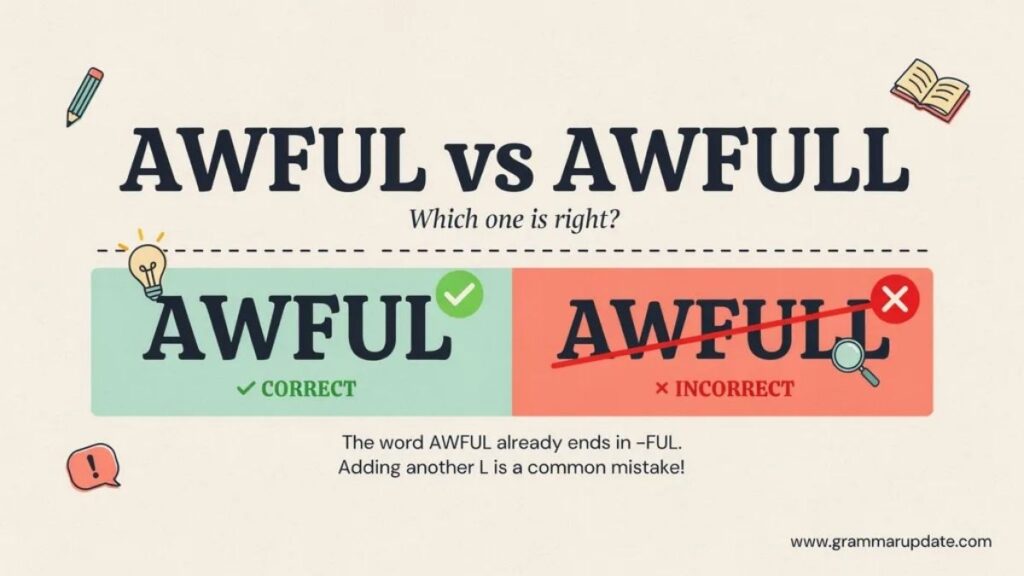
The Awful vs Awfull confusion can make a simple spelling choice feel oddly complicated. Which one is correct? The answer is easy: awful is the correct spelling, while awfull is a common mistake. Many people add the extra “l” because the word full has two “l”s. However, awful ends with “-ful,” which uses only one “l.” In this guide, you’ll learn the correct spelling, meaning, word origin, pronunciation, common mistakes, and practical examples of awful. You’ll also see why awfull is incorrect and how to remember the right spelling. By the end, the Awful vs Awfull confusion will be completely clear.
Awful vs Awfull quick answer
The answer is straightforward:
| Spelling | Correct? | Meaning |
|---|---|---|
| awful | Yes | Extremely bad, unpleasant, or very great in certain expressions |
| awfull | No | Standard spelling error |
| aweful | No | Common misspelling of “awful” |
| awe full | Usually not | A separate phrase, not the spelling of “awful” |
If you’re wondering what is the correct spelling of awful, use awful.
Correct examples
- The weather was awful yesterday.
- That was an awful mistake.
- The restaurant had an awful smell.
- She felt awful after hearing the news.
- We spent an awful lot of money on repairs.
Incorrect examples
- The weather was awfull yesterday.
- That was an awfull mistake.
- It was an aweful experience.
The extra “l” doesn’t belong. Neither does the extra “e.”
If you’re checking an awful vs awfull spelling comparison, remember this simple rule:
Awful has one L. Awfull has one L too many.
Learn the difference between tricky grammar more words
Acreage vs Acrag difference and Which Spelling Is Correct?
What Does Awful Mean?
The modern awful meaning usually relates to something extremely bad, unpleasant, or low in quality.
For example:
- The movie was awful.
- We had awful weather.
- That was an awful experience.
- He made an awful decision.
In each sentence, “awful” expresses a strong negative judgment.
The word can describe a physical experience, an emotional situation, a person’s behavior, an object, an event, or a general condition.
Awful can describe many things
You might say:
- an awful headache
- an awful smell
- an awful noise
- an awful mistake
- an awful experience
- an awful day
- an awful decision
- an awful performance
- an awful situation
The word usually carries more force than the plain adjective “bad.”
Compare:
The food was bad.
with:
The food was awful.
The second sentence sounds much stronger. The speaker isn’t merely disappointed. The speaker is expressing a much stronger negative reaction.
Learn the difference between tricky grammar more words
Ingenuine vs Ungenuine Which one Is Correct?
Awful Definition A Closer Look
A useful awful definition needs to account for more than one modern use.
Common modern meaning
Awful can mean:
- extremely bad
- very unpleasant
- poor in quality
- distressing
- unpleasant to experience
- shocking or serious in certain contexts
For example:
The traffic was awful this morning.
The speaker means the traffic was extremely unpleasant or difficult.
A second modern meaning
Awful can also mean very great or very large, especially in expressions such as “an awful lot.”
For example:
There was an awful lot of traffic.
Here, the speaker isn’t necessarily saying the traffic was terrible. “An awful lot” means a very large amount.
That distinction matters because context determines which sense the reader understands.
Is Awfull a Word?
No. Awfull isn’t the standard English spelling of the adjective.
If you type “awfull” into a sentence, a spell checker will usually flag it because standard English dictionaries use awful, not “awfull.”
That doesn’t mean nobody has ever written “awfull.” Misspellings appear everywhere. You may see them in informal posts, comments, messages, usernames, old documents, or search queries. Their existence doesn’t make them standard English.
Consider:
Incorrect: That was an awfull experience.
Correct: That was an awful experience.
The difference is only one letter, but that letter changes whether the spelling follows standard English conventions.
Why Is Awful Spelled With One L?
This is where the history of the word clears up the confusion.
The word awful developed from awe + -ful. Historical forms of the word date back to Middle English and were connected with awe, fear, and reverence.
The suffix -ful means something like “full of” or “characterized by.”
You can see the same pattern in words such as:
- careful
- useful
- helpful
- harmful
- hopeful
- peaceful
- joyful
- faithful
- awful
The important point is that -ful is spelled with one L when it functions as this suffix.
So:
awe + ful = awful
Not:
awe + full = awfull
This distinction explains why the spelling looks slightly strange if you approach it from the word “full.”
Why “full” causes trouble
The word full is a separate word. It has two l’s.
The suffix -ful, however, normally has one.
That means:
The cup is full.
but:
The cup is useful.
And:
The experience was awful.
The spelling isn’t based on simply attaching the whole word “full.” English spelling often preserves historical word-building patterns rather than following what looks visually obvious.
Awful Word Origin and Awful Original Meaning
The awful original meaning is one of the most interesting parts of this word.
Today, if someone says:
“That was awful.”
you probably understand that the experience was very bad.
That wasn’t the original sense.
Historically, awful referred to something closer to worthy of awe, inspiring fear, or causing deep reverence. The word developed from older forms connected to the noun awe.
So the word once carried a much more serious emotional weight.
Imagine standing before something enormous, powerful, or terrifying. You might experience awe rather than simply thinking, “Wow, that’s bad.”
That older meaning helps explain why related expressions such as “awe-inspiring” still have a positive or admiring sense.
How did the meaning change?
Over time, awful shifted toward negative meanings associated with dread and unpleasantness. Eventually, the everyday sense of “very bad” became dominant.
The meaning of a word can change gradually as speakers use it in different situations. Awful provides a particularly clear example of semantic change because its modern meaning differs sharply from its older sense.
The word remains historically connected to awe, but modern speakers usually don’t use awful to mean “worthy of reverence.”
Learn the difference between tricky grammar more words
Ironic vs Unironic which one is correct and usage?
Awful vs Aweful Which Spelling Is Correct?
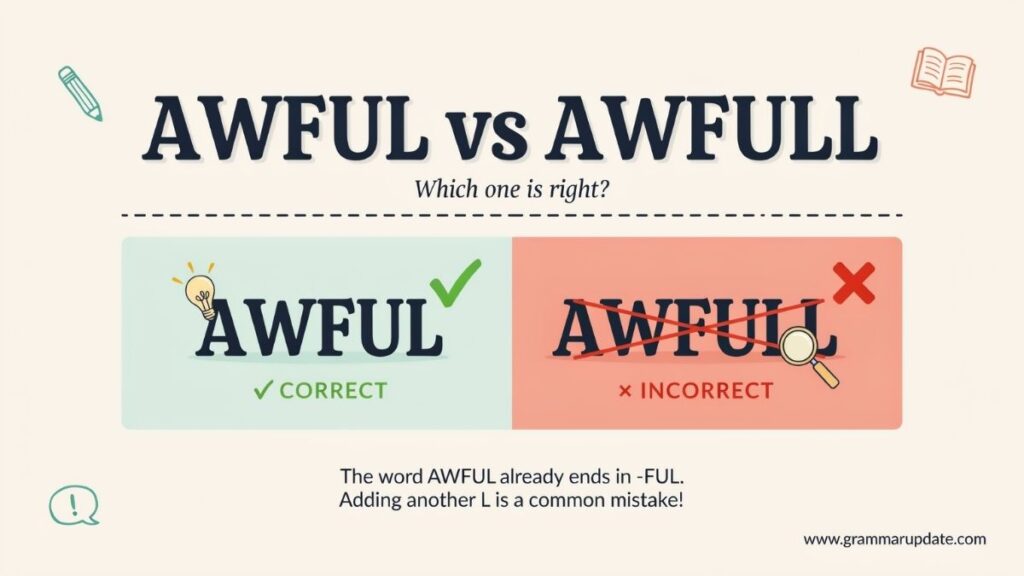
The awful vs aweful confusion makes perfect sense once you look at the word’s origin.
Because awful comes historically from awe + -ful, it can seem natural to spell it aweful.
But standard English settled on awful, not “aweful.”
So if you’re asking is aweful correct, the answer is no in standard modern English.
| Form | Standard spelling? | Reason |
| awful | Yes | Established modern spelling |
| aweful | No | Common spelling mistake |
| awfull | No | Incorrect extra L |
| awe full | Not as a spelling of awful | Separate words when used literally |
Why is aweful incorrect?
The problem isn’t the meaning of awe. “Awe” is a perfectly valid English word.
The problem comes from assuming that the visible word “awe” must remain intact when the suffix -ful attaches to it.
Historical spelling doesn’t work that neatly.
English has many words whose modern spelling reflects established forms rather than a simple letter-by-letter formula.
So the answer to why is aweful incorrect is simple: the standard English form is awful, even though the word has a historical connection to awe.
Is Aweful a Word?
If you’re searching is aweful a word, the practical answer is:
Not as the standard spelling of the adjective awful.
You may encounter “aweful” in informal writing or as a deliberate formation. However, it isn’t the standard spelling you should use in essays, articles, emails, schoolwork, business writing, or other edited English.
If your intended meaning is “extremely bad,” write:
awful
not:
aweful
This matters when you’re trying to produce proper English spelling in professional or academic contexts.
Learn the difference between basic English word mistakes
Rehireable vs Rehirable Which Spelling Is Correct?
Awe Full Why It Looks Right but Isn’t
The phrase awe full can create another spelling trap.
“Awe” is a noun or verb, while “full” is an adjective. In a literal context, the two words can appear separately in a sentence.
For example:
The room was full of awe-inspiring artwork.
But “awe full” isn’t the spelling of awful.
The adjective awful is one word.
Think of the distinction like this:
- awe = a feeling of wonder, reverence, or amazement
- full = containing as much as possible
- awful = a standard adjective with its own established meanings
- aweful = nonstandard spelling of awful
This is why the awe full meaning shouldn’t be used to justify spelling awful as two words.
Awful vs Awfull at a Glance
Here’s the entire issue in one table:
| Feature | Awful | Awfull |
| Standard English spelling | Yes | No |
| Correct in formal writing | Yes | No |
| Part of speech | Adjective | — |
| Common meaning | Extremely bad or unpleasant | — |
| Historical connection | Awe + -ful | Incorrect formation |
| Example | “The weather was awful.” | “The weather was awfull.” |
| Correct choice | Use this | Avoid this |
If you remember only one fact from this article, remember this:
Awful has one L.
How to Use Awful in a Sentence
The easiest way to understand how do you use the word awful correctly is to see it in different contexts.
1.Describing something unpleasant
The smell in the kitchen was awful.
2.Describing poor quality
The movie had an awful ending.
3.Describing a difficult experience
We had an awful experience at the hotel.
4.Describing someone’s behavior
That was an awful thing to say.
5.Describing physical discomfort
She had an awful headache.
6.Describing a serious situation
The community faced an awful tragedy.
7.Describing a large amount
They spent an awful lot of money on the renovation.
These awful examples in sentences show how flexible the adjective can be.
Awful Pronunciation
In American English, awful is commonly pronounced approximately as “AW-fuhl.”
The word has two syllables.
The spelling doesn’t contain a second “l,” and the pronunciation doesn’t give you a reason to add one. English spelling and pronunciation don’t always line up perfectly, but in this case the correct written form is firmly established.
If you’re learning American English pronunciation, focus on the two syllables rather than trying to pronounce a nonexistent second “l.”
Awful Can Sound Blunt
Correct grammar doesn’t automatically guarantee the right tone.
Awful can sound strong because it expresses a clear negative judgment.
Compare these sentences:
The report was awful.
The report was disappointing.
The report needs significant improvement.
All three communicate dissatisfaction. However, they don’t sound equally harsh.
In a workplace setting, awful may sound blunt or personal. A more precise alternative can make criticism more useful.
Consider the context
| Strong wording | Softer or more precise alternative |
| awful | disappointing |
| awful quality | poor quality |
| awful mistake | serious mistake |
| awful result | disappointing result |
| awful performance | weak performance |
| awful conditions | difficult conditions |
This doesn’t mean you should avoid awful. In casual conversation, it’s completely natural.
It simply means that good word choice considers tone as well as grammar.
Learn the difference between basic English word mistakes
Cancell vs Cancel Which One Is Correct?
An Awful Lot A Surprisingly Different Meaning
One of the strangest modern uses of awful appears in the expression “an awful lot.”
Here, awful doesn’t necessarily mean terrible.
It means a very large amount or degree.
For example:
I learned an awful lot from that mistake.
The speaker means:
I learned a great deal from that mistake.
Other examples include:
- We have an awful lot of work to finish.
- She knows an awful lot about computers.
- That repair cost an awful lot of money.
- There was an awful lot of traffic.
This is a good example of how context can reshape the force of a word.
Awful vs Awfully What’s the Difference?
Don’t confuse awful with awfully.
The basic grammatical difference is straightforward:
- awful = adjective
- awfully = adverb
Compare:
It was an awful mistake.
Here, awful describes the noun mistake.
Now look at:
She performed awfully.
Here, awfully modifies the verb performed.
Awfully can also work as an intensifier meaning very or extremely.
For example:
It’s awfully cold today.
This doesn’t necessarily mean “in a manner that inspires awe.” It simply intensifies cold.
Awful vs Terrible vs Horrible vs Bad
The most useful awful synonyms include terrible, horrible, dreadful, unpleasant, poor, atrocious, and abysmal. The best choice depends on the context.
| Word | Typical force | Example |
| bad | Broad and general | The food was bad. |
| awful | Strongly negative | The food was awful. |
| terrible | Very bad or serious | We received terrible news. |
| horrible | Very unpleasant, bad, or shocking | There was a horrible smell. |
These aren’t interchangeable in every sentence.
For instance, terrible often works naturally with serious events:
They received terrible news.
Horrible can emphasize disgust, unpleasantness, or shock:
There was a horrible smell.
Awful often works as a broad everyday judgment:
The service was awful.
Bad remains the broadest and least specific option.
Learn the difference between basic English word mistakes
Favour vs Favor Which Spelling Is Correct?
Awful Synonyms and Antonyms
Understanding awful synonyms helps you choose the right level of intensity.
Synonyms
Depending on context, you might use:
- terrible
- horrible
- dreadful
- unpleasant
- atrocious
- abysmal
- horrendous
- poor
- unacceptable
- appalling
Antonyms
Possible awful antonyms include:
- good
- excellent
- wonderful
- pleasant
- enjoyable
- impressive
- outstanding
- fantastic
The opposite depends on what awful describes.
If you say:
The food was awful.
the natural opposite might be:
The food was delicious.
If you say:
The weather was awful.
the opposite might be:
The weather was pleasant.
Precision beats simply grabbing the first synonym that appears in a thesaurus.
Learn the difference between basic English word mistakes
Instalments vs Installments Which Is Correct and Use It?
Common Spelling Mistakes With Awful
The biggest awful spelling mistakes usually come from adding letters that seem logical.
Awfull
Incorrect:
The service was awfull.
Correct:
The service was awful.
The writer probably associates the ending with “full.”
Aweful
Incorrect:
It was an aweful experience.
Correct:
It was an awful experience.
The writer probably remembers the word “awe.”
Awefull
Incorrect:
That was an awefull mistake.
Correct:
That was an awful mistake.
This combines both common spelling errors.
A full
Be careful with this one too.
The bottle is full.
Here, full is a separate adjective.
The movie was awful.
Here, awful is a single word.
They may look related, but they serve completely different grammatical purposes.
Awful vs Aweful Reddit Why People Get Confused
Searches such as awful vs aweful Reddit can reveal informal discussions where people debate whether aweful should count as a word or wonder why the spelling doesn’t preserve the visible form of awe.
The confusion has a logical source: awful really is historically connected to awe. The mistake happens when that historical connection gets converted into a modern spelling rule.
That doesn’t work.
English spelling often preserves forms that have become conventional over time. A word’s history can explain why it looks the way it does without telling you exactly how to spell it today.
So if an informal discussion asks:
“Is aweful a real word?”
the practical writing answer remains:
Use “awful” in standard English.
Learn the difference between confusing word pairs
Invokes vs Evokes which one is correct?
Awful in Formal and Informal Writing
Awful works perfectly well in everyday American English.
You might hear:
That movie was awful.
I feel awful today.
The traffic was awful.
In formal writing, however, precision can matter more than emotional intensity.
Instead of:
The company’s performance was awful.
a report might say:
The company’s performance declined significantly.
Or:
The company recorded its weakest quarterly results in five years.
The second versions tell the reader what happened rather than simply labeling it.
That doesn’t make awful incorrect. It makes the alternatives more informative in certain contexts.
Why “Awful” Doesn’t Mean Only “Very Bad”
Modern readers usually associate awful with something negative. Yet dictionaries preserve another important use.
Awful can mean very great or very large, especially in expressions such as “an awful lot.”
Consider:
It took an awful long time.
Here, awful functions as an intensifier.
Likewise:
They spent an awful amount of money.
The word isn’t necessarily judging the money itself as morally or objectively bad. It emphasizes the size of the amount.
This is a useful reminder that vocabulary can’t always be decoded word by word. Idioms and established expressions carry their own meanings.
A Practical Case Study Choosing the Right Word
Imagine a student writes:
“The science experiment was awfull and the results were terrible.”
There are two problems.
First, awfull is misspelled. It should be awful.
Second, the sentence uses two strong negative adjectives without explaining what actually went wrong.
A stronger version might be:
“The science experiment produced unreliable results because the temperature changed during testing.”
The correction doesn’t merely fix spelling. It improves communication.
That is the bigger lesson behind proper English spelling: correct words matter, but precise language matters even more.
How to Remember the Correct Spelling of Awful
If awful vs awfull keeps causing trouble, use this simple memory trick:
AWE + FUL = AWFUL
Remember that the suffix is -ful, not -full.
Think about these examples:
- help + ful = helpful
- care + ful = careful
- use + ful = useful
- awe + ful = awful
The pattern becomes easier once you stop treating “full” as the building block.
A one-second spelling test
Before submitting your writing, ask:
“Does this word contain the suffix -ful?”
If yes, check whether you’ve accidentally added a second “l.”
That tiny pause can catch the mistake before a reader does.
Learn the difference between confusing word pairs
Pretty vs Prety difference and Which Spelling Is Correct ?
Awful Examples Correct and Incorrect
| Incorrect | Correct | Explanation |
| The weather was awfull. | The weather was awful. | Remove the extra L. |
| It was an aweful mistake. | It was an awful mistake. | Remove the unnecessary E. |
| She had an awefull day. | She had an awful day. | Use the established spelling. |
| The food tastes awfull. | The food tastes awful. | Awful has one L. |
| That was an aweful experience. | That was an awful experience. | Aweful is nonstandard. |
These examples also show why spelling errors can survive proofreading. The incorrect forms look plausible. That’s precisely what makes them easy to miss.
Learn the difference between confusing word pairs
Lend vs Lent difference and which is Correct?
Practice Session Awful vs Awfull
Fill in each blank with the correct form: awful, awfull, aweful, or awe full.
- The weather was ________ yesterday.
- She had an ________ experience at the restaurant.
- That was an ________ mistake to make.
- The movie was absolutely ________.
- He felt ________ after hearing the bad news.
- We had an ________ lot of work to finish.
- The traffic was ________ this morning.
- The food had an ________ smell.
- It was an ________ decision that caused several problems.
- The service at the hotel was ________.
- She made an ________ spelling mistake in her report.
- The noise outside was ________.
- They spent an ________ lot of money on repairs.
- The accident caused an ________ situation for everyone involved.
- He gave an ________ performance during the competition.
- The old building had an ________ appearance.
- The headache was so ________ that she couldn’t concentrate.
- That was an ________ thing to say to someone.
- The journey became ________ because of the heavy rain.
- The room was filled with ________ noise.
- Which spelling is correct: awful or ________?
- Which spelling is correct: awful or ________?
- The correct spelling of the word is ________.
- The sentence “It was an ________ experience” needs the correct spelling of the word.
- Remember: awe + ful = ________.
Answers
- awful
- awful
- awful
- awful
- awful
- awful
- awful
- awful
- awful
- awful
- awful
- awful
- awful
- awful
- awful
- awful
- awful
- awful
- awful
- awful
- awfull
- aweful
- awful
- awful
- awful
Here’s a trusted source for clear word meanings:
FAQs
Why is “awfull” commonly misspelled with two Ls?
The mistake likely comes from the word “full,” which has two Ls. Since awful sounds as though it contains “full,” some writers add an extra L. The correct spelling uses one L: awful.
How can you remember the correct spelling of awful?
Use this simple memory trick: awe + ful = awful. The ending is “-ful,” not “-full.” Once you remember that pattern, the extra L becomes much easier to avoid.
Does “awfull” have a different meaning from “awful”?
No. Awfull isn’t a standard alternative spelling with its own meaning. In standard English, it is simply a misspelling of awful.
Can awful appear before and after a noun?
Yes. You can use awful before a noun, as in “an awful mistake,” or after a linking verb, as in “The mistake was awful.” In both cases, awful functions as an adjective.
Is awful always used to describe something negative?
Usually, yes. In modern English, awful most often describes something extremely bad, unpleasant, or poor in quality. However, expressions such as “an awful lot” use the word as an intensifier rather than to express something negative.
Can awful describe a person?
Yes. For example, “He was an awful person” makes a strong judgment about someone’s character. Because the phrase can sound harsh, a more specific description may be better when you want to explain the person’s behavior.
Can awful describe something that is only slightly bad?
It can, but awful usually sounds stronger than words such as “poor,” “unpleasant,” or “disappointing.” If something isn’t seriously bad, a milder word may communicate the situation more accurately.
Is awful an adjective or an adverb?
Awful is an adjective. It describes a person, thing, situation, or experience. Awfully is the related adverb.
Can awful be used with “very”?
It can appear with very, but “very awful” often sounds unnecessary because awful already expresses a strong degree. Depending on the context, “extremely unpleasant” or another more precise expression may sound more natural.
Does awful have a plural form?
No. Awful is an adjective, so it doesn’t change for singular or plural nouns. You can say “an awful mistake” or “awful mistakes.”
Can awful be used in academic writing?
Yes, but it may not always be the most precise choice. Academic writing often benefits from specific terms such as “inaccurate,” “ineffective,” “unreliable,” or “inadequate.” These words explain the problem instead of simply calling something awful.
Is awful historically related to awe?
Yes. Awful developed from older forms connected with awe and the suffix “-ful.” Its earlier sense referred to something capable of inspiring awe, fear, or reverence. Its common modern meaning developed later.
Is awful related to awesome?
Yes. Both words have a historical connection with awe. Their meanings eventually moved in different directions. Awesome now commonly expresses admiration or enthusiasm, while awful usually expresses a strong negative reaction.
Why does awful contain a “w” if it isn’t spelled aweful?
Awful developed from historical forms related to awe, but its modern spelling became established as awful. The historical connection explains the relationship without making aweful the correct spelling.
Can awful act as an intensifier?
Yes. In phrases such as “an awful lot” or “an awful long time,” awful can intensify the amount or degree being described. In these expressions, it doesn’t simply mean “very bad.”
Is awful common in everyday American English?
Yes. Awful is a familiar word in everyday American English. People commonly use it to describe unpleasant experiences, poor quality, difficult situations, bad weather, and strong negative reactions.
Can awful ever have a positive meaning?
Historically, yes. Earlier uses of awful could describe something that inspired awe or deep reverence. In modern everyday English, however, awful normally carries a negative meaning unless it appears in a specific expression.
Why does “an awful lot” mean a large amount?
In “an awful lot,” awful works as an intensifier. The phrase means a very large amount or degree rather than something that is literally terrible.
Is awful formed from the words “awe” and “full”?
No. Awful developed from awe combined with the suffix “-ful.” The word full is not the spelling model for the ending. That distinction explains why awful has one L rather than two.
What is the quickest way to fix the spelling “awfull”?
Replace awfull with awful. A useful proofreading trick is to remember that the ending is “-ful,” just as in helpful, useful, careful, and hopeful. The suffix has one L.
Conclusion
The Awful vs Awfull confusion is easy to clear up once you know the correct spelling. The right word is awful, with just one “l.” Awfull is a common spelling mistake and isn’t the standard English form.
The confusion often comes from the word full, which has two “l”s. However, awful ends with the suffix “-ful,” which has only one “l.” A simple trick can help: awe + ful = awful.
Awful usually means very bad, unpleasant, or poor in quality. It can also appear in phrases such as “an awful lot,” where it means a very large amount.
So, when you’re writing, don’t let that extra “l” sneak into your sentence. Remember: Awful is correct. Awfull is not. One small letter settles the whole confusion.

Jhon AJS, the creative mind behind Grammar Update, is an experienced blogger passionate about simplifying English grammar. He focuses on explaining confusing word vs word differences, grammar rules, punctuation, and sentence structure in a clear and practical way. Through easy to understand guides and examples, Jhon helps readers improve their writing and communicate with confidence. With years of blogging experience, he continues to share helpful insights that make learning grammar simple, useful, and accessible for everyone.