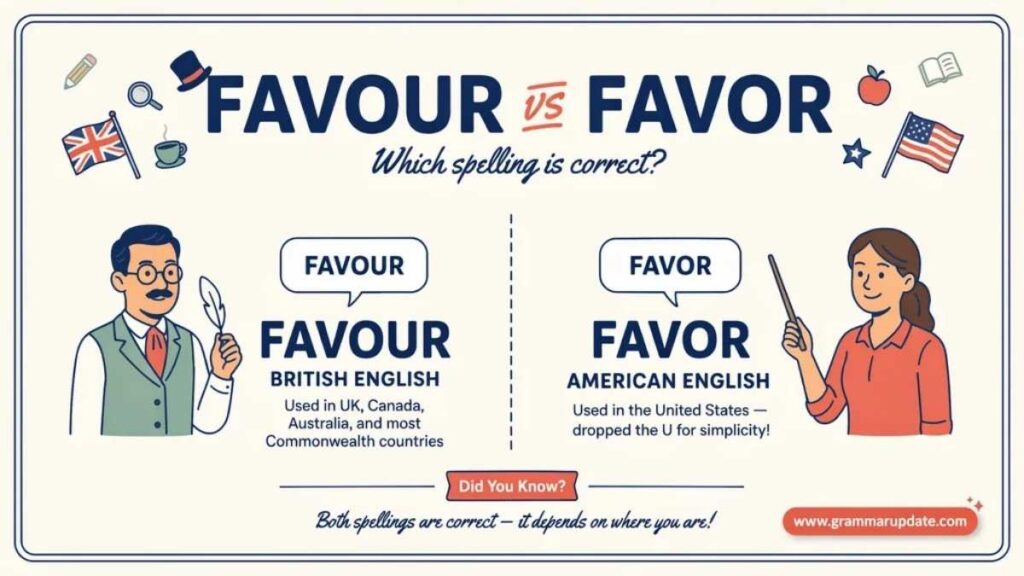
When it comes to favour vs favor, that extra “u” can make a simple spelling choice feel strangely complicated. The good news? There’s no real mystery here. Favor and favour are both correct spellings of the same word. The difference depends on the type of English you’re using. American English uses favor, while British English uses favour. The meaning and basic grammar remain the same. So, which spelling should you choose? Simply match your spelling to your audience and keep it consistent. In this guide, you’ll learn the difference between favour vs favor, see clear examples, and avoid the common spelling mistakes that can trip writers up.
Favour vs Favor The Quick Answer
The easiest way to understand favor vs favour is to treat them as regional spelling variants of the same word.
| Spelling | Main usage | Example |
|---|---|---|
| favor | American English | “Could you do me a favor?” |
| favour | British English | “Could you do me a favour?” |
The meaning doesn’t change.
Both forms can refer to:
- An act of kindness or help
- Support or approval
- An advantage
- A preference
- Positive treatment toward someone
- A small gift given to guests at an event
As a noun, the word can describe something helpful that you do for another person. As a verb, it can mean to support, prefer, benefit, or treat someone more positively.
So, which is correct favor or favour? Both are correct. Your choice depends on the English variety you’re using.
Learn the difference between often confused words
Scrapped vs Scraped difference Which One Is Correct?
Favour vs Favor Meaning What Does the Word Actually Mean?
The favour vs favor meaning stays the same even though the spelling changes.
The word has several related meanings. Most connect to ideas such as help, support, approval, preference, or advantage.
Favour or Favor as an Act of Kindness
One of the most common meanings describes something you do to help another person.
For example:
- “Can you do me a favor?”
- “Could you do me a favour?”
- “She asked me for a favor.”
- “He returned the favour the following week.”
Here, the word refers to a helpful act or act of kindness.
When someone asks, “Can you do me a favor?” they aren’t asking you to choose something. They’re asking you to help them with a task or request.
Favour or Favor as Support or Approval
The word can also describe support or approval.
For example:
“ The committee voted in favor of the proposal.”
In British English:
“The committee voted in favour of the proposal.”
The expression in favor of means supporting or approving of something. The British form is in favour of.
This use appears frequently in business writing, politics, academic discussions, and everyday conversation.
Favour or Favor as an Advantage
The word can also describe something that works to someone’s advantage.
For example:
- “The evidence is in his favor.”
- “The evidence is in his favour.”
- “The decision went in her favor.”
- “The decision went in her favour.”
In these examples, the word describes a situation that benefits someone.
Favour or Favor as a Preference
As a verb, the word can mean to support or prefer one option over another.
For example:
- “I favor the first proposal.”
- “I favour the first proposal.”
If someone says, “I favor this approach,” they mean they support or prefer it.
This use appears often in formal discussions:
- “The researchers favor the second explanation.”
- “The researchers favour the second explanation.”
The spelling changes, but the meaning doesn’t.
Learn the difference between often confused words
Invokes vs Evokes which one is correct?
Favor Definition and Favour Definition
A useful favor definition needs to cover both the noun and verb forms because the word has several uses.
The favour definition follows the same pattern. The spelling changes according to the English variety, not the definition.
| Part of speech | Meaning | US example | UK example |
|---|---|---|---|
| Noun | A helpful act | “He did me a favor.” | “He did me a favour.” |
| Noun | Support or approval | “The plan has public favor.” | “The plan has public favour.” |
| Noun | Advantage | “The odds are in her favor.” | “The odds are in her favour.” |
| Noun | Small gift | “The guests received party favors.” | “The guests received party favours.” |
| Verb | To support or prefer | “I favor this option.” | “I favour this option.” |
| Verb | To give an advantage | “The conditions favored the team.” | “The conditions favoured the team.” |
| Verb | To treat someone preferentially | “The teacher favored one student.” | “The teacher favoured one student.” |
The word can also have the sense of resembling someone, particularly in expressions such as “He favors his father” in American English and “He favours his father” in British English.
Context determines which meaning applies.
Learn the difference between often confused words
Drily vs Dryly Which One Is Correct?
What Is the Difference Between Favor and Favour?
The main favor and favour difference is spelling.
There isn’t a basic difference in meaning. There isn’t a separate grammatical rule that makes one form a noun and the other a verb.
Instead, the difference reflects regional spelling conventions.
American English generally uses:
favor
British English generally uses:
favour
This follows a broader pattern in US vs UK spelling.
| British English | American English |
|---|---|
| colour | color |
| honour | honor |
| behaviour | behavior |
| labour | labor |
| favour | favor |
| favourite | favorite |
| flavour | flavor |
The extra “u” doesn’t create a different word. It reflects a different spelling convention.
Favor Spelling Why Does American English Use “Favor”?
The favor spelling without the “u” is the standard American form.
American English uses the ending -or in many words where British English uses -our.
For example:
- color
- honor
- labor
- behavior
- favor
This means the American spelling of favor isn’t a shortened or informal version. It’s the standard spelling used in American English.
If you’re writing a US report, article, email, essay, or website, write:
“Could you do me a favor?”
Instead of:
“Could you do me a favour?”
The second version isn’t wrong everywhere. It simply follows British-style spelling.
Favour Spelling Why Does British English Keep the “U”?
The favour spelling with the “u” is standard British English.
British English keeps the -our ending in words such as favour, colour, honour, and behaviour.
For example:
- “Could you do me a favour?”
- “The proposal was in favour of stricter regulations.”
- “She favoured the second option.”
The extra “u” doesn’t make the writing more formal. It simply identifies the spelling convention being used.
Favor vs Favour American English Which One Should You Use?
For favor vs favour American English, the answer is straightforward: use favor.
Examples include:
- “Can you do me a favor?”
- “She asked for a favor.”
- “The evidence is in his favor.”
- “Most voters favor the proposal.”
- “The weather favored the outdoor event.”
- “She is my favorite author.”
If you’re writing consistently in American English, favor should be your preferred spelling.
Using favour occasionally won’t usually confuse an American reader. However, mixing American and British spelling throughout an article can make the writing look inconsistent.
Learn the difference between often confused words
Weighed vs Weighted Which One Is Correct?
Favor vs Favour British English Which One Should You Use?
For favor vs favour British English, use favour.
Examples include:
- “Can you do me a favour?”
- “She asked for a favour.”
- “The evidence is in his favour.”
- “Most voters favour the proposal.”
- “The weather favoured the outdoor event.”
- “She is my favourite author.”
British English also uses related forms such as favourable, favourably, favoured, and favouring.
Again, consistency is the key.
Favour vs Favor in a Sentence
Seeing both forms in context makes the difference much easier to understand.
Here are useful favour vs favor in a sentence examples:
| American English | British English |
|---|---|
| “Can you do me a favor?” | “Can you do me a favour?” |
| “She asked me for a favor.” | “She asked me for a favour.” |
| “The decision went in his favor.” | “The decision went in his favour.” |
| “I favor the first option.” | “I favour the first option.” |
| “The evidence favored the defendant.” | “The evidence favoured the defendant.” |
| “The committee favors the proposal.” | “The committee favours the proposal.” |
| “This is my favorite book.” | “This is my favourite book.” |
| “The conditions favored rapid growth.” | “The conditions favoured rapid growth.” |
The sentences have the same meanings. Only the spelling changes.
More Favor vs Favour Examples
Consider these everyday examples.
American English:
“Can you do me a favor and send the report today?”
British English:
“Can you do me a favour and send the report today?”
Another example:
American English:
“The committee favors a gradual change.”
British English:
“The committee favours a gradual change.”
One more:
American English:
“The final decision was in our favor.”
British English:
“The final decision was in our favour.”
These favor vs favour examples show that the difference affects nouns, verbs, and common expressions.
Learn the difference between often confused words
Insue vs Ensue Which One Is Correct?
Common Expressions Favor vs Favour?

Some expressions appear frequently enough to deserve special attention.
Do Me a Favor or Do Me a Favour
This expression means to do something helpful for someone.
American English:
“Can you do me a favor?”
British English:
“Can you do me a favour?”
The expression is common in both varieties.
In Favor of or In Favour of
This phrase means supporting or approving of something.
American English:
“The committee voted in favor of the proposal.”
British English:
“The committee voted in favour of the proposal.”
In Someone’s Favor or In Someone’s Favour
This expression means that circumstances benefit someone.
American English:
“The odds are in our favor.”
British English:
“The odds are in our favour.”
Out of Favor or Out of Favour
This expression describes someone or something that has lost popularity, approval, or support.
American English:
“The idea has fallen out of favor.”
British English:
“The idea has fallen out of favour.”
These expressions are worth learning because they appear frequently in both everyday and formal English.
Learn the difference between often confused words
Chief vs Chef difference and Which One Is Correct?
Related Words Favor vs Favour Doesn’t Stop at One Word
The spelling difference continues into related words.
| American English | British English |
|---|---|
| favor | favour |
| favors | favours |
| favored | favoured |
| favoring | favouring |
| favorable | favourable |
| favorably | favourably |
| favorite | favourite |
For example:
US English:
“The results were favorable.”
UK English:
“The results were favourable.”
Another example:
US English:
“That is my favorite restaurant.”
UK English:
“That is my favourite restaurant.”
This pattern helps you recognize related British English words when you encounter them.
Is It Favor or Favour in American English?
If you’re writing standard American English, choose favor.
The basic rule is:
- favor = standard US spelling
- favour = British-style spelling
The same principle applies to related words.
| US English | UK English |
|---|---|
| favor | favour |
| favorable | favourable |
| favorite | favourite |
| favored | favoured |
| favoring | favouring |
The important thing is to choose the English variety that fits your audience.
Learn the difference between often confused words
Costumer vs Customer difference and Which One Is Correct?
Is Favour Correct in American English?
Favour is a real English spelling, but it isn’t the standard American form.
That distinction matters.
You might still see favour in American contexts when someone quotes a British source, uses a British organization’s established spelling, or intentionally follows British English.
However, if you’re simply writing standard US English, favor is the preferred spelling.
So, is favour correct in American English?
It is a legitimate English spelling, but favor is the normal American choice.
Is Favor Correct in British English?
Favor is understandable to British readers, but favour is the standard British form.
If you’re writing for a British audience, use favour to maintain a consistent British English style.
The same pattern appears in other common spelling differences:
- favourite / favorite
- colour / color
- behaviour / behavior
- honour / honor
- flavour / flavor
Formal writing doesn’t make one variety universally correct. It simply requires you to follow the appropriate spelling conventions consistently.
Learn the difference between often confused words
Absorption vs Absorbsion difference and Which Is Correct?
Which Countries Use Favour?
The answer isn’t limited to the United Kingdom.
Different English-speaking regions use different combinations of spelling conventions.
United Kingdom
British English normally uses favour.
Canada
Canadian English deserves special attention because it doesn’t fit neatly into either the American or British category.
Canadian English often uses British-style -our spellings, including favour, favourable, and favourite.
At the same time, Canadian spelling includes influences from both British and American English. Individual words can therefore follow different conventions.
Australia
Australian English generally follows British spelling patterns.
Words such as favour, colour, honour, and behaviour are commonly used.
New Zealand
New Zealand English also generally follows British spelling conventions.
As a result, favour is commonly preferred over favor.
A broad comparison looks like this:
| Region | Common spelling |
|---|---|
| United States | favor |
| United Kingdom | favour |
| Canada | favour generally preferred |
| Australia | favour |
| New Zealand | favour |
These are general patterns rather than absolute rules for every organization or publication.
Favour vs Favor Pronunciation
The favour vs favor pronunciation is generally very similar.
The spelling difference doesn’t create a completely different pronunciation.
In many accents, the word sounds essentially the same. Differences may occur because of regional accents rather than because of the spelling itself.
The important point is simple: don’t pronounce an extra syllable just because favour contains an additional “u.”
The “u” changes the spelling, not the basic identity of the word.
Favor vs Favour Grammar Noun and Verb Forms
The favor vs favour grammar is straightforward because both forms can function as a noun and a verb.
As a noun
“She asked for a favor.”
“She asked for a favour.”
Here, the word refers to a helpful act.
As a verb
“I favor this proposal.”
“I favour this proposal.”
Here, the word means to support or prefer something.
The grammatical function remains the same regardless of the spelling.
This is an important part of understanding the noun and verb forms because the spelling difference doesn’t change the word’s role in a sentence.
A Practical Case Study One Article, Two English Varieties
Imagine that a company publishes the same article for readers in the United States and the United Kingdom.
The US version might say:
“Our customers favor simple checkout options. Our favorite feature is the one-click payment system.”
The UK version might say:
“Our customers favour simple checkout options. Our favourite feature is the one-click payment system.”
The meaning remains unchanged.
The editor simply adjusts the spelling to match the intended audience.
Now imagine a Canadian version:
“Our customers favour simple checkout options. Our favourite feature is the one-click payment system.”
That spelling fits common Canadian usage.
This example shows why regional spelling isn’t really a question of right versus wrong. It’s about choosing the standard spelling for your audience.
Favor vs Favour in Formal and Academic Writing
Formal writing doesn’t automatically require one spelling.
Instead, formal writing requires consistency.
If you’re preparing a university paper in American English, you might write:
“The findings favor the second explanation.”
If your institution requires British English, write:
“The findings favour the second explanation.”
A writing style guide can settle the issue when you’re unsure. Universities, publishers, newspapers, government organizations, and businesses often specify which English variety their writers should follow.
Before starting an important document, check:
- Your organization’s style guide
- Your university’s requirements
- Your publisher’s instructions
- Your client’s preferred English variety
- Your target audience
- The spelling already used throughout the document
Once you’ve chosen a variety, stick with it.
Should I Use Favor or Favour?
If you’re asking should I use favor or favour, use this simple rule:
Writing for a US audience?
Use favor.
Writing for a UK audience?
Use favour.
Writing for a Canadian audience?
Favour is generally preferred.
Writing for an Australian audience?
Favour is generally preferred.
Writing for a New Zealand audience?
Favour is generally preferred.
Following a specific style guide?
Follow the guide.
Quoting an original source?
Keep the source’s original spelling when the quotation requires it.
This approach takes the guesswork out of the decision.
Need Your Favour vs Favor?
The phrase need your favour or favor follows the same regional spelling rule.
American English:
“I need your favor.”
British English:
“I need your favour.”
However, everyday English often uses a more natural phrase depending on the context.
For example:
“I need a favor.”
or:
“Could I ask you a favor?”
In British English:
“I need a favour.”
or:
“Could I ask you a favour?”
The phrase can you do me a favor is especially common in American English, while can you do me a favour is the corresponding British form.
My Favour Meaning What Does It Mean?
If you’re searching for my favour meaning, the meaning depends on the sentence.
For example:
“The decision went in my favour.”
This means the decision benefited me or produced an outcome that supported my position.
In American English:
“The decision went in my favor.”
The expression in my favor means something like “to my advantage” or “supporting my position.”
That meaning differs slightly from asking someone to do you a favor.
Compare these sentences:
“She did me a favor.”
This means she helped me.
“The decision went in my favor.”
This means the decision benefited me.
The same word appears in both sentences, but the context gives it a different meaning.
Favor vs Favour in the Bible
Searches for favor vs favour in the Bible can become confusing because Bible translations follow their own spelling and editorial traditions.
A US English translation may use favor, while a British English edition may use favour.
The spelling itself doesn’t create a different theological meaning. When comparing biblical passages, the translation, edition, wording, and context matter more than the presence or absence of the “u.”
So, if you see both forms in biblical writing, don’t assume they represent different concepts simply because they use different spellings.
Learn the difference between confusing word pairs
Take Effect vs Take Affect Which one Is Correct?
Favor vs Favour Synonym What Words Can Replace It?
The best favour vs favor synonym depends on the meaning of the word in your sentence.
When it means a helpful act
Possible alternatives include:
- help
- kindness
- service
- courtesy
- assistance
Example:
“Could you do me a favor?”
Possible alternative:
“Could you help me?”
When it means support
Possible alternatives include:
- support
- approval
- backing
- endorsement
- agreement
Example:
“The committee voted in favor of the proposal.”
Possible alternative:
“The committee supported the proposal.”
When it means preference
Possible alternatives include:
- prefer
- support
- choose
- select
Example:
“She favors local shops.”
Possible alternative:
“She prefers local shops.”
A synonym doesn’t automatically work in every context. The intended meaning still matters.
Learn the difference between confusing word pairs
Fistulogram vs Fistulagram which is correct and Difference ?
Favor vs Favour Examples You Can Use
Here are practical examples covering several common uses.
American English
- “Can you do me a favor?”
- “She asked for a favor.”
- “The evidence is in his favor.”
- “The voters favor the proposal.”
- “The weather favored the event.”
- “The committee favors a gradual approach.”
- “He is my favorite teacher.”
- “The results were favorable.”
British English
- “Can you do me a favour?”
- “She asked for a favour.”
- “The evidence is in his favour.”
- “The voters favour the proposal.”
- “The weather favoured the event.”
- “The committee favours a gradual approach.”
- “He is my favourite teacher.”
- “The results were favourable.”
These examples demonstrate that the spelling difference appears in nouns, verbs, adjectives, and related words.
Learn the difference between confusing word pairs
Insuring vs Ensuring Difference and which is correct?
A Common Mistake Mixing Regional Spellings
One of the easiest ways to make polished writing look inconsistent is to mix American and British spelling without a reason.
For example:
“My favorite color is blue, but my colleague’s favourite colour is green.”
Nothing makes the sentence impossible to understand. However, it combines two spelling systems.
If you’re writing in US English, write:
“My favorite color is blue, but my colleague’s favorite color is green.”
If you’re writing in British English, write:
“My favourite colour is blue, but my colleague’s favourite colour is green.”
The goal isn’t to erase regional English. The goal is to keep your chosen variety consistent.
What Grammar Checkers Say About Favor and Favour
A spell checker can only help if you’ve selected the correct language setting.
If your software uses American English, it may flag favour and suggest favor.
If you switch to British English, the software may accept favour as the standard form.
That doesn’t mean the spelling that gets flagged is wrong everywhere. It means the software is applying a particular dictionary and language setting.
This is why writers should understand the underlying rule instead of blindly accepting every automated suggestion.
A grammar checker can identify a spelling mismatch. It can’t always decide which English variety your audience expects.
Why Consistency Matters More Than the Extra “U”
Spelling conventions help readers recognize the English variety you’re using.
A US reader will understand favour. A UK reader will understand favor. The issue isn’t comprehension.
Consistency is the real goal.
Think of regional spelling like two roads leading to the same destination. Both routes work. You simply don’t want to change roads every few miles without a reason.
For professional writing, choose one convention and stay with it.
American English commonly uses:
- favor
- favorite
- favorable
- color
- behavior
British English commonly uses:
- favour
- favourite
- favourable
- colour
- behaviour
The same principle applies to many other English vocabulary differences and regional variations.
Quick Comparison Favour vs Favor
| Feature | Favor | Favour |
|---|---|---|
| Main English variety | American English | British English |
| Meaning | Same | Same |
| Part of speech | Noun and verb | Noun and verb |
| Extra “u” | No | Yes |
| Example | “Do me a favor.” | “Do me a favour.” |
| Related adjective | favorable | favourable |
| Related word | favorite | favourite |
| Common in Canada | Sometimes | Generally preferred |
| Common in Australia | Less common | Generally preferred |
| Common in New Zealand | Less common | Generally preferred |
Is Favor or Favour Correct?
Both are correct.
Use favor in American English.
Use favour in British English and in English varieties that generally follow British spelling conventions.
The favor and favour difference is primarily regional spelling. The words share the same core meanings and grammatical functions.
So, when you’re deciding is it favor or favour, don’t ask which form is universally correct. Ask which English variety you’re using.
That one question usually settles the issue.
Learn the difference between confusing word pairs
Leary vs Leery Which Is Correct and Difference?
Practice Session Favour vs Favor
Fill in each blank with the correct form of favor vs favour.
- Can you do me a ______ and send me the report today?
- In American English, the correct spelling is ______.
- In British English, the correct spelling is ______.
- She asked me for a small ______.
- The decision went in his ______.
- The committee voted in ______ of the proposal. (American English)
- The committee voted in ______ of the proposal. (British English)
- I ______ the second option because it costs less. (American English)
- I ______ the second option because it costs less. (British English)
- She tends to ______ local shops. (American English)
- She tends to ______ local shops. (British English)
- The weather ______ the home team. (American English)
- The weather ______ the home team. (British English)
- This is my ______ restaurant. (American English)
- This is my ______ restaurant. (British English)
- The results were ______ for the company. (American English)
- The results were ______ for the company. (British English)
- The evidence is clearly in our ______. (American English)
- The evidence is clearly in our ______. (British English)
- He asked me to do him a ______. (American English)
- He asked me to do him a ______. (British English)
- The proposal ______ gradual reform. (American English)
- The proposal ______ gradual reform. (British English)
- The word “favour” is generally associated with ______ English.
- The word “favor” is the standard spelling in ______ English.
Answers
- favor
- favor
- favour
- favor/favour
- favor/favour
- favor
- favour
- favor
- favour
- favor
- favour
- favored
- favoured
- favorite
- favourite
- favorable
- favourable
- favor
- favour
- favor
- favour
- favors
- favours
- British
- American
Here’s a trusted source for clear word meanings:
FAQs
Is favor vs favour correct?
Both are correct. Favor is the standard American English spelling, while favour is the standard British English spelling. The meaning stays the same.
What is the difference between favor and favour?
The main difference is spelling. American English uses favor, while British English uses favour. Both forms can function as nouns and verbs and carry the same core meanings.
Do Americans say favor vs favour?
Americans generally use favor in both writing and everyday communication. For example, “Can you do me a favor?” is the standard American form.
Do British people say favour vs favor?
British English generally uses favour. For example, “Could you do me a favour?” follows standard British spelling.
How do Australians spell favor?
Australian English generally uses favour. Australian spelling follows many British English conventions, including the -our ending in words such as favour, colour, and honour.
How do Brits spell favorite?
British English spells favorite as favourite. The same spelling pattern appears in favor and favour.
Is it a wedding favor or favour?
Both spellings are correct. American English uses wedding favor, while British English uses wedding favour. A wedding favor is a small gift given to guests as a gesture of appreciation.
Can I ask you a favor or favour?
Yes. Both forms are grammatically correct. Use “Can I ask you a favor?” in American English and “Can I ask you a favour?” in British English.
Is “I need a favor” grammatically correct?
Yes. “I need a favor” is grammatically correct and natural in American English. It means you need someone to do something helpful for you.
Is “I need a favour” correct?
Yes. “I need a favour” is correct in British English and other varieties that use British-style spelling.
Is “Can I have a favor?” correct?
The sentence is understandable, but “Can I ask you a favor?” or “Could you do me a favor?” sounds more natural in everyday English.
Is “Can I ask a favor of you?” grammatically correct?
Yes. The sentence is grammatically correct. However, “Can I ask you a favor?” sounds more natural in most everyday situations.
What is a polite way to ask for a favor?
You can make a request more polite by using phrases such as “Could you,” “Would you mind,” or “Would you be able to?”
For example:
- “Could you do me a favor?”
- “Would you mind helping me with this?”
- “Would you be able to send me the file?”
What does “my favor” mean?
“My favor” can refer to something that benefits or supports the speaker. For example, “The decision went in my favor” means the decision benefited me.
In British English, you would write “The decision went in my favour.”
What are examples of favors?
A favor is usually a helpful act someone does for another person. Examples include giving someone a ride, lending an item, sending a document, picking up a package, or helping with a task.
For example:
“Could you pick up my package on your way home?”
That request asks someone to do a favor.
What is another word for favor?
The best alternative depends on the meaning. When favor means help, you could use assistance, kindness, service, or courtesy. When it means support, alternatives include approval, backing, endorsement, or support.
What’s a better word for favor?
There isn’t one replacement that works in every situation. Use a word that matches the intended meaning. “Help” works well in casual writing, while “assistance” sounds more formal. “Support” works better when you mean approval of an idea or position.
What does “favor” mean?
Favor can mean a helpful act, support, approval, preference, advantage, or preferential treatment. As a verb, it can mean to support, prefer, benefit, or treat someone positively.
What does “favour” mean?
Favour has the same meanings as favor. The difference is regional spelling: favour is standard in British English, while favor is standard in American English.
What is the full meaning of favour?
Favour can describe a helpful act, support, approval, preference, advantage, or goodwill. As a verb, it can mean to support or prefer someone or something.
What does “favor” mean biblically?
In biblical contexts, favor generally refers to approval, goodwill, kindness, grace, or special blessing. The precise meaning depends on the passage and the translation.
What is the biblical meaning of favor?
Biblically, favor can describe God’s goodwill, approval, grace, or gracious treatment toward a person. The exact meaning depends on the context and the original language behind the translation.
What is another word for God’s favor?
Depending on the context, related terms include grace, blessing, goodwill, mercy, kindness, and divine approval. These words can overlap with favor, but they don’t always mean exactly the same thing.
What does “spiritual favor” mean?
Spiritual favor generally refers to divine goodwill, grace, blessing, or special kindness toward a person. The meaning can vary depending on the religious tradition and context.
What is the difference between blessing and favor?
A blessing generally refers to a benefit, gift, or expression of goodwill. Favor focuses more on approval, goodwill, or special kindness toward someone. The two ideas can overlap, but they aren’t identical in every context.
Is it favor or favour in the Bible?
Either spelling may appear depending on the Bible translation. American English editions may use favor, while British English editions may use favour. The spelling itself doesn’t change the underlying biblical concept.
How is favor spelled in the Bible?
There isn’t one universal spelling across all English Bible translations. Translations that follow American English may use favor, while those following British English conventions may use favour.
What is the Hebrew meaning of favor?
The English word favor can represent several Hebrew concepts depending on the biblical passage. One important Hebrew term is chen, which can refer to favor, grace, charm, or goodwill. The surrounding context determines the most accurate meaning.
What is the Greek meaning of favor?
Several Greek terms can convey ideas related to favor, grace, goodwill, or kindness. Charis is particularly important because it can mean grace, favor, kindness, or a gracious gift depending on the context.
Is “God’s favor” grammatically correct?
Yes. “God’s favor” is grammatically correct in American English. In British English, write “God’s favour.”
Is “I need your favour” grammatically correct?
Yes. “I need your favour” is grammatically correct in British English. In American English, use “I need your favor.”
Is “I need your favor” grammatically correct?
Yes. The sentence is grammatically correct in American English. However, “I need a favor” often sounds more natural when you’re asking someone for help.
What is another word for “favour”?
Depending on the context, possible alternatives include help, kindness, assistance, support, approval, goodwill, preference, and advantage.
What is another word for “favor” in the Bible?
Depending on the passage, related concepts may include grace, goodwill, kindness, mercy, blessing, or approval. No single synonym fits every biblical use of the word.
What is an example of a favor?
If a friend gives you a ride to the airport because you don’t have transportation, that helpful act is a favor.
What does “favor” mean in a sentence?
The meaning depends on the context. In “Can you do me a favor?” it means a helpful act. In “I favor this proposal,” it means support or preference.
What does “favor or favour” mean?
Favor and favour are two regional spellings of the same English word. Favor is standard in American English, while favour is standard in British English.
What is an old word for “favor”?
The word favor has been used in English for centuries, with meanings connected to goodwill, kindness, approval, and partiality. Its history reaches through Old French to Latin roots.
What is a nickname for Favour?
Favour can be shortened informally to names such as Fav or Favy. These are personal nicknames rather than standard forms, so the preferred choice depends on the individual.
What is the spiritual meaning of the name Favour?
As a personal name, Favour is often associated with grace, goodwill, blessing, or divine kindness. The intended meaning can vary by culture and religious tradition.
Can you do me a favor or favour?
Yes. Both are correct. Use “Can you do me a favor?” in American English and “Can you do me a favour?” in British English.
How do you say “Can I ask you a favor?”
“Can I ask you a favor?” is natural and correct in American English. For a slightly more polite version, say, “Could I ask you a favor?”
In British English, use “Can I ask you a favour?”
Conclusion
The favour vs favor confusion is actually pretty simple once you know the rule. Both spellings are correct, and neither one is a mistake. The difference comes down to the type of English you’re using.
Use favor in American English and favour in British English. The same pattern appears in words such as favorite/favourite and favorable/favourable.
So, if you’re writing for a US audience, choose favor. If you’re following British English, choose favour. Just keep your spelling consistent throughout your writing.
That little “u” may cause a bit of confusion, but it doesn’t change the meaning. Choose the spelling that fits your audience and move on. Grammar drama officially avoided!

Jhon AJS, the creative mind behind Grammar Update, is an experienced blogger passionate about simplifying English grammar. He focuses on explaining confusing word vs word differences, grammar rules, punctuation, and sentence structure in a clear and practical way. Through easy to understand guides and examples, Jhon helps readers improve their writing and communicate with confidence. With years of blogging experience, he continues to share helpful insights that make learning grammar simple, useful, and accessible for everyone.