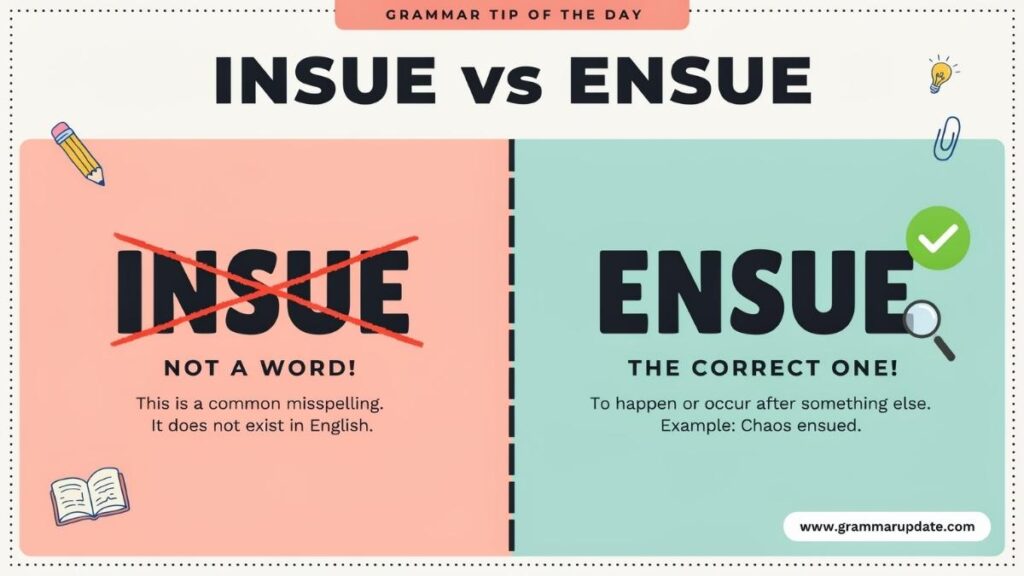
English spelling can trip you up when a word sounds different from the way it looks on the page. That’s exactly what happens with insue vs ensue. If you’ve ever paused while writing and wondered which spelling belongs in your sentence, you’re not alone. “Insue” may seem natural because of the way ensue sounds, but it isn’t the standard modern spelling. The correct word is ensue. In this guide, you will learn the ensue meaning, correct spelling, pronunciation, grammar, common mistakes, and everyday usage with clear examples. By the end, you’ll know exactly when to use ensue and why insue should be avoided.
Insue vs Ensue The Quick Answer
When comparing insue vs ensue, modern standard English recognizes ensue as the correct spelling for the verb meaning “to happen afterward” or “to follow as a result.”
| Word | Modern Standard English | Meaning | Example |
|---|---|---|---|
| Ensue | Yes | To happen afterward or as a result | A heated argument ensued. |
| Insue | No | Not the standard modern spelling of ensue | Avoid this spelling in modern writing. |
| Ensure | Yes | To make certain | Please ensure the door is locked. |
If you’re writing an email, school assignment, business report, article, academic paper, or professional document, choose ensue.
There’s no need to overthink the spelling. When the intended meaning is “happen afterward,” the correct spelling is ensue.
Learn the difference between confusing word pairs
Rosin vs Resin Difference and Which is Correct?
What Does Ensue Mean?
The basic ensue meaning is “to happen afterward.” The word can also suggest that something happens as a result of an earlier event.
For example:
A heated debate ensued after the announcement.
The announcement happened first. The debate came afterward.
Another example makes the relationship even clearer:
Confusion ensued when the instructions changed.
The change in instructions created a situation in which confusion followed. That is exactly the kind of relationship the verb ensue describes.
A useful way to remember the ensue definition is:
Event → consequence → ensue
The word doesn’t simply mean that something exists later in time. It often connects the later event with what came before it.
What Does Ensue Mean in Simple English?
If the word feels too formal, replace it mentally with one of these simpler expressions:
- happen afterward
- follow
- come next
- result
- happen as a consequence
For example:
A long silence ensued.
You could say:
A long silence followed.
Or:
A long silence happened afterward.
The first version sounds more polished and compact. The second is simpler and more conversational.
That difference matters when you’re developing your English vocabulary. Knowing a word’s definition is useful, but understanding its tone and context makes your word usage much stronger.
Learn the difference between confusing word pairs
Performing vs Preforming difference and Which One Is Correct?
Ensue Definition What Does the Word Actually Describe?
The standard ensue definition focuses on something that happens after another event. The relationship can involve time, consequence, or both.
Consider these examples:
The lights went out, and panic ensued.
The announcement surprised everyone, and a long discussion ensued.
Several complications ensued after the software update.
In each case, the event described by ensue comes after something else.
That makes ensue particularly useful when you want to show a clear sequence without using a long phrase such as “happened afterward.”
Instead of writing:
Several problems happened afterward because of the technical error.
You can write:
Several problems ensued from the technical error.
The second sentence is shorter and more precise.
What Is the Insue Meaning?
The phrase insue meaning can be misleading because insue isn’t the standard modern spelling of the verb that means “to happen afterward.”
If you encounter insue in an old text, historical document, or discussion of older English, that doesn’t mean modern writers should use it. English has changed over time, and historical texts often contain spellings that differ from today’s standard forms.
For contemporary English writing, the practical answer is straightforward:
Use ensue.
Do not use insue when you mean “to happen afterward” or “to follow as a result.”
This distinction prevents a common spelling error while also avoiding an overly broad claim that the sequence of letters “insue” could never appear anywhere in historical English.
Is Insue a Word?
The question “is insue a word?” deserves a careful answer.
If the question means, “Is insue the standard modern spelling of the verb meaning ‘to happen afterward’?” then no.
If the question means, “Has this spelling ever appeared in historical English?” the answer requires more nuance because older forms of English contain many spellings that modern writers no longer use.
For practical English writing, however, the correction is simple:
Insue → Ensue
If a grammar checker flags insue in a sentence where you intended the meaning of ensue, replace it with ensue.
Learn the difference between confusing word pairs
Sergeant vs Sargent difference and Which Is Correct?
Insue vs Ensue What’s the Difference?
The main difference between insue vs ensue is spelling and modern usage rather than meaning.
Ensue is the standard modern form. It functions as a verb and means that something happens afterward or as a consequence.
Insue should not be used as the modern spelling of that verb.
| Feature | Ensue | Insue |
|---|---|---|
| Standard modern spelling | Yes | No |
| Part of speech | Verb | Not the standard modern form |
| Meaning | Happen afterward or as a result | Historical or nonstandard spelling context |
| Recommended for modern writing | Yes | No |
| Past form | Ensued | Not standard |
| Present participle | Ensuing | Not standard |
This is why the word comparison doesn’t require two separate modern definitions. You’re not choosing between two contemporary words with different meanings.
You’re choosing between the standard spelling and a spelling that modern writers should avoid.
Why Do People Confuse Insue vs Ensue?

English spelling often gives readers mixed signals. A word can sound one way while its spelling points in another direction.
That’s one reason insue vs ensue cause confusion.
The pronunciation of ensue begins with a sound that can make the spelling “insue” seem reasonable. Someone who has heard the word but rarely seen it written may naturally guess the spelling.
That guess makes sense phonetically. It’s still not the correct spelling.
The Pronunciation Creates a Spelling Trap
The US ensue pronunciation is /ɪnˈsuː/.
For a simple pronunciation guide, think:
en-SOO
The stress falls on the second syllable.
Because the first syllable sounds like “in,” some writers may instinctively spell the word with an i.
That creates the common error:
Insue
The correct spelling is:
Ensue
This is a good example of why pronunciation alone can’t always determine correct English spelling. English contains many words whose sounds don’t provide enough information to reconstruct the spelling accurately.
The Word Looks Like Other “In-” Words
English has many familiar words beginning with in-, including:
- include
- increase
- influence
- inform
- inspect
- invite
Because of that pattern, insue may look perfectly reasonable to someone writing quickly.
However, spelling patterns don’t always work consistently across English. A familiar beginning doesn’t guarantee that a word follows the same spelling pattern.
That’s one reason commonly misspelled words can remain difficult even for fluent speakers.
How to Spell Ensue Correctly
If you’re wondering how to spell ensue, break it into its letters:
E-N-S-U-E
The easiest way to remember the difference is to focus on the first two letters.
Correct:
Ensue
Incorrect in modern standard usage:
Insue
A simple memory trick can help:
Think of “E” for “event.”
An event happens first. Something else follows. That later event can ensue.
For example:
The company announced major changes, and uncertainty ensued.
The announcement came first. Uncertainty followed.
The memory trick isn’t an English spelling rule. It’s simply a way to make the correct spelling easier to recall.
Ensue in a Sentence How to Use It Correctly
Searching for ensue in a sentence examples is useful because knowing the dictionary definition doesn’t automatically tell you how the verb behaves.
Ensue is generally an intransitive verb. In practical terms, you usually don’t place a direct object after it.
Correct:
A heated argument ensued.
Correct:
Confusion ensued after the announcement.
Incorrect:
The manager ensued the argument.
The last sentence doesn’t work because ensue doesn’t mean “to cause something to happen.” It describes something that follows another event.
If you want to describe the cause, use a different verb:
The manager caused the argument.
Or:
The announcement triggered an argument.
Then you can use ensue to describe what followed:
An argument ensued after the announcement.
That distinction is an important part of ensue grammar.
Learn the difference between confusing word pairs
Leeched vs Leached Difference and which is correct ?
Common Sentence Patterns With Ensue
Once you understand the basic structure, ensue usage becomes much easier.
Pattern A Result + Ensue
Confusion ensued.
Panic ensued.
A debate ensued.
Silence ensued.
This is probably the simplest construction.
The subject identifies what happened afterward.
Pattern A Result + Ensued + After
Confusion ensued after the announcement.
A heated discussion ensued after the meeting.
Several problems ensued after the system failed.
This pattern clearly identifies the earlier event.
Pattern A Result + Ensued + From
Several complications ensued from the original mistake.
New concerns ensued from the unexpected findings.
This construction emphasizes the source or cause of the later event.
Pattern Event + and + Result + Ensued
The announcement surprised employees, and confusion ensued.
The referee made the controversial call, and an argument ensued.
This pattern works especially well in narrative and explanatory writing.
Ensue Examples in Everyday English
The best ensue examples show how naturally the word fits into different contexts.
Everyday Situations
A disagreement ensued over the last slice of pizza.
Laughter ensued after the unexpected joke.
A long silence ensued.
Confusion ensued when everyone received different instructions.
These sentences use ensue naturally because each later event follows something that happened first.
Workplace Situations
A detailed discussion ensued after the proposal was presented.
Several questions ensued during the meeting.
Further negotiations ensued after the initial offer was rejected.
The word fits professional writing particularly well because it expresses sequence and consequence without using unnecessary wording.
Academic Situations
Further debate ensued after the researchers presented their findings.
Additional analysis ensued once the initial results raised new questions.
A broader discussion ensued from the study’s findings.
In academic writing, however, clarity still matters more than formality. If “followed” sounds more natural in a particular sentence, there’s no reason to force “ensued” into it.
Ensue Grammar Understanding Its Word Forms
Good ensue grammar requires more than knowing the base form. You should also recognize its common forms.
| Grammatical form | Word | Example |
|---|---|---|
| Base form | ensue | Further problems may ensue. |
| Present, third person | ensues | Confusion ensues when instructions conflict. |
| Past tense | ensued | A heated argument ensued. |
| Present participle | ensuing | The ensuing debate lasted two hours. |
Ensue
Use the base form when the grammar of the sentence calls for it.
Further complications may ensue.
Ensues
Use ensues with a singular third-person subject in the present tense.
Confusion ensues whenever the instructions change.
Ensued
Use ensued for past events.
A heated debate ensued after the announcement.
Ensuing
Ensuing describes something that follows afterward.
The ensuing discussion lasted two hours.
The ensuing chaos delayed the event.
The ensuing months brought several changes.
The distinction between ensued and ensuing is worth remembering because both forms appear frequently in formal English.
Ensue vs Follow Are They the Same?
“Follow” is one of the closest ensue synonym choices, but the words aren’t interchangeable in every sentence.
Follow has a much wider meaning.
You can say:
The dog followed its owner.
And You can’t naturally replace “followed” with “ensued” there.
You can say:
A debate followed the announcement.
You can also say:
A debate ensued after the announcement.
The two sentences communicate a similar sequence, but ensue gives the sentence a stronger sense of consequence or development.
Compare:
A meeting followed the announcement.
This mainly tells you what came next.
A heated debate ensued after the announcement.
This suggests that the debate developed as a consequence of the announcement.
Ensue Synonym List
Depending on the context, possible alternatives include:
- follow
- result
- happen afterward
- come next
- arise
- develop
- occur afterward
However, these alternatives don’t always carry exactly the same tone or meaning.
For example, “result” often focuses strongly on cause and effect. “Follow” focuses more broadly on sequence. “Ensue” sits between these ideas and often works best when one event naturally leads to another.
Learn the difference between confusing word pairs
Anyway vs Any Way Difference and which is Correct?
Ensue vs Ensure Two Words That Look Similar
Once you understand ensue, another spelling trap appears: ensure.
The words look similar, but their meanings differ completely.
| Word | Meaning | Example |
|---|---|---|
| Ensue | Happen afterward or as a result | A dispute ensued. |
| Ensure | Make certain | Ensure that the report is complete. |
Consider these two sentences:
Confusion ensued after the instructions changed.
Please ensure that everyone receives the updated instructions.
The first sentence describes a result.
The second tells someone to make certain that something happens.
Mixing these words can change the entire meaning of a sentence.
Common Mistakes With Insue vs Ensue
Spelling errors in English often happen because writers rely on sound instead of established spelling.
Here are some forms to watch:
| Incorrect | Correct |
|---|---|
| insue | ensue |
| insued | ensued |
| insuing | ensuing |
| ensueed | ensued |
| ensure | ensue when the meaning is “happen afterward” |
For example:
Incorrect: Confusion insued after the announcement.
Correct: Confusion ensued after the announcement.
Another common mistake involves the past tense.
Because the base word ends in e, writers sometimes create the incorrect form “ensueed.”
The correct past tense is simply:
ensued
English spelling can be strange, but this one is easy once you’ve seen the correct form a few times.
Is Insue a Spelling Mistake?
If you intended to write the modern verb meaning “to happen afterward,” then yes, insue is a spelling mistake in contemporary standard English.
Consider:
Confusion insued after the announcement.
The correction is:
Confusion ensued after the announcement.
Likewise:
An argument insued.
Should become:
An argument ensued.
This is a small correction, but it matters in polished English writing. A single incorrect letter can make an otherwise strong sentence look careless.
Is Ensue a Word?
Yes. If you’re asking, “is ensue a word?” the answer is an uncomplicated yes.
Ensue is a standard English verb. It means to happen afterward or as a consequence.
The word appears in formal writing, journalism, academic prose, business communication, and storytelling.
Its common forms include:
- ensue
- ensues
- ensued
- ensuing
The word therefore belongs to standard English vocabulary and has a well-established grammatical role.
Is Insue Accepted in English?
For modern standard English, don’t use insue as the ordinary spelling of ensue.
That doesn’t mean every historical appearance of the spelling should be erased from the history of the language. Older English contains many forms that differ from the spelling used today.
The practical rule for modern writers remains simple:
Use ensue.
This is especially important in formal English, academic writing, professional communication, and published content where correct English spelling matters.
Ensue Pronunciation How Do You Say It?
The correct ensue pronunciation can make the spelling easier to remember.
In US English, ensue is pronounced /ɪnˈsuː/. The stress falls on the second syllable.
A simple pronunciation guide is:
en-SOO
The final sound rhymes with words such as “too,” “blue,” and “through.”
The first syllable is short and unstressed. That matters because the sound can make some people assume the word begins with “in” rather than “en.”
That pronunciation-based confusion likely contributes to the spelling error.
How to Pronounce Ensue
If you’re asking how to pronounce ensue, say it in two parts:
en + SOO
Then blend them together:
ensue
Avoid giving equal stress to both syllables. The natural pronunciation emphasizes the second syllable.
The pronunciation itself doesn’t change the spelling. Even if the first syllable sounds similar to “in,” the correct written form remains:
ensue
This is a useful reminder for English language learning: pronunciation and spelling often support each other, but they don’t always match perfectly.
Ensue in Modern English
Ensue has a long history in English, but its modern meaning remains straightforward.
In contemporary English, it means that something happens after another event, particularly as a result of it.
For example:
A disagreement ensued after the announcement.
The word remains common in formal writing because it efficiently expresses a relationship between two events.
You’ll often see it in contexts involving:
- discussions
- arguments
- confusion
- conflict
- delays
- consequences
- negotiations
- celebrations
- silence
- chaos
- investigations
- debates
The word doesn’t inherently describe something negative.
For example:
A celebration ensued after the team won.
That sentence works perfectly well.
Likewise:
A period of calm ensued.
The result can be positive, negative, or neutral. Context determines the tone.
When to Use Ensue
The simplest answer to when to use ensue is this:
Use ensue when you want to show that one event happens after another, especially when the second event develops as a result of the first.
Consider:
The company announced the changes, and confusion ensued.
The sentence establishes a clear sequence.
First, the company announced the changes.
Then, confusion followed.
The verb ensue captures that relationship in one word.
Use Ensue for Clear Consequences
Ensue works particularly well when the later event has a clear connection to what came before it.
The power failed, and several technical problems ensued.
The negotiations broke down, and further delays ensued.
The unexpected announcement triggered questions, and a lengthy discussion ensued.
In each example, the later event grows naturally out of the earlier event.
Don’t Use Ensue When You Mean Cause
One of the most important points in ensue usage is that the word describes what follows. It doesn’t mean “cause.”
Incorrect:
The announcement ensued confusion.
Better:
Confusion ensued after the announcement.
Or:
The announcement caused confusion.
This distinction may seem small, but it separates correct verb usage from an awkward construction.
Learn the difference between often confused words
Lint vs Lent Difference Which one is correct?
Ensue Grammar Examples
A few clear patterns can make ensue grammar easier to remember.
Pattern One Subject + Ensue
An argument ensued.
Confusion ensued.
Silence ensued.
Panic ensued.
This is the shortest and most common structure.
Pattern Two Subject + Ensued + After
An argument ensued after the meeting.
Confusion ensued after the announcement.
Several delays ensued after the equipment failed.
This construction makes the sequence especially clear.
Pattern Three Subject + Ensued + From
Several problems ensued from the original mistake.
Further complications ensued from the software failure.
This construction highlights the source of the later event.
Pattern Four Subject + May or Might + Ensue
Further complications may ensue.
Additional problems might ensue.
This pattern often appears in warnings, reports, instructions, and professional writing.
For example:
If the safety procedure is ignored, serious problems may ensue.
Here, ensue describes a possible future consequence.
Ensued vs Ensuing
Two forms of the word often cause their own small spelling and grammar questions: ensued and ensuing.
They don’t perform the same grammatical job.
Ensued is the past tense of ensue.
A heated debate ensued.
The debate happened afterward.
Ensuing usually works as a present participle or adjective.
The ensuing debate lasted for several hours.
Here, ensuing describes the debate that followed.
The difference becomes clearer in a table:
| Word | Function | Example |
|---|---|---|
| Ensue | Base verb | Problems may ensue. |
| Ensues | Present-tense verb | Confusion ensues quickly. |
| Ensued | Past-tense verb | An argument ensued. |
| Ensuing | Participial/adjectival form | The ensuing argument lasted an hour. |
A simple memory rule helps:
Something ensued.
The ensuing event followed.
What Does Ensuing Mean?
Ensuing means following afterward.
It usually appears directly before a noun.
Examples include:
the ensuing debate
the ensuing discussion
the ensuing months
the ensuing chaos
the ensuing investigation
For example:
The decision created uncertainty, and the ensuing debate lasted for weeks.
Here, ensuing identifies the debate that followed the decision.
This form is especially useful in formal English because it lets you describe a later event without repeatedly writing “that followed.”
Instead of:
The debate that followed the decision lasted for weeks.
You can write:
The ensuing debate lasted for weeks.
Both are correct. The second is more concise and formal.
Ensue Synonym What Words Can Replace It?
There isn’t one universal ensue synonym because the best replacement depends on context.
The most useful alternatives include:
- follow
- result
- happen afterward
- come next
- arise
- develop
- occur
- come about
However, each word carries a slightly different shade of meaning.
Ensue vs Follow
“Follow” is broader and more conversational.
A discussion followed.
“Ensue” sounds more formal and can suggest a consequence.
A discussion ensued.
Ensue vs Result
“Result” strongly emphasizes cause and effect.
Several problems resulted from the error.
“Ensue” can express the same relationship while emphasizing what happened afterward.
Several problems ensued from the error.
Ensue vs Happen
“Happen” is simple and common.
Confusion happened after the announcement.
That sentence is understandable, but it sounds less natural than:
Confusion ensued after the announcement.
Or:
Confusion followed the announcement.
The best word depends on the tone and context of the sentence.
Ensue Word Meaning in Context
The ensue word meaning becomes clearer when you stop treating it as an isolated dictionary entry.
Imagine a row of dominoes.
One falls.
Then another falls.
Then another.
The later movement follows the earlier movement.
In language, ensue describes the event that comes afterward.
For example:
One mistake led to another, and confusion ensued.
The word helps the reader see the sequence without explaining every step.
That’s why ensue works particularly well in narrative, journalism, professional reports, and academic analysis.
Correct Spelling of Ensue
The correct spelling of ensue contains five letters:
E-N-S-U-E
The most common spelling error changes the first letter:
insue
That single letter creates a nonstandard modern form.
Other errors include:
insued
insuing
ensueed
The correct forms are:
ensued
ensuing
ensue
English spelling rules can feel inconsistent, but this group becomes easy once you recognize the base word.
Is Insue a Spelling Mistake?
If the intended meaning is “to happen afterward,” then writing insue in modern English is a spelling mistake.
Consider this sentence:
Confusion insued after the instructions changed.
The correct version is:
Confusion ensued after the instructions changed.
The mistake doesn’t change the intended meaning dramatically because most readers can guess what the writer meant. Still, correct English spelling matters, especially in professional and academic contexts.
A spelling error can distract readers from otherwise strong writing.
Why Is Insue Incorrect?
The question why is insue incorrect has a simple practical answer: modern standard English uses ensue for this verb.
The issue isn’t that English speakers can’t understand insue. The problem is that it doesn’t match the established modern spelling.
English has many words whose spelling can’t be predicted perfectly from pronunciation.
Consider words such as:
- receive
- deceive
- separate
- necessary
- privilege
- definitely
Knowing a word’s correct written form is part of building reliable English vocabulary.
With ensue, the safest approach is to memorize the standard spelling rather than trying to derive it from pronunciation.
Is Insue Accepted in English?
The answer depends on what “accepted” means.
If you mean accepted as the standard modern spelling of the verb meaning “to happen afterward,” then no.
Modern English uses ensue.
Historical writing can contain older spellings, but that doesn’t make those spellings suitable for contemporary communication.
The same principle applies to many historical English forms. A spelling can have historical value without being the spelling you should use in an email or school paper today.
For modern English writing, choose:
ensue
Learn the difference between often confused words
Then vs Than difference which one is correct ?
British English vs American English
The spelling of ensue remains the same in American and British English.
You don’t need one spelling for a US audience and another for a UK audience.
The main difference appears in pronunciation.
US English commonly uses:
/ɪnˈsuː/
British English may use:
/ɪnˈsjuː/
Despite that pronunciation difference, the written form stays:
ensue
This makes ensue easier than many other English words because you don’t have to remember an American spelling and a British spelling.
Is Ensue Formal English?
Yes. Ensue has a formal tone.
That doesn’t mean it belongs only in academic writing. It can appear in ordinary speech, journalism, fiction, business writing, and professional communication.
Still, it sounds more polished than simple alternatives such as “happen afterward.”
Compare:
A lengthy discussion followed.
A lengthy discussion ensued.
Both sentences work.
The second has a more formal and compact feel.
Where Ensue Works Well
You can use ensue naturally in:
- academic papers
- professional reports
- business writing
- journalism
- formal essays
- legal or policy writing
- narrative writing
- literary prose
When a Simpler Word Is Better
Formal doesn’t always mean better.
In a casual conversation, this might sound perfectly natural:
We changed the schedule, and a bunch of questions followed.
You probably wouldn’t need:
We changed the schedule, and a series of inquiries ensued.
The second sentence sounds much more formal.
Strong writing matches vocabulary to the audience.
Ensue in Professional Writing
Professional writing often needs to describe consequences without wasting words.
For example:
Several operational delays ensued after the supplier changed its delivery schedule.
The sentence tells the reader three things:
- The supplier changed its schedule.
- Delays followed.
- The delays were connected to that change.
Another example:
A review ensued after the audit identified inconsistencies.
The sentence is concise and formal without becoming difficult to understand.
That makes ensue useful in reports, internal documents, business articles, and formal correspondence.
Ensue in Academic Writing
Academic writing often discusses relationships between events, findings, and consequences.
For example:
Further research ensued after the initial experiment produced unexpected results.
Or:
A broader debate ensued following the publication of the study.
These sentences use ensue to connect an earlier event with a later development.
However, academic writing should never use a complicated word simply to sound intelligent.
If “followed” is clearer, use “followed.”
The goal is precise communication, not vocabulary gymnastics.
Learn the difference between often confused words
Dammit vs Damn It Which One Is Correct?
A Real-World Case Study From Announcement to Consequence
Consider a fictional company that announces a major change to its work schedule.
The first sentence might say:
The company announced a four-day workweek.
That is the initial event.
Employees then begin asking questions about schedules, salaries, and responsibilities.
A natural sentence is:
A lengthy discussion ensued among employees and managers.
The word ensued tells readers that the discussion followed the announcement.
Now imagine that management later changes the policy.
You could write:
The policy change triggered further questions, and another round of discussions ensued.
The verb works twice because two separate developments followed earlier events.
This illustrates one of the most useful aspects of ensue: it lets you describe a chain of events without repeatedly saying “then something happened.”
Ensue Usage in News and Narrative Writing
Writers often use ensue when they want to describe a noticeable consequence.
For example:
The unexpected decision sparked protests, and a tense confrontation ensued.
Or:
The actor made an unexpected comment, and laughter ensued.
Or:
The storm damaged several roads, and widespread delays ensued.
The word creates movement in the sentence. One event happens, and another follows.
That makes it particularly effective in storytelling.
Learn the difference between often confused words
Firey vs Fiery difference Which one Is Correct?
Ensue Examples Formal vs Simple
The difference in tone becomes clearer when sentences are placed side by side.
| More formal | Simpler |
| Confusion ensued after the announcement. | Confusion followed the announcement. |
| A debate ensued after the decision. | A debate followed the decision. |
| Several problems ensued from the error. | Several problems resulted from the error. |
| A lengthy discussion ensued. | A lengthy discussion followed. |
| Panic ensued after the alarm. | People panicked after the alarm. |
None of these alternatives is automatically better.
The right choice depends on your audience, purpose, and tone.
How to Use Ensue Without Making Your Writing Sound Stiff
The easiest way to misuse a formal word is to force it into every sentence.
You don’t need to replace every “followed” with “ensued.”
Instead, use the word when it adds something useful.
Good:
The announcement caused confusion, and a lengthy discussion ensued.
Less natural:
The teacher entered the classroom, and a lesson ensued.
The second sentence isn’t grammatically impossible, but it sounds unnecessarily formal because “the lesson began” or “the lesson followed” would probably communicate the idea more naturally.
Good word choice isn’t about using the most sophisticated word available. It’s about choosing the word that fits.
Ensue According to the Dictionary
The dictionary meaning of ensue centers on the idea of something happening after another event.
The word is commonly associated with consequences or developments that follow what came before.
That explains why phrases such as these sound natural:
chaos ensued
confusion ensued
debate ensued
silence ensued
an argument ensued
delays ensued
The noun before ensued usually represents the event or condition that developed afterward.
This pattern is useful for vocabulary development because it lets you recognize the word even when you encounter it in unfamiliar contexts.
Ensue Grammar Common Errors to Avoid
Several mistakes appear repeatedly when writers learn this verb.
Using Ensue as a Transitive Verb
Incorrect:
The announcement ensued confusion.
Correct:
Confusion ensued after the announcement.
Or:
The announcement caused confusion.
Using the Wrong Past Tense
Incorrect:
Confusion ensueed.
Correct:
Confusion ensued.
Using Insue Instead of Ensue
Incorrect:
An argument insued.
Correct:
An argument ensued.
Confusing Ensue With Ensure
Incorrect:
Please ensue that the form is complete.
Correct:
Please ensure that the form is complete.
These errors may look minor, but understanding the underlying grammar rules makes them easier to avoid.
The Main Rule to Remember
1.When you need a verb that means “to happen afterward” or “to follow as a result,” choose ensue.
2.When you need to say “make certain,” choose ensure.
3.When you need to describe something that followed, choose ensuing.
And when you’re tempted to write insue because the pronunciation makes it look plausible, stop for a second and remember the spelling:
E-N-S-U-E
That one small spelling choice keeps your English accurate, clear, and polished.
Ensuing Meaning and Usage
Ensuing means following afterward.
It usually modifies a noun.
Examples:
the ensuing debate
the ensuing discussion
the ensuing investigation
the ensuing months
the ensuing chaos
Here’s the difference:
A debate ensued.
versus:
The ensuing debate lasted for hours.
The first tells you that the debate happened afterward.
The second describes the debate as the one that followed.
This distinction is small but important for polished English.
Ensue vs Happen
Happen is one of the simplest alternatives to ensue, but it isn’t always an exact replacement.
Consider:
Something happened after the meeting.
This tells you very little.
Now compare:
A heated discussion ensued after the meeting.
The second sentence gives the reader a specific event and clearly connects it to what happened earlier.
That’s why ensue can be more useful in formal writing.
Still, simple words have their place. If the context is casual, “happen” may be better.
Good writing isn’t about choosing the most formal word. It’s about choosing the clearest word.
Ensue vs Follow
Follow is probably the most useful synonym for ensue.
Compare:
A discussion followed the announcement.
A discussion ensued after the announcement.
Both are correct.
Follow is more flexible. It can describe time, order, movement, position, or sequence.
Ensue is narrower. It usually describes an event or condition that happens afterward, especially as a consequence.
That difference makes ensue particularly useful in formal cause-and-effect writing.
Ensue vs Result
Result also overlaps with ensue.
For example:
Several problems resulted from the error.
Several problems ensued from the error.
Both sentences indicate that the problems developed because of the error.
The difference is subtle.
Result often puts stronger emphasis on the outcome.
Ensue puts more emphasis on what followed.
Neither word is automatically better. Choose according to the relationship you want to highlight.
Ensue vs Ensure vs Insure
English contains several words that look similar but carry completely different meanings.
The most useful comparison is:
| Word | Meaning | Example |
| Ensue | Happen afterward or as a result | A debate ensued. |
| Ensure | Make certain | Ensure that the door is locked. |
| Insure | Provide or obtain insurance | The company insured the vehicle. |
These words can cause spelling errors in English because their letters overlap.
The meanings, however, are distinct.
A simple memory system can help:
- ensue = happen afterward
- ensure = make certain
- insure = provide insurance
If you remember the meanings first, the spellings become much easier to separate.
Learn the difference between often confused words
Pose vs Poise Difference and Which one is correct ?
Common Spelling Mistakes With Ensue
Some errors appear because writers spell the word according to pronunciation.
Others happen because writers apply a familiar spelling pattern incorrectly.
Here are common forms to avoid:
| Incorrect | Correct |
| insue | ensue |
| insued | ensued |
| insuing | ensuing |
| ensueed | ensued |
| ensueing | ensuing |
The correct forms are worth memorizing because they appear often enough to become familiar through reading.
Why Grammar Checkers Aren’t Enough
A grammar checker can be useful, but software shouldn’t replace language knowledge.
A spelling tool might tell you that “insue” should become “ensue.” That fixes the immediate error.
It doesn’t necessarily explain why.
Understanding the word helps you avoid the same mistake later.
It also helps you recognize related forms such as:
ensue
ensues
ensued
ensuing
That knowledge is more valuable than simply accepting an automatic correction.
English Spelling Rules and the Word Ensue
English spelling doesn’t always allow writers to predict a word from pronunciation.
That’s one reason English spelling rules can feel frustrating.
Words may reflect:
- historical pronunciation
- borrowed vocabulary
- changes in pronunciation
- older spelling patterns
- word origins
- conventional modern usage
The spelling of ensue is simply something modern writers need to learn as part of standard English vocabulary.
Instead of asking whether “insue” looks more logical, ask which spelling standard English uses.
The answer is ensue.
A Practical Editing Case Study
Imagine this sentence in a draft:
After the announcement, confusion insued among the employees.
Two problems appear.
First, the spelling is incorrect.
Second, the sentence can be improved stylistically.
A basic correction would be:
After the announcement, confusion ensued among the employees.
That version fixes the spelling.
A slightly tighter version is:
Confusion ensued after the announcement.
The second sentence sounds cleaner because it puts the main event first.
This is a useful editing lesson: correcting spelling is important, but polishing the surrounding sentence can make the writing much stronger.
How to Improve Your English Writing With Word Comparison
Word comparison is one of the easiest ways to strengthen vocabulary.
Instead of memorizing isolated definitions, compare related words:
| Word | Core idea |
| Ensue | Follow afterward |
| Follow | Come after |
| Result | Happen as an outcome |
| Ensure | Make certain |
| Insure | Provide insurance |
| Ensuing | Following afterward |
This kind of comparison makes vocabulary more memorable because each word has a clear place in the group.
It also helps reduce commonly misspelled words and confusing English words in everyday writing.
Ensue in Professional and Academic Contexts
The word is especially useful when precision and concision matter.
For example, a business report might say:
Several operational problems ensued after the supplier changed its delivery schedule.
An academic paper might say:
Further debate ensued after the researchers published their findings.
A formal report might say:
A detailed investigation ensued following the discovery of the discrepancy.
These sentences work because the word connects an initial event with a later development.
However, don’t use ensue merely to make writing sound sophisticated.
Compare:
The meeting ended, and a discussion ensued.
That sounds natural.
But:
The employee walked into the office, and a greeting ensued.
That feels unnecessarily formal.
Context decides whether the word belongs.
When Not to Use Ensue
Knowing when not to use a word can be just as valuable as knowing when to use it.
Avoid ensue when you simply mean:
- move behind someone
- obey instructions
- come after in a list
- happen at any random time
- cause something
- make something certain
For example:
The student followed the teacher.
You can’t replace followed with ensued.
Likewise:
The manager ensured that everyone received the report.
You can’t replace ensured with ensued.
And:
The accident caused traffic delays.
You shouldn’t automatically change caused to ensued.
Good language usage depends on meaning, not just on finding sophisticated synonyms.
Ensue vs Insue Quick Decision Guide
When you’re unsure about the spelling, ask yourself one question:
Does the sentence mean “to happen afterward” or “to follow as a result”?
If yes, write:
ensue
For example:
A debate ensued.
If the sentence means “make certain,” write:
ensure
For example:
Ensure that all information is accurate.
If the sentence refers to insurance, consider:
insure
For example:
The company insured the vehicle.
This quick test can prevent several common spelling errors at once.
Learn the difference between often confused words
Leary vs Leery Which Is Correct and Difference?
Practice Session Insue vs Ensue
Fill in each blank with the perfect form of the word: ensue, ensues, ensued, or ensuing. In some sentences, use ensure vs insure where the context requires it.
- A heated argument ______ after the manager announced the decision.
- Confusion ______ whenever the instructions are unclear.
- Several problems ______ from the original error.
- The announcement surprised everyone, and silence ______.
- The ______ discussion lasted nearly two hours.
- Please ______ that all the information is accurate before submitting the form.
- A long debate ______ after the committee rejected the proposal.
- If the warning is ignored, serious consequences may ______.
- The company should ______ that every employee receives the updated policy.
- The ______ chaos made it difficult for emergency workers to reach the area.
- An unexpected delay ______ after the computer system failed.
- The teacher changed the schedule, and confusion ______ among the students.
- Several complications may ______ if the equipment isn’t maintained properly.
- The ______ investigation revealed several important details.
- Laughter ______ after someone made an unexpected joke.
- Further negotiations ______ following the rejection of the original offer.
- The company decided to ______ its new delivery vehicles against damage.
- A disagreement ______ when the two teams could not agree on the rules.
- The ______ debate attracted considerable attention from the public.
- If the instructions aren’t followed carefully, additional problems could ______.
- The sudden power failure caused confusion, and several delays ______.
- The manager asked the staff to ______ that every document had the correct information.
- A period of uncertainty ______ after the company announced the changes.
- The ______ events changed the direction of the entire project.
- The announcement triggered several questions, and a detailed discussion ______.
Answers
- ensued
- ensues
- ensued
- ensued
- ensuing
- ensure
- ensued
- ensue
- ensure
- ensuing
- ensued
- ensued
- ensue
- ensuing
- ensued
- ensued
- insure
- ensued
- ensuing
- ensue
- ensued
- ensure
- ensued
- ensuing
- ensued
FAQs
What is the correct spelling: “insue vs ensue”?
The correct modern spelling is “ensue.” Use it when you mean that something happens afterward or follows as a result of an earlier event. “Insue” is not the standard spelling for this meaning.
Why do people spell “ensue” as “insue”?
The mistake usually comes from pronunciation. “Ensue” is pronounced /ɪnˈsuː/ in US English, so the first syllable can sound like “in.” That can lead writers to spell it as “insue.” However, the standard spelling begins with “en.”
What does “ensue” mean in simple English?
“Ensue” means “to happen afterward” or “to follow as a result.” For example, “Confusion ensued after the announcement” means that confusion followed the announcement.
Can “ensue” describe a positive event?
Yes. “Ensue” doesn’t automatically describe something bad. It can refer to positive, negative, or neutral events.
Example: “Celebrations ensued after the team won the championship.”
Can “ensue” describe a future event?
Yes. You can use “ensue” to describe something that may happen later.
Example: “Further problems may ensue if the warning is ignored.”
What is the difference between “Insue vs Ensue”?
“Ensue” is the base form of the verb, while “ensued” is its past-tense form.
Examples:
“Further complications may ensue.”
“Several complications ensued after the system failed.”
What is the difference between “ensue” and “ensuing”?
“Ensue” functions as a verb. “Ensuing” usually describes a noun and means “following afterward.”
Examples:
“A debate ensued.”
“The ensuing debate lasted for hours.”
Can you say “ensue after”?
Yes. “Ensue after” is a natural construction when you want to identify the event that came first.
Example: “A heated discussion ensued after the announcement.”
Can you say “ensue from”?
Yes. “Ensue from” emphasizes the event or situation that led to the later development.
Example: “Several complications ensued from the original error.”
Can “ensue” be used as a transitive verb?
Generally, no. Ensue normally describes an event that follows rather than something that a person or thing directly causes.
Correct: “Confusion ensued after the announcement.”
Incorrect: “The announcement ensued confusion.”
For the second meaning, use “caused” instead: “The announcement caused confusion.”
Is “ensue” appropriate in formal writing?
Yes. “Ensue” has a somewhat formal tone and works well in academic, professional, journalistic, and other polished writing. In casual conversation, simpler alternatives such as “follow” may sound more natural.
What are common phrases that use “ensue”?
Natural expressions include:
- chaos ensued
- confusion ensued
- silence ensued
- an argument ensued
- a debate ensued
- panic ensued
- delays ensued
- further complications ensued
- celebrations ensued
What is a good alternative to “ensue”?
The best alternative depends on the sentence. Possible choices include “follow,” “result,” “arise,” “develop,” or “happen afterward.”
For example:
“Confusion ensued.”
“Confusion followed.”
Both sentences work, although “ensued” sounds more formal.
Is “ensue” the same as “follow”?
They can have similar meanings when you’re describing one event coming after another. However, “follow” has many other meanings, while “ensue” specifically focuses on something happening afterward or developing as a consequence.
Is “ensue” the same as “result”?
Not exactly. “Result” emphasizes an outcome, while “ensue” emphasizes what follows an earlier event.
For example:
“Several problems resulted from the mistake.”
“Several problems ensued after the mistake.”
The meanings overlap, but the emphasis differs slightly.
What is the opposite of “ensue”?
There isn’t one exact opposite in every context. “Precede” can express the opposite when you’re talking about sequence because something that precedes comes before rather than after another event.
Example:
“The announcement preceded the debate.”
“The debate ensued after the announcement.”
Is “insue” acceptable in modern English?
No, not as the standard modern spelling of the verb meaning “to happen afterward.” Modern writers should use “ensue.”
Does “ensue” always mean that something happens immediately?
No. “Ensue” doesn’t specify how much time passes between two events. Something can ensue immediately, shortly afterward, or after a longer period.
Example: “Several legal disputes ensued in the years following the decision.”
Can “ensue” describe a chain of events?
Yes. You can use it when one event leads to another and that development continues.
Example: “The announcement caused confusion, a debate ensued, and further questions followed.”
This makes “ensue” useful when explaining sequences and consequences.
What part of speech is “ensue”?
“Ensue” is a verb. Its common forms are “ensue,” “ensues,” “ensued,” and “ensuing.”
Examples:
“Problems may ensue.”
“Confusion ensues.”
“An argument ensued.”
“The ensuing discussion was lengthy.”
How can you remember the spelling of “ensue”?
Remember that the correct spelling begins with “en”:
E-N-S-U-E
If the sentence means “to happen afterward,” choose “ensue,” not “insue.”
What should you use in a professional document: “Insue vs Ensue”?
Use “ensue.” It is the standard modern spelling and the appropriate choice for professional, academic, business, and formal English writing.
Can “ensue” be replaced with “happen”?
Sometimes, but the meaning and tone may change. “Happen” is much broader, while “ensue” specifically suggests that something follows an earlier event.
For example:
“A debate happened after the announcement.”
“A debate ensued after the announcement.”
The second sentence sounds more natural and precise in formal English.
Conclusion
English has a talent for making simple words look more complicated than they really are. Insue vs ensue is a perfect example. The pronunciation can make “insue” seem like a reasonable spelling, but there’s no need to second-guess it.
The correct spelling is ensue.
Use ensue when you mean that something happens afterward or follows as a result of something else. For example, “Confusion ensued after the announcement” means the confusion came afterward. You can also use ensued for the past tense and ensuing when you mean something that followed.
The spelling insue is not the standard modern form. So, if you’ve written it before, don’t worry. It’s an easy mistake to make, and now you know how to fix it.
Here’s the simple rule to remember:
If you mean “to happen afterward,” write ensue.
That’s it. No complicated grammar trick. No spelling gymnastics. Just ensue.
The next time you find yourself asking, “Is it insue vs ensue?” you’ll know exactly what to choose. And once this little spelling confusion is out of the way, you can get back to writing without letting one sneaky letter cause unnecessary trouble.

Jhon AJS, the creative mind behind Grammar Update, is an experienced blogger passionate about simplifying English grammar. He focuses on explaining confusing word vs word differences, grammar rules, punctuation, and sentence structure in a clear and practical way. Through easy to understand guides and examples, Jhon helps readers improve their writing and communicate with confidence. With years of blogging experience, he continues to share helpful insights that make learning grammar simple, useful, and accessible for everyone.