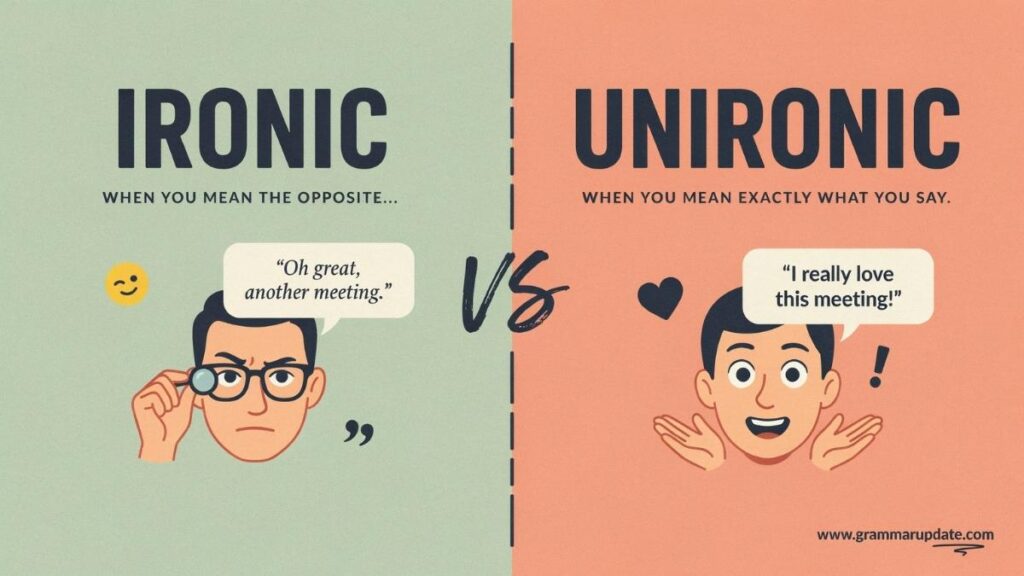
Ironic vs unironic can be confusing, especially when a simple sentence could sound like a joke, sarcasm, or a genuine opinion. The difference, however, is easier than it looks. Ironic describes something that involves irony, while unironic means the speaker genuinely means what they say. The tricky part is that people often confuse irony with sarcasm, humor, coincidence, or simply saying the opposite of what they mean. That’s where things can get messy. This guide clears up the confusion with simple definitions, clear examples, common mistakes, and practical usage tips. By the end, you’ll know exactly when to use ironic, ironically, unironic, and unironically.
Ironic vs Unironic quick answer
The easiest way to understand ironic vs unironic is to compare their basic meanings.
Ironic describes something that involves irony. Depending on the context, it can describe a statement, action, situation, or outcome that creates a contrast between what appears to be true and what is actually meant or expected.
Unironic means not ironic. In everyday communication, it often emphasizes that someone is being sincere, genuine, or straightforward rather than joking through irony.
| Word | Meaning | Example |
|---|---|---|
| Ironic | Involving or characterized by irony | “It was ironic that the driving instructor failed the driving test.” |
| Unironic | Not involving irony; sincere or genuine | “Her compliment was unironic.” |
| Ironically | In an ironic way | “Ironically, he forgot the advice he always gave others.” |
| Unironically | Sincerely or without irony | “I unironically love that old movie.” |
Neither word is a misspelling of the other. They perform different jobs.
If irony shapes the meaning, ironic may be the right choice. If you want to make clear that someone genuinely means what they say, unironic or unironically may fit better.
Learn the difference between confusing more English words
Acreage vs Acrag difference and Which Spelling Is Correct?
Ironic Meaning What Does Ironic Mean?
The ironic meaning of a statement or situation depends heavily on context.
In everyday English, ironic often describes a meaningful contrast between expectation and reality. It can also describe language in which the speaker’s intended meaning differs from the literal wording.
For example:
A fire station burns down.
That event may seem ironic because a fire station exists to respond to fires, yet the building itself becomes the victim of one.
Now consider a different example:
Someone arrives an hour late and says, “Perfect timing.”
The literal words sound positive. The context suggests the speaker means the opposite. That creates verbal irony.
This distinction matters because people sometimes use ironic to describe anything surprising, awkward, or unfortunate. That’s too broad.
An unexpected event isn’t automatically ironic. Irony usually requires a stronger contrast between expectation and reality or between literal wording and intended meaning.
Ironic Meaning in English and Context
The meaning of ironic can change depending on the surrounding situation.
Imagine someone says:
“What a beautiful day.”
If the sun is shining and the speaker genuinely enjoys the weather, the sentence has a straightforward meaning.
Now imagine someone says the exact same words while standing in a flooded street during a violent storm.
The words remain identical. The contextual meaning changes.
That is one reason irony can become difficult to recognize in written communication. Readers can’t hear the speaker’s voice or see their facial expression. They have to rely on context, punctuation, surrounding comments, cultural references, and shared knowledge.
This becomes especially important in social media and internet communication, where a short sentence can carry several possible interpretations.
Learn the difference between confusing more English words
Dammit vs Damn It Which One Is Correct?
Unironic Meaning What Does Unironic Mean?
The unironic meaning is much more direct.
Unironic means not involving irony. In everyday conversation, people often use it to emphasize that their feelings or opinions are genuine.
Consider these examples:
- “I unironically love this song.”
- “She gave him an unironic compliment.”
- “He was unironic about his admiration for the design.”
- “Her apology was completely unironic.”
- “I unironically recommend that movie.”
In each example, the speaker wants the reader to understand that the statement shouldn’t be interpreted as an ironic joke.
What Does Unironically Mean?
What does unironically mean?
Unironically means sincerely, genuinely, or without irony.
For example:
“I unironically listen to 1980s pop music every morning.”
The speaker isn’t saying that the music is so outdated that listening to it becomes a joke. The speaker genuinely enjoys it.
The word can also prevent a common misunderstanding.
Suppose someone says:
“I unironically think this is one of the best movies ever made.”
The speaker probably expects other people to assume the statement is a joke because the movie has a reputation for being strange, cheesy, or unpopular. Adding unironically tells readers that the admiration is genuine.
How Do You Use Unironically in a Sentence?
Use unironically when you want to emphasize that your opinion, reaction, preference, or action is sincere.
Examples include:
- “I unironically enjoy watching old game shows.”
- “She unironically collects vintage advertisements.”
- “He unironically thinks the retro design looks better.”
- “They unironically chose the simplest option.”
- “I unironically recommend that restaurant.”
Notice that unironically doesn’t mean humorlessly.
A person can genuinely enjoy something while also finding it funny. Sincerity and humor aren’t opposites.
Learn the difference between often confused words
Firey vs Fiery difference Which one Is Correct?
Ironic vs Unironic Examples
Examples make the difference much clearer because these words often describe the same subject from opposite perspectives.
Music
Ironic:
“He listened to the cheesy love song ironically because his friends thought it was terrible.”
Unironic:
“He listened to the same song unironically because he genuinely loved it.”
The song hasn’t changed. The listener’s attitude has.
Fashion
Ironic:
“She wore the outdated tracksuit ironically.”
She may have chosen the outfit as a joke or deliberately embraced an exaggerated style.
Unironic:
“She wore the outdated tracksuit unironically because she genuinely liked it.”
Here, the choice reflects a real preference.
Compliments
Ironic:
“After the disastrous presentation, he said, ‘That was brilliant.’”
The surrounding situation may make the praise ironic.
Unironic:
“She gave him an unironic compliment after the presentation.”
She genuinely thought he performed well.
Movies
Ironic:
“He praised the terrible movie ironically because he found its flaws hilarious.”
Unironic:
“He unironically called the movie a masterpiece.”
The first statement treats the praise as part of the joke. The second expresses genuine admiration.
Internet Culture
Someone posts:
“This is the greatest movie ever made.”
If the movie is famously bad and the post clearly mocks it, the statement may be ironic.
If the person genuinely believes the movie deserves that praise, the statement is unironic.
That distinction appears constantly in modern internet language.
Learn the difference between often confused words
Pretty vs Prety difference and Which Spelling Is Correct ?
Ironic vs Unironic in Internet Culture

Internet culture has made unironically especially useful.
Online communication blends memes, parody, sarcasm, exaggeration, cultural references, jokes, and sincere opinions. As a result, readers can’t always tell whether someone genuinely means what they wrote.
Someone might post:
“This song is actually incredible.”
A reader could reasonably wonder:
- Are they joking?
- Are they mocking the song?
- Are they participating in a meme?
- Do they genuinely like it?
Adding “unironically” removes much of that uncertainty:
“I unironically think this song is incredible.”
The speaker is emphasizing genuine appreciation.
This is why unironically appears so often in modern internet language. It helps the writer signal sincerity in an environment where almost anything can become a joke.
Internet Slang and Unironically
The word also describes a common shift in online culture.
Someone may first enjoy something ironically because it seems ridiculous. After spending enough time with it, they may begin to genuinely appreciate it.
For example:
- A person listens to an old pop song because it’s funny.
- They keep listening to it.
- They start enjoying the song for real.
- They tell their friends, “I unironically love this song.”
The word captures the change from ironic enjoyment to genuine enjoyment.
This pattern can happen with movies, fashion, music, food, hobbies, video games, television shows, and other forms of entertainment.
Learn the difference between often confused words
Agast vs Aghast difference and Which one Is Correct?
Ironic vs Unironic and the Difference Between Irony and Sarcasm
One of the most common mistakes in this topic is treating irony and sarcasm as exact synonyms.
They aren’t.
Irony has a broader meaning than sarcasm. Sarcasm often uses ironic language, but irony doesn’t always involve sarcasm.
For example:
“Great job.”
Imagine someone says this immediately after another person makes an obvious mistake.
The remark may be sarcastic because the speaker uses praise to mock the mistake.
Now consider:
A company that sells security systems suffers a major security breach.
The situation may be ironic. Nobody needs to make a sarcastic comment for the contrast to exist.
Ironically vs Sarcastically
The difference between ironically vs sarcastically becomes clearer when you compare their purposes.
| Term | Main idea | Example |
| Ironically | Involves irony or a meaningful contrast | “Ironically, the driving instructor failed his own test.” |
| Sarcastically | Uses language to mock or ridicule | “He sarcastically said, ‘Excellent work,’ after the mistake.” |
| Unironically | Expresses something sincerely or without irony | “She unironically praised the performance.” |
Sarcasm often has a sharp or mocking edge. Irony can be humorous, serious, dramatic, literary, tragic, or subtle.
That makes irony the broader concept.
Is Ironic the Same as Sarcastic?
No.
Sarcasm and irony overlap, but they aren’t interchangeable.
A sarcastic remark may use irony to communicate its meaning. However, an ironic situation doesn’t necessarily contain sarcasm.
For example:
A company that sells umbrellas runs out of umbrellas during a major storm.
That situation can be ironic. Nobody has to make a sarcastic statement.
The key distinction is simple: sarcasm usually concerns a speaker’s mocking tone or intent, while irony can describe a broader contrast between meaning, expectation, and reality.
Ironically vs Unironically Funny Can Something Be Both?
The phrase ironically vs unironically funny creates another common misunderstanding.
Something can be funny ironically. It can also be funny unironically.
Suppose someone watches a deliberately ridiculous comedy.
They might laugh because the movie is absurd. They could also genuinely enjoy the movie.
Now imagine someone says:
“I unironically think this is one of the funniest movies ever made.”
The speaker genuinely believes it is funny.
The important distinction isn’t whether the person laughs.
The distinction is whether irony shapes the person’s statement or attitude.
Unironic humor is still humor. A sincere joke is still a joke.
Learn the difference between often confused words
Lend vs Lent difference and which is Correct?
Three Main Types of Irony
A useful understanding of irony requires more than a simple definition. English uses irony in several ways, especially in literature, rhetoric, storytelling, and everyday speech.
Verbal Irony
Verbal irony occurs when someone says something that contrasts with what they actually mean.
For example:
“Wonderful weather.”
If the speaker says this while standing in pouring rain, the statement may be ironic.
The literal meaning and intended meaning don’t match.
Verbal irony appears frequently in everyday conversation because speakers can use it to create humor, criticism, emphasis, or understatement.
Situational Irony
Situational irony occurs when an outcome contrasts strongly with what people expect.
For example:
A professional driving instructor fails a driving test.
The result creates an obvious contrast between the person’s profession and the unexpected outcome.
However, not every surprise counts as situational irony. The contrast needs to carry some meaningful connection between expectation and reality.
Dramatic Irony
Dramatic irony occurs when the audience knows something important that a character doesn’t know.
This technique appears frequently in literature, theater, television, and film.
Imagine a story in which the audience knows that a character’s trusted friend is secretly the villain. The character continues to trust that person because they lack information that the audience already has.
That gap in knowledge creates dramatic irony.
It can build suspense, humor, tension, or tragedy.
Ironic vs Unironic Side-by-Side Comparison
| Feature | Ironic | Unironic |
| Core meaning | Involving irony | Not involving irony |
| Main focus | Contrast or ironic intent | Sincerity or direct intent |
| Common tone | Humorous, serious, mocking, subtle, or dramatic | Genuine, direct, or sincere |
| Common adverb | Ironically | Unironically |
| Example | “He ironically praised the terrible performance.” | “He unironically praised the performance.” |
The central difference is intent and contextual meaning.
If irony forms part of the message, ironic may be appropriate. If the speaker wants to emphasize genuine intent, unironic or unironically may be more useful.
Learn the difference between often confused words
Rehireable vs Rehirable Which Spelling Is Correct?
Common Mistakes With Ironic and Unironic
Mistake Assuming Ironic Means Unexpected
An unexpected event isn’t automatically ironic.
For example:
“I forgot my umbrella and it started raining.”
That’s unfortunate. It may be annoying. It isn’t necessarily ironic.
Now consider:
“The company that manufactures umbrellas ran out of umbrellas during a major storm.”
The connection between expectation and reality creates a much stronger case for irony.
Mistake Thinking Unironic Means Boring
Unironic doesn’t mean boring, dull, or humorless.
Consider:
“He unironically wore the enormous cowboy hat.”
The statement doesn’t say that the choice was boring. It says that he genuinely wanted to wear the hat rather than using it as an ironic joke.
Mistake Treating Unironically as a Synonym for Literally
Unironically and literally have different meanings.
Literally concerns whether language has its direct meaning rather than a figurative one.
Unironically concerns whether irony is involved.
For example:
“I literally ate the whole cake.”
This tells you what happened.
“I unironically love this cake.”
This tells you that the speaker genuinely loves it rather than praising it as part of a joke.
The concepts can overlap in some contexts, but they aren’t interchangeable.
Mistake Assuming Unironically Means Completely Serious
Someone can be unironically enthusiastic and still be playful.
For example:
“I unironically think that ridiculous hat looks fantastic.”
The speaker may laugh while saying it. The admiration can still be genuine.
Sincerity doesn’t require a solemn tone.
Mistake Writing Un Ironically
In ordinary modern usage, write:
unironically
not:
un ironically
Likewise, write:
unironic
rather than:
un ironic
The standard forms are straightforward:
- ironic
- ironically
- unironic
- unironically
Learn the difference between confusing word pairs
Bellwether vs Bellweather difference and usage?
Ironic vs Unironic Grammar and Word Forms
Knowing the related forms makes these words easier to use correctly.
| Word | Part of speech | Meaning | Example |
| Ironic | Adjective | Involving irony | “That was an ironic outcome.” |
| Ironically | Adverb | In an ironic way | “Ironically, he forgot his own advice.” |
| Unironic | Adjective | Without irony | “Her response was unironic.” |
| Unironically | Adverb | In a sincere or non-ironic way | “He unironically loves the song.” |
| Irony | Noun | A quality or situation involving irony | “The irony was difficult to miss.” |
The adjective ironic describes a noun:
“It was an ironic situation.”
The adverb ironically describes how something happens or how someone speaks:
“He ironically praised the terrible performance.”
The adjective unironic describes a noun:
“Her response was unironic.”
The adverb unironically describes how someone expresses an attitude or performs an action:
“She unironically enjoyed the movie.”
How to Choose Between Ironic and Unironic
When you’re unsure which word fits, work through the context rather than guessing from the sentence alone.
Look for an Ironic Contrast
Ask whether the meaning depends on a contrast between expectation and reality or between literal wording and intended meaning.
If it does, ironic may fit.
“It was ironic that the anti-littering campaign produced a huge amount of waste.”
Check the Speaker’s Intention
Ask whether the speaker genuinely means what they’re saying.
If the answer is yes and you want to emphasize that sincerity, unironically may work.
“I unironically prefer the older version.”
Separate Irony From Sarcasm
Ask whether the speaker is specifically mocking someone.
If mockery drives the statement, sarcastic may be more precise.
“He sarcastically congratulated his friend after the mistake.”
Consider the Whole Context
Don’t judge an isolated sentence too quickly.
Tone, background information, cultural references, and the situation can completely change how a statement sounds.
This matters particularly in text messages and social media posts, where readers can’t hear vocal tone.
Learn the difference between confusing word pairs
Strips vs Stripes Difference and which is correct?
Ironic Expression vs Unironic Expression
An ironic expression often creates a gap between literal wording and intended meaning.
An unironic expression doesn’t depend on that gap.
Compare:
“Oh, fantastic. Another software update.”
Depending on the situation, this could be ironic.
Now compare:
“I’m genuinely happy about the software update.”
The second statement directly expresses the speaker’s attitude.
This contrast demonstrates how figurative language, contextual meaning, speech patterns, and conversational context work together.
Case Study One Sentence With Two Different Meanings
Consider the sentence:
“This is exactly what I needed.”
Imagine someone receives a package that arrives badly damaged. They look at the ruined box and say:
“This is exactly what I needed.”
The statement may be ironic because the literal words conflict with the person’s actual reaction.
Now imagine the same person receives something they’ve wanted for months.
They open the package and say:
“This is exactly what I needed.”
This time, the statement is straightforward and unironic.
The words haven’t changed.
The context has.
This example shows why irony can’t always be identified through vocabulary alone. A proper interpretation may require knowledge of the situation, speaker intention, tone, shared expectations, and surrounding conversation.
Learn the difference between confusing word pairs
Calendar vs Calender difference and Which Spelling Is Correct?
Ironic vs Unironic in Professional and Academic Writing
Ironic appears naturally in professional, academic, literary, and journalistic writing when the writer discusses irony or an ironic outcome.
For example:
“The novel reaches an ironic conclusion.”
That sentence works naturally in literary analysis.
Unironic can also appear in serious writing when the writer needs to emphasize sincerity or the absence of irony.
For example:
“The article presents an unironic defense of traditional design.”
However, another writer might prefer:
“The article presents a sincere defense of traditional design.”
The best choice depends on the intended emphasis.
Use unironic when the absence of irony matters. Use sincere or genuine when the main point concerns authentic feelings or beliefs.
Ironic vs Unironic in American English
The basic distinction between ironic and unironic doesn’t change in American English.
Common examples include:
- “That was ironic.”
- “She was being ironic.”
- “He said it ironically.”
- “I genuinely meant it.”
- “She was being unironic.”
- “I unironically love it.”
The main difference you’ll notice is register.
Unironically appears frequently in casual speech, online discussions, entertainment commentary, and social media language. In formal writing, sincere, genuine, or without irony may sometimes sound more direct.
There isn’t a special American grammar rule that makes one word correct and the other incorrect.
Google USA Search Terms and Language Questions
People often use search engines to investigate unfamiliar words and expressions. As a result, a vocabulary topic can appear alongside completely unrelated searches.
For example, someone might search Google USA search, Google USA English, Google USA translate, or Google USA address while looking for information about language.
Other searches have different purposes:
- Google USA shopping relates to online shopping.
- Google USA map relates to digital maps and navigation.
- Google USA flights relates to travel searches.
- Google USA search account can relate to account or search activity.
- Google US search results refer to results shown for searches associated with the United States.
- Google English search refers to finding information in English.
- Google search by address relates to location-based search.
- Google account login relates to account access.
- Google Shopping USA relates to product searches.
- Google Maps USA relates to digital maps and navigation.
- Google Flights USA relates to flight searches.
These phrases don’t affect the meaning of ironic or unironic.
The important distinction is search intent. A person searching for Google USA search is looking for information about a search service or search experience. A person searching for ironic vs unironic is asking about English vocabulary and semantics.
Google USA Search and English Vocabulary
A Google USA search can return dictionary definitions, grammar explanations, forums, examples, and social media discussions.
However, search results don’t automatically provide the clearest linguistic explanation.
For example, a search for ironic vs unironic should distinguish between meaning, intention, context, irony, sarcasm, and sincerity rather than treating the terms as competing spellings.
Likewise, Google USA English, Google search in English, and English language search describe ways of finding English-language information. They don’t create a separate American meaning for unironic.
The basic English meanings remain the same.
Google USA Translate and the Meaning of Irony
Someone searching Google USA translate or Google Translate USA may want to translate a word or phrase.
Translation becomes more complicated when the expression contains irony.
Why?
Because irony often depends on cultural references, humor, tone, social expectations, and context. A direct translation may preserve the individual words while losing the intended meaning.
This issue becomes especially noticeable with internet slang.
The meaning of unironically in internet culture can’t always be understood from a word-for-word translation. The surrounding conversation may carry information that the individual word doesn’t contain.
Learn the difference between confusing word pairs
Apprised vs Appraised difference and Which One Is Correct?
Google USA Map, Address, Shopping, and Flights
Terms such as Google USA map, Google USA address, Google USA shopping, and Google USA flights belong to different areas of search intent.
1.Google Maps USA relates to digital maps and online navigation.
2.Google search by address relates to location-based searches.
3.Google Flights USA relates to travel search.
4.Google Shopping USA relates to online shopping and product searches.
5.Google account search and Google account management relate to account activity and settings.
None of these services changes the grammar or meaning of ironic and unironic.
The connection is simply that people use search engines to investigate many different kinds of questions. A language article should keep the linguistic question separate from unrelated search-service terms.
Is Unironic a Real Word?
Yes.
Unironic is a real English word.
The word follows a familiar English pattern in which the prefix un- creates a negative or opposite meaning.
Examples include:
- happy → unhappy
- fair → unfair
- certain → uncertain
- usual → unusual
- necessary → unnecessary
- ironic → unironic
English doesn’t allow this pattern with every adjective, but unironic has established usage.
Unironically is the corresponding adverb.
So if you’re wondering, “Is unironically a real word?” the answer is yes.
It’s particularly common in informal communication and internet culture, where speakers often need to distinguish sincere opinions from ironic or humorous ones.
Is Ironic the Opposite of Unironic?
In ordinary usage, yes.
Ironic describes something involving irony. Unironic means without irony.
However, unironic doesn’t necessarily mean formal, serious, or humorless.
For example:
“He unironically told the same terrible joke every morning.”
The person may genuinely enjoy telling the joke. The joke can still make everyone laugh.
The word simply tells us that the person isn’t using irony to express the attitude.
This is why serious vs sarcastic isn’t a perfect way to understand the difference. Communication has more shades than two simple categories.
Ironic Examples vs Unironic Examples
| Ironic example | Unironic example |
| “He wore the ridiculous hat ironically.” | “He unironically wore the hat because he liked it.” |
| “She sarcastically called the broken printer perfect.” | “She unironically said the new printer worked well.” |
| “Ironically, the repair shop’s car broke down.” | “The mechanic unironically bought the same car because he liked it.” |
| “He praised the terrible movie ironically.” | “He unironically called the movie a masterpiece.” |
| “She used the phrase as ironic humor.” | “She expressed genuine appreciation.” |
The speaker’s intention determines the better description.
A Simple Test for Ironic vs Unironic
When you’re uncertain, ask yourself four questions.
- Is there an important contrast between expectation and reality?
- Does the speaker mean something different from the literal wording?
- Is the speaker genuinely expressing the stated opinion?
- Is the speaker mocking someone, making sarcasm the more precise term?
1.If irony drives the meaning, choose ironic or ironically.
2.If the speaker wants to emphasize genuine intent, choose unironic or unironically.
3.If mockery drives the statement, sarcastic may be the better word.
A useful memory rule is:
Ironic means irony is involved.
Unironic means irony isn’t involved.
That simple distinction handles most everyday uses.
Learn the difference between confusing word pairs
Cancell vs Cancel Which One Is Correct?
Practice Session Ironic vs Unironic
Fill in each blank with the correct form of the word: ironic, ironically, unironic, or unironically.
- It was ______ that the professional chef burned his own dinner.
- I ______ enjoy watching old sitcoms.
- Her compliment was completely ______ and sincere.
- ______, the person who always tells others to be on time arrived late.
- The situation was highly ______ because the safety expert forgot to wear protective equipment.
- He ______ praised the terrible movie because he genuinely thought it was entertaining.
- She made an ______ comment that was meant as a joke.
- I ______ think this is one of the best songs from the 1990s.
- The teacher’s response was sincere and completely ______.
- ______, the person who warned everyone about losing their keys lost his own keys.
- His admiration for the old-fashioned design was completely ______.
- The statement sounded ______ because the speaker meant the opposite of the literal words.
- She ______ said, “Great job,” after he deleted the entire file.
- He wasn’t making fun of the restaurant. He was ______ recommending it.
- It was ______ that the company promoting healthy living opened a fast-food restaurant.
- Her love for the unusual fashion style was completely ______.
- The writer used ______ language to create humor.
- I ______ love that cheesy horror movie.
- The speaker gave an ______ expression of appreciation.
- ______, the repair shop’s own vehicle broke down on the way to work.
- His comment was ______ rather than a genuine compliment.
- She ______ believes that the old version was better.
- The situation became ______ when the solution created an even bigger problem.
- He was ______ about his support for the unpopular idea.
- The audience could tell that she was speaking ______ because she genuinely meant what she said.
Answers
- ironic
- unironically
- unironic
- Ironically
- ironic
- unironically
- ironic
- unironically
- unironic
- Ironically
- unironic
- ironic
- ironically
- unironically
- ironic
- unironic
- ironic
- unironically
- unironic
- Ironically
- ironic
- unironically
- ironic
- unironic
- unironically
Here’s a trusted source for clear word meanings:
FAQs
What is the clearest difference between ironic and unironic?
Ironic describes something that involves irony, while unironic describes something expressed without irony. For example, praising a terrible movie as a joke can be ironic. Genuinely praising the same movie is unironic.
What does it mean when someone says something unironically?
When someone says something unironically, they mean it genuinely rather than as a joke, parody, or ironic statement. For example, “I unironically love this song” means the speaker truly enjoys the song.
Can something be ironic without being funny?
Yes. Irony doesn’t require humor. A situation can be ironic because it creates a striking contrast between what people expect and what actually happens. Irony can also appear in serious, dramatic, or tragic situations.
How can you recognize irony in a sentence?
Look at the relationship between the words and the context. If the speaker’s literal words differ from the intended meaning, or if an outcome sharply contrasts with expectations, the statement or situation may involve irony.
Why can irony be difficult to identify in text messages?
Text removes many clues that help people recognize tone, such as facial expressions, gestures, and voice inflection. As a result, an ironic comment can sometimes look completely sincere when you read it without additional context.
Is unironically used only for opinions and preferences?
No. Unironically can describe many kinds of genuine attitudes, actions, reactions, and statements. For example, someone might unironically recommend a movie, admire a strange fashion trend, support an unusual idea, or enjoy an unpopular song.
What does “I unironically love this” actually communicate?
It communicates genuine affection or approval. The speaker expects that others might assume the statement is a joke, so “unironically” removes that doubt and emphasizes that the feeling is real.
Is unironic different from genuine?
Yes, although the meanings can overlap. Unironic specifically means that irony isn’t involved. Genuine means authentic or sincerely felt. A speaker may use either word depending on whether the focus falls on irony or authenticity.
Can a sincere statement still be humorous?
Yes. Sincerity and humor aren’t opposites. Someone can genuinely make a joke, genuinely enjoy something funny, or sincerely find an absurd situation entertaining without using irony.
Is unironic the same as literal?
No. Literal describes language that uses its direct meaning. Unironic describes communication that doesn’t rely on irony. A person can express a figurative idea sincerely, so the two terms don’t always overlap.
Does unironically mean “completely serious”?
Not necessarily. Unironically means without irony. Someone can use the word while laughing, joking around, or discussing something ridiculous as long as the underlying opinion or reaction remains genuine.
Why has unironically become common in internet language?
Online communication often mixes memes, parody, sarcasm, exaggeration, and genuine opinions. Because readers can’t always identify the speaker’s intention, unironically helps signal that a statement reflects a real opinion rather than an ironic performance.
Can ironic and unironically describe the same subject?
Yes. The difference comes from the speaker’s attitude or the way the subject appears in context. Someone might enjoy a movie ironically because they find its flaws entertaining. Another person might enjoy that same movie unironically because they genuinely consider it good.
How is ironic different from sarcastic?
Ironic and sarcastic overlap, but they aren’t interchangeable. Sarcasm usually involves mockery, ridicule, or a cutting tone. Irony has a broader meaning and can describe contrasts between expectation and reality, literal wording and intended meaning, or different levels of knowledge.
Can an ironic statement also be sarcastic?
Yes. Sarcasm often uses verbal irony. For example, saying “Brilliant work” after someone makes an obvious mistake can be both ironic and sarcastic if the speaker intends to mock the mistake.
Does every unexpected event count as ironic?
No. An unexpected event isn’t automatically ironic. A stronger contrast usually needs to exist between what people expect and what actually happens. Simply being surprising or unlucky doesn’t make something ironic.
What is a natural way to use unironically in a sentence?
Place unironically before the verb or near the part of the sentence that expresses the genuine attitude. For example, “I unironically enjoy that old comedy” clearly shows that the speaker genuinely enjoys it.
Can unironically be used in professional writing?
Yes, although another word may sometimes sound more natural. In formal contexts, sincere, genuine, or without irony may provide greater clarity. Unironically works especially well when the writer needs to contrast genuine appreciation with ironic enjoyment.
Is unironically one word?
Yes. The standard spelling is unironically. The related adjective is unironic. Writing “un ironically” as two words is not the standard form.
Can irony appear in literature without sarcasm?
Yes. Literature uses irony in many ways that don’t depend on sarcasm. Dramatic irony, situational irony, and verbal irony can create suspense, tension, humor, criticism, or deeper meaning without requiring a mocking tone.
What is a simple rule for remembering ironic vs unironic?
Think about whether irony plays a role in the meaning. If it does, ironic may fit. If the speaker wants to emphasize that the statement is genuine and not ironic, unironic or unironically is usually the better choice.
Conclusion
Ironic vs Unironic may look confusing at first, but the difference is actually simple. Ironic means irony is involved, while unironic means something is genuine and not meant ironically.
For example, if someone praises a terrible movie as a joke, that praise may be ironic. If they say, “I unironically love this movie,” they genuinely mean it. No hidden joke. No secret sarcasm.
Another common mistake is treating ironic and sarcastic as the same thing. They can overlap, but sarcasm usually involves mockery, while irony has a broader meaning. And remember, not every surprising or unfortunate event is ironic. Sometimes life is simply being life.
When you’re unsure, ask yourself one question: “Is irony part of the meaning?” If yes, use ironic or ironically. If the person wants to emphasize genuine feelings, use unironic or unironically.
Once you understand that small difference, the confusion disappears. Ironic means irony is at work. Unironic means the speaker genuinely means it. Simple, clear, and thankfully not ironic.

Jhon AJS, the creative mind behind Grammar Update, is an experienced blogger passionate about simplifying English grammar. He focuses on explaining confusing word vs word differences, grammar rules, punctuation, and sentence structure in a clear and practical way. Through easy to understand guides and examples, Jhon helps readers improve their writing and communicate with confidence. With years of blogging experience, he continues to share helpful insights that make learning grammar simple, useful, and accessible for everyone.