Choosing between rehireable vs rehirable can be surprisingly confusing. Both spellings look reasonable, and that extra “e” can make a simple HR term feel like a grammar puzzle. But which one is correct? More importantly, does the spelling change the meaning? This guide clears up the rehireable vs rehirable confusion in simple, practical language. You’ll learn what each form means, which spelling works best in professional writing, and how to use it correctly in sentences. We’ll also look at rehire, rehired, rehire eligibility, and the clearer phrase eligible for rehire. By the end, you’ll know exactly which form to use without second-guessing your grammar.
Rehireable vs Rehirable Quick Answer
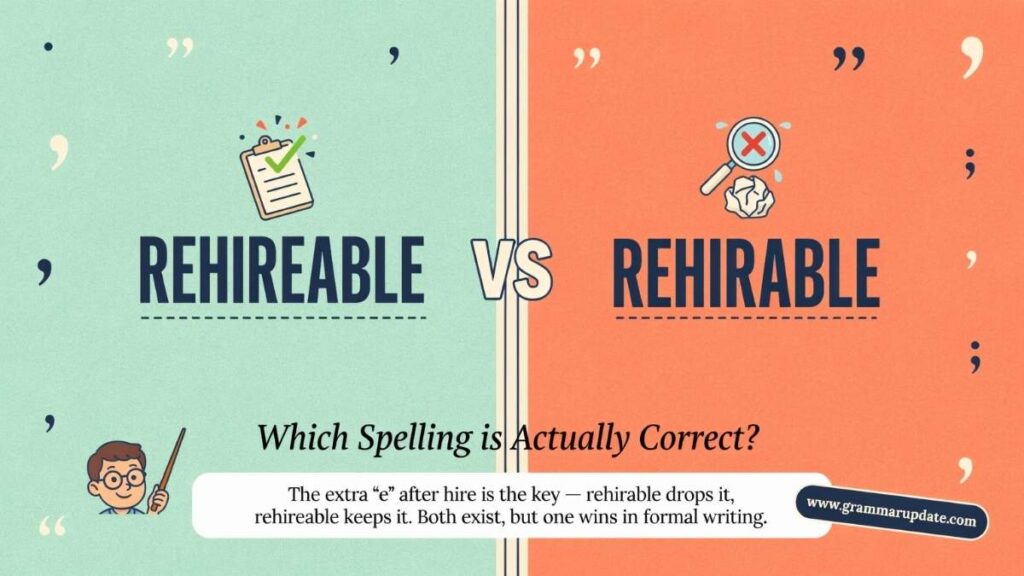
The simplest answer is that rehirable is the preferred concise form, while rehireable is an alternative spelling that readers can understand.
However, neither form should be confused with rehired. These words don’t describe the same situation.
| Word or phrase | Meaning | Example |
|---|---|---|
| Rehire | To hire someone again | The company may rehire him. |
| Rehired | Already hired again | She was rehired last year. |
| Rehiring | The act of hiring again | The company started rehiring workers. |
| Rehirable | Able or potentially eligible to be hired again | He is rehirable. |
| Rehireable | Alternative form intended to express the same idea | He is rehireable. |
| Eligible for rehire | Meets the employer’s criteria for possible future employment | She is eligible for rehire. |
If you need one practical rule, use rehirable as the concise adjective. When you’re writing an HR policy, employment record, or formal business document, eligible for rehire often provides better clarity.
Learn the difference between tricky grammar more words
Cancell vs Cancel Which One Is Correct?
What Does Rehirable Mean?
The rehirable meaning is simple: someone can potentially be hired again.
The word usually describes a former employee’s eligibility or suitability for future employment with the same organization.
For example:
- The former employee is rehirable.
- HR confirmed that Maria is rehirable.
- Employees who leave in good standing may remain rehirable.
- The manager considers the former worker rehirable.
The word describes a possibility. It does not guarantee a future job.
Suppose an employee leaves a company on good terms. Two years later, a suitable position becomes available. The company may consider that former employee for the role. In that situation, the person could be described as rehirable.
However, being rehirable doesn’t mean the company has promised to hire the person again.
The employer may still consider:
- available positions
- current qualifications
- interview performance
- experience
- company needs
- previous employment records
- current hiring requirements
That distinction matters. Rehirable describes eligibility or possibility. Rehired describes an actual employment decision.
What Does Rehireable Mean?
The rehireable meaning is essentially the same as rehirable. It describes someone who can potentially be hired again.
The spelling looks natural because writers often build the word directly from rehire:
rehire + able = rehireable
That construction makes sense. Readers can understand it immediately.
However, rehirable offers a cleaner spelling because it follows the established form hirable more closely.
This explains why writers encounter both forms in workplace vocabulary. One form keeps the final e from rehire, while the other removes it before adding -able.
For everyday communication, readers will usually understand either form from context. For polished professional writing, consistency matters more. Rehirable provides the more streamlined option.
Learn the difference between tricky grammar more words
Favour vs Favor Which Spelling Is Correct?
Rehireable vs Rehirable Which Is Correct?
When comparing rehireable vs rehirable, rehirable is the better choice for a concise adjective in professional US English.
That doesn’t mean rehireable is meaningless or impossible. It appears in actual employment writing, HR discussions, and online workplace content.
The important point is that the two forms don’t have an established difference in meaning.
Some explanations try to assign separate meanings to them. For example, they may claim that one describes someone who can legally return while the other describes someone an employer wants to hire again.
That distinction isn’t a standard English grammar rule.
Both forms are generally intended to communicate the idea that someone can be hired again.
If precision matters, use eligible for rehire instead.
That phrase is especially useful in formal HR documents because it clearly describes an employment classification rather than relying on an uncommon adjective.
Learn the difference between tricky grammar more words
Invokes vs Evokes which one is correct?
Rehireable vs Rehirable Comparison
| Feature | Rehirable | Rehireable |
| Basic meaning | Able or potentially eligible to be hired again | Intended to mean the same thing |
| Base word | Rehire | Rehire |
| Spelling | Drops the final e before -able | Retains the final e |
| Professional readability | Clear and concise | Understandable but less streamlined |
| HR usage | Possible, but eligible for rehire is clearer | Possible, but eligible for rehire is clearer |
| Meaning difference | No established separate meaning | No established separate meaning |
| Best concise choice | Rehirable | Less preferred |
The practical takeaway is straightforward: don’t treat rehireable and rehirable as two completely different employment classifications.
The real question is which form gives your reader the clearest message.
Why Do People Confuse Rehireable and Rehirable?
The confusion comes from English word formation.
The base word is rehire. It combines the prefix re- with hire. The prefix re- generally expresses the idea of doing something again.
So:
- hire = employ someone
- rehire = employ someone again
When writers add -able, the spelling becomes less obvious.
The suffix -able often creates an adjective meaning capable of, suitable for, or possible to do something.
For example:
- read → readable
- understand → understandable
- accept → acceptable
- hire → hirable
- rehire → rehirable
The word hirable is especially useful here because it provides a direct comparison.
Hirable means capable of being hired. Rehirable extends that idea to someone who can be hired again.
The problem starts when writers mechanically attach -able to the entire spelling of rehire:
rehire + able = rehireable
It looks perfectly logical. That’s why the alternative continues to appear.
English spelling, however, doesn’t always follow a single mechanical formula. Some words retain a final e before a suffix while others drop it. Variant forms can also develop through common usage.
That’s why the safest approach isn’t to memorize a rigid rule. Instead, learn the preferred spelling and use clear alternatives when the context demands precision.
Rehire + -Able How Is Rehirable Formed?
To understand the spelling, break the word into its parts.
Re- means again.
Hire means to employ someone.
-able creates an adjective that expresses possibility, capability, or suitability.
Together, rehireable vs rehirable describes something that can be hired again.
Consider these related forms:
- hire
- hirable
- rehire
- rehirable
The pattern becomes easier to see when you compare hire with rehire.
Hirable means capable of being hired.
Rehirable means capable of being hired again.
That makes rehirable a natural extension of the established word hirable.
The spelling also explains why many writers prefer rehirable. The final e in rehire doesn’t remain before the suffix.
Still, English spelling contains plenty of exceptions and variants. That’s why rehireable remains understandable and appears in actual usage.
Is Rehireable a Word?
If you’re asking is rehireable a word, the practical answer requires a little nuance.
Rehireable is an understandable English formation that appears in real-world employment writing. People use it to describe former employees who may be hired again.
However, a word can appear in real-world writing without being the preferred dictionary form.
That’s an important distinction.
English contains many derived words, informal formations, technical terms, and workplace expressions that don’t always receive separate dictionary entries. A dictionary also doesn’t determine every question of style or clarity.
So, is rehireable a valid word?
It can function as an adjective and readers understand its intended meaning. However, rehirable is the cleaner choice when you want a concise professional adjective.
For formal HR communication, eligible for rehire is usually even better.
Is Rehirable a Word?
The question is rehirable the correct spelling has a straightforward practical answer.
Yes. Rehirable works as an adjective meaning capable of or eligible to be hired again.
It follows the same basic formation as hirable.
For example:
The former employee is rehirable.
This sentence tells the reader that the person may be considered for employment again.
In formal communication, however, you may want to replace the adjective with a clearer phrase:
The former employee is eligible for rehire.
The second sentence leaves less room for interpretation. That’s particularly useful when you’re discussing employment records, HR policies, or official company procedures.
Rehirable Definition in Plain English
The simplest rehirable definition is:
Rehirable means capable of or eligible to be hired again.
The word can describe a former employee who remains eligible for future employment with a company.
It does not automatically mean:
- the employee will definitely be hired again
- the employee has a right to another job
- the employee will return to the same position
- the employee will receive the same salary
- the employee will bypass the normal hiring process
- the company must offer employment
Those details depend on the employer’s policy.
Think of rehirable as an open door rather than a guaranteed invitation.
The person may be allowed to walk through the door again, but the company still decides whether and when to open it.
Learn the difference between tricky grammar more words
Drily vs Dryly Which One Is Correct?
Rehireable vs Rehirable Examples
The best rehireable vs rehirable examples show how the word works in real sentences.
Workplace Examples
- The former employee is rehirable under the company’s current policy.
- HR confirmed that the employee remains rehirable.
- The manager considers the former worker rehirable.
- Employees who leave in good standing may remain rehirable.
- The company considers qualified former employees rehirable.
Formal HR Examples
- The employee is eligible for rehire.
- HR confirmed the employee’s rehire eligibility.
- The former employee may apply for future positions.
- The employee’s rehire status remains active.
- The company reviews rehire eligibility before considering a former employee for a new position.
Examples With Rehired
- The company rehired three former employees.
- Maria was rehired after two years.
- The organization rehired several experienced workers.
- He was rehired for a different position.
Notice the difference.
Rehirable describes possible future employment.
Rehired describes employment that actually happened.
Rehireable vs Rehirable Grammar
The rehireable vs rehirable grammar question is mostly a matter of word formation and usage.
Both forms function as adjectives when they appear before a noun or after a linking verb.
Examples include:
- a rehirable employee
- a rehireable employee
- the employee is rehirable
- the employee is rehireable
The bigger concern isn’t whether readers can understand the grammar. They can.
The concern is which spelling sounds more polished and familiar.
For most professional contexts, rehirable is the cleaner choice.
If the sentence appears in an official HR document, eligible for rehire may be even better because it makes the employment status explicit.
Learn the difference between often confused words
Weighed vs Weighted Which One Is Correct?
Rehireable vs Rehirable in HR and Workplace Writing
Human resources departments often use specific categories to describe former employees.
A company’s rehire policy may determine whether someone is:
- eligible for rehire
- ineligible for rehire
- eligible under certain conditions
- subject to additional review
- required to complete a new application
This makes rehire status more than a vocabulary question.
It can become an internal employment classification.
For example, a company may record that an employee left voluntarily and remained eligible for future employment. Another employee may receive an ineligible status because of a serious policy violation.
The exact rules vary from one organization to another.
That’s why employees shouldn’t assume that every company defines rehire eligibility in the same way.
What Can Affect Rehire Eligibility?
Companies may consider factors such as:
- reason for leaving
- performance history
- disciplinary record
- conduct
- attendance
- resignation procedures
- notice period
- whether the employee left in good standing
- whether company property was returned
- previous employment records
- current company policy
- applicable hiring requirements
A company might also distinguish between a voluntary resignation and termination.
For example, an employee who resigns properly may remain eligible for rehire. Someone terminated for serious misconduct may become ineligible.
The exact result depends on the organization’s employee rehire policy.
What Does Eligible for Rehire Mean?
The phrase eligible for rehire usually means that the former employee hasn’t been disqualified from future employment with the organization.
It doesn’t mean the company must hire that person again.
An eligible former employee may still need to:
- apply for an open position
- meet current qualifications
- complete an interview
- pass required screening
- compete with other applicants
- satisfy current employment requirements
So when someone asks what does eligible for rehire mean, the clearest answer is:
It means the company considers the former employee eligible to be considered for future employment under its policies.
The phrase describes eligibility, not a guaranteed job.
What Does Not Eligible for Rehire Mean?
Not eligible for rehire generally means the employer’s records or policy prevent the former employee from returning under the current rules.
The reason may vary.
A company might use this status after:
- serious misconduct
- major policy violations
- certain types of termination
- failure to follow separation procedures
- other circumstances defined by company policy
However, there isn’t one universal definition that every employer must use.
Some companies may have review procedures or waiting periods. Others may treat certain situations differently.
If you’re trying to understand your own status, ask the employer directly rather than assuming what the label means.
How Do Companies Determine Rehire Eligibility?
There is no single rehire eligibility rule that applies to every company.
Employers typically create their own rehire policy based on organizational needs and applicable employment requirements.
A typical process may look like this:
- The employee leaves the company.
- HR records the employee separation.
- The company reviews the reason for separation.
- HR records an appropriate employment status.
- The former employee later applies for another position.
- HR checks the person’s previous employment record.
- The hiring team evaluates the candidate under the current hiring process.
This process can vary significantly.
A large organization may have an automated HR system that displays rehire status. A small business may handle the process manually through HR records and management review.
Either way, the goal is usually the same: determine whether the former employee can be considered for future employment.
Learn the difference between often confused words
Insue vs Ensue Which One Is Correct?
Case Study A Former Employee Who Left in Good Standing
Consider a fictional employee named Daniel.
Daniel worked for a company for five years. He accepted another opportunity and resigned properly. He gave notice, completed his assigned work, returned company property, and left on good terms.
Two years later, the company creates a position that closely matches Daniel’s experience.
If the company’s rehire policy allows former employees who leave in good standing to return, Daniel may have eligible rehire status.
However, that doesn’t mean he automatically receives the position.
He may still need to submit an application, participate in interviews, and meet the current requirements for the role.
This example shows why rehire eligibility and rehiring aren’t the same thing.
Case Study A Former Employee Who Was Terminated
Now consider another employee who was terminated for a serious workplace violation.
The company may classify the employee as ineligible for rehire.
If that status remains active, the person may not qualify for future employment with the company.
Again, the specific outcome depends on the employer’s policy.
The lesson is important: rehire eligibility usually depends on the circumstances surrounding employee separation, not simply on the fact that someone previously worked for the company.
How Can I Check My Rehire Status?
If you’re wondering how can I check my rehire status, the best source is your former employer.
You can check:
- separation documents
- HR correspondence
- employee portals
- former employee portals
- employment records
- company policies
- written termination documents
- resignation paperwork
You can also contact the former HR department.
A professional question might look like this:
“Could you confirm whether my employment record lists me as eligible for rehire?”
That wording is clear and direct.
If the company doesn’t disclose internal classifications, HR may still explain whether you can apply for future positions.
Can a Former Employee Be Rehired?
Yes. A former employee can be rehired when the employer allows it and the person meets the current requirements.
Companies rehire former workers for many legitimate reasons.
A former employee may already understand:
- the company’s systems
- internal processes
- workplace culture
- products or services
- customers
- industry requirements
That experience can make returning employees attractive candidates.
Still, rehiring isn’t automatic.
The company may need to evaluate the person’s current qualifications and determine whether the available position matches their skills.
Learn the difference between often confused words
Chief vs Chef difference and Which One Is Correct?
Can an Employee Be Rehired After Termination?
The answer depends on the employer’s policy and the reason for termination.
Some former employees may become eligible for future employment after a period of time. Others may remain permanently ineligible under company rules.
The important distinction is between termination as a general employment event and the specific reason for termination.
For example:
- Layoff may be treated differently from misconduct.
- Poor performance may be treated differently from serious policy violations.
- A voluntary resignation may receive different treatment from termination.
Because company policies vary, there is no universal answer to whether a terminated employee can return.
Rehireable vs Rehirable Salary Does It Affect Pay?
The phrase rehireable vs rehirable salary can create another misunderstanding.
Neither rehirable nor rehireable describes a salary.
The words describe a person’s potential eligibility for future employment.
A returning employee’s salary may depend on:
- the new position
- location
- qualifications
- experience
- internal pay ranges
- market conditions
- company policy
- negotiation
- current compensation practices
A former employee could return at a higher salary, lower salary, or similar salary depending on the circumstances.
Previous employment doesn’t automatically determine future compensation.
So there is no standard “rehireable salary.”
Learn the difference between often confused words
Amateur vs Amatuer difference and Which one Is Correct?
Rehireable vs Rehirable California Is the Spelling Different?
The search phrase rehireable vs rehirable California may suggest that California uses a different spelling.
It doesn’t.
The spelling isn’t determined by California.
California employers may have their own employment policies and procedures that affect whether former employees can return. Those employment rules are separate from the spelling of the adjective.
If you’re writing for a California company, use the terminology required by that company’s HR system or policy.
For general US English, rehirable remains the cleaner concise adjective.
For official documentation, eligible for rehire is often clearer.
Rehire or Re Hire Which Is Correct?
The correct standard form is rehire.
Rehire functions as both a verb and a noun.
Examples:
- The company plans to rehire several workers.
- The manager wants to rehire a former employee.
- The company has a formal rehire policy.
- HR approved the rehire.
The two-word form re hire isn’t the standard spelling for the modern verb.
Related forms include:
- rehire
- rehired
- rehiring
- rehirable
Once you understand the base word, the related forms become much easier to recognize.
Is Rehirable Used in HR Documents?
Yes, rehirable can appear in HR documents and workplace writing.
However, formal HR language often benefits from greater precision.
Compare these sentences:
The employee is rehirable.
The employee is eligible for rehire.
The second version gives the reader a more explicit description of the employment status.
That makes it particularly useful for:
- HR documents
- employment records
- employee policies
- job application terminology
- internal workforce management
- employment verification
- employee separation records
If the audience includes people outside HR, the longer phrase may also be easier to understand.
Can You Use Rehirable in a Resume?
You can use rehirable if the context specifically requires it, but it usually isn’t necessary on a resume.
A resume should focus on your:
- experience
- skills
- accomplishments
- education
- certifications
- professional results
If an application asks whether you are eligible for rehire by a former employer, answer that question directly.
For example:
Eligible for rehire: Yes
That is clearer than:
Rehirable: Yes
The phrase eligible for rehire also matches common job application terminology and sounds more professional.
Learn the difference between often confused words
Agast vs Aghast difference and Which one Is Correct?
Rehirable for Resumes and Professional Writing
For resumes, cover letters, applications, and professional communication, clarity should come first.
If you’re describing your former employment status, use a phrase that readers can understand immediately.
Good choices include:
- eligible for rehire
- eligible for future employment
- eligible to be rehired
- available for future employment
- eligible for reemployment
However, don’t add this information unless the application or employer requests it.
A resume isn’t a storage box for every fact about your employment history. Include information that supports the application.
Better Rehireable Synonyms
If you’re searching for a rehireable synonym, choose one that matches the exact meaning.
| Alternative | Best use |
| Eligible for rehire | Formal HR status |
| Eligible to be rehired | Clear general wording |
| Eligible for future employment | Broader professional wording |
| Suitable for reemployment | Formal or administrative contexts |
| Considered for reemployment | When future evaluation is possible |
| Available for future employment | When emphasizing future opportunities |
The best alternative depends on what you actually mean.
If you mean the employee meets a company’s eligibility rules, use eligible for rehire.
If you simply mean the company could consider the person again, considered for reemployment may be more accurate.
Learn the difference between often confused words
Firey vs Fiery difference Which one Is Correct?
Common Mistakes With Rehireable and Rehirable
Mistake 1 Assuming the two spellings have different meanings
There is no standard grammar rule that gives rehireable and rehirable completely different meanings.
Both forms generally express the idea of being able or eligible to be hired again.
Mistake 2 Using rehired when you mean eligible
Rehired means the person has already been hired again.
Rehirable means the person may be hired again.
Don’t swap them.
Mistake 3 Assuming rehire eligibility guarantees a job
It doesn’t.
Eligibility means the person can be considered under the company’s rules.
Mistake 4 Writing re-hireable
The standard forms are rehirable and rehireable.
The unnecessary hyphen makes the word look awkward and can distract from an otherwise professional document.
Mistake 5 Assuming every employer follows the same rules
Companies create their own rehire guidelines.
One employer may welcome former employees who left voluntarily. Another may have stricter requirements.
Mistake 6 Using a complicated adjective when a clearer phrase exists
Sometimes eligible for rehire simply works better.
Clear writing doesn’t win points for making a sentence harder to read.
Rehireable vs Rehirable in Professional Writing
Professional writing should favor clarity over novelty.
If you’re writing an internal HR note and the organization already uses the term rehirable, consistency may matter more than changing the terminology.
If you’re creating a new policy, employee guide, or public-facing document, eligible for rehire is usually easier for a broad audience to understand.
Consider these examples:
Less direct:
“The former employee is rehirable.”
More direct:
“The former employee is eligible for rehire.”
Even more specific:
“The former employee may apply for future positions under the company’s rehire policy.”
The best choice depends on the purpose of the document.
Rehire Status vs Employment Status
Rehire status is a specific part of an employee’s employment history.
It generally answers a question like:
Can this former employee be considered for employment again?
Employment status is broader. It can describe whether someone is:
- currently employed
- on leave
- separated
- terminated
- retired
- a contractor
- a former employee
Don’t treat rehire status and employment status as interchangeable terms.
A person can be a former employee while also having an eligible rehire status.
Rehire Eligibility Meaning in Simple Terms
The rehire eligibility meaning becomes easier to understand when you separate two ideas:
First, the person previously worked for the company.
Second, the company has determined whether that person can be considered again.
That’s rehire eligibility.
1.It doesn’t guarantee a position.
2.It doesn’t guarantee a particular salary.
3.It doesn’t guarantee an interview.
4.It simply determines whether the former employee remains eligible under the organization’s rules.
How to Know If You Are Rehirable
If you’re wondering how to know if you are rehirable, don’t rely on assumptions.
Check:
- Your separation documents.
- Your former employer’s rehire policy.
- Any HR correspondence you received.
- Your former employee portal.
- Your employment records.
- The company’s HR department.
If you’re applying again, you can ask:
“Am I eligible for rehire under your current policy?”
That question gets straight to the point.
How to Become Eligible for Rehire
There isn’t one universal method for becoming eligible for rehire.
If your employer allows former employees to regain eligibility after a waiting period or review, follow the organization’s process.
You may need to:
- wait for the required period
- contact HR
- request a review
- provide updated information
- apply through the normal hiring process
- meet current job requirements
If the company has a permanent ineligible status for certain circumstances, there may not be a path back.
The policy determines the answer.
Learn the difference between often confused words
Dammit vs Damn It Which One Is Correct?
How to Choose the Right Form Every Time
When you’re unsure about rehirable spelling, use this simple guide.
1.If you mean “hire someone again,” use rehire.
2.If you mean “already hired again,” use rehired.
3.If you mean “the process of hiring again,” use rehiring.
4.If you mean “can potentially be hired again,” use rehirable.
5.If you’re writing a formal HR document and want maximum clarity, use eligible for rehire.
That covers almost every situation.
Learn the difference between often confused words
Achieve vs Achive Difference Which Spelling Is Correct?
Practice Session Rehireable vs Rehirable
Fill in each blank with the most appropriate word or phrase.
- The former employee is ______ under company policy.
- The company may ______ several former workers.
- Maria was ______ after the position reopened.
- HR confirmed his ______ status.
- The company is considering ______ former employees.
- Employees who leave in good standing may remain ______.
- The applicant is ______ for future employment.
- The manager asked whether the former worker was ______.
- The company has a formal ______ policy.
- He was ______ two years after leaving.
- HR handles the employee’s ______ status.
- The former worker remains ______ under the current policy.
- The company decided to ______ experienced employees.
- She is ______ but still needs to apply for the new position.
- The employee’s ______ status depends on the reason for separation.
- The organization has formal ______ guidelines.
- He left voluntarily and remained ______.
- The company began ______ former workers.
- She is not ______ under the current policy.
- The former employee asked HR about ______ eligibility.
- The company may ______ him for a different role.
- The employee was classified as ______ after a review.
- HR confirmed that she was ______ for future positions.
- The manager documented the employee’s ______ status.
- The company has separate rules for former employees who are eligible and ______ for rehire.
Answers
- Rehirable
- Rehire
- Rehired
- Rehire
- Rehiring
- Rehirable
- Eligible for rehire
- Rehirable
- Rehire
- Rehired
- Rehire
- Rehirable
- Rehire
- Eligible for rehire
- Rehire
- Rehire
- Rehirable
- Rehiring
- Eligible for rehire
- Rehire
- Rehire
- Eligible for rehire
- Eligible for rehire
- Rehire
- Ineligible
Here’s a trusted source for clear word meanings:
FAQs
Is “rehirable” a word?
Yes. Rehirable is an English adjective that means someone can potentially be hired again. In workplace and HR contexts, it usually describes a former employee who remains eligible for future employment.
How do you spell “rehireable”?
The spelling is rehireable: R-E-H-I-R-E-A-B-L-E. However, rehirable is the cleaner and more concise spelling for an adjective meaning capable of being hired again.
Is it rehirable or rehireable?
Rehirable is generally the preferred form when you need a concise adjective. Rehireable also appears in workplace writing and has the same intended meaning. In formal HR documents, eligible for rehire often provides the clearest wording.
What makes someone not eligible for rehire?
An employer may classify a former employee as ineligible for rehire because of serious misconduct, certain policy violations, poor separation practices, or other reasons outlined in its rehire policy. The specific criteria vary from one company to another.
Can you get off a do-not-rehire list?
Sometimes. It depends on the employer’s policy. Some companies allow former employees to request a review after a certain period or under specific circumstances. Others may keep a no-rehire designation in place indefinitely.
Who decides if you’re eligible for rehire?
The employer determines rehire eligibility according to its policies. HR typically reviews employment records and separation details, while managers or other authorized staff may provide additional input.
What is another word for “rehire”?
Depending on the context, you can use reemploy, employ again, hire again, or bring back. Reemploy works particularly well in formal or administrative writing.
Is it “rehired” or “re-hired”?
Rehired is the standard spelling in US English. For example, “The company rehired three former employees.” The hyphenated form re-hired is generally unnecessary.
How can you become rehirable?
There isn’t one universal process. Your status depends on your former employer’s policies and the circumstances of your departure. If the company allows rehire-status reviews, you can contact HR and ask whether your status can be reconsidered.
Can a company say you are not rehireable?
Yes. A company can classify a former employee as not eligible for rehire when its policies support that decision. The terminology may vary, but employers commonly maintain rehire classifications in their employment records.
Can a company rehire you after firing you?
Yes. A company can rehire a former employee after termination if its policies allow it and the person meets the requirements for an available position. The reason for termination can play an important role in that decision.
How can I check if I’m eligible for rehire?
Contact your former employer’s HR department and ask whether your employment record lists you as eligible for rehire. You can also review separation paperwork, employee records, or information provided through a former employee portal.
Can a no-rehire status be changed?
It can be changed in some organizations. The possibility depends on company policy, the reason for the original designation, and whether the employer provides a review or appeal process.
Do companies like to rehire former employees?
Many companies see benefits in rehiring former employees because they may already understand the organization’s systems, procedures, customers, and workplace culture. However, every employer makes its own hiring decisions based on current business needs.
Do background checks show rehire eligibility?
Not usually. A standard background check may verify employment history or other information, but an employer’s internal rehire status doesn’t automatically appear as a separate background-check result.
Is “rehire” a Scrabble word?
Whether rehire is accepted depends on the official word list used by the particular Scrabble edition or game. Different word lists can have different accepted terms, so the applicable dictionary provides the final answer.
Can I be rehired if I quit without notice?
Possibly. Quitting without notice may affect your rehire status, but it doesn’t produce the same result at every company. The employer’s separation and rehire policies determine whether you remain eligible.
What are the three C’s of hiring?
A common hiring framework uses competence, character, and culture fit. However, the meaning of the three C’s can vary depending on the employer or hiring framework.
How long is it respectable to stay at a job?
There’s no universal minimum or maximum. Career goals, industry standards, job growth, compensation, and your reason for leaving all matter. What you accomplished during your time at a company often matters more than a specific number of months or years.
What are signs you’re not valued at work?
Consistently being overlooked for meaningful opportunities, receiving little useful feedback, having your contributions ignored, or seeing no reasonable path for growth can indicate that an employer doesn’t value your work. Look for ongoing patterns rather than one isolated event.
How do I know if I’m eligible for rehire?
The most reliable way is to ask your former employer. You can say, “Could you confirm whether my employment record lists me as eligible for rehire?” This gives HR a clear question to answer.
How do I get off an ineligible-for-rehire status?
Start by asking HR whether the company allows former employees to request a rehire-status review. If a formal process exists, follow the required steps and provide any relevant information the company requests.
Is it “re-hire” or “rehire”?
Rehire is the standard closed spelling in US English. The prefix re- combines with hire to create the verb rehire.
What is a more formal word for “restore”?
Depending on the context, you can use reinstate, renew, revive, rehabilitate, recover, or reestablish. Reinstate works especially well when you mean returning someone or something to a previous status.
What is another word for “recreatable”?
Depending on the context, alternatives include reproducible, repeatable, replicable, or recoverable. Replicable works well when something can be recreated using the same method or process.
What does “rehireable” mean?
Rehireable means capable of being hired again. It generally describes a former employee whom a company may consider for future employment.
What’s a more formal word for “repair”?
Possible alternatives include restore, mend, refurbish, rehabilitate, rectify, and reconstruct. Restore works well when you want to emphasize returning something to its previous condition.
What is another word for “terminated from a job”?
Depending on the circumstances, you can use dismissed, discharged, released, separated, or let go. In formal HR writing, employment separation may provide a neutral alternative.
What is a synonym for “reapplying”?
Useful alternatives include applying again, submitting another application, seeking reemployment, or applying for another position. Reapplying remains the simplest and most natural choice in most situations.
What is another way to say “returning to work”?
You can say resuming work, returning to employment, reentering the workforce, or returning to the workplace. Reemployment works well in formal contexts when someone returns to paid employment.
What is another word for job abandonment?
Depending on the employer’s terminology, job abandonment may be described as unauthorized absence, failure to report to work, or voluntary separation following an unreported absence. The exact wording depends on company policy.
How do I spell “rehireable”?
Rehireable is spelled R-E-H-I-R-E-A-B-L-E. Rehirable is another form and is generally the more concise choice.
Is it possible to be rehired?
Yes. Companies can rehire former employees when their policies allow it and the former employee meets the requirements for the available role.
How do you find out if you are rehirable?
Contact your former employer’s HR department and ask about your rehire status. If the company provides separation documents or access to a former employee portal, those resources may also contain relevant information.
How long does a no-rehire status last?
There is no universal duration. Some companies set a specific period, while others may maintain a no-rehire status indefinitely. The employer’s policy determines how long the designation remains in effect.
Who is not eligible for rehire?
A former employee may become ineligible when the circumstances of their separation fall under an employer’s no-rehire rules. Serious misconduct, certain policy violations, or specific termination circumstances may affect eligibility.
Is non-rehireable forever?
Not necessarily. Some employers allow rehire status to be reviewed or changed, while others may treat certain no-rehire decisions as permanent. The company’s policy determines whether reconsideration is possible.
How long after termination can a company rehire you?
There is no universal waiting period. A company may allow a former employee to apply soon after termination, require a waiting period, or prevent future reemployment altogether. The employer’s rehire policy controls the process.
Does a termination show up on a background check?
Not necessarily. A background check may verify employment dates or other information, but termination itself doesn’t automatically appear as a separate entry on every background check. What a former employer reports can also vary.
What should you not say when being fired?
Avoid threats, insults, accusations, or sharing confidential company information. Keep the conversation professional. Ask practical questions about your final pay, benefits, employment documents, and rehire status if those details matter to you.
Can HR reverse a termination?
Sometimes, depending on the company’s procedures and the circumstances. HR may review an employment decision or correct an error, but it doesn’t necessarily have sole authority to reverse every termination.
How do I get off a no-rehire list?
Ask your former employer whether it offers a review, appeal, or reconsideration process. If one exists, follow the company’s procedure and provide a professional explanation or supporting information when appropriate.
How long does a termination stay on your record?
There isn’t one universal time period. Employers maintain employment records according to their own recordkeeping practices and applicable requirements. A termination may remain part of an organization’s internal employment history for an extended period.
Conclusion
Rehirable vs rehireable? It’s an easy spelling mix-up, especially when both forms look perfectly reasonable. But the answer is simple: rehirable is the cleaner choice for describing someone who can be hired again. Rehireable is also used, but it’s less streamlined.
For professional HR writing, eligible for rehire is often even clearer because it leaves little room for confusion.
Just remember: rehire means to hire someone again, rehired means someone has already been hired again, and rehirable means someone can potentially be hired again. Once you know this simple difference, the spelling mystery is over. No HR detective required.

Jhon AJS, the creative mind behind Grammar Update, is an experienced blogger passionate about simplifying English grammar. He focuses on explaining confusing word vs word differences, grammar rules, punctuation, and sentence structure in a clear and practical way. Through easy to understand guides and examples, Jhon helps readers improve their writing and communicate with confidence. With years of blogging experience, he continues to share helpful insights that make learning grammar simple, useful, and accessible for everyone.