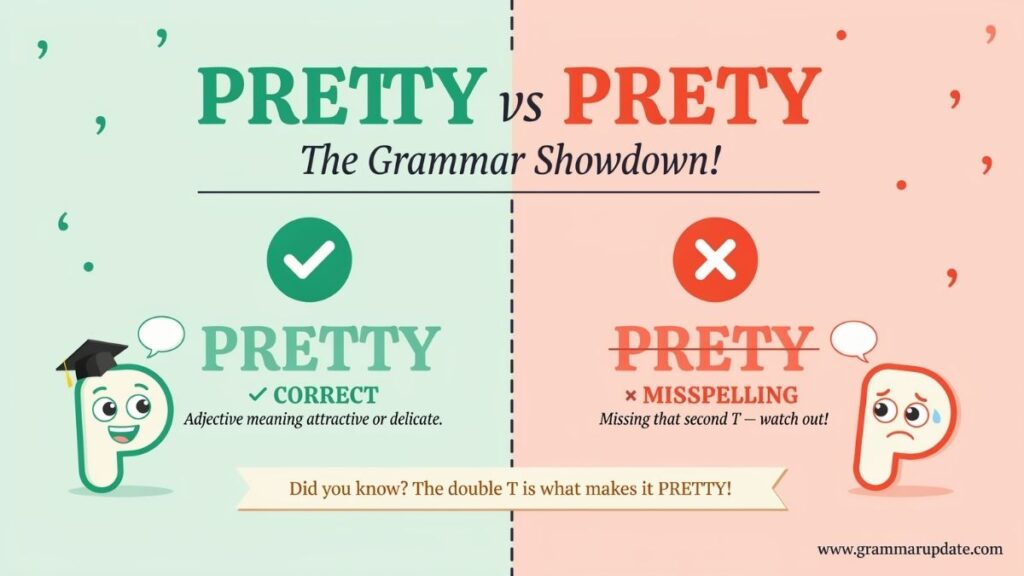
Ever typed prety, hit send, and instantly wished you could grab that missing “t” before anyone noticed? You’re not alone. The confusion between pretty vs prety catches thousands of writers because both spellings sound exactly the same, yet only one is correct. The good news is that the rule is surprisingly simple. Once you understand why pretty always has two t’s, you’ll never second-guess yourself again. In this guide, you’ll learn the correct spelling, the meaning of pretty, how to use it as both an adjective and an adverb, common mistakes to avoid, and practical examples that make the rule easy to remember.
Pretty vs Prety Quick Answer
If you’re wondering, pretty vs prety which is correct?” the answer is simple.
Pretty is the only correct spelling in standard English.
Prety is a misspelling. It does not appear as a standard English word in reputable dictionaries and should never be used in formal or informal writing unless you’re intentionally showing a spelling mistake.
Here’s the simple rule:
| Word | Correct? | Dictionary Word? | Use It? |
|---|---|---|---|
| Pretty | Yes | Yes | Always |
| Prety | No | No | Never |
If you ever ask yourself, “Is prety a word?” the answer is no. The correct spelling pretty always uses two t letters.
Learn the difference between commonly mixed-up more words
Absorption vs Absorbsion difference and Which Is Correct?
Pretty vs Prety at a Glance
The difference between these two spellings is surprisingly straightforward.
| Feature | Pretty | Prety |
|---|---|---|
| Correct spelling | Yes | No |
| Standard English | Yes | No |
| Found in dictionaries | Yes | No |
| Used in professional writing | Yes | No |
| Accepted in schools | Yes | No |
| Common spelling mistake | No | Yes |
Many people search for prety vs pretty because the words sound identical when spoken. The only difference is the spelling.
If you’re writing an email, school assignment, blog post, or social media update, always choose pretty.
Learn the difference between commonly mixed-up more words
Ether vs Either which is correct and Difference?
What Does Pretty Mean?
Understanding the pretty meaning makes it easier to remember how to use the word correctly.
The pretty definition depends on how the word functions in a sentence. It can describe appearance, or it can modify another adjective or adverb to mean “fairly” or “moderately.”
This flexibility makes pretty one of the most common words in everyday English.
Pretty as an Adjective
When pretty describes a noun, it works as a descriptive adjective.
In this sense, pretty means attractive, pleasing to look at, charming, or lovely.
Examples include:
- She wore a pretty dress to the party.
- They bought a pretty flower for the garden.
- The house looks pretty after the renovation.
- Everyone admired her pretty face.
- That’s a pretty painting.
The adjective pretty usually describes beauty that feels pleasant, delicate, or attractive rather than dramatic.
For example:
- A sunset can be beautiful.
- A small garden can be pretty.
- A child may have a pretty smile.
- A lake may have a beautiful view.
Although both pretty and beautiful describe attractiveness, beautiful often suggests greater admiration or elegance.
Pretty as an Adverb
Many learners don’t realize that pretty as an adverb has a completely different meaning.
Instead of describing beauty, it describes degree or intensity.
It means:
- fairly
- moderately
- quite
- rather
Examples include:
- I’m pretty sure we’ll arrive on time.
- The movie was pretty good.
- The test was pretty easy.
- She runs pretty fast.
- We’ve pretty much finished the project.
In each sentence, pretty acts as a degree adverb because it changes the strength of another word.
This is one reason the word appears so often in spoken English.
Learn the difference between commonly mixed-up more words
In-Person vs In Person What’s the Difference?
Is Prety a Real Word?
No.
The answer is simple and consistent across major English dictionaries.
Prety meaning does not exist because prety isn’t a recognized English word.
If you search for is prety a correct spelling, every reliable grammar source reaches the same conclusion:
Prety is simply a spelling mistake.
The confusion usually comes from dropping one of the two t’s while typing quickly.
Fortunately, modern spell checkers usually detect this error immediately.
Common examples include:
Incorrect:
- She is prety.
- That’s a prety flower.
- I’m prety sure.
Correct:
- She is pretty.
- That’s a pretty flower.
- I’m pretty sure.
Once you remember that pretty always has two t’s, this mistake becomes much easier to avoid.
Learn the difference between confusing word pairs
Take Effect vs Take Affect Which one Is Correct?
Why People Misspell Pretty as Prety
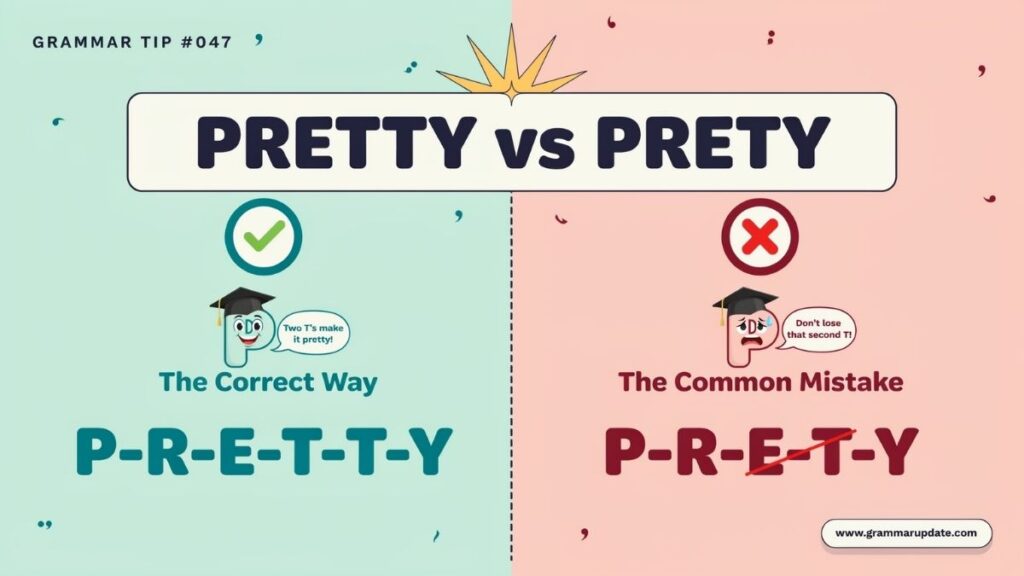
English spelling isn’t always predictable. That’s why even experienced writers occasionally make mistakes.
Several reasons explain why the prety spelling mistake happens so often.
Fast Typing
Most spelling errors happen because people type quickly.
While writing emails or text messages, it’s easy to skip one letter without noticing.
For example:
pretty → prety
This tiny mistake changes the word into an incorrect spelling.
Double Letters Are Easy to Forget
Many English words contain double letters.
Examples include:
- little
- better
- happy
- coffee
- address
- committee
Since double letters don’t always follow obvious rules, writers sometimes remove one by accident.
Pretty belongs to this group because it requires a double t.
Pronunciation Doesn’t Reveal the Spelling
Another reason for confusion is pretty pronunciation.
When spoken naturally, most native speakers don’t emphasize both t’s.
As a result, learners hear the word but don’t always recognize that it contains two t letters.
This explains why people frequently ask:
- Is pretty spelled with one t?
- Is pretty spelled with two t’s?
- Why is pretty spelled with two t’s?
The answer is simple.
English spelling often preserves historical word forms instead of matching modern pronunciation exactly.
Mobile Keyboard Errors
Smartphones have made typing faster, but they’ve also increased typing mistakes.
A missed keystroke can quickly turn:
- pretty into prety
- better into beter
- little into litle
Always proofread important messages before sending them.
English Learners
People learning English naturally focus first on pronunciation and vocabulary.
Spelling usually develops later.
That’s why searches like these are very common:
- how do you spell pretty
- how to spell pretty
- pretty spelling
- spelling of pretty
- correct spelling pretty
Fortunately, this particular spelling rule is easy to master once you know it.
Learn the difference between confusing word pairs
Waving vs Waiving Which is correct and Difference?
Pretty Meaning Explained
The pretty meaning in English changes depending on the context.
Let’s explore the most common uses.
Pretty Girl Meaning
The phrase pretty girl meaning refers to a girl or woman who is attractive or pleasant to look at.
It usually describes appearance in a friendly and positive way.
Examples:
- She is a pretty girl with a warm smile.
- Everyone complimented the pretty girl at the event.
Pretty girl definition focuses on physical attractiveness without necessarily implying extraordinary beauty.
Pretty Good Meaning
One of the most common adverb uses appears in the phrase pretty good.
Pretty good meaning is:
- fairly good
- quite good
- better than average
Examples:
- The pizza was pretty good.
- Your presentation was pretty good.
- He’s pretty good at math.
The phrase sounds natural in both spoken and written English.
Pretty Sure Meaning
Pretty sure meaning in English expresses confidence without claiming complete certainty.
Examples:
- I’m pretty sure the meeting starts at ten.
- She’s pretty sure she locked the door.
This phrase means you’re confident, although there may still be a small chance you’re mistaken.
Pretty Much Meaning
Pretty much meaning refers to “almost completely” or “essentially.”
Examples include:
- We’ve pretty much finished.
- That’s pretty much the whole story.
- The project is pretty much complete.
Native speakers use this expression constantly in casual conversation.
Pretty Well Meaning
Pretty well meaning usually means fairly well or reasonably well.
Examples:
- She speaks Spanish pretty well.
- Everything went pretty well.
- The team performed pretty well despite the weather.
Learn the difference between confusing word pairs
Performing vs Preforming difference and Which One Is Correct?
Pretty as an Adjective
One reason the word appears so often is its flexibility. As an adjective, pretty describes someone or something that is attractive, pleasing, or enjoyable to look at. It usually refers to gentle or delicate beauty rather than something breathtaking or dramatic.
The adjective pretty can describe people, places, objects, or even nature.
Examples of pretty as an adjective include:
- She bought a pretty dress for the wedding.
- The garden looks pretty after the rain.
- They stayed in a pretty little cottage.
- The child drew a pretty picture.
- We found a pretty beach during our vacation.
In each example, pretty describes a noun. That makes it a descriptive adjective.
When to Use Pretty as an Adjective
Use pretty when you want to describe something that is:
- Attractive
- Charming
- Pleasant
- Lovely
- Good-looking
- Pleasing to look at
It often suggests simple beauty rather than elegance or grandeur.
Compare these examples:
| Sentence | Meaning |
|---|---|
| She has a pretty smile. | Pleasant and attractive. |
| She has a beautiful smile. | More striking or exceptional. |
| They live in a pretty village. | Charming and inviting. |
| They visited a beautiful city. | Impressive and magnificent. |
Both words are correct, but they create slightly different impressions.
Pretty as an Adverb
Many learners are surprised to discover that pretty as an adverb has nothing to do with beauty.
Instead, it works as a degree adverb. It increases or softens the meaning of another adjective, adverb, or expression.
In this role, pretty means:
- Fairly
- Quite
- Moderately
- Rather
This is one of the most common uses in modern English.
Examples of pretty as an adverb include:
- The exam was pretty easy.
- She’s pretty busy today.
- They arrived pretty early.
- The soup tastes pretty good.
- I’m pretty sure that’s correct.
Notice that pretty no longer describes appearance. Instead, it tells you the degree of something.
This explains why phrases like pretty easy meaning, pretty fast meaning, pretty good meaning, and pretty sure meaning appear so often in everyday conversation.
How Pretty Changes Meaning
Compare these sentences:
- The movie was good.
- The movie was pretty good.
The second sentence suggests the movie was better than average, although perhaps not excellent.
Now compare another example:
- He’s sure.
- He’s pretty sure.
The second sentence leaves a little room for doubt while still expressing confidence.
That small difference makes the conversation sound more natural.
Learn the difference between confusing word pairs
Tomatoes vs Tomatos difference and Which Is Correct?
Is Pretty an Adjective or Adverb?
One of the most common grammar questions is:
“Is pretty an adjective or adverb?”
The answer is both.
Its role depends entirely on the sentence.
| Sentence | Part of Speech |
|---|---|
| That’s a pretty flower. | Adjective |
| The flower is pretty. | Adjective |
| The test was pretty easy. | Adverb |
| She sings pretty well. | Adverb |
| We’re pretty much finished. | Adverb |
A simple trick helps identify its role.
If pretty describes a noun, it’s an adjective.
If it modifies another adjective, adverb, or phrase, it’s an adverb.
Understanding this difference makes your grammar much stronger.
Pretty in Different Contexts
The pretty English word works naturally in many situations.
Knowing when to use it helps you sound more confident.
Everyday Conversations
Native speakers use pretty constantly in casual speech.
Examples include:
- That’s pretty cool.
- I’m pretty tired.
- She’s pretty funny.
- It was pretty exciting.
- We’re pretty close.
These expressions sound relaxed and natural.
Academic Writing
In formal writing, many style guides recommend using more precise words instead of pretty.
Instead of writing:
- The results were pretty good.
You could write:
- The results were satisfactory.
- The results were favorable.
- The results were significant.
Academic writing values precision over conversational language.
Professional Emails
Pretty is acceptable in workplace communication when the tone is friendly.
For example:
- The project is pretty much complete.
- The report looks pretty good.
- I’m pretty sure we can finish today.
For highly formal business documents, stronger wording often works better.
Creative Writing
Authors frequently use pretty to create vivid descriptions.
For example:
- A pretty flower swayed gently in the breeze.
- The old town looked pretty beneath the evening sky.
- She wore a pretty blue scarf that matched her eyes.
Because the word feels warm and familiar, it appears often in fiction.
Social Media
Social media favors conversational language, making pretty extremely common.
Examples include:
- That’s pretty amazing.
- This place is pretty beautiful.
- Today was pretty awesome.
- Life is pretty good.
These expressions sound friendly and authentic.
Learn the difference between confusing word pairs
Sergeant vs Sargent difference and Which Is Correct?
Pretty vs Beautiful vs Cute
Although these words all describe attractiveness, they are not identical.
| Word | Typical Meaning | Best Used For |
|---|---|---|
| Pretty | Attractive in a gentle or pleasant way | People, flowers, clothes, houses |
| Beautiful | Exceptionally attractive or inspiring | People, landscapes, art, nature |
| Cute | Attractive in an adorable or playful way | Children, pets, small objects |
Consider these examples.
A pretty flower looks pleasant.
A beautiful mountain creates awe.
A cute puppy makes people smile.
Choosing the right word helps your writing sound more precise.
Pretty Synonyms
If you repeat pretty too often, your writing becomes predictable.
Using suitable alternatives keeps your vocabulary fresh.
Pretty Synonyms for Appearance
Some excellent pretty synonyms include:
- Beautiful
- Lovely
- Attractive
- Charming
- Pleasing
- Elegant
- Graceful
- Delightful
- Good-looking
- Gorgeous
Each carries a slightly different meaning.
For example, gorgeous suggests stronger admiration than pretty.
Pretty Synonyms in English for Degree
When pretty functions as an adverb, these alternatives often work well:
- Fairly
- Quite
- Rather
- Moderately
- Somewhat
- Reasonably
- Relatively
Examples:
- The test was fairly easy.
- The meeting went quite well.
- She’s rather busy today.
- The weather is moderately warm.
These alternatives help reduce repetition while preserving meaning.
Beautiful Synonyms
When describing exceptional beauty, consider using:
- Stunning
- Gorgeous
- Magnificent
- Elegant
- Radiant
- Exquisite
Attractive Synonyms
If you want a more neutral description, try:
- Appealing
- Pleasant
- Good-looking
- Handsome
- Charming
- Alluring
Choosing the best synonym depends on the tone you want to create.
Pretty Pronunciation
Many spelling mistakes happen because pronunciation and spelling don’t always match perfectly.
The standard pretty pronunciation in English is:
/ˈprɪt.i/
It contains two syllables:
prit-ee
Although the written form includes two t letters, native speakers pronounce them smoothly. That’s one reason people sometimes wonder whether the spelling contains one t or two.
The answer never changes.
Pretty with two t’s is always correct.
Learn the difference between confusing word pairs
Focussed vs Focused Which Spelling Is Correct?
How to Spell Pretty Correctly
If you’ve ever asked:
- How do you spell pretty?
- How to spell pretty correctly?
- Is pretty spelled with one t?
Remember this simple pattern.
P + R + E + T + T + Y
Notice the double t.
A helpful memory trick is to connect pretty with another familiar word that also contains double letters, such as little or better.
The repeated letter becomes easier to remember through association.
Another useful habit is reading your writing before sending it. A quick review catches many spelling errors, including prety misspelling.
Why Is Pretty Spelled With Two T’s?
English spelling often reflects history instead of pronunciation.
The pretty two t spelling developed over centuries as the language evolved from earlier forms of English.
Although many words changed their pronunciation over time, their written forms remained relatively stable.
That’s why the correct spelling of pretty still includes two t letters today.
This isn’t unusual.
Many common English words preserve older spelling patterns even after pronunciation shifts.
Examples include:
- Better
- Little
- Matter
- Butter
- Written
Pretty belongs to this same group.
Pretty Word Origin
Learning the history behind a word often makes it easier to remember.
The pretty word origin goes back to Old English. Early forms of the word carried meanings closer to “clever,” “skillful,” or “tricky.”
Over hundreds of years, those meanings gradually shifted.
By Middle English, pretty began describing something neat, elegant, or attractive.
Eventually, modern English settled on today’s familiar meanings of attractive, pleasant, and fairly or moderately.
This fascinating evolution explains why one simple word now serves two different grammatical purposes.
Learn the difference between confusing word pairs
Aswell vs As Well Which is Correct and Difference?
Pretty Etymology and Meaning
The pretty etymology shows how language naturally changes over time.
Words rarely keep exactly the same meaning for centuries.
Pretty began with meanings related to cleverness.
Later, speakers associated it with refinement and attractiveness.
Eventually, it also became a degree adverb meaning fairly or moderately.
Today, both meanings are standard English.
This makes pretty one of the most versatile everyday words in the language.
Common Expressions with Pretty
Many of the most frequently spoken English expressions use pretty as an adverb.
Here are some of the most common examples.
| Expression | Meaning |
|---|---|
| Pretty good | Better than average |
| Pretty sure | Fairly confident |
| Pretty easy | Not difficult |
| Pretty fast | Fairly quickly |
| Pretty much | Almost completely |
| Pretty well | Quite well |
| Pretty busy | Fairly occupied |
| Pretty amazing | Quite impressive |
These phrases appear naturally in conversation because they soften statements while still expressing confidence.
Compare these examples:
- The assignment was pretty easy.
- She’s pretty sure the answer is correct.
- We finished pretty fast.
- Everything turned out pretty well.
- The food was pretty good.
Using these expressions correctly makes your English sound more fluent and natural.
Common Mistakes and How to Fix Them
Even experienced writers occasionally make spelling mistakes. Fortunately, the confusion between pretty vs prety is easy to fix once you understand the correct pattern.
The biggest mistake is dropping one of the two t letters.
Incorrect:
- She is prety.
- What a prety flower!
- I’m prety sure you’re right.
- That’s a prety dress.
Correct:
- She is pretty.
- What a pretty flower!
- I’m pretty sure you’re right.
- That’s a pretty dress.
If you remember that the correct spelling pretty always contains two t’s, you’ll avoid this mistake almost every time.
Common Grammar Mistakes with Pretty
Spelling isn’t the only area where people make mistakes. Grammar can also cause confusion.
Here are some examples.
| Incorrect | Correct | Why? |
|---|---|---|
| She is a beautifully girl. | She is a pretty girl. | Beautifully is an adverb, not an adjective. |
| The flower looks prettily. | The flower looks pretty. | Linking verbs take adjectives. |
| I’m pretty understand. | I understand pretty well. | Pretty should modify an adjective or adverb. |
| She pretty sings. | She sings pretty well. | Pretty needs another descriptive word. |
Learning these patterns improves both your spelling and your grammar.
Learn the difference between tricky grammar more words
Rancor vs Rancour Difference and Which Spelling Is Correct?
Case Study: One Missing Letter Can Change Everything
Imagine two students submitting the same essay.
Student A writes:
She has a pretty smile and a pretty dress.
Student B writes:
She has a prety smile and a prety dress.
Although the ideas are identical, the second version immediately looks less polished because of the repeated misspelling.
Teachers, employers, and readers often notice spelling errors before they evaluate the quality of the writing. A small mistake can distract from an otherwise excellent piece of work.
That’s why proofreading remains an essential part of good writing.
Learn the difference between tricky grammar more words
Seperate vs Separate Which Spelling Is Correct?
Real-Life Sentence Examples
Seeing words in context is one of the fastest ways to remember them.
Pretty as an Adjective Examples
These examples show the adjective pretty describing nouns.
- She wore a pretty dress to the party.
- We found a pretty flower beside the trail.
- The little village looked pretty at sunset.
- He bought his mother a pretty necklace.
- They decorated the room with pretty lights.
- Her handwriting is neat and pretty.
- That’s a pretty painting.
- The garden looks pretty after the rain.
- She has a pretty face.
- We visited a pretty beach last weekend.
Pretty as an Adverb Examples
These examples show the adverb pretty modifying another word.
- The exam was pretty easy.
- She’s pretty busy today.
- I’m pretty sure that’s correct.
- They finished pretty quickly.
- The children behaved pretty well.
- The restaurant was pretty good.
- The weather turned pretty cold.
- We arrived pretty early.
- He’s pretty fast at solving puzzles.
- We’ve pretty much completed the project.
These examples demonstrate why context determines whether pretty functions as an adjective or an adverb.
Learn the difference between tricky grammar more words
Gray vs Grey Which Spelling Is Correct and Difference?
Pretty in a Sentence Before and After Corrections
Sometimes the easiest way to learn is by comparing incorrect and correct sentences.
| Incorrect Sentence | Correct Sentence |
|---|---|
| She is prety. | She is pretty. |
| That’s a prety flower. | That’s a pretty flower. |
| I’m prety sure. | I’m pretty sure. |
| The movie was prety good. | The movie was pretty good. |
| We finished prety fast. | We finished pretty fast. |
Notice that every correction simply restores the missing t.
Quick Proofreading Tips
Before publishing or sending your writing, spend a minute checking these points.
- Look for the word prety.
- Replace every instance with pretty.
- Check words that contain double letters.
- Read each sentence aloud.
- Use your spelling checker as a final review rather than your only review.
These habits improve accuracy in every type of writing.
Word Formation
Understanding how words are formed can strengthen your spelling skills.
The word pretty belongs to a group of English words that contain doubled consonants.
Examples include:
- Better
- Little
- Written
- Butter
- Matter
These words follow established spelling patterns in modern English rather than simple pronunciation rules.
Because English developed over many centuries, many spellings preserve historical forms.
That’s why pretty with two t’s remains the accepted spelling today.
Learn the difference between tricky grammar more words
Propose vs Purpose Which Is Correct?
Practical Tips to Remember the Correct Spelling
Simple memory techniques often work better than memorizing rules.
Try these strategies.
Think of the Double T
Picture the word like this:
PRE + TT + Y
The double t sits in the middle.
Compare It with Familiar Words
Connect pretty to other common words with double letters.
- Better
- Little
- Butter
The spelling pattern becomes easier to remember.
Read More English
Reading books, articles, and newspapers helps you recognize correct spellings naturally.
The more often you see pretty, the less likely you’ll write prety.
Practice Writing It
Writing the word several times helps build muscle memory.
Practice using sentences such as:
- The garden is pretty.
- She’s pretty funny.
- The lesson was pretty easy.
- That’s a pretty picture.
- I’m pretty sure we’ll win.
Learn the difference between tricky grammar more words
Envolved vs Involved Which Is Correct?
Practice Session Pretty vs Prety
Fill in the blanks with the correct word: pretty vs prety.
- She wore a ______ dress to the wedding.
- I’m ______ sure we parked on this street.
- The garden looks ______ in the spring.
- Is “______” a correct English spelling?
- The movie was ______ good, so I’d watch it again.
- He gave his mom a ______ bouquet of flowers.
- That’s a common ______ spelling mistake.
- We finished the assignment ______ quickly.
- Her new puppy is really ______.
- The weather is ______ nice today.
- She has a ______ smile that brightens the room.
- I’m ______ sure the store closes at 9 p.m.
- The lake looked ______ at sunrise.
- The teacher corrected the word ______ to “pretty.”
- That was a ______ easy question.
- They decorated the room with ______ lights.
- This cake tastes ______ good.
- His handwriting is ______ neat.
- Don’t write ______ in your essay.
- The children were ______ excited about the trip.
- She bought a ______ blue scarf.
- We arrived ______ early for the meeting.
- The painting is ______ beautiful.
- Always remember the correct spelling is ______.
- The old village looked ______ after the snowfall.
Answers
- pretty
- pretty
- pretty
- prety
- pretty
- pretty
- prety
- pretty
- pretty
- pretty
- pretty
- pretty
- pretty
- prety
- pretty
- pretty
- pretty
- pretty
- prety
- pretty
- pretty
- pretty
- pretty
- pretty
- pretty
Here’s a trusted source for clear word meanings:
FAQs
Is it prety vs pretty?
Pretty is the correct spelling in standard English. Prety is a common misspelling and should not be used in writing.
What does “pretty prety” mean?
“Pretty prety” has no meaning because prety is not a real English word. If you meant “pretty,” it can describe something attractive or mean “fairly” when used as an adverb.
How do you spell prity?
The correct spelling is pretty. Spell it as P-R-E-T-T-Y with two t’s.
Why does “pretty” have two meanings?
Pretty functions as both an adjective and an adverb. As an adjective, it means attractive or pleasing. As an adverb, it means fairly or moderately.
Why is “pretty” spelled that way?
The spelling comes from the word’s historical development in Old English and Middle English. Although pronunciation has changed over time, the traditional spelling with two t’s has remained standard.
Why do we say “pretty much”?
Pretty much is an idiomatic expression that means almost, nearly, or essentially. Native English speakers use it to soften statements or summarize ideas.
Is “pretty pretty” grammatically correct?
Yes. Repeating pretty can be grammatically correct for emphasis. For example, “The dress is pretty, pretty expensive.” In casual speech, the repetition adds extra emphasis.
How do you say “pretty” in slang?
Common slang alternatives include cute, hot, fine, gorgeous, stunning, fire, and adorable. The best choice depends on the situation and tone.
Is it pretties or prettys?
The correct plural form is pretties. English nouns ending in a consonant plus y usually change y to ies in the plural.
What is the opposite of pretty?
Common opposites include unattractive, plain, ugly, homely, and unappealing. The most appropriate opposite depends on the context.
How do British people pronounce “pretty”?
British English typically pronounces pretty as /ˈprɪt.i/. The pronunciation is very similar to American English, though the accent differs slightly.
How do you say “pretty” in a cute way?
You can use affectionate alternatives such as adorable, lovely, charming, sweet, darling, or gorgeous, depending on the person and situation.
Why did someone call me pretty?
Calling someone pretty is generally a compliment about their appearance. Depending on the context, it may express admiration, friendliness, or romantic interest.
What is an old-fashioned word for “pretty”?
Traditional alternatives include comely, bonny, fair, winsome, and beauteous. These words appear more often in classic literature than in modern conversation.
Do Americans use the word “pretty”?
Yes. Americans use pretty every day. It commonly describes appearance and also acts as an adverb in phrases such as “pretty good” and “pretty sure.”
What did “pretty” mean in Old English?
The earliest forms of pretty were associated with meanings such as clever, skillful, or crafty. Over time, the word evolved to describe attractiveness and later developed its adverb meaning.
What are the three forms of pretty?
As an adjective, the forms are:
- Positive: pretty
- Comparative: prettier
- Superlative: prettiest
Is “pretty much” grammatically correct?
Yes. Pretty much is a grammatically correct and widely accepted expression in both spoken and informal written English.
Is “pretty” an outdated term?
No. Pretty remains one of the most commonly used English words for describing appearance and degree. It is widely used in modern English.
Is saying “pretty please” flirting?
Not usually. Pretty please is a playful way of making a polite request. Whether it sounds flirtatious depends on the relationship and tone of the conversation.
Where did the word “pretty” come from?
Pretty developed from Old English through Middle English. Its meaning gradually shifted from clever or skillful to attractive and eventually also came to mean fairly or moderately.
Which word is stronger, beautiful or pretty?
Beautiful is generally stronger than pretty. Beautiful suggests exceptional beauty, while pretty usually refers to gentle, pleasant, or charming attractiveness.
What can I say instead of “pretty much”?
Good alternatives include almost, nearly, practically, essentially, largely, mostly, virtually, and more or less.
What’s the difference between “pretty” and “pretty much”?
Pretty modifies adjectives or adverbs and means fairly or moderately. Pretty much means almost completely or essentially.
Which is correct: pretty vs prettiest?
Both are correct. Pretty is the base adjective, while prettiest is the superlative form used to describe the highest degree of beauty.
What are the two meanings of pretty?
Pretty has two primary meanings. It can describe someone or something as attractive, and it can also mean fairly or quite when used as an adverb.
Why is “pretty” used to mean “very”?
Originally, pretty meant moderately rather than very. Over time, everyday conversation strengthened its meaning in some contexts, although it still usually means fairly or quite instead of extremely.
What is Gen Z slang for pretty?
Popular Gen Z alternatives include fire, gorgeous, stunning, serving, slay, fine, and ate, though usage varies across social media and communities.
What can I say instead of “pretty”?
Depending on the context, you can use beautiful, lovely, attractive, charming, cute, gorgeous, elegant, stunning, or appealing.
Does the word “pretties” exist?
Yes. Pretties is the plural form of the noun pretty, although it is uncommon. It usually refers to attractive things, decorations, or ornaments.
What does prity mean?
Prity has no recognized meaning in standard English. It is simply another misspelling of pretty.
What is a word for not attractive?
Common words include unattractive, plain, homely, unappealing, and ordinary. The best choice depends on the context and desired tone.
How do Americans say “pretty”?
Americans typically pronounce pretty as /ˈprɪt̬i/. The t often sounds like a soft flap, making it sound similar to “priddy.”
How do you call someone pretty in a unique way?
Instead of saying pretty, you could say radiant, captivating, graceful, charming, elegant, breathtaking, or effortlessly beautiful, depending on the compliment you want to give.
What’s slang for pretty?
Informal alternatives include cute, fine, hot, gorgeous, stunning, fire, and easy on the eyes.
Can you say “pretty” to a guy?
Yes. Although pretty traditionally describes women or attractive objects, it can also describe men, especially in expressions like “a pretty face.” However, words such as handsome or good-looking are more common for men.
Conclusion
If you’ve ever hesitated between pretty vs prety, you can stop guessing now. The answer is simple: pretty is the only correct spelling, and it always has two t’s. Prety isn’t a real English word. It’s just a common spelling mistake that can easily slip into your writing if you’re typing too quickly.
Remember this simple rule: if you’re talking about a pretty girl, a pretty flower, or saying you’re pretty sure or pretty much finished, the spelling never changes. Whether pretty is used as an adjective to describe something attractive or as an adverb to mean “fairly” or “quite,” it always keeps its double t.
Think of those two t’s as teammates. If one disappears, the word loses its place in standard English. A quick proofread can catch this tiny mistake before anyone else does.
Now that you know the difference, you can write with confidence and leave the “prety” typo behind for good. After all, your writing deserves to look just as pretty as the words you choose.

Jhon AJS, the creative mind behind Grammar Update, is an experienced blogger passionate about simplifying English grammar. He focuses on explaining confusing word vs word differences, grammar rules, punctuation, and sentence structure in a clear and practical way. Through easy to understand guides and examples, Jhon helps readers improve their writing and communicate with confidence. With years of blogging experience, he continues to share helpful insights that make learning grammar simple, useful, and accessible for everyone.