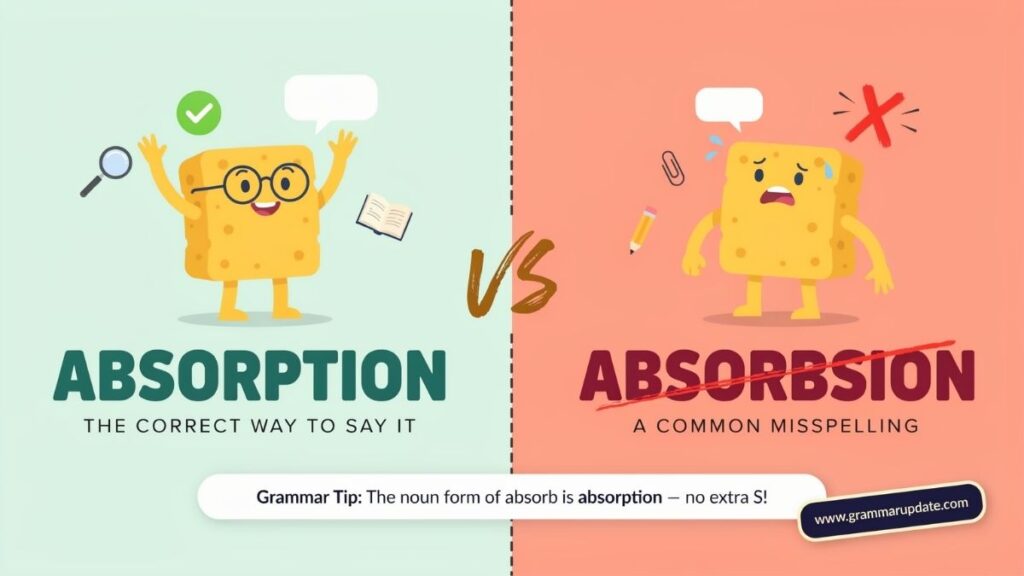
Have you ever typed “absorbsion” without a second thought, only for your spell checker to tell you otherwise? Don’t worry—you’re in good company. Because the words sound so similar, it’s easy to wonder which spelling is actually correct. That’s exactly why so many people search for “Absorption vs Absorbsion.” The good news is that the answer is simple once you know the rule. In this guide, you’ll learn the correct spelling, understand what absorption means, see how it differs from adsorption, and explore clear examples that make the difference easy to remember. By the end, you’ll use the right word with complete confidence.
Quick Answer Absorption vs Absorbsion
If you’re looking for the short answer, here it is.
| Word | Correct? | Meaning |
|---|---|---|
| Absorption | Yes | The process of taking in or soaking up a substance, energy, or information. |
| Absorbsion | No | A misspelling. It is not recognized in English dictionaries. |
Whenever you write about a sponge soaking up water, your body taking in nutrients, or a material capturing heat, the correct spelling is always “absorption.”
For example:
Correct:
- Water absorption helps plants survive during dry weather.
- The body’s absorption of nutrients is essential for good health.
- Scientists measured the absorption rate of the material.
Incorrect:
- Water absorbsion helps plants survive.
- Nutrient absorbsion occurs in the intestine.
Although “absorbsion” may look reasonable because it resembles the verb “absorb,” it isn’t a valid English word.
Learn the difference between confusing more English words
Aswell vs As Well Which is Correct and Difference?
Absorption vs Absorbsion Comparison Table
The easiest way to remember the difference is to compare them side by side.
| Feature | Absorption | Absorbsion |
|---|---|---|
| Correct spelling | Yes | No |
| Recognized in dictionaries | Yes | No |
| Used in academic writing | Yes | No |
| Used in scientific research | Yes | No |
| Accepted in US English | Yes | No |
| Accepted in British English | Yes | No |
Whether you’re writing in American English or British English, the spelling never changes.
Why People Misspell “Absorption” as “Absorbsion”
This spelling mistake happens for several understandable reasons. English has many words that don’t match their pronunciation perfectly. As a result, people often write words exactly as they hear them.
The Pronunciation Trap
When people say “absorption,” the sounds blend together quickly.
The combination of letters “pt” becomes soft during speech. Instead of hearing the “p” clearly, many people think they hear a “bs” sound. That leads them to type “absorbsion.”
This is a common spelling error caused by pronunciation rather than misunderstanding.
Similar Word Patterns in English
English includes many words ending in “-sion.”
For example:
- Decision
- Division
- Explosion
- Confusion
After seeing so many “-sion” words, it’s natural to assume that “absorbsion” follows the same pattern.
It doesn’t.
Instead, “absorption” belongs to another family of words ending in “-ption.”
Examples include:
- Reception
- Exception
- Description
- Consumption
- Eruption
Recognizing this pattern makes the correct spelling much easier to remember.
Why the Extra “B” Feels Natural
Another reason people write “absorbsion” is that the base verb is “absorb.”
Since the verb ends with “b,” writers sometimes believe the noun should keep that sound exactly.
English doesn’t always build nouns by simply adding a suffix. Instead, many words change slightly as they evolve from their original Latin forms.
That’s exactly what happened with “absorption.”
Learn the difference between confusing word pairs
Gray vs Grey Which Spelling Is Correct and Difference?
What Does “Absorption” Mean?
The absorption meaning is the process of taking something into another substance, object, or system.
Depending on the subject, the word can describe many different processes.
For example:
- A sponge absorbs water.
- Plants absorb moisture from the soil.
- The human intestine absorbs nutrients from food.
- Black clothing absorbs more sunlight than white clothing.
- Students become absorbed in an interesting book.
In every case, something moves into another material or system.
This idea remains the same whether you’re discussing everyday life, biology, medicine, or engineering.
Absorption Definition in Simple Words
A simple absorption definition is:
“The process in which a substance enters the entire volume of another material.”
Unlike adsorption, where a substance accumulates only on the surface, absorption means molecules penetrate the material itself.
This distinction becomes especially important in absorption chemistry and adsorption chemistry.
Absorption Meaning in English
In everyday English, absorption can also describe complete attention.
For example:
- Her absorption in the novel made her forget the time.
- His total absorption in the project impressed the entire team.
Here, the word doesn’t describe a physical process. Instead, it refers to deep concentration.
Why “Absorbsion” Is Incorrect
Many spelling mistakes follow logical patterns, but that doesn’t make them correct.
“Absorbsion” isn’t accepted in dictionaries, style guides, educational materials, or scientific publications.
Whether you’re writing an email, research paper, or school assignment, always choose “absorption.”
The Spelling Rule Behind Absorption
The noun comes from the verb “absorb,” but English changes the ending when forming the noun.
Instead of adding “-sion,” English uses the suffix “-ption.”
This pattern appears in many other words.
| Verb | Correct Noun |
|---|---|
| Consume | Consumption |
| Receive | Reception |
| Describe | Description |
| Absorb | Absorption |
Understanding these word families makes spelling much easier.
How the Word Is Formed
The word develops in two steps.
Base verb:
Absorb
Correct noun:
Absorption
Notice that English doesn’t create the noun by simply attaching “-sion.”
Instead, historical spelling patterns preserve the “-ption” ending.
That’s why “absorbsion” never became part of standard English.
Why English Keeps the “-ption” Pattern
Many English words came from Latin through French before becoming part of modern English.
During that journey, spellings were preserved even when pronunciation changed over time.
As a result, English still uses:
- Reception
- Consumption
- Description
- Absorption
Although some letters become nearly silent in speech, they remain part of the correct spelling.
Learn the difference between confusing word pairs
Propose vs Purpose Which Is Correct?
The Origin of the Word “Absorption”
Learning where a word comes from often makes it easier to remember.
The word “absorption” traces its roots to the Latin verb absorbere.
The original Latin word combines two parts:
- ab = away
- sorbere = to suck in or swallow
Together, they describe the act of drawing something inward.
Over centuries, the word entered French before becoming part of English.
Despite changes in pronunciation, the traditional spelling remained largely unchanged.
That’s why modern English still writes “absorption” instead of “absorbsion.”
Understanding this history explains why the spelling may look unusual but remains correct.
How to Pronounce Absorption Correctly
Although pronunciation varies slightly across regions, the spelling never changes.
American Pronunciation
Most American speakers pronounce it similarly to:
ab-SORP-shən
The “p” is subtle, which is one reason many people accidentally spell the word incorrectly.
British Pronunciation
British English pronunciation is very similar.
The stress remains on the second syllable, while the ending sounds like “shun.”
Even though the “p” isn’t strongly pronounced, it remains an essential part of the spelling.
Common Pronunciation Mistakes
People often make these assumptions:
- If I can’t hear the “p,” I shouldn’t write it.
- Since many words end in “-sion,” this one probably does too.
Neither assumption is correct.
Whenever you’re unsure, remember this simple rule:
The word comes from “absorb,” but the correct noun is always “absorption.”
Learn the difference between confusing word pairs
Envolved vs Involved Which Is Correct?
Absorption in Different Contexts
The meaning of absorption stays consistent across many fields. Something moves into another substance, material, or system instead of remaining on the outside.
Even though the basic idea never changes, the absorption process looks different depending on the subject. In science, it involves molecules entering a material. and In medicine, it describes how the body takes in nutrients or drugs. In business, it refers to allocating costs. Understanding these contexts makes the word much easier to use correctly.
Absorption in Science
In science, absorption occurs when a substance enters the entire volume of another substance. Scientists describe this as a bulk phenomenon because the molecules move beneath the surface instead of remaining on top.
For example:
- A sponge absorbs water throughout its structure.
- Cotton absorbs spilled milk.
- A paper towel absorbs liquid after a spill.
- Dry soil absorbs rainwater after a storm.
These examples all involve molecules penetrating the material rather than simply sticking to its surface.
Facts about scientific absorption:
- It is a bulk phenomenon.
- Molecules penetrate the material.
- The absorbed substance spreads throughout the material.
- The absorption rate depends on temperature, pressure, and the properties of the material.
Everyday examples of absorption include:
| Material | What It Absorbs |
|---|---|
| Sponge | Water |
| Paper towel | Juice, oil, or water |
| Cotton | Sweat |
| Soil | Rainwater |
| Diaper | Moisture |
If you’ve ever noticed how quickly a sponge absorbs water, you’ve already seen absorption in action.
Absorption in Chemistry
The topic of Adsorption vs absorption in chemistry confuses many students because the two words look and sound similar. However, they describe completely different processes.
What is absorption in chemistry?
In chemistry, absorption means one substance enters the entire volume of another substance. The molecules penetrate the material rather than remaining on the outside.
This is the standard absorption definition chemistry uses in textbooks and laboratories.
Examples include:
- Oxygen dissolving into water.
- Carbon dioxide absorbed into certain liquids.
- Hydrogen absorbed by some metals.
- Water absorbed by a hydrogel.
These are classic examples of bulk absorption because the molecules move throughout the material.
Important characteristics of absorption chemistry include:
- Substance enters the bulk material.
- Uniform distribution throughout the material.
- Controlled by solubility.
- Influenced by the concentration gradient.
- Often affected by temperature effect and pressure effect.
How the Absorption Mechanism Works
The absorption mechanism usually follows these steps:
- Molecules come into contact with the material.
- They begin moving inward.
- They penetrate the entire volume of the material.
- They become evenly distributed over time.
The speed of this process is called the absorption rate.
Scientists often study absorption capacity to determine how much material can be absorbed before saturation occurs.
Real-Life Absorption Chemistry Examples
Here are several common absorption examples you encounter every day.
| Situation | Type of Absorption |
|---|---|
| Sponge absorbs water | Liquid absorption |
| Plant roots take in water | Water absorption |
| Medicine enters the bloodstream | Biological absorption |
| Oxygen dissolves in water | Gas absorption |
| Ink soaks into paper | Liquid absorption |
These simple situations help explain the absorption process without complicated scientific language.
Absorption in Biology
Living organisms depend on absorption every day.
Without it, plants couldn’t grow and humans couldn’t survive.
One of the best examples is nutrient absorption.
After food is digested, the small intestine absorbs vitamins, minerals, proteins, fats, carbohydrates, and water into the bloodstream.
This process allows every cell in the body to receive the nutrients it needs.
Common biological examples include:
- The intestine absorbs nutrients.
- Plant roots absorb minerals.
- Cells absorb oxygen.
- Seeds absorb moisture before germination.
These examples demonstrate absorption in biological systems, where molecules penetrate tissues and become available for use.
Interesting fact:
The human small intestine has millions of tiny finger-like projections called villi. Together, they create an enormous surface area that greatly improves nutrient absorption.
Absorption in Medicine
Doctors frequently use the word absorption when discussing medications.
Every medicine must be absorbed before it can begin working.
The absorption rate determines how quickly a drug reaches the bloodstream.
Factors affecting drug absorption include:
- Age
- Food intake
- Blood flow
- Body temperature
- Chemical structure of the medicine
- Route of administration
For example:
- Tablets usually absorb more slowly than injections.
- Liquid medicines often absorb faster than capsules.
- Some medications absorb better when taken with food.
- Others must be taken on an empty stomach.
Common medical phrases include:
- Drug absorption
- Nutrient absorption
- Calcium absorption
- Iron absorption
- Vitamin absorption
- Intestinal absorption
Medical Example
A doctor prescribes an iron supplement to treat anemia. If the patient’s body cannot absorb the iron properly, the treatment becomes much less effective regardless of the dosage.
This illustrates why absorption matters just as much as the medicine itself.
Absorption in Physics
Physics also relies heavily on the concept of absorption.
Instead of liquids entering materials, energy enters them.
Common examples include:
- Light absorption
- Heat absorption
- Sound absorption
- Radiation absorption
For example:
Dark-colored clothing absorbs more sunlight than white clothing.
Acoustic foam absorbs sound waves to reduce echoes inside recording studios.
Solar panels absorb sunlight and convert it into electricity.
Scientists measure how efficiently different materials absorb various forms of energy.
Applications include:
- Building insulation
- Solar technology
- Noise reduction
- Protective coatings
- Optical instruments
Absorption in Environmental Science
Environmental scientists study absorption when managing pollution and conserving natural resources.
Important applications include:
- Soil absorbs rainwater.
- Wetlands absorb floodwater.
- Forest floors absorb moisture.
- Certain materials absorb oil during spill cleanups.
Engineers also design absorbent materials that capture hazardous liquids before they spread.
These technologies help protect ecosystems and improve environmental safety.
Absorption in Psychology
Not every type of absorption involves physical materials.
Psychology uses the word to describe deep mental focus.
Someone who experiences mental absorption becomes completely engaged in an activity.
Examples include:
- Reading an exciting novel.
- Playing a musical instrument.
- Painting for several hours.
- Solving a challenging puzzle.
- Watching an intense movie.
Example sentence:
Her complete absorption in the painting made her forget about the passing time.
Here, nothing physically enters another substance. Instead, the person’s attention becomes fully occupied.
Absorption in Education
Teachers often encourage active learning because it improves knowledge absorption.
Students usually retain information better when they:
- Participate in discussions.
- Solve problems.
- Teach concepts to others.
- Practice repeatedly.
Passive reading alone rarely produces the same level of understanding.
Educational psychologists often describe this as better information absorption rather than simple memorization.
Absorption in Business and Finance
The business world uses absorption differently from science, but the underlying idea remains similar.
Companies often spread certain costs across products or departments.
This accounting method is known as cost absorption.
Common business terms include:
- Cost absorption
- Overhead absorption
- Absorption costing
- Fixed cost absorption
Example
A furniture manufacturer produces tables and chairs.
Instead of charging factory rent to only one product, the company distributes—or absorbs—the expense across every item produced.
This creates a more accurate picture of production costs.
Why Businesses Use Absorption Costing
Businesses choose absorption costing because it:
- Includes both fixed and variable manufacturing costs.
- Helps calculate product profitability.
- Supports financial reporting.
- Meets accounting standards in many countries.
Although this use differs from science, the central idea remains the same: something is taken in and distributed throughout a larger system.
Absorption in Everyday Life
You encounter absorption dozens of times every day without realizing it.
Consider these familiar situations:
- A sponge absorbs water while washing dishes.
- A towel absorbs moisture after a shower.
- Coffee filters absorb liquid during brewing.
- A diaper absorbs moisture to stay dry.
- Your skin absorbs certain creams and lotions.
- Plants absorb water after you water the garden.
Learn the difference between confusing word pairs
Unselect vs Deselect Which Term Is Correct?
Adsorption vs Absorption What Is the Difference?
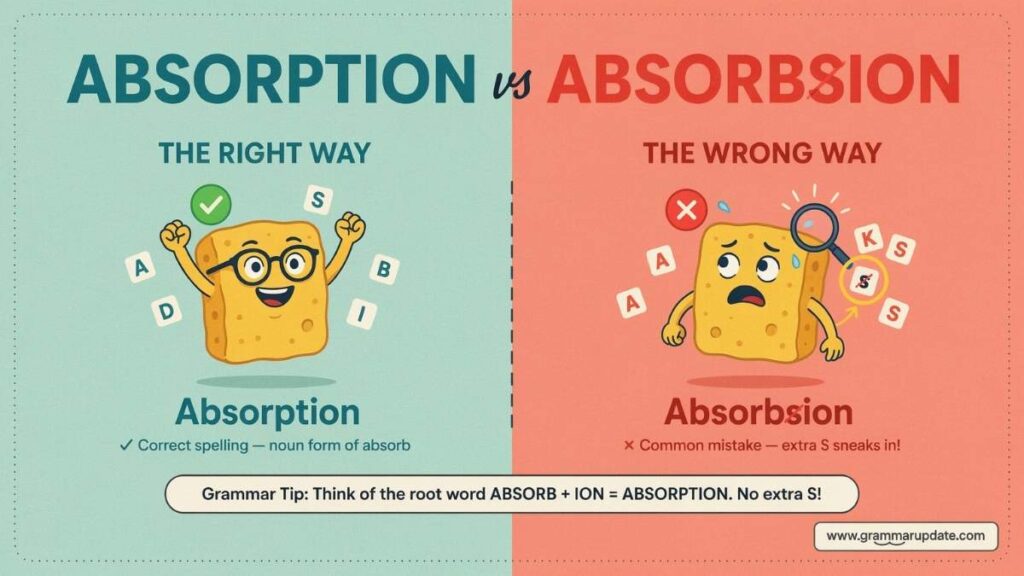
Many people use these two words interchangeably, but they describe completely different scientific processes. Understanding the Difference between adsorption and absorption is essential in chemistry, biology, environmental science, and engineering.
The easiest way to remember the distinction is this:
- During absorption, a substance enters the entire volume of a material.
- During adsorption, a substance accumulates on the surface of a material.
Although the names differ by only one letter, their meanings are very different.
If you’re asking, “What is the difference between adsorption and absorption?” the answer comes down to where the molecules go.
- In absorption, molecules penetrate the material.
- In adsorption, molecules attach to the surface.
This simple rule explains nearly every example you’ll encounter.
Adsorption Meaning
The adsorption meaning is the process in which molecules stick to the surface of a solid or liquid without entering its interior.
In other words, the substance accumulates on the surface instead of moving into the entire volume of a material.
Scientists describe adsorption as a surface phenomenon because it happens only at the outer layer of the adsorbent.
Examples include:
- Activated carbon adsorbs impurities from water.
- Silica gel adsorbs moisture from the air.
- Charcoal removes odors by adsorbing odor molecules.
- Gas molecules adsorb onto the surface of catalysts.
This is the standard adsorption definition used in chemistry.
Absorption Meaning
The absorption meaning is the process in which molecules enter the bulk material and spread throughout it.
Unlike adsorption, absorption is a bulk phenomenon because the substance becomes part of the entire material.
Examples include:
- A sponge absorbs water.
- A paper towel absorbs liquid.
- The intestine absorbs nutrients.
- A hydrogel absorbs water.
Difference Between Adsorption and Absorption
The following table summarizes the Adsorption and absorption difference.
| Feature | Adsorption | Absorption |
|---|---|---|
| Process | Molecules attach to the surface | Molecules enter the bulk material |
| Type | Surface phenomenon | Bulk phenomenon |
| Distribution | Surface concentration only | Uniform distribution throughout the material |
| Main Driving Force | Surface forces and molecular attraction | Solubility and concentration gradient |
| Example | Activated carbon adsorbs impurities | Sponge absorbs water |
| Scientific Field | Surface chemistry | Physical chemistry, biology, medicine |
This comparison answers one of the most searched questions online: What is the difference between adsorption and absorption?
Adsorption vs Absorption in Chemistry
Adsorption vs absorption in chemistry is one of the first topics students learn in surface chemistry.
Although both involve the movement of molecules, the adsorption mechanism and absorption mechanism operate differently.
During adsorption:
- Molecules attach to the adsorbent surface.
- Only the surface of a solid or liquid participates.
- Surface concentration increases.
- The interior remains mostly unchanged.
During absorption:
- Molecules penetrate the material.
- The entire volume of a material participates.
- The absorbed substance spreads throughout the material.
- Bulk absorption occurs.
This distinction forms the basis of adsorption chemistry and absorption chemistry.
Adsorption and Absorption in Chemistry
Scientists often compare Adsorption and absorption in chemistry because both processes occur in laboratories, industrial plants, and natural systems.
For example:
Adsorption
- Air filters trap pollutants.
- Catalysts hold gas molecules.
- Activated charcoal captures toxins.
Absorption
- Water dissolves gases.
- Plants absorb nutrients.
- Medicines enter the bloodstream.
Although they sometimes occur together, they should never be confused.
Adsorption vs Absorption Examples
The easiest way to understand these concepts is through familiar situations.
| Situation | Adsorption or Absorption? | Why? |
|---|---|---|
| Sponge absorbs water | Absorption | Water enters the sponge. |
| Paper towel absorbs juice | Absorption | Liquid penetrates the fibers. |
| Silica gel removes moisture | Adsorption | Water molecules collect on the surface. |
| Activated charcoal removes odors | Adsorption | Odor molecules stick to the surface. |
| Intestine absorbs nutrients | Absorption | Nutrients move into the bloodstream. |
| Water filter removes contaminants | Mostly adsorption | Impurities collect on activated carbon. |
These Adsorption and absorption examples appear frequently in classrooms because they clearly show the difference.
Adsorption vs Absorption With Example
Here is one simple comparison that students often remember.
Absorption example
A sponge absorbs water.
The water moves throughout the sponge’s entire structure.
Adsorption example
Activated carbon adsorbs impurities.
The impurities remain attached to the adsorbent surface rather than entering the carbon itself.
This Adsorption vs absorption with example highlights the biggest difference between the two processes.
Adsorb vs Absorb
Another common source of confusion is Adsorb vs absorb.
Although they differ by only one letter, their meanings are distinct.
Absorb means:
To take a substance into the interior.
Examples:
- Plants absorb water.
- Skin absorbs lotion.
- Cotton absorbs oil.
Adsorb means:
To collect molecules on a surface.
Examples:
- Activated charcoal adsorbs toxins.
- Silica gel adsorbs moisture.
- Catalysts adsorb gases.
Remember this shortcut:
Absorb = Inside
Adsorb = Surface
Adsorbent vs Absorbent
Many people also confuse Adsorbent vs absorbent.
An absorbent material allows liquids or gases to enter its interior.
Examples:
- Sponge
- Cotton
- Paper towel
- Diaper
An adsorbent material attracts molecules to its outer surface.
Examples:
- Activated charcoal
- Silica gel
- Activated alumina
- Zeolites
Comparison table
| Absorbent | Adsorbent |
|---|---|
| Holds substances inside | Holds substances on the surface |
| Bulk absorption | Surface adsorption |
| Sponge | Activated charcoal |
| Cotton | Silica gel |
| Paper towel | Zeolite |
Knowing the Adsorbent vs absorbent difference prevents many scientific writing mistakes.
Adsorbate vs Absorbate
Students often ask about Adsorbate vs absorbate.
An adsorbate is the substance that sticks to the surface of an adsorbent.
Examples include:
- Water molecules on silica gel.
- Odor molecules on activated carbon.
- Pollutants on charcoal filters.
An absorbate is the substance taken into an absorbent material.
Examples include:
- Water inside a sponge.
- Medicine entering body tissues.
- Nutrients absorbed into the bloodstream.
Although “adsorbate” appears frequently in chemistry literature, “absorbate” is much less common outside technical writing.
Learn the difference between confusing word pairs
Tieing vs Tying Which Spelling Is Correct in English?
Adsorption vs Absorption vs Sorption
The phrase Adsorption vs absorption vs sorption often appears in scientific research.
So, what is sorption?
Sorption is the general term that includes both adsorption and absorption.
Think of it like this:
Sorption
├── Adsorption
└── Absorption
Scientists use the word sorption when they know a substance is being taken up but haven’t yet determined whether the process occurs on the surface, inside the material, or both.
This explains the relationship in Absorption vs adsorption vs sorption.
Types of Sorption
Sorption includes:
- Adsorption
- Absorption
- Combined sorption processes
Many environmental systems involve more than one mechanism at the same time.
Learn the difference between confusing word pairs
Neighbour vs Neighbor Which Spelling Is Correct?
Adsorption vs Absorption vs Desorption
Another important comparison is Adsorption vs absorption vs desorption.
Desorption is the opposite of adsorption.
Instead of attaching to a surface, molecules leave the surface.
Comparison table
| Process | What Happens |
|---|---|
| Adsorption | Molecules attach to the surface. |
| Absorption | Molecules enter the material. |
| Desorption | Molecules leave the surface. |
For example:
Activated charcoal adsorbs pollutants from water.
Heating the charcoal later causes desorption, releasing the trapped molecules.
Understanding Adsorption vs absorption vs desorption is especially important in industrial filtration systems.
Learn the difference between confusing word pairs
Verbiage vs Verbage Which Spelling Is Correct?
Adsorption vs Absorption vs Adhesion
Adsorption vs absorption vs adhesion can also confuse beginners because all three involve interactions between materials.
However, they describe different phenomena.
| Process | Description |
|---|---|
| Adhesion | Attraction between different materials. |
| Adsorption | Molecules stick to a surface. |
| Absorption | Molecules move inside a material. |
For example:
- Water sticking to glass demonstrates adhesion.
- Moisture sticking to silica gel demonstrates adsorption.
- Water entering a sponge demonstrates absorption.
Although adhesion helps adsorption occur in some situations, the two processes are not identical.
Learn the difference between confusing word pairs
Ether vs Either which is correct and Difference?
Types of Adsorption
Not all adsorption happens in the same way.
Scientists recognize two major forms.
Physical Adsorption
Physical adsorption, also called physisorption, occurs through weak intermolecular forces such as van der Waals forces.
Characteristics include:
- Weak molecular attraction.
- No chemical bonding.
- Usually reversible adsorption.
- Lower heat released during adsorption.
- Strong temperature dependence.
- Pressure dependence is significant for gases.
Examples:
- Gas adsorption on activated charcoal.
- Moisture adsorption by silica gel.
Chemical Adsorption
Chemical adsorption, also called chemisorption, occurs when chemical bonds form between the adsorbate and the adsorbent surface.
Characteristics include:
- Strong chemical bonding.
- Often irreversible adsorption.
- Greater heat released during adsorption.
- Highly specific reactions.
- Usually slower than physisorption.
Examples include:
- Catalytic converters.
- Industrial catalysts.
- Hydrogen bonding to metal surfaces.
Learn the difference between confusing word pairs
In-Person vs In Person What’s the Difference?
Adsorption and Absorption in Water Treatment
One of the best places to see both processes working together is in modern water treatment systems. Although they often appear in the same filtration unit, adsorption and absorption perform different jobs.
Understanding Adsorption vs absorption in water treatment helps explain why clean drinking water requires several purification methods instead of just one.
How Adsorption Works in Water Purification
Adsorption removes unwanted substances by trapping them on the surface of an adsorbent material.
The most common adsorbents include:
- Activated charcoal (activated carbon)
- Silica gel
- Activated alumina
- Zeolites
Among these, activated charcoal is the most widely used because it has an enormous surface area filled with millions of microscopic pores.
As contaminated water passes through activated charcoal, pollutants stick to its surface instead of remaining in the water.
This process removes:
- Chlorine
- Bad odors
- Unpleasant tastes
- Organic chemicals
- Some pesticides
- Certain industrial pollutants
This is a classic example of adsorption in water treatment.
How Absorption Helps in Water Treatment
Absorption plays a smaller but still important role in certain purification technologies.
During absorption, molecules penetrate an absorbent material rather than remaining on its surface.
Examples include:
- Specialized absorbent polymers soaking up contaminated liquids.
- Industrial absorbent pads used during chemical spills.
- Certain filtration materials designed to absorb dissolved substances.
Unlike adsorption, where contaminants remain on the outside, absorption allows the substance to move into the material itself.
Water Purification Comparison
| Process | Primary Function | Common Material |
|---|---|---|
| Adsorption | Removes contaminants from the surface | Activated charcoal |
| Absorption | Takes liquids into the material | Absorbent polymers |
| Filtration | Removes suspended particles | Sand, membranes |
| Disinfection | Kills microorganisms | Chlorine, UV light |
Modern water purification systems often combine all four methods to produce safe drinking water.
Learn the difference between tricky grammar more words
Take Effect vs Take Affect Which one Is Correct?
Activated Charcoal Absorb or Adsorb?
A very common question is:
Does activated charcoal absorb or adsorb?
The correct answer is:
Activated charcoal adsorbs impurities.
Its countless microscopic pores create an enormous adsorbent surface where contaminants attach through molecular attraction.
Because the pollutants stay on the surface rather than entering the carbon itself, the process is adsorption rather than absorption.
Activated charcoal is commonly used in:
- Household water filters
- Aquarium filters
- Air purification systems
- Gas masks
- Medical treatments for certain poisonings
- Industrial wastewater treatment
Its high adsorption capacity makes it one of the most effective materials for removing impurities.
Why Activated Carbon Is So Effective
A single gram of activated carbon can have a surface area exceeding 1,000 square meters.
That tremendous surface provides countless locations where molecules can attach.
As a result, activated carbon adsorbs impurities extremely efficiently, even when they are present in very small amounts.
Is Silica Gel Adsorption or Absorption?
Another question that frequently appears in chemistry classes is:
Is silica gel adsorption or absorption?
The answer is adsorption.
Silica gel adsorbs moisture from the surrounding air.
Water molecules collect on the adsorbent surface through weak intermolecular forces instead of penetrating the entire material.
This is why silica gel packets are placed inside:
- Shoe boxes
- Electronics packaging
- Medicine bottles
- Camera equipment
- Food containers
Their purpose is to reduce humidity by removing water vapor from the air.
Although many people casually say silica gel “absorbs moisture,” scientists describe the process as moisture adsorption.
Learn the difference between tricky grammar more words
Rosin vs Resin Difference and Which is Correct?
Does a Sponge Absorb or Adsorb Water?
This question offers one of the easiest ways to remember the difference.
A sponge absorbs water.
Water moves deep into the sponge’s porous structure until much of its internal volume becomes filled.
That makes it an excellent example of bulk absorption.
Similarly:
- A towel absorbs moisture.
- Cotton absorbs liquid.
- Paper towels absorb spills.
These are all examples of absorbent material rather than adsorbent material.
Moisture Absorption vs Moisture Adsorption
Although both phrases describe water, they refer to different processes.
| Moisture Absorption | Moisture Adsorption |
|---|---|
| Water enters the material. | Water remains on the surface. |
| Bulk phenomenon | Surface phenomenon |
| Sponge | Silica gel |
| Cotton | Activated alumina |
| Paper towel | Molecular sieve |
This comparison helps eliminate one of the most common misunderstandings in absorption chemistry.
Learn the difference between tricky grammar more words
Waving vs Waiving Which is correct and Difference?
Gas Adsorption and Gas Absorption
Gases can also undergo either adsorption or absorption.
Gas Adsorption
Gas molecules attach to the surface of a solid.
Examples include:
- Hydrogen adsorbing onto catalysts.
- Carbon monoxide adsorbing onto activated carbon.
- Oxygen adsorbing onto metal surfaces.
1.Gas adsorption plays an essential role in:
- Catalytic converters
- Industrial gas separation
- Pollution control
- Air purification
Gas Absorption
The Gas molecules dissolve into another substance.
Examples include:
- Carbon dioxide dissolving into water.
- Oxygen dissolving into blood.
- Ammonia dissolving into water.
Gas absorption is especially important in chemical manufacturing and environmental engineering.
Learn the difference between tricky grammar more words
Performing vs Preforming difference and Which One Is Correct?
Liquid Adsorption and Liquid Absorption
Liquids also demonstrate both processes.
Liquid Adsorption
Liquid molecules remain attached to a solid surface.
Examples include:
- Dye molecules adsorbing onto activated charcoal.
- Pollutants attaching to filtration media.
Liquid Absorption
Liquids penetrate the material.
Examples include:
- Ink soaking into paper.
- Water entering concrete.
- Oil soaking into absorbent pads.
These examples clearly illustrate the adsorption process and the absorption process.
Factors That Affect Adsorption
Scientists study adsorption equilibrium because adsorption does not continue forever.
Eventually, the adsorbent surface becomes full.
Several factors influence adsorption rate and adsorption capacity.
Surface Area
A larger surface area provides more places for molecules to attach.
This explains why powdered activated carbon usually performs better than larger chunks.
Temperature Effect
Temperature has a major influence on adsorption.
In many cases:
- Lower temperatures increase physical adsorption.
- Higher temperatures reduce adsorption caused by weak intermolecular forces.
However, chemisorption may behave differently because chemical bonding is involved.
Pressure Effect
Pressure dependence is particularly important for gases.
Increasing gas pressure usually increases the amount of gas adsorbed until adsorption equilibrium is reached.
Nature of the Adsorbent
Different adsorbent materials have different pore sizes, chemical properties, and adsorption capacities.
Common adsorbents include:
- Activated charcoal
- Silica gel
- Activated alumina
- Zeolites
- Molecular sieves
Each material is selected for specific industrial applications.
Factors That Affect Absorption
The absorption process depends on a different set of variables.
Solubility
Greater solubility generally leads to faster absorption.
If a substance dissolves easily, it usually enters the absorbent material more readily.
Concentration Gradient
The concentration gradient is one of the strongest driving forces behind absorption.
When the concentration outside the material is much higher than inside, molecules naturally move inward until equilibrium is reached.
Temperature
Temperature can either increase or decrease absorption depending on the materials involved.
In many liquids, warmer temperatures increase molecular movement and change absorption rates.
Material Structure
Porous materials generally have greater absorption capacity because they contain more internal space for liquids or gases.
Learn the difference between tricky grammar more words
Tomatoes vs Tomatos difference and Which Is Correct?
Real-Life Case Studies
Case Study Household Water Filter
A family installs an activated carbon water filter to improve the taste of tap water.
As water passes through the filter:
- Chlorine molecules attach to the activated carbon.
- Organic contaminants stick to the adsorbent surface.
- Odors are greatly reduced.
This is adsorption, not absorption.
Case Study Kitchen Sponge
A sponge accidentally falls into a sink full of water.
Within seconds, water fills the tiny pores throughout the sponge.
The water enters the entire volume of the material.
This is absorption.
Case Study Medical Treatment
A patient swallows a pain-relief tablet.
The tablet dissolves in the digestive tract.
The medicine then passes through the intestinal wall and enters the bloodstream.
This process is known as drug absorption and is an example of absorption in biological systems.
These real-world examples make the difference between adsorption and absorption much easier to understand than definitions alone. They also show why scientists carefully distinguish between a surface phenomenon and a bulk phenomenon when describing how substances interact with materials.
Learn the difference between tricky grammar more words
Sergeant vs Sargent difference and Which Is Correct?
Practice Session Absorption vs Absorbsion
Choose the correct word or term to complete each sentence. Some questions test spelling, while others check your understanding Absorption vs Absorbsion and related concepts.
- The correct spelling is __________, not absorbsion.
- A sponge __________ water after being placed in a bucket.
- Activated charcoal __________ impurities from drinking water.
- In chemistry, absorption is a __________ phenomenon.
- In chemistry, adsorption is a __________ phenomenon.
- The small intestine __________ nutrients from digested food.
- Silica gel is commonly used because it __________ moisture from the air.
- During absorption, molecules enter the __________ of a material.
- During adsorption, molecules attach to the __________ of a solid.
- The process opposite to adsorption is called __________.
- Activated carbon is an excellent __________ for removing pollutants.
- Cotton is an excellent __________ material for cleaning spills.
- The process in which gas molecules stick to a catalyst is called gas __________.
- Oxygen dissolving in water is an example of gas __________.
- Physical adsorption is also known as __________.
- Chemical adsorption is also known as __________.
- Weak __________ forces are responsible for most physical adsorption.
- The movement of molecules from a high concentration to a lower concentration is influenced by the __________ gradient.
- Water entering a paper towel is an example of __________.
- The substance that sticks to the surface of an adsorbent is called the __________.
- The general term that includes both adsorption and absorption is __________.
- The correct pair is “adsorbent” and “__________.”
- The process by which medicine enters the bloodstream is called drug __________.
- “Absorbsion” is a common spelling __________.
- The phrase “Adsorption vs __________” is frequently discussed in chemistry classes.
Answers
- absorption
- absorbs
- adsorbs
- bulk
- surface
- absorbs
- adsorbs
- entire volume
- surface
- desorption
- adsorbent
- absorbent
- adsorption
- absorption
- physisorption
- chemisorption
- van der Waals
- concentration
- absorption
- adsorbate
- sorption
- absorbent
- absorption
- mistake
- absorption
Here’s a trusted source for clear word meanings:
FAQs
Which one is correct, absorbtion vs absorption?
The correct spelling is “absorption.” The word “absorbtion” is a common misspelling and isn’t accepted in standard English. Whether you’re writing for school, work, or science, always use “absorption.”
Is it absorbance or absorption?
They are different terms. Absorption is the process of taking in light, liquids, gases, or other substances. Absorbance is a scientific measurement that shows how much light a sample absorbs during laboratory testing.
What’s the difference between absorption and adsorption?
Absorption happens when a substance enters the entire volume of a material. Adsorption occurs when molecules attach only to the surface of a material. In short, absorption is a bulk phenomenon, while adsorption is a surface phenomenon.
Is it absorbed or adsorbed?
Use “absorbed” when something enters a material, such as a sponge absorbed water. Use “adsorbed” when molecules stick to a surface, such as activated charcoal adsorbed impurities.
Why is it absorption and not absorbtion?
The noun comes from the Latin root of “absorb” and follows the English “-ption” spelling pattern. That’s why “absorption” is correct, while “absorbtion” is a spelling error.
Is there a word “absorption”?
Yes. “Absorption” is a standard English word used in everyday language as well as in science, medicine, engineering, and business. It describes the process of taking something into a material or system.
What does absorbance mean?
Absorbance is a numerical value used in chemistry and physics to measure how much light a substance absorbs at a specific wavelength. Higher absorbance means less light passes through the sample.
What is an example of absorption?
A sponge soaking up water is one of the simplest examples of absorption. Other examples include plant roots absorbing water, the small intestine absorbing nutrients, and a paper towel absorbing spilled juice.
Is UV absorbance or absorption?
Ultraviolet light undergoes absorption when a material takes in the light energy. Scientists measure this process using absorbance, which indicates how much UV light the material has absorbed.
Why is it adsorption and not absorption?
Use “adsorption” when molecules collect on the surface of a material instead of entering it. Materials such as activated carbon and silica gel remove substances through adsorption rather than absorption.
Do sponges absorb or adsorb?
Sponges absorb water. The liquid moves into the sponge’s internal pores, making absorption the correct term.
Does charcoal absorb or adsorb?
Activated charcoal primarily adsorbs impurities. Contaminants attach to its large surface area instead of entering the material itself.
Which is correct, absorption vs absorbsion?
The correct spelling is “absorption.” “Absorbsion” is not a recognized English word and should never be used in formal or informal writing.
Is heat absorbed or adsorbed?
Heat is absorbed. When a material takes in thermal energy, the process is called heat absorption, not adsorption.
Is there a word “adsorbed”?
Yes. “Adsorbed” is the past tense of “adsorb.” It describes molecules that have attached to the surface of a material.
When should you use adsorption vs absorption?
Use “adsorption” when substances stick to a surface. Use “absorption” when substances move inside a material. The choice depends on whether the process involves the surface or the interior.
Is absorption the same as absorb?
No. “Absorb” is a verb, while “absorption” is the noun that names the process. For example, a towel absorbs water, and that process is called absorption.
Are absorption and resorption the same?
No. Absorption refers to taking substances into a material or living organism. Resorption usually describes the body’s process of breaking down and reabsorbing tissues, such as bone during normal remodeling.
What is another word for absorption?
Depending on the context, similar words include uptake, assimilation, intake, soaking, imbibition, incorporation, and assimilation. The best synonym depends on how the word is being used.
What is the verb for absorption?
The verb is “absorb.” For example, plants absorb water through their roots, and towels absorb moisture after a shower.
How is absorption spelled?
The correct spelling is A-B-S-O-R-P-T-I-O-N.
What is absorption in simple words?
Absorption is the process of taking something inside. It happens when liquids, gases, energy, or nutrients move into another material or living organism.
What is absorbance and absorption?
Absorption is the process of taking in energy or matter. Absorbance is the measurement scientists use to determine how much light has been absorbed by a sample.
What absorbance is too high?
In many laboratory instruments, absorbance values above about 2.0 may produce less reliable results because very little light reaches the detector. Scientists often dilute samples with extremely high absorbance before measuring them again.
What does absorption mean?
Absorption means taking a substance, energy, or information into another material or system. Depending on the context, it can describe physical, biological, psychological, or chemical processes.
What are the two types of absorption?
The two common categories are physical absorption and chemical absorption. Physical absorption occurs without forming new chemical bonds, while chemical absorption involves chemical reactions between substances.
What is a real-life example of absorption?
Everyday examples include a paper towel soaking up water, your body absorbing nutrients after a meal, and soil absorbing rainwater after a storm.
How do you explain absorbance?
Absorbance tells you how much light a substance blocks or takes in. A higher absorbance value means more light has been absorbed and less light passes through the sample.
Is UV absorbed by water?
Yes. Water absorbs portions of ultraviolet light, especially shorter UV wavelengths. However, the amount absorbed depends on the wavelength and the depth of the water.
What does 100% UV absorption mean?
It means a material blocks essentially all incoming ultraviolet radiation within the specified wavelength range, allowing almost no UV light to pass through.
What is the opposite of absorption?
The opposite of absorption is desorption in surface chemistry or release, emission, or expulsion in other contexts, depending on what is being discussed.
What are the two types of adsorption?
The two main types are physical adsorption (physisorption), which relies on weak intermolecular forces, and chemical adsorption (chemisorption), which involves chemical bonding.
How is absorption used in everyday life?
You see absorption every day when a sponge absorbs water, a towel dries your hands, your skin absorbs lotion, your body absorbs nutrients, and plants absorb water from the soil.
Why shouldn’t you leave sponges in the sink?
A wet sponge stays moist for long periods, creating an ideal environment for bacteria, mold, and unpleasant odors. Letting it dry completely between uses helps reduce microbial growth.
Do desiccants absorb or adsorb?
Most common desiccants, such as silica gel, adsorb moisture. Water molecules attach to their surface instead of entering the material’s interior.
What is the main predator of sponges?
Sea turtles, especially hawksbill sea turtles, are among the best-known sponge predators. Certain fish, nudibranchs, and sea stars also feed on marine sponges, depending on the species and habitat.
Conclusion
English spelling can be tricky, but this one doesn’t have to be. The correct spelling is always “absorption,” while “absorbsion” is simply a misspelling. Once you remember that the noun comes from “absorb” and follows the “-ption” pattern, the confusion quickly disappears.
It’s also important not to mix up absorption and adsorption. Absorption happens when a substance moves inside a material, while adsorption occurs when it sticks to the surface. Knowing this simple difference will help you write more accurately in everyday conversations, school assignments, and scientific topics.
The next time you see “Absorption vs Absorbsion,” you won’t have to guess. You’ll know the correct spelling, understand the meaning, and use it with confidence every time.

Jhon AJS, the creative mind behind Grammar Update, is an experienced blogger passionate about simplifying English grammar. He focuses on explaining confusing word vs word differences, grammar rules, punctuation, and sentence structure in a clear and practical way. Through easy to understand guides and examples, Jhon helps readers improve their writing and communicate with confidence. With years of blogging experience, he continues to share helpful insights that make learning grammar simple, useful, and accessible for everyone.