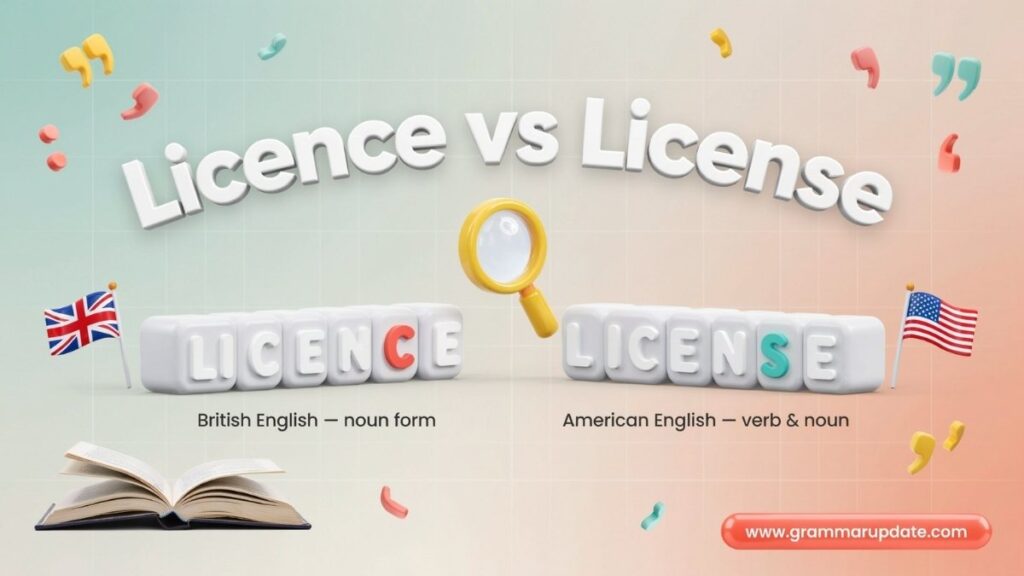
The licence vs license confusion is one of the most common spelling mistakes in English. Many writers assume one spelling is wrong and the other is right, only to discover that both can be correct depending on where you live and how the word is used. The confusion often starts when a document, application, or official permit requires careful wording. Suddenly, a simple spelling choice feels like a grammar test. Fortunately, there is a clear rule behind the difference. In this guide, you’ll learn the meaning of both forms, understand the key distinctions between British and American English, and confidently avoid this common writing mistake in any situation.
Licence vs License The Quick Answer
If you’re looking for the simplest answer, here it is:
- American English: Use license for both the noun and verb.
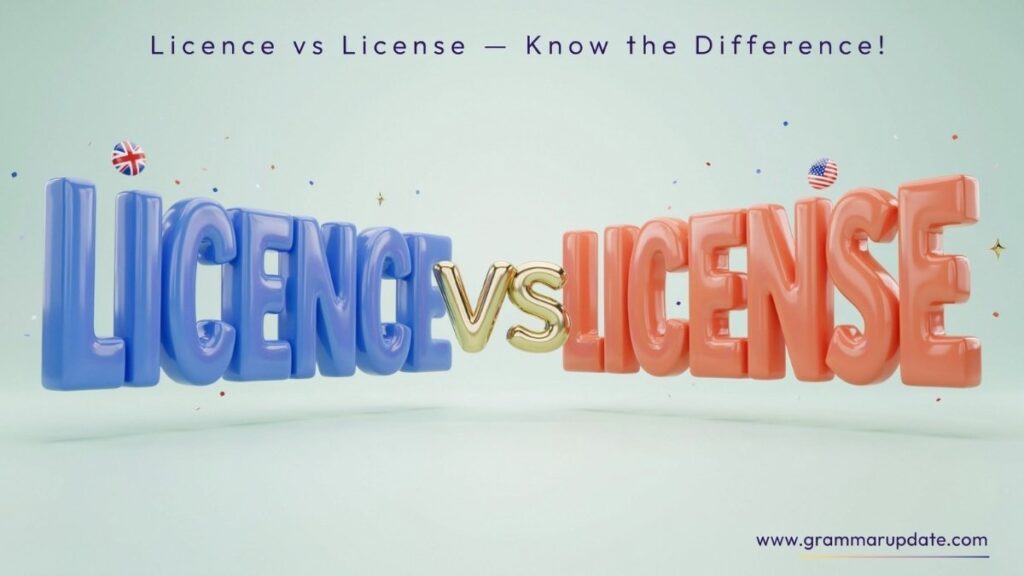
- British English: Use licence as a noun and license as a verb.
- Lisense is always incorrect.
Quick Comparison Table
| Word | Region | Part of Speech | Correct? |
|---|---|---|---|
| Licence | British English | Noun | Yes |
| License | British English | Verb | Yes |
| License | American English | Noun and Verb | Yes |
| Lisense | Any English Variety | None | No |
Quick Examples
American English
- I renewed my driver’s license.
- The state will license new businesses.
British English
- She received her driving licence.
- The council will license the event.
Understanding this distinction immediately solves most licence vs license confusion.
What Does License Mean?
Before comparing spellings, it helps to understand the actual meaning of the word.
License Meaning
A license is an official authorization that gives a person, organization, or business legal permission to perform a particular activity.
In many situations, a license serves as proof that an individual has met specific requirements established by a government agency, licensing authority, or regulatory body.
Common Definitions
A license can refer to:
- Legal permission
- Official permit
- Authorization document
- Government-issued license
- Certification document
- Operating permit
- Regulatory approval
At its core, a license grants permission that would otherwise be restricted.
Real-World Examples
You may need a license to:
- Drive a vehicle
- Operate a business
- Practice medicine
- Sell alcohol
- Broadcast media
- Use copyrighted software
- Hunt or fish legally
Without the appropriate authorization, performing these activities may violate regulations or laws.
Learn the difference between tricky more English words
Compair vs Compare Which Is Correct and usage?
Licence Meaning and License Meaning in Everyday Englis
Whether you write licence or license, the meaning remains largely the same.
The word generally refers to permission granted by an authority.
For example:
- A driving licence allows you to drive legally.
- A business license permits a company to operate.
- A medical license authorizes a doctor to practice medicine.
- A software license allows users to install and use software legally.
The spelling changes, but the concept remains consistent.
Quote to Remember
A license is not simply a document. It is legal permission granted by an authorized body.
This definition applies across most professional, legal, and governmental contexts.
The Origin of the Word License
The history of the word helps explain why different spellings exist today.
The term comes from the Latin word licentia, meaning freedom, permission, or liberty.
Over centuries, the word entered Old French before becoming part of Middle English.
As English evolved, regional spelling conventions emerged.
Eventually:
- American English standardized license.
- British English adopted licence for nouns and license for verbs.
These changes reflect broader patterns found throughout English spelling differences.
Similar examples include:
| American English | British English |
|---|---|
| Practice | Practise |
| Defense | Defence |
| Offense | Offence |
| License | Licence |
These spelling conventions continue today.
Fix common more word mistakes in English
Totaled vs Totalled Which Spelling Is Correct?
Why “Lisense” Is Incorrect
One of the most searched questions online is whether lisense is a real word.
The answer is simple.
Is Lisense a Real Word?
No.
Lisense is not recognized in:
- American English
- British English
- Canadian English
- Australian English
- Professional dictionaries
It is simply a common misspelling.
Why Do People Spell License as Lisense?
The mistake usually happens because English spelling doesn’t always match pronunciation.
When spoken aloud, license sounds similar to how many people believe it should be spelled.
Writers often rely on sound rather than established spelling rules.
As a result, they produce variations such as:
- Lisense
- Lisence
- Liscense
- Liscence
All of these spellings are incorrect.
The Pronunciation Trap
The pronunciation of license remains:
/ˈlaɪ.səns/
Because the “c” produces an “s” sound, many people mistakenly replace the letter entirely.
However, the correct spelling always includes the letter “c.”
Learn the difference between tricky more English words
Abley vs Ably Which Spelling Is Correct in English?
Common Misspellings Related to License
Writers frequently confuse several versions of the word.
Common Errors
| Incorrect Spelling | Correct Spelling |
|---|---|
| Lisense | License |
| Lisence | License |
| Liscense | License |
| Liscence | License |
| Licens | License |
Although spell-check tools often catch these mistakes, relying entirely on software isn’t a good strategy.
Understanding the correct form improves your writing accuracy and professionalism.
License as a Noun and a Verb
This is where the topic becomes more interesting.
The distinction between licence and license in British English depends largely on grammar.
License Noun and Verb Usage
A noun names a thing.
A verb describes an action.
The word can function as both.
License as a Noun
When used as a noun, the word refers to an official document or authorization.
Examples:
- She applied for a business license.
- His driver’s license expired.
- The agency issued a professional license.
In American English, the noun is always written as license.
In British English, the noun becomes licence.
License as a Verb
When used as a verb, the word means to authorize, permit, or grant permission.
Examples:
- The government will license new operators.
- The board licenses qualified professionals.
- The agency licensed the software for public use.
Both American and British English use license as the verb spelling.
Licence Noun vs License Verb in British English
This distinction confuses many learners.
A simple rule helps.
British English Rule
- Licence = Noun
- License = Verb
Examples:
Correct:
- She obtained her driving licence.
- The council will license the new restaurant.
Incorrect:
- She obtained her driving license. (British English noun)
- The council will licence the new restaurant. (British English verb)
Memory Trick
Think of the letter C in licence as standing for certificate.
Both are nouns.
That small association helps many writers remember the correct British form.
Fix common more word mistakes in English
Carat vs Caret vs Karat Which is Differences?
American English License
The American English follows a simpler system.
American English License Rule
The spelling license serves as both:
- Noun
- Verb
Examples:
- My driver’s license expires next year.
- The state licenses commercial drivers.
This approach removes the noun-versus-verb distinction entirely.
Because American English dominates many websites and software platforms, people outside the United States sometimes encounter the American spelling more often than their local version.
Examples of American English License
- Business license
- Driver’s license
- Medical license
- Software license
- Professional license
All use the same spelling.
British English Licence
The British English preserves the traditional distinction between noun and verb forms.
British English Licence as a Noun
Examples include:
- Driving licence
- Fishing licence
- Television licence
- Professional licence
- Trade licence
In each case, the word refers to a document, permit, or authorization.
Why Britain Uses Licence
The spelling follows a broader British pattern.
Other examples include:
| Noun | Verb |
|---|---|
| Advice | Advise |
| Practice | Practise |
| Licence | License |
This distinction helps identify a word’s grammatical function immediately.
Learn the difference between tricky more English words
Exercise vs Exorcise Differences and Correct Usage
Licence vs License UK and US Comparison
The easiest way to remember regional differences is through a simple chart.
| Usage | British English | American English |
|---|---|---|
| Noun | Licence | License |
| Verb | License | License |
| Driving Document | Driving Licence | Driver’s License |
| Business Authorization | Business Licence | Business License |
| Software Permission | Software Licence | Software License |
This table summarizes the entire licence vs license UK and licence vs license US distinction in one place.
Driver’s Licence or License?
Few phrases generate more searches than driver’s licence or license.
The correct answer depends on location.
In the United Kingdom
The correct spelling is:
Driving Licence
Example:
- She received her driving licence after passing the test.
In the United States
The correct spelling is:
Driver’s License
Example:
- He renewed his driver’s license online.
Although both documents serve the same purpose, regional spelling conventions determine which version is correct.
Learn how to use confusing more words correctly
Canon vs Cannon Difference and Usage
Business Licence or License
Whether you’re starting a small local shop or launching a multinational company, you’ll likely need some form of legal authorization to operate.
A business licence or license is an official permit issued by a government agency or regulatory authority that allows a company to conduct specific business activities.
Business Licence in British English
In the UK, the noun form is business licence.
Example:
- The company obtained a business licence before opening its first location.
Business License in American English
In the US, the noun form is business license.
Example:
- The city requires every food truck to have a valid business license.
Why Business Licenses Matter
A business license helps:
- Ensure regulatory compliance
- Protect consumers
- Establish legal accountability
- Verify business legitimacy
- Support public safety standards
Operating without the required authorization can result in fines, penalties, or business closure.
Learn how to use confusing more words correctly
Either vs Eather Which is Correct Spelling and Usage
Professional Licence or License
Many careers require individuals to hold a valid professional authorization before practicing.
Examples include:
- Doctors
- Nurses
- Pharmacists
- Lawyers
- Architects
- Engineers
- Accountants
Professional Licence in the UK
British English uses professional licence as the noun.
Professional License in the US
American English uses professional license.
Why Professional Licensing Exists
Professional licensing protects the public by ensuring practitioners meet established standards.
Requirements often include:
- Formal education
- Examinations
- Background checks
- Continuing education
- Ethical compliance
A licensed professional demonstrates verified competence within a regulated field.
Software License or Licence
Technology has expanded the meaning of the word beyond physical permits and documents.
A software license is a legal agreement that grants users permission to install, access, or distribute software under specific conditions.
Examples of Software Licensing
Common software licenses include:
- Proprietary licenses
- Open-source licenses
- Enterprise licenses
- Subscription licenses
- Educational licenses
Why Software Licensing Matters
Software licensing determines:
- Who may use the software
- How many devices can install it
- Whether modification is permitted
- Distribution rights
- Intellectual property protections
A software license protects both developers and users.
Software License or Licence by Region
| Region | Preferred Spelling |
|---|---|
| United States | Software License |
| United Kingdom | Software Licence |
| Canada | Often Both |
| Australia | Software Licence |
Other Common Types of Licenses
Many people associate the word only with driving, but licenses appear throughout daily life.
Marriage License
A marriage license grants legal authorization to marry.
Fishing Licence
A fishing licence permits individuals to fish in regulated areas.
Hunting License
Hunters often need government-issued authorization before participating in hunting activities.
Trade Licence
A trade licence allows certain commercial activities within regulated industries.
Broadcasting License
Television and radio operators may require licenses from government authorities.
Medical License
Doctors must maintain valid licenses before practicing medicine legally.
These examples demonstrate how licensing affects numerous aspects of society.
Fix common more word mistakes in English
Ingage vs Engage Which Spelling Is Correct?
License Meaning in Legal and Professional Contexts
In legal settings, a license represents more than permission. It often serves as proof of compliance with laws and regulations.
Government-Issued License
Governments issue licenses to regulate activities that affect public safety, health, or economic stability.
Examples include:
- Driver’s licenses
- Medical licenses
- Firearms licenses
- Business licenses
- Broadcasting licenses
Licensing Authority
A licensing authority is an organization responsible for granting, monitoring, renewing, and revoking licenses.
Examples include:
- Motor vehicle agencies
- Medical boards
- Local councils
- Professional associations
- Regulatory commissions
Regulatory Approval
Licensing often involves regulatory approval.
Applicants may need to:
- Submit documentation
- Complete training
- Pass examinations
- Pay fees
- Meet ongoing requirements
This process ensures accountability and public protection.
Learn how to use confusing more words correctly
Home Made vs Homemade Which Is Correct?
Licence and License Examples
Examples help reinforce proper usage.
Everyday Examples
American English
- My driver’s license expires next year.
- She applied for a fishing license.
- The company received a business license.
British English
- My driving licence expires next year.
- She applied for a fishing licence.
- The company received a business licence.
Verb Examples
- The agency will license qualified operators.
- The board licenses healthcare professionals.
- Authorities licensed the event organizers.
Notice that license remains the verb spelling in both British and American English.
Learn how to use confusing more words correctly
Encode vs Incode Correct Usage
Licence vs License Key Differences Explained
Many writers search for the difference between licence and license because both spellings appear correct in different situations.
The Main Difference
The distinction depends on:
- Region
- Grammar
- Usage
Licence vs License Comparison
| Feature | Licence | License |
|---|---|---|
| British English Noun | Yes | No |
| British English Verb | No | Yes |
| American English Noun | No | Yes |
| American English Verb | No | Yes |
| Correct UK Driving Document | Yes | No |
| Correct US Driving Document | No | Yes |
Which Version Should You Use?
Use the spelling that matches your audience.
If writing for:
- American readers → use license
- British readers → use licence (noun) and license (verb)
Consistency matters more than anything else.
Common Mistakes Related to License
The confusion surrounding licence or license creates several recurring mistakes.
Mistake Writing Lisense
Incorrect:
- I renewed my lisense.
Correct:
- I renewed my license.
Mistake Mixing UK and US Spellings
Incorrect:
- I received my driving license. (British English noun)
Correct:
- I received my driving licence.
Mistake Using Licence as a Verb
Incorrect:
- The government will licence new operators.
Correct:
- The government will license new operators.
Mistake Inconsistent Usage
Switching between British and American spellings within the same document creates confusion.
Choose one style and maintain it throughout.
Fix common more word mistakes in English
Kinesthesiology vs Kinesiology difference Explained
Popular Phrases Using License
Certain expressions appear frequently in everyday English.
Driver’s License
The most common American usage.
Driving Licence
The standard British usage.
License Agreement
A legal contract granting rights or permissions.
License Plate
The identification plate attached to a vehicle.
License Renewal
The process of extending authorization.
Licensed Professional
An individual authorized to practice a regulated profession.
License to Kill
One of the most famous phrases in popular culture.
The expression refers to official authorization to use lethal force and became widely recognized through the James Bond franchise.
Why Correct Spelling Matters
Some people assume spelling differences are unimportant.
In reality, correct spelling affects credibility and professionalism.
Professional Communication
Accurate spelling reflects attention to detail.
Academic Writing
Universities often require consistent adherence to regional spelling standards.
Legal Documents
Incorrect spelling may create confusion in contracts, permits, and regulatory filings.
Business Credibility
Customers often judge professionalism based on written communication.
Search Visibility
Using the correct spelling improves clarity and helps content align with audience expectations.
Easy Ways to Remember the Correct Spelling
Remember Your Audience
Ask yourself:
- Am I writing for the UK?
- Am I writing for the US?
That question usually determines the correct spelling.
Think About Grammar
British English:
- Licence = Noun
- License = Verb
Connect Licence with Certificate
Both words contain a similar visual structure and function as nouns.
Remember the American Rule
American English uses license for everything.
Simple and straightforward.
Here’s a trusted source for clear word meanings:
Practice Section Licence vs License
Choose the correct answer.
Fill in the Blanks
- She renewed her driving __________.
- The state will __________ new businesses.
- My medical __________ expires next year.
- The agency will __________ qualified professionals.
- The company purchased a software __________.
Answers
- Licence (UK) / License (US)
- License
- Licence (UK) / License (US)
- License
- Licence (UK) / License (US)
FAQs
Is it licence or license?
Both are correct. British English uses licence as a noun and license as a verb. American English uses license for both.
What is the difference between licence and license?
The difference depends on regional spelling conventions and grammatical function.
Is driver’s licence or driver’s license correct?
Driver’s license is correct in American English. Driving licence is correct in British English.
Is licence correct in the UK?
Yes. In British English, licence is the standard noun spelling.
Is license correct in the US?
Yes. American English uses license as both a noun and a verb.
When should I use licence?
Use licence when writing a noun in British English.
When should I use license?
Use license as a verb in British English and as both a noun and verb in American English.
Why are licence and license spelled differently?
The distinction developed through historical spelling conventions that evolved differently in British and American English.
Is licence a noun or verb?
In British English, licence is a noun.
Is license a noun or verb?
In American English, license functions as both. In British English, it functions as a verb.
How do British people spell license?
British writers typically use licence as a noun and license as a verb.
How do Americans spell licence?
Americans generally use license for both forms.
Conclusion
The licence vs license confusion is one of the most common spelling challenges in English. Because both forms are widely used and share the same meaning, many writers are unsure which spelling is correct. The answer depends on the type of English being used and, in some cases, the grammatical function of the word. While the distinction may seem minor, using the correct spelling enhances clarity, professionalism, and credibility in your writing. Understanding when to use licence and when to use license helps eliminate a frequent source of confusion and ensures your communication aligns with established language standards. With these rules in mind, you can confidently choose the correct spelling in academic, professional, and everyday contexts.

Jhon AJS, the creative mind behind Grammar Update, is an experienced blogger passionate about simplifying English grammar. He focuses on explaining confusing word vs word differences, grammar rules, punctuation, and sentence structure in a clear and practical way. Through easy to understand guides and examples, Jhon helps readers improve their writing and communicate with confidence. With years of blogging experience, he continues to share helpful insights that make learning grammar simple, useful, and accessible for everyone.