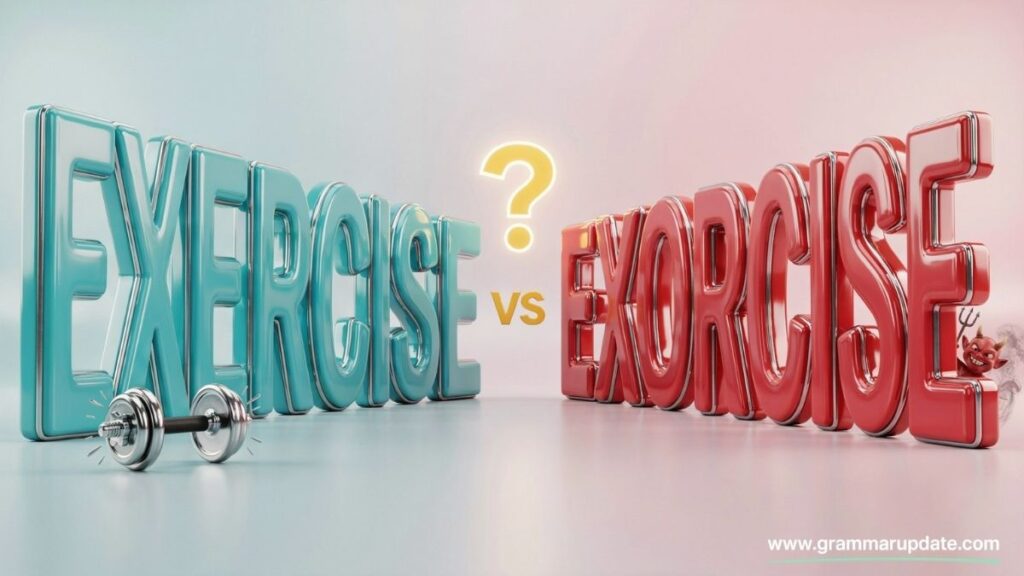
Exercise vs Exorcise is one of those English word pairs that creates confusion far more often than it should. The words share a similar spelling, sound somewhat alike in conversation, and differ by only a few letters. As a result, many writers accidentally choose the wrong one and completely change the meaning of a sentence. A person can exercise to improve fitness, health, or skills, but nobody exercises a demon out of a haunted house. Likewise, a priest may exorcise an evil spirit, but he certainly does not exorcise at the gym. This guide clears up the confusion, corrects common mistakes, and explains the proper meaning, pronunciation, and usage of each word with clear examples.
Exercise vs Exorcise Quick Answer

The simplest distinction is this:
- Exercise relates to physical activity, practice, training, or using a right, skill, or ability.
- Exorcise means to drive out an evil spirit or remove something unwanted, often in a religious or figurative sense.
If you’re talking about fitness, practice, training, rights, judgment, or health, use exercise.
If you’re talking about demons, spirits, fears, trauma, or banishing negative influences, use exorcise.
Exercise vs Exorcise at a Glance
| Word | Meaning | Common Context |
|---|---|---|
| Exercise | Physical activity, practice, or use of a skill | Fitness, education, law, business |
| Exorcise | Remove an evil spirit or unwanted influence | Religion, literature, psychology |
| Exercise | Can be a noun or verb | “Exercise daily” |
| Exorcise | Always a verb | “Exorcise a demon” |
Why People Confuse Exercise and Exorcise
Several factors contribute to this confusion.
First, the words share a similar spelling pattern. Both begin with “ex” and contain many of the same letters.
Second, pronunciation similarities cause people to hear one word and assume the other.
Third, autocorrect and typing errors often create mistakes such as excercise or exercise, which adds another layer of confusion.
Finally, many writers encounter the words infrequently. Since exorcise appears mainly in religious, literary, and figurative contexts, people sometimes mistake it for a variation of exercise.
Fix common more word mistakes in English
Carat vs Caret vs Karat Which is Differences?
What Does Exercise Mean?
Exercise Definition
The exercise definition includes physical activity, practice, training, or the use of a power, right, or skill.
As a noun, exercise refers to an activity performed to improve health, fitness, or ability.
As a verb, exercise means to use, develop, practice, or apply something.
Exercise Meaning in Everyday English
People commonly use exercise when discussing:
- Physical fitness
- Sports training
- Mental training
- Practicing skills
- Exercising rights
- Exercising authority
- Exercising judgment
The core idea remains consistent: active use or development.
Common Uses of Exercise
Exercise for Physical Health
Most people first think of fitness when they hear the word exercise.
Regular physical activity improves cardiovascular health, strengthens muscles, increases flexibility, and supports overall wellness.
Examples include:
- Walking
- Running
- Cycling
- Swimming
- Weight training
Exercise for Mental Health
Research consistently shows that exercise supports mental well-being.
Many studies link regular physical activity to reduced symptoms of depression and anxiety.
People discussing exercise and depression often mention improved mood, better sleep quality, and increased energy levels.
Exercise Your Rights
Exercise also appears in legal and professional settings.
Examples include:
- Exercise your voting rights.
- Exercise your right to remain silent.
- Exercise authority responsibly.
Exercise Good Judgment
The word frequently appears in business communication.
Examples:
- Exercise caution before investing.
- Exercise patience during negotiations.
- Exercise good judgment when making decisions.
Learn the difference between tricky more English words
Abley vs Ably Which Spelling Is Correct in English?
Exercise Examples
Understanding usage becomes easier through examples.
Exercise Examples in Sentences
- She exercises every morning before work.
- Doctors encourage regular exercise for heart health.
- The manager exercised his authority fairly.
- Students completed the grammar exercise.
- Citizens should exercise their voting rights.
These examples demonstrate how flexible the word can be.
Learn the difference between tricky more English words
Totaled vs Totalled Which Spelling Is Correct?
Exercise Pronunciation
Many learners search for exercise pronunciation because spelling and pronunciation do not perfectly match.
Exercise Pronunciation in American English
Exercise is commonly pronounced:
EK-ser-size
Phonetic form:
/ˈek.sɚ.saɪz/
Common Pronunciation Mistakes
Some speakers incorrectly say:
- ex-er-cise
- ek-sor-size
- ex-or-size
Listening to native pronunciation helps build confidence and accuracy.
What Does Exorcise Mean?
Exorcise Definition
The exorcise definition refers to driving out evil spirits, demons, or unwanted influences.
The word often appears in religious traditions, folklore, literature, films, and figurative language.
Unlike exercise, exorcise functions only as a verb.
Exorcise Meaning
The traditional meaning involves spiritual or religious practices.
A priest, religious leader, or spiritual authority may attempt to exorcise an evil spirit from a person or location.
However, modern writers often use exorcise figuratively.
Examples include:
- Exorcising painful memories
- Exorcising fear
- Exorcising guilt
- Exorcising negative thoughts
In these cases, no supernatural event occurs. Instead, the writer describes removing emotional burdens.
Learn how to use confusing more words correctly
Compair vs Compare Which Is Correct and usage?
Common Uses of Exorcise
Exorcising Demons
The most traditional meaning involves spiritual cleansing.
Example:
“The priest attempted to exorcise the demon.”
Exorcising Fear
Writers frequently use the word metaphorically.
Example:
“Writing helped her exorcise years of fear.”
Exorcising Trauma
Authors often describe emotional healing through figurative exorcism.
Example:
“The memoir helped him exorcise painful memories.”
Exorcise Examples in Sentences
Understanding how to use exorcise in a sentence becomes easier through examples.
- The priest performed a ritual to exorcise the spirit.
- She hoped therapy would exorcise her anxiety.
- The novelist used writing to exorcise painful memories.
- The ceremony aimed to exorcise negative influences.
- The villagers believed the ritual could exorcise evil forces.
Learn how to use confusing more words correctly
Busing vs Bussing Difference and Correct Usage
Exorcise Pronunciation
Many learners search for exorcise pronunciation because they confuse it with exercise.
Exorcise Pronunciation in American English
Exorcise is typically pronounced:
EK-sor-size
Phonetic form:
/ˈek.sɔːr.saɪz/
Exorcise vs Exercise Pronunciation
Although the words sound somewhat similar, they contain a noticeable difference.
| Word | Approximate Pronunciation |
|---|---|
| Exercise | EK-ser-size |
| Exorcise | EK-sor-size |
That small vowel shift often causes confusion.
Learn how to use confusing more words correctly
Lilies vs Lillies Which Is the Correct Spelling?
Exercise vs Exorcise Side-by-Side Comparison
Meaning Differences
| Feature | Exercise | Exorcise |
|---|---|---|
| Main Meaning | Physical activity or use of ability | Remove evil spirits or unwanted influences |
| Part of Speech | Noun and verb | Verb |
| Context | Health, education, law, business | Religion, literature, psychology |
| Tone | Neutral | Spiritual or dramatic |
Grammar Differences
The grammar differences are important.
Exercise works as both a noun and verb.
Examples:
- Exercise improves health.
- I exercise daily.
Exorcise works only as a verb.
Example:
- The priest exorcised the spirit.
Fix common more word mistakes in English
Channel vs Chanel Difference and Usage
Exercise vs Exorcise Sentence Examples
Seeing both words together highlights the distinction.
Correct Examples
- Regular exercise improves physical health.
- The church attempted to exorcise the demon.
- Exercise can reduce stress.
- The ritual sought to exorcise evil influences.
- Exercise helps maintain fitness.
- The writer used storytelling to exorcise painful memories.
Exercise vs Exorcise Common Grammar Mistakes
Mistake: Using Exorcise Instead of Exercise
Incorrect:
“I exorcise every day at the gym.”
Correct:
“I exercise every day at the gym.”
Mistake: Using Exercise Instead of Exorcise
Incorrect:
“The priest exercised the demon.”
Correct:
“The priest exorcised the demon.”
Mistake: Excercise or Exercise
Many people incorrectly spell exercise as “excercise.”
Correct Spelling
Exercise
Incorrect Spelling
Excercise
This ranks among the most common English spelling mistakes.
Fix common more word mistakes in English
Seing vs Seeing Difference and Usage
Exorcize or Exorcise Which Spelling Is Correct?
A common question asks: Exorcize or exorcise?
Both spellings exist.
However, exorcise remains the preferred spelling in most dictionaries and style guides.
Exorcize or Exorcise in American English
American English accepts both forms, though exorcise appears more frequently.
Exorcize or Exorcise in British English
British English strongly favors exorcise.
Dictionary Preferences
Several major references support exorcise as the primary form:
- Merriam-Webster
- Cambridge Dictionary
- Oxford English Dictionary
For most writers, exorcise remains the safest choice.
Word Origins and Etymology
Origin of Exercise
Exercise comes from Latin exercere, meaning “to keep busy, train, or practice.”
The word entered English centuries ago and gradually expanded into fitness, education, and legal contexts.
Origin of Exorcise
Exorcise originates from Greek and later Latin words associated with binding by oath and driving out evil spirits.
Religious traditions adopted the term long before modern English developed.
Its historical connection to spiritual rituals remains visible today.
Exorcise Synonym and Related Words
Exorcise Synonym
Common synonyms include:
| Word | Meaning |
|---|---|
| Banish | Force away |
| Expel | Drive out |
| Remove | Take away |
| Purge | Cleanse |
| Cast out | Send away |
Exercise Synonyms
| Word | Meaning |
|---|---|
| Workout | Physical training |
| Practice | Repetition for improvement |
| Training | Skill development |
| Activity | Physical movement |
| Drill | Repeated practice |
Can Exercise Help With Depression and Anxiety?
This question appears frequently online.
Research consistently suggests that regular exercise can support mental health.
Physical activity encourages the release of neurotransmitters associated with improved mood.
People discussing does exercise help with depression reddit discussions often report benefits such as:
Better mood, improved sleep, increased energy, and reduced stress.
Exercise does not replace professional treatment when needed, but many healthcare professionals recommend it as part of a broader wellness strategy.
Learn how to use confusing more words correctly
Stellar vs Steller Differences and Usage
Real-Life Examples of Exercise vs Exorcise Confusion
Online discussions reveal countless examples of accidental misuse.
A student once wrote:
“My doctor told me to exorcise regularly.”
The intended word was exercise.
Another writer stated:
“The priest exercised the demons.”
The correct word was exorcised.
These examples show how one spelling mistake can completely change meaning.
Learn how to use confusing more words correctly
Conex or Connex Differences Explained
How to Remember the Difference Between Exorcise Vs Exercise
Memory tricks help eliminate confusion quickly.
Think of exercise as connected to fitness, activity, and effort.
Think of exorcise as connected to spirits, demons, and removal.
A simple rule works well:
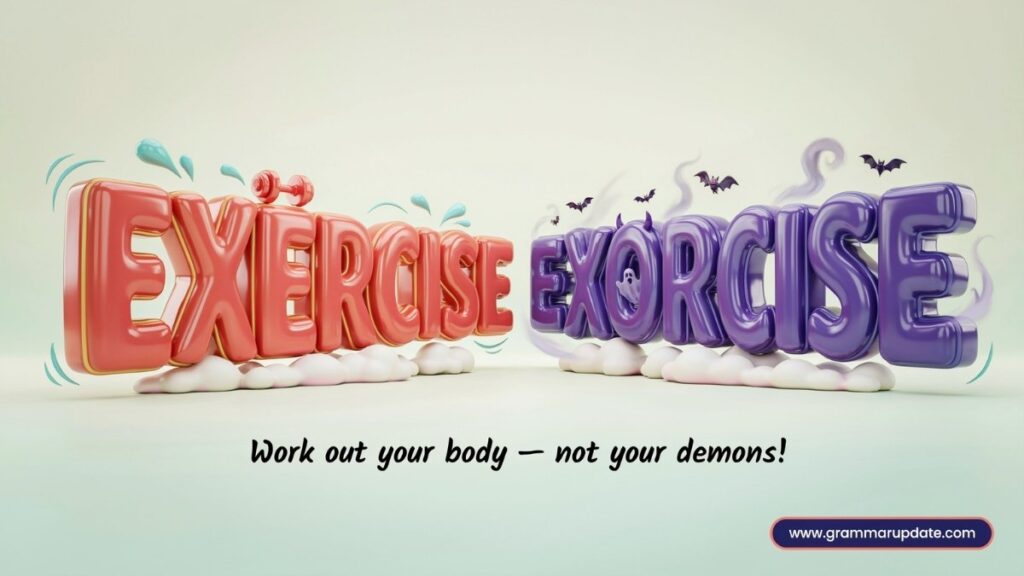
If it belongs in a gym, use exercise. If it belongs in a horror movie, use exorcise.
Most people remember the distinction immediately.
Why Correct Word Choice Matters
Choosing the correct word improves:
- Writing accuracy
- Professional communication
- Academic performance
- Search engine optimization
- Reader trust
Using the wrong term can distract readers and weaken credibility.
Strong writing depends on precise vocabulary.
Fix common more word mistakes in English
Dysregulated vs Disregulated Correct Usage Explained
Practice Session Exercise vs Exorcise
Fill each blank with the correct word: exercise or exorcise.
Questions
- Doctors recommend regular ______ for better physical health.
- The priest attempted to ______ the evil spirit from the house.
- You should ______ caution before signing any legal document.
- Daily ______ can improve heart health and fitness.
- The villagers asked a religious leader to ______ the demon.
- Students must ______ critical thinking skills during debates.
- She goes for ______ every morning before work.
- The author used writing to ______ painful memories.
- Citizens can ______ their right to vote during elections.
- The coach encouraged the team to ______ regularly.
- The ceremony aimed to ______ negative influences from the building.
- Regular ______ may help reduce stress and anxiety.
- Managers should ______ good judgment when making decisions.
- The movie shows a priest trying to ______ a spirit.
- Walking is a simple form of ______.
- Therapy helped him ______ years of fear and guilt.
- Athletes ______ every day to improve performance.
- The community believed the ritual could ______ evil forces.
- Teachers often assign a grammar ______ for homework.
- She wanted to ______ self-control during the difficult conversation.
- The church invited a specialist to ______ the spirit.
- Swimming provides excellent ______ for the entire body.
- He worked hard to ______ negative thoughts from his mind.
- Parents should ______ patience when teaching young children.
- Regular ______ supports both physical and mental well-being.
Answers
- exercise
- exorcise
- exercise
- exercise
- exorcise
- exercise
- exercise
- exorcise
- exercise
- exercise
- exorcise
- exercise
- exercise
- exorcise
- exercise
- exorcise
- exercise
- exorcise
- exercise
- exercise
- exorcise
- exercise
- exorcise
- exercise
- exercise
Here’s a trusted source for clear word meanings:
FAQs
What is the difference between exercise and exorcise?
Exercise relates to physical activity, practice, or using a skill. Exorcise means removing evil spirits or unwanted influences.
Is it exercise or exorcise demons?
The correct phrase is exorcise demons.
What does exorcise mean?
Exorcise means to drive out evil spirits or remove troubling influences.
What does exercise mean?
Exercise refers to physical activity, practice, training, or the use of a right or ability.
How do you pronounce exorcise and exercise?
Exercise is commonly pronounced “EK-ser-size,” while exorcise is pronounced “EK-sor-size.”
Can exercise help with depression and anxiety?
Many studies suggest regular physical activity supports mental well-being and may help reduce symptoms of depression and anxiety.
Conclusion
The confusion between exercise vs exorcise often starts with their similar spelling and pronunciation, but the meanings could not be more different. Exercise relates to physical activity, practice, training, and the use of skills, rights, or judgment. Exorcise, on the other hand, means to drive out evil spirits or, in a figurative sense, remove unwanted fears, memories, or negative influences. Mixing them up can create sentences that are confusing, inaccurate, and sometimes unintentionally funny. The good news is that once you understand the distinction, the choice becomes simple. If the context involves fitness, learning, health, or personal development, use exercise. If it involves banishing or removing something troubling, use exorcise. Keep this rule in mind, and you will avoid common mistakes, eliminate confusion, and write with greater clarity, accuracy, and confidence.

Jhon AJS, the creative mind behind Grammar Update, is an experienced blogger passionate about simplifying English grammar. He focuses on explaining confusing word vs word differences, grammar rules, punctuation, and sentence structure in a clear and practical way. Through easy to understand guides and examples, Jhon helps readers improve their writing and communicate with confidence. With years of blogging experience, he continues to share helpful insights that make learning grammar simple, useful, and accessible for everyone.