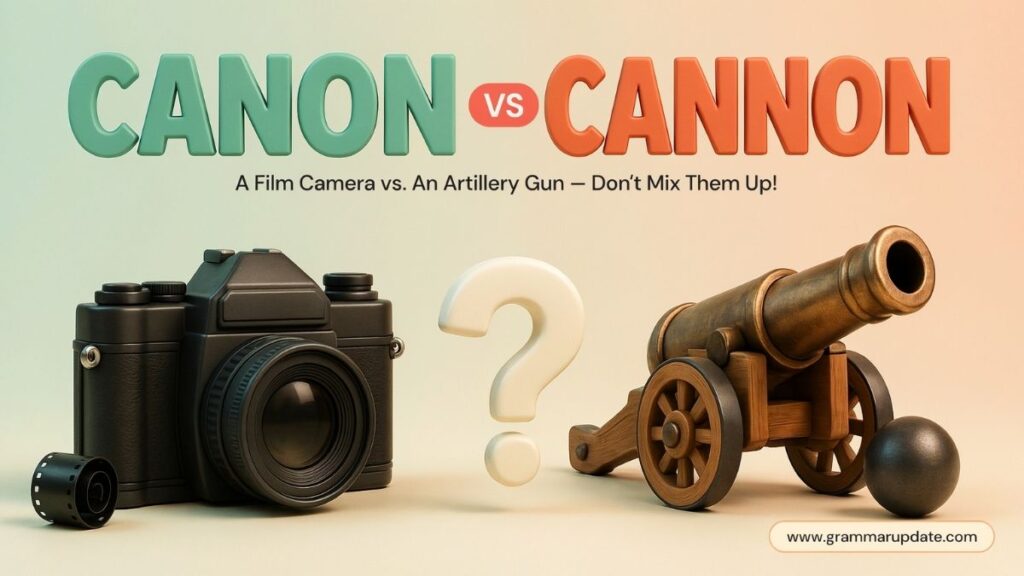
The canon vs cannon confusion is one of the most common spelling mistakes in the English language. Since both words are pronounced exactly the same, many writers mistakenly use one when they mean the other. While the error may seem minor, a single extra “n” can completely change the meaning of a sentence. Imagine discussing an official movie storyline but accidentally referring to a piece of military artillery instead. These mistakes appear frequently in academic writing, online discussions, fandom communities, and everyday communication. Understanding the difference between canon and cannon is essential for clear and accurate writing. This guide will explain their meanings, usage, examples, and simple memory tricks to help you use each word correctly with confidence.
Canon vs Cannon Quick Difference at a Glance
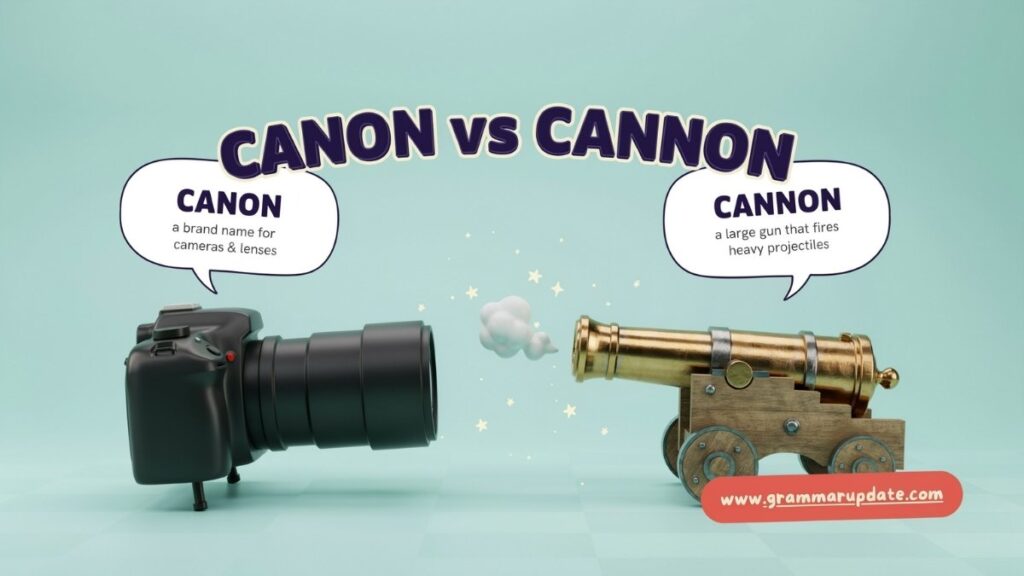
If you’re looking for the short answer, here’s the simplest explanation:
| Word | Meaning | Common Context |
|---|---|---|
| Canon | Official rule, accepted work, or official storyline | Religion, literature, fandom, music |
| Cannon | Large artillery gun or military weapon | Military, warfare, history |
Canon vs Cannon in One Sentence
- Canon relates to accepted stories, rules, texts, or standards.
- Cannon refers to a large gun used in warfare.
Quick Examples
That event is canon in the Marvel Universe.
The church recognizes those books as part of the biblical canon.
The soldiers fired a cannon during the battle.
The naval cannon protected the ship from attack.
This simple distinction solves most canon or cannon mistakes.
Fix common more word mistakes in English
Busing vs Bussing Difference and Correct Usage
What Does Canon Mean?
Understanding canon meaning is the key to avoiding confusion.
Canon Definition
The canon definition generally refers to something officially accepted, recognized, or established.
Depending on the context, canon may describe:
- Official storylines
- Religious texts
- Literary works
- Artistic standards
- Musical structures
- Accepted lore
The word comes from ancient Greek and Latin terms meaning “rule” or “standard.”
A Simple Way to Think About Canon
When something is canon, it belongs to the official version.
Think of canon as the “approved truth.”
If a movie event happened in the official story, it is canon.
If a book belongs to a recognized collection of religious texts, it is canon.
And If a work appears among the most important literary works, it may be part of the literary canon.
Canon as an Accepted Rule or Standard
Long before fandoms and superhero movies existed, people used canon to describe official standards.
Religious organizations, scholars, and artists often used the word when discussing accepted works or rules.
Examples
- Church canon laws govern certain religious practices.
- Academic institutions discuss the Western literary canon.
- Art historians refer to the art canon when studying influential works.
In these contexts, canon represents authority, recognition, and acceptance.
More Related Articles You May Find Helpful
Compair vs Compare Which Is Correct and usage?
Religious Canon
One of the oldest uses of the word appears in religion.
What Is Religious Canon?
A religious canon is a collection of texts officially accepted as authentic and authoritative.
The most famous example is the Bible.
Different Christian traditions recognize slightly different collections of books, but each denomination maintains an official canon.
Church Canon
The term church canon may refer to:
- Official church laws
- Religious regulations
- Approved religious texts
For example, the Catholic Church has canon law that guides governance and religious practice.
Why Religious Canon Matters
Religious canon helps establish:
- Accepted doctrine
- Historical continuity
- Shared beliefs
- Official teachings
Without an agreed canon, interpretations could vary dramatically.
More Related Articles You May Find Helpful
Totaled vs Totalled Which Spelling Is Correct?
Literary Canon
Another important use appears in literature.
What Is the Literary Canon?
The literary canon refers to works widely considered significant, influential, or essential.
These books often appear in schools and universities because they shaped literature and culture.
Examples of Literary Canon
Common examples include works by:
- William Shakespeare
- Jane Austen
- Charles Dickens
- Homer
- Mark Twain
These authors helped define literary traditions and continue influencing modern storytelling.
Why the Literary Canon Exists
The literary canon serves several purposes:
- Preserves influential works
- Provides historical context
- Establishes educational standards
- Encourages cultural understanding
Of course, debates about which works belong in the canon continue today.
Fix common more word mistakes in English
Abley vs Ably Which Spelling Is Correct in English?
Canon in Movies, TV Shows, and Books
For many readers, this is the most familiar meaning.
What Is Canon in Fiction?
Canon in fiction refers to events, characters, locations, and storylines officially recognized within a fictional universe.
In simple terms:
Canon means “it really happened in the official story.”
Anything outside the official story usually falls into the category of non-canon content.
Famous Examples
Star Wars
The Star Wars franchise has an official canon that includes approved movies, television series, novels, and comics.
Some older stories once belonged to the Expanded Universe but later became non-canon.
Marvel Universe
The Marvel Universe contains thousands of interconnected stories.
Events occurring within official Marvel continuity are considered canon.
Harry Potter
The Harry Potter books establish the core canon of the wizarding world.
Additional material may expand the universe, but fans often debate whether certain information belongs to official canon.
Disney
Disney franchises frequently create canon discussions when new movies alter previous storylines.
DC Comics
DC Comics regularly revises continuity through major crossover events.
These changes often spark debates about which events remain canon.
Fix common more word mistakes in English
Carat vs Caret vs Karat Which is Differences?
Canon vs Cannon in Fandom
One reason people search for canon vs cannon in fandom is because fandom communities use the word canon constantly.
What Is Fandom Canon?
Fandom canon refers to the officially accepted storyline within a franchise.
It includes:
- Official lore
- Canonical events
- Story continuity
- Character histories
- Approved world-building details
Fans rely on canon to understand a fictional universe accurately.
Official Storyline vs Fan Interpretation
Many fans create theories and alternative explanations.
These ideas can be entertaining, but they aren’t automatically canon.
A fan theory becomes canon only when creators officially confirm it.
Why Canon Matters in Storytelling
Canon provides consistency.
Without canon, stories would quickly become confusing.
Imagine if every superhero movie contradicted the previous one without explanation.
The result would be narrative chaos.
Canon helps maintain:
- Storytelling consistency
- Fictional continuity
- Franchise lore
- Character development
Fix common more word mistakes in English
Exercise vs Exorcise Differences and Correct Usage
What Is Non Canon?
The opposite of canon is non-canon.
Non-Canon Definition
Non-canon content exists outside the official storyline.
Examples include:
- Alternate endings
- Promotional stories
- Fan fiction
- Parody content
- Unofficial adaptations
Example
Suppose a fan writes a story where Harry Potter becomes a professional astronaut.
The story might be creative, but it isn’t part of official Harry Potter continuity.
Therefore, it is non-canon.
Learn the difference between confusing more English words
Success vs Sucess Which is Correct? Complete Guide
Headcanon vs Canon
Modern fandom discussions introduced another important term.
What Is Headcanon?
Headcanon refers to a personal belief about a fictional universe that isn’t officially confirmed.
For example:
A fan may believe two characters secretly knew each other before the story began.
Nothing in the official storyline proves this idea, but it makes sense to the fan.
That’s headcanon.
Canon vs Headcanon
| Canon | Headcanon |
|---|---|
| Officially confirmed | Personally imagined |
| Supported by creators | Supported by fans |
| Part of continuity | Not necessarily part of continuity |
This distinction appears constantly in fandom discussions.
Learn the difference between confusing more English words
Party’s vs Parties Basic Difference
What Does Cannon Mean?
Now let’s examine the second word.
Cannon Definition
The cannon definition is much simpler.
A cannon is a large firearm designed to launch projectiles over long distances.
Historically, cannons changed warfare forever.
They became one of the most powerful weapons on battlefields around the world.
Cannon Meaning in Simple Terms
A cannon is:
- A military weapon
- A heavy weapon
- An artillery gun
- A gunpowder weapon
Unlike canon, cannon has nothing to do with storytelling, religion, literature, or official lore.
More Related Articles You May Find Helpful
Grately vs Greatly Differences and Correct Usage
Cannon as a Military Weapon
When discussing canon vs cannon military meaning, remember this simple rule:
Cannon = weapon.
Characteristics of a Cannon
Traditional cannons usually feature:
- Heavy metal construction
- Long barrels
- Gunpowder propulsion
- Large projectiles
For centuries, armies relied on cannons to destroy fortifications and support troops during combat.
Historical Artillery
Cannons became widespread between the 14th and 19th centuries.
They transformed warfare by allowing armies to attack targets from greater distances.
Important forms included:
- Siege cannon
- Field cannon
- Naval cannon
- Fortress artillery
The development of artillery dramatically altered military strategy.
Cannonball and Artillery Warfare
One famous symbol of historical warfare is the cannonball.
What Is a Cannonball?
A cannonball is a projectile fired from a cannon.
Most early cannonballs were made from stone or iron.
They could:
- Break walls
- Damage ships
- Destroy defenses
- Injure enemy soldiers
In many battles, cannon artillery determined victory or defeat.
Fix common more word mistakes in English
Encorporate vs Incorporate Correct Usage
Naval Cannon and Maritime Warfare
Warships relied heavily on cannons for centuries.
A naval cannon allowed ships to engage enemies at sea long before modern missiles existed.
Major naval powers often equipped vessels with dozens of cannons.
These weapons played crucial roles in:
- Trade protection
- Naval warfare
- Coastal defense
- Maritime expansion
The age of sail would have looked very different without cannon technology.
Common Cannon Examples
Here are some examples using the correct spelling.
Cannon Examples in Sentences
- The soldiers loaded the cannon before the attack.
- A naval cannon guarded the harbor entrance.
- The museum displays a cannon from the eighteenth century.
- Historical artillery changed the outcome of many wars.
- The cannonball struck the fortress wall.
Notice how every example relates to weapons or warfare.
Fix common more word mistakes in English
Realist vs Realest Correct Usage
Canon vs Cannon Usage The Key Difference
The easiest way to remember canon vs cannon usage is this:
| If You Mean… | Use… |
|---|---|
| Official storyline | Canon |
| Accepted lore | Canon |
| Religious texts | Canon |
| Literary works | Canon |
| Military weapon | Cannon |
| Artillery gun | Cannon |
| Cannonball weapon | Cannon |
A single extra “n” completely changes the meaning.
Send “continue” and I’ll provide the next section covering pronunciation, homophones, canon event meaning, Spider-Verse canon event, music canon, Canon camera brand confusion, Reddit discussions, memory tricks, FAQs, case study examples, and the conclusion.
For AEO (Answer Engine Optimization), answers should be concise, direct, definition-first, and optimized for featured snippets, AI Overviews, voice search, and People Also Ask results.
Practice Session Canon vs Cannon
Choose the correct word (canon or cannon) to complete each sentence.
Easy Level
- The event became part of the official __________ storyline.
- The soldiers fired a __________ during the battle.
- Many fans debate whether a character is __________.
- The museum displays a historic __________ from the 18th century.
- The books were added to the biblical __________.
- A naval __________ protected the harbor.
- That scene is not __________ according to the creators.
- The army transported a large __________ across the field.
- The novel is considered part of the literary __________.
- The fortress was damaged by a __________ ball.
Medium Level
- Fans disagreed about whether the new movie should be considered __________.
- The ship carried several __________ for defense.
- The church officially recognized the text as part of its __________.
- Historians studied the __________ used during the siege.
- The character’s death became an important __________ event.
- The old stone walls were destroyed by __________ fire.
- Scholars continue to debate which works belong in the literary __________.
- The commander ordered the __________ to be loaded immediately.
- According to official lore, that battle is __________.
- The massive __________ could launch projectiles over long distances.
Advanced Level
- The expanded universe stories were removed from official __________.
- The king’s army relied heavily on __________ artillery during the war.
- The franchise creators confirmed that the episode is fully __________.
- Several ancient texts were excluded from the biblical __________.
- The enemy fortress was attacked using a siege __________.
- The writer accidentally typed “__________” instead of “canon” in the article.
- The Marvel timeline treats those events as official __________.
- A __________ was once one of the most powerful battlefield weapons available.
- The professor discussed the Western literary __________ in class.
- The harbor defenses included multiple __________ aimed at approaching ships.
Answers
- Canon
- Cannon
- Canon
- Cannon
- Canon
- Cannon
- Canon
- Cannon
- Canon
- Cannon
- Canon
- Cannons
- Canon
- Cannon
- Canon
- Cannon
- Canon
- Cannon
- Canon
- Cannon
- Canon
- Cannon
- Canon
- Canon
- Cannon
- Cannon
- Canon
- Cannon
- Canon
- Cannons
Bonus Challenge
Correct the spelling mistakes in these sentences.
- That episode is not cannon according to the official storyline.
- The cannon of Scripture differs among some Christian traditions.
- Fans often argue about what is cannon in the franchise.
- The soldiers positioned a canon near the castle walls.
- The literary cannon includes many influential works.
Answers
- canon
- canon
- canon
- cannon
- canon
Here’s a trusted source for clear word meanings:
FAQs
Is it spelled canon or cannon?
Both spellings are correct, but they have different meanings. Canon refers to an official rule, accepted text, or official storyline. Cannon refers to a large artillery weapon used in warfare. The correct spelling depends on the context.
Is a story canon or cannon?
A story is canon, not cannon. In fiction, canon refers to events, characters, and details that officially belong to a story’s continuity. Anything outside the official storyline is considered non-canon.
Is there a canon in the Catholic Church?
Yes. The Catholic Church has a biblical canon, which is the official collection of books recognized as Scripture. The Church also follows canon law, a system of rules that governs church practices and administration.
How is canon pronounced?
Canon is pronounced KAN-uhn (/ˈkænən/). It sounds exactly the same as cannon, making the two words homophones.
Why do people say cannon instead of canon?
People often write cannon instead of canon because both words have the same pronunciation. This common spelling mistake frequently appears in fandom discussions, social media posts, and online forums.
Is “cannon’s mouth” a phrase?
Yes. The phrase mouth of a cannon refers to the open end of a cannon barrel where projectiles are fired. It commonly appears in military and historical writing.
What does canon mean?
Canon means something officially accepted or recognized as authentic. It can refer to religious texts, literary works, artistic standards, musical forms, or official storylines within a fictional universe.
Why is everyone saying canon now?
The word canon has become popular because of fandom culture, social media, anime, gaming communities, and major franchises such as Marvel and Star Wars. Fans use it to describe official events and accepted lore within a story.
What are the three canons of the Bible?
The three major biblical canons are:
- Protestant Canon (66 books)
- Catholic Canon (73 books)
- Eastern Orthodox Canon (includes additional books)
Each Christian tradition recognizes a slightly different collection of biblical texts.
What does canon mean in LGBTQ+ discussions?
In LGBTQ+ discussions, canon refers to officially confirmed representation within a story. If a creator confirms a character’s identity or relationship, it becomes canon rather than fan speculation.
What were cannonballs filled with?
Most cannonballs were solid iron or stone projectiles. Some specialized versions contained explosives, incendiary materials, grapeshot, or chain shot designed for specific military purposes.
What does canon mean in Gen Z slang?
In Gen Z slang, canon usually means something that is officially part of a story or franchise. The term gained popularity through fandom culture and phrases like “canon event.”
What does “then the whining schoolboy with his satchel” mean?
This phrase comes from Shakespeare’s As You Like It. It describes the childhood stage of life and portrays a young student reluctantly going to school with a satchel.
Why is everyone saying canon?
People frequently use canon because discussions about movies, TV shows, games, anime, and comic book franchises often focus on official story continuity. The term has become part of everyday internet vocabulary.
Is canon a slang term?
Canon is not originally slang. It has been used for centuries in religion, literature, and scholarship. However, modern fandom communities have adopted it as a common term when discussing official storylines and continuity.
What does a canon mean in the Bible?
In the Bible, canon refers to the officially recognized collection of books accepted as Scripture. The biblical canon determines which texts are considered authoritative within a particular Christian tradition.
Conclusion
The canon vs cannon confusion is a common grammar mistake that often leads to unclear or unintended meanings in writing. Because the words sound identical, a single extra “n” can completely change the context of a sentence. What should refer to an official storyline, accepted text, or recognized work can accidentally turn into a reference to a military weapon used in warfare. This error frequently appears in academic writing, online discussions, and fandom conversations. The distinction is straightforward once learned. Canon refers to official content or accepted continuity in religion, literature, and fiction, while cannon refers to artillery or a battlefield weapon. Understanding this difference ensures clearer, more accurate, and more professional writing.

Jhon AJS, the creative mind behind Grammar Update, is an experienced blogger passionate about simplifying English grammar. He focuses on explaining confusing word vs word differences, grammar rules, punctuation, and sentence structure in a clear and practical way. Through easy to understand guides and examples, Jhon helps readers improve their writing and communicate with confidence. With years of blogging experience, he continues to share helpful insights that make learning grammar simple, useful, and accessible for everyone.