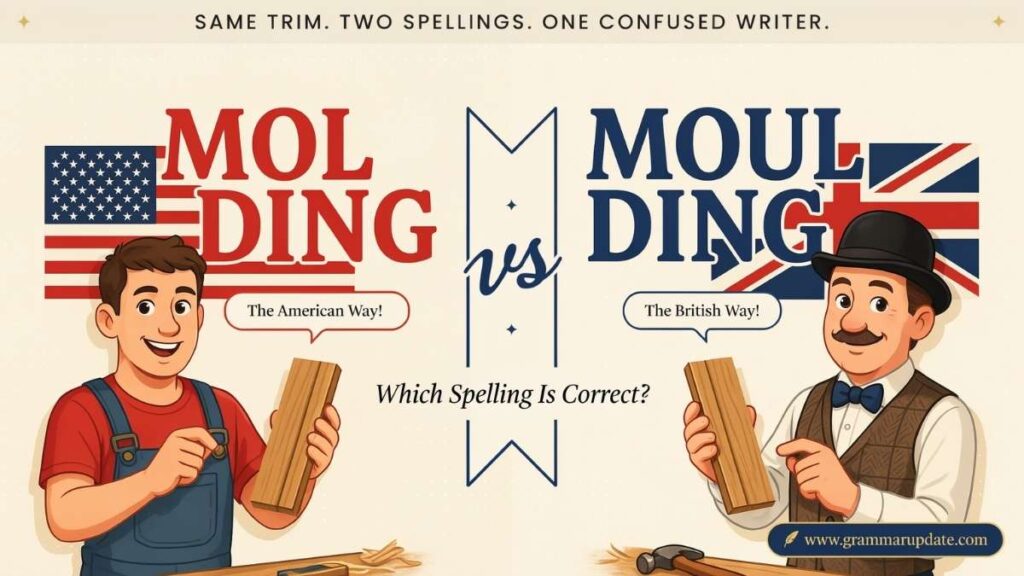
Molding vs moulding is one of those subtle English spelling variations that often creates unnecessary confusion, even for experienced writers. At first glance, both forms look interchangeable, and in meaning they largely are. The real challenge comes from regional usage rather than definition. You might be describing elegant crown molding in interior design or precision moulding in industrial manufacturing and still pause, unsure which spelling is correct. This hesitation often leads to inconsistent writing and avoidable errors. In this guide, you will clearly understand when to use molding vs moulding, how to avoid common spelling mistakes, and how to apply each form confidently in any context.
Molding vs Moulding What’s the Real Difference?
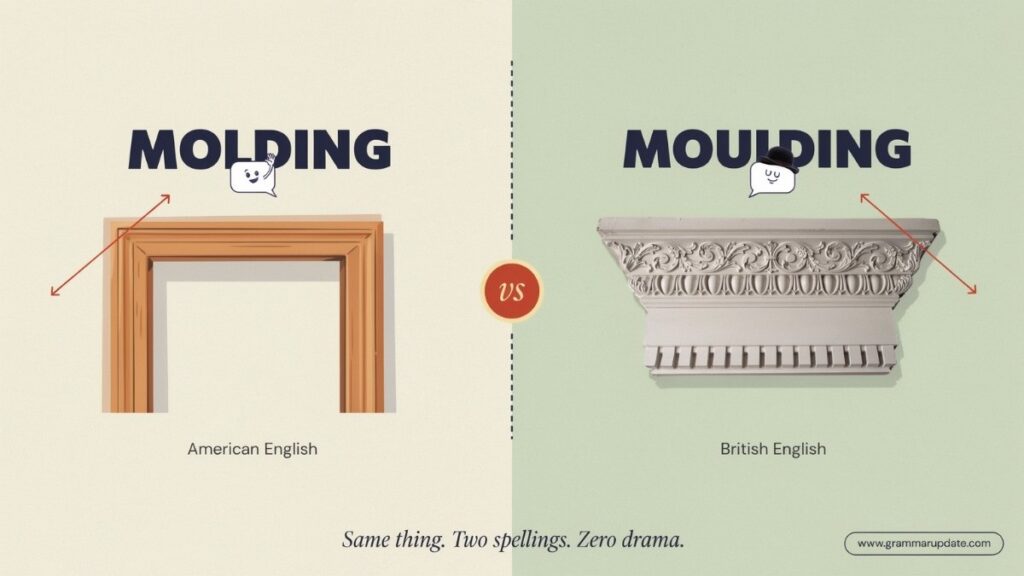
At the core, molding and moulding mean the same thing. The difference lies only in spelling conventions.
Molding Meaning or Moulding Meaning
The molding meaning (or moulding meaning) refers to:
- Shaping a material into a specific form
- Decorative architectural trim in buildings
- Industrial manufacturing processes
- The act of influencing or forming something abstract, like behavior or personality
Molding Definition / Moulding Definition
The molding definition can be understood in three main ways:
- Physical shaping of materials like clay, plastic, or metal
- Architectural design element used in interiors
- Metaphorical shaping of ideas, behavior, or identity
In short:
Molding = shaping something into form, physically or conceptually.
Key Takeaway
There is no difference in meaning between moulding vs molding. The only difference is spelling style based on region.
Learn the difference between tricky more English words
Canon vs Cannon Difference and Usage
Molding vs Moulding UK vs US English Usage
The difference between molding and moulding is rooted in language evolution.
Molding in American English
In the United States, the correct spelling is:
Molding (American English)
This simplified spelling was popularized by Noah Webster, who aimed to streamline English spelling in the 18th and 19th centuries.
Common usage includes:
- molding trim
- decorative molding
- plastic molding
- injection molding
Moulding in British English
In the United Kingdom and many Commonwealth countries, the spelling remains:
Moulding (British English)
Common usage includes:
- decorative moulding
- crown moulding
- wall moulding
- interior moulding
Regional Spelling Table
| Region | Correct Spelling | Example |
|---|---|---|
| United States | molding | crown molding |
| United Kingdom | moulding | crown moulding |
| Canada | mixed usage | molding / moulding |
| Australia | moulding | wall moulding |
Simple Rule
Use molding in American English and moulding in British English.
More Related Articles You May Find Helpful
Licence vs License Which Spelling Is Correct?
Molding vs Moulding Pronunciation
One of the most common questions learners ask is whether molding and moulding are pronounced differently. The answer is simple: they are not.
Despite the difference in spelling, both words share the exact same pronunciation in American and British English. The extra “u” in moulding affects the spelling only, not the way the word is spoken.
Pronunciation Guide
| Word | IPA Pronunciation |
|---|---|
| Molding | /ˈmoʊl.dɪŋ/ |
| Moulding | /ˈmoʊl.dɪŋ/ |
How to Pronounce Molding and Moulding
Both words are pronounced as:
MOHL-ding
The first syllable rhymes with old, while the second syllable sounds like ding.
Why Do They Sound the Same?
The spelling difference reflects regional writing conventions rather than pronunciation. Just as American English uses color and British English uses colour, the spoken form remains virtually identical. The same principle applies to molding and moulding.
This is why many people search for:
- Is it molding or moulding pronunciation?
- Molding vs moulding sound difference
- How do you pronounce molding?
- How do you pronounce moulding?
The answer remains the same in every case:
There is no pronunciation difference between molding and moulding. Only the spelling changes.
Fix common more word mistakes in English
Planing vs Planning Difference and Correct Usage
Molding vs Moulding in Architecture and Interior Design
One of the most common uses of this word is in home design and construction.
What Is Trim Molding or Trim Moulding?
Trim molding (or trim moulding) refers to decorative wood or material used to enhance interiors.
It is used for:
- covering gaps between surfaces
- adding decorative detail
- improving room aesthetics
Fix common more word mistakes in English
Muscle vs Mussel Which is Difference and usage?
Types of Architectural Molding
Architectural molding plays an important role in both design and functionality. These decorative elements add character, create visual interest, and provide a polished finish to interior spaces. Whether you use the American spelling molding or the British spelling moulding, the purpose remains the same: enhancing the appearance of a room while highlighting architectural details.
Crown Molding vs Crown Moulding
Crown molding (or crown moulding) is installed where the wall meets the ceiling. It creates a smooth transition between surfaces and is often considered one of the most elegant architectural features in a home.
Benefits of crown molding include:
- Adds sophistication and visual appeal
- Creates a finished, high-end appearance
- Enhances traditional and contemporary interiors
- Increases perceived architectural value
Because of its decorative nature, crown molding is frequently found in luxury homes, formal dining rooms, living rooms, and upscale commercial spaces.
Baseboard Molding vs Baseboard Moulding
Baseboard molding is installed along the bottom of a wall where it meets the floor. While it serves a decorative purpose, it also provides practical protection.
Key advantages include:
- Protects walls from scuffs, scratches, and furniture damage
- Covers expansion gaps between flooring and walls
- Creates a clean, finished transition
- Complements a room’s overall design style
Baseboard molding is one of the most common types of trim used in modern residential and commercial construction.
Wall Molding vs Wall Moulding
Wall molding refers to decorative trim or paneling applied directly to walls. It is often used to create depth, texture, and architectural interest.
Popular applications include:
- Picture frame molding
- Raised panel designs
- Wainscoting accents
- Decorative geometric layouts
Wall molding is particularly popular in classic European-inspired interiors where elegance and craftsmanship are key design elements.
Door and Window Molding
Door and window molding frames openings throughout a home or building. These trim pieces provide a finished appearance while helping define architectural lines.
Common benefits include:
- Enhances the visual appeal of doors and windows
- Covers gaps between walls and frames
- Creates a more refined and cohesive design
- Adds dimension and architectural depth
When carefully selected, door and window molding can transform simple openings into standout design features that elevate the entire space.
Quick Comparison of Architectural Molding Types
| Type | Location | Primary Purpose |
|---|---|---|
| Crown Molding | Between wall and ceiling | Decorative finishing and elegance |
| Baseboard Molding | Between wall and floor | Protection and visual transition |
| Wall Molding | Directly on walls | Decorative detail and dimension |
| Door Molding | Around door frames | Finishing and architectural enhancement |
| Window Molding | Around window frames | Visual framing and decorative appeal |
From grand crown molding to subtle door trim, architectural molding remains one of the most effective ways to add character, style, and value to a space.
More Related Articles You May Find Helpful
Imbed vs Embed Which Spelling Should You Use?
Interior Molding vs Decorative Trim
| Feature | Molding / Moulding | Trim |
|---|---|---|
| Purpose | Structural + decorative | Mostly decorative |
| Material | Wood, PVC, plaster | Wood, MDF |
| Use | Walls, ceilings, doors | Finishing edges |
Modern Interior Design Trends
A 2024 interior design survey showed:
- 68% of luxury homes use crown molding
- Minimalist homes reduce decorative molding by 40%
- White-painted molding remains the most popular finish globally
Designers report that decorative molding and moulding continues to symbolize premium interior finishing.
Molding vs Moulding in Manufacturing
Beyond homes, molding and moulding in manufacturing plays a major industrial role.
What Is Plastic Molding / Plastic Moulding?
Plastic molding is the process of shaping plastic into final products using heat and pressure.
Used for:
- bottles
- containers
- toys
- automotive parts
Injection Molding / Injection Moulding
One of the most important manufacturing processes.
Steps include:
- Melting plastic
- Injecting into a mold
- Cooling and solidifying
- Removing finished product
Industries using injection molding:
- automotive
- medical equipment
- electronics
Other Manufacturing Types
| Process | Description |
|---|---|
| Blow molding | Creates hollow objects like bottles |
| Rotational molding | Produces large hollow parts |
| Compression molding | Used for rubber and thermoset plastics |
Industrial Importance
Over 80% of plastic goods worldwide are made using some form of molding process, making it essential in global manufacturing.
More Related Articles You May Find Helpful
Emigrate vs Immigrate Difference and usage
Molding or Moulding as a Verb
The word also works as a verb meaning to shape or influence something.
Physical Shaping Meaning
You can mold materials like:
- clay
- plastic
- chocolate
- wax
Example:
- She is molding clay into a sculpture.
Molding a Person / Moulding a Person
In a metaphorical sense, it refers to shaping behavior or personality.
Examples:
- Teachers help in molding students’ character
- Parents play a role in molding a child’s values
- Mentors assist in shaping future leaders
This is often linked to:
- personality development
- leadership training
- behavioral influence
Learn the difference between tricky more English words
Pent vs Pant Usage and Difference Explained
Molding in Everyday Life
Food Molding or Culinary Uses
Food molding is used in culinary arts to create visually appealing dishes.
Examples:
- chocolate molding
- cake molding
- dessert presentation molds
Chefs use molds to create:
- geometric desserts
- shaped chocolates
- decorative plating designs
Clay and Craft Applications
Molding clay is a core technique in art and pottery.
Used in:
- sculpture making
- ceramic design
- pottery shaping
Common techniques include:
- hand molding
- wheel shaping
- sculpting tools
Learn the difference between tricky more English words
All-time favorite vs all times favorite Which Is Correct?
Why Is It Molding or Moulding?
Many people ask, “Is it molding or moulding?” The answer lies in the history of the English language rather than in any difference in meaning.
Both spellings originated from the same word, but over time American and British English adopted different spelling conventions. As a result, molding became the preferred form in the United States, while moulding remained the standard spelling in the United Kingdom and many other English-speaking countries.
The Noah Webster Influence
One of the biggest reasons for this spelling difference can be traced to Noah Webster, the American lexicographer best known for creating Webster’s Dictionary.
During the late 18th and early 19th centuries, Webster advocated for a simpler and more standardized form of English spelling. His goal was to make words easier to read, write, and learn.
As part of this movement, several words lost the extra “u” that remained common in British English.
Some well-known examples include:
| British English | American English |
|---|---|
| Colour | Color |
| Favour | Favor |
| Honour | Honor |
| Labour | Labor |
| Moulding | Molding |
These changes eventually became standard throughout the United States and are still used today.
British English Preserved Traditional Spellings
While American English embraced simplified spelling, British English largely retained its traditional forms.
As a result, words such as:
- moulding
- colour
- flavour
- neighbour
- humour
continue to be widely used across the United Kingdom and many Commonwealth countries, including Australia and New Zealand.
Why Both Spellings Are Correct
The important thing to remember is that molding and moulding have the same meaning. The difference is purely regional.
Whether you’re referring to decorative trim in a home, a manufacturing process, or the act of shaping something, both spellings are acceptable when used in the appropriate language style.
Molding is the standard American English spelling, while moulding is the standard British English spelling.
Understanding this historical distinction makes it much easier to choose the correct form and avoid unnecessary confusion in your writing. exist today.
Fix common more word mistakes in English
Bellies vs Bellys Which one is Correct?
Common Mistakes to Avoid
Although molding and moulding are easy to understand once you know the regional spelling difference, writers still make a few common mistakes. Avoiding these errors will help keep your writing accurate, consistent, and professional.
Mixing American and British Spellings
One of the most frequent mistakes is using the wrong spelling for your target audience.
For example:
- Using moulding in a document written for an American audience
- Using molding in formal UK publications or British-style content
Neither spelling is incorrect, but consistency matters. If you’re writing in American English, use molding throughout the entire document. If you’re writing in British English, use moulding consistently.
Assuming Molding and Moulding Have Different Meanings
Many people believe that molding and moulding refer to different things. This is a common misconception.
In reality, both words mean exactly the same thing. They can refer to:
- Shaping or forming a material
- Decorative architectural trim
- Manufacturing processes
- Influencing or shaping behavior, character, or development
The spelling changes based on region, but the meaning does not.
Using Both Spellings in the Same Article
Another common mistake is switching between molding and moulding within the same piece of writing.
For example, writing “crown molding” in one paragraph and “decorative moulding” in the next can make content appear inconsistent and unprofessional.
Choose one spelling based on your audience and use it consistently from beginning to end.
Ignoring Audience Expectations
Readers generally expect content to follow the spelling conventions of their region.
- American readers typically expect molding
- British readers typically expect moulding
Matching your audience’s language preferences improves readability and creates a more polished experience.
Quick Recap
To avoid confusion, remember these simple rules:
Molding = American English
Moulding = British English
Both words have the same meaning
Use one spelling consistently throughout your writing
Match the spelling to your target audience
Following these guidelines will help you avoid one of the most common spelling mistakes associated with molding vs moulding.randomly, which reduces content consistency.
Fix common more word mistakes in English
Togather vs Together Which Is the Correct Word to Use?
Quick Guide When to Use Each Spelling
Simple Decision Rule
- Use molding for American English audiences
- Use moulding for British English audiences
Quick Flow Check
- Writing for US readers → molding
- Writing for UK readers → moulding
- Unsure → match your target audience style
Practice Session Molding vs Moulding
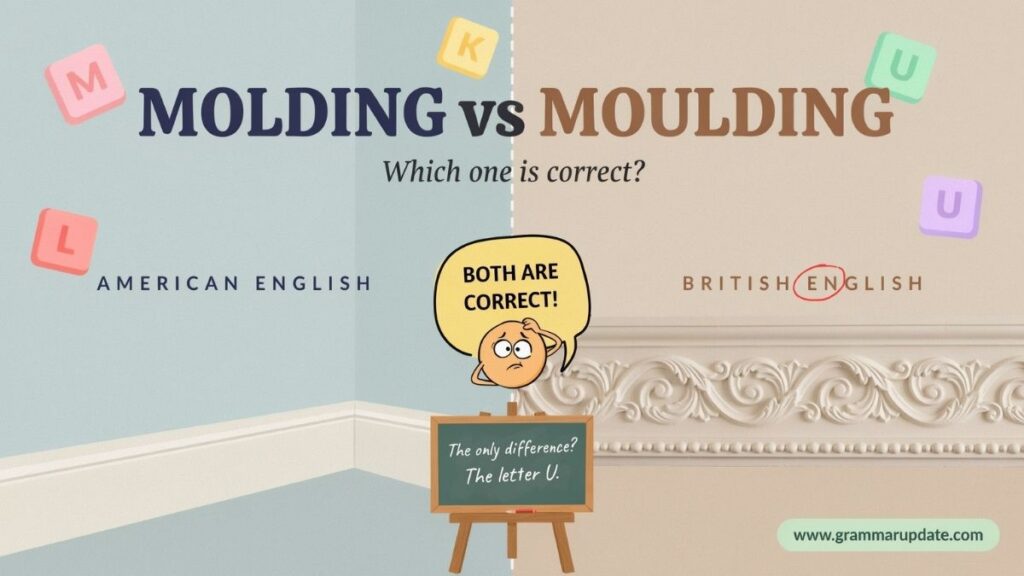
Choose the correct word (molding or moulding) to complete each sentence. Use American English or British English rules where appropriate.
Fill in the Blanks
- The carpenter installed decorative __________ along the ceiling for a finished look.
- In the United States, builders often refer to crown __________ in interior design.
- The factory uses injection __________ to produce plastic parts.
- The artist started __________ clay into a human face sculpture.
- Baseboard __________ helps protect walls from damage.
- The bakery used chocolate __________ to create shaped desserts.
- In British English, the correct spelling is crown __________.
- The company specializes in custom plastic __________ for industrial products.
- Teachers play a role in __________ a student’s personality and behavior.
- Wall __________ adds elegance to traditional home interiors.
- The technician explained how rotational __________ works in manufacturing.
- She is __________ clay into a bowl using traditional techniques.
- Door __________ gives a polished finish to interior spaces.
- Food __________ is used in professional culinary presentation.
- The workshop demonstrated compression __________ for rubber materials.
- He believes mentors help in __________ future leaders.
- Ceiling __________ is common in luxury home designs.
- Plastic __________ is widely used in packaging production.
- The sculptor spent hours __________ clay into detailed shapes.
- Interior designers often recommend decorative __________ for classic homes.
- Injection __________ is essential in modern manufacturing industries.
- The chef experimented with dessert __________ techniques.
- Wood __________ is commonly used in furniture finishing.
- They studied how behavioral __________ affects child development.
- Rotational __________ is used to create hollow plastic products.
Answers
- moulding / molding
- molding
- molding
- molding
- moulding / molding
- molding
- moulding
- molding
- molding
- moulding / molding
- molding
- molding
- moulding / molding
- molding
- molding
- molding
- moulding / molding
- molding
- molding
- moulding / molding
- molding
- molding
- moulding / molding
- molding
- molding
Here’s a trusted source for clear word meanings:
FAQs
What is the difference between molding and moulding?
There is no difference in meaning. Molding and moulding refer to the same process of shaping or forming something. The only distinction is spelling: “molding” is used in American English, while “moulding” is used in British English.
Is it molding or moulding?
Both are correct. The choice depends on your audience. Use molding for American English and moulding for British or Commonwealth English. The meaning stays the same in both cases.
What does molding mean?
Molding meaning refers to the act of shaping a material, object, or idea into a specific form. It can describe physical processes in construction and manufacturing or abstract influence, such as shaping behavior or personality.
What does moulding mean?
Moulding meaning is identical to molding. It refers to forming or shaping something physically or conceptually, depending on context such as architecture, industry, or personal development.
How do you pronounce molding and moulding?
Both molding pronunciation and moulding pronunciation are the same: /ˈmoʊl.dɪŋ/. There is no pronunciation difference between the two spellings.
Why do Americans spell molding without a “u”?
The spelling “molding” comes from American English spelling reforms, most notably influenced by Noah Webster, who simplified many English words by removing unnecessary letters for consistency and efficiency.
What is molding used for in construction?
In construction, molding refers to decorative trim used to enhance interiors. It includes elements like crown molding, baseboard molding, and wall molding that provide a finished architectural look.
What is moulding used for in construction?
In British English, moulding refers to the same decorative architectural trim used in interiors, including crown moulding, door moulding, and ceiling moulding.
What is injection molding or injection moulding?
Injection molding (or moulding) is a manufacturing process where molten material, usually plastic, is injected into a mold to create precise industrial or consumer products such as containers, parts, and tools.
Are molding and moulding the same thing?
Yes. They are the same word with the same meaning. The only difference lies in regional spelling conventions between American and British English.
Which is correct molding or moulding?
Both are correct. Use molding for American English writing and moulding for British English writing. The correct form depends entirely on your target audience.
What does molding a person mean?
Molding a person refers to shaping someone’s character, behavior, or development through influence, guidance, education, or mentorship.
More Related Articles You May Find Helpful
Convertor vs Converter Which Spelling Is Correct?
Conclusion
The debate over molding vs moulding often creates more confusion than it deserves. While the two spellings may look different, they share the same meaning and are used in the same contexts, from architecture and interior design to manufacturing, crafts, and personal development. The real difference is not what the word means but where it is being used.
The good news is that this common spelling dilemma has a simple solution. If you are writing for an American audience, use molding. If you are writing for a British audience, use moulding. Once you understand this distinction, the uncertainty disappears.
So the next time you find yourself staring at the word and wondering whether that extra “u” belongs there, remember that both spellings are correct. The key is choosing the version that matches your audience. Master that one rule, and you’ll avoid a common writing mistake while keeping your communication clear, polished, and professional.

Jhon AJS, the creative mind behind Grammar Update, is an experienced blogger passionate about simplifying English grammar. He focuses on explaining confusing word vs word differences, grammar rules, punctuation, and sentence structure in a clear and practical way. Through easy to understand guides and examples, Jhon helps readers improve their writing and communicate with confidence. With years of blogging experience, he continues to share helpful insights that make learning grammar simple, useful, and accessible for everyone.