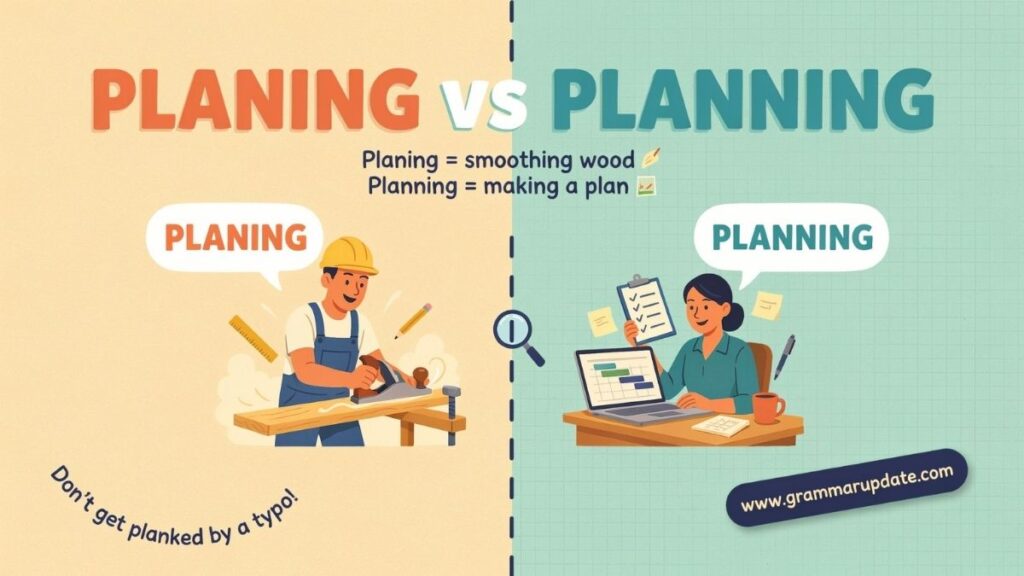
The confusion between planing vs planning is a common writing mistake that can easily distort meaning in both casual and professional communication. Because the two words look almost identical, writers often swap them without realizing it, which leads to unclear or incorrect sentences. However, the difference is straightforward once understood. Planning refers to preparation, organization, scheduling, strategy, and decision-making for future goals, projects, or actions. In contrast, planing is a technical term used in woodworking, carpentry, manufacturing, and marine engineering to describe the process of smoothing, shaping, or leveling a surface with specialized tools. Mastering this distinction improves clarity, prevents grammar mistakes, and ensures more accurate and professional writing in everyday use.
Planing vs Planning The Quick Answer
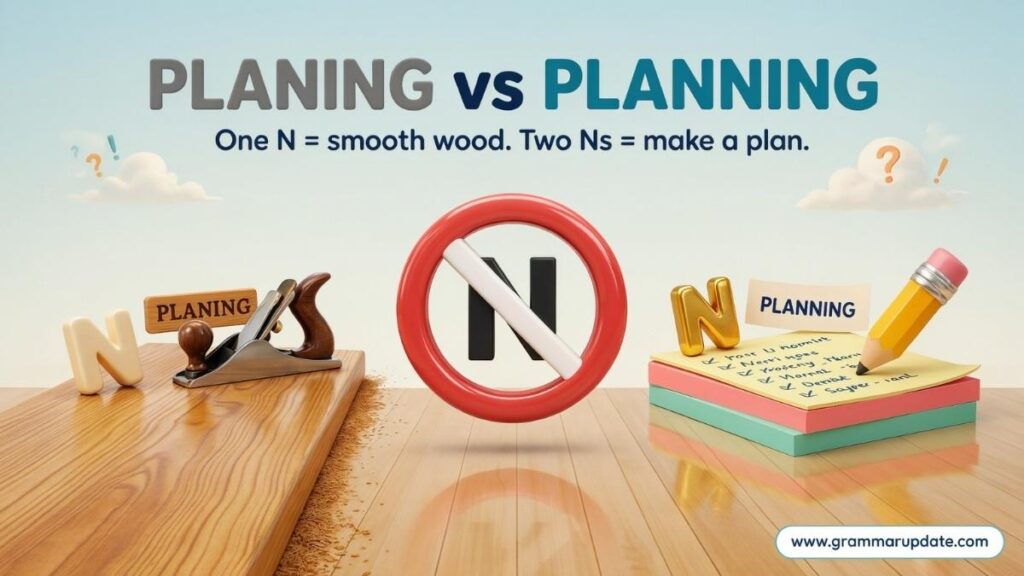
If you’re looking for a simple explanation, here’s the answer:
- Planning means preparing, organizing, or arranging future actions.
- Planing means smoothing, shaping, or leveling a surface using a plane or planing machine.
Although the words look similar, they belong to entirely different contexts.
Planing vs Planning at a Glance
| Word | Meaning | Common Context | Usage Frequency |
|---|---|---|---|
| Planning | Organizing or preparing for future actions | Business, education, projects, daily life | Very common |
| Planing | Smoothing or shaping a surface | Woodworking, manufacturing, engineering | Specialized |
Quick Examples
Planning
- We are planning a new marketing campaign.
- Careful planning improves project success.
- She spent months planning her wedding.
Planing
- The carpenter is planing a wooden board.
- The machine is planing the surface of the lumber.
- He spent the afternoon planing rough timber.
One extra letter creates a completely different meaning.
Learn how to use confusing more words correctly
Licence vs License Which Spelling Is Correct?
What Does Planning Mean?
Among the two words, planning is far more common in everyday English.
Whether you’re preparing for a meeting, organizing a vacation, creating a budget, or launching a business, you’re engaging in planning.
Planning Definition
Planning is the process of deciding in advance what actions should be taken to achieve a goal.
According to major dictionaries such as the Merriam-Webster Dictionary, Oxford Dictionary, and Cambridge Dictionary, planning involves preparation, organization, and decision-making directed toward future outcomes.
Planning Meaning in Everyday English
The planning meaning generally includes:
- Preparation
- Organization
- Scheduling
- Goal setting
- Strategy development
- Resource allocation
- Decision making
- Forecasting
In simple terms, planning is the act of thinking ahead.
Why Planning Matters
Effective planning helps people:
- Save time
- Reduce mistakes
- Manage resources efficiently
- Meet deadlines
- Achieve goals more consistently
- Respond to challenges more effectively
Whether in personal life or professional settings, planning creates structure and direction.
Good planning turns intentions into actions and goals into achievable results.
Planning as the Present Participle of Plan
Understanding how the word is formed helps explain its spelling.
The base verb is:
Plan
When the suffix -ing is added, the word becomes:
Planning
This form can function as:
- A present participle
- A gerund
- A noun describing a process
Examples
- We are planning a conference.
- They are planning next year’s budget.
- Planning ahead prevents unnecessary problems.
Because planning is derived from the verb plan, it follows established English spelling conventions.
Learn the difference between tricky more English words
Totaled vs Totalled Which Spelling Is Correct?
Why Planning Uses Double N
One of the most frequently searched questions is:
Why is planning spelled with double n?
The answer lies in a standard English grammar rule.
Planning With Double N
The word plan ends with:
- One vowel (a)
- One consonant (n)
When a short word follows this pattern and receives a suffix beginning with a vowel, English often doubles the final consonant.
As a result:
- Plan → Planning
Not:
- Plan → Planing
This spelling preserves pronunciation and follows recognized word formation rules.
The Grammar Rule Behind Planning
The spelling of planning is not arbitrary. It follows the well-established consonant doubling rule.
The Consonant Doubling Rule
A final consonant is often doubled when:
- The word has one syllable.
- The word ends with a single vowel followed by a single consonant.
- A suffix beginning with a vowel is added.
Common Examples
| Base Word | Correct Form |
|---|---|
| Plan | Planning |
| Run | Running |
| Sit | Sitting |
| Stop | Stopping |
| Swim | Swimming |
| Begin | Beginning |
This rule explains why the correct spelling planning requires two “n” letters.
Why the Rule Exists
The rule helps maintain pronunciation.
Without doubling the consonant, the vowel sound could change or the word could resemble another term entirely. In the case of planing, the spelling already belongs to a different word with a different meaning.
Learn the difference between tricky more English words
Abley vs Ably Which Spelling Is Correct in English?
Is Planning Spelled With One N or Two?
Many English learners ask:
Is planning spelled with one n or two?
The answer is simple.
Planning is always spelled with two n’s.
Incorrect Examples
- We are planing a business strategy.
- She is planing her future career.
- They spent weeks planing the project.
Correct Examples
- We are planning a business strategy.
- She is planning her future career.
- They spent weeks planning the project.
When discussing preparation, organization, or future actions, planning is always the correct spelling.
Why Is Planning Spelled With Two N’s?
The reason is both grammatical and practical.
If English did not double the final consonant, the resulting word would be planing, which already exists as a separate term.
This distinction helps writers and readers immediately recognize the intended meaning.
Compare the Difference
| Word | Meaning |
|---|---|
| Planning | Preparing or organizing |
| Planing | Smoothing or leveling surfaces |
The additional “n” serves an important purpose. It separates two completely different concepts.
Learn the difference between tricky more English words
Carat vs Caret vs Karat Which is Differences?
Planning Meaning and Usage in Everyday English
The planning process influences nearly every area of modern life.
From personal goals to corporate strategy, planning helps people move from ideas to action.
Personal Planning
Personal planning helps individuals organize their lives and make informed decisions.
Examples include:
- Vacation planning
- Family planning
- Retirement planning
- Financial planning
- Career planning
People who develop clear plans often make progress more efficiently because they have defined objectives and realistic timelines.
Academic Planning
Students rely heavily on planning throughout their educational journey.
Common examples include:
- Course scheduling
- Study planning
- Exam preparation
- Research planning
- Degree planning
Strong academic planning helps students manage workloads and improve performance.
Career Planning
Career planning involves preparing for long-term professional growth.
Activities often include:
- Setting career goals
- Identifying skill gaps
- Pursuing certifications
- Building professional networks
- Exploring advancement opportunities
Successful careers rarely happen by chance. They are usually the result of consistent planning and preparation.
Fix common more word mistakes in English
Exercise vs Exorcise Differences and Correct Usage
Business Planning
Business planning remains one of the most important activities in any organization.
Before launching products, expanding operations, hiring employees, or entering new markets, businesses typically create detailed plans.
What Business Planning Includes
- Strategic objectives
- Budget forecasts
- Market research
- Resource allocation
- Risk assessment
- Performance measurements
Without planning, organizations often operate reactively rather than proactively.
Real-World Example
Imagine two startups entering the same industry.
The first company conducts market research, develops financial projections, defines customer segments, and establishes measurable goals.
The second company launches immediately without preparation.
After several months, the first company is more likely to stay within budget, meet milestones, and adapt effectively to challenges.
The difference is not necessarily talent or luck.
The difference is planning.
Financial Planning
Financial planning helps individuals and organizations manage resources effectively.
It involves evaluating current finances and preparing for future needs.
Common Areas of Financial Planning
- Budgeting
- Saving
- Investing
- Tax planning
- Debt reduction
- Retirement preparation
Effective financial planning provides greater stability and reduces uncertainty.
Benefits of Financial Planning
- Improved money management
- Better decision-making
- Increased savings
- Reduced financial stress
- Greater long-term security
Many financial experts consider planning one of the most important habits for achieving financial goals.
Project Planning
Every successful project begins with careful preparation.
Project planning creates a roadmap that guides teams from the beginning of a project to its completion.
Key Components of Project Planning
- Goals and objectives
- Timelines
- Resource requirements
- Budgets
- Risk management
- Team responsibilities
When organizations skip planning, projects frequently experience delays, cost overruns, and communication problems.
Common Project Planning Activities
- Creating schedules
- Defining milestones
- Allocating resources
- Forecasting costs
- Managing dependencies
Effective planning increases efficiency and accountability throughout the project lifecycle.
Learn how to use confusing more words correctly
Canon vs Cannon Difference and Usage
Strategic Planning
Strategic planning focuses on long-term direction and organizational success.
Unlike day-to-day planning, strategic planning examines broader goals and future opportunities.
Strategic Planning Often Addresses
- Market expansion
- Competitive positioning
- Innovation initiatives
- Resource investment
- Organizational growth
Businesses, universities, nonprofits, and government agencies all rely on strategic planning to make informed decisions.
Characteristics of Effective Strategic Planning
- Clear objectives
- Data-driven analysis
- Long-term focus
- Measurable outcomes
- Flexibility and adaptability
Strong strategy begins with strong planning.
Event Planning
Few activities require as much coordination as event planning.
Whether organizing a wedding, conference, trade show, fundraiser, or corporate meeting, planners must manage countless details simultaneously.
Typical Event Planning Responsibilities
- Venue selection
- Budget management
- Scheduling
- Vendor coordination
- Guest communication
- Logistics planning
Successful events rarely happen by accident. Behind every seamless event is extensive preparation and organization.
Fix common more word mistakes in English
Coaches vs Coach’s Difference and Usage
Common Planning Synonyms
Several words share similar meanings with planning.
Planning Synonyms
- Organizing
- Preparing
- Arranging
- Scheduling
- Strategizing
- Coordinating
- Designing
- Mapping out
- Plotting
- Formulating
Although each word has subtle differences, they all relate to preparation and future action.
Key Facts About Planning
- Planning is the present participle of plan.
- Planning always uses a double “n.”
- Planning refers to preparation, organization, and future decision-making.
- The spelling follows the standard consonant doubling rule.
- Planning is common in business, education, project management, and daily life.
- Most everyday uses involve planning, not planing.
- Understanding the spelling rule improves writing accuracy and reduces common grammar mistakes.
What Does Planing Mean?
Many people assume planing is simply a misspelling of planning. In reality, planing is a legitimate English word with a completely different meaning.
Planing Definition
Planing refers to the process of smoothing, shaping, or leveling a surface by removing thin layers of material. The term most commonly appears in woodworking, carpentry, manufacturing, marine engineering, and aviation.
According to major dictionaries, including the Merriam-Webster Dictionary, Oxford Dictionary, and Cambridge Dictionary, planing is the act of using a plane or planer to create a smooth and even surface.
Planing Meaning in Woodworking
In carpentry, planing involves shaving thin layers from wood to improve its appearance, dimensions, or smoothness.
A carpenter may plane wood to:
- Remove rough surfaces
- Create flat edges
- Adjust thickness
- Improve fit between pieces
- Prepare lumber for finishing
Without planing, many woodworking projects would have uneven surfaces and poor joints.
Planing Meaning in Manufacturing
Manufacturing industries use planing machines to shape metal, wood, and composite materials.
Industrial planing helps:
- Improve surface accuracy
- Produce precise dimensions
- Prepare materials for assembly
- Enhance product quality
This technical meaning differs completely from the planning process associated with preparation and organization.
Learn how to use confusing more words correctly
Bailer vs Baler the Difference and Usage
Planing Meaning and Usage in Technical Fields
Planing Wood Meaning
When discussing woodworking, planing wood means removing a thin layer from the surface of lumber using a cutting tool.
For example:
- The carpenter spent the afternoon planing the oak boards.
- Planing removed the rough spots from the tabletop.
What Is a Plane Tool?
A plane is a woodworking tool designed to shave thin layers from wood.
Traditional hand planes have been used for centuries.
Modern versions include:
- Bench planes
- Block planes
- Jointer planes
- Smoothing planes
- Electric planers
Each serves a specific purpose during woodworking projects.
Hand Planing vs Machine Planing
| Feature | Hand Planing | Machine Planing |
|---|---|---|
| Tool Used | Hand Plane | Wood Planer |
| Speed | Slower | Faster |
| Precision | High Control | High Consistency |
| Best For | Fine Finishing | Large Projects |
| Skill Required | Higher | Moderate |
Both methods remain important in modern carpentry.
Planing Machine Meaning and Uses
A planing machine is a device that removes material from a surface to achieve uniform thickness and smoothness.
Common applications include:
- Furniture production
- Cabinet making
- Flooring manufacturing
- Construction projects
- Industrial fabrication
The machine significantly reduces labor while improving consistency.
Learn the difference between tricky more English words
Laid vs Layed Difference and Usage in English Grammar
Planing in Aviation and Marine Engineering
The word planing has another specialized meaning beyond woodworking.
What Is Boat Planing?
In marine engineering, planing occurs when a boat rises and skims across the water’s surface at higher speeds.
Instead of pushing through the water, the hull generates lift and rides partially above it.
This process reduces:
- Drag
- Fuel consumption
- Resistance
Boat Hull Dynamics
A planing boat hull is specifically designed to achieve lift.
Examples include:
- Speedboats
- Racing boats
- Personal watercraft
- High-performance recreational vessels
At sufficient speed, the vessel transitions from displacement mode to planing mode.
Watercraft Planing Benefits
Benefits include:
- Higher speed
- Better fuel efficiency
- Improved performance
- Reduced water resistance
Aviation Uses of Planing
Although less common, aviation engineering may use the term planing when discussing surface finishing or aerodynamic preparation.
In both aviation and marine contexts, the term remains entirely unrelated to making plans or organizing future activities.
Learn the difference between tricky more English words
maintained vs maintenanced Differences Explained
Planning vs Plan Understanding the Relationship
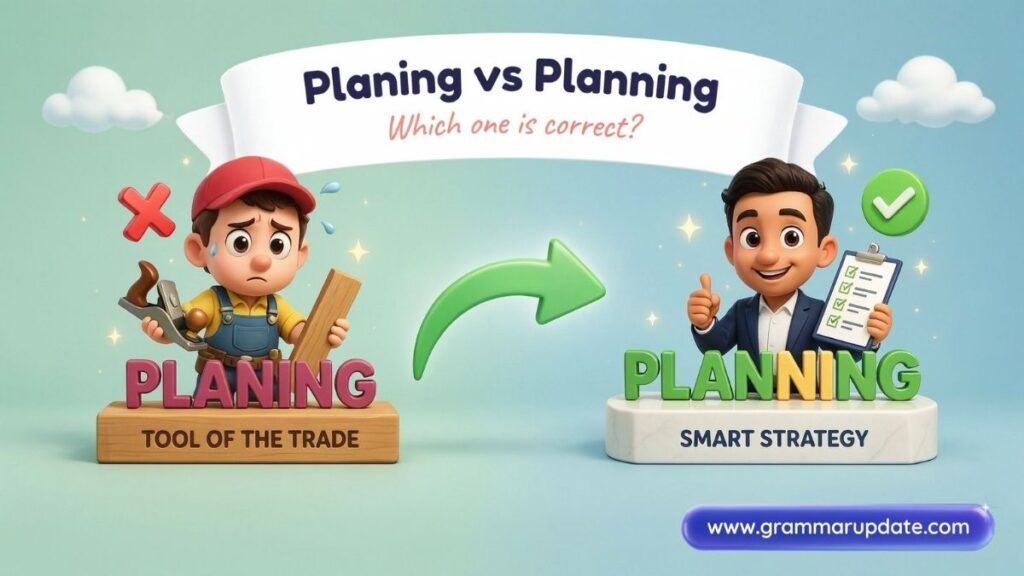
Many learners also search for planning vs plan because the words are closely related.
Plan as a Noun
A plan is a strategy, proposal, or method designed to achieve a goal.
Examples:
- Business plan
- Marketing plan
- Financial plan
- Project plan
- Action plan
Plan as a Verb
As a verb, plan means to prepare, organize, or arrange future actions.
Examples:
- I plan to start a business.
- We plan to travel next year.
How Planning Is Formed
The word planning comes from adding -ing to the verb plan.
Because plan ends with:
- One vowel (a)
- One consonant (n)
English spelling rules require doubling the final consonant.
Plan → Planning
This is why planning with double n is correct.
Planing vs Planning Examples
Seeing the words in context makes the distinction much easier.
Planning Examples
These examples relate to preparation, organizing, scheduling, and future actions.
- Strategic planning helped the company increase profits.
- Project planning reduced delays and budget overruns.
- Good planning often prevents unnecessary problems.
- Financial planning can improve long-term stability.
- Event planning requires attention to detail.
Planing Examples
These examples involve woodworking, machinery, or surface smoothing.
- The carpenter spent hours planing the wood.
- Planing created a smooth finish on the table.
- The machine is used for planing large boards.
- The craftsman enjoyed hand planing antique lumber.
- Proper planing improves woodworking accuracy.
Side-by-Side Comparison
| Planning | Planing |
|---|---|
| Preparing for the future | Smoothing surfaces |
| Business planning | Wood planing |
| Strategic planning | Planing machine |
| Scheduling projects | Shaving wood |
| Goal setting | Surface finishing |
Common Mistakes Learners Make
The difference between planing and planning often causes confusion among writers.
Mistake 1: Using Planing Instead of Planning
Incorrect:
- We are planing a new project.
Correct:
- We are planning a new project.
Mistake 2: Forgetting the Double N
Incorrect:
- The company is planing for growth.
Correct:
- The company is planning for growth.
Mistake 3: Assuming Planing Is Always Wrong
Incorrect assumption:
- Planing isn’t a real word.
Reality:
- Planing is a legitimate term used in woodworking, manufacturing, and marine engineering.
Mistake 4: Relying Entirely on Spell Check
Spell-check software may not catch the mistake because both words exist in English.
Context matters.
Fix common more word mistakes in English
Present vs Presant Differences and Correct Usage
Planing vs Planning in Professional Writing
Using the correct word matters in professional communication.
Business Communication
Business professionals almost always mean planning.
Examples include:
- Strategic planning
- Workforce planning
- Financial planning
- Project planning
Using planing in these contexts creates confusion.
Academic Writing
Students frequently misspell planning because they forget the consonant-doubling rule.
Accurate spelling improves writing quality and credibility.
Technical Documentation
In manufacturing or carpentry manuals, planing is often the correct term.
For example:
- Planing procedures
- Surface planing specifications
- Wood planing techniques
Why Correct Usage Matters
Correct word usage improves:
- Clarity
- Professionalism
- Writing accuracy
- Reader understanding
Which Word Should You Use?
The answer depends entirely on context.
Use Planning When Talking About:
- Preparation
- Scheduling
- Organization
- Strategy
- Goal setting
- Decision making
- Project management
Use Planing When Talking About:
- Woodworking
- Carpentry
- Surface smoothing
- Manufacturing
- Marine engineering
- Planing machines
- Watercraft planing
Simple Decision Guide
Ask yourself:
“Am I discussing future actions or smoothing a surface?”
If it’s future preparation, use planning.
If it’s surface shaping, use planing.
Easy Memory Tricks for Planing vs Planning
Planning Has an Extra N for the Next Step
Many writers remember the correct spelling by linking the extra n to the word next.
Planning involves preparing for what comes next.
Planing Uses a Plane
The word planing contains plane, which is the tool used to smooth wood.
Goal vs Tool Trick
- Planning = Goals
- Planing = Tool
Simple and effective.
Visual Memory Trick
Think of:
- Planning → Calendars, schedules, goals
- Planing → Wood shavings, tools, lumber
The mental image quickly reveals the correct word.
Practice Session Planing vs Planning
Choose the correct word (planning or planing) to complete each sentence. Pay attention to meaning and context.
Easy Level
- We are __________ our vacation for next summer.
- The carpenter is __________ the wooden table surface.
- Good __________ helps avoid last-minute problems.
- He spent hours __________ the floorboards.
- The team is __________ a new marketing strategy.
Medium Level
- Careful __________ improves project success rates.
- The woodworker started __________ the rough edges of the plank.
- Financial __________ is important for long-term stability.
- The machine is used for __________ large wooden sheets.
- They are __________ an event for the end of the year.
Advanced Level
- Without proper __________, the project may fail to meet deadlines.
- The craftsman was __________ oak wood for fine finishing work.
- Strategic __________ plays a key role in business development.
- The factory uses industrial __________ machines for precision work.
- Poor __________ often leads to confusion and delays in execution.
Answers
- planning
- planing
- planning
- planing
- planning
- planning
- planing
- planning
- planing
- planning
- planning
- planing
- planning
- planing
- planning
Here’s a trusted source for clear word meanings:
FAQs
Is Planing or Planning Correct?
Both are correct words, but they have different meanings.
What Is the Difference Between Planing vs Planning?
Planning refers to preparation and organization. Planing refers to smoothing surfaces or specific engineering processes.
Why Is Planning Spelled With Double N?
English spelling rules require doubling the final consonant before adding -ing to certain short words ending in a vowel followed by a consonant.
Can Planning Be Spelled With One N?
No. When referring to preparation or organizing, planning must use two n’s.
Is Planing a Real Word?
Yes. Planing is a recognized term in woodworking, manufacturing, and marine engineering.
What Is Planing Wood?
Planing wood means smoothing or shaping lumber using a hand plane or wood planer.
What Is a Planing Machine?
A planing machine removes thin layers of material to create smooth, flat surfaces.
How Do You Spell Planning?
The correct spelling is:
Planning
What Is the Grammar Rule for Planning?
The consonant-doubling rule applies because the base word plan ends in a vowel followed by a consonant.
How Do You Use Planning in a Sentence?
Example:
- Careful planning helped the project succeed.
How Do You Use Planing in a Sentence?
Example:
- The carpenter spent the afternoon planing the boards.
Conclusion
The planing vs planning confusion is one of those quiet grammar traps that slips into writing without much warning, then changes meaning in a way that feels almost sneaky. A single extra “n” can turn a carefully designed business strategy into something that sounds like a carpentry workshop task, or flip a woodworking instruction into an unintended discussion about future goals. English has a habit of doing this, and this pair is a perfect example.
The distinction itself is simple once it settles in. Planning refers to preparation, organization, scheduling, strategy, and decision-making for future goals or actions. It lives in calendars, meetings, project timelines, and long-term thinking. Planing, however, belongs in a completely different world woodworking, carpentry, manufacturing, and marine engineering where surfaces are shaped, smoothed, or leveled using a plane or planer.
So the final check is easy but powerful. If you’re working with ideas, goals, or future structure, you’re planning. If you’re working with wood, tools, or physical surfaces, you’re planing. That small pause before you finalize a sentence is often all it takes to keep your writing precise, professional, and free from confusion that a single letter can create.

Jhon AJS, the creative mind behind Grammar Update, is an experienced blogger passionate about simplifying English grammar. He focuses on explaining confusing word vs word differences, grammar rules, punctuation, and sentence structure in a clear and practical way. Through easy to understand guides and examples, Jhon helps readers improve their writing and communicate with confidence. With years of blogging experience, he continues to share helpful insights that make learning grammar simple, useful, and accessible for everyone.