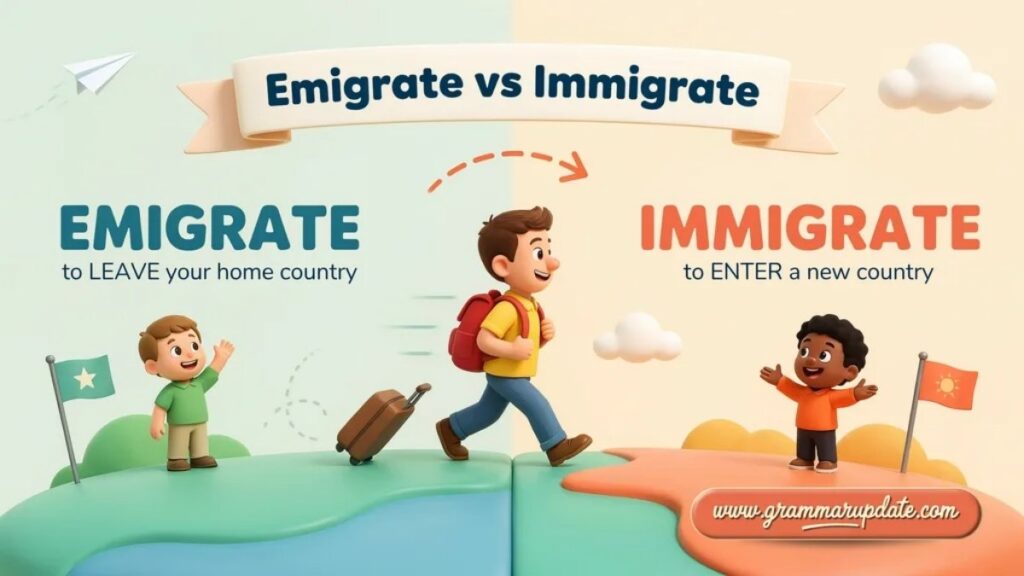
Ever freeze mid-sentence wondering about emigrate vs immigrate and feel your grammar confidence quietly slip away? It’s a common moment that leads to clear mistakes and confusion, even for experienced writers. The issue is not ability, but direction. These words look almost identical, sound nearly the same, yet they describe opposite sides of the same journey, which is where most confusion usually starts. Add “migrate” into the mix and things become even more interesting. The good news is that once you understand the simple distinction, everything becomes logical, easy, and surprisingly memorable. This guide clears mistakes and confusion in a friendly, practical way.
Quick Answer Emigrate vs Immigrate
If you’ve ever wondered whether someone should emigrate or immigrate, you’re not alone. These two words are among the most commonly confused terms in English because they describe the same journey from different perspectives.
Here’s the simplest way to understand them:
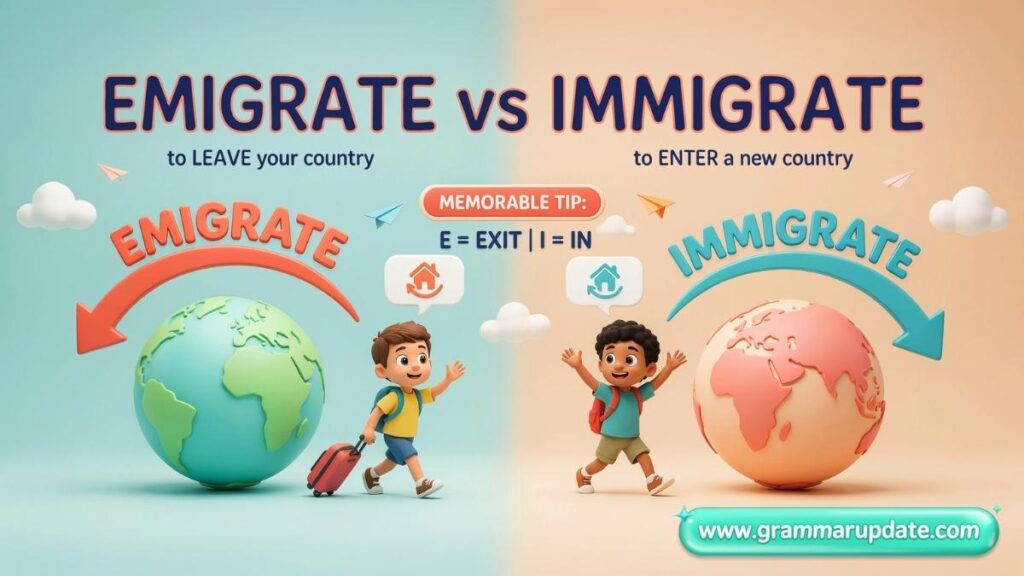
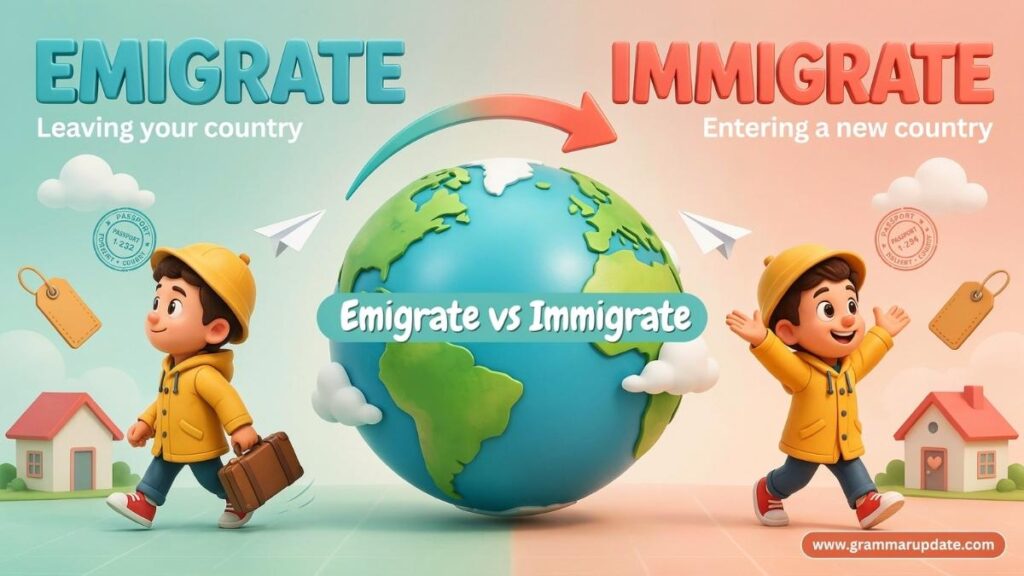
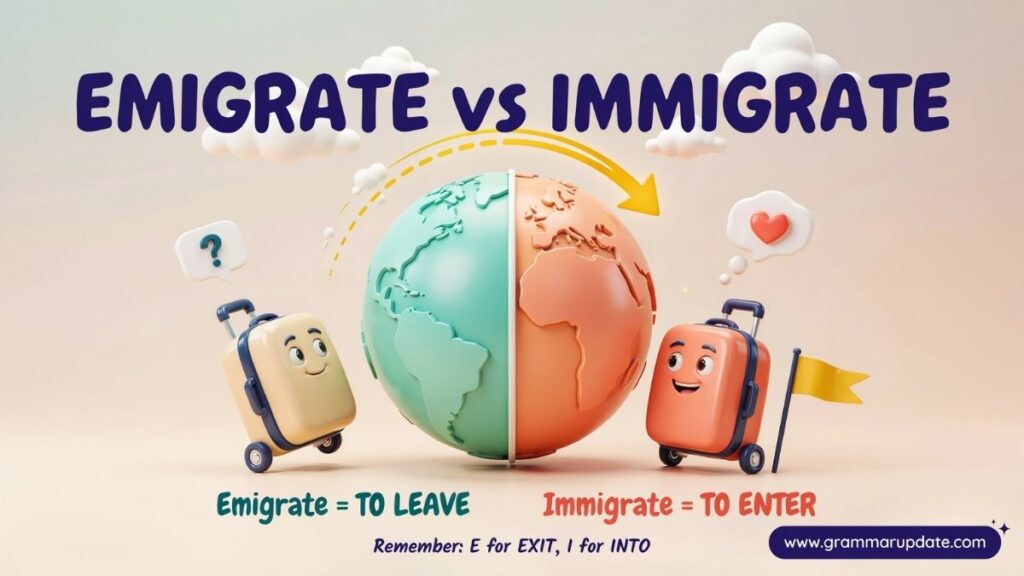
- Emigrate means to leave a country.
- Immigrate means to enter a country.
- Migrate means to move from one place to another.
Example
Imagine a family moves from Pakistan to Canada.
- They emigrated from Pakistan.
- They immigrated to Canada.
Both statements are correct. The difference lies in the viewpoint. One focuses on the country they left, while the other focuses on the country they entered.
| Term | Meaning | Focus |
|---|---|---|
| Emigrate | Leave a country | Departure |
| Immigrate | Enter a country | Arrival |
| Migrate | Move from one place to another | Movement |
Understanding this distinction makes it much easier to choose the right word in conversation, writing, and professional communication.
What Does Emigrate Mean?
Emigrate Meaning
The emigrate meaning centers on departure. When a person leaves their home country to settle in another country permanently or for a long period, they emigrate.
The word comes from the Latin emigrare, meaning “to move away.” That origin still reflects how the word is used today.
Whenever the focus is on leaving one’s home country, emigrate is usually the correct choice.
When to Use Emigrate
Use emigrate when discussing where someone started their journey rather than where they ended up.
Examples of Emigrate
- My grandparents emigrated from Italy after World War II.
- Thousands of professionals emigrate each year for better career opportunities.
- She plans to emigrate from Pakistan after completing her master’s degree.
In each example, the emphasis remains on the country being left behind.
Emigrate From or Emigrate To?
Many writers wonder whether they should say emigrate from or emigrate to.
Both forms are correct.
Examples:
- They emigrated from Germany.
- She emigrated to Australia.
- They emigrated from Pakistan to Canada.
The last example is often the clearest because it shows both the origin and destination.
More Related Articles You May Find Helpfu
In Tact vs Intact Which Spelling Is Correct in English?
What Does Immigrate Mean?
Immigrate Meaning
The immigrate meaning focuses on arrival. A person immigrates when they enter another country with the intention of living there permanently or long-term.
The word comes from the Latin immigrare, which means “to move into.”
Unlike emigration, immigration focuses on the destination rather than the departure point.
When to Use Immigrate
Use immigrate when discussing the country a person enters and settles in.
Examples of Immigrate
- Her family immigrated to Canada in 2018.
- He immigrated to Australia through a skilled-worker program.
- They immigrated to New Zealand seeking a better quality of life.
Each sentence highlights the country where the person arrived and established residence.
Immigrate From or Immigrate To?
The most common structure is:
Immigrate to + country
Examples:
- Immigrate to Canada
- Immigrate to Germany
- Immigrate to Australia
You can also include both locations for greater clarity.
Example:
They immigrated to Canada from Pakistan.
This structure immediately tells readers where the journey began and ended.
Fix common more word mistakes in English
Noisy vs Noisey Which is Correct and Usage?
Difference Between Immigrate and Emigrate
The difference between immigrate and emigrate is not about the action itself. It is about perspective.
A single international move can involve both emigration and immigration at the same time.
Example
A software engineer leaves Pakistan and settles in Germany.
From Pakistan’s perspective:
He emigrated from Pakistan.
From Germany’s perspective:
He immigrated to Germany.
The move remains exactly the same. Only the viewpoint changes.
Quick Comparison
| Question | Correct Word |
|---|---|
| Did the person leave a country? | Emigrate |
| Did the person enter a country? | Immigrate |
| Are you discussing movement generally? | Migrate |
This is the easiest way to remember the difference between immigrate and emigrate.
Fix common more word mistakes in English
Imbed vs Embed Which Spelling Should You Use?
Immigrate vs Emigrate vs Migrate
Many learners understand immigration and emigration but become confused when the word migrate appears.
The reality is that migration is the broader concept.
Migrate Meaning
The migrate meaning refers to moving from one place to another. Unlike immigration and emigration, migration does not always involve crossing international borders.
A person can migrate between cities, states, regions, or countries.
Examples of Migrate
- Workers migrate to large cities for employment opportunities.
- Families migrate from rural areas to urban centers.
- Birds migrate seasonally in search of food and favorable weather.
These examples demonstrate why migration is considered a broader term.
Immigrate vs Emigrate vs Migrate Explained
Think of migration as the umbrella term.
Under that umbrella, you find immigration and emigration.
| Word | Meaning |
|---|---|
| Emigrate | Leave a country |
| Immigrate | Enter a country |
| Migrate | Move from one place to another |
Example
A teacher moves from Mexico to Canada.
You could accurately say:
- She emigrated from Mexico.
- She immigrated to Canada.
- She migrated from Mexico to Canada.
All three statements are correct. They simply emphasize different aspects of the same movement.
More Related Articles You May Find Helpfu
Planing vs Planning Difference and Correct Usage
Emigrate Pronunciation and Immigrate Pronunciation
Because these words look and sound similar, pronunciation often causes confusion.
Emigrate Pronunciation
EM-uh-grayt
Immigrate Pronunciation
IM-uh-grayt
The primary difference appears in the first syllable.
Immigrate vs Emigrate Pronunciation
| Word | Pronunciation |
|---|---|
| Emigrate | EM-uh-grayt |
| Immigrate | IM-uh-grayt |
A useful tip is to practice the words together.
Emigrate from. Immigrate to.
Repeating this phrase helps reinforce both pronunciation and meaning.
Fix common more word mistakes in English
Licence vs License Which Spelling Is Correct?
Common Mistakes with Emigrate and Immigrate
Even experienced writers occasionally mix these terms up.
Fortunately, most mistakes fall into a few predictable categories.
Using the Wrong Direction
Incorrect:
She immigrated from Pakistan.
Correct:
She emigrated from Pakistan.
The first sentence focuses on departure, so emigrated is the correct choice.
Using the Wrong Preposition
Incorrect:
He immigrated from Canada.
Correct:
He immigrated to Canada.
Immigration focuses on the destination country.
Confusing Migration with Immigration
Migration is broader than immigration.
Correct:
Workers migrated to urban areas.
Correct:
The family immigrated to Canada.
The first sentence describes general movement. The second describes entering a new country.
Fix common more word mistakes in English
Canon vs Cannon Difference and Usage
Real-Life Examples of Emigrate vs Immigrate
These words appear regularly in everyday communication.
News Example
Journalists frequently report on immigration policies, visa programs, and population changes.
Example:
Thousands immigrated through skilled-worker pathways last year.
Learn how to use confusing more words correctly
Comming vs Coming Difference and Correct Usage
Academic Example
Researchers often study migration patterns, human migration, and international population movement.
Example:
The study examined migration trends across Europe over three decades.
Business Example
Global companies often hire professionals who relocate internationally.
Example:
The company recruited engineers who immigrated through employment-based visa programs.
Personal Example
My aunt emigrated from India and later immigrated to Australia.
This sentence clearly demonstrates both concepts within a single real-world situation.
More Related Articles You May Find Helpfu
Exercise vs Exorcise Differences and Correct Usage
Easy Memory Trick
Sometimes the simplest memory aids work best.
E = Exit
Think of emigrate as exiting a country.
I = Into
Think of immigrate as moving into a country.
Example
If you leave Pakistan, you emigrate.
If you arrive in Canada, you immigrate.
Many English learners find this trick helpful because it focuses on direction rather than complicated grammar rules.
More Related Articles You May Find Helpfu
Carat vs Caret vs Karat Which is Differences?
Practice Session Emigrate vs Immigrate
- She decided to ______ from Pakistan to Canada after getting a scholarship.
- Many skilled workers ______ to Australia every year for better job opportunities.
- My grandfather ______ from Italy in the 1950s.
- The family plans to ______ to Germany next year.
- He ______ from India and later settled in the UK.
- Thousands of people ______ to the United States in search of a better life.
- They ______ from their home country due to political instability.
- My cousin ______ to New Zealand after completing university.
- She ______ from Pakistan and started a new life abroad.
- Many professionals ______ to Canada under skilled migration programs.
Answers
- emigrate
- immigrate
- emigrated
- emigrate
- emigrated
- immigrate
- emigrated
- immigrate
- emigrated
- immigrate
Here’s a trusted source for clear word meanings:
FAQs
What is the difference between immigrate and emigrate?
Emigrate means leaving a country to live elsewhere, while immigrate means entering a new country to live there.
Is it emigrate or immigrate when leaving a country?
When someone leaves a country, the correct word is emigrate.
Is it immigrate or emigrate when entering a country?
When someone enters a new country, the correct word is immigrate.
What does emigrate mean?
Emigrate means to leave your home country and move to another country to live.
What does immigrate mean?
Immigrate means to enter and settle in a new country.
What is the main difference between immigrate and emigrate?
The difference is direction:
- Emigrate = leaving a country
- Immigrate = entering a country
Can a person be both an immigrant and an emigrant?
Yes. A person is an emigrant from the country they leave and an immigrant in the country they enter.
How do you remember immigrate vs emigrate easily?
A simple trick:
- E = Exit (emigrate)
- I = Into (immigrate)
Which prepositions are used with immigrate and emigrate?
- Emigrate from a country
- Immigrate to a country
What is migrate in simple words?
Migrate means to move from one place to another, either within a country or across countries.
What is the difference between migrate and immigrate?
Migrate is general movement, while immigrate specifically means entering a new country to live.
Why do people confuse immigrate and emigrate?
Because both words describe the same movement but from different perspectives—one focuses on leaving, the other on arriving.
Learn how to use confusing more words correctly
Seal vs Seel Difference and Correct Usage
Conclusion
Grammar can be tricky, and emigrate vs immigrate is one of those pairs that often causes confusion and clear mistakes in writing. The words look similar, but they do very different jobs, and mixing them up can change the meaning of a sentence completely.
Here’s the simple rule that clears everything: emigrate means leaving a country, and immigrate means entering a country. That’s all there is to it. No complicated grammar rules, just direction.
Most mistakes happen when this direction is reversed. For example, saying “I immigrated from Pakistan” is incorrect because it confuses leaving with entering. This is where the confusion usually shows up.
The easiest way to remember it is simple: exit and entry. Once you keep that in mind, the confusion disappears, mistakes become rare, and you start using both words correctly without thinking too hard.
So next time you see these words, you’ll know exactly which one to choose and avoid confusion with confidence.

Jhon AJS, the creative mind behind Grammar Update, is an experienced blogger passionate about simplifying English grammar. He focuses on explaining confusing word vs word differences, grammar rules, punctuation, and sentence structure in a clear and practical way. Through easy to understand guides and examples, Jhon helps readers improve their writing and communicate with confidence. With years of blogging experience, he continues to share helpful insights that make learning grammar simple, useful, and accessible for everyone.