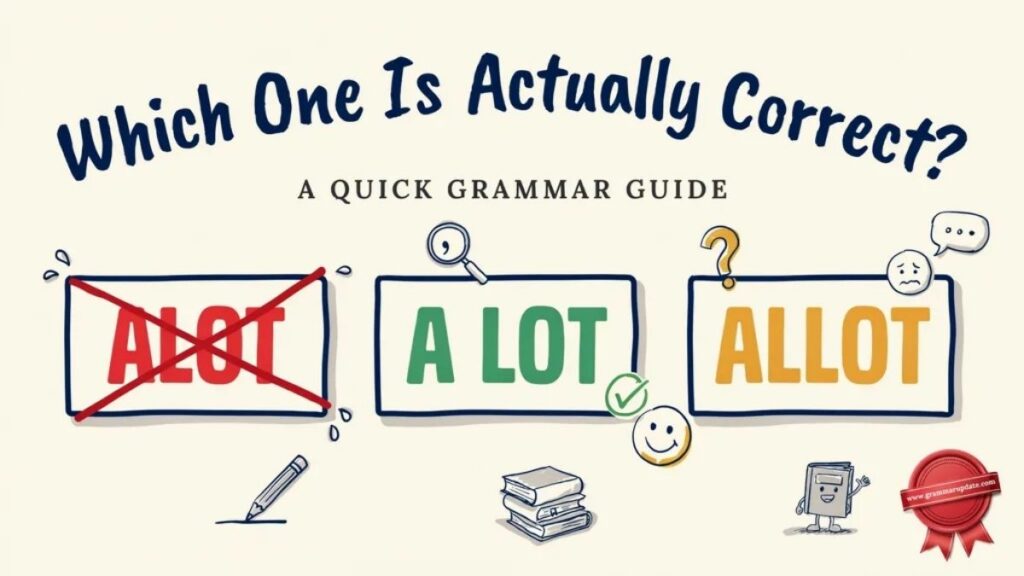
The confusion between alot vs a lot vs allot is one of the most common and avoidable grammar mistakes in English writing, appearing across academic work, professional emails, and everyday digital communication. If you’ve ever typed “alot” without thinking twice, you’re definitely not alone, even though standard grammar rules firmly disagree with it. This article explains the difference in a clear, structured, and easy-to-follow way, with just enough light humor to make the concepts stick. You’ll learn what each form actually means, how to use them correctly in real sentences, and why only “a lot” and “allot” are accepted in formal English writing today.
Quick Answer Alot vs A Lot
The confusion around alot vs a lot vs allot is extremely common in everyday writing, especially in texting, exams, emails, and social media posts. At first glance, the three forms look almost identical, which is exactly why so many learners mix them up.
Here is the correct breakdown:
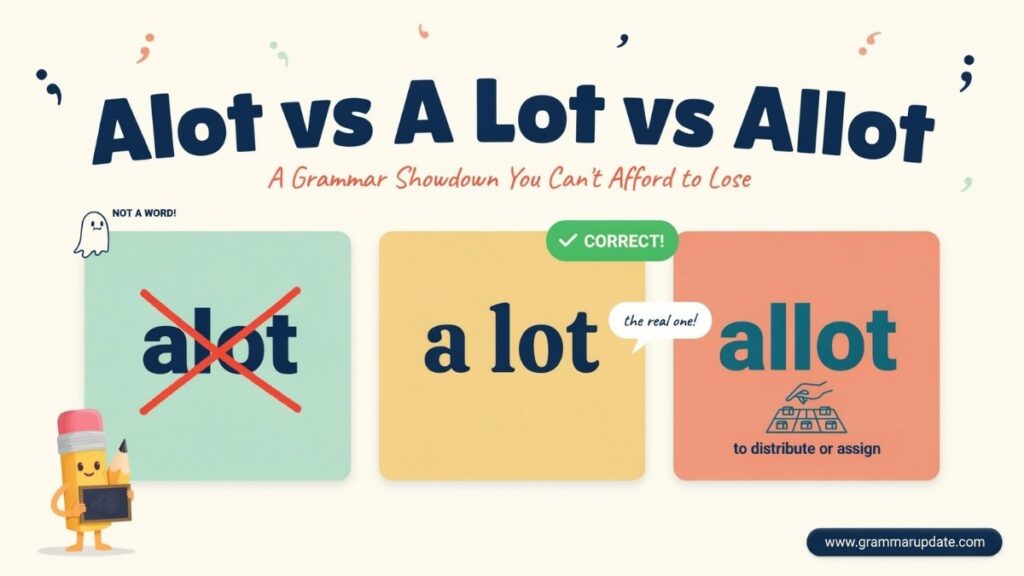
“a lot” is the correct phrase used to express quantity or frequency. “allot” is a correct verb that means to assign or distribute something. “alot” is not correct in standard English and is considered a spelling mistake.
The simplest way to understand it is this: “a lot” tells how much, “allot” tells how something is given out, and “alot” is simply an incorrect fusion of two words that should always stay separate.
- I have a lot of assignments to complete before tomorrow
- The teacher will allot time for each presentation
What Does “A Lot” Mean? (Correct Usage Explained)
A Lot Meaning in English
The phrase a lot meaning refers to a large quantity, a high amount, or a frequent occurrence of something. It is one of the most flexible and widely used expressions in English because it fits naturally into both spoken and written communication.
It can describe concrete things like money or people, as well as abstract ideas like effort, attention, or time.
- a lot of people = many individuals
- a lot of time = long duration
- a lot of money = large sum
- a lot of work = heavy workload
This flexibility is why “a lot” is often preferred over more rigid expressions in casual communication.
Grammar Role of “A Lot”
In grammar, a lot works as both an adverbial phrase and a quantifier depending on sentence structure.
When it modifies a verb, it acts like an adverb, as in “I travel a lot.” When it modifies a noun, it acts as a quantifier, as in “a lot of students attended.”
Even though its meaning is simple, its structure is fixed. English grammar does not allow it to become one word.
- I think about this a lot
- A lot of students passed the exam
Examples of “A Lot” in Real Usage
In real-life communication, “a lot” appears constantly because it is natural and versatile.
- She studies a lot during exam season and avoids distractions
- There was a lot of noise coming from the construction site
- He spends a lot of money on books and learning materials
- A lot of people joined the online workshop this year
These examples show how easily it adapts to different contexts without changing meaning.
Understand confusing English more words simply
Planing vs Planning Difference and Correct Usage
What Is “Alot”? (Is Alot a Word?)
Is Alot a Word?
No, “alot” is not a correct word in English. If the question is “is alot a word,” the consistent answer across grammar rules, dictionaries, and academic standards is no.
It is widely seen online, but frequency does not make it correct.
Alot Meaning Explained
The phrase alot meaning does not exist in standard English grammar. It is simply a spelling error created when speakers combine “a” and “lot” into one unit.
This usually happens because spoken English naturally blends the two words, making them sound like a single expression.
- Incorrect: I have alot of homework tonight
- Correct: I have a lot of homework tonight
Even though the meaning stays the same, correctness depends entirely on spelling and spacing.
Why “Alot” Is Incorrect
The issue is grammatical structure. English separates function words like articles from nouns. “a” is an article, and “lot” is a noun, so they must remain separate.
It is also:
not recognized in standard dictionaries
flagged in academic writing tools
rejected in professional editing standards
Because of this, “alot” is always treated as a spelling error, not an alternative form.
Understand confusing English more words simply
Imbed vs Embed Which Spelling Should You Use?
A Lot vs Allot vs Alot Full Comparison
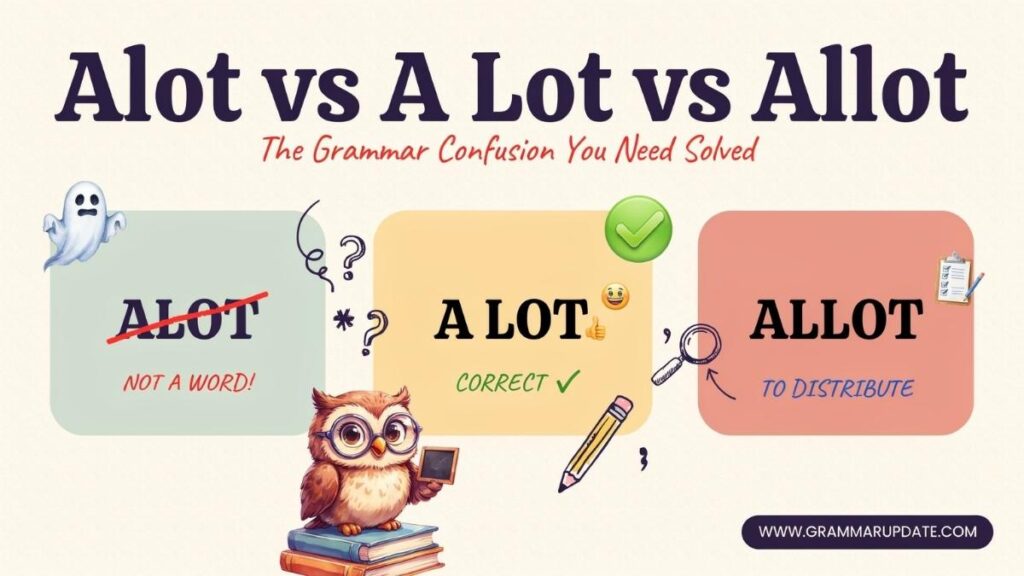
This is where most confusion happens because the three words look similar but behave completely differently in grammar.
Comparison Table
| Word | Type | Meaning | Example |
|---|---|---|---|
| a lot | phrase | large quantity or frequency | I have a lot of time today |
| allot | verb | assign or distribute | The manager will allot tasks fairly |
| alot | error | incorrect spelling | not accepted in English |
Allot Meaning Explained
The allot meaning refers to assigning something in a structured or planned way. It is commonly used in education, business, and administrative contexts where resources or responsibilities are divided.
It always involves controlled distribution rather than describing quantity.
- The teacher will allot 10 minutes for discussion
- The company will allot resources for training
- The government will allot funds for development projects
- The manager will allot responsibilities based on experience
More Related Articles You May Find Helpful
Tapping vs Taping Difference and Correct Usage
Examples of Allot in Sentences
To understand it more clearly, here are additional real-world examples:
- The school will allot specific time slots for presentations
- They allot budgets carefully across departments
- The committee will allot space for new members
- The organizer will allot tasks according to skill level
Key Distinction
A simple way to remember it is this: “a lot” expresses amount, “allot” expresses action, and “alot” is always an error that should never appear in formal writing.
Understand confusing English more words simply
Emigrate vs Immigrate Difference and usage
Why People Write “Alot”
This mistake happens for very natural reasons rather than ignorance.
One major cause is pronunciation. In spoken English, “a lot” is often said quickly and sounds like a single word, which leads to confusion in writing.
Typing behavior also contributes. In fast texting, people skip spaces or overlook small spelling details.
Social media reinforces the mistake because informal writing dominates platforms where grammar is rarely corrected.
- Fast typing reduces attention to spacing
- Spoken language blends the phrase into one sound
- Online exposure normalizes incorrect forms
Fix common more word mistakes in English
Girlie vs Girly Which Spelling Is Correct?
Easy Memory Trick
A reliable way to avoid this mistake is to focus on grammatical structure instead of sound.
Think of it this way: “a” is an article and “lot” is a noun. Since English keeps grammatical units separate, they must remain separate in writing.
A helpful habit is to pause mentally between the two words before writing them.
- “a” = article
- “lot” = noun
- together = phrase, not a single word
More Related Articles You May Find Helpful
Muscle vs Mussel Which is Difference and usage?
Real-Life Usage Examples
In social media communication, “a lot” is everywhere. People naturally write “I miss you a lot” or “a lot of people agree with this,” which are both correct.
In professional emails, accuracy matters more. “Thank you a lot for your support” is correct, while “thanks alot” is incorrect and reduces professionalism.
In academic writing, precision is essential. “A lot of research supports this conclusion” is correct, while “alot of research supports this conclusion” is marked as a spelling error.
In everyday speech, “a lot” is extremely common and natural in phrases like “I like it a lot” or “she works a lot.”
Fix common more word mistakes in English
Molding vs Moulding Which Spelling Is Correct and Usage?
Common Mistakes with “A Lot”
The most common mistake is writing “alot” instead of “a lot.” Another frequent issue is confusing it with “allot,” especially in structured writing tasks.
Some writers also overuse “a lot,” which can weaken style in formal writing if not balanced with stronger vocabulary.
- Overuse reduces writing clarity
- Confusion leads to spelling errors
- Lack of proofreading increases mistakes
Understand confusing English more words simply
Shinny vs Shiny Which Spelling Is Correct?
Better Formal Alternatives
In formal writing, replacing “a lot” can improve clarity and style.
Instead of repeating it, writers often use alternatives like many, numerous, considerable, or significant amount. These expressions sound more precise and professional in academic or business contexts.
- many people attended the event
- a significant amount of research supports this
- numerous studies confirm the findings
Fix common more word mistakes in English
Ladel vs Ladle Difference and Usage
Practice Session Alot vs A Lot vs Allot
Complete each sentence with the correct form: “a lot”, “allot”, or identify the incorrect usage when needed. This exercise will help you clearly understand alot vs a lot vs allot in real contexts.
Fill in the blanks
- I have ___ of assignments to complete before tomorrow.
- The teacher will ___ 15 minutes for each presentation.
- She studies ___ during exam season.
- The company will ___ budget for the new project.
- A ___ of students attended the lecture today.
- Please avoid writing “___” in formal English.
- He spends ___ of time practicing football.
- The manager will ___ tasks among team members.
- There were ___ of errors in the report.
- I miss my family ___ when I travel abroad.
- The government will ___ funds for education programs.
- They travel ___ for work-related meetings.
- A ___ of effort is needed to succeed in exams.
- The coach will ___ training time for each player.
- She laughs ___ at his jokes.
- I have seen ___ of improvement in your writing.
- The principal will ___ responsibilities to teachers.
- We talked ___ about the new plan.
- A ___ of people joined the webinar.
- The organization will ___ space for new employees.
- He works ___ every single day.
- Please do not use “___” in academic writing.
- The team will ___ extra time for practice sessions.
- A ___ of money was donated to the charity event.
- She cares ___ about her studies and future.
Answers
a lot
a lot
allot
a lot
allot
lot (as part of “a lot of students”)
alot (incorrect spelling – should be “a lot”)
a lot
allot
a lot
a lot
allot
a lot
a lot
allot
a lot
a lot
allot
a lot
a lot
allot
a lot
alot (incorrect form – should be “a lot”)
allot
a lot
Here’s a trusted source for clear word meanings:
FAQs
Is “alot” a correct word in English?
No. “Alot” is not accepted in standard English. It is a spelling mistake. The correct form is always “a lot,” written as two separate words.
Why is “alot” considered wrong?
It is incorrect because English grammar keeps the article “a” and the noun “lot” separate. They are two different grammatical units, so they cannot be merged into one word.
What is the difference between “a lot” and “allot”?
“A lot” expresses a large quantity or frequency, while “allot” is a verb meaning to assign or distribute something in an organized way.
What does “a lot” mean?
“A lot” means a large amount or quantity of something. For example, “a lot of people attended the meeting” means many people attended.
What does “allot” mean?
“Allot” means to distribute or assign something. For example, “The teacher will allot time for each student” means time is being divided among students.
Is it “thanks a lot” or “thanks alot”?
The correct form is “thanks a lot.” Writing “thanks alot” is incorrect because “a lot” must always be written as two words.
Is “a lot” one word or two words?
It is always two words in correct English grammar. Writing it as one word (“alot”) is considered a spelling error.
When should I use “allot” in a sentence?
Use “allot” when referring to assigning resources, time, or responsibilities. For example, “The manager will allot tasks to the team.”
How can I remember the difference easily?
Think of it like this: “a lot” = quantity, “allot” = action of assigning. If you are talking about “how much,” use “a lot.” If you are talking about “giving out,” use “allot.”
Why do people often write “alot”?
It usually happens because of fast typing, lack of proofreading, and the way spoken English blends “a” and “lot” together, making it sound like one word.
More Related Articles You May Find Helpful
Intention vs Intension Which Is Correct?
Conclusion
The confusion between alot vs a lot vs allot is one of the most common grammar mistakes in English, but it is also one of the easiest to fix once you understand the difference. While these forms may look similar, they serve very different purposes. “A lot” is the correct phrase for expressing quantity or frequency, “allot” is a verb meaning to assign or distribute something, and “alot” is simply a misspelling that should be avoided in standard English writing.
Remember the key rule: “a lot” is always two words. If you are talking about a large amount of something, use “a lot.” If you are assigning time, resources, tasks, or responsibilities, use “allot.” And if you find yourself typing “alot,” consider it a helpful reminder to add the missing space.
Mastering the difference between these commonly confused forms will improve your grammar, strengthen your writing, and help you communicate with greater clarity and professionalism. Sometimes, the smallest details make the biggest difference and in this case, that difference is a single space.

Jhon AJS, the creative mind behind Grammar Update, is an experienced blogger passionate about simplifying English grammar. He focuses on explaining confusing word vs word differences, grammar rules, punctuation, and sentence structure in a clear and practical way. Through easy to understand guides and examples, Jhon helps readers improve their writing and communicate with confidence. With years of blogging experience, he continues to share helpful insights that make learning grammar simple, useful, and accessible for everyone.