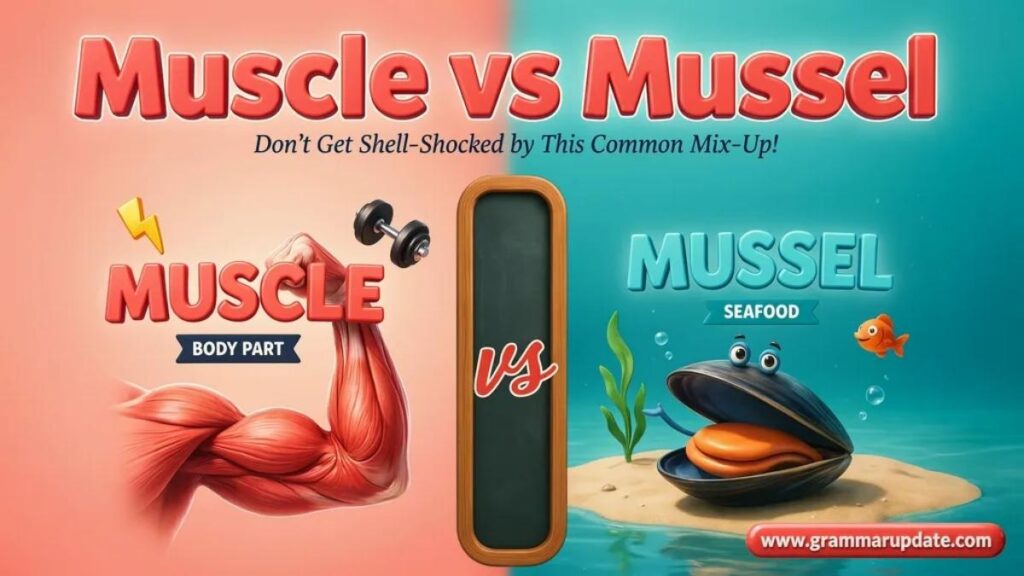
Muscle vs Mussel may look like a simple spelling issue, but it creates surprisingly serious confusion in everyday writing. Just one letter changes everything from strength in your body to seafood on your plate. You might mean building muscle at the gym and accidentally write about eating mussels instead, which can make your sentence unintentionally funny or just plain wrong. This mix-up often appears in grammar lessons, ESL learning, and even professional writing. Both words sound exactly the same, yet their meanings belong to completely different worlds. In this guide, you will clear the confusion around muscle vs mussel with simple explanations, examples, and practice that actually sticks.
Muscle vs Mussel Quick Answer
Here’s the simplest explanation.
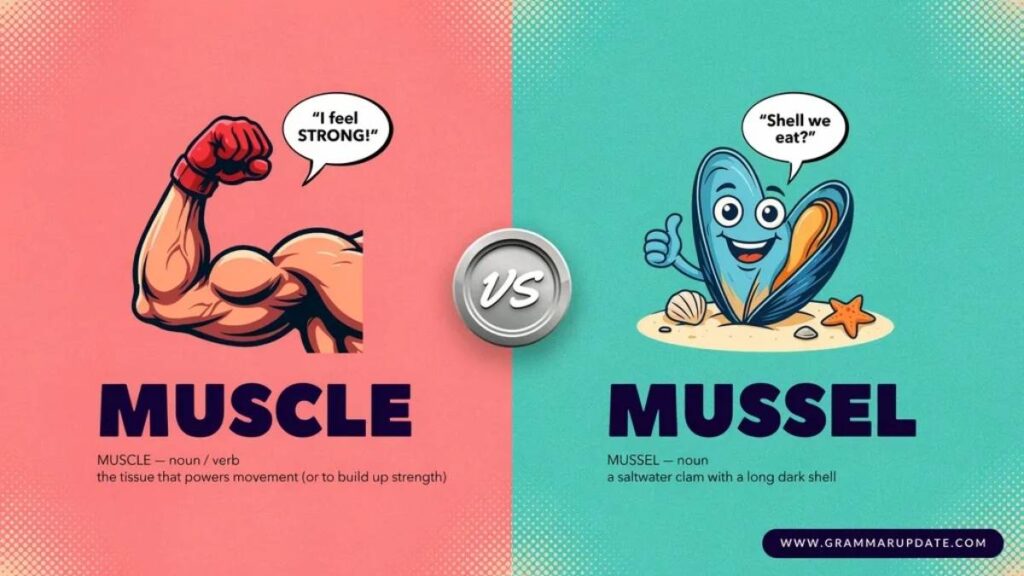
A muscle is tissue in the body that creates movement. Every time you walk, smile, lift a box, or take a breath, your muscles are working behind the scenes.
A mussel, on the other hand, is a type of shellfish. It lives in freshwater or saltwater environments and is often served as seafood in many cuisines around the world.
Although the words look similar and share the same pronunciation, their meanings are completely unrelated.
Muscle vs Mussel at a Glance
| Feature | Muscle | Mussel |
|---|---|---|
| Meaning | Tissue that helps the body move | A shellfish that lives in water |
| Field | Human anatomy | Marine biology |
| Function | Movement, posture, and support | Filter feeding and ecosystem balance |
| Found In | Humans and animals | Oceans, rivers, and lakes |
| Pronunciation | Same as mussel | Same as muscle |
| Common Context | Fitness, health, biology | Seafood, ecology, marine life |
One quick rule can save you from most spelling mistakes:
If you’re talking about the body, use muscle. If you’re talking about seafood or shellfish, use mussel.
Muscle vs Mussel Meaning Understanding the Real Difference
At first glance, these words seem closely related. After all, they share nearly identical spelling and exactly the same sound. However, that’s where the similarity ends.
The difference between muscle and mussel comes down to context.
When people discuss fitness, exercise, strength, movement, or anatomy, they’re referring to muscles.
When people discuss shellfish, seafood dishes, rivers, oceans, or aquatic ecosystems, they’re referring to mussels.
Consider these examples:
Correct:
- Building muscle strength requires regular exercise.
- The chef prepared steamed mussels with garlic and herbs.
Incorrect:
- Building mussel strength requires regular exercise.
- The chef prepared steamed muscles with garlic and herbs.
The incorrect examples may sound right when spoken because of the identical pronunciation. Yet the spelling changes the meaning completely.
This is exactly why muscle and mussel confused words appear so frequently in writing.
Why Do Muscle and Mussel Sound the Same?
English contains thousands of words that sound alike but have different meanings.
These words are called homophones.
Are Muscle and Mussel Homophones?
Yes.
In fact, muscle vs mussel homophones is one of the most common examples used in English vocabulary lessons.
A homophone is a word that:
- Shares the same pronunciation as another word
- Has a different spelling
- Has a different meaning
Other well-known examples include:
| Word 1 | Word 2 |
|---|---|
| Sea | See |
| Flour | Flower |
| Pair | Pear |
| Right | Write |
| Muscle | Mussel |
For English language learners, homophones often create spelling mistakes because the ear hears no difference between the words.
Muscle vs Mussel Pronunciation
One of the most searched questions online is about muscle vs mussel pronunciation.
Surprisingly, there is no pronunciation difference.
IPA Pronunciation Guide
| Word | IPA Pronunciation |
|---|---|
| Muscle | /ˈmʌs.əl/ |
| Mussel | /ˈmʌs.əl/ |
According to the International Phonetic Alphabet (IPA), both words share exactly the same pronunciation.
How to Pronounce Muscle
The word muscle contains two syllables:
MUS-suhl
Many learners mistakenly pronounce the “c” because it appears in the spelling.
The correct pronunciation keeps the “c” silent.
How to Pronounce Mussel
Mussel follows the same pattern:
MUS-suhl
When spoken aloud, listeners cannot distinguish muscle from mussel without additional context.
Muscle Pronunciation in American English
The standard muscle pronunciation in American English is:
/ˈmʌsəl/
Native speakers usually pronounce it smoothly, placing stress on the first syllable.
British English Pronunciation
The British English pronunciation is nearly identical:
/ˈmʌsəl/
As a result, both American and British speakers pronounce muscle and mussel the same way.
Why Do Muscle and Mussel Sound the Same?
Language history provides the answer.
Over hundreds of years, words borrowed from different languages often evolved toward similar pronunciations. Although muscle and mussel developed from different origins, their spoken forms eventually converged.
That’s why searches such as:
- why do muscle and mussel sound the same
- muscle vs mussel sound
- muscle and mussel meaning and pronunciation
- how to pronounce muscle and mussel
Muscle vs Mussel Examples in Everyday Sentences
Reading definitions helps. Seeing words in context helps even more.
The following muscle vs mussel examples show exactly how each word works in real-world writing and conversation.
Muscle Examples
These sentences use muscle correctly.
- Building muscle takes time, consistency, and proper nutrition.
- The cyclist developed impressive leg muscle after years of training.
- Human muscles work together to produce movement.
- A strained shoulder muscle kept her out of competition.
- Resistance training can improve muscle strength and endurance.
Mussel Examples
These sentences use mussel correctly.
- The chef prepared cooked mussels in a white wine sauce.
- Blue mussels are popular in many European seafood dishes.
- Freshwater mussels help keep rivers clean by filtering water.
- Researchers studied a rare mussel species in the lake.
- The mussel shell protected the animal from predators.
Muscle vs Mussel in a Sentence
One of the easiest ways to understand the difference between muscle and mussel is to compare them directly.
| Incorrect Usage | Correct Usage |
|---|---|
| I pulled a mussel while running. | I pulled a muscle while running. |
| The restaurant served steamed muscles. | The restaurant served steamed mussels. |
| Human mussels help movement. | Human muscles help movement. |
| The mussels in your arm are strong. | The muscles in your arm are strong. |
Common Muscle vs Mussel Mistakes
Among all confusing English words, muscle and mussel rank near the top because they sound identical.
Mistake: Using Mussel for Body Parts
Incorrect:
My arm mussel feels sore today.
Correct:
My arm muscle feels sore today.
Whenever you’re talking about the body, anatomy, movement, strength, or exercise, use muscle.
Mistake: Using Muscle for Seafood
Incorrect:
We ate steamed muscles for dinner.
Correct:
We ate steamed mussels for dinner.
Whenever you’re discussing shellfish, seafood, oceans, rivers, or aquatic animals, use mussel.
Why Spellcheck Doesn’t Always Help
Spellcheck programs often miss these errors because both words are spelled correctly.
The issue isn’t spelling. It’s choosing the right word for the context.
That makes context clues especially important.
A Quick Editing Tip
Before publishing or submitting your writing, ask:
Am I talking about the human body or seafood?
The answer immediately reveals whether you need muscle or mussel.
More Related Articles You May Find Helpful
Cheer vs Chear difference and Usage Guide
Muscle vs Mussel Homophones Why This Confusion Happens
The phrase muscle vs mussel homophones appears frequently in online searches because homophones naturally create confusion.
What Makes Them Homophones?
Homophones share:
- The same pronunciation
- Different meanings
- Different spellings
Muscle and mussel fit this definition perfectly.
Other Common Homophone Words
| Word Pair | Meaning Difference |
|---|---|
| Their / There | Possession vs location |
| To / Too | Direction vs also |
| Sea / See | Ocean vs vision |
| Flower / Flour | Plant vs baking ingredient |
| Muscle / Mussel | Body tissue vs shellfish |
For many English language learners, mastering homophones becomes one of the biggest challenges in vocabulary development.
More Related Articles You May Find Helpful
Placque vs Plaque Difference and Correct Usage
Muscle vs Mussel for ESL Learners
Students learning English often struggle with similar sounding words.
Why ESL Students Get Confused
Several factors contribute:
- Silent letters
- Historical spellings
- Multiple meanings
- Homophones in English
A learner may hear “muscle” and “mussel” spoken aloud and assume they share the same spelling.
Simple Rule for ESL Vocabulary Learners
Remember:
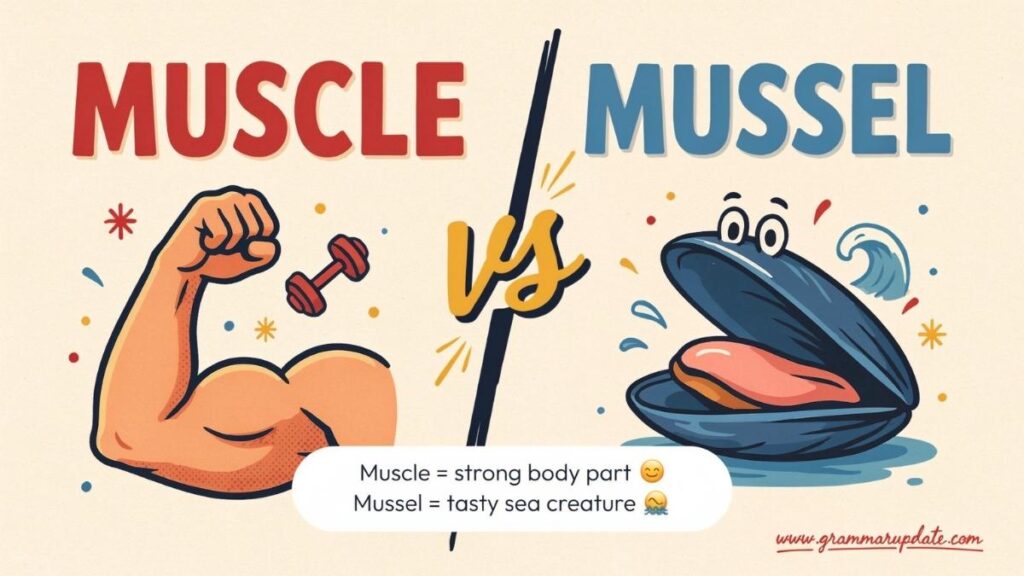
Muscle = Movement
Mussel = Marine Animal
That single association solves most confusion.
Visual Learning Trick
Think about the letters:
MusCLE
The word contains “cle,” which resembles “clench.”
People clench muscles.
MusSEL
The ending “sel” can remind you of a shell.
Mussels live inside shells.
While not scientifically related, these associations help many learners remember the correct spelling.
More Related Articles You May Find Helpful
Trauma vs Trama Difference and Correct Usage
How to Remember the Difference Between Muscle and Mussel
Even native speakers occasionally hesitate when writing these words.
Fortunately, a few memory tricks make them easy to distinguish.
Easy Memory Trick for Muscle
Think:
Muscles help you move.
Both words begin with the letter M.
Movement requires muscles.
Easy Memory Trick for Mussel
Think:
Mussels have shells.
The double “s” in mussel can remind you of the double sides of a shell.
Visual Memory Method
Picture two images:
- A bodybuilder flexing an arm
- A bowl of seafood mussels
The visual contrast makes the difference unforgettable.
Quick Comparison Chart
| Remember This | Word |
|---|---|
| Movement | Muscle |
| Shellfish | Mussel |
| Fitness | Muscle |
| Seafood | Mussel |
| Anatomy | Muscle |
| Marine Mollusk | Mussel |
More Related Articles You May Find Helpful
Bearable vs Bareable Which Spelling Is Correct?
Muscle Pronunciation in American English
Many readers search for muscle pronunciation American English audio because the spelling looks different from the sound.
American English Pronunciation
IPA:
/ˈmʌsəl/
Phonetic spelling:
MUS-uhl
The letter “c” remains silent.
Common Pronunciation Errors
Incorrect:
- Mus-kel
- Mus-clee
- Mus-kull
Correct:
- MUS-uhl
More Related Articles You May Find Helpful
Natzi vs Nazi Which Is the Correct Spelling?
Pronunciation Guide
Think of these similar sounding words:
- Hustle
- Rustle
- Bustle
Muscle follows a similar rhythm.
Muscle vs Mussel Pronunciation in American English
The answer surprises many learners:
There is no pronunciation difference.
| Word | Pronunciation |
|---|---|
| Muscle | MUS-uhl |
| Mussel | MUS-uhl |
This explains why muscle vs mussel pronunciation in American English remains a popular search query.
More Related Articles You May Find Helpful
Emigrate vs Immigrate Difference and usage
Mussels Meaning, Nutrition, and Health Benefits
Beyond spelling and grammar, mussels are fascinating animals and highly nutritious foods.
What Are Mussels?
Mussels belong to a group of aquatic animals known as bivalve mollusks.
Characteristics include:
- Two-part shell
- Soft body
- Filter-feeding behavior
- Freshwater and saltwater habitats
Many species are harvested for food.
Are Mussels Healthy to Eat?
Yes.
Nutrition experts often classify mussels among the healthiest seafood options available.
They offer high nutrient density while remaining relatively low in calories.
Mussels Nutrition Facts
A typical 3-ounce (85-gram) serving of cooked mussels provides approximately:
| Nutrient | Amount |
|---|---|
| Calories | 146 |
| Protein | 20 grams |
| Fat | 4 grams |
| Iron | High |
| Vitamin B12 | Extremely High |
| Selenium | High |
| Omega-3 Fatty Acids | Significant |
These numbers may vary slightly depending on preparation methods.
Fix common more word mistakes in English
Imbed vs Embed Which Spelling Should You Use?
Mussels Benefits
The mussels benefits extend far beyond protein.
Excellent Source of Protein
Mussels provide complete protein containing all essential amino acids.
Rich in Vitamin B12
A single serving often exceeds daily vitamin B12 requirements.
Supports Heart Health
Omega-3 fatty acids contribute to cardiovascular health.
Provides Important Minerals
Mussels contain:
- Iron
- Zinc
- Selenium
- Manganese
Low-Calorie Nutrition
People seeking protein-rich foods often choose mussels because they deliver substantial nutrition without excessive calories.
Seafood Nutrition Snapshot
“Mussels combine high-quality protein, beneficial omega-3 fats, and essential vitamins in a relatively low-calorie package.”
That’s one reason dietitians frequently recommend shellfish as part of a balanced diet.
Popular Ways Mussels Are Cooked
Many cultures prepare mussels differently.
Popular dishes include:
- Steamed mussels
- Garlic butter mussels
- White wine mussels
- Tomato broth mussels
- Seafood pasta with mussels
Among seafood lovers, blue mussels remain one of the most commonly consumed varieties worldwide.
More Related Articles You May Find Helpful
Planing vs Planning Difference and Correct Usage
Mussels vs Clams Difference
People often compare mussels and clams because both belong to the shellfish family.
However, important differences exist.
Mussels vs Clams Comparison
| Feature | Mussels | Clams |
|---|---|---|
| Shape | Elongated | Rounder |
| Shell Surface | Smooth | Often ridged |
| Habitat | Attached to surfaces | Buried in sand |
| Flavor | Rich and briny | Mild and sweet |
| Appearance | Dark blue or black | Various colors |
Are Mussels Better Than Clams?
There isn’t a universal winner.
It depends on personal preference.
People who enjoy stronger seafood flavors often prefer mussels.
People who enjoy milder flavors may prefer clams.
Both offer excellent nutrition and protein.
Fix common more word mistakes in English
Licence vs License Which Spelling Is Correct?
Muscle vs Mussel Reddit Discussions
The phrase muscle vs mussel reddit appears frequently because users often discuss confusing English words online.
Common questions include:
- Why do muscle and mussel sound the same?
- Which spelling is correct?
- Are muscle and mussel homophones?
- Why does English have so many similar sounding words?
A common observation from online discussions is simple:
People rarely confuse the meanings when speaking. Most confusion happens when writing.
That’s because context usually makes the intended word obvious during conversation.
Muscle vs Mussel Final Comparison
After exploring pronunciation, biology, grammar, and nutrition, the distinction becomes clear.
Quick Recap Table
| Category | Muscle | Mussel |
|---|---|---|
| Meaning | Body tissue | Shellfish |
| Pronunciation | MUS-uhl | MUS-uhl |
| Homophone | Yes | Yes |
| Related Field | Human anatomy | Marine biology |
| Example | Bicep muscle | Blue mussel |
| Function | Movement | Water filtration |
The One Difference You Should Never Forget
Remember this simple sentence:
Muscles move your body. Mussels live in shells.
Everything else builds from that distinction.
Fix common more word mistakes in English
Canon vs Cannon Difference and Usage
Practice Questions Muscle vs Mussel
Test your understanding of muscle vs mussel with these fill-in-the-blank exercises. Choose the correct word (muscle or mussel) to complete each sentence.
Fill in the Blanks
Easy Level
- She pulled a __________ while lifting a heavy box.
- The restaurant is famous for its steamed __________ dishes.
- Regular exercise helps build __________ strength.
- A __________ uses its shell for protection.
- The athlete injured a leg __________ during training.
- We ordered garlic __________ as an appetizer.
- Human __________ help the body move.
- The scientist discovered a rare freshwater __________.
- Stretching can help prevent a sore __________.
- The fisherman found a large __________ attached to a rock.
Intermediate Level
- The largest __________ in the human body is the gluteus maximus.
- Blue __________ are commonly served in seafood restaurants.
- Weightlifting promotes __________ growth over time.
- The __________ filtered water as it fed.
- Strong core __________ improve balance and posture.
- A freshwater __________ can live for many years.
- The coach explained how each __________ contributes to movement.
- The chef cooked the __________ in a white wine sauce.
- Skeletal __________ work with bones to produce movement.
- The empty __________ shell washed onto the beach.
Advanced Level
- Damage to a cardiac __________ can affect heart function.
- The marine biologist studied a protected __________ species.
- Resistance training increases __________ strength and endurance.
- The __________ attached itself to the dock using strong fibers.
- Understanding the difference between __________ and mussel helps avoid common spelling mistakes.
Answers
| Question | Answer |
|---|---|
| 1 | muscle |
| 2 | mussel |
| 3 | muscle |
| 4 | mussel |
| 5 | muscle |
| 6 | mussels |
| 7 | muscles |
| 8 | mussel |
| 9 | muscle |
| 10 | mussel |
| 11 | muscle |
| 12 | mussels |
| 13 | muscle |
| 14 | mussel |
| 15 | muscles |
| 16 | mussel |
| 17 | muscle |
| 18 | mussels |
| 19 | muscles |
| 20 | mussel |
| 21 | muscle |
| 22 | mussel |
| 23 | muscle |
| 24 | mussel |
| 25 | muscle |
Here’s a trusted source for clear word meanings:
FAQs
What is the difference between muscle and mussel?
The difference between muscle and mussel is their meaning. A muscle is body tissue that helps humans and animals move, maintain posture, and perform physical activities. A mussel is a type of shellfish that lives in freshwater or saltwater environments. While the words sound the same, they refer to completely different things.
Is it muscle or mussel?
Use muscle when talking about the human body, fitness, anatomy, movement, or strength. Use mussel when referring to a shellfish or marine animal. The correct choice depends entirely on the context.
Are muscle and mussel homophones?
Yes. Muscle and mussel are homophones because they have the same pronunciation but different spellings and meanings. This is why they are often listed among commonly confused words in English.
How do you pronounce muscle?
The word muscle is pronounced MUS-uhl. Its IPA pronunciation is /ˈmʌsəl/. The letter “c” is silent and should not be pronounced separately.
How do you pronounce mussel?
The word mussel is also pronounced MUS-uhl. Its IPA pronunciation is /ˈmʌsəl/, which is exactly the same as muscle.
Why do muscle and mussel sound the same?
Muscle and mussel sound the same because they are homophones. Although they come from different word origins, historical changes in English pronunciation caused them to develop the same spoken sound over time.
What does muscle mean?
The muscle meaning refers to specialized tissue in the body that contracts and relaxes to create movement. Muscles help people walk, run, lift objects, breathe, and maintain posture.
What does mussel mean?
The mussel meaning refers to a bivalve mollusk that lives in aquatic environments. Mussels have two hinged shells and can be found in rivers, lakes, and oceans.
What are examples of muscle and mussel in sentences?
Here are simple muscle vs mussel examples:
Muscle:
- Weight training helped him build muscle strength.
- She pulled a muscle while running.
Mussel:
- The restaurant served steamed mussels with garlic butter.
- A freshwater mussel was discovered in the river.
How can I remember the difference between muscle and mussel?
A simple memory trick is:
Muscles move. Mussels live in shells.
If the topic involves anatomy, fitness, or movement, use muscle. If it involves seafood, shellfish, or marine life, use mussel.
What type of animal is a mussel?
A mussel is a bivalve mollusk, which is a type of shellfish. It belongs to the same broader group as clams, oysters, and scallops.
Are mussels healthy to eat?
Yes. Mussels are highly nutritious and provide high-quality protein, vitamin B12, iron, zinc, selenium, and omega-3 fatty acids. They are considered one of the most nutrient-dense seafood options available.
What are the health benefits of mussels?
The main mussels benefits include:
- High protein content
- Rich source of vitamin B12
- Supports heart health through omega-3 fats
- Provides iron and zinc
- Low in calories compared to many protein sources
What are mussels made of?
Mussels consist of a soft-bodied animal protected by a hard shell made primarily of calcium carbonate. The shell has two hinged halves that open and close.
What is muscle tissue?
Muscle tissue is specialized tissue that contracts to produce movement. The three main types are skeletal muscle, smooth muscle, and cardiac muscle.
What are the three types of muscles in the human body?
The three major types of human muscles are:
- Skeletal muscle – controls voluntary movement
- Smooth muscle – found in organs and blood vessels
- Cardiac muscle – forms the heart
Each type performs a unique function within the muscular system.
How many muscles are in the human body?
The human body contains more than 600 muscles. Together, they form the muscular system and enable movement, stability, and essential bodily functions.
Are mussels and clams the same thing?
No. Although both are shellfish and belong to the bivalve mollusk family, they differ in shell shape, habitat, texture, and flavor. Mussels typically have elongated dark shells while clams usually have rounder shells.
Which is healthier, mussels or clams?
Both are nutritious seafood choices. Mussels generally contain higher levels of omega-3 fatty acids and vitamin B12, while clams are often richer in iron. The healthier option depends on individual dietary needs.
Why do English learners confuse muscle and mussel?
Many English language learners confuse muscle and mussel because the words have identical pronunciation. Since both sound like “MUS-uhl,” learners often struggle to remember which spelling matches which meaning.
Is muscle or mussel more commonly used?
Muscle is generally used more frequently in everyday English because it appears in discussions about fitness, health, medicine, sports, and anatomy. Mussel is less common and usually appears in seafood, cooking, and marine biology contexts.
Fix common more word mistakes in English
Exercise vs Exorcise Differences and Correct Usage
Conclusion
Muscle vs mussel confusion is a subtle but common English error that can completely alter meaning while still sounding correct in speech. A single missing letter can shift a sentence from human anatomy and physical strength to seafood and marine life, often leading to unintended humor or miscommunication. The distinction is straightforward once understood: muscle refers to body tissue that enables movement, while mussel refers to a shellfish found in freshwater and marine environments.
Once this difference is clear, avoiding mistakes becomes easy. Before writing, take a moment to check the context. If the subject relates to fitness, strength, or the human body, muscle is correct. If it relates to seafood or aquatic life, mussel is appropriate. This simple habit ensures clarity, accuracy, and professional writing in every context.

Jhon AJS, the creative mind behind Grammar Update, is an experienced blogger passionate about simplifying English grammar. He focuses on explaining confusing word vs word differences, grammar rules, punctuation, and sentence structure in a clear and practical way. Through easy to understand guides and examples, Jhon helps readers improve their writing and communicate with confidence. With years of blogging experience, he continues to share helpful insights that make learning grammar simple, useful, and accessible for everyone.