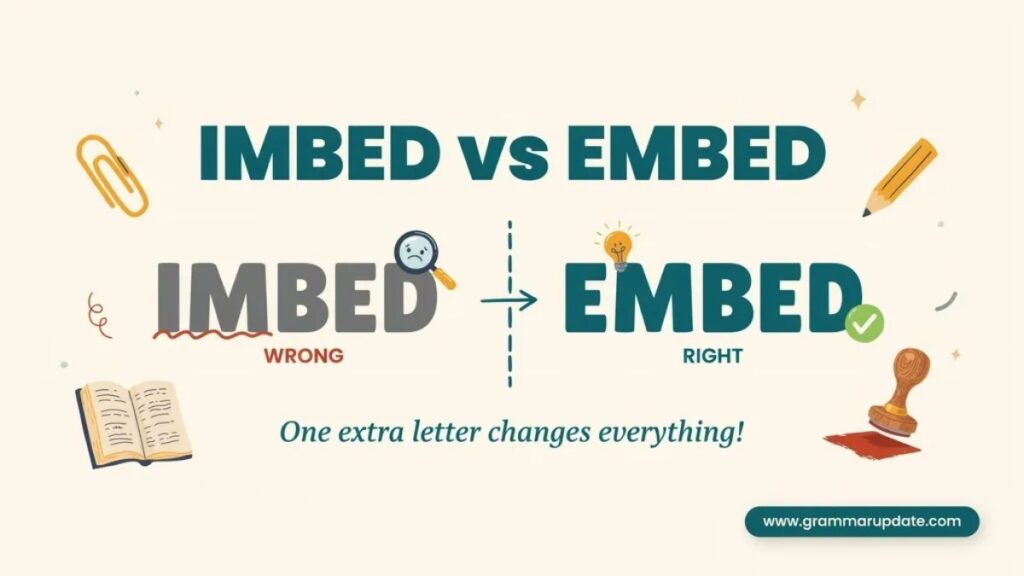
Have you ever typed imbed into a document, only to have your spell checker instantly react like you’ve broken a serious rule of English? That small moment captures the entire imbed vs embed confusion that puzzles writers, students, and professionals alike. Because both spellings appear in dictionaries, many people assume they must carry different meanings or levels of correctness. In reality, the difference is far simpler. Both words mean the same thing, but only one is widely preferred in modern writing. In this guide, you’ll clearly understand the confusion, avoid common mistakes, and confidently choose the correct form in any academic, business, or professional context without hesitation.
Quick Answer Imbed vs Embed
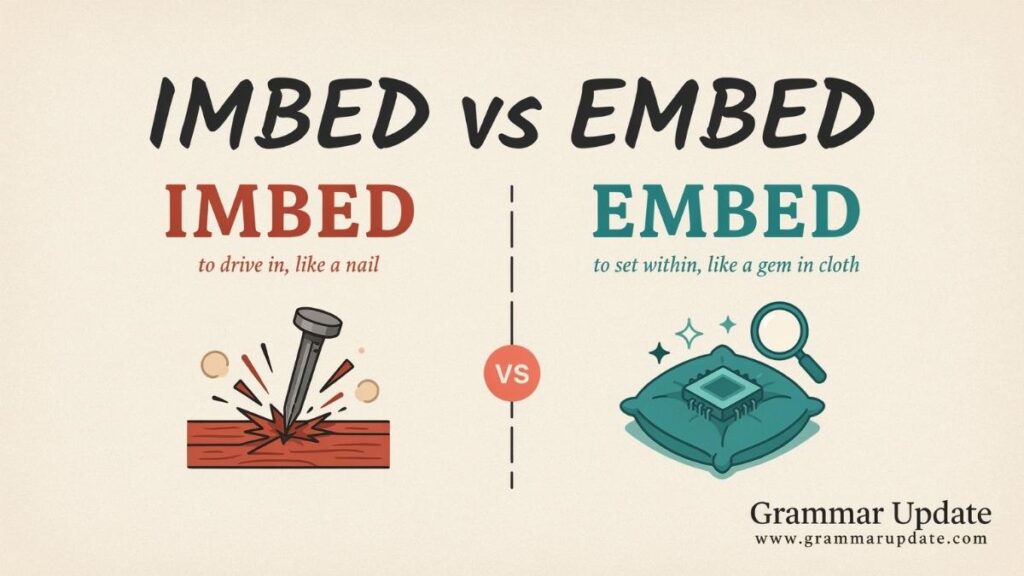
The short answer is simple:
There is no difference in meaning between imbed and embed.
Both words mean:
To fix, place, insert, or set something firmly within another thing.
Whether you write embed or imbed, the core meaning remains the same. The distinction is not about definition—it’s about usage and preference.
Today, embed is considered the standard spelling, while imbed is generally treated as a less common variant.
Quick Comparison Table
| Feature | Embed | Imbed |
|---|---|---|
| Meaning | Set firmly within something | Set firmly within something |
| Dictionary Recognition | Yes | Yes |
| Modern Popularity | Very high | Low |
| Professional Writing | Preferred | Rarely preferred |
| Technology Usage | Standard | Rare |
| Academic Writing | Recommended | Uncommon |
| Editorial Preference | Strongly preferred | Limited |
For most situations, embed is the safest and most widely accepted choice.
Are Imbed and Embed the Same Word?
Yes. In modern English, imbed and embed are simply different spellings of the same verb.
Consider these examples:
- The documentary was embedded into the website.
- The documentary was imbedded into the website.
Both sentences are grammatically correct.
However, most editors, publishers, and style guides would choose the first sentence because embed spelling is now considered the standard form.
This is why many grammar experts classify imbed as a spelling variant rather than a separate word with its own meaning.
Which Spelling Is Preferred Today?
If you’re asking:
“Should I use imbed or embed?”
The answer is straightforward:
Use embed in almost every situation.
You’ll find embed used extensively in:
- Academic research
- Business communication
- Journalism
- Technical documentation
- Website development
- Computer programming
- Digital marketing
- Government publications
Even though imbed definition and embed definition are identical, modern writing overwhelmingly favors embed.
Quick Rule
If you’re unsure which version to choose, remember this:
When in doubt, use embed.
It’s the spelling readers expect to see.
What Does Embed Mean?
To understand the imbed vs embed meaning, it’s important to begin with the modern definition of embed.
Embed Definition
The standard embed definition is:
To fix firmly and deeply within a surrounding object, structure, context, or environment.
In simple terms, something becomes inserted so securely that it appears to be a natural part of the whole.
This idea applies to physical objects, digital content, ideas, values, memories, and even organizational practices.
Embed Pronunciation
Many English learners search for embed pronunciation because the spelling can be slightly misleading.
The correct pronunciation is:
em-BED
Phonetic transcription:
/ɪmˈbed/
The stress falls on the second syllable.
Examples
- em-BED a video
- em-BED an image
- em-BED a document
- em-BED a value into company culture
The pronunciation remains essentially the same in both American English and British English.
Learn the difference between tricky more English words
Abley vs Ably Which Spelling Is Correct in English?
Literal Meaning of Embed
Historically, the verb embed referred to physically placing one object inside another.
Examples include:
- Fossils embedded in stone.
- A gemstone embedded in a ring.
- Steel rods embedded in concrete.
- A fragment embedded in wood.
In each example, the object becomes firmly fixed within another material.
This physical meaning remains common today in fields such as construction, geology, engineering, and medicine.
Figurative Meaning of Embed
Modern English often uses embed in a figurative sense.
Instead of placing physical objects inside something, we place ideas, habits, values, or concepts within a system or culture.
Examples
- Safety principles are embedded throughout the organization.
- These traditions are deeply embedded in society.
- The lesson became embedded in her memory.
- Ethical standards are embedded in the company’s policies.
This figurative use is especially common in business, education, psychology, and leadership communication.
Embed Synonym
A common search query is embed synonym.
Depending on context, possible alternatives include:
- Insert
- Integrate
- Incorporate
- Implant
- Ingrain
- Lodge
- Fix
- Set
- Root
- Plant
Example
Original:
Innovation is embedded in the company’s culture.
Alternative:
Innovation is integrated into the company’s culture.
Although many synonyms exist, embed often suggests a deeper and more permanent connection than words like insert or place.
Learn the difference between tricky more English words
Planing vs Planning Difference and Correct Usage
Embed Antonym
The opposite of embed depends on context, but common antonyms include:
- Remove
- Extract
- Separate
- Detach
- Withdraw
- Uninstall
- Dislodge
Example
- Surgeons removed the fragment that was embedded in the tissue.
The relationship between embed and extract is particularly common in technical and medical writing.
What Does Imbed Mean?
Now let’s examine the less common spelling.
Imbed Definition
The imbed definition is exactly the same as the definition of embed.
It means:
To place or fix something firmly within another thing.
There is no separate meaning attached to the word.
This fact alone answers many questions about the difference between imbed and embed.
The difference is spelling not meaning.
Is Imbed a Word?
One of the most frequently searched questions online is:
Is Imbed a Real Word?
Yes.
Imbed is absolutely a real word.
Major dictionaries continue to recognize it as an accepted spelling variant.
However, acceptance does not necessarily mean preference.
Many words remain technically correct while becoming less common over time. That is exactly what happened with imbed.
Today, most writers rarely use it.
Why Dictionaries Still Include Imbed
Leading dictionaries continue to include imbed because it has a long history in the English language.
You’ll find references to it in respected resources such as:
- Merriam-Webster
- Cambridge Dictionary
- Oxford English Dictionary
However, these references often indicate that embed is the preferred or more common spelling.
This reflects a common pattern in language evolution: older variants remain recognized even after one form becomes dominant.
Imbed Meaning in Modern English
The modern imbed meaning has not changed.
Examples include:
- The seeds were imbedded in the soil.
- The values became imbedded in company culture.
- The memory remained imbedded in his mind.
All of these sentences are grammatically correct.
However, modern editorial standards would usually replace imbedded with embedded and imbed with embed.
That preference explains why many readers rarely encounter the older spelling.
Fix common more word mistakes in English
Carat vs Caret vs Karat Which is Differences?
Imbed Synonym
An imbed synonym is generally identical to an embed synonym because both words have the same meaning.
Examples include:
- Insert
- Integrate
- Incorporate
- Implant
- Fix
- Ingrain
- Lodge
Because the meanings overlap completely, their synonyms overlap as well.
Embed Meaning in Technology and Computing
One of the biggest reasons embed has become far more common than imbed is the rise of technology.
While both spellings are accepted, the digital world overwhelmingly favors embed. Every day, millions of people encounter terms such as embedded content, embedded systems, embedded software, embedded media, and embed code. As a result, the spelling embed has become deeply rooted in modern communication.
In fact, many people first learn the word through websites, apps, social media platforms, and software documentation rather than through traditional grammar lessons.
This widespread exposure has helped establish embed as the standard spelling in both technical and non-technical writing.
What Does Embed Mean in Computer Technology?
The embed meaning in computer terminology is slightly more specialized than its general dictionary definition.
In computing, embed means:
To insert digital content, functionality, or code into another digital environment so it can operate as part of that environment.
In simpler terms, embedding allows one piece of content to appear inside another without recreating it from scratch.
You encounter embedding almost every time you browse the internet.
Examples include:
- A YouTube video displayed within a blog post
- A Google Map shown on a business website
- A social media post appearing inside an online article
- A PDF document displayed directly on a webpage
- An online form integrated into a website
In each case, the content originates elsewhere but functions seamlessly within its new location.
This process is commonly known as website embedding or content embedding.
What Is Embedded Content?
Embedded content refers to any digital content that is displayed within another webpage, application, or document.
Instead of forcing users to visit another website, embedded content brings information directly to them.
Common examples include:
- Videos
- Images
- Audio files
- Maps
- Social media posts
- Surveys
- Presentations
- Documents
- Interactive tools
For example, if an online news article displays a social media post directly within the story, that post is considered embedded content.
Why Embedded Content Matters
Modern websites rely heavily on embedded content because it offers several advantages:
- Improves user experience
- Increases visitor engagement
- Reduces navigation interruptions
- Enhances visual appeal
- Allows real-time updates
- Keeps users on the page longer
This is why embedded content has become a core component of modern web design and digital publishing.
Fix common more word mistakes in English
Exercise vs Exorcise Differences and Correct Usage
What Is an Embed Code?
An embed code is a small snippet of code that allows external content to appear on another website.
Most embed codes use HTML, JavaScript, or iframe technology.
A typical example looks like this:
<iframe src="example-url"></iframe>
Website owners simply copy the code and place it within their webpage.
The content then appears automatically.
Common examples include:
- YouTube embed codes
- Google Maps embed codes
- Spotify embed codes
- Podcast embed codes
- Social media embed codes
Without embed codes, sharing interactive content across multiple websites would be far more complicated.
Understanding the HTML Embed Tag
Another important technology term is the HTML embed tag.
This tag allows developers to display external resources directly within a webpage.
Common uses include:
- PDF files
- Audio players
- Video players
- Interactive media
- Online documents
Although modern web development often relies on iframes and JavaScript-based solutions, the HTML embed tag remains an important part of web development history.
It also helps explain why the spelling embed became deeply associated with the technology industry.
How to Embed a Video
One of the most common uses of the word is embed a video.
Instead of uploading the same video to multiple websites, creators upload it once and then embed it wherever needed.
This approach provides several benefits:
- Faster website performance
- Reduced server storage requirements
- Easier content management
- Automatic updates
- Improved user experience
For this reason, bloggers, educators, businesses, and news organizations frequently embed videos rather than hosting separate copies.
How to Embed a Website
Another common application is the ability to embed a website or part of a website inside another webpage.
This is typically accomplished using an iframe.
Examples include:
- Booking platforms
- Payment systems
- Customer support portals
- Survey forms
- Analytics dashboards
Embedding allows users to interact with external services without leaving the page they are currently viewing.
As websites become more interconnected, embedding continues to play a critical role in digital content integration.
Embedded Media and Digital Content Integration
The term embedded media refers to media elements displayed within another digital environment.
Examples include:
- Embedded videos
- Embedded audio files
- Embedded presentations
- Embedded documents
- Embedded social media posts
Today, embedded media powers much of the modern internet.
Streaming platforms, educational websites, online newspapers, and social networks all depend on embedding technology to deliver content efficiently.
Without embedded media, many of the seamless online experiences users enjoy today would not exist.
What Are Embedded Systems?
The word embedded has another important meaning in technology that extends far beyond websites.
This meaning appears in the term embedded systems.
Embedded Systems Definition
An embedded system is a specialized computer system designed to perform a specific function within a larger device or machine.
Unlike a personal computer, which performs many tasks, an embedded system is usually built for one dedicated purpose.
Examples include:
- Smart thermostats
- GPS navigation systems
- Digital cameras
- Medical monitoring equipment
- Vehicle braking systems
- Smart watches
- Security systems
- Industrial machinery
Most people interact with embedded systems every day without even realizing it.
Why Embedded Systems Are Important
Embedded systems power countless devices that modern society depends on.
They help control:
- Transportation systems
- Healthcare equipment
- Telecommunications networks
- Manufacturing facilities
- Consumer electronics
Because these systems often operate in real time, they must be reliable, efficient, and highly optimized.
This need for precision has made embedded systems one of the most important areas of modern engineering.
More Related Articles You May Find Helpful
Canon vs Cannon Difference and Usage
Embedded Systems Engineering
Embedded systems engineering focuses on designing, developing, and maintaining these specialized systems.
Engineers in this field work with:
- Hardware components
- Microcontrollers
- Sensors
- Firmware
- Real-time operating systems
- Communication protocols
Their work influences everything from automobiles and aircraft to smart appliances and medical devices.
As automation and connected technologies continue to expand, demand for embedded systems engineers continues to grow worldwide.
Embedded Software Explained
Embedded software is software specifically created to run embedded systems.
Unlike traditional desktop applications, embedded software is designed for a particular device and function.
Examples include software that controls:
- Washing machines
- Smart refrigerators
- Fitness trackers
- Medical devices
- Traffic control systems
- Industrial robots
Because embedded software often operates under strict performance requirements, developers must prioritize stability, speed, and efficiency.
More Related Articles You May Find Helpful
Licence vs License Which Spelling Is Correct?
Imbedded vs Embedded Which Form Should You Use?
Another common source of confusion involves the past tense and past participle forms.
Many people search for:
imbedded vs embedded
Fortunately, the answer is straightforward.
What Is the Difference Between Imbedded and Embedded?
There is no difference in meaning.
Both words mean:
Fixed firmly within something else.
Examples:
- The sensor was embedded inside the device.
- The sensor was imbedded inside the device.
Both sentences are grammatically correct.
However, one form is clearly preferred in modern English.
Why Embedded Is More Common
The spelling embedded dominates modern writing.
You’ll find it in:
- Academic journals
- News publications
- Technical manuals
- Business reports
- Government documents
- Software documentation
Although imbedded still appears occasionally, it is significantly less common than embedded.
As a result, most professional writers and editors automatically choose embedded.
Embedded Meaning and Embedded Definition
The embedded meaning refers to something firmly fixed, integrated, or incorporated into a larger structure.
A common embedded definition is:
Positioned securely within another object, system, or environment.
Examples include:
- Embedded software
- Embedded content
- Embedded systems
- Embedded values
- Embedded sensors
The term is used in both literal and figurative contexts.
Imbedded Meaning
The imbedded meaning is exactly the same.
There is no separate definition, separate rule, or separate grammatical function.
The only distinction is spelling preference.
Modern English overwhelmingly favors embedded.
Imbed vs Embed Examples
The best way to understand proper usage is to see the words in context.
Embed in a Sentence
Here are several examples of embed in a sentence:
- The company embedded safety standards into every department.
- We embedded the video directly on the homepage.
- The professor embedded practical exercises throughout the course.
- Security features are embedded within the software.
- The journalist was embedded with military personnel.
Notice how natural and familiar the spelling appears.
This is the version readers expect to see.
Imbed in a Sentence
Examples of imbed in a sentence include:
- The company imbedded safety standards into every department.
- The lesson became imbedded in her memory.
- Values were imbedded throughout the organization.
- The image was imbedded into the document.
Although these examples are grammatically acceptable, they feel less modern because contemporary writing strongly favors embed.
Imbed vs Embed Examples: Side-by-Side Comparison
| Preferred Modern Form | Less Common Variant |
|---|---|
| Embed a video | Imbed a video |
| Embed a website | Imbed a website |
| Embedded software | Imbedded software |
| Embedded systems | Imbedded systems |
| Embedded media | Imbedded media |
| Embedded content | Imbedded content |
The difference is immediately noticeable.
The versions using embed align with current editorial standards, technology terminology, and reader expectations.
Imbed or Embed UK and US English
Many writers assume spelling differences between countries might explain the variation.
However, the reality is more straightforward.
Imbed vs Embed in American English
In American English, the preferred spelling is overwhelmingly embed.
You’ll find it used in:
- Universities
- Newspapers
- Publishing houses
- Government agencies
- Technology companies
For practical purposes, American English embed is the accepted standard.
Imbed vs Embed in British English
The same pattern appears in the United Kingdom.
If you’re wondering about imbed or embed UK usage, modern British publications also strongly favor embed.
Major newspapers, educational institutions, and publishers rarely use imbed today.
Is Embed Correct in UK English?
Yes.
One of the most common questions readers ask is:
Is embed correct in UK English?
Absolutely.
Not only is it correct, but it is also the preferred spelling throughout most contemporary British English writing.
Why Both Countries Prefer Embed
Several factors contributed to the global preference for embed:
- Editorial standardization
- Technology terminology
- International publishing practices
- Educational materials
- Software development language
- Digital communication
As technology became increasingly global, the spelling embed gained even greater dominance.
More Related Articles You May Find Helpful
Vender vs Vendor Which Spelling Is Correct?
Common Phrases That Use Embed
One of the clearest reasons embed has become the dominant spelling is its presence in everyday language. Whether you’re reading a business report, browsing a website, watching online content, or reviewing technical documentation, you’re likely to encounter the word regularly.
Over time, these frequent uses have helped establish embed as the standard spelling across multiple industries.
Let’s look at some of the most common expressions.
Embed a Video
The phrase embed a video has become a fundamental part of digital publishing.
Instead of uploading the same video to multiple websites, creators can display a video hosted elsewhere by using an embed code.
Example
We embedded a product demonstration video on the homepage to improve customer engagement.
Video embedding offers several advantages:
- Faster page loading
- Lower hosting costs
- Easier content management
- Improved user experience
- Automatic content updates
Today, nearly every major content platform supports video embedding.
Embed a Website
Another common phrase is embed a website or embed a portion of a website within another webpage.
Businesses frequently embed:
- Appointment booking systems
- Customer support portals
- Payment forms
- Survey tools
- Interactive dashboards
Embedding allows users to access external services without leaving the current page, creating a smoother browsing experience.
Embed Code
An embed code is a snippet of code that allows digital content to appear on another website.
Examples include:
- YouTube embed codes
- Google Maps embed codes
- Spotify embed codes
- Social media embed codes
- Podcast embed codes
Without embed codes, modern content sharing would be significantly less efficient.
Embedded Media
The term embedded media refers to media content displayed within another platform or webpage.
Examples include:
- Embedded videos
- Embedded audio
- Embedded presentations
- Embedded documents
- Embedded social posts
Embedded media has become a cornerstone of modern digital communication because it allows content to remain interactive while appearing seamlessly within another environment.
Embedded Values and Ideas
Not every use of embed relates to technology.
In business, education, and leadership, the word frequently describes ideas that become deeply integrated into a culture or system.
Examples include:
- Customer service is embedded in the company’s culture.
- Innovation is embedded throughout the organization.
- Ethical standards are embedded in every business process.
- Safety principles are embedded into employee training.
In these contexts, embed suggests something more permanent than simply adding or inserting.
Imbed vs Embed in Professional Writing
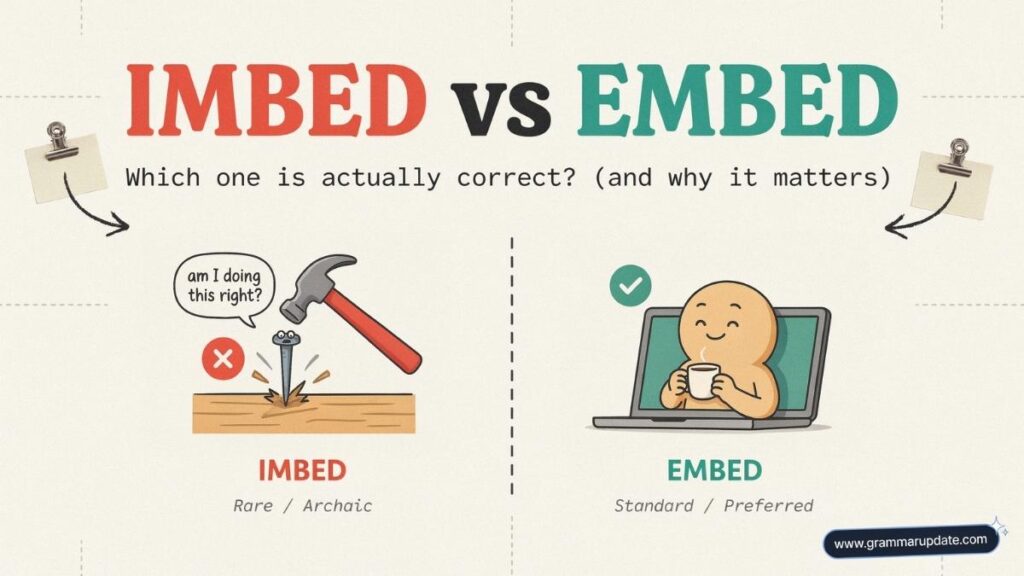
Although both spellings are technically correct, professional writers overwhelmingly prefer embed.
This preference exists because modern editorial standards prioritize consistency, clarity, and reader familiarity.
Business Communication
Professional communication depends on credibility.
Most corporate style guides encourage writers to use the most widely accepted spelling whenever possible.
Preferred Example
The organization embeds leadership development into every training program.
Less Common Variant
The organization imbeds leadership development into every training program.
While both are correct, the first version aligns with contemporary business writing standards and appears more natural to most readers.
More Related Articles You May Find Helpful
Contractor vs Contractee Usage and Differences Explained
Academic Writing
Universities, research institutions, and scholarly journals generally favor standardized spellings.
As a result, embed appears far more frequently in:
- Research papers
- Journal articles
- Theses
- Dissertations
- Academic textbooks
Students writing formal assignments should typically use embed, as it reflects modern academic conventions.
Journalism and Publishing
News organizations maintain detailed style guides to ensure consistency.
Most newspapers, magazines, and online publications use embed exclusively.
Examples include:
- Embedded journalists
- Embedded video reports
- Embedded social media posts
- Embedded graphics
Because journalism reaches millions of readers, this consistent usage reinforces the popularity of embed.
Technical Writing
Few industries demonstrate the dominance of embed more clearly than technology.
Terms such as:
- Embedded systems
- Embedded software
- Embedded content
- Embedded media
- Embedded devices
appear throughout engineering manuals, software documentation, and technical publications.
Using imbed in these contexts may appear outdated because industry terminology overwhelmingly favors embed.
Fix common more word mistakes in English
Writing vs Writting which is Correct Spelling
Common Mistakes Writers Make
The relationship between imbed and embed seems simple once explained, yet several misconceptions continue to cause confusion.
Mistake: Assuming the Words Have Different Meanings
One of the most common misunderstandings is believing that imbed and embed represent different concepts.
They do not.
Both words share the same definition:
To place firmly within something else.
The distinction is based on spelling preference rather than meaning.
Mistake: Believing Imbed Is Incorrect
Many people ask:
Is imbed correct grammar?
Yes.
Imbed is grammatically correct and recognized by major dictionaries.
However, because it is less common, many writers mistakenly assume it is an error.
Mistake: Switching Between Spellings
Consistency is essential in professional writing.
Avoid using embed in one section and imbed in another.
For example:
❌ Embed a video in one paragraph.
❌ Imbed a video in the next.
Choose one spelling and maintain it throughout the document.
In most cases, that spelling should be embed.
Mistake: Ignoring Reader Expectations
Language is not only about correctness; it is also about familiarity.
Because readers encounter embed far more often than imbed, the standard spelling generally feels more natural and professional.
Good writing considers both accuracy and audience expectations.
Learn the difference between tricky more English words
Icycle vs Icicle Differences and Correct Usage
Embedded Deductible An Important Insurance Term
The word embedded also appears in the insurance industry, where it has a completely different meaning.
This usage is unrelated to grammar, spelling, technology, or digital content.
Instead, it refers to how deductibles function within certain health insurance plans.
What Is an Embedded Deductible?
An embedded deductible is a deductible structure commonly used in family health insurance plans.
Under this arrangement:
- Each family member has an individual deductible.
- The family also has a larger combined deductible.
Once an individual reaches their personal deductible, insurance benefits may begin for that person even if the family deductible has not yet been met.
Embedded Deductible Example
Consider the following family health insurance plan:
| Deductible Type | Amount |
|---|---|
| Individual Deductible | $2,000 |
| Family Deductible | $6,000 |
If one family member incurs $2,000 in eligible medical expenses, that person’s insurance coverage can begin immediately.
Meanwhile, the remaining family members continue contributing toward the overall family deductible.
This structure provides flexibility and can reduce out-of-pocket costs for individuals with significant healthcare expenses.
Embedded Deductible vs Aggregate Deductible
Understanding the difference between these deductible structures is important when comparing insurance plans.
| Embedded Deductible | Aggregate Deductible |
|---|---|
| Individual deductible applies | No individual deductible |
| Family deductible also applies | Only family deductible applies |
| Coverage may begin for one member early | Coverage begins after family deductible is met |
| More flexibility for families | Simpler deductible structure |
Because of these advantages, embedded deductibles are common in employer-sponsored family health plans.
Fix common more word mistakes in English
Shute vs Chute Differences and Correct Usage
Imbedded Deductible Meaning
Some people search for imbedded deductible meaning, but insurance providers almost always use the spelling embedded deductible.
The meaning remains the same; only the spelling differs.
Why Is Embed More Common Than Imbed?
A common People Also Ask question is:
Why is embed more common than imbed?
The answer involves several factors working together over time.
Editorial Standardization
Publishers, educators, and editors gradually standardized around embed.
As readers repeatedly encountered this spelling, it became the expected form.
Technology’s Influence
The technology industry strongly reinforced the preference for embed through terms such as:
- Embedded systems
- Embedded software
- Embedded content
- Embed code
- Embedded media
Because these terms appear millions of times across websites, software manuals, and technical resources, they continuously strengthen the dominance of embed.
Search Trends and Online Visibility
Internet users overwhelmingly search for:
- Embed meaning
- Embed code
- Embedded systems
- Embedded content
- Embed a video
This increased visibility helps maintain the spelling’s popularity.
Reader Familiarity
Readers naturally trust the forms they encounter most often.
Since embed appears far more frequently than imbed, it feels more familiar, modern, and professional.
How to Remember the Correct Choice
If you ever struggle to decide between imbed vs embed, these simple memory techniques can help.
The Technology Rule
Think about the technology terms you see every day:
- Embedded systems
- Embedded software
- Embedded content
- Embed code
Notice that they all use embed.
Technology consistently points toward the preferred spelling.
The Professional Writing Rule
Ask yourself:
Which spelling would I expect to see in a university paper, business report, or newspaper article?
The answer is almost always embed.
The Reader Rule
When two spellings are technically correct, choose the one readers expect.
Today, that spelling is embed.
Practice Session Imbed vs Embed
Fill in each blank with the correct word: imbed or embed
- The teacher decided to ______ a video in the lesson.
- Fossils were ______ in rock layers for millions of years.
- You can ______ a map directly into your website.
- The stone was ______ inside the concrete wall.
- Many websites ______ YouTube videos for better engagement.
- The correct modern spelling is ______.
- The file was ______ into the system for easy access.
- Ancient insects were ______ in amber.
- Developers often ______ code into web pages.
- Although ______ still exists, it is rarely used today.
- The journalist was ______ with the military unit.
- Safety rules are ______ in company training programs.
- The image was ______ into the document.
- Scientists ______ sensors inside the device.
- The message became deeply ______ in her memory.
- The blog post ______ a social media feed.
- A GPS chip was ______ in the tracker.
- The lesson was ______ with real-world examples.
- Modern apps ______ multimedia content easily.
- The idea was ______ into the organization’s culture.
- The video was ______ on the homepage.
- Engineers ______ software into smart devices.
- The data was ______ into the report.
- The value system is ______ in the company.
- The final design ______ interactive elements for users.
Answers
- embed
- embedded
- embed
- embedded
- embed
- embed
- embedded
- embedded
- embed
- imbed
- embedded
- embedded
- embedded
- embed
- embedded
- embeds
- embedded
- embedded
- embed
- embedded
- embedded
- embed
- embedded
- embedded
- embeds
Here’s a trusted source for clear word meanings:
FAQs
Is imbed a real word?
Yes, imbed is a real word, but it is a less common spelling variant of embed. Both words have the same meaning: to place or fix something firmly within something else. However, modern English strongly prefers embed in professional and academic writing.
What is the difference between imbed vs embed?
There is no difference in meaning between imbed and embed. The only difference is spelling. Embed is the standard, widely accepted form in modern English, while imbed is an older, less frequently used variant.
Should I use imbed vs embed?
You should almost always use embed. It is the preferred spelling in education, business, journalism, and technology. Using embed ensures your writing looks modern, professional, and aligned with standard usage.
Why is embed more common than imbed?
Embed is more common because English style guides, dictionaries, publishers, and technology industries standardized on it. Over time, usage in media, coding, and digital content reinforced embed as the default spelling.
Is imbed correct in UK English or American English?
Yes, imbed is technically correct in both British and American English, but it is rarely used today. Both regions overwhelmingly prefer embed in modern writing and communication.
What does embed mean?
The embed meaning is to fix, place, or insert something firmly within another thing. It can be physical (like embedding a stone in metal) or digital (like embedding a video in a website).
What does embed mean in computers and technology?
In technology, embed means integrating content, code, or media into another system or platform. Examples include embedding videos, maps, or social media posts into websites using embed code or HTML iframe elements.
What is the difference between embedded and imbedded?
There is no difference in meaning between embedded and imbedded. However, embedded is the preferred and far more commonly used spelling in modern English, especially in technical and professional writing.
How do you pronounce embed?
Embed is pronounced as “em-BED” (/ɪmˈbɛd/), with stress on the second syllable. The pronunciation remains the same in both American and British English.
Can I use imbed instead of embed in formal writing?
You can, but it is not recommended. Most style guides, editors, and academic standards prefer embed, so using it improves clarity, consistency, and professionalism in formal writing.
Conclusion
So, after clearing up the confusion, the takeaway is refreshingly simple. The imbed vs embed question is not about correctness in meaning it’s about usage in modern English. Both spellings refer to the same idea, but only embed is widely accepted in professional, academic, and digital writing today. The confusion exists because English has evolved over time, leaving older spellings like imbed still appearing in some contexts, even though they are rarely used now. Think of imbed as a historical variant, while embed is the standard you’ll see almost everywhere. So whenever you hesitate between the two, choose embed and keep your writing clear, confident, and professional.

Jhon AJS, the creative mind behind Grammar Update, is an experienced blogger passionate about simplifying English grammar. He focuses on explaining confusing word vs word differences, grammar rules, punctuation, and sentence structure in a clear and practical way. Through easy to understand guides and examples, Jhon helps readers improve their writing and communicate with confidence. With years of blogging experience, he continues to share helpful insights that make learning grammar simple, useful, and accessible for everyone.