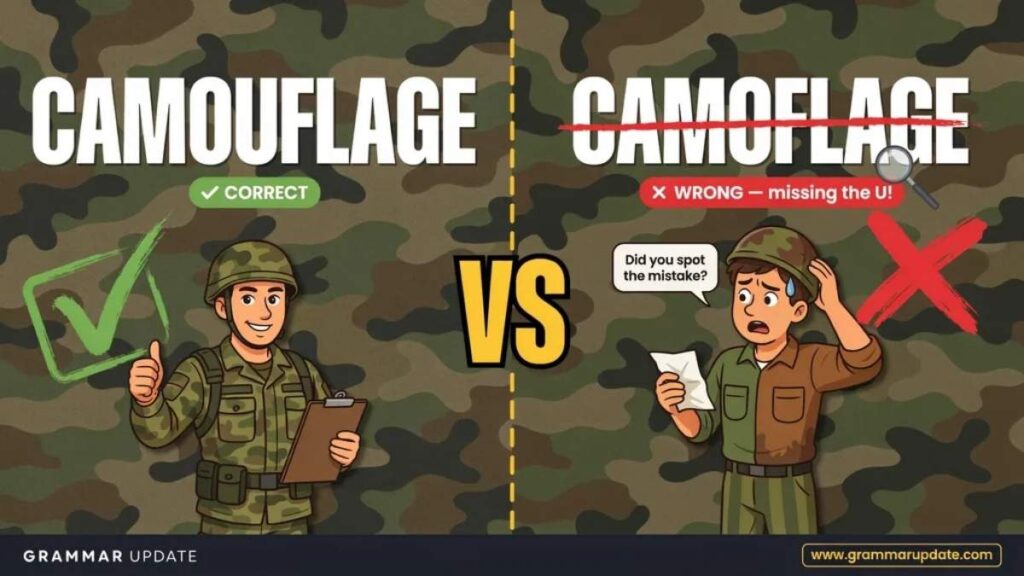
Camouflage can be surprisingly tricky to spell. The confusion between camouflage vs camoflage usually comes from one small but important detail: the letter u. Both versions may look familiar at first glance, but only one is correct. If Grammarly flags camoflage, it has caught a genuine spelling mistake, not a minor variation. So, which spelling should you use, and why does this word cause so much confusion? This guide explains the correct spelling of camouflage, shows you why camoflage is incorrect, and gives you simple examples to help you remember the spelling. By the end, you’ll know exactly which form to use every time.
Camouflage Vs Camoflage Quick Answer
If you only need the answer to the camouflage vs camoflage which spelling is correct question, here it is:
Camouflage is the correct spelling.
Camoflage is an incorrect spelling.
The proper spelling of camouflage is:
C-A-M-O-U-F-L-A-G-E
The easiest part to forget is the u. Many writers remember the general sound of the word but leave out that letter when they write it.
Here is the difference at a glance:
| Spelling | Correct? | Meaning |
|---|---|---|
| camouflage | Yes | A method of hiding or blending into surroundings |
| camoflage | No | Misspelling of camouflage |
| camoflauge | No | Misspelling with the letters in the wrong order |
So, if you’re wondering whether to write camouflage or camoflage, always choose camouflage.
For example:
The soldiers wore camouflage during the training exercise.
Not:
The soldiers wore camoflage during the training exercise.
That missing u may look small, but it makes the spelling incorrect.
Learn the difference between confusing word pairs
Buoyant vs Bouyant Which one Is Correct?
What Does Camouflage Mean?
The camouflage word meaning centers on one basic idea: hiding something by making it harder to see, recognize, or identify.
The camouflage definition can apply to people, animals, objects, clothing, vehicles, and even ideas or intentions.
In a physical sense, camouflage can help something blend into its surroundings. A green insect sitting on a leaf may be difficult to notice because its coloring resembles the leaf. A soldier may wear a patterned uniform that helps reduce visibility in a particular environment.
The word also has a figurative meaning. Someone might use humor as camouflage for nervousness, for example. In that case, the humor doesn’t physically hide the person. Instead, it hides what the person is really feeling.
Camouflage can therefore refer to both physical concealment and figurative concealment.
Camouflage as a Noun
As a noun, camouflage refers to a method, pattern, material, appearance, or effect that helps conceal something.
For example:
The hunter wore camouflage in the woods.
The moth’s camouflage made it difficult to see against the tree bark.
The vehicle was covered in a camouflage pattern.
In each sentence, camouflage describes something that helps reduce visibility or recognition.
The word doesn’t always mean complete invisibility. In many cases, camouflage simply makes something less obvious.
That’s an important distinction. A camouflaged object can still be visible. It may simply become harder to identify or separate from the surrounding environment.
Camouflage as a Verb
Camouflage also works as a verb.
As a verb, it means to hide or disguise someone or something by making it blend into its surroundings or by making it less noticeable.
For example:
The soldiers camouflaged the equipment with branches.
The pattern helps camouflage the animal.
The dark paint camouflaged the scratch on the wall.
Here, camouflage describes an action rather than the thing being used for concealment.
This is an example of how camouflage can function as both a noun and a verb.
Is Camoflage a Word?
If you’ve searched for is camoflage a word, the answer is no when you’re asking about the standard spelling of this English word.
The standard form is camouflage.
You may still see camoflage online. People make spelling mistakes in emails, comments, social media posts, text messages, school assignments, and other forms of everyday writing. The fact that a misspelling appears frequently doesn’t turn it into a standard spelling.
Camoflage is simply a common spelling mistake.
The same applies to camoflauge. It may look close enough to the correct word at first glance, but it isn’t the standard form.
Use:
camouflage
Don’t use:
camoflage
camoflauge
camoflague
camofluage
When you’re writing professionally or academically, the safest approach is straightforward: use camouflage.
Learn the difference between confusing word pairs
Humorous vs Humerous Which one Is Correct?
Why Do People Misspell Camouflage as Camoflage?
The spelling problem isn’t difficult to understand.
Camouflage contains an unusual sequence of letters:
camouflage
The most common mistake removes the u:
camoflage
The pronunciation contributes to the confusion because the word doesn’t sound exactly the way its spelling looks.
When people hear camouflage, they don’t necessarily hear every letter clearly. The middle of the word can feel almost compressed in normal speech. As a result, someone may remember the sound but reconstruct the spelling incorrectly.
The unusual spelling also comes from the word’s history. Camouflage is a French-derived word. English borrowed it from French, which helps explain why its spelling doesn’t follow an obvious English spelling pattern.
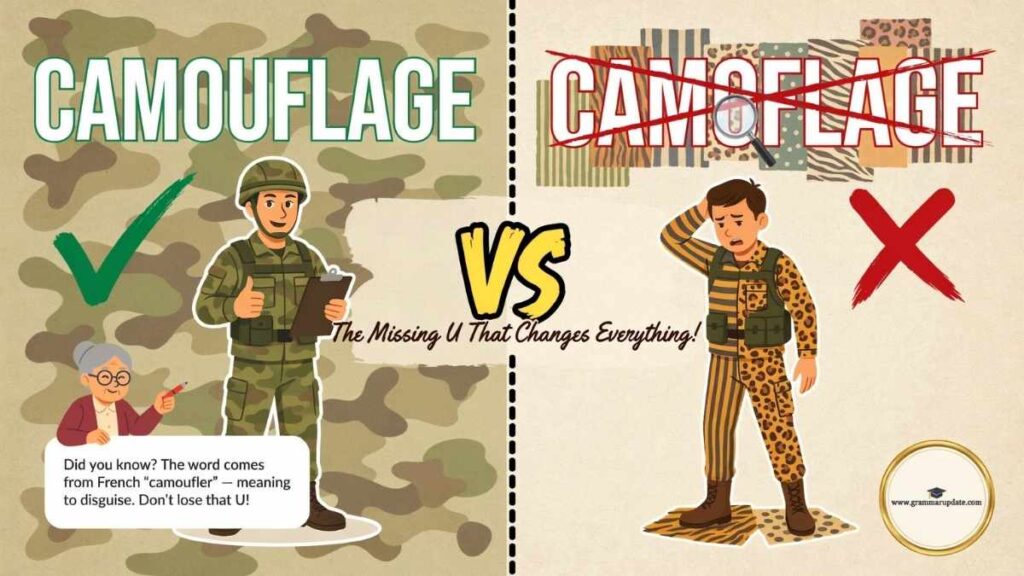
The origin of the word camouflage is connected to the French verb camoufler, meaning to disguise. The English word became especially associated with military concealment during the First World War.
There is another simple reason for the error: people often spell unfamiliar words according to how they sound.
That’s a perfectly understandable habit. Unfortunately, English has plenty of words that refuse to cooperate.
Camouflage Vs Camoflage at a Glance
The camouflage vs camoflage difference comes down to one important letter.
| Word | Standard spelling? | Main issue |
| camouflage | Yes | Correct form |
| camoflage | No | Missing u |
| camoflauge | No | Incorrect letter order |
| camoflague | No | Incorrect letter sequence |
The key point is easy to remember:
Camouflage contains ou before flage.
Camoflage does not.
Once you recognize that pattern, the spelling becomes much easier.
Learn the difference between confusing word pairs
Tomorrow vs Tommorow Which one Is Correct?
How Do You Spell Camouflage?
If you’re asking how do you spell camouflage, write:
C-A-M-O-U-F-L-A-G-E
A useful way to remember the spelling is to divide it into smaller parts:
cam + ou + flage
The middle is where most spelling mistakes happen.
Remember the word as:
cam-ou-flage
The important thing is not to lose the u.
You can also use a simple memory trick:
Don’t let the u hide.
That fits the meaning of the word while giving you a quick reminder about the spelling.
Common Camouflage Spelling Mistakes
Several incorrect versions appear because writers either remove or rearrange letters.
| Incorrect spelling | Correct spelling | Problem |
| camoflage | camouflage | Missing u |
| camoflauge | camouflage | ou is rearranged |
| camoflague | camouflage | Incorrect letter sequence |
| camofluage | camouflage | Letters are in the wrong order |
The most common camouflage spelling mistake is camoflage.
If you’re unsure, slow down and look at the middle:
camouflage
Not:
camoflage
Camouflage Pronunciation in American English
Camouflage pronunciation can make the spelling difficult because the spoken word doesn’t clearly reveal every letter.
In American English, camouflage is commonly pronounced roughly like:
KAM-uh-flahzh
The final sound can vary slightly among speakers. The important point for spelling is that pronunciation doesn’t tell you to remove the u.
The word has a French-influenced sound, which can make it feel less predictable than many everyday English words.
This is one reason why people can pronounce camouflage perfectly well but still spell it incorrectly.
If you’re learning the word, connect the pronunciation with the written form:
camouflage
Then remember the middle:
ou
That small visual cue can prevent the most common mistake.
Learn the difference between confusing word pairs
Awful vs Awfull Which one Is Correct?
Camouflage in British English and American English
One thing you don’t need to worry about is a regional spelling difference.
Camouflage is accepted in both American English and British English.
The spelling stays the same:
American English: camouflage
British English: camouflage
So, when someone searches for camouflage spelling UK, the answer is still camouflage.
This word doesn’t behave like color and colour or center and centre. There is no standard British spelling called camoflage.
The pronunciation may differ slightly between speakers and regions, but the written form remains camouflage.
Camouflage Etymology and Origin
The camouflage etymology helps explain why the word has such an unusual spelling.
Camouflage entered English from French. The French word camoufler means to disguise. The word has an earlier connection to Italian camuffare.
English began using camouflage in the early twentieth century, and the term became strongly associated with military concealment during the First World War.
The idea itself is much older than the English word. Humans and animals have used forms of concealment for much longer than the word camouflage has existed in English.
Military forces used colors, materials, and patterns to make people and equipment less noticeable. Animals evolved their own forms of concealment through natural selection.
So, while the word has a relatively recent history in English, the concept behind it is ancient.
Learn the difference between often confused words
Ingenuine vs Ungenuine Which one Is Correct?
How to Use Camouflage in a Sentence
Learning how to use camouflage in a sentence becomes easier when you understand whether you’re using it as a noun or a verb.
Here are several camouflage examples from different contexts.
Camouflage as a Noun
The soldiers wore camouflage during the exercise.
The insect’s natural camouflage made it difficult to spot.
The vehicle had a green and brown camouflage pattern.
The snow provided camouflage for the white hare.
The bird’s feathers gave it excellent camouflage among the branches.
These sentences use camouflage as something that provides or describes concealment.
Camouflage as a Verb
The soldiers camouflaged the equipment with branches.
The animal uses its coloring to camouflage itself.
The dark pattern camouflages the stain.
The crew camouflaged the vehicle before moving it.
The leaves helped camouflage the nest.
Here, camouflage describes the action of hiding or making something less noticeable.
Learn the difference between often confused words
Apprised vs Appraised difference and Which One Is Correct?
Camouflage Grammar Camouflaged, Camouflaging, and Camouflages
Understanding camouflage grammar helps you use the word correctly in different sentences.
The verb has several standard forms.
| Form | Function | Example |
| camouflage | Base verb | They camouflage the equipment. |
| camouflages | Third-person singular | The pattern camouflages the insect. |
| camouflaged | Past tense | They camouflaged the vehicle. |
| camouflaging | Present participle | They are camouflaging the equipment. |
Camouflaged
Camouflaged is the past tense and past participle of camouflage.
For example:
The team camouflaged the equipment before the exercise.
The vehicle was camouflaged with a patterned covering.
Camouflaging
Camouflaging is the -ing form.
For example:
The team is camouflaging the equipment.
The animal is camouflaging itself among the leaves.
The spelling keeps the ou:
camouflaging
Not:
camoflaging
Camouflages
Camouflages is the third-person singular present form.
For example:
The pattern camouflages the animal.
The dark coloring camouflages the object.
Notice that the base word remains intact. The final s simply reflects the grammatical form.
Military Camouflage
Military camouflage is one of the most familiar uses of the word.
When people hear camouflage, they often picture green and brown uniforms. However, military camouflage isn’t limited to one color combination.
Camouflage works best when it relates to the environment.
A pattern designed for a woodland setting may contain greens, browns, and other colors found among vegetation. A pattern intended for a desert environment may use very different tones.
The purpose isn’t necessarily to make someone completely invisible. Instead, camouflage can reduce visibility, break up recognizable shapes, or make equipment harder to identify against the surrounding environment.
Military camouflage can involve:
- Uniform patterns
- Face paint
- Vehicle paint
- Camouflage nets
- Covers
- Natural vegetation
- Equipment patterns
- Environmental color matching
The effectiveness of camouflage depends on several factors, including the background, lighting, distance, movement, and viewing angle.
A pattern that works well in one setting may perform poorly somewhere else.
Learn the difference between often confused words
Ironic vs Unironic which one is correct and usage?
Animal Camouflage
Animal camouflage shows that concealment isn’t just a human invention.
In nature, camouflage is a defensive adaptation that can help animals avoid predators. Predators can also use camouflage to approach prey without being detected.
This makes animal camouflage a fascinating part of survival.
An animal may blend into leaves, bark, sand, snow, rocks, grass, or other features of its habitat.
Background Matching
Background matching occurs when an animal’s appearance resembles the environment around it.
For example, an insect that looks like a leaf may become much harder to spot when it rests among leaves.
Disruptive Coloration
Some patterns help break up an animal’s outline.
Instead of presenting one obvious body shape, contrasting patches can make the edges harder to recognize.
This can be especially useful when an animal needs to avoid detection.
Countershading
Countershading occurs when an animal has darker coloring on its upper surface and lighter coloring underneath.
This pattern can reduce the appearance of three-dimensional shape under natural light.
Mimicry
Mimicry and camouflage can overlap, but they aren’t identical.
Camouflage generally helps an organism blend into its surroundings or become harder to detect.
Mimicry involves resembling another organism, object, or feature in a way that provides an advantage.
For example, an animal may resemble a leaf rather than simply matching the general color of the vegetation.
The distinction matters because not every form of resemblance counts as camouflage in exactly the same way.
Camouflage Patterns
Camouflage patterns do more than make something look green or brown.
A pattern can influence how easily the eye identifies an object’s outline.
Imagine a dark object sitting against a mixed forest background. If the object has a clear, solid outline, it may be easy to recognize.
Now imagine that the surface contains irregular patches that resemble leaves, shadows, and branches. The object’s outline may become harder to distinguish.
This is one reason camouflage patterns can use contrasting shapes rather than relying on one uniform color.
Several factors can influence how well a camouflage pattern works:
- Background color
- Pattern size
- Contrast
- Shape
- Texture
- Lighting
- Distance
- Movement
- Viewing angle
Camouflage doesn’t operate in a vacuum. It works in relation to an environment and an observer.
Camouflage vs Camo
The difference between camo and camouflage is mainly a matter of form.
Camo is a shortened, informal form of camouflage.
For example:
He bought a new camo jacket.
The full word would be:
He bought a new camouflage jacket.
Both can work in everyday communication. However, camouflage is the standard full form and is the better choice in formal writing.
| Word | Meaning | Typical use |
| camouflage | Full word | Formal and general writing |
| camo | Shortened form | Casual speech and writing |
So, camo vs camouflage isn’t really a spelling dispute.
Camo is a shortened form.
Camouflage is the complete word.
Learn the difference between often confused words
Rehireable vs Rehirable Which Spelling Is Correct?
Camouflage vs Disguise vs Concealment
The Camouflage, disguise, and concealment are closely related, but they aren’t perfect synonyms.
Camouflage usually involves blending into an environment or making something harder to recognize.
Disguise generally involves changing or hiding someone’s appearance or identity.
Concealment is the broad idea of keeping something hidden.
Consider these examples:
The animal uses camouflage to blend into the leaves.
The actor wore a disguise to hide his identity.
The box was placed behind the wall for concealment.
A simple way to remember the difference is:
Camouflage blends.
Disguise changes.
Concealment hides.
The words can overlap, but the context determines which one fits best.
Camouflage Synonyms
A camouflage synonym depends on what you want to say.
Useful related words include:
- disguise
- concealment
- cover
- masking
- hiding
- screening
- obscuring
However, these words aren’t always interchangeable.
For example, camouflage may describe an animal’s natural coloring. Disguise doesn’t always fit that situation.
Likewise, concealment can refer to something being hidden without suggesting that it blends into its surroundings.
Choosing the right word therefore depends on the exact meaning you want to communicate.
Common Camouflage Misspellings
Many writers make the same few mistakes when spelling camouflage.
The most common one is camoflage.
Another frequent mistake is camoflauge, where the letters in the middle appear in the wrong order.
Here are the most useful corrections:
| Incorrect | Correct |
| camoflage | camouflage |
| camoflauge | camouflage |
| camoflague | camouflage |
| camofluage | camouflage |
The spelling problem usually occurs because of the unusual letter sequence.
The best solution isn’t to memorize a dozen corrections. Remember the standard word:
camouflage
Then focus on ou.
Why Do People Misspell Camouflage?
There are several reasons people make this mistake.
First, the word doesn’t have a simple sound-to-letter relationship. English spelling often contains patterns that aren’t obvious from pronunciation alone.
Second, the middle of camouflage can be easy to overlook when the word is spoken quickly.
Third, the word comes from French, so its spelling doesn’t follow the most familiar English patterns.
Finally, people often rely on visual memory. If they’ve seen camoflage several times online, the misspelling may begin to look familiar.
Familiarity, however, isn’t the same as correctness.
That’s why many writers misspell camouflage as camoflage, even though the correct form is easy to verify once you know what to look for.
A Simple Case Study Camouflage in Different Environments
Imagine a soldier standing in a dense green forest wearing a green-and-brown camouflage pattern.
From a distance, the pattern may help break up the person’s outline and make them less noticeable.
Now place the same person in a sandy desert.
The same green-and-brown pattern may stand out instead of blending in.
Nothing about the word camouflage has changed. What changed is the environment.
This illustrates an important principle: camouflage depends on context.
The same idea applies to animals.
A white animal can blend well into snow but stand out against dark soil. An animal with brown coloring may disappear among tree bark but become obvious against a pale background.
Camouflage works because appearance interacts with surroundings.
Learn the difference between often confused words
Cancell vs Cancel Which One Is Correct?
Real-World Examples of Camouflage
Camouflage appears in many areas of life.
Military Use
Military organizations use camouflage patterns and materials to make personnel and equipment less noticeable in particular environments.
Wildlife
Animals use coloration, patterns, body shapes, and other physical features to reduce the chance of detection.
Hunting and Outdoor Activities
Camouflage clothing is commonly associated with hunting and outdoor recreation because it can help a person blend into a natural environment.
Vehicles and Equipment
Objects can use colors, coverings, and patterns that reduce their visual prominence.
Everyday Objects
Camouflage patterns also appear on clothing, bags, furniture, accessories, and decorative products. In these cases, the pattern may be used mainly for style rather than concealment.
Figurative Language
Camouflage can also describe something that hides a deeper reality.
For example:
His jokes served as camouflage for his nervousness.
Here, no physical object is being hidden. The word describes emotional concealment.
Interesting Facts About Camouflage
A few facts help put the word into perspective:
- Camouflage can function as both a noun and a verb.
- Camouflage is a French-derived word.
- The English word became especially associated with military concealment during the First World War.
- Camouflage is used in both American English and British English.
- Camo is a common shortened form of camouflage.
- Animals use camouflage as part of their survival strategies.
- Camouflage doesn’t always make something invisible.
- Effective camouflage depends heavily on the surrounding environment.
- Camouflage can involve color, pattern, shape, texture, and contrast.
- Camouflage can describe literal concealment and figurative hiding.
- The most common spelling error is camoflage.
- Camouflage contains ou before flage.
- The word ends with -flage.
Learn the difference between often confused words
Invokes vs Evokes which one is correct?
How to Remember the Correct Spelling of Camouflage
If the word keeps slipping through your spelling net, use one simple trick:
Don’t let the u hide.
Remember:
cam + ou + flage
That gives you:
camouflage
The key is to picture the middle of the word rather than trying to memorize the whole thing at once.
Another useful trick is to write the word several times while saying the letters:
1.camouflage
2.camouflage
3.camouflage
After a few repetitions, the ou becomes much easier to recognize.
The goal isn’t to memorize a complicated spelling rule. It’s simply to remember that camouflage has that extra u.
How to Use Camouflage Correctly
Before using the word, decide whether you need a noun or a verb.
Use camouflage as a noun when you’re talking about the concealment itself:
The animal’s camouflage is impressive.
Use camouflage as a verb when you’re talking about the act of hiding:
The pattern can camouflage the animal.
Use camouflaged for the past:
The equipment was camouflaged with branches.
Use camouflaging for an ongoing action:
The crew is camouflaging the vehicle.
Use camouflages with a singular subject:
The pattern camouflages the insect.
This small grammar distinction keeps your sentences accurate and natural.
Learn the difference between basic English word mistakes
Favour vs Favor Which Spelling Is Correct?
Practice Session Camouflage Vs Camoflage
Fill in each blank with the correct word or form of the word. Camouflage Vs Camoflage
- The correct spelling is __________, not camoflage.
- The soldiers wore __________ uniforms during the training exercise.
- The insect’s natural __________ helped it blend into the leaves.
- The leaves helped __________ the small animal from predators.
- The team __________ the vehicle before moving it into the forest.
- The patterned fabric is __________ the object against the wall.
- The dark pattern __________ the animal among the rocks.
- Many writers make a __________ mistake by leaving out the letter u.
- If you’re unsure how to spell the word, remember that __________ contains the letters “ou.”
- The hunter wore __________ while walking through the woods.
- The animal’s coloring provides effective __________ in its natural habitat.
- The crew is __________ the equipment with natural materials.
- Which spelling is correct: __________ or camoflage?
- Which spelling is incorrect: camouflage or __________?
- The word __________ can function as both a noun and a verb.
- The vehicle was __________ to make it less noticeable.
- The bird’s feathers provide __________ against the tree bark.
- The pattern helps __________ the animal from predators.
- The word camo is commonly used as a shortened form of __________.
- The correct spelling contains the letter sequence __________ before “flage.”
- The soldiers used branches to __________ their equipment.
- The moth’s __________ made it difficult to spot.
- The word __________ is accepted in both American English and British English.
- Many people write “camoflage” because they forget the __________ in the middle of the word.
- To spell the word correctly, write __________ instead of camoflage.
Answers
- camouflage
- camouflage
- camouflage
- camouflage
- camouflaged
- camouflaging
- camouflages
- camouflage spelling
- camouflage
- camouflage
- camouflage
- camouflaging
- camouflage
- camoflage
- camouflage
- camouflaged
- camouflage
- camouflage
- camouflage
- ou
- camouflage
- camouflage
- camouflage
- u
- camouflage
Here’s a trusted source for clear word meanings:
FAQs
What is the correct spelling of camouflage?
The correct spelling is camouflage. Camoflage is a common misspelling. The correct word contains the letters “ou” before “flage.”
Is camoflage a correct spelling?
No. Camoflage is not the standard spelling. Use camouflage in formal, academic, professional, and everyday writing.
Why do people spell camouflage as camoflage?
The unusual letter sequence and pronunciation often cause the confusion. When people spell the word from memory, they may leave out the u because they don’t clearly hear it in normal speech.
Does camouflage contain the letter U?
Yes. The correct spelling is camouflage, with “ou” in the middle:
C-A-M-O-U-F-L-A-G-E
Remembering the “ou” can help you avoid writing camoflage.
Is camoflauge another spelling of camouflage?
No. Camoflauge is also incorrect. The letters in the middle appear in the wrong order. The standard spelling is camouflage.
How can you remember how to spell camouflage?
Break the word into three parts: cam + ou + flage. The “ou” is the key detail to remember because many spelling mistakes occur in this part of the word.
Can camouflage be a noun and a verb?
Yes. Camouflage works as both a noun and a verb.
As a noun: “The animal’s camouflage helped it blend into the leaves.”
As a verb: “The pattern helps camouflage the animal.”
What does camouflage mean?
Camouflage means hiding or disguising something by making it blend into its surroundings or become harder to recognize. It can describe military clothing, animal coloring, objects, patterns, and even figurative forms of concealment.
What is the past tense of camouflage?
The past tense is camouflaged.
Example: “The soldiers camouflaged the equipment before the exercise.”
What is the correct -ing form of camouflage?
The correct form is camouflaging.
Example: “The team is camouflaging the vehicle.”
The spelling keeps the “ou” from the original word.
What is the third-person singular form of camouflage?
The correct form is camouflages.
Example: “The pattern camouflages the insect against the tree bark.”
Is camouflage a countable noun?
Camouflage is usually an uncountable noun when you mean concealment, a camouflage material, or camouflage in general.
For example:
“The soldiers wore camouflage.”
When referring to particular designs or varieties, it is clearer to use expressions such as “camouflage patterns” or “types of camouflage.”
Can you say “a camouflage”?
Usually, you wouldn’t use “a camouflage” when referring to camouflage in general. More natural choices include “a camouflage pattern,” “a camouflage design,” or simply “camouflage.”
Is camouflage an adjective?
Camouflage is primarily a noun and a verb. However, it can appear before another noun in phrases such as “camouflage pattern” or “camouflage clothing.” In these phrases, camouflage functions as a noun modifying another noun rather than as a standard adjective.
What is the difference between camouflage and concealment?
Camouflage is a particular type of concealment that often makes something blend into its surroundings or disrupts its recognizable appearance. Concealment has a broader meaning and refers generally to keeping something hidden.
What is the difference between camouflage and disguise?
Camouflage usually helps something blend into its surroundings or become harder to detect. A disguise generally changes or hides someone’s appearance or identity.
Is camouflage a French word?
Camouflage is a French-derived English word. English borrowed it from French, which helps explain its unusual spelling and pronunciation.
Why is camouflage spelled that way?
The spelling reflects the word’s French origin. Its pronunciation also doesn’t make every letter obvious, which can lead people to spell it according to how it sounds. That’s one reason camoflage appears so often as a misspelling.
Does camouflage have a different spelling in British English?
No. The standard spelling is camouflage in both American English and British English. Camoflage isn’t a British alternative.
Is camo the same as camouflage?
Camo is a shortened, informal form of camouflage. It commonly appears in casual speech and writing, especially when discussing clothing and patterns.
Can you use camo in formal writing?
You can, depending on the context, but camouflage is usually the better choice for formal or academic writing. Camo has a more casual tone.
What is the most common spelling mistake for camouflage?
Camoflage is a common misspelling because writers often leave out the u. Camoflauge is another frequent error caused by rearranging the letters in the middle.
How can you quickly check the spelling of camouflage?
Look at the middle of the word. Correct spelling contains “ou”:
camouflage
If you’ve written camoflage, you’ve left out the u.
Does camouflage make something completely invisible?
Not necessarily. Camouflage can make a person, animal, or object harder to notice or recognize without making it completely invisible. Its effectiveness depends on factors such as the environment, lighting, distance, pattern, and movement.
Can camouflage have a figurative meaning?
Yes. Camouflage can describe something that hides an emotion, intention, or truth rather than a physical object.
For example:
“His jokes were camouflage for his nervousness.”
What is the plural of camouflage?
Camouflage usually functions as an uncountable noun when it refers to the general concept or material. The form camouflages is more commonly used as the third-person singular form of the verb.
What is the opposite of camouflage?
There isn’t one universal antonym. Depending on the context, words such as visibility, exposure, highlighting, revealing, or displaying can express the opposite idea.
Does camouflage only refer to military clothing?
No. Camouflage also applies to animals, plants, equipment, vehicles, outdoor clothing, patterns, and figurative forms of concealment. Military use is simply one of its best-known applications.
Why is camouflage often confused with camoflage?
The spelling contains an unusual “ou” sequence that isn’t obvious from the pronunciation. When people rely on sound instead of remembering the written form, they may drop the u and write camoflage.
What is the easiest way to distinguish camouflage from camoflage?
Remember one simple detail: camouflage contains “ou.”
Correct: camouflage
Incorrect: camoflage
That extra u is the small letter that keeps the spelling on the right track.
Conclusion
The confusion between camouflage vs camoflage is easy to clear once you know the correct spelling. Camouflage is correct, while camoflage is simply a misspelling.
The tricky part is the middle of the word. Remember that camouflage contains “ou” before “flage.” That little u is easy to forget, but it makes all the difference.
Whether you’re writing about military clothing, animal adaptations, camouflage patterns, or everyday concealment, always use camouflage. If you’re writing casually, you can also use camo as the shortened form.
So, when camoflage tries to sneak into your sentence, don’t let it hide there. Remember the simple rule: camouflage has “ou.” Once you remember that, this spelling mistake becomes much easier to avoid.

Jhon AJS, the creative mind behind Grammar Update, is an experienced blogger passionate about simplifying English grammar. He focuses on explaining confusing word vs word differences, grammar rules, punctuation, and sentence structure in a clear and practical way. Through easy to understand guides and examples, Jhon helps readers improve their writing and communicate with confidence. With years of blogging experience, he continues to share helpful insights that make learning grammar simple, useful, and accessible for everyone.