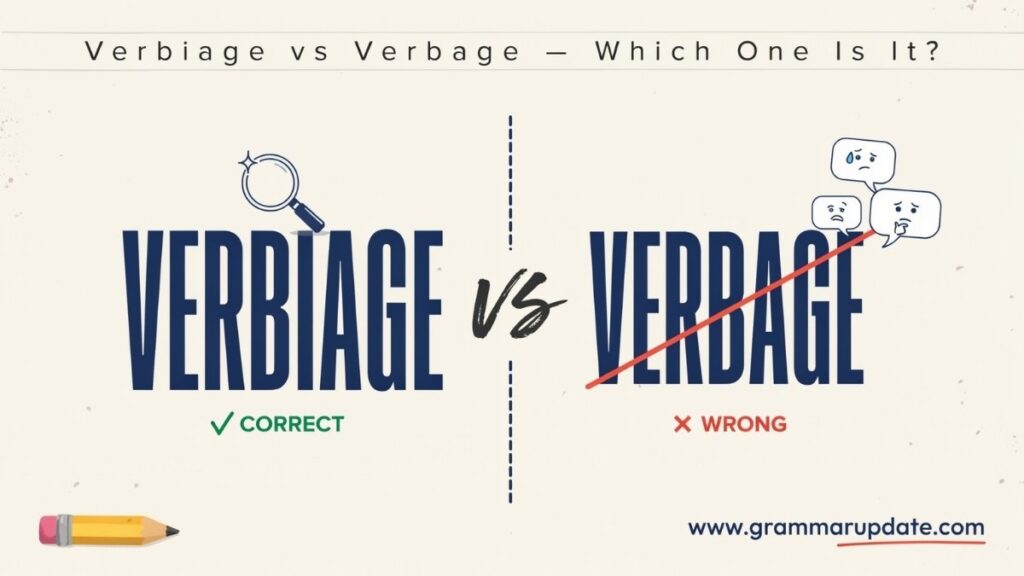
Ever pause while writing and wonder whether it should be verbiage vs verbage? This small spelling confusion creates more mistakes than most people expect, especially in emails, essays, and professional documents where accuracy matters. One form is correct and widely accepted in modern English, while the other appears frequently because it sounds natural when spoken. That is where the error usually starts. This introduction clears that confusion and corrects the common mistake so you can write with confidence and precision. Once you understand the difference between verbiage vs verbage, you stop guessing, avoid avoidable spelling errors, and communicate more clearly in both formal and everyday writing situations.
Verbiage vs Verbage The Quick Answer
If you need a quick answer, the rule is straightforward.
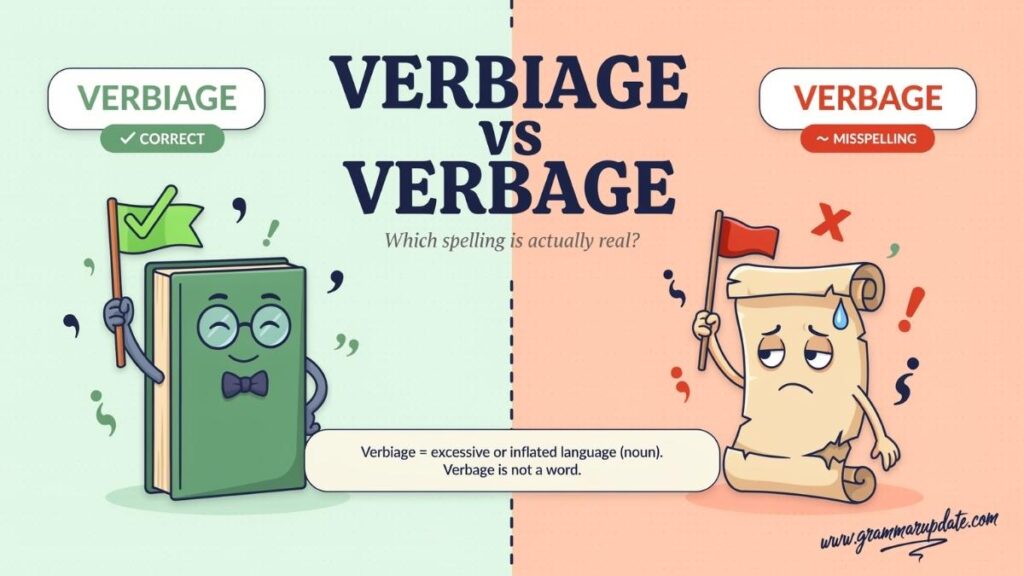
Verbiage is the correct spelling.
Verbage is incorrect in standard English.
You should use verbiage in:
- Academic writing
- Business communication
- Professional emails
- Legal documents
- Reports and articles
- Everyday writing
Consider these examples:
Correct:
The editor removed unnecessary verbiage.
The contract contains legal verbiage.
The report suffers from excessive verbiage.
Incorrect:
The report contains verbage.
The email includes too much verbage.
Whenever you ask yourself verbiage or verbage which is correct, remember this simple rule:
Verbiage is correct. Verbage is a misspelling.
Is Verbage a Real Word?
One of the most frequently asked questions is:
Is verbage a word?
In modern English, verbage is generally considered a spelling mistake rather than an accepted word. Although some dictionaries may mention it because people commonly misspell verbiage, major dictionaries and style guides recognize only one standard spelling.
The following dictionaries list verbiage:
- Oxford Dictionary
- Merriam-Webster
- Cambridge Dictionary
- Collins Dictionary
As a result, writers should avoid verbage in professional, academic, legal, and business writing.
If you are wondering is verbage a word in English, the answer is no. It appears mainly as a common misspelling.
Fix common more word mistakes in English
Instalments vs Installments Which Is Correct and Use It?
What Does Verbiage Mean?
Understanding the verbiage meaning makes the word easier to use correctly.
The verbiage definition usually refers to:
- Excessive wording
- Unnecessary words
- Wordy language
- Verbose expression
- Overly complicated writing
Most dictionaries define verbiage as language that uses more words than necessary.
Verbiage as Excessive Wording
Examples:
The report contains unnecessary verbiage.
The speech suffers from excessive wording.
The article includes too much verbiage.
In these examples, the word carries a negative meaning because the writing contains unnecessary language.
Verbiage as Language or Wording
Sometimes people use verbiage more neutrally.
Example:
The legal verbiage confused the customers.
Here, the word refers to the wording or terminology rather than criticizing the writing itself.
Learn how to use confusing more words correctly
Labelling vs Labeling Which Spelling Is Correct and Use It?
Verbiage Definition in Modern English
The modern verbiage word meaning often carries a slightly negative tone. Writers commonly use the word to describe:
- Wordiness
- Verbosity
- Long-winded writing
- Redundant language
- Inflated language
- Excessive wording
For example:
The proposal contains excessive verbiage.
This sentence suggests that the writer used more words than necessary.
However, modern usage occasionally employs the word neutrally when discussing technical, legal, or specialized language.
Verbiage vs Verbage: What’s the Difference?
The difference between these two spellings is simple.
| Feature | Verbiage | Verbage |
|---|---|---|
| Correct spelling | Yes | No |
| Dictionary recognition | Yes | No |
| Professional writing | Yes | No |
| Academic writing | Yes | No |
| Standard English | Yes | No |
| Accepted usage | Yes | No |
The comparison verbiage vs verbage involves one accepted spelling and one spelling error.
If you want clear, professional writing, always use verbiage.
The Origin and History of Verbiage
The word verbiage entered English during the eighteenth century. It comes from the French word verbiage, which referred to excessive words or unnecessary language.
The French term traces back to the Latin word verbum, meaning “word.”
From its earliest usage, the word often carried a negative meaning. Writers used it to criticize speeches, essays, and documents that relied on unnecessary wording.
Over time, the meaning expanded slightly. Today, some writers use the term to describe specialized language, although the connection to wordiness remains strong.
This historical development explains why verbiage in English still frequently refers to excessive or overly complicated language.
Fix common more word mistakes in English
Eying vs Eyeing Which Spelling Is Correct?
Why Do People Spell Verbiage as Verbage?
Many writers wonder why this mistake appears so often.
Pronunciation Creates Confusion
The pronunciation does not clearly emphasize the middle syllable.
Many people hear:
VER-beej
As a result, they write:
verbage
instead of:
verbiage
This explains why the verbage misspelling remains extremely common.
Similar English Word Endings
English contains many words ending in:
- message
- package
- village
- postage
Because these words use the ending “-age,” many writers assume that verbage follows the same spelling pattern.
Typing and Memory Errors
Fast typing also contributes to the problem. Since verbage appears believable, many writers overlook the mistake during proofreading.
Verbiage Pronunciation
Many readers search for:
- verbiage pronunciation
- how to pronounce verbiage
The standard pronunciation is:
VUR-bee-ij
Phonetic spelling:
/ˈvɜːrbiɪdʒ/
American English Pronunciation
American speakers generally pronounce the word as:
VER-bee-ij
British English Pronunciation
British pronunciation remains very similar, with only minor differences in accent.
Learning how to pronounce verbiage can help writers remember the correct spelling.
Fix common more word mistakes in English
Honor vs Honour Which Spelling Is Correct?
Does Verbiage Always Have a Negative Meaning?
Many people ask:
Is verbiage always negative?
Not necessarily.
Traditionally, verbiage refers to:
- Excessive wording
- Wordiness
- Verbosity
- Unnecessary language
In these situations, the word carries criticism.
Example:
The report contains too much verbiage.
However, modern usage sometimes employs the word more neutrally.
Examples:
The legal verbiage confused the customers.
The technical verbiage made the instructions difficult to understand.
Here, the word describes specialized language rather than criticizing the writer.
Verbiage vs Language
The comparison verbiage vs language often causes confusion.
| Verbiage | Language |
|---|---|
| Refers to wording | Refers to a communication system |
| Often negative | Usually neutral |
| May indicate wordiness | Includes grammar and vocabulary |
| Focuses on expression | Focuses on communication |
Language refers to English, Spanish, French, or other communication systems.
Verbiage refers to the words used within that language.
Wording vs Verbiage
The difference between wording vs verbiage is important.
Wording
Wording simply means the words chosen to express an idea.
Example:
I like the wording of the agreement.
Verbiage
Verbiage often suggests unnecessary or excessive wording.
Example:
The agreement contains too much verbiage.
As a result, wording usually remains neutral, while verbiage frequently suggests wordiness.
Diction vs Verbiage
Another common comparison involves diction vs verbiage.
Diction
Diction refers to a writer’s choice of words.
Verbiage
Verbiage refers to unnecessary wording or excessive language.
Examples:
The author uses excellent diction.
The report suffers from excessive verbiage.
A writer may have strong diction while avoiding verbiage entirely.
Verbiage Synonym
Several words share similar meanings with verbiage.
Common verbiage synonym options include:
- Wordiness
- Verbosity
- Redundancy
- Circumlocution
- Long-windedness
- Excessive wording
- Inflated language
- Unnecessary words
Although these terms overlap, each carries a slightly different meaning. Together, they describe writing that uses more words than necessary.
Legal Verbiage What Does It Mean?
One of the most common phrases associated with this word is legal verbiage. Legal documents often contain formal terminology, technical expressions, and specialized wording that can make contracts, agreements, and policies difficult to understand.
Examples include:
The legal verbiage in the contract confused the customer.
The attorney simplified the legal verbiage before presenting the agreement.
Legal language exists to ensure precision and reduce ambiguity. However, overly complex wording can create barriers for readers who lack legal training.
Common forms of legal verbiage include:
- Contract clauses
- Terms and conditions
- Liability statements
- Legal disclaimers
- Regulatory language
Modern legal writing increasingly favors plain English because clear language improves understanding without sacrificing accuracy.
Technical Verbiage in Professional Communication
Another common expression is technical verbiage.
Industries such as engineering, medicine, finance, and technology often rely on specialized terminology that may confuse readers outside the field.
Examples:
The software manual contains technical verbiage.
The engineer simplified the technical verbiage in the report.
The following industries frequently use technical language:
| Industry | Examples of Technical Verbiage |
|---|---|
| Technology | Software specifications |
| Medicine | Medical terminology |
| Engineering | Technical reports |
| Finance | Financial terminology |
| Law | Legal terminology |
Specialized language serves an important purpose, but writers should avoid unnecessary complexity whenever possible.
Fix common more word mistakes in English
In Tact vs Intact Which Spelling Is Correct in English?
Verbiage in Business Writing
Effective business communication depends on clarity, precision, and efficiency. Excessive wording often weakens professional writing and makes information harder to understand.
Consider this example.
Wordy version:
Due to the fact that the meeting has been rescheduled, it is necessary for all employees to make the appropriate adjustments to their calendars.
Improved version:
Because the meeting was rescheduled, employees should update their calendars.
Removing unnecessary words improves:
- Communication clarity
- Reader engagement
- Professional tone
- Workplace efficiency
Strong business writing focuses on delivering information clearly and directly.
Verbiage Meaning in Business Writing
The verbiage meaning in business writing often refers to unnecessary wording that reduces clarity.
Examples:
The report contains too much verbiage.
The proposal needs less verbiage and stronger evidence.
Managers, editors, and executives frequently encourage concise communication because clear writing saves time and improves understanding.
Learn how to use confusing more words correctly
Speach vs Speech Which Spelling Is Correct in English?
Verbiage Meaning in Legal Documents
The verbiage meaning in legal documents often refers to specialized wording that appears in contracts, agreements, and legal notices.
Examples:
The legal verbiage made the agreement difficult to understand.
The attorney revised the verbiage to make the contract clearer.
Although precision remains essential in legal writing, many professionals now encourage plain language to improve accessibility.
Verbiage Usage in Modern Writing
Understanding verbiage usage helps writers use the word correctly.
Verbiage is appropriate when discussing:
- Excessive wording
- Wordy writing
- Legal terminology
- Technical language
- Unnecessary language
However, writers should avoid:
- Using verbage instead of verbiage
- Treating verbiage as a synonym for vocabulary
- Assuming the word always has a negative meaning
Context plays an important role.
Learn how to use confusing more words correctly
Vender vs Vendor Which Spelling Is Correct?
Verbiage in a Sentence
Learning through examples makes the meaning easier to understand.
Negative Examples
The speech contained unnecessary verbiage.
The article suffers from excessive verbiage.
The report includes too much verbiage.
Neutral Examples
The legal verbiage confused the readers.
The technical verbiage made the instructions difficult to follow.
Professional Examples
The editor removed unnecessary verbiage from the manuscript.
The manager asked the team to reduce the verbiage in the proposal.
These verbiage examples demonstrate how the word functions in different contexts.
Learn the difference between tricky more English words
Inclosed vs Enclosed Which Spelling Is Correct?
Excessive Verbiage and Writing Quality
Many writers struggle with excessive verbiage.
Using too many words can create several problems:
- Reader fatigue
- Reduced clarity
- Confusion
- Slower communication
- Less effective writing
Consider this example.
Wordy:
At this point in time, it is necessary to make a determination regarding the future course of action.
Concise:
We need to decide what to do next.
The shorter version communicates the same idea more clearly and efficiently.
Learn the difference between tricky more English words
Contractor vs Contractee Usage and Differences Explained
Concise Writing vs Verbiage
The comparison between concise writing vs verbiage highlights one of the most important principles of effective communication.
| Concise Writing | Excessive Verbiage |
|---|---|
| Clear | Wordy |
| Direct | Indirect |
| Efficient | Long-winded |
| Easy to read | Difficult to read |
| Reader-focused | Overly complex |
Strong writers remove unnecessary words while preserving meaning.
As the famous writing advice suggests:
Omit needless words.
Clear writing almost always outperforms inflated language.
Common Mistakes with Verbiage
Several mistakes appear repeatedly.
Writing Verbage
Incorrect:
The report contains verbage.
Correct:
The report contains verbiage.
Confusing Verbiage with Vocabulary
Incorrect:
My verbiage is improving.
Correct:
My vocabulary is improving.
Assuming Verbiage Is Always Positive
Verbiage often carries a negative meaning because it suggests unnecessary wording.
Confusing Verbiage with Jargon
Jargon refers to specialized terminology used within a profession.
Verbiage refers to excessive wording or unnecessary language.
Although the two concepts sometimes overlap, they are not identical.
Learn the difference between tricky more English words
Seperate vs Separate Which Spelling Is Correct?
What Do Dictionaries Say?
Major dictionaries agree on the correct spelling.
Oxford Dictionary
Oxford lists verbiage as the accepted spelling and defines it as language that is more complicated or lengthy than necessary.
Merriam-Webster
Merriam-Webster defines verbiage as excessive wordiness or wording.
Cambridge Dictionary
Cambridge recognizes only verbiage and associates the word with unnecessary language.
Collins Dictionary
Collins also recognizes only verbiage.
The evidence is clear.
The correct spelling of verbiage is verbiage.
Learn the difference between tricky more English words
Writing vs Writting which is Correct Spelling
How to Avoid Excessive Verbiage
Writers can improve clarity by following several simple principles.
Remove unnecessary words.
Choose precise vocabulary.
Prefer shorter sentences.
Avoid repetition.
Use active voice.
Edit carefully.
For example:
Wordy:
In the event that you have questions, please do not hesitate to contact us.
Clear:
If you have questions, contact us.
Small edits often create stronger writing.
Laid vs Layed Difference and Usage in English Grammar
Practice Session Verbiage vs Verbage
Test your understanding of verbiage vs verbage by completing the sentences below. Choose the correct word for each blank.
Word Bank:
verbiage | verbage
- The editor removed unnecessary __________ from the article.
- The contract contained complicated legal __________.
- Many writers mistakenly spell __________ instead of the correct word.
- The report suffered from excessive __________.
- The manager asked the team to reduce the __________ in the proposal.
- The technical __________ made the instructions difficult to understand.
- The dictionary recognizes __________ as the correct spelling.
- The speech contained too much __________ and very little useful information.
- Lawyers often use specialized __________ in contracts.
- The professor corrected the __________ misspelling in the essay.
- The article included unnecessary __________ that confused readers.
- The writer replaced the lengthy __________ with clear and concise language.
- Many students ask whether __________ is a real word.
- The editor eliminated excessive __________ from the manuscript.
- The business report contained too much __________.
- The legal __________ made the agreement difficult to understand.
- Good writing avoids unnecessary __________.
- The student accidentally typed __________ during the exam.
- The technical manual contained confusing __________.
- The author reduced the __________ to improve readability.
- Professional writers avoid the __________ spelling mistake.
- The speech became stronger after removing unnecessary __________.
- Major dictionaries recognize __________ as the standard spelling.
- Excessive __________ often makes writing difficult to follow.
- Clear communication requires less __________ and more clarity.
Answers
- verbiage
- verbiage
- verbage
- verbiage
- verbiage
- verbiage
- verbiage
- verbiage
- verbiage
- verbage
- verbiage
- verbiage
- verbage
- verbiage
- verbiage
- verbiage
- verbiage
- verbage
- verbiage
- verbiage
- verbage
- verbiage
- verbiage
- verbiage
- verbiage
Here’s a trusted source for clear word meanings:
FAQs
What does the word “verbiage” mean?
Verbiage refers to unnecessary or overly wordy language. It can also describe formal or specialized wording used in legal, technical, or official communication.
Do you say verbage or verbiage?
The correct spelling is verbiage. The word verbage is a misspelling and does not belong in standard English writing.
What is the difference between verbiage and verbage?
There is no meaning difference. The only difference is spelling. Verbiage is correct, while verbage is incorrect.
How do you properly use verbiage?
Use verbiage when describing language that feels wordy, complex, or unnecessarily long. It often applies to formal writing, legal text, or technical documents.
Example:
The report contains unnecessary verbiage that reduces clarity.
How do you use verbiage in a sentence?
You use it to describe wording that is too long or overly complex.
Example:
The contract includes legal verbiage that is difficult to interpret.
Is verbiage always negative?
Not always. It often has a negative tone when it means “too many words,” but it can also describe neutral or technical wording in legal and professional contexts.
What is a better word for verbiage?
Depending on context, better alternatives include:
- wordiness
- verbosity
- wording
- phrasing
- jargon
- redundant language
What does verbiage mean in writing?
In writing, verbiage refers to unnecessary or overly complicated wording that reduces clarity and makes text harder to understand.
Which is correct, verbiage or verbage?
Verbiage is correct in modern English. Verbage is a common spelling mistake.
Is verbiage a derogatory term?
It is mildly critical when used to describe unnecessary words, but it is not an insulting or offensive term.
What makes verbiage unnecessary?
Verbiage becomes unnecessary when sentences:
- repeat the same idea
- use more words than needed
- replace simple language with complex phrasing
- reduce clarity instead of improving it
What is the correct use of verbiage?
Use it when referring to:
- excessive wording in writing
- complex legal or technical language
- unclear or word-heavy communication
What are good synonyms for verbiage?
Common synonyms include:
- verbosity
- wordiness
- redundancy
- circumlocution
- inflated language
What is an example of verbiage?
Example:
The speech was filled with unnecessary verbiage and lacked clear ideas.
What is another word for legal verbiage?
Better alternatives include:
- legal language
- contractual wording
- legal terminology
- legal phrasing
Why do people say verbiage?
People use it when they want to describe writing that feels overly wordy, formal, or difficult to understand.
Why do people spell it as verbage?
The spelling error happens because the pronunciation sounds like “ver-bij,” and many assume it follows common “-age” word patterns like “package” or “message.”
What is the correct pronunciation of verbiage?
It is pronounced as: VER-bee-ij.
What is the difference between language and verbiage?
Language is a complete system of communication.
Verbiage refers only to wording, especially when it is excessive or unnecessarily complex.
What is good verbiage?
The phrase usually means clear, precise, and well-chosen wording that avoids unnecessary complexity.
What are the 3 V’s of communication?
They are:
- Verbal
- Vocal
- Visual
These describe communication methods, not the word verbiage itself.
When did verbiage become a word?
It entered English in the 18th century from French verbiage, which traces back to the Latin word verbum, meaning “word.”
What is a better word than verbiage?
Depending on meaning:
- clarity (for improvement)
- wording (neutral usage)
- verbosity (similar meaning)
- brevity (opposite idea)
What is the first word ever said in the world?
There is no historical record of the first spoken word. Language developed gradually over thousands of years, not from a single origin word.
Why do Brits say “sod off”?
It is informal British slang meaning “go away.” It is considered rude in many contexts and should be used carefully.
Why is it called vernissage?
The word vernissage comes from French, originally referring to the varnishing of paintings before an exhibition. Today, it refers to an art exhibition preview event.
Learn the difference between tricky more English words
Laid vs Layed Difference and Usage in English Grammar
Conclusion
In the end, the confusion around verbiage vs verbage fades once the rule becomes clear. One form is correct and widely accepted in modern English. The other is a spelling error that slips in easily because it sounds familiar when spoken or typed quickly.
Verbiage refers to wordy or formal wording, often used in business, academic, and technical writing. It can describe unnecessary words or specialized language depending on context. Verbage, however, does not belong in standard English and should be avoided in all professional writing.
So the next time you hesitate, keep it simple. Choose verbiage, trust the correct spelling, and move forward with confidence. Strong writing always comes from small, accurate choices like this, and now the confusion is completely cleared.

Jhon AJS, the creative mind behind Grammar Update, is an experienced blogger passionate about simplifying English grammar. He focuses on explaining confusing word vs word differences, grammar rules, punctuation, and sentence structure in a clear and practical way. Through easy to understand guides and examples, Jhon helps readers improve their writing and communicate with confidence. With years of blogging experience, he continues to share helpful insights that make learning grammar simple, useful, and accessible for everyone.