
Have you ever typed Neighbour vs Neighbor, paused for a moment, and felt like English is quietly testing your patience? One extra letter the British u often creates confusion in emails, essays, and professional writing. Many writers hesitate and wonder whether they should write neighbour or neighbor, especially when both look correct at first glance. The truth is simple and reassuring. Both spellings are correct, but they belong to different varieties of English. This guide clears the confusion around neighbour vs neighbor, explains the spelling rules in a clear and practical way, and helps you avoid common mistakes so your writing stays consistent, accurate, and properly aligned with your audience every time.
Neighbour vs Neighbor The Quick Answer

If you need a quick answer, here it is:
Neighbour is correct in British English.
Neighbor is correct in American English.
Both words have the same meaning. They refer to a person who lives near another person.
Examples:
- My neighbour lives next door. (British English)
- My neighbor lives next door. (American English)
The meaning never changes. Only the spelling changes.
Quick Comparison Table
| Feature | Neighbour | Neighbor |
|---|---|---|
| British English | Yes | No |
| American English | No | Yes |
| Canadian English | Common | Sometimes used |
| Australian English | Yes | Rare |
| Meaning | Same | Same |
| Pronunciation | Same | Same |
| Grammar | Same | Same |
Fix common more word mistakes in English
Verbiage vs Verbage Which Spelling Is Correct?
What Does Neighbour or Neighbor Mean?
The neighbour or neighbor meaning remains exactly the same regardless of spelling.
A neighbor is someone who:
- Lives nearby.
- Occupies an adjoining house or apartment.
- Shares a local community.
- Lives in the surrounding area.
The term may also describe nearby places, countries, or organizations.
Neighbor Definition
The neighbor definition is:
A person who lives near or next to another person.
Neighbour Definition
The neighbour definition is identical:
A person living close to another person or occupying nearby property.
Both definitions appear in major dictionaries and language references.
Fix common more word mistakes in English
Bearable vs Bareable Which Spelling Is Correct?
Literal Meaning
The most common use refers to people living close to one another.
Examples:
- Our neighbour moved to London.
- The new neighbor introduced himself yesterday.
- Their next-door neighbour owns a bakery.
- My neighbor waters the garden while I travel.
The word often carries positive meanings associated with community, friendship, and cooperation.
Figurative Meaning
The word also applies to places and countries.
Examples:
- Canada is a neighbor of the United States.
- France and Belgium are neighboring countries.
- The neighboring cities share transportation services.
This meaning frequently appears in geography, politics, and international relations.
Learn the difference between tricky more English words
Labelling vs Labeling Which Spelling Is Correct and Use It?
Neighbour vs Neighbor The Main Difference
Many writers search for the difference between neighbour and neighbor, expecting separate meanings. However, the difference is much simpler.
Spelling Difference
The only difference is the letter u.
- Neighbour
- Neighbor
British English keeps the u, while American English removes it.
Same Meaning
Both spellings refer to:
- People living nearby.
- Nearby communities.
- Adjacent countries.
- Close relationships.
Same Grammar
Both words function as nouns.
Examples:
- She is my neighbor.
- He is our neighbour.
Same Pronunciation
The neighbour or neighbor pronunciation remains nearly identical in both British and American English.
The spelling changes, but the spoken word stays the same.
British English vs American English Spelling
The difference between British English neighbour and American English neighbor follows a broader spelling pattern.
Several words share this variation.
| British English | American English |
|---|---|
| Neighbour | Neighbor |
| Colour | Color |
| Honour | Honor |
| Favourite | Favorite |
| Labour | Labor |
| Behaviour | Behavior |
These differences represent two accepted spelling systems within the English language.
Learn the difference between tricky more English words
Eying vs Eyeing Which Spelling Is Correct?
Neighbour in British English
The neighbour spelling UK remains standard throughout:
- England
- Scotland
- Wales
- Northern Ireland
Examples:
- My neighbour bought a new car.
- The neighbouring village hosts the festival.
- Our neighbours invited us to dinner.
British schools, newspapers, universities, and publishers consistently use this spelling.
The correct spelling of neighbour in British English always includes the letter u.
Neighbor in American English
The neighbor spelling US is standard throughout the United States.
Examples:
- Our neighbor moved last month.
- The neighboring state experienced heavy snowfall.
- Good neighbors support one another.
American schools, government agencies, newspapers, and businesses use this spelling exclusively.
The correct spelling of neighbor in American English does not include the letter u.
Neighbour or Neighbor in Canada
Many writers ask about neighbour or neighbor in Canada.
Canadian English often combines British and American influences. However, Canadian spelling traditionally favors British forms.
As a result:
- Neighbour is more common.
- Neighbor sometimes appears.
Government publications, educational materials, and Canadian style guides often prefer neighbour, although both spellings can be found.
Fix common more word mistakes in English
Pent vs Pant Usage and Difference Explained
Neighbour or Neighbor in Australia
The answer to neighbour or neighbor in Australia is straightforward.
Australian English follows British spelling conventions.
Australians write:
- neighbour
- neighbouring
- neighbourhood
The American versions appear much less frequently in formal writing and publications.
Honor vs Honour Which Spelling Is Correct?
Why Is Neighbour Spelled Differently?
Many people ask:
Why is neighbour spelled differently?
The answer lies in the history of English.
British English preserved many traditional spellings influenced by French after the Norman Conquest. American English later simplified several words by removing silent letters.
This created two accepted spelling systems:
- British spelling conventions
- American spelling conventions
Both systems remain correct today.
The Origin and History of Neighbour and Neighbor
The word comes from Old English.
Its earliest form was:
neahgebur
This ancient word combined two ideas:
- neah meaning near
- gebur meaning dweller or resident
Over centuries, the spelling gradually evolved into neighbour.
American spelling reforms later produced neighbor.
Despite these changes, the meaning remained virtually unchanged.
Noah Webster and American Spelling Reform
American lexicographer Noah Webster played a major role in spelling reform.
He believed American English should become:
- Simpler
- More logical
- Easier to learn
His dictionaries encouraged spellings such as:
- color
- honor
- labor
- neighbor
These forms eventually became the accepted standard in the United States.
This explains why neighbor in American English differs from neighbour in British English.
Is Neighbour Correct?
Yes.
Many writers ask:
Is neighbour correct spelling?
The answer is absolutely yes.
Use neighbour when writing for:
- The United Kingdom
- Australia
- New Zealand
- Much of Canada
The spelling appears in major British dictionaries and educational resources.
Learn the difference between tricky more English words
Speach vs Speech Which Spelling Is Correct in English?
Is Neighbor Correct?
Yes.
Another common question is:
Is neighbor correct spelling?
Again, the answer is yes.
Use neighbor when writing for:
- The United States
- American businesses
- American schools
- American publications
The spelling appears in major American dictionaries and style guides.
Which Spelling Should You Use?
The answer depends entirely on your audience.
Use neighbor if your readers are primarily American.
Use neighbour if your audience uses British English.
For international audiences, consistency matters more than the specific spelling.
Avoid mixing both forms.
Incorrect:
My neighbour lives beside my neighbor.
Correct:
My neighbour lives beside my neighbour.
or
My neighbor lives beside my neighbor.
Maintaining one spelling style improves professionalism and readability.
Learn the difference between tricky more English words
Inclosed vs Enclosed Which Spelling Is Correct?
A Simple Rule to Remember
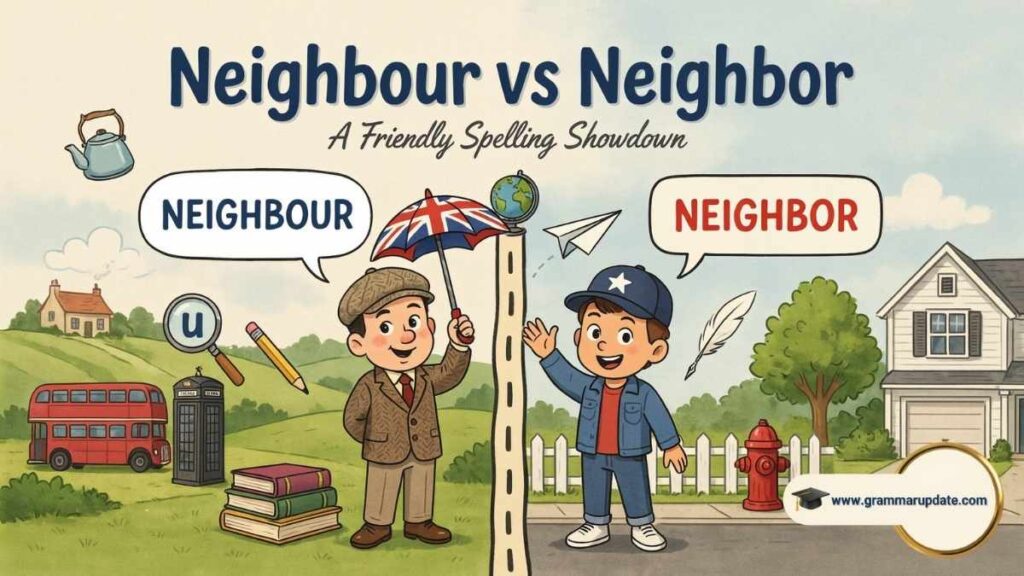
A helpful memory rule is:
British English keeps the u. American English removes the u.
This pattern appears in many words:
- colour → color
- honour → honor
- labour → labor
- neighbour → neighbor
Once you remember this pattern, choosing the correct spelling becomes much easier.
The answer to neighbour or neighbor which is correct is therefore simple:
- Neighbour is correct in British English.
- Neighbor is correct in American English.
- Both spellings are accepted.
- The meaning and pronunciation remain exactly the same.
Neighbour or Neighbor Pronunciation
The pronunciation of neighbour and neighbor remains almost identical in both British and American English. Although the spellings differ, the spoken word changes very little.
- British English: /ˈneɪ.bə/
- American English: /ˈneɪ.bɚ/
British speakers often soften the final r, while American speakers pronounce it more clearly. However, most listeners cannot tell which spelling you use simply by hearing the word.
Examples:
My neighbour lives next door.
My neighbor lives next door.
How to Spell Neighbour
The British spelling is:
N-E-I-G-H-B-O-U-R
- Used in the United Kingdom, Australia, New Zealand, and much of Canada.
- Always includes the letter u.
Examples:
good neighbour
next-door neighbour
friendly neighbour
How to Spell Neighbor
The American spelling is:
N-E-I-G-H-B-O-R
- Used throughout the United States.
- Never includes the letter u.
Examples:
good neighbor
next-door neighbor
friendly neighbor
Are Neighbour and Neighbor Pronounced Differently?
Many people assume the different spellings create different pronunciations, but that is not true.
- Both words sound nearly identical.
- Accent differences matter more than spelling differences.
The spoken forms remain extremely similar in everyday conversation.
Neighbour Plural Form
The plural form in British English is:
neighbours
- Used in British English and related varieties.
- Follows regular plural rules by adding -s.
Examples:
Our neighbours moved recently.
The neighbours organized a party.
Neighbor Plural Form
The plural form in American English is:
neighbors
- Used throughout the United States.
- Functions exactly like the British plural form.
Examples:
Our neighbors helped us.
The neighbors attended the meeting.
Neighbouring or Neighboring
Related adjectives also follow regional spelling patterns.
- British English uses neighbouring.
- American English uses neighboring.
Examples:
The neighbouring village held a festival.
The neighboring city expanded rapidly.
Neighbourhood or Neighborhood
This spelling difference extends to another common word.
- British English uses neighbourhood.
- American English uses neighborhood.
Examples:
Our neighbourhood is peaceful.
Their neighborhood is growing quickly.
Neighbourly or Neighborly
These adjectives describe friendliness and kindness.
- British English uses neighbourly.
- American English uses neighborly.
Examples:
She showed neighbourly kindness.
He displayed a neighborly attitude.
Learn the difference between tricky more English words
Noisy vs Noisey Which is Correct and Usage?
Common Mistakes with Neighbour and Neighbor
Writers often make mistakes when using these spellings.
- Mixing both spellings in the same document.
- Using British spelling for American audiences or vice versa.
Incorrect:
My neighbour called my neighbor.
Correct:
My neighbour called my neighbour.
Correct:
My neighbor called my neighbor.
Neighbour vs Neighbor in Business Writing
Professional writing should follow the audience’s regional spelling preferences.
- British companies usually write neighbour.
- American companies generally use neighbor.
Examples:
Please contact your nearest neighbour.
Please contact your nearest neighbor.
Neighbour vs Neighbor in Academic Writing
Academic institutions usually follow regional standards.
- British universities prefer neighbour.
- American universities prefer neighbor.
Students should follow the style guide required by their institution.
Neighbour vs Neighbor in News Writing
Media organizations maintain consistent spelling standards.
- British newspapers use neighbour.
- American newspapers use neighbor.
Examples:
The neighbour reported the incident.
The neighbor reported the incident.
Neighbour vs Neighbor in International English
Global audiences often encounter both spellings.
- Use neighbour for British, Australian, and Canadian audiences.
- Use neighbor for American audiences.
Consistency remains more important than the specific spelling.
Learn the difference between tricky more English words
Natzi vs Nazi Which Is the Correct Spelling?
Examples of Neighbour and Neighbor in Sentences
British English examples:
- My neighbour owns a bookstore.
- The neighbourhood is quiet.
American English examples:
- My neighbor adopted a dog.
- The neighborhood has excellent schools.
Both spellings communicate exactly the same meaning.
Good Neighbour vs Good Neighbor
This phrase describes helpful and supportive people.
- Good neighbour is British English.
- Good neighbor is American English.
Examples:
He has always been a good neighbour.
She has always been a good neighbor.
Next-Door Neighbour vs Next-Door Neighbor
This expression refers to someone living immediately beside you.
- British English uses next-door neighbour.
- American English uses next-door neighbor.
Examples:
Our next-door neighbour helped us move.
The next-door neighbor watched our house.
Nearest Neighbour vs Nearest Neighbor
This term frequently appears in mathematics and computer science.
- British English uses nearest neighbour.
- American English uses nearest neighbor.
The meaning remains identical in both forms.
What Do Dictionaries Say?
Major dictionaries recognize both spellings.
- Oxford Dictionary lists neighbour as the British form.
- Merriam-Webster lists neighbor as the American form.
Learn the difference between tricky more English words
Seperate vs Separate Which Spelling Is Correct?
Practice Session Neighbour vs Neighbor

Fill in the Blanks
- My ______ helped me carry my groceries home.
- The ______ is very quiet and peaceful at night.
- Our ______ invited us to a dinner party.
- She is a very friendly ______.
- The ______ complained about the loud music.
- We live in a busy ______.
- My next-door ______ is a doctor.
- The ______ children play in the park every evening.
- He greeted his ______ warmly.
- Their ______ moved to another city last year.
- The ______ hood has many schools and shops.
- A good ______ always helps others in need.
- The ______ing village is famous for farming.
- Our ______s are very helpful during emergencies.
- She baked cookies for her ______.
Answers
- neighbor / neighbour
- neighborhood / neighbourhood
- neighbors / neighbours
- neighbor / neighbour
- neighbors / neighbours
- neighborhood / neighbourhood
- neighbor / neighbour
- neighbors / neighbours
- neighbor / neighbour
- neighbors / neighbours
- neighborhood / neighbourhood
- neighbor / neighbour
- neighboring / neighbouring
- neighbors / neighbours
- neighbor / neighbour
Here’s a trusted source for clear word meanings:
FAQs
Is it neighbour or neighbor in the UK?
In the UK, the correct spelling is neighbour. British English keeps the letter “u” in this word as part of its standard spelling system.
Is it neighbour or neighbor in Australia?
In Australia, neighbour is the correct form because Australian English follows British spelling conventions.
Is it neighbour or neighbor in Canada?
In Canada, both spellings appear, but neighbour is more common in formal writing and education.
Why is neighbour spelled differently in English?
The difference comes from British and American English spelling conventions, where American English simplified many words by removing certain letters like “u”.
Is there a correct spelling for everyone?
Both spellings are correct, but usage depends on regional English and audience preference. British English uses “neighbour,” while American English uses “neighbor”.
Do Canadians say neighbour or neighbor?
Canadians mostly use neighbour, but both forms are understood and occasionally used depending on context.
Why did America drop the “u” in neighbor?
American English adopted simplified spelling reforms to make written language more consistent and easier to standardize.
What does neighbour mean?
A neighbour is a person who lives near or next to another person, especially in the same area or community.
What is the difference between neighbour and neighbor?
There is no difference in meaning. The only difference is spelling based on regional English variations.
Is neighbor American English?
Yes, neighbor is the standard American English spelling.
What is the plural of neighbour?
The plural form is neighbours in British English and neighbors in American English.
Are neighbour and neighbor pronounced differently?
No, both words are pronounced almost the same. Differences come only from regional accents, not spelling.
What is a good neighbour?
A good neighbour is someone who is friendly, helpful, and respectful to people living nearby.
What does next-door neighbour mean?
It refers to a person who lives directly beside your home.
Is neighbour used in international English?
Yes, both forms are accepted in international English, but writers should stay consistent within one chosen style.
Is neighbour a noun or verb?
“Neighbour” is mainly a noun, but it can also work as a verb meaning to be located next to something.
What is the adjective form of neighbour?
The adjective forms are neighbourly (British English) and neighborly (American English).
Is neighbourhood or neighborhood correct?
Both are correct. Neighbourhood is British English, while neighborhood is American English.
Why do people confuse neighbour and neighbor?
People get confused because both spellings look different but sound identical, leading to uncertainty in writing.
Can I mix neighbour and neighbor in writing?
It is not recommended. Mixing both forms creates inconsistent and less professional writing.
Conclusion
In the end, neighbour vs neighbor is not a question of right or wrong, but a simple case of English spelling variation. Both words mean the same thing, sound almost identical, and follow the same grammar rules. The only real difference is regional spelling, where one version includes a small extra letter and the other does not.
If you write for British, Australian, or Canadian readers, neighbour is the correct choice. If your audience is American, neighbor is the standard form. The confusion usually happens when writers mix both spellings in the same text, which creates inconsistency and makes writing look less clear than it should be.
So the key takeaway is simple: there is no real conflict between the two words. Choose one spelling based on your audience, stick to it throughout your writing, and your message will stay clear, correct, and easy to read.

Jhon AJS, the creative mind behind Grammar Update, is an experienced blogger passionate about simplifying English grammar. He focuses on explaining confusing word vs word differences, grammar rules, punctuation, and sentence structure in a clear and practical way. Through easy to understand guides and examples, Jhon helps readers improve their writing and communicate with confidence. With years of blogging experience, he continues to share helpful insights that make learning grammar simple, useful, and accessible for everyone.