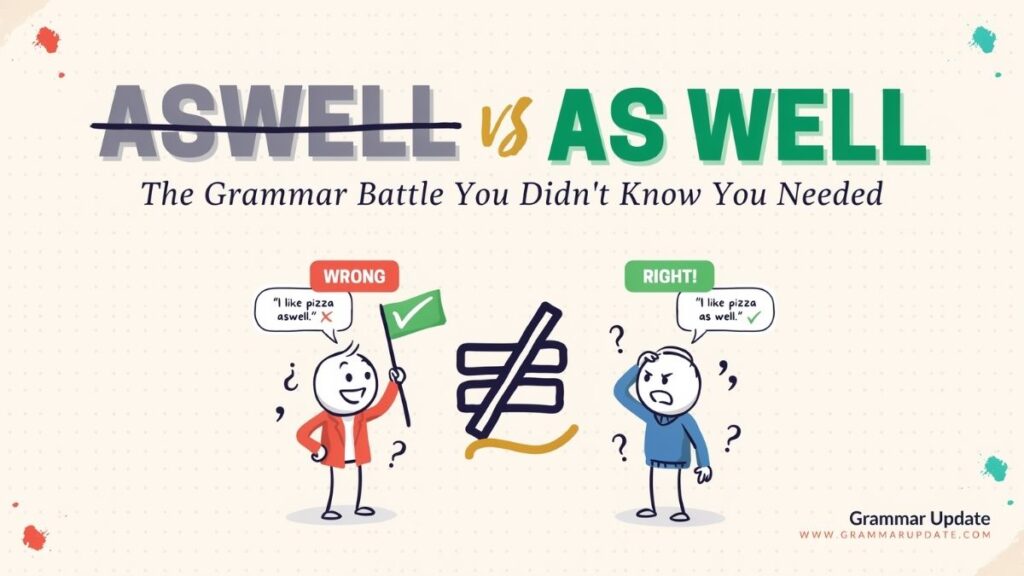
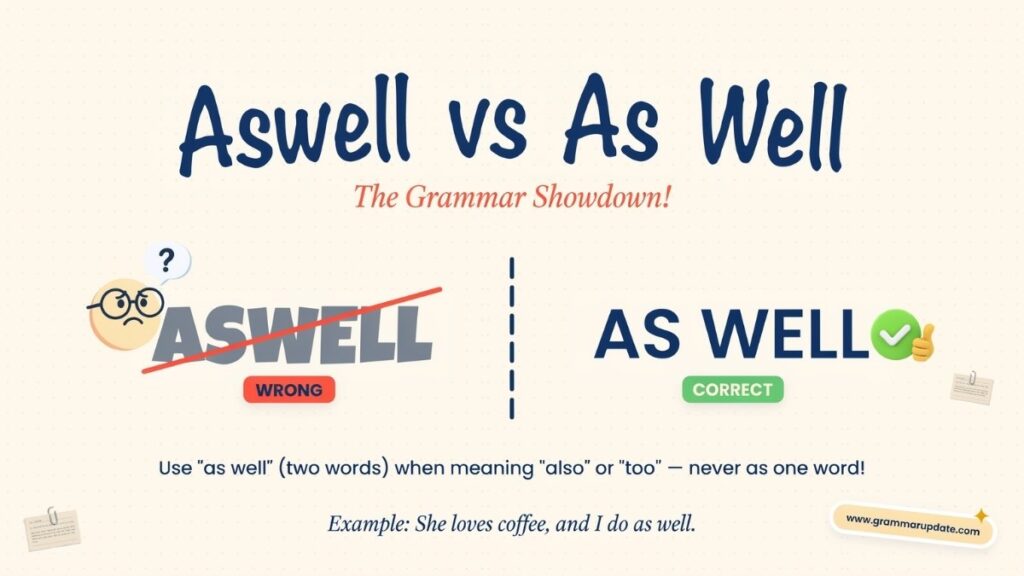
The confusion between aswell vs as well is one of those small English grammar traps that looks harmless but quietly leads to repeated mistakes in school writing, exams, and professional communication. It is the kind of error that slips into sentences so easily that even spellcheck sometimes overlooks it, while grammar rules firmly do not. The problem is simple: learners hear “as well” in fast, connected speech, assume it is a single word, and confidently write “aswell” without realizing that English spelling and pronunciation do not always match. This article breaks down the correct usage, meaning, and grammar rules of aswell or as well in a clear, practical, and slightly humorous way so you can avoid this common confusion and write with confidence.
Aswell vs As Well Meaning Explained
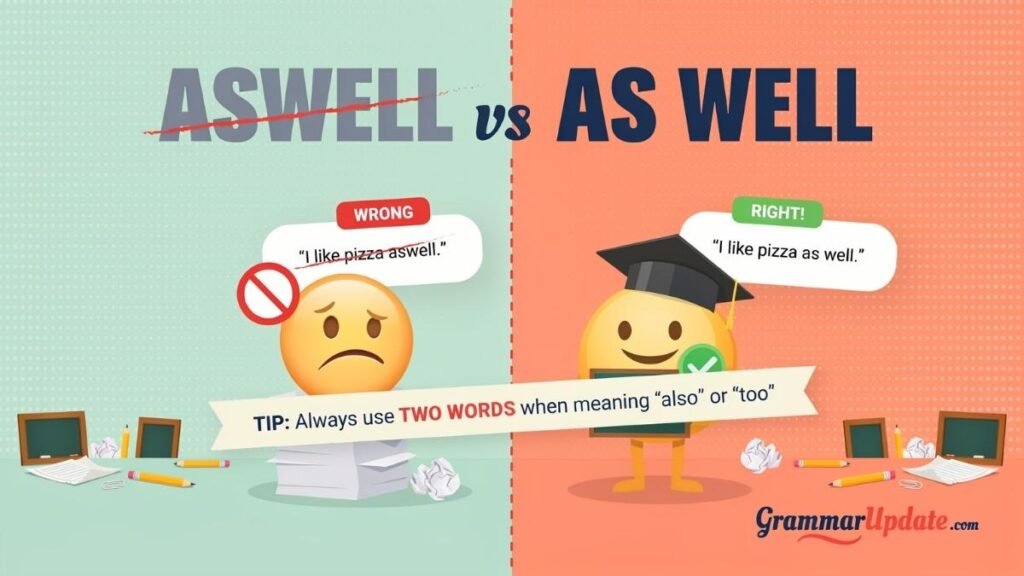
To understand as well meaning, we first need to understand its grammatical role. The correct form “as well” is used to express addition or inclusion in a sentence. It functions similarly to “also” and “too,” but with slightly different placement and tone.
The as well definition in English grammar is:
An adverbial phrase used to indicate something additional or included.
In simple terms, as well in English is used when you want to add extra information without repeating ideas.
What Does “As Well” Mean in Real Usage?
In practical communication, as well usage always signals that something additional is included alongside what has already been mentioned.
For example:
- I bought a phone and a charger as well.
- She attended the meeting as well.
- We visited Paris as well during our trip.
In each case, the phrase adds information naturally, improving sentence flow and avoiding repetition.
Learn the difference between tricky more English words
Click vs Clique Which is Difference and usage?
Does “Aswell” Exist as a Correct Word?
A frequently asked question is is aswell correct?
The answer is clear:
“Aswell” is not correct in standard English grammar. It is a spelling mistake.
According to authoritative sources such as the Oxford Dictionary, only “as well” is accepted as the correct form.
Key clarification:
- Correct form: as well
- Incorrect form: aswell
- Meaning: identical in speech, but only one is grammatically valid
Even though “aswell” is commonly seen in informal writing, it is not acceptable in formal, academic, or professional contexts.
Learn how to use confusing more words correctly
Check-in vs Check In Explained and Usage
Formal vs Informal Usage of “As Well”
The phrase as well usage remains consistent in meaning across contexts, but its tone and placement vary.
In formal writing, it is typically used at the end of sentences to maintain clarity and grammatical flow. It is commonly found in reports, essays, and professional communication.
In informal speech, it is used more freely and naturally, often without conscious attention to structure.
For example:
- Formal: The organization provided support as well.
- Informal: I’m coming as well!
Learn the difference between tricky more English words
Granddad vs Grandad which spelling is Correct and Usage?
Aswell vs As Well Grammar Rules and Spelling Differences
The core issue in as well grammar is understanding that it is not a single word but a fixed adverbial phrase. English grammar treats it as two separate components working together rather than one combined lexical item.
Why “As Well” Is the Correct Form
The correct structure is based on grammatical function:
- “as” acts as a connective element
- “well” functions as an adverb meaning “also” or “in addition”
Together, they form a phrase used to extend meaning without changing sentence structure.
This is why correct spelling as well always requires separation.
Why “Aswell” Is Incorrect
The incorrect form appears mainly due to real-world writing habits rather than grammar rules. Common causes include fast typing, spoken English influence, autocorrect merging words, and informal digital communication styles.
This leads to frequent confusion in as well vs aswell grammar, especially among learners who rely heavily on sound rather than structure when writing.
Grammar principle:
“Aswell is not recognized as a valid word in standard English usage.”
Word Formation Rule in English
English often preserves spacing in adverbial phrases to maintain clarity. Many similar expressions remain separate words because they function grammatically rather than lexically.
Examples include:
- in fact
- at all
- as well
This confirms that spacing is a structural requirement, not optional styling.
Learn how to use confusing more words correctly
Counselor vs Councilor Which is the Difference and Usage?
Aswell vs As Well Pronunciation and Speech Influence
One of the strongest reasons behind the confusion in aswell vs as well is pronunciation. In natural spoken English, the phrase “as well” is often spoken quickly and smoothly as:
/əz wel/
Because of connected speech, the words blend together, and the boundary between them becomes almost invisible. This creates the impression that it is a single word, especially in fast, casual conversation. As a result, many learners incorrectly assume it should also be written as one word, leading to the common mistake “aswell.”
Why Learners Get Confused
The confusion develops due to a combination of linguistic and learning-related factors that influence how English is processed.
First, spoken English naturally reduces pauses between words, especially in common expressions, which makes phrases like “as well” sound merged. Second, the word “as” is usually unstressed in speech, so it becomes weak and less noticeable compared to “well,” which carries the main stress. Third, learners often depend heavily on listening when acquiring vocabulary, and they unconsciously transfer spoken patterns into writing without applying spelling rules.
This is why search queries such as is aswell one word appear frequently among learners trying to match spoken English with written grammar.
Spoken vs Written English Difference
In spoken English, smooth blending and connected speech are natural and necessary for fluent communication. Native speakers prioritize rhythm, speed, and natural flow, which often removes clear word boundaries in pronunciation. However, written English follows fixed grammatical rules where spelling, spacing, and structure must remain accurate and standardized.
This difference between sound and writing is one of the main reasons why aswell vs as well UK usage confusion persists even among advanced learners. While it may sound like a single unit in speech, written English always separates it into two words: as well.
Pronunciation vs Writing Comparison Table
| Aspect | Spoken English | Written English | Effect on Learners |
|---|---|---|---|
| Word Flow | Sounds like “aswell” due to connected speech | Written as “as well” with clear spacing | Creates spelling confusion |
| Stress Pattern | “as” is weak, “well” is stressed | No stress marking in writing | Learners miss word separation |
| Speed of Communication | Fast and fluid pronunciation | Structured and rule-based | Leads to incorrect assumptions |
| Learning Impact | Words feel merged in hearing | Words must remain separate in writing | Causes frequent spelling errors |
| Example | /əz wel/ (sounds like one unit) | as well (two separate words) | Difference between sound and grammar |
Fix common more word mistakes in English
Reining vs Reigning Which Is Difference?
Aswell vs As Well in Sentences (Usage Guide)
Understanding how to use as well in a sentence is essential for natural English writing.
Sentence Placement Rule
The most common and grammatically accepted position is at the end of a sentence. This placement ensures natural rhythm and clarity.
Examples:
- I need a pen as well.
- She joined the class as well.
- We visited the museum as well.
This structure is standard in both spoken and written English.
Structural Patterns in English
A common grammatical pattern is subject plus verb plus object followed by “as well.” Another pattern uses compound sentences where “as well” adds supplementary information without repetition.
For example, “I like tea, and I like coffee as well” shows how it helps maintain flow and avoid redundancy.
Grammar Insight
Sentence-ending adverbial phrases like as well are widely used because they improve readability and maintain sentence balance. This is part of broader English clarity principles.
Learn the difference between tricky more English words
Appendices vs Appendixes Which is Correct and Usage?
Aswell vs As Well Examples in Real Contexts
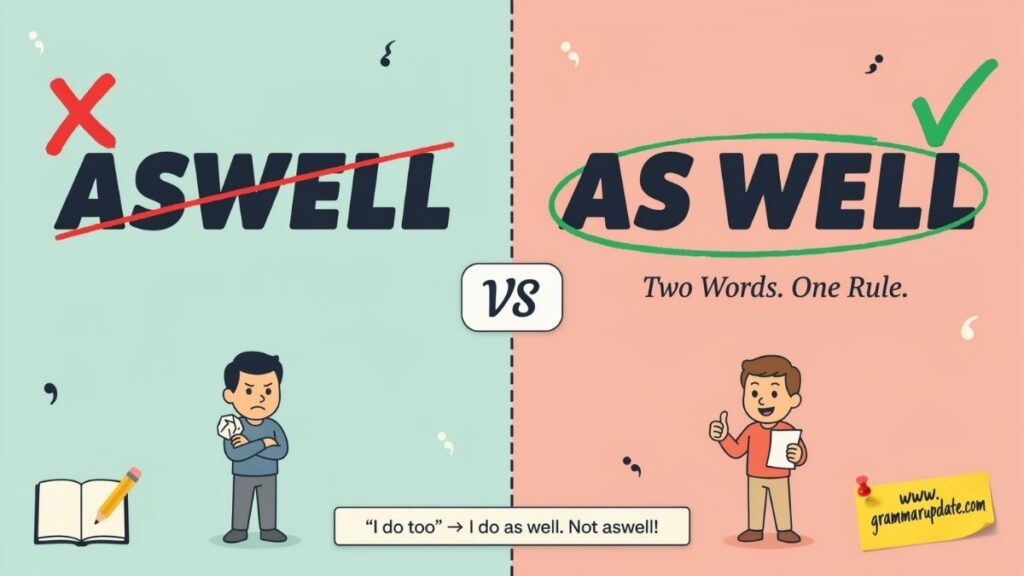
In everyday English, as well usage appears across all communication levels, from casual conversation to academic writing and professional communication. It is used to add extra information naturally, without repeating ideas or making sentences sound heavy.
In real-life writing and speech, “as well” is extremely common because it works smoothly as an additive phrase meaning “also” or “in addition.” For example, people naturally say sentences like “I need a pen as well” or “She is coming as well,” where the phrase simply adds extra meaning to the statement.
Incorrect usage is still common in informal writing, such as “I will join aswell,” which remains grammatically incorrect despite being understandable. This mistake usually appears in fast typing or casual messaging, but it is not accepted in standard English writing.
Incorrect usage example: She wants to come aswell to the event.
Correct usage example: I finished my homework as well before dinner.
Correct usage example: The company offers training as well for new employees.
Incorrect usage example: I will attend the meeting aswell tomorrow.
Fix common more word mistakes in English
Hustle vs Hussle Which is Correct Spelling and Usage?
Why People Get Confused Between Aswell and As Well
The confusion between aswell or as well is closely tied to modern communication habits rather than actual grammar difficulty. In spoken English, words naturally blend together due to connected speech, which makes phrases like as well sound like a single unit. This auditory blending often misleads learners into assuming it should also be written as one word.
Digital communication adds another layer to the problem. On messaging apps and social media platforms, people tend to type quickly, often ignoring spacing rules or relying on autocorrect, which can incorrectly merge words. Over time, repeated exposure to informal writing makes the incorrect form feel familiar, even though it is not grammatically accepted.
Social media also encourages relaxed grammar standards, where clarity and speed are prioritized over correctness. This reinforces the habit of writing phrases the way they sound rather than the way they are structured in formal English.
This is why learners often search queries such as aswell or as well Oxford dictionary, trying to verify the correct form and separate natural speech from proper written grammar rules.
Learn the difference between tricky more English words
To Bad vs Too Bad Which is correct and usage?
Common Mistakes in Aswell vs As Well Usage
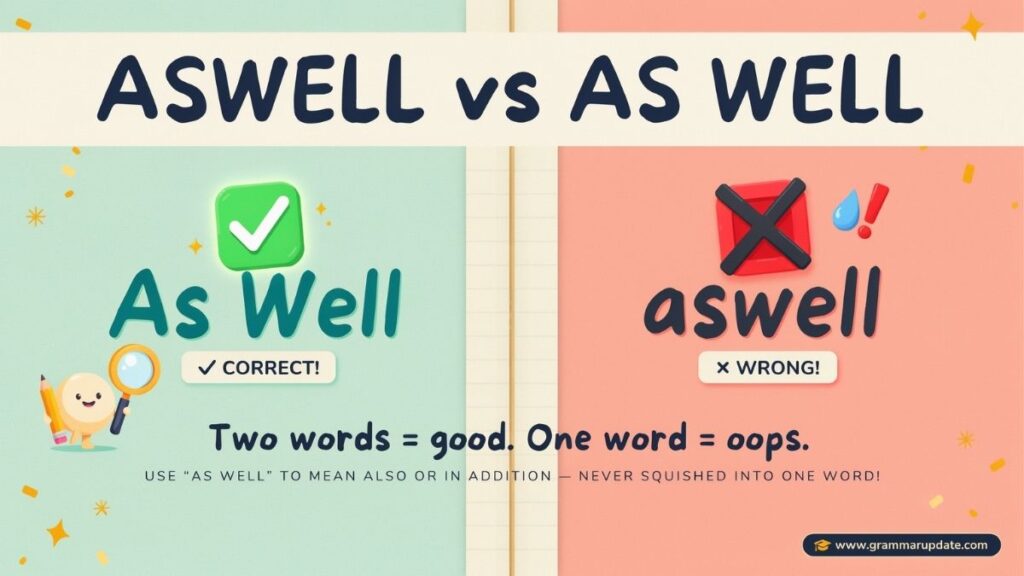
The most frequent error in aswell vs as well usage is writing “aswell” as a single word. This mistake usually comes from fast typing, autocorrect habits, or spoken English influence, where the phrase sounds like one continuous unit. Although the meaning is still understood in casual communication, it is not accepted in standard written English and is considered incorrect.
Another common problem is confusing “as well” with “as well as.” These two expressions look similar but function differently in grammar. “As well” is mainly used to add extra information, usually at the end of a sentence, while “as well as” is used to connect two ideas or subjects within the same sentence and can change the structure of the sentence entirely.
Some learners also place “as well” in unnatural positions within sentences, which can make writing sound awkward or less fluent. In formal writing, overusing it can also weaken style, especially when better alternatives like “also” or “in addition” would be more appropriate.
Despite these variations, the rule remains simple and consistent: “aswell” is always incorrect, while “as well” is always the correct form in standard English grammar.
Fix common more word mistakes in English
Faring vs Fairing, What’s the Difference?
Common Mistakes Table
| Mistake Type | Incorrect Example | Correct Example | Explanation |
|---|---|---|---|
| Single-word spelling | I will join aswell. | I will join as well. | “Aswell” is not a valid English word; spacing is required. |
| Confusing with “as well as” | She sings as well plays piano. | She sings as well as plays piano. | “As well” adds information; “as well as” connects clauses. |
| Wrong sentence placement | I as well will go there. | I will go there as well. | “As well” is usually placed at the end of a sentence. |
| Overuse in formal writing | The report is detailed as well and complete as well. | The report is detailed and complete. | Overuse weakens clarity and style. |
| Informal spelling habit | I’m coming aswell later. | I’m coming as well later. | Common typing shortcut error in digital communication. |
Fix common more word mistakes in English
Requester vs Requestor Which Is Correct and usage?
Aswell vs As Well Usage Rules
The correct usage is consistent across contexts. “As well” is used to add extra information in both formal and informal English. It is generally placed at the end of sentences for natural flow and should never be written as a single word in standard writing.
A helpful way to remember this is to separate pronunciation from spelling. Even if it sounds like one word in speech, written English always preserves the separation.
Practice Session Aswell vs As Well
Complete each sentence by choosing the correct form: as well or aswell (correct form only is “as well”).
- I will join the meeting ______.
- She is coming ______ to the party.
- He bought a phone and a charger ______.
- We visited London ______ last year.
- They want to come ______ tomorrow.
- I like tea and coffee ______.
- The teacher explained the lesson ______.
- You should bring your notebook ______.
- My friend is invited ______.
- I finished my homework ______ before dinner.
- She speaks English ______.
- He will travel ______ next week.
- I need milk and bread ______.
- They arrived ______ on time.
- We enjoyed the movie ______.
- You can call me ______ later.
- The manager attended the meeting ______.
- I want to learn French ______.
- She completed the project ______.
- We went to the park ______.
- He likes football and cricket ______.
- I will help you ______.
- They stayed home ______ because of rain.
- She bought a dress and shoes ______.
- I am ready ______ for the test.
Answers
All answers use the correct form:
- as well
- as well
- as well
- as well
- as well
- as well
- as well
- as well
- as well
- as well
- as well
- as well
- as well
- as well
- as well
- as well
- as well
- as well
- as well
- as well
- as well
- as well
- as well
- as well
- as well
Here’s a trusted source for clear word meanings:
FAQs
Is aswell or as well correct?
The correct form is as well. It is a standard English adverbial phrase used to show addition, meaning “also” or “too.” The form “aswell” is always incorrect in standard English writing and is considered a spelling mistake in academic, professional, and formal contexts.
Is it you aswell or you as well?
The correct expression is you as well. For example: “Nice to meet you, you as well.” The incorrect form “you aswell” appears due to fast typing or spoken English influence, but it is not accepted in standard grammar.
How do you use as well?
You use as well to add extra information to a sentence. It usually comes at the end of a sentence and works similarly to “also” or “too.”
For example: “I will join the meeting as well.”
Is it me aswell or me as well?
The correct form is me as well. It is commonly used in responses or agreement. For example: “I enjoyed the movie.” “Me as well.” The spelling “me aswell” is incorrect in all standard English writing.
Does “aswell” mean too?
In meaning, people often intend it to mean “too” or “also,” but “aswell” is not a valid English word. The correct written form is as well, which carries the same meaning but follows proper grammar rules.
When should I use as well?
You should use as well when you want to add extra information in a sentence. It is commonly used in both spoken and written English. It is especially natural at the end of sentences, such as: “She joined us as well.”
Is it correct to use “as well”?
Yes, “as well” is fully correct English grammar. It is widely used in formal writing, academic essays, professional communication, and everyday speech. It is one of the most common additive phrases in English.
How to use just as well?
The phrase “just as well” is different from “as well.” It means something is fortunate or acceptable in a situation. For example: “It’s just as well we left early because the traffic got worse.” It expresses relief or suitability rather than addition.
What is correct, as well or aswell?
The correct form is as well. “Aswell” is always incorrect in standard English grammar and should never be used in formal, academic, or professional writing.
Is it correct to write “aswell” in informal writing?
No, even in informal writing, “aswell” is still incorrect. While it may appear in chats or social media, it is not accepted in proper English grammar.
Why do people write aswell instead of as well?
People often write “aswell” because spoken English blends the sounds together, making it feel like one word. Fast typing and social media habits also contribute to missing spaces between words.
Is “as well” used in British and American English?
Yes, “as well” is used in both British and American English. However, placement and frequency may vary slightly, with British English using it more commonly at the end of sentences.
What is the difference between as well and as well as?
“As well” adds extra information, while “as well as” connects two elements in a sentence and changes its structure. For example: “She sings as well as dances” means both actions are connected, not simply added.
Can I start a sentence with as well?
No, in standard English, “as well” is usually not used at the beginning of a sentence. It is more natural and grammatically correct at the end of a sentence.
Is “aswell” ever acceptable in English writing?
No, “aswell” is never acceptable in standard English writing. It is always considered a spelling error, regardless of context or formality.
How can I remember the correct form easily?
A simple rule is to remember that English separates this phrase into two parts because it is an adverbial expression. Even if it sounds like one word in speech, it must always be written as “as well” in text.
Fix common more word mistakes in English
Unorganized vs Disorganized Difference and Use?
Conclusion
The confusion between aswell vs as well is not a difficult grammar issue, but a simple mismatch between spoken English and written rules. Because the phrase sounds smooth and connected in everyday speech, it is easy to assume it functions as a single word. However, English writing is far more structured, and correctness in this case depends entirely on proper word separation.
Once this distinction is clear, the mistake becomes easy to avoid. “As well” is always the correct adverbial phrase used to express addition or inclusion, while “aswell” is simply a spelling error that arises from informal typing habits and pronunciation influence rather than accepted grammar rules.
Ultimately, understanding this difference is a small but important step toward more accurate and professional writing. When you separate sound from spelling, your English becomes clearer, more precise, and noticeably more polished in any academic or professional setting.

Jhon AJS, the creative mind behind Grammar Update, is an experienced blogger passionate about simplifying English grammar. He focuses on explaining confusing word vs word differences, grammar rules, punctuation, and sentence structure in a clear and practical way. Through easy to understand guides and examples, Jhon helps readers improve their writing and communicate with confidence. With years of blogging experience, he continues to share helpful insights that make learning grammar simple, useful, and accessible for everyone.