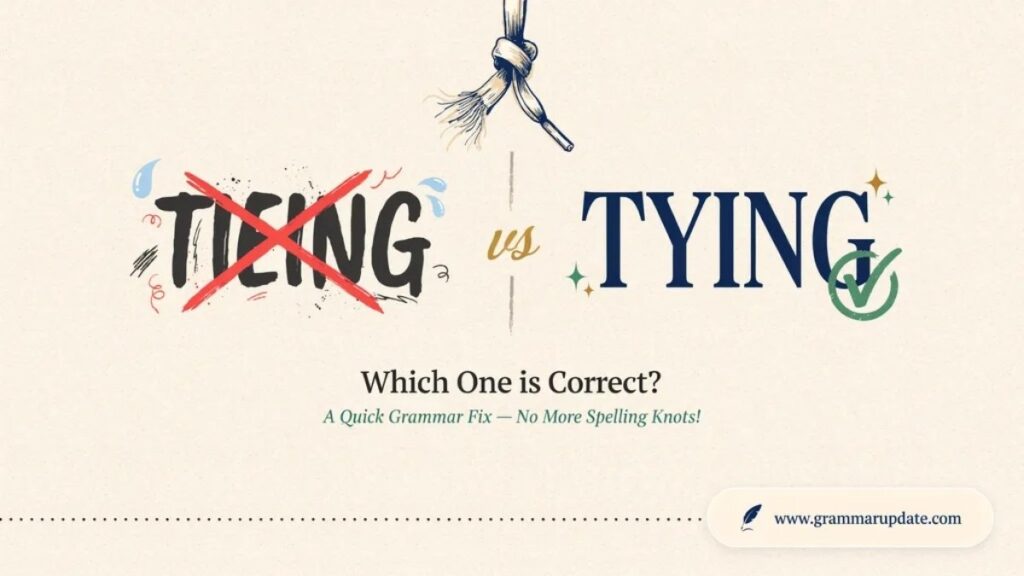
Ever found yourself stuck between tieing vs tying, staring at the word as if it is trying to tie your thoughts into a knot? You are definitely not alone. Many writers confidently type tieing, only to discover that English grammar has other plans. The confusion makes sense because the verb tie feels like it should simply take “-ing” and carry on unchanged. Instead, English applies a spelling rule that quietly transforms it into tying. This small change leads to one of the most common spelling mistakes in writing. In this guide, we will untangle the confusion around tieing vs tying, explain the grammar rule clearly, and help you use it correctly every time without hesitation.
Tieing vs Tying Quick Answer
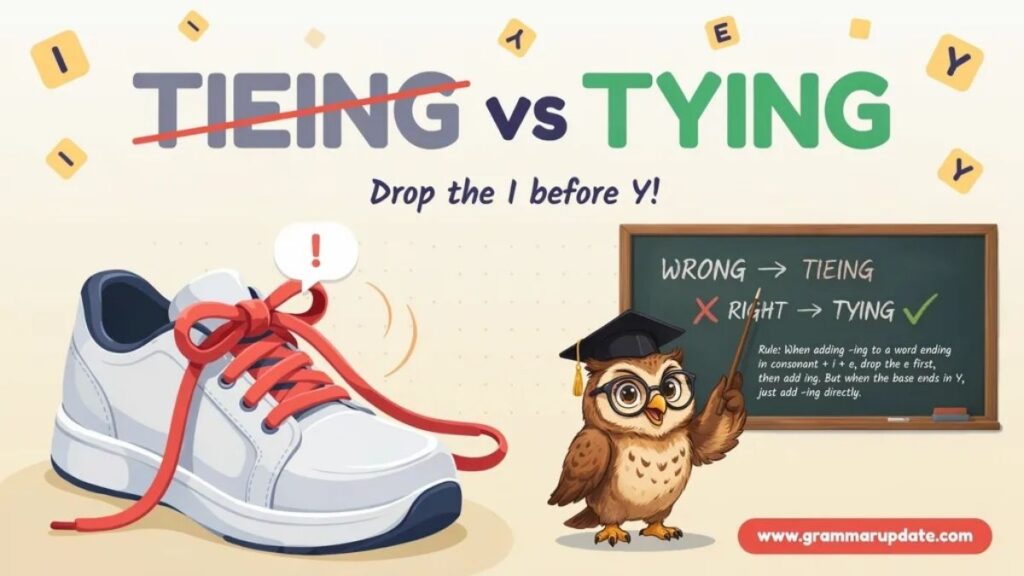
If you only need the short answer, here it is:
| Spelling | Correct? | Meaning |
|---|---|---|
| Tying | ✓ Correct | The present participle of tie |
| Tieing | ✗ Incorrect | A common spelling mistake |
Examples:
✓ She is tying her shoes.
✓ They are tying the rope securely.
✗ She is tieing her shoes.
✗ We are tieing the knot.
The correct spelling of tying changes the ending -ie to -y before adding -ing.
What Does Tying Mean?
The tying meaning refers to fastening, securing, binding, or connecting something.
The tying definition is:
The act of fastening or securing something using a knot, rope, string, ribbon, cord, or similar material.
The word can describe both physical actions and figurative expressions.
Common examples include:
- Tying shoelaces.
- Tying a ribbon.
- Tying a rope.
- Tying a game.
Tying Definition in English
In English grammar, tying serves two functions.
Tying as a Verb
She is tying her shoes.
Tying as a Gerund
Tying knots requires patience.
Both uses follow the same spelling rule.
Fix common more word mistakes in English
Verbiage vs Verbage Which Spelling Is Correct?
Tieing vs Tying: Which Spelling Is Correct?
The answer is straightforward:
Tying is correct.
Tieing is incorrect.
Many people believe that the verb tie simply takes -ing, but verbs ending in -ie follow a different rule.
Correct Examples
| Base Verb | Correct Form |
|---|---|
| tie | tying |
| die | dying |
| lie | lying |
| untie | untying |
Because of this rule, tieing is not accepted in standard English.
Is Tieing a Word?
Many people search:
Is tieing a word?
The answer is no.
Modern dictionaries recognize tying as the proper spelling. The form tieing is considered a misspelling.
Why Writers Use Tieing
- They add -ing directly to tie.
- The pronunciation sounds similar to “tie-ing.”
- They do not know the spelling rule.
Learn the difference between confusing more English words
Eying vs Eyeing Which Spelling Is Correct?
Why Do People Write Tieing?
This spelling mistake happens for several reasons.
Many English verbs simply add -ing:
- walk → walking
- jump → jumping
- read → reading
Because of these patterns, writers expect:
tie → tieing
However, English follows a different rule for verbs ending in -ie.
The Grammar Rule Behind Tying
The most important rule behind tying grammar involves verbs ending in -ie.
The IE to Y Rule
When a verb ends in -ie, English changes ie to y before adding -ing.
ie → y + ing
Examples:
| Verb | Correct Form |
|---|---|
| tie | tying |
| die | dying |
| lie | lying |
| untie | untying |
This rule makes the spelling easier to read and pronounce.
Why Is Tying Spelled Without E?
Many learners ask:
Why is tying spelled without e?
English removes the ie before adding -ing.
Incorrect:
tieing
Correct:
tying
This prevents awkward spelling combinations.
Learn the difference between confusing more English words
Honor vs Honour Which Spelling Is Correct?
Present Participle of Tie
The present participle of tie is:
tying
Tie Verb Forms
| Verb Form | Example |
|---|---|
| Base form | tie |
| Past tense | tied |
| Past participle | tied |
| Present participle | tying |
Examples:
She tied the ribbon.
They have tied the package.
He is tying the rope.
Tying Grammar Explained
The word tying can appear in several grammatical situations.
As a Present Participle
He is tying the rope.
As a Gerund
Tying knots takes practice.
In Continuous Tenses
They are tying decorations.
Once the spelling rule is understood, the grammar becomes much easier.
Learn the difference between confusing more English words
Speach vs Speech Which Spelling Is Correct in English?
Tying Pronunciation
The pronunciation of tying is:
/ˈtaɪ.ɪŋ/
It sounds like:
TYE-ing
Because the pronunciation contains two clear sounds, many people assume the spelling should be tieing. However, pronunciation does not determine spelling.
Tying Shoelaces
One of the most common uses of the word appears when discussing shoes.
Examples:
She is tying her shoelaces.
The child learned how to tie his shoes.
Learning to tie shoelaces is often one of the first practical skills children develop.
Tying Knots
The word is also commonly used when discussing knots.
Examples:
He is tying a fishing knot.
Sailors spend years learning knot tying techniques.
Knot tying is important in activities such as:
- Sailing.
- Fishing.
- Camping.
- Climbing.
Tying Ribbons and Strings
The verb also describes fastening decorative items.
Examples:
She is tying a ribbon around the gift.
He is tying strings together.
In these situations, tying means fastening or securing something.
Learn the difference between confusing more English words
Inclosed vs Enclosed Which Spelling Is Correct?
Tying Objects Together
The action of connecting objects often uses the word tying.
Examples:
They are tying the poles together.
Workers are tying wires securely.
Depending on the situation, tying may mean:
- Binding.
- Connecting.
- Securing.
- Attaching.
Tying Synonyms
Several words can replace tying depending on the context.
| Tying | Synonym |
|---|---|
| tying a rope | fastening |
| tying objects | binding |
| tying materials | securing |
| tying strings | connecting |
| tying pieces | attaching |
Each synonym emphasizes a slightly different meaning.
Learn the difference between tricky more English words
Seperate vs Separate Which Spelling Is Correct?
Tying in Everyday English
The word appears regularly in everyday conversations.
Examples:
She is tying her hair back.
He spent the afternoon tying packages.
The children are tying decorations.
Because the action itself is common, the word appears frequently in both speaking and writing.
Tying Examples in Sentences
Here are some examples:
She is tying her shoes.
He is tying the rope to the tree.
They are tying the boxes together.
The children are tying ribbons for the party.
The workers are tying cables safely.
He spent an hour tying fishing knots.
These examples demonstrate the flexibility of the verb.
Learn the difference between tricky more English words
Neighbour vs Neighbor Which Spelling Is Correct?
Common Mistakes with Tying
Several mistakes occur repeatedly.
Writing Tieing
Incorrect:
She is tieing her shoes.
Correct:
She is tying her shoes.
Ignoring the Spelling Rule
Many writers forget that verbs ending in -ie change before adding -ing.
Spelling According to Sound
Since the word sounds like “tie-ing,” many writers mistakenly choose:
tieing
instead of:
tying
Similar Words That Follow the Same Rule
The same spelling pattern appears in several common verbs.
| Incorrect | Correct |
|---|---|
| dieing | dying |
| lieing | lying |
| tieing | tying |
| untieing | untying |
Learning this single rule helps eliminate several common spelling mistakes.
Learn the difference between tricky more English words
All-time favorite vs all times favorite Which Is Correct?
Dying vs Dieing
Correct:
He is dying.
Incorrect:
He is dieing.
Lying vs Lieing
Correct:
She is lying on the sofa.
Incorrect:
She is lieing on the sofa.
The same ie → y rule applies.
A Simple Memory Trick
Remember this rule:
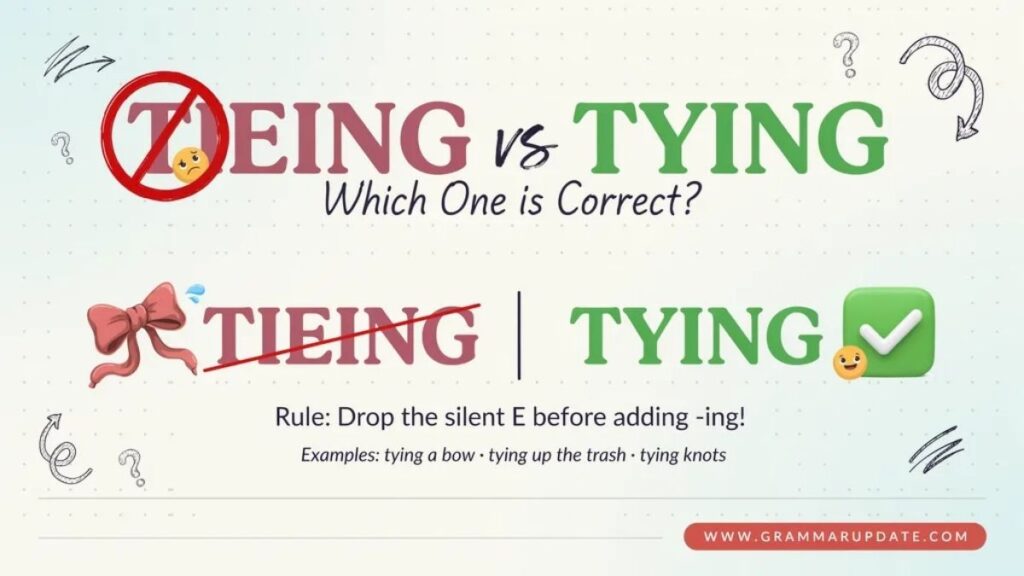
If a verb ends in -ie, change ie to y before adding -ing.
Therefore:
tie → tying
Never:
tie → tieing
Once you understand this rule, the confusion between tieing vs tying becomes much easier to avoid.
Learn the difference between tricky more English words
Bellies vs Bellys Which one is Correct?
Tying a Game: Meaning in Sports
The verb tying frequently appears in sports, where it means making the score equal. When one team scores enough points, goals, or runs to match its opponent, the team is said to be tying the game.
Examples:
The striker scored in the final minute, tying the game 2–2.
Her three-point shot tied the score with five seconds remaining.
The late goal helped the team tie the match.
In many sports, a tied score may lead to overtime, extra time, penalty kicks, or a tie-breaker, depending on the rules of the competition. Because of this, the phrase tying the score is extremely common in sports journalism and commentary.
Sports Terms Related to Tying
| Expression | Meaning |
|---|---|
| tying the game | making the score equal |
| tying the score | reaching the same score |
| tied game | a game with equal scores |
| tie-breaker | a method used to determine a winner |
| deadlock | a tied score |
| equalizer | a score that ties the game |
Tying in Sports
The word tying is widely used across different sports.
Football and Soccer
The striker scored in injury time, tying the match.
Basketball
The player made two free throws, tying the game.
Baseball
The home run tied the score in the ninth inning.
Hockey
The team scored a late goal, tying the contest.
Tennis
Although tennis usually uses “tie-break,” players can still tie sets or games during play.
Sports announcers frequently use expressions such as:
- The game is tied.
- The score is tied.
- The team tied the match.
- The goal tied the game.
Tying Into Meaning and Usage
The phrasal verb tie into means to connect with, relate to, or support another idea, topic, or system.
Examples:
The new chapter ties into the previous lesson.
The research findings tie into earlier studies.
The campaign ties into the company’s marketing goals.
This expression is especially common in:
- Business writing.
- Academic writing.
- Presentations.
- Reports.
- Project management.
When something “ties into” another idea, it creates a logical connection.
Fix common more word mistakes in English
Hoping vs Hopeing Which Spelling Is Correct?
Tie In With, Meaning
The expression tie in with carries a similar meaning.
It means:
- To match.
- To connect.
- To support.
- To correspond with.
Examples:
The evidence ties in with the witness statement.
Her proposal ties in with the company’s objectives.
The colors tie in with the room’s design.
This phrase is widely used in both formal and informal English.
Fix common more word mistakes in English
Soo vs So Difference and Which One Is Correct?
Tying Up Loose Ends Meaning
The expression tying up loose ends means completing unfinished tasks or resolving remaining details.
Examples:
She spent Friday tying up loose ends before leaving for vacation.
The team is tying up loose ends before the project deadline.
He stayed late to tie up loose ends at work.
The phrase often appears in:
- Workplace communication.
- Business meetings.
- Project management.
- Personal planning.
When someone says they are “tying up loose ends,” they are finishing the small tasks that remain before a project, event, or decision is complete.
Tying the Knot Meaning
One of the most famous idioms containing the word is:
tying the knot
This expression means:
getting married
Examples:
The couple is tying the knot next spring.
They finally tied the knot after many years together.
The phrase originated from ancient wedding traditions in which cords, ribbons, or hands were literally tied together to symbolize the union of two people.
Today, the expression remains extremely popular in:
- Wedding announcements.
- Invitations.
- Social media.
- Newspapers.
- Entertainment magazines.
Tying in Business Writing
Business communication often uses tying to describe connections between ideas, departments, or goals.
Examples:
The recommendations tie into our long-term strategy.
The report ties together several important findings.
The proposal ties in with customer expectations.
Managers and executives frequently use the word to show relationships between projects and objectives.
Common expressions include:
- Tying ideas together.
- Tying departments together.
- Tying strategy to results.
- Tying performance to goals.
Tying in Academic Writing
Academic writing also uses tying to create logical connections.
Examples:
The author ties the theory to modern research.
The conclusion ties together the main arguments.
The evidence ties into previous studies.
Strong academic writing often depends on tying ideas together so readers can follow the argument clearly.
Tying in Everyday English
The word appears naturally in everyday situations.
Examples:
She is tying her hair back.
He spent the afternoon tying packages.
The children are tying decorations for the party.
We are tying balloons to the fence.
Because the action itself is common, the word appears frequently in both spoken and written English.
Tying Examples in Sentences
Understanding tying in a sentence helps learners recognize the different meanings.
Physical Actions
She is tying her shoes.
He is tying the rope to the tree.
The child is tying a ribbon around the gift.
Sports
The goal tied the game.
The basket tied the score.
Figurative Meanings
The presentation ties the ideas together.
The report ties into the company’s objectives.
Idiomatic Expressions
They are tying the knot next year.
We are tying up loose ends before moving.
These examples demonstrate how one word can function in many situations.
Tying Synonyms
The best synonym depends on the context.
| Tying | Synonym |
|---|---|
| tying a knot | knotting |
| tying a rope | fastening |
| tying objects | binding |
| tying materials | securing |
| tying ideas | connecting |
| tying information | linking |
| tying projects | integrating |
| tying cords | attaching |
Although these words share similar meanings, tying often implies creating a connection through fastening, joining, or linking.
What Do Dictionaries Say?
Major dictionaries recognize only:
tying
The accepted spelling appears in:
- Oxford Dictionary.
- Merriam-Webster Dictionary.
- Cambridge Dictionary.
- Collins Dictionary.
The spelling tieing is generally labeled as a spelling mistake or a rare historical variant that is no longer considered standard English.
Modern style guides, schools, universities, and publishers use tying exclusively.
Tieing vs Tying Comparison Table
| Feature | Tying | Tieing |
|---|---|---|
| Correct spelling | ✓ Yes | ✗ No |
| Dictionary accepted | ✓ Yes | ✗ No |
| Present participle of tie | ✓ Yes | ✗ No |
| Modern English usage | ✓ Yes | ✗ No |
| Academic writing | ✓ Yes | ✗ No |
| Professional writing | ✓ Yes | ✗ No |
| Grammar guides | ✓ Yes | ✗ No |
| School usage | ✓ Yes | ✗ No |
The comparison clearly shows that tying is the only correct spelling in modern English.
Practice Session Tieing vs Tying
Fill in each blank with the correct spelling: tying (or use the correct verb form where required).
Questions
- She is ______ her shoelaces before leaving the house.
- The sailor is ______ the rope tightly to the dock.
- They are ______ packages with strong string.
- He is ______ a secure knot in the rope.
- The team is ______ the game in the final minutes.
- The coach is ______ different strategies together.
- I am ______ up loose ends before the deadline.
- She is ______ a ribbon around the gift box.
- The technician is ______ cables carefully.
- They are ______ balloons to the chairs for the event.
- He is ______ his tie before the job interview.
- The students are ______ decorations in the classroom.
- The fisherman is ______ nets on the boat.
- The player is ______ the score with a last-minute goal.
- She is ______ her hair back with a band.
- The climber is ______ ropes for safety.
- We are ______ ideas together in the presentation.
- The child is ______ strings together for an art project.
- They are ______ the final details of the report.
- He is ______ a knot before starting the hike.
- The referee confirmed the match was ______.
- She is ______ flowers into a bouquet.
- The team is ______ the result in the final seconds.
- He is ______ everything together before leaving.
- The crew is ______ equipment securely before takeoff.
Answers
- tying
- tying
- tying
- tying
- tying
- tying
- tying
- tying
- tying
- tying
- tying
- tying
- tying
- tying
- tying
- tying
- tying
- tying
- tying
- tying
- tied
- tying
- tying
- tying
- tying
Here’s a trusted source for clear word meanings:
FAQs
Is it “tieing up” or “tying up”?
The correct form is tying up, not tieing up. The spelling tieing is incorrect in standard English.
What is the meaning of “tieing”?
Tieing is not accepted in modern English. The correct form is tying, which means fastening, securing, or connecting something.
Is it “tieing or tying the knot”?
The correct expression is tying the knot, meaning getting married.
Is it “tying or tieing for first place”?
The correct usage is tying for first place, meaning equal ranking in a competition.
Which is correct: tieing or tying?
Tying is correct. Tieing is a spelling mistake caused by misapplying English spelling rules.
Can I say “I was tied up”?
Yes. I was tied up means you were busy or unavailable, or physically restrained depending on context.
Is it “tying or tieing in a game”?
The correct form is tying in a game, meaning equalizing the score.
Is it “tying or tieing shoes”?
The correct form is tying shoes or tying shoelaces.
Is it “tying out” or “tieing out”?
The correct form is tying out. Tieing out is incorrect.
Is “tying” grammatically correct?
Yes. Tying is the correct present participle of the verb tie.
Why do people say “tying the knot”?
It is an idiom meaning marriage, originally linked to symbolic knot-tying traditions in weddings.
How do you use “tying” in a sentence?
Example: She is tying her shoes before leaving for school.
Why do they call it “tying one on”?
It is informal slang meaning heavy drinking, historically linked to older English expressions.
What does “tying” mean?
It means fastening, securing, binding, connecting, or making something equal in score.
What are common tying mistakes?
The most common mistake is writing tieing instead of tying, due to pronunciation confusion and incorrect rule application.
How do you spell “tying” (like tying shoes)?
It is spelled t-y-i-n-g.
Is it “tying up” or “tieing up”?
The correct form is tying up, meaning completing tasks or securing something.
What does “sorry I am tied up” mean?
It means I am busy or unavailable.
Is it “tieing or tying in sports”?
The correct form is tying in sports, meaning making the score equal.
Is it “tieing the knot or tying the knot”?
The correct phrase is tying the knot, meaning getting married.
Is it “tieing into or tying into”?
The correct form is tying into, meaning connecting or relating to something.
How do I say “tying my shoes”?
You simply say: I am tying my shoes.tying a game mean?
Conclusion
The confusion between tieing vs tying is one of those small English quirks that looks simple but still manages to trip up even careful writers. The correct form is always tying, while tieing is a spelling mistake that appears when we rely on sound instead of grammar rules. The reason is straightforward: English replaces -ie with -y before adding -ing, creating a consistent pattern across similar verbs.
Once this rule clicks, the uncertainty disappears. No more guessing, no more spelling hesitation. Whether you are tying shoelaces, tying a knot, or tying up loose ends, the spelling remains the same.
So the next time “tieing” shows up in your mind, remember: English already handled the correction you just need to follow it.

Jhon AJS, the creative mind behind Grammar Update, is an experienced blogger passionate about simplifying English grammar. He focuses on explaining confusing word vs word differences, grammar rules, punctuation, and sentence structure in a clear and practical way. Through easy to understand guides and examples, Jhon helps readers improve their writing and communicate with confidence. With years of blogging experience, he continues to share helpful insights that make learning grammar simple, useful, and accessible for everyone.