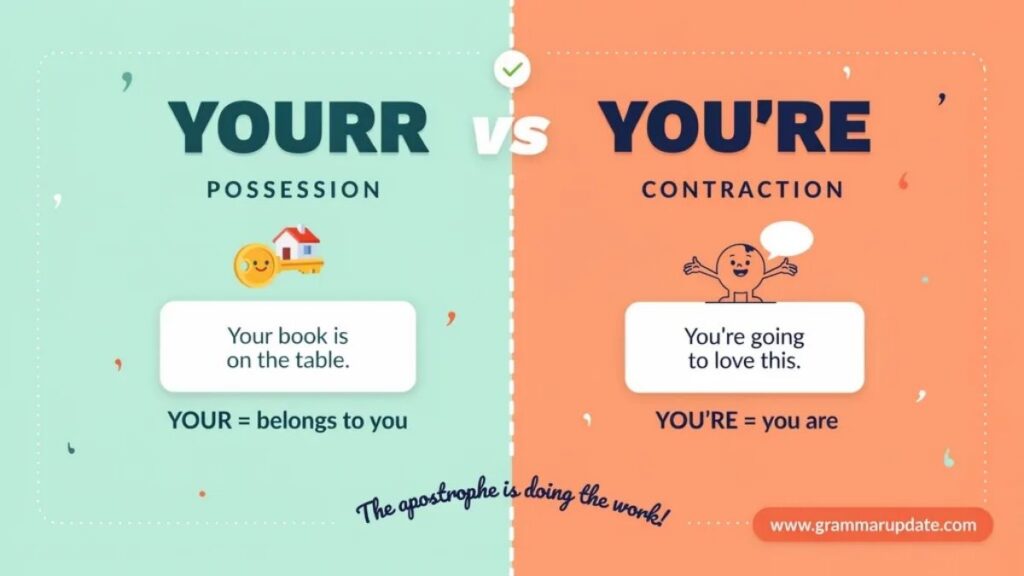
Your vs you’re is one of those small grammar mix-ups that can turn a perfectly good sentence into a confusing one. The two words sound nearly the same, but they have different jobs. Your shows that something belongs to you or is connected to you, as in “your book” or “your idea.” You’re is the short form of “you are,” as in “you’re ready” or “you’re helpful.” The apostrophe may be tiny, but it changes the meaning completely. Fortunately, the difference is easy to remember once you know the rule. This guide breaks down your and you’re with clear explanations, simple examples, and a quick test.
Quick Answer
Your and you’re are both correct words, but they are not interchangeable.
Your is used before a noun to show possession, belonging, association, or connection. You’re is the shortened form of you are.
| Word | Meaning | Grammatical function | Example |
|---|---|---|---|
| Your | Belonging to or associated with you | Possessive determiner | I like your idea. |
| You’re | You are | Contraction | You’re very helpful. |
The fastest way to remember the your you’re difference is this:
Your means something belongs to you or is connected with you.
You’re means you are.
Consider these two sentences:
“Your phone is ringing.”
“You’re holding your phone.”
In the first sentence, your identifies whose phone is ringing. In the second sentence, you’re means you are.
That simple distinction explains most cases of your vs youre in everyday English writing.
Fix common more word mistakes in English
Principal vs Principle Difference and usage ?
What Is the Difference Between Your and You’re?
The difference between your and you’re comes down to grammar and meaning.
Your is a possessive determiner. It normally appears before a noun or noun phrase and tells the reader that something belongs to, relates to, or is associated with the person being addressed.
You’re is a contraction made from you and are. The apostrophe shows that letters have been left out of the longer expression you are.
For example:
“Your answer is correct.”
“You’re correct.”
The first sentence talks about an answer associated with you. The second sentence means you are correct.
Therefore, when asking what is the difference between your and you’re, the simplest answer is possession versus a contraction.
The distinction becomes even clearer when you expand you’re.
“You’re ready.”
becomes:
“You are ready.”
The meaning stays the same.
However:
“Your answer is ready.”
cannot become:
“You are answer is ready.”
That version does not work. The sentence needs your because answer is a noun connected with you.
Fix common more word mistakes in English
Extreme vs Extreem difference and usage?
Your Meaning and Correct Usage
Your shows possession, belonging, relationship, or association. In traditional grammar, it may be called a possessive adjective. In modern grammatical terminology, it is commonly described as a possessive determiner.
Whatever terminology a grammar guide uses, the practical rule stays the same.
Your normally comes before a noun.
For example:
“Your car is outside.”
“Your brother called earlier.”
“I enjoyed your presentation.”
“Please check your email.”
“What is your opinion?”
In each sentence, your connects the noun with the person being addressed.
Importantly, possession does not always mean physical ownership. For example, “your teacher” does not mean you own the teacher. It identifies the teacher associated with you. Likewise, your opinion describes a view that belongs to you in the sense that it is your personal view.
So, your can express ownership, relationship, responsibility, association, or personal connection.
Your in a Sentence
If you are searching for how to use your in a sentence, look at what follows it.
“Your house looks beautiful.”
“Your new job sounds exciting.”
“I understand your concern.”
“Where is your passport?”
“Your explanation was easy to understand.”
In each example, your comes before a noun or a noun phrase.
That pattern provides a useful clue. When the sentence needs a word that identifies whose thing, idea, person, or responsibility is being discussed, your may be the correct choice.
Learn the difference between confusing word pairs
Exceed vs Excede difference and usages?
You’re Meaning and Correct Usage
You’re means you are. It is a contraction, which means it combines two words into a shorter form.
You + are = you’re
The apostrophe marks the omitted part of the original expression. Therefore, whenever you see you’re, you should be able to expand it to you are without changing the basic meaning.
For example:
“You’re late.”
means:
“You are late.”
Likewise:
“You’re learning quickly.”
means:
“You are learning quickly.”
“You’re my best friend.”
means:
“You are my best friend.”
The word you’re can appear in several sentence structures. It can come before an adjective, a noun phrase, a present participle, or another phrase that completes the meaning.
For example:
1.“You’re happy.”
2.“You’re a good friend.”
3.“You’re working hard.”
4.“You’re in the right place.”
Because you’re contains the verb are, it plays a completely different grammatical role from your.
You’re in a Sentence
To understand how to use you’re in a sentence, expand it to you are.
“You’re ready to leave.”
becomes:
“You are ready to leave.”
“You’re making good progress.”
becomes:
“You are making good progress.”
“You’re the person I was looking for.”
becomes:
“You are the person I was looking for.”
If the expanded sentence works naturally, you’re is usually the correct choice.
Learn the difference between confusing word pairs
Grateful vs Greatful difference and Usage?
Your vs You’re Grammar The Core Rule
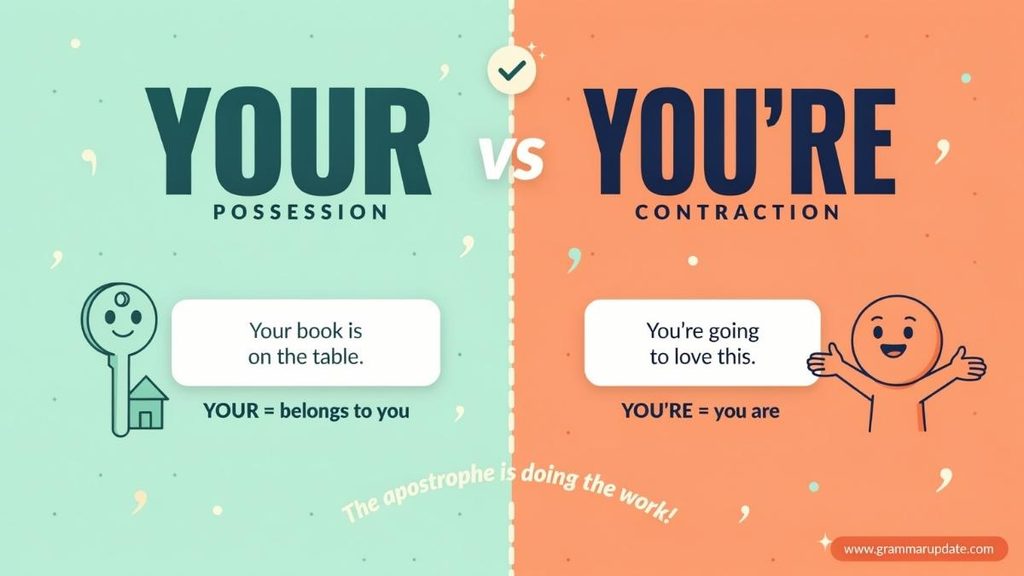
The central your vs you’re grammar rule is straightforward.
Your shows possession, belonging, or association.
You’re means you are.
The two forms may sound alike, but they perform different grammatical jobs.
| Grammar point | Your | You’re |
|---|---|---|
| Meaning | Belonging to or associated with you | You are |
| Word type | Possessive determiner | Contraction |
| Contains a verb | No | Yes, through are |
| Apostrophe | No | Yes |
| Typical position | Before a noun | Before a description or phrase |
| Example | Your answer is clear. | You’re correct. |
This distinction is more useful than trying to memorize dozens of isolated examples.
Once you know the grammatical function, you can usually choose the correct word even when you encounter a sentence you have never seen before.
The You Are Test for Your vs You’re
When you cannot decide whether to use your or you’re, try replacing the word with you are.
This is one of the simplest and most reliable ways to solve the problem.
Consider this sentence:
“You’re going to enjoy this book.”
Replace you’re with you are:
“You are going to enjoy this book.”
The sentence still makes sense. Therefore, you’re is correct.
Now consider:
“I like your new book.”
Replace your with you are:
“I like you are new book.”
That does not make sense. Therefore, your is correct.
Here is another example:
“Your very talented.”
Replace your with you are:
“You are very talented.”
That works. Therefore, the original sentence should use you’re:
“You’re very talented.”
This test works because you’re is literally a shortened form of you are.
Learn the difference between confusing word pairs
Beginning vs Beggining difference and usage?
Your vs You’re Examples in Everyday English
Real sentences make the distinction easier to see.
| Your | You’re |
|---|---|
| I like your new shoes. | You’re wearing new shoes. |
| Is this your bag? | You’re carrying my bag. |
| Your answer is correct. | You’re correct. |
| I remember your name. | You’re easy to remember. |
| Where is your brother? | You’re talking about your brother. |
| I like your idea. | You’re very creative. |
| Your dog is outside. | You’re taking the dog outside. |
| Please check your email. | You’re checking your email. |
Notice how the surrounding words reveal the difference.
Your usually connects a noun with you. You’re describes you or tells us something about you.
That is the key to your vs you’re examples in sentences.
Your vs You’re Sentence Patterns
Sentence structure can also help you identify the correct word.
Your often follows this pattern:
Your + noun
Examples include:
1.“Your car is clean.”
2.“Your opinion matters.”
3.“Your answer helped.”
“You should bring your passport.”
You’re follows a different pattern because it contains you and are.
1.You’re + adjective:
2.“You’re kind.”
3.“You’re patient.”
4.“You’re correct.”
5.You’re + verb ending in -ing:
6.“You’re working.”
7.“You’re studying.”
8.“You’re improving.”
9.You’re + noun phrase:
10.“You’re a good teacher.”
11.“You’re the person we need.”
12.You’re + phrase:
13.“You’re in the right room.”
14.“You’re on the correct page.”
These patterns do not replace the meaning test, but they make the difference easier to recognize.
Learn the difference between confusing word pairs
Hierarchy vs Heirarchy difference and usage?
Common Mistakes With Your and You’re
Some mistakes appear again and again because the two words sound alike. However, once you understand the grammar, these errors become much easier to catch.
Your Welcome or You’re Welcome?
The standard expression is:
“You’re welcome.”
Why?
Because it means:
“You are welcome.”
Therefore, when someone says “Thank you,” the normal response is “You’re welcome.”
The phrase your welcome can exist in a different grammatical context when welcome functions as a noun.
For example:
“Your welcome made the new student feel comfortable.”
Here, your modifies the noun welcome.
However, that is not the expression used to respond to thanks.
So, when asking about your vs you’re welcome, remember:
“You’re welcome” means “You are welcome.”
Your Right or You’re Right?
When you mean “you are correct,” write:
“You’re right.”
The substitution test confirms it:
“You are right.”
However, your right can also be correct in another context.
For example:
“Raise your right hand.”
Here, your modifies the noun phrase right hand.
Therefore, the issue is not that one form is always correct and the other is always wrong. The meaning and sentence structure determine the correct word.
Your Going or You’re Going?
This is a very common mistake.
Incorrect:
“Your going to love this movie.”
Correct:
“You’re going to love this movie.”
The reason is simple.
“You are going to love this movie.”
The expanded form works perfectly, so you’re is required.
Your Doing or You’re Doing?
Compare these sentences:
“Your work is improving.”
“You’re doing great work.”
In the first sentence, your modifies work.
In the second, you’re means you are.
The words may appear next to similar ideas, but their grammatical functions are different.
Your Idea or You’re Idea?
The correct sentence is:
“I like your idea.”
Why not you’re?
Try the substitution test:
“I like you are idea.”
That does not work.
The sentence refers to an idea associated with you, so your is correct.
However, you’re can appear in a different sentence:
“You’re an excellent source of ideas.”
Here, you’re means you are.
Learn the difference between confusing word pairs
Possession vs Posession difference and usage?
Your vs You’re in Questions
Questions can contain either form.
For example:
“Is this your phone?”
“What is your name?”
“Where is your car?”
In each sentence, your identifies something associated with you.
Now consider:
“Are you ready?”
“I think you’re ready.”
The first sentence uses the full pronoun and verb separately. The second uses you’re as a contraction of you are.
This distinction also prevents a common mistake:
“Are you’re ready?”
That sentence is incorrect because are and you’re would create an unnecessary combination of two forms of the same verb structure.
The correct sentence is:
“Are you ready?”
Or:
“I know you’re ready.”
Your vs You’re and Possessive Forms
Understanding possessive forms can make this grammar lesson even clearer.
English has several possessive forms.
| Personal form | Possessive determiner | Possessive pronoun |
|---|---|---|
| I | my | mine |
| you | your | yours |
| he | his | his |
| she | her | hers |
| we | our | ours |
| they | their | theirs |
Your normally comes before a noun.
“This is your book.”
Yours can stand alone.
“This book is yours.”
That difference matters because your is not simply another spelling of you’re. It belongs to the possessive system of English grammar.
Also, your does not need an apostrophe.
The correct forms are:
“your book”
“yours”
Not:
“your’s”
The apostrophe in you’re serves a different purpose because it marks a contraction.
Why Your and You’re Are Confusing Words
The main reason for the confusion is pronunciation.
In many varieties of English, your and you’re are pronounced the same or very similarly. As a result, the ear cannot reliably tell you which spelling belongs in a sentence.
That makes them a classic example of commonly confused words.
The same general problem appears with other English forms such as there, their, and they’re, or to, too, and two.
Similar sounding words can have completely different meanings and grammatical functions.
Therefore, when writing, do not rely only on pronunciation. Instead, look at what the word is doing in the sentence.
Learn the difference between confusing word pairs
Guarantee vs Guarentee difference and usage ?
Are Your and You’re Homophones?
Your and you’re are commonly treated as homophones because they can have the same pronunciation while having different spellings and meanings.
This explains why someone can say a sentence correctly but still type the wrong form.
For example, when spoken aloud, these sentences may sound very similar:
“Your amazing.”
“You’re amazing.”
On the page, however, the grammatical difference is obvious.
“You’re amazing” is correct because it means:
“You are amazing.”
The first version does not contain the required form of the verb.
Therefore, pronunciation can explain the confusion, but grammar provides the solution.
Your vs You’re Pronunciation
Pronunciation varies among speakers and regions. In everyday American English, your and you’re commonly sound the same or nearly the same.
That is why trying to hear the difference is not a dependable proofreading method.
Instead, read the sentence for meaning.
If you mean you are, use you’re.
If you mean belonging to or associated with you, use your.
For English learners, this is especially useful because spelling often provides information that pronunciation does not.
Learn the difference between confusing more English words
Dumbbell vs Dumbell difference and usage?
Your vs You’re in Formal and Informal Writing
Both your and you’re are standard English forms.
Your is appropriate in formal writing, informal writing, academic work, emails, articles, and everyday communication.
You’re is also grammatically standard. It is simply a contraction of you are.
For example:
“Your application has been received.”
“You’re welcome to contact us.”
Both forms can appear in professional communication.
However, some writers choose the full form you are when they want a slightly more formal or deliberate tone.
Compare:
“You’re responsible for the final report.”
“You are responsible for the final report.”
Both are grammatically correct. The second may sound more formal or emphatic depending on the context.
Therefore, never assume that you’re is incorrect simply because it contains an apostrophe.
Your vs You’re in Digital Communication
Fast typing creates plenty of grammar mistakes.
People write quickly in text messages, comments, captions, emails, and social media posts. As a result, your and you’re often get mixed up.
For example:
“Your going to love this.”
The intended meaning is almost certainly:
“You’re going to love this.”
Similarly:
“Thanks, your the best.”
should be:
“Thanks, you’re the best.”
Although readers can often understand the intended meaning, these mistakes become more noticeable in professional English writing.
A quick proofreading check can prevent them.
Whenever you see your or you’re in an important piece of writing, pause briefly and ask whether the word means possession or you are.
Learn the difference between confusing more English words
Airplane vs Aeroplane difference and usage?
Your vs You’re in Professional Writing
Small grammar choices can affect how polished writing appears.
Consider a customer email:
“Please review your account information.”
Here, your is correct because it identifies the account associated with the customer.
Now consider:
“You’re responsible for updating the information.”
Here, you’re means you are.
The same distinction applies to reports, applications, school assignments, website copy, business communication, and workplace messages.
Correct word choice does not require complicated grammar. It requires attention to meaning.
Your vs You’re A Simple Way to Remember the Difference
If you need an easy way to remember your and you’re, keep one rule in mind:
Your means belongs to you.
You’re means you are.
For example:
“Your jacket is on the chair.”
The jacket belongs to or is associated with you.
“You’re sitting beside your jacket.”
That means:
“You are sitting beside your jacket.”
Another useful reminder is the apostrophe.
You’re contains an apostrophe because it is a contraction.
Your does not contain an apostrophe because it is a possessive determiner.
Once these two ideas become automatic, the spelling becomes much easier.
Your vs You’re A Practical Proofreading Method
When proofreading, read the sentence and focus on the meaning rather than the sound.
First, find the word your or you’re.
Next, ask whether it expresses possession, belonging, or association.
If it does, use your.
Then, if the word means you are, use you’re.
Finally, expand you’re to you are to make sure the sentence still works.
For example:
“You’re going to enjoy your vacation.”
Expand the first word:
“You are going to enjoy your vacation.”
The sentence works.
Now examine your:
“You are going to enjoy you are vacation.”
That does not work, so your is necessary.
This method is simple, fast, and useful for both native speakers and English learners.
Learn the difference between confusing more English words
Foreign vs Foriegn difference and usage?
Practice Session Your vs You’re
Fill in each blank with either Your vs You’re.
- ______ going to love this new restaurant.
- Did you remember to bring ______ notebook?
- I think ______ making the right decision.
- Where did you put ______ keys?
- ______ always welcome at my house.
- I really like ______ new haircut.
- ______ one of the most helpful people on the team.
- Please check ______ email before the meeting.
- I hope ______ feeling better today.
- What is ______ favorite movie?
- ______ doing a great job with this project.
- Please take ______ shoes off before entering.
- I think ______ going to need more time.
- Is this ______ phone on the table?
- ______ absolutely right about the answer.
- How was ______ trip to Chicago?
- ______ going to enjoy this book.
- I like ______ idea for the presentation.
- I can tell ______ excited about the results.
- Did you finish ______ homework?
- ______ welcome to join us for dinner.
- I think ______ improving with every lesson.
- Where is ______ brother today?
- ______ probably going to receive an email soon.
- Make sure ______ name is written clearly on the form.
Answers
- You’re
- your
- you’re
- your
- You’re
- your
- You’re
- your
- you’re
- your
- You’re
- your
- you’re
- your
- You’re
- your
- You’re
- your
- you’re
- your
- You’re
- you’re
- your
- You’re
- your
Here’s a trusted source for clear word meanings:
FAQs
What is the easiest way to remember your and you’re?
Remember one simple rule: “your” shows possession or association, while “you’re” means “you are.” If you can replace the word with “you are” and the sentence still makes sense, use “you’re.” Otherwise, “your” is usually the correct choice.
Does your always come before a noun?
In standard usage, “your” normally comes before a noun or noun phrase. For example, you can say “your phone,” “your answer,” or “your new jacket.” It identifies something connected with or belonging to the person being addressed.
Can you use you’re before a noun?
Yes. “You’re” can come before a noun or noun phrase when it means “you are.” For example, “You’re a great friend” means “You are a great friend.” The word after “you’re” does not determine the choice by itself; the meaning of the complete sentence does.
Does your always show ownership?
Not necessarily. “Your” can show ownership, but it can also express a relationship or association. For example, “your house” can indicate ownership, while “your teacher” identifies a relationship. In both cases, “your” connects the noun with the person being addressed.
Can you use your by itself?
“Your” normally needs a noun to follow it. When the possessive form stands alone, “yours” is generally used instead. For example, “This is your book” becomes “This book is yours.”
What is the difference between your and yours?
Both words can express possession, but they work differently in a sentence. “Your” normally comes before a noun, as in “your car.” “Yours” can stand alone, as in “The car is yours.” Therefore, you should choose the form based on how it functions in the sentence.
Does you’re always mean you are?
Yes. “You’re” is the contraction of “you are.” For example, “You’re ready” means “You are ready,” while “You’re my neighbor” means “You are my neighbor.” This makes the “you are” test a useful way to check your writing.
Can you’re be used before an adjective?
Yes. “You’re” commonly appears before an adjective because it contains the verb “are.” For example, you can write “You’re happy,” “You’re tired,” or “You’re helpful.” In each sentence, “you’re” can be expanded to “you are.”
Can your be used before a verb?
“Your” normally does not replace “you are” before a verb. It functions as a possessive determiner and generally modifies a noun. If the sentence means “you are” followed by an action or description, “you’re” is usually needed.
Why does your have no apostrophe?
“Your” is not a contraction, so it does not need an apostrophe. “You’re,” however, combines “you” and “are,” with the apostrophe marking the shortened form. Therefore, the apostrophe helps distinguish the two words.
Is “your’s” a correct spelling?
No. “Your’s” is a common spelling mistake. The correct forms are “your” and “yours.” Use “your” before a noun, such as “your idea,” and “yours” when the possessive form stands alone, such as “The idea is yours.”
Is “youre” correct without an apostrophe?
In standard English, “you’re” is the correct spelling when you mean “you are.” Writing “youre” without the apostrophe is generally considered a spelling error.
Can your and you’re sound the same?
For many English speakers, “your” and “you’re” have the same or very similar pronunciation. That similarity can make them easy to confuse in writing. However, their meanings and grammatical functions are different, so pronunciation alone cannot tell you which one to use.
Is your a pronoun or an adjective?
“Your” is commonly classified as a possessive determiner. Traditional grammar terminology may also call it a possessive adjective. It normally appears before a noun, as in “your name,” “your opinion,” or “your computer.”
What part of speech is you’re?
“You’re” is a contraction formed from the pronoun “you” and the verb “are.” Its full form is always “you are.” The contraction can appear in sentences such as “You’re ready,” “You’re a student,” and “You’re learning quickly.”
Can your and you’re appear in the same sentence?
Yes. Both words can appear naturally in the same sentence when they serve different purposes. For example, “You’re wearing your new shoes” uses “you’re” to mean “you are” and “your” to show possession.
How can I check whether to use your or you’re?
Start by asking what the sentence means. If you mean “you are,” use “you’re.” If you mean something belongs to you or is connected with you, use “your.” You can also expand “you’re” to “you are” as a quick grammar check.
What is the difference between your and you are?
“Your” is a possessive determiner used with a noun, while “you are” contains the pronoun “you” and the verb “are.” “You’re” is simply the contracted form of “you are.” For example, “your car” shows possession, while “you are driving” describes an action.
Why is your usually followed by a noun?
“Your” identifies the person connected with the noun that follows it. In “your computer,” for example, “your” indicates that the computer belongs to or is associated with the person being addressed. This is why “your” commonly appears directly before nouns.
Can you’re show possession?
No. “You’re” does not express possession. It always represents “you are.” If you want to show possession or association, use “your” before a noun or “yours” when the possessive form stands alone.
Learn the difference between confusing more English words
Embarrass vs Embarass difference and usage?
Conclusion
Your vs you’re may look like a tiny grammar problem, but one little apostrophe can change the meaning of a sentence. The good news is that the difference is easy to remember. Use “your” when you are talking about something that belongs to you or is connected to you, such as “your phone” or “your idea.” Use “you’re” when you mean “you are,” such as “you’re ready” or “you’re doing well.”
When you are unsure, try the simple “you are” test. Replace “you’re” with “you are.” If the sentence still sounds right, “you’re” is correct. If it does not, “your” is probably the word you need. Once this habit becomes automatic, your vs you’re becomes one less grammar trap to worry about.

Jhon AJS, the creative mind behind Grammar Update, is an experienced blogger passionate about simplifying English grammar. He focuses on explaining confusing word vs word differences, grammar rules, punctuation, and sentence structure in a clear and practical way. Through easy to understand guides and examples, Jhon helps readers improve their writing and communicate with confidence. With years of blogging experience, he continues to share helpful insights that make learning grammar simple, useful, and accessible for everyone.