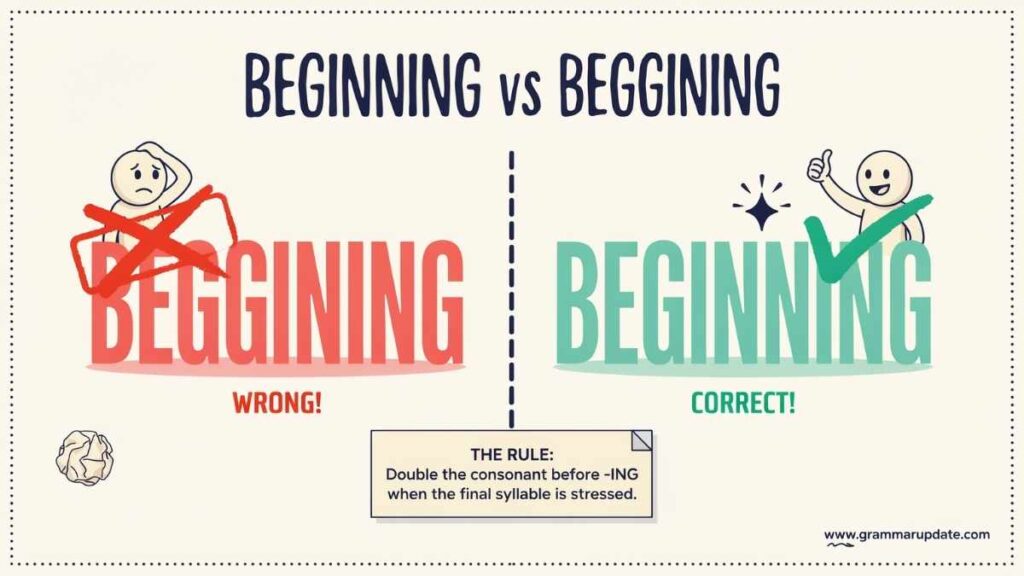
Spelling mistakes can make a simple word look much more complicated than it really is. The phrase beginning vs beggining often causes confusion because both forms look almost right at first glance. However, only beginning is correct. Beggining is a misspelling, while begining is another common mistake that leaves out one n. The good news is that the correct spelling follows a simple pattern. Start with begin, add -ing, and double the final n to get beginning. In this guide, you’ll learn the correct spelling, meaning, grammar, pronunciation, common mistakes, useful examples, and an easy way to remember beginning without second-guessing yourself.
Quick Answer
Beginning is correct. Beggining is incorrect.
The word beginning contains one g and two n’s. The incorrect form beggining contains two g’s and only one n.
| Word | Correct? | Meaning |
|---|---|---|
| beginning | Yes | The start, first part, or earliest stage of something |
| beggining | No | A misspelling of beginning |
| begining | No | A misspelling that leaves out one n |
For example:
Correct: The beginning of the movie was exciting.
Incorrect: The beggining of the movie was exciting.
If you are searching for beginning vs beggining, beginning vs begining, or asking how to spell beginning, the answer remains the same. Use beginning.
Fix common more word mistakes in English
Argument vs Arguement Which one Is Correct?
What Does Beginning Mean?
The beginning meaning is the first part, starting point, or earliest stage of something. It can describe a particular moment when something starts or the early part of a longer process.
For example, the beginning of a book is its first section. The beginning of a meeting is the time when the meeting starts. The beginning of a career refers to its earliest stage.
Consider these sentences:
The beginning of the story was mysterious.
We arrived at the beginning of the meeting.
She enjoyed the beginning of her new job.
The company had humble beginnings.
The word can also describe the origin of something. When people talk about the beginnings of a tradition, business, organization, or movement, they are talking about how it first developed.
Beginning as a Noun
In English grammar, beginning commonly works as a noun.
In the sentence “The beginning of the story was exciting,” beginning names the first part of the story.
You can use the word in several common structures:
The beginning of the movie was slow.
We missed the beginning of the game.
She remembers the beginning of her career.
The beginning was more difficult than expected.
This noun use explains familiar expressions such as at the beginning, from the beginning, and in the beginning.
Learn the difference between commonly misused words
Cemetery vs Cemetary Which one Is Correct?
Why Is Beginning Spelled With One G and Two N’s?
The spelling becomes easier to understand when you start with the root word, begin.
When you add the suffix -ing, the final consonant doubles:
begin + ing = beginning
Look closely at the two forms:
begin
beginning
The final n in begin becomes nn when -ing is added. The g does not double.
This is why the correct spelling is beginning rather than beggining.
The easiest way to see the pattern is:
begi + nn + ing = beginning
The word has one g and two n’s.
The Double Consonant Rule
The spelling of beginning follows a broader English spelling pattern. Some short verbs double their final consonant before adding -ing.
For example:
run becomes running.
sit becomes sitting.
plan becomes planning.
stop becomes stopping.
begin becomes beginning.
The important detail is that the consonant being doubled comes from the end of the base word.
The base word is begin, and its final letter is n. Therefore, n doubles.
That gives you:
begin → beginning
It does not give you:
begin → beggining
This explains why beginning spelling with double n is correct.
Why Do People Spell Beginning as Beggining?
The mistake often happens because people remember the g sound in the middle of the word. Since begin contains a noticeable g sound, it can seem natural to double the g when adding -ing.
English spelling does not work that way here.
The spelling change happens at the end of the base word. Since begin ends in n, the n is the letter that doubles.
Think of the word as a small construction project. The base word is already complete before you add the new ending. You simply attach -ing to it while following the appropriate spelling rule.
begin + ing
The final n doubles.
beginning
That is the form you want.
Is Beggining a Word?
No. Beggining is not the standard spelling of the English word.
If you see beggining in an essay, email, article, school assignment, or other piece of writing, it should normally be corrected to beginning.
The same applies to begining, which is another common misspelling.
These three forms are easy to compare:
| Form | Status | Problem |
|---|---|---|
| beginning | Correct | None |
| begining | Incorrect | One n is missing |
| beggining | Incorrect | The wrong consonant is doubled |
So, if you are wondering is beggining correct, the answer is no.
If you are wondering is begining correct, the answer is also no.
The correct form is beginning.
Learn the difference between commonly misused words
Controversy vs Contraversy which one is correct?
Beginning vs Begining Which Is Correct?
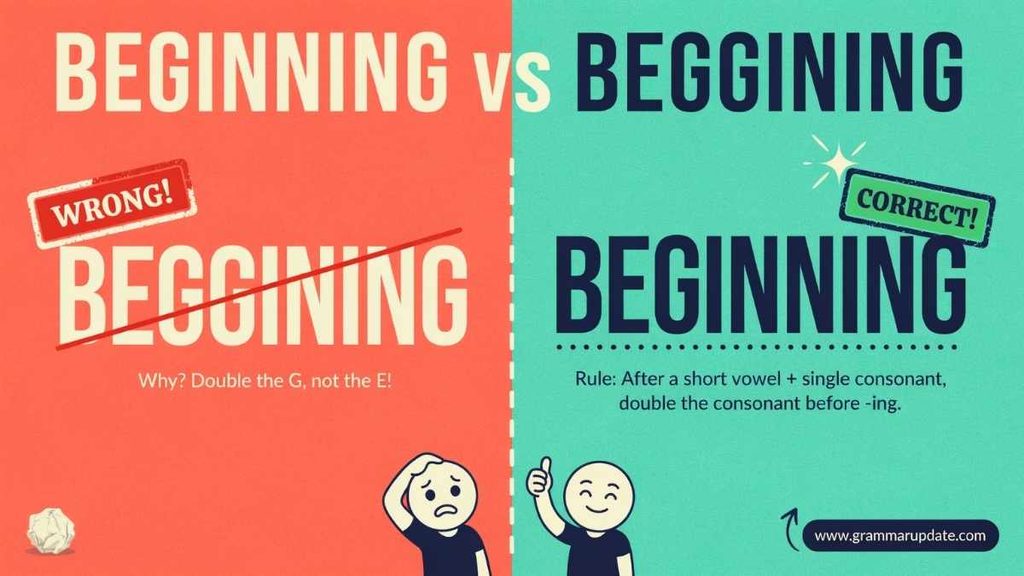
The Beginning is correct, while begining is incorrect.
The difference is easy to miss because the two words look almost identical. However, beginning contains two n’s.
Correct:
beginning
Incorrect:
begining
The missing n in begining is not optional. It is part of the correct spelling pattern created when begin takes the -ing ending.
A useful way to remember this is to build the word from its base:
begin + ing = beginning
Once you see the word this way, the spelling becomes much more logical.
Beginning vs Begin What Is the Difference?
The beginning vs begin comparison involves two different grammatical forms.
Begin is the base verb. It means to start something or to start happening.
Beginning can function as a noun or as the present participle of begin.
Compare these examples:
The movie will begin at eight.
The movie is beginning now.
The beginning of the movie was slow.
1.In the first sentence, begin is the main verb.
2.In the second sentence, beginning forms part of the verb phrase is beginning.
3.In the third sentence, beginning is a noun.
The main forms of the verb are:
| Form | Word | Example |
|---|---|---|
| Base form | begin | We begin at noon. |
| Third-person singular | begins | The show begins at eight. |
| Past tense | began | The show began at eight. |
| Past participle | begun | The show has begun. |
| Present participle | beginning | The show is beginning. |
Understanding these word forms helps prevent both spelling and grammar mistakes.
Began, Begun, and Beginning
Begin is an irregular verb, so its past forms do not follow the regular -ed pattern.
You do not say:
The meeting beginned at nine.
You say:
The meeting began at nine.
For the past participle, use begun:
The meeting has begun.
For the present participle, use beginning:
The meeting is beginning.
These forms can be summarized simply:
Begin: I begin work at nine.
Began: I began work at nine yesterday.
Begun: I have begun the project.
Beginning: I am beginning the project now.
Knowing these forms makes it easier to understand where beginning fits into English grammar.
Learn the difference between commonly misused words
Grateful vs Greatful difference and Usage?
Beginning as a Present Participle
Beginning does not only work as a noun. It can also serve as the present participle of begin.
For example:
The rain is beginning to fall.
The child is beginning to understand the lesson.
The machine is beginning to shake.
The company is beginning to expand.
In each sentence, beginning describes an action that is starting to happen.
You can also use it with different forms of be:
I am beginning.
You are beginning.
She is beginning.
We are beginning.
They are beginning.
The spelling remains beginning in every case.
Beginning vs Start Are They the Same?
Beginning and start have closely related meanings, and they can often replace each other.
For example:
We arrived at the beginning of the meeting.
We arrived at the start of the meeting.
Both sentences work.
However, the two words are not identical in every situation.
Beginning often focuses on the first part or earliest stage of something.
The beginning of the novel introduces several important characters.
Start often emphasizes the action or moment of starting.
We need to start the meeting now.
This difference becomes clearer when you compare their common uses.
| Situation | Natural choice |
|---|---|
| First part of a book | the beginning of the book |
| Starting an activity | start the activity |
| Earliest stage of a career | the beginning of a career |
| Turning on a machine | start the machine |
| First part of a movie | the beginning of the movie |
| Point when an event starts | the start of the event |
There is plenty of overlap. The best choice depends on the sentence and the meaning you want to emphasize.
Begin vs Start vs Commence
The Begin, start, and commence all relate to the idea of something starting.
Begin means to start happening or to start doing something.
The class will begin at nine.
Start has a very similar meaning and is especially common in everyday English.
The class will start at nine.
Commence also means to begin, but it generally sounds more formal.
The ceremony will commence at nine.
The basic difference can be summarized this way:
| Word | Basic meaning | Common tone |
|---|---|---|
| begin | to start | Neutral |
| start | to begin | Everyday and flexible |
| commence | to begin | Formal |
You might use commence in an official announcement, but begin or start will usually sound more natural in everyday conversation.
Learn the difference between confusing more English words
Exceed vs Excede difference and usages?
To Begin or Start Synonyms and Usage
If you are looking for a to begin or start synonym, several alternatives may work depending on the context.
Common alternatives include begin, start, commence, initiate, launch, open, and embark on.
These words are related, but they do not always carry exactly the same meaning.
For example:
1.The company launched a new product.
2.The company started a new campaign.
3.The company initiated a new program.
Each sentence describes a beginning, but the verbs add slightly different shades of meaning.
Launch often suggests a formal introduction. Initiate can sound more formal and may emphasize the act of setting a process in motion. Commence has a formal tone.
Good word choice depends on context rather than simply replacing one word with another.
Begin to Start in a Sentence
The phrase begin to start can sound repetitive because begin and start often have nearly the same meaning.
For example:
The meeting began to start at nine.
This sounds awkward because the two verbs repeat the same basic idea.
A clearer sentence would be:
The meeting began at nine.
Or:
The meeting started at nine.
However, begin to is completely natural when another action follows it.
She began to laugh.
The child began to cry.
The machine began to shake.
The weather began to change.
In these sentences, begin introduces the action that started happening.
So, when using begin to start in a sentence, make sure both verbs have a real purpose. If they simply repeat the same idea, one will usually be enough.
Learn the difference between confusing more English words
Extreme vs Extreem difference and usage?
Common Phrases With Beginning
Beginning appears in several useful English expressions.
At the Beginning
At the beginning refers to the first point or first part of something.
We met at the beginning of the semester.
The explanation appears at the beginning of the chapter.
From the Beginning
From the beginning means from the earliest point onward.
She knew the truth from the beginning.
He supported the project from the beginning.
In the Beginning
1.In the beginning refers to an early period or initial stage.
2.In the beginning, the business had only three employees.
From Beginning to End
From beginning to end means throughout the entire period.
She read the book from beginning to end.
A New Beginning
A new beginning refers to a fresh start or a new stage.
Moving to a new city gave him a new beginning.
These expressions show how flexible the word can be.
Learn the difference between confusing more English words
Caught vs Cauhgt difference and usage?
Common Spelling Mistakes With Beginning
Beginning appears in several incorrect forms, especially when people are typing quickly or are unsure about the double consonant rule.
The most common mistakes include beggining and begining.
| Common misspelling | Correct form | Problem |
|---|---|---|
| beggining | beginning | Double g instead of double n |
| begining | beginning | One n is missing |
| beginingg | beginning | Wrong consonant pattern and extra g |
These are spelling errors, not alternative forms of the word.
If you see beggining or begining in your writing, replace it with beginning.
The key pattern remains:
begin + ing = beginning
Common Mistakes With Beginning
Spelling is only part of using the word correctly. You also need to consider context.
For example:
The beginning started at 8 a.m.
This sentence is understandable, but it can sound repetitive because beginning and started overlap in meaning.
A cleaner version would be:
The event started at 8 a.m.
Or:
The event’s beginning was delayed.
Another example is:
At the beginning, we first started the project.
The words at the beginning, first, and started repeat similar ideas. A smoother sentence would be:
At the beginning, we started the project.
Good writing does not simply avoid spelling mistakes. It also removes unnecessary repetition.
Beginning in a Sentence Examples
The word beginning works naturally in many types of writing.
Here are some everyday examples:
The beginning of the movie was surprisingly slow.
We arrived at the beginning of the ceremony.
She remembered the beginning of their friendship.
The class was difficult at the beginning.
He explained everything from the beginning.
In academic writing, you might see sentences such as:
The beginning of the semester was busy.
The beginning of the chapter introduces the main argument.
The essay needs a stronger beginning.
The experiment produced unusual results at the beginning.
In workplace writing:
The project had a difficult beginning.
We discussed the budget at the beginning of the meeting.
The company had only a few employees in its beginning stages.
The new process is beginning to show results.
In storytelling:
The beginning of the novel introduces the main character.
From the beginning, the character knows something is wrong.
The story has an unusual beginning and an unexpected ending.
These beginning examples show how the word can describe a point in time, a first section, an early stage, or an action that is starting.
Beginning Pronunciation
The beginning pronunciation is represented in the International Phonetic Alphabet as /bɪˈɡɪn.ɪŋ/.
The word has three syllables:
be-gin-ning
The main stress falls on the middle syllable.
The pronunciation can sometimes contribute to spelling mistakes because English spelling does not always perfectly reflect pronunciation. Hearing the word does not automatically tell you which consonant should double.
That is why remembering the written form is useful:
beginning
The pronunciation stays the same even though people sometimes write the word incorrectly as beggining or begining.
Beginning Synonyms
If you need a beginning synonym, choose one based on the exact meaning you want.
Common synonyms include start, outset, opening, origin, inception, commencement, dawn, onset, and introduction.
These words have related meanings, but each has its own typical use.
Opening works well for the first part of a book, speech, event, or ceremony.
The opening of the ceremony lasted ten minutes.
Origin focuses on where something came from.
Researchers studied the origin of the tradition.
Inception often describes the point when an idea, project, or organization began.
The project has changed considerably since its inception.
Onset often describes the beginning of something such as a condition, period, or event.
The onset of winter brought colder temperatures.
Choosing a synonym is therefore more than finding a word that appears in a thesaurus. The context determines which word fits best.
Beginning Antonyms
The most common beginning antonyms are words associated with an ending or completion.
These include:
end
ending
finish
conclusion
completion
termination
For example:
The beginning of the story was exciting, but the ending was disappointing.
The project moved from its beginning toward completion.
The exact opposite depends on the context. End often refers to the final point, while conclusion may emphasize the final part or result.
Learn the difference between confusing word pairs
Daiquiri Vs Dacquiri Which one Is Correct?
How to Remember the Spelling of Beginning
If you frequently forget the beginning spelling, do not try to memorize every letter separately.
Build the word from its base form.
Start with:
begin
Add:
-ing
Then double the final n:
begin + ing = beginning
A useful visual pattern is:
BEGI + NN + ING
The important part is NN.
Remembering the word this way also helps distinguish beginning from both common misspellings:
begining
beggining
Only beginning has the correct double n pattern.
A Simple Memory Check
When you are unsure how to spell beginning, ask yourself three questions.
What is the base verb?
Begin.
What is the final letter of the base verb?
N.
Which letter doubles before -ing?
N.
The answer is therefore:
Beginning.
This approach is more reliable than simply asking whether a spelling looks familiar.
Learn the difference between confusing word pairs
Category vs Catagory Which one Is Correct?
Beginning Spelling in American and British English
The beginning spelling in American English is beginning.
The beginning spelling in British English is also beginning.
There is no American English versus British English spelling difference for this word.
Whether you are writing for an American audience, a British audience, or a general English-speaking audience, the correct form remains beginning.
The confusion is therefore not a regional spelling issue. It is simply a matter of correct spelling versus incorrect spelling.
Beginning Grammar
The beginning grammar question becomes much easier when you identify the role the word plays in a sentence.
As a noun:
The beginning was difficult.
Here, beginning names the first stage.
As a present participle:
The project is beginning to take shape.
Here, beginning forms part of the verb phrase is beginning.
In a phrase:
We discussed the beginning of the project.
Here, beginning functions as a noun followed by an of-phrase.
Understanding these uses helps you choose the right form when writing.
A Practical Case Study Correcting Beginning Mistakes
Consider this short paragraph:
“At the beggining of the semester, I was nervous. I did not know how the classes would begining. By the second week, things were much easier.”
There are two different problems.
The first is a spelling mistake:
beggining → beginning
The second involves both spelling and grammar:
begining → begin
The corrected version is:
“At the beginning of the semester, I was nervous. I did not know how the classes would begin. By the second week, things were much easier.”
This example shows why context matters. Not every incorrect-looking form should simply be changed to beginning.
The sentence “I did not know how the classes would begin” requires the base verb begin. Replacing it with beginning would create a grammatical problem.
Correct spelling and correct grammar work together.
Learn the difference between confusing word pairs
Conscious vs Conscience Difference and which is correct?
Practice Session Beginning vs Beggining
Fill in each blank with the correct word or form.Beginning vs Beggining
- The ______ of the movie was very interesting.
- We arrived at the ______ of the meeting.
- She was nervous at the ______ of her new job.
- The teacher will ______ the lesson at nine o’clock.
- The class is ______ to get more difficult.
- He ______ writing the report yesterday.
- The project has already ______.
- The story has a strong ______.
- They have supported the plan from the ______.
- The company is ______ to expand into new markets.
- Which spelling is correct: beginning or ______?
- Which spelling is correct: beginning or ______?
- The ______ of the book introduces the main character.
- We watched the movie from ______ to end.
- The ceremony will ______ shortly.
- The child is ______ to understand the lesson.
- She remembers the ______ of her career clearly.
- The meeting ______ at eight this morning.
- The new semester had a difficult ______.
- He has ______ to understand the problem.
- The ______ of the story was more exciting than the ending.
- Which word is spelled correctly: begining or ______?
- The rain is ______ to fall.
- They discussed the issue at the ______ of the meeting.
- The business had a humble ______ before it became successful.
Answers
- beginning
- beginning
- beginning
- begin
- beginning
- began
- begun
- beginning
- beginning
- beginning
- beggining
- begining
- beginning
- beginning
- begin
- beginning
- beginning
- began
- beginning
- begun
- beginning
- beginning
- beginning
- beginning
- beginning
Here’s a trusted source for clear word meanings:
FAQs
Why does beginning have two n’s?
Beginning comes from the verb begin. When you add -ing, the final n doubles, giving you beginning. The g does not double because n is the final letter of the base word.
Is there a spelling rule for the double n in beginning?
Yes. Certain verbs double their final consonant before adding -ing. Since begin ends in n, the n doubles when -ing is added: begin + ing = beginning.
How can a teacher explain the double n in beginning?
Start with the base word begin. Explain that the word ends in n, so the n doubles before -ing is added. This gives you beginning rather than begining or beggining.
Is beginning a noun or a verb?
Beginning can be a noun or the present participle of begin. As a noun, it means the first part or starting point of something. As a verb form, it describes something that is starting.
What is the plural of beginning?
The plural form is beginnings. For example, “The business had humble beginnings.”
What is the difference between beginning and beginnings?
Beginning refers to one starting point or early stage. Beginnings refers to multiple starting points or the early stages of something. For example, “The beginning of the story” refers to one part, while “the beginnings of the tradition” refers to its early development.
Is “new beginning” or “new beginnings” correct?
Both are correct. New beginning usually refers to one fresh start, while new beginnings can describe several fresh starts or a broader period of change.
What can I say instead of beginning?
Depending on the context, you can use start, opening, outset, origin, inception, commencement, or onset. Each synonym has a slightly different use, so choose the one that best fits your sentence.
What is a fancy word for a new beginning?
Words such as renewal, rebirth, renaissance, and inception can describe a new beginning. However, their meanings are not exactly the same, so the context matters.
What is a beautiful word for a new beginning?
Renewal is a natural choice when you want to describe a fresh start or a period of positive change. Rebirth can also suggest a major transformation or a completely fresh stage.
What is a metaphor for a new beginning?
A sunrise is a common metaphor for a new beginning because it represents the start of a new day. A fresh page is another simple metaphor for starting over.
What is the opposite of beginning?
The most common opposite of beginning is ending. Depending on the context, finish, conclusion, completion, and termination can also express the opposite idea.
What is an antonym of begin?
Common antonyms of begin include end, finish, conclude, stop, and terminate. The right choice depends on the action or situation you are describing.
Can beginning describe a period of time?
Yes. Beginning can describe the early part of a period, event, process, or activity. For example, “The beginning of the year was very busy.”
Can beginning refer to the origin of something?
Yes. Beginning can refer to the point where something started or first developed. For example, “The company has changed greatly since its beginning.”
What does “at the beginning” mean?
“At the beginning” means at the first part or earliest point of something. For example, “The instructions are at the beginning of the book.”
What does “from the beginning” mean?
“From the beginning” means starting at the earliest point of something. For example, “She understood the plan from the beginning.”
What does “in the beginning” mean?
“In the beginning” refers to an early stage or the first period of something. For example, “In the beginning, the project was difficult.”
Can beginning be followed by “of”?
Yes. Beginning is commonly followed by of when you identify what is starting or what the first part belongs to. Examples include “the beginning of the story” and “the beginning of the year.”
Can beginning be followed by “to”?
Yes. Beginning can be followed by to and another verb when it forms part of a verb phrase. For example, “The weather is beginning to change.”
What is the difference between beginning and commencement?
Both words refer to the start of something. Beginning is more common in everyday English, while commencement usually sounds more formal.
What is the difference between beginning and outset?
Both words refer to the start or early stage of something. Outset often emphasizes the earliest point of an activity or situation, as in “from the outset.”
What are some common phrases with beginning?
Common phrases include “at the beginning,” “from the beginning,” “in the beginning,” “from beginning to end,” “a new beginning,” and “the beginning of.”
Can beginning refer to the first part of a story?
Yes. Beginning can refer to the first section of a story, book, movie, article, or other narrative. For example, “The beginning of the story introduces the main character.”
Can beginning be used in both formal and informal English?
Yes. Beginning is a standard English word used in both formal and informal writing and conversation. The surrounding words usually determine the overall tone.
What is the easiest way to remember the spelling of beginning?
Remember the base word begin. It ends in n, so the n doubles when you add -ing:
begin + ing = beginning
The key is to remember that beginning has double n, not double g.
Learn the difference between confusing word pairs
Apparent Vs Aparent Which one Is Correct?
Conclusion
The confusion between beginning, begining, and beggining is easy to clear up once you look at the base word. The correct spelling is beginning. It has one g and two n’s. Both begining and beggining are incorrect spellings.
The easiest way to remember this is to start with begin. When you add -ing, the final n doubles:
begin + ing = beginning
That gives you the correct spelling every time. The g stays single, while the n gets doubled.
So, whether you are writing about the beginning of a story, the beginning of a career, or a new beginning in life, use beginning. Once you remember “one g, two n’s,” this common spelling mistake should no longer trip you up.

Jhon AJS, the creative mind behind Grammar Update, is an experienced blogger passionate about simplifying English grammar. He focuses on explaining confusing word vs word differences, grammar rules, punctuation, and sentence structure in a clear and practical way. Through easy to understand guides and examples, Jhon helps readers improve their writing and communicate with confidence. With years of blogging experience, he continues to share helpful insights that make learning grammar simple, useful, and accessible for everyone.