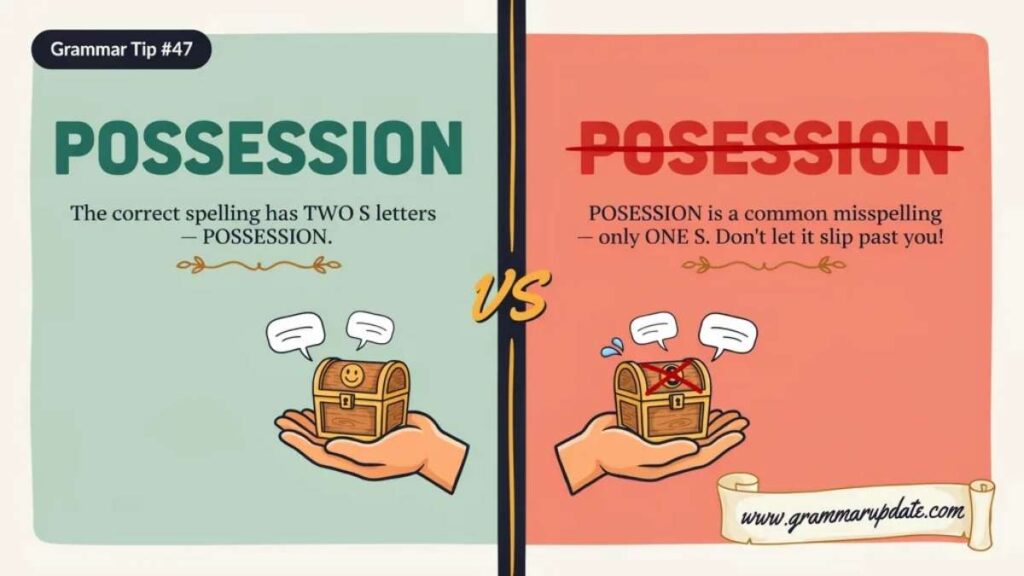
English spelling has a way of turning one tiny missing letter into a surprisingly big problem. The confusion between possession vs posession is a perfect example. Both versions look almost identical, but only one is correct. Possession is the standard spelling, while posession is a common misspelling. The extra s may seem easy to overlook, especially when you say the word aloud, but it matters when you write it. The good news is that this spelling is easy to remember once you connect it with possess. In this guide, you will learn the correct spelling, meaning, usage, common mistakes, and a simple trick to remember possession.
Quick Answer
If you are asking, “posession vs possession which is correct?” the answer is possession.
| Spelling | Correct? | Meaning |
|---|---|---|
| possession | Yes | Ownership, control, custody, or something owned |
| posession | No | A common misspelling of possession |
For example, this sentence is correct:
The antique watch is her most valuable possession.
This sentence contains the common spelling error:
The antique watch is her most valuable posession.
The second version does not have a different meaning. It simply leaves out one s.
Learn the difference between tricky grammar more words
Daiquiri Vs Dacquiri Which one Is Correct?
Possession vs Posession The Key Difference
The difference between possession vs posession is spelling, not meaning. Possession is the established English word. Posession is an incorrect spelling that often appears when someone writes the word based on how it sounds.
The correct form is connected to the verb possess:
possess → possession
That connection provides one of the easiest ways to remember the correct spelling. The word possess already contains the important double s. When you move from possess to possession, that spelling pattern remains.
A common mistake is to simplify the word and write posession. The problem is that the correct form needs another s.
Once you recognize the connection between possess and possession, the spelling becomes much easier to remember.
What Does Possession Mean?
The possession meaning changes slightly depending on the sentence, but the central idea involves having, owning, or controlling something.
Possession can describe ownership. For example, if someone owns a house, the house can be described as that persons possession.
It can also refer to something that someone owns:
Her grandmother’s necklace is one of her most treasured possessions.
In this sentence, possession refers to the necklace itself.
The word can also describe custody or control:
The documents are currently in his possession.
Here, possession does not necessarily mean that he legally owns the documents. It means that he has them or controls them.
In sports, possession has another familiar meaning. A soccer team can have possession of the ball when it controls play. In that situation, possession does not mean permanent ownership.
The word can also appear in stories and fictional writing to describe supernatural control over a person.
As a result, the possession definition depends heavily on context.
Possession Definition A Closer Look
A useful possession definition is the state of having, owning, or controlling something. The word can also refer to something that a person owns.
These two uses are worth separating.
Consider this sentence:
The buyer took possession of the house.
Here, possession refers to gaining control or custody of the property.
Now consider:
The house is one of his most valuable possessions.
Here, possession refers to something that he owns.
The same noun works in both sentences, but the surrounding words tell you which meaning applies.
This flexibility is one reason possession appears so often in everyday English. You can use it when talking about personal belongings, property, documents, sports, custody, or control.
Learn the difference between tricky grammar more words
Hierarchy vs Heirarchy difference and usage?
Why Do People Confuse Possession vs Posession?
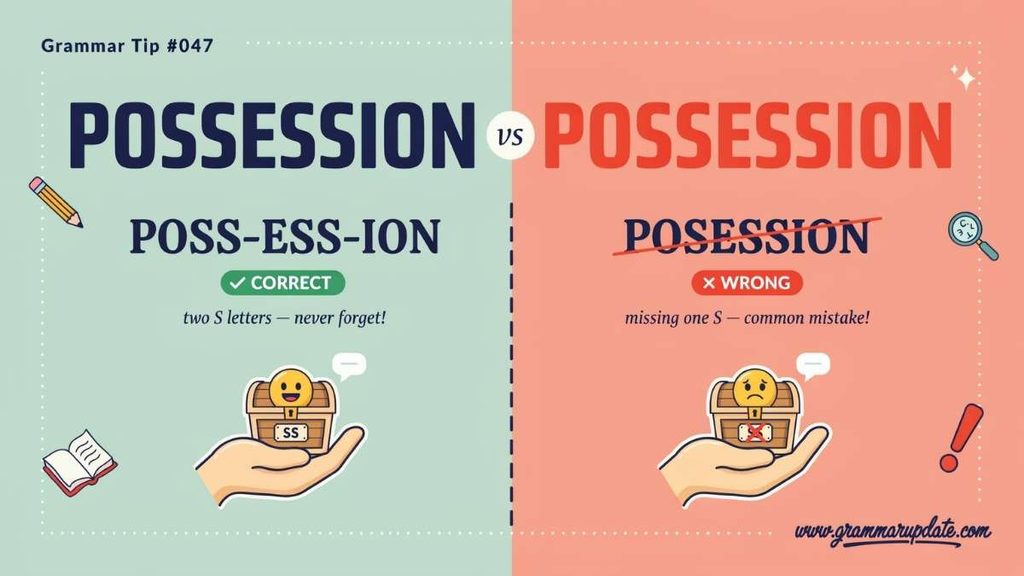
The common spelling mistake possession usually happens because pronunciation does not make the spelling obvious.
When you say possession aloud, the repeated letters do not sound like separate, clearly pronounced s sounds. Your brain recognizes the whole word rather than processing every letter individually. When you later try to write it, it is easy to leave one s out.
Another problem comes from the visual structure of the word. Some writers remember the general shape of possession but not the exact sequence of letters.
That can lead to this:
posession
The correct version is:
possession
The safest solution is not to rely on sound alone. Instead, connect the noun with the word possess.
possess → possession
This gives you a spelling pattern to remember rather than forcing you to recall every letter from scratch.
How to Spell Possession
If you are wondering how to spell possession correctly, start with the base verb possess.
Possess is spelled with double s at the end. Possession keeps that important spelling pattern.
Possess becomes possession.
A simple memory trick is:
Possess has ss, and possession keeps ss.
You do not need a complicated spelling rule for this word. The relationship between the two forms is enough to prevent the most common error.
When checking your writing, pay attention to the middle of the word. If you see posession, something is missing. Change it to possession.
Learn the difference between tricky grammar more words
Beginning vs Beggining difference and usage?
Possession Spelling and Pronunciation
The possession pronunciation can make the spelling seem more difficult than it really is.
In US English, possession is pronounced approximately as /pəˈzeʃ.ən/. The stress falls on the second syllable.
The pronunciation explains why some writers leave out an s. English spelling and pronunciation do not always match perfectly. A word can contain letters that are not obvious from its spoken form.
The same pattern appears in the related word possess, which is pronounced approximately as /pəˈzes/.
Because possess and possession belong to the same word family, remembering the spelling of possess can help you remember possession.
This is an important point when learning possession in English. Pronunciation helps you recognize a word, but it does not always tell you exactly how to spell it.
Possession as a Noun
Possession is a noun. It can describe a state of ownership or control, or it can name something that someone owns.
For example:
The documents are in her possession.
Here, possession describes her having or controlling the documents.
Now consider:
The painting is one of his most valuable possessions.
In this sentence, possession refers to something he owns.
The plural form is possessions. People often use this form when talking about personal belongings.
She packed all her possessions before moving.
The noun can also appear in formal expressions such as take possession of and in possession of.
The buyer took possession of the property after the sale.
The records remained in the company’s possession.
These expressions are common in both everyday and formal writing.
Possess vs Possession
The difference between possess vs possession is mainly grammatical.
Possess is a verb. It means to have, own, or control something.
Possession is a noun. It refers to the state of having or owning something, control or custody of something, or an object that someone owns.
Compare these sentences:
She possesses several valuable paintings.
The paintings are in her possession.
The first sentence uses possess as a verb. The second uses possession as a noun.
The connection becomes even clearer when you place the forms together:
Possess: She possesses the property.
Possession: The property is in her possession.
Possessed: He possessed the documents.
Possessive: The possessive form shows a relationship of ownership.
Understanding the word family helps with both spelling and grammar.
Possessive vs Possession
Possessive vs possession is another comparison that often causes confusion because both words relate to ownership.
Possession is a noun. It refers to ownership, control, custody, or something owned.
Possessive usually works as an adjective. It can describe something related to ownership, or it can describe someone who strongly wants to keep control of something.
Possessive also has a grammatical use. A possessive form shows a relationship between one person or thing and another.
Consider:
Maria’s book is on the table.
Maria’s is a possessive form because it shows a relationship between Maria and the book.
Now compare:
The book is in Maria’s possession.
Possession is the noun in this sentence.
The words are closely related, but they are not interchangeable.
Learn the difference between tricky grammar more words
Grateful vs Greatful difference and Usage?
Possession Examples in Everyday English
A good possession example should show how the word works naturally in context.
The keys are in my possession.
Her camera is one of her most useful possessions.
The buyer took possession of the property.
The team regained possession of the ball.
The original documents remained in the lawyer’s possession.
That old photograph became a treasured possession.
These examples show why context matters. Possession can refer to something you own, something you control, something you are holding, or control of a ball during a game.
How to Use Possession in a Sentence
If you want to know how to use possession in a sentence, first decide which meaning you need.
To describe something owned, you might write:
The antique clock is her most prized possession.
To describe custody or control, you could write:
The passport is currently in his possession.
To describe a transfer of control, you could say:
The buyer took possession of the property.
For sports, you might write:
The team maintained possession for most of the second half.
Each sentence uses possession naturally, but the meaning changes with the context.
The phrase in possession of is especially common in formal writing:
The company was in possession of the required documents.
The phrase take possession of commonly means to begin having or controlling something:
The new owner took possession of the building in June.
Possession in Different Contexts
Everyday Ownership
In ordinary conversation, possession often means something that belongs to someone.
For example:
That guitar is my favorite possession.
Personal possessions can include clothing, books, jewelry, electronics, furniture, documents, and other belongings.
The word can sound slightly more formal than belongings, but both can refer to things a person owns.
Sports
Sports provide another familiar use of possession.
When a soccer team controls the ball, commentators often describe that team as having possession.
For example:
The home team dominated possession during the first half.
Here, possession does not mean ownership in the permanent sense. It refers to control of the ball during play.
Property
Possession of property can involve having physical control or occupying a property.
For example:
The tenant took possession of the apartment at the beginning of the month.
This sentence does not necessarily mean the tenant owns the apartment. It means the tenant gained control or occupancy of it.
This distinction shows why ownership and possession are related but not always identical.
Legal Context
Possession is also an important legal term. However, its exact meaning can depend on the jurisdiction and the area of law involved.
Legal discussions may distinguish between actual possession and constructive possession. They may also discuss physical control, knowledge, access, custody, and intent to control.
Because legal rules vary, a general English explanation should not be treated as a legal definition for a specific case.
Learn the difference between tricky grammar more words
Conscious vs Conscience Difference and which is correct?
Actual Possession vs Constructive Possession
The difference between actual possession vs constructive possession becomes important in some areas of law.
Actual possession generally refers to direct physical custody or control of an item. If someone is physically holding an object, that is a straightforward example of actual possession in ordinary language.
Constructive possession is different. A person may not physically hold an item but may still be considered to have possession under applicable legal rules because of their relationship to the item and their ability to control it.
Imagine that an object is stored inside a locked container that someone controls. That person may not be physically holding the object, but the legal analysis could focus on whether the person knew about it and had the ability or intent to control it.
The exact legal definition of possession varies by jurisdiction. Different laws can also require different combinations of knowledge, access, control, and intent.
| Type | General meaning |
|---|---|
| Actual possession | Direct physical custody or control |
| Constructive possession | Legal possession without immediate physical custody |
| Physical possession | Direct physical holding or control |
| Legal possession | Possession recognized under applicable law |
These distinctions can appear in discussions of criminal law, property rights, custody, and other legal matters.
Possession With Intent to Distribute Meaning
The phrase possession with intent to distribute appears in criminal law. Generally, it refers to an allegation that a person possessed a controlled substance or another regulated item while intending to distribute it rather than simply keep it for personal use.
The exact legal requirements depend on the jurisdiction and the particular offense.
A case involving possession with intent to distribute may involve questions about the substance or item, the quantity, knowledge, control, and evidence of intended distribution.
Similarly, the phrase first offense possession can refer to a person’s first alleged or documented possession offense. However, the consequences of a first offense vary widely according to local law and the specific circumstances.
Terms such as criminal possession and possession charge therefore need to be understood in their proper legal setting.
For general English writing, the important point is simply that possession has a specialized legal meaning beyond its everyday sense of owning something.
Learn the difference between tricky grammar more words
Apparent Vs Aparent Which one Is Correct?
Common Possession Spelling Mistakes
The most common error is writing posession instead of possession.
The incorrect form is:
posession
The correct form is:
possession
This mistake does not create a new English word. It simply removes one s from the standard spelling.
Another common problem occurs when writers confuse possession with possessive. Although both words belong to the same word family, they serve different grammatical purposes.
A third mistake involves possess and possession. Possess is a verb, while possession is a noun.
Keeping these forms together makes the differences much easier to understand.
Possession Word Forms
Possession belongs to a larger family of related words.
| Word | Function | Example |
|---|---|---|
| possess | Verb | They possess valuable equipment. |
| possesses | Verb | She possesses excellent skills. |
| possessed | Past form of possess | He possessed the necessary documents. |
| possessing | Present participle | The company is possessing? |
| possession | Noun | The document is in his possession. |
| possessions | Plural noun | Her possessions were packed away. |
| possessive | Adjective or noun | The possessive form shows ownership. |
| possessiveness | Noun | His possessiveness created tension. |
There is one useful usage point here. Although possessing is a legitimate form of possess, the progressive construction is not natural in every situation. Possess often describes a state, so forms such as possesses and possessed frequently sound more natural.
For example:
She possesses several rare books.
sounds more natural than:
She is possessing several rare books.
The first sentence uses the verb in a way that fits its usual meaning.
Possession Synonyms
Possession has several related words, but they do not work as exact replacements in every sentence.
When the meaning involves ownership, possible alternatives include ownership, property, belongings, holdings, and assets.
When the meaning involves control or custody, alternatives may include control, custody, command, or charge.
For example, ownership and possession can describe closely related ideas, but they are not always identical. A tenant can have possession of a home while another person retains ownership of it.
Likewise, belongings usually refers to things someone owns, while possession can refer either to the thing itself or to the state of having or controlling it.
Choosing the right synonym depends on the exact meaning of the sentence.
Learn the difference between tricky grammar more words
Cemetery vs Cemetary Which one Is Correct?
Common Phrases With Possession
Possession appears in several common expressions.
The phrase in possession of means having or holding something.
She was in possession of the original document.
The phrase in someone’s possession emphasizes that someone currently has or controls something.
The records are in the accountant’s possession.
The phrase take possession of means to begin having or controlling something.
The buyer took possession of the building after the transaction.
Personal possessions refers to things owned by an individual.
Please collect your personal possessions before leaving.
Ball possession refers to control of the ball during a sports match.
The team had most of the ball possession during the second half.
These expressions demonstrate how flexible possession can be in English.
Is Posession a Word?
If you are asking is posession a word, the answer is no in standard English.
Posession is a misspelling of possession. It is not a standard alternative spelling and should not be used in formal writing, academic work, professional communication, or published content.
The correct form is possession.
This distinction is especially useful when checking a document because spell-check software may catch the error, but knowing why the error occurs makes it easier to avoid repeating it.
Is Possession Spelled Correctly?
If you have written possession, the spelling is correct.
If you have written posession, one s is missing.
The easiest way to check the correct spelling of possession is to connect it with possess.
Possess → possession
That small connection can save you from one of the most common spelling errors associated with this word.
Learn the difference between tricky grammar more words
Bougie vs Boujee which one is correct?
Possession vs Posession Spelling Quick Comparison
| Feature | Possession | Posession |
|---|---|---|
| Standard English spelling | Yes | No |
| Dictionary word | Yes | No |
| Refers to ownership | Yes | No |
| Can refer to something owned | Yes | No |
| Used in sports | Yes | No |
| Used in formal writing | Yes | No |
| Common misspelling | No | Yes |
| Related to possess | Yes | No |
There is no difference in meaning to learn between the two forms. The real issue is simply choosing the correct spelling.
Possession Definition and Examples
The possession definition becomes easier when you look at its major uses.
1.In the sentence, “The documents are in her possession,” possession means she has or controls the documents.
2.In “The ring is her most valuable possession,” possession means something she owns.
3.In “The team had most of the possession,” the word refers to control of the ball.
4.In “The buyer took possession of the property,” it describes gaining control or occupancy.
These examples show why the word can appear in very different subjects while keeping its central idea of having or controlling something.
Ownership and Possession
Ownership and possession often overlap, but they are not always the same thing.
Suppose Jordan buys a bicycle and leaves it at a repair shop for two weeks. Jordan remains the owner, but the repair shop has physical possession of the bicycle during the repair.
Now imagine that Jordan lends the bicycle to a friend. The friend has physical control of it for a period, while Jordan remains the owner.
This simple situation demonstrates why possession can describe a person’s relationship with an object without automatically answering who owns it.
The distinction becomes even more important when discussing possession of property, legal possession, or property rights.
Learn the difference between confusing more English words
Existence vs Existance which one is correct?
Direct and Indirect Possession
The ideas of direct possession and indirect possession can appear in formal or legal discussions.
Direct possession generally suggests that a person has an immediate relationship with the object, such as physically holding or controlling it.
Indirect possession can describe a situation in which control exists through another person, arrangement, or means.
The precise meaning depends on the context. Legal systems can apply specific rules to determine whether a person has possession and what evidence establishes it.
For ordinary English, however, the central idea remains simple: possession concerns having, holding, owning, or controlling something.
Possession Spelling The Easiest Way to Remember It
When the spelling starts to look confusing, go back to the base word possess.
Possess has the double s.
Possession keeps that spelling pattern.
So remember:
possess → possession
The common mistake looks like this:
posess → posession
That missing s is the entire problem.
You do not need to memorize a long spelling rule. Just remember the word family and check the spelling before submitting important writing.
Learn the difference between confusing more English words
Argument vs Arguement Which one Is Correct?
practice sesstion Possession vs Posession
Fill in each blank with the correct word or form. Possession vs Posession
- The correct spelling is __________, not posession.
- She took __________ of the keys after her father gave them to her.
- The police found the missing phone in his __________.
- The word __________ means having or controlling something.
- Please check the __________ of the word before submitting your assignment.
- He was arrested for __________ of illegal substances.
- The museum has a valuable painting in its __________.
- Can you explain the __________ meaning of this word?
- The team maintained __________ of the ball for most of the game.
- The lawyer discussed the defendant’s __________ of the property.
- Which spelling is correct: posession or __________?
- To form possession correctly, remember that the word contains two __________ letters in the middle.
- She wanted to know how to spell __________ correctly.
- The child kept the toy in his __________.
- The landlord remained in legal __________ of the property.
- The verb __________ means to have, own, or control something.
- The noun form of possess is __________.
- Do not confuse __________ with possessive, which describes a form showing ownership or a desire to control.
- The sentence “The book is in my __________” uses the noun correctly.
- Is __________ a word, or is it a common misspelling?
- The correct __________ of the word is possession.
- The word possession can refer to ownership, control, or physical __________ of an item.
- The phrase “take possession of” means to gain __________ or control of something.
- If you remember the spelling of possess, it can help you remember the spelling of __________.
- Choose the correct sentence: “The car is in her __________” or “The car is in her posession.”
Answers
- possession
- possession
- possession
- possession
- possession
- possession
- possession
- possession
- possession
- possession
- possession
- s
- possession
- possession
- possession
- possess
- possession
- possession
- possession
- posession
- spelling
- possession
- possession
- possession
- possession
Here’s a trusted source for clear word meanings:
FAQs
Is “posession” an accepted spelling?
No. “Posession” is a misspelling. The correct spelling is “possession,” with the letters written as p-o-s-s-e-s-s-i-o-n.
Why is “posession” spelled incorrectly?
“Posession” is usually a spelling error caused by leaving out one of the s’s in “possession.” The pronunciation can also make the repeated s sounds easy to overlook.
How can you remember the spelling of possession?
Connect “possession” with the word “possess.” You can think of it as possess + ion = possession. Remembering the base word makes the correct spelling much easier.
Does possession have a double s?
Yes. “Possession” contains multiple s letters. Its correct spelling is p-o-s-s-e-s-s-i-o-n. Remembering the spelling of “possess” can help you keep the s’s in the right places.
Is “posession” a common misspelling?
Yes. “Posession” is a common misspelling of “possession.” Writers often leave out one s because the repeated letters are easy to miss.
What part of speech is possession?
“Possession” is a noun. It can refer to something a person owns or controls, or to the state of having or controlling something.
What is the plural of possession?
The plural is “possessions.” For example, “She packed her possessions before moving to a new home.”
Can possession refer to things other than physical objects?
Yes. Possession can refer to property, documents, money, belongings, or other things that someone has or controls. The exact meaning depends on the context.
What is the verb form of possession?
The related verb is “possess.” For example, “She possesses excellent communication skills.” The noun form is “possession.”
How is possession used in a sentence?
“Possession” is commonly used when talking about ownership, control, or something that someone has. For example, “The watch has been in his possession for years.”
Can possession describe control without ownership?
Yes. Someone can have possession of something without owning it. For example, you may have possession of a borrowed laptop even though someone else owns it.
What is the difference between possess and possession?
“Possess” is a verb, while “possession” is a noun. You can possess something, while that thing can be in your possession.
What is the adjective related to possession?
“Possessive” is a related adjective. In grammar, it describes words or forms that show ownership or association. In everyday use, it can also describe a strong desire to control someone or something.
Can possession describe abstract things?
Yes. Depending on the context, possession can refer to something abstract, such as rights, information, or control. It does not always refer to a physical object.
What is the root word of possession?
“Possess” is the base word related to “possession.” The noun “possession” developed from the same word family and refers to having, holding, or controlling something.
Does possession always mean ownership?
No. Possession and ownership are closely related, but they are not always the same. Possession generally involves having or controlling something, while ownership refers to having rights over it.
Can possession be used in formal writing?
Yes. “Possession” is a standard English word that works naturally in formal, academic, professional, legal, and everyday writing.
What is a simple example of possession?
A simple example is, “The keys are in my possession.” This means the speaker has or controls the keys.
Why does possession contain so many s’s?
The spelling is connected to the word “possess” and its historical development. English preserves these letters in related forms rather than spelling the word purely according to its pronunciation.
Is possession pronounced exactly as it is spelled?
Not completely. As with many English words, the pronunciation does not make every letter equally obvious. That can make the repeated s’s easy to overlook when spelling “possession.”
Can possession be used as a countable noun?
Yes. When you mean an individual thing that someone owns, “possession” can be used as a countable noun. For example, “The ring was one of her most valuable possessions.”
What is the easiest way to avoid misspelling possession?
Remember the base word “possess” before adding “-ion.” This gives you “possess + ion = possession” and helps prevent the common mistake of writing “posession.”
Is possession related to possessive?
Yes. Both words belong to the same word family and are related to “possess.” “Possession” is a noun, while “possessive” can describe ownership or a grammatical form that shows ownership.
Which spelling should you use in professional writing: Possession vs Posession?
When it comes to possession vs posession, use “possession.” It is the standard and correct English spelling. “Posession” is a misspelling and should be corrected in professional, academic, or published writing.
Learn the difference between confusing more English words
Category vs Catagory Which one Is Correct?
Conclusion
The confusion between possession vs posession is easy to clear up once you remember one simple rule: possession is correct, while posession is a misspelling. When checking possession vs posession, remember that the correct spelling contains more than one s. The word has more than one s, so dropping one can quickly lead to the wrong spelling. A helpful trick is to remember the related word possess and connect it with possession. In the possession vs posession debate, possession is always the correct choice. Whether you’re talking about something you own, something you have, or something you control, use possession. That extra s may look small, but it makes all the difference. So when in doubt, stick with possession and leave posession behind.

Jhon AJS, the creative mind behind Grammar Update, is an experienced blogger passionate about simplifying English grammar. He focuses on explaining confusing word vs word differences, grammar rules, punctuation, and sentence structure in a clear and practical way. Through easy to understand guides and examples, Jhon helps readers improve their writing and communicate with confidence. With years of blogging experience, he continues to share helpful insights that make learning grammar simple, useful, and accessible for everyone.