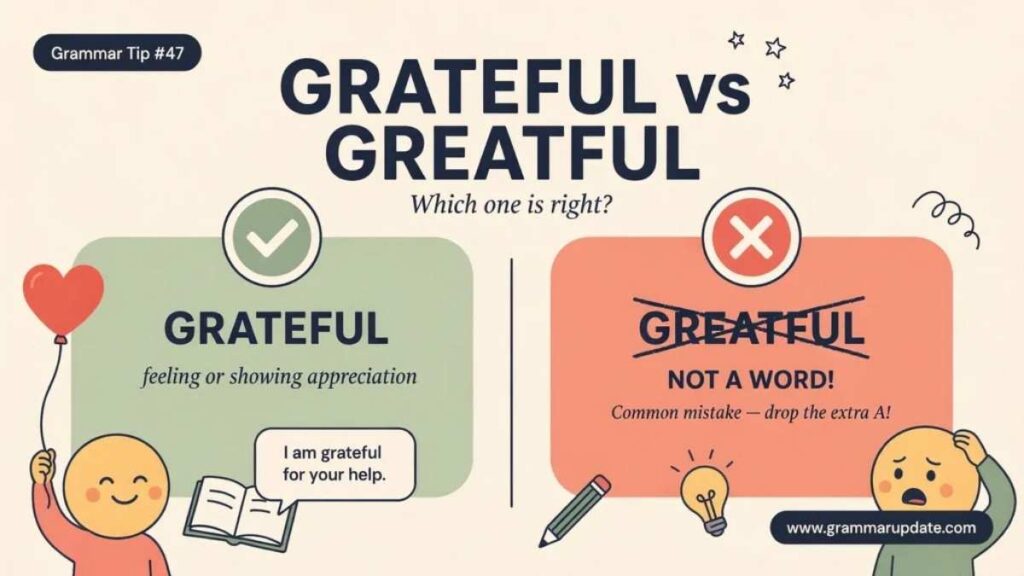
English spelling can turn an easy word into a little puzzle, and grateful is a good example. Many people write greatful because it looks like it comes from the word great. Others add an extra l and write gratefull. Neither spelling is correct. In this guide to grateful vs greatful, you will learn the correct spelling, understand what grateful means, and see why these common mistakes happen. You will also learn how to use grateful, gratefully, and related forms in clear, natural sentences. By the end, the confusion will be easy to clear up, and you will know exactly which spelling to use whenever you write this word.
quick answer
Grateful is the correct spelling.
Greatful is incorrect when you want to express the meaning of feeling or showing appreciation. Gratefull is also incorrect.
The difference is easy to see:
| Word | Correct? | Meaning |
|---|---|---|
| grateful | Yes | Feeling or showing appreciation |
| greatful | No | Misspelling of grateful |
| gratefull | No | Misspelling of grateful |
| gratefully | Yes | In an appreciative or thankful way |
| gratefulness | Yes | The quality or state of being grateful |
| gratitude | Yes | The feeling of appreciation |
For example, you can write:
I am grateful for your help.
You should not write:
I am greatful for your help.
You should also not write:
I am gratefull for your help.
If you are searching for grateful vs greatful which is correct, the answer is simply grateful.
Learn the difference between often confused words
Exceed vs Excede difference and usages?
Grateful vs Gratefull What Is the Difference?
There is no difference in meaning between grateful and gratefull because gratefull is not the standard spelling of a separate English word. It is simply a misspelling of grateful.
The extra l probably appears because English has the word full, which ends with two l’s. Someone may naturally assume that grateful means something like “full of gratitude” and therefore spell it gratefull.
English spelling does not always follow that kind of literal logic.
The suffix -ful is normally written with one l. You can see the same pattern in words such as careful, helpful, hopeful, useful, and thankful.
Grateful follows the same pattern.
The correct form is grateful, not gratefull.
What Does Grateful Mean?
The grateful meaning is straightforward. Grateful describes someone who feels or shows appreciation for something, someone, an action, an opportunity, or a positive situation.
The grateful definition can be expressed simply as feeling or showing thanks and appreciation.
For example:
I am grateful for your support.
This sentence tells the reader that the speaker appreciates the support.
You can also say:
She is grateful to her parents.
Here, the sentence identifies the people who receive her appreciation.
Another example is:
We are grateful that everyone arrived safely.
In this sentence, grateful describes appreciation for a positive situation.
The word can therefore describe both a personal feeling and an expression of gratitude.
Grateful Meaning in English
In everyday English, grateful usually expresses sincere appreciation. The thing that creates this feeling can be large or small.
You might feel grateful because someone helped you with a difficult task. You might be grateful for an opportunity, a gift, good advice, or support during a challenging period.
For example:
I am grateful for the advice you gave me.
She was grateful for the opportunity to study abroad.
We are grateful to everyone who supported the project.
He felt grateful that his family was safe.
In each example, the person recognizes something valuable and responds with appreciation.
That is the central idea behind grateful.
Is Greatful a Word?
If you have searched for “is greatful a word,” the answer needs a little clarification.
Greatful is not the standard English spelling of the adjective meaning thankful or appreciative. When you want to express gratitude, use grateful.
The same applies to the questions “is greatful a correct word” and “is greatful a word in English?”
The intended word is normally grateful.
For example:
Incorrect: I am greatful for your kindness.
Correct: I am grateful for your kindness.
The misspelled version may still be understood because the intended meaning is obvious. However, understanding a spelling mistake does not make the spelling correct.
Greatful Meaning
People sometimes search for greatful meaning because they have seen the word written that way.
In standard English, greatful does not function as the correct adjective meaning thankful. It is generally a misspelling of grateful.
For example:
I am greatful for the opportunity.
The intended meaning is clear, but the spelling should be:
I am grateful for the opportunity.
It is better to think of greatful as a spelling mistake rather than as a separate word with its own definition.
Learn the difference between often confused words
Bougie vs Boujee which one is correct?
Is Gratefull a Word?
Gratefull is another common misspelling of grateful.
If you are wondering, “is gratefull correct spelling?” the answer is no.
The correct spelling is grateful.
The mistake usually comes from confusing the suffix -ful with the standalone word full. Although grateful expresses the idea of appreciation, its spelling is not based on adding the word full to grate.
Compare these words:
| Correct | Incorrect |
|---|---|
| grateful | gratefull |
| grateful | greatful |
| gratefully | greatfully |
| gratefulness | greatfulness |
Remembering the correct base word makes all of these related forms easier to recognize.
Why Is It Grateful and Not Greatful?
The question “why is it grateful and not greatful” makes sense because grateful looks as if it could come from great.
However, grateful is not formed from great plus the suffix -ful.
The word has a much older history. It is related to the Latin word gratus, which carried meanings connected with being pleasing, thankful, or appreciated. The English word developed through historical forms rather than from the modern English adjective great.
That is why the spelling grateful should not be interpreted as “great + ful.”
The correct spelling begins with grate:
grate + ful = grateful
This does not mean that every English word can be broken apart this way. It simply gives you a useful memory aid for this particular spelling.
If you remember that grateful begins with grate rather than great, one of the most common spelling errors disappears immediately.
Why Is Grateful Spelled Without E?
The question “why is grateful spelled without e” can be confusing because grateful actually does contain an e.
The real issue is that grateful is not spelled like great.
Here is the difference:
grateful: g-r-a-t-e-f-u-l
greatful: g-r-e-a-t-f-u-l
The correct word contains grate before the suffix -ful. The incorrect version uses great.
So the issue is not whether grateful contains an e. It does. The important point is that its letters appear in the sequence grate rather than great.
Learn the difference between often confused words
Existence vs Existance which one is correct?
How Do You Spell Grateful Correctly?
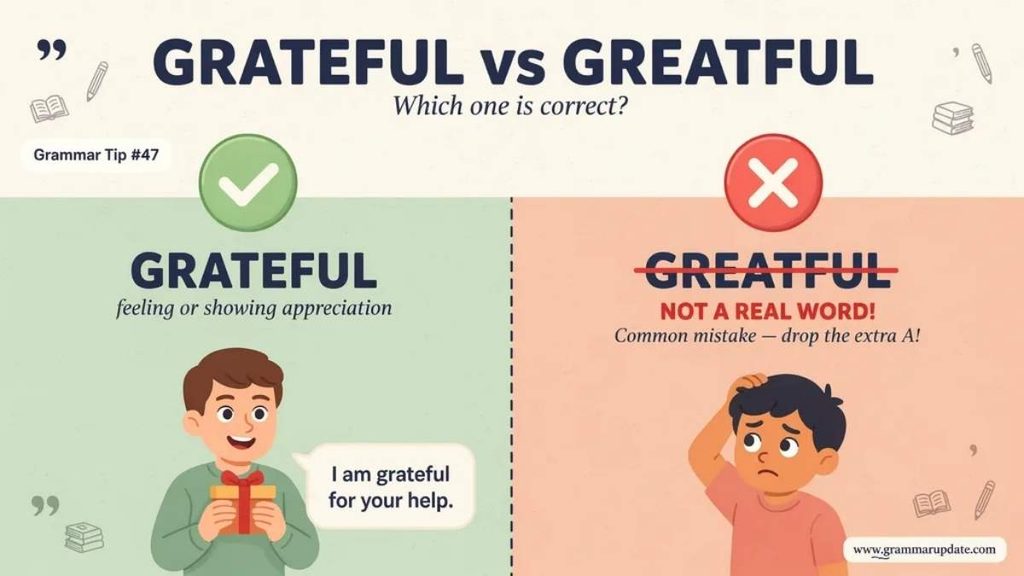
If you are asking how to spell grateful, the correct form is:
grateful
A useful memory trick is to remember two things.
First, the word begins with grate, not great.
Second, it ends in -ful, which has one l.
That gives you:
grate + ful = grateful
Not:
great + ful = greatful
And not:
grate + full = gratefull
This simple distinction can help you avoid one of the most common spelling mistakes involving the word.
Grateful and the Suffix -ful
The confusion around gratefull becomes easier to understand when you look at words ending in ful.
The suffix -ful commonly means “full of” or “characterized by.” When used as a suffix, it normally contains one l.
Consider these examples:
| Word | Correct Form |
|---|---|
| care + ful | careful |
| help + ful | helpful |
| hope + ful | hopeful |
| use + ful | useful |
| thank + ful | thankful |
| grate + ful | grateful |
The standalone word full has two l’s, but the suffix -ful has one.
That distinction explains why grateful has only one l at the end.
The same spelling pattern appears in many familiar English words, so it is worth remembering when dealing with adjective spelling rules.
Grateful vs Greatful Meaning
The phrase greatful vs grateful meaning can be misleading because it suggests that the two spellings have different definitions.
They do not.
Grateful is the correct word. Greatful is a misspelling.
| Form | Status | Meaning |
|---|---|---|
| grateful | Correct | Feeling or showing appreciation |
| greatful | Incorrect | Misspelling of grateful |
For example:
I am grateful for the chance to work with you.
The adjective grateful tells us that the speaker appreciates the opportunity.
You should not replace grateful with greatful to make the word sound stronger. Greatful has no standard meaning of “very grateful” or “extremely grateful.”
Learn the difference between commonly mixed-up more words
Argument vs Arguement Which one Is Correct?
How to Use Grateful in a Sentence
Grateful commonly appears with for, to, and that. Each construction serves a slightly different purpose.
Grateful for
Use grateful for when you are naming the thing, action, opportunity, or situation you appreciate.
Examples include:
I am grateful for your help.
She is grateful for the opportunity.
We are grateful for your kindness.
He was grateful for the support he received.
This is one of the most common ways to use the word.
Grateful to
Use grateful to when you identify the person toward whom you feel appreciation.
For example:
I am grateful to my parents.
She is grateful to her teacher.
We are grateful to everyone who helped.
You can combine to and for when you want to identify both the person and the reason for the gratitude.
I am grateful to you for your support.
Here, to you identifies the person, while for your support explains what the speaker appreciates.
Grateful that
Grateful can also introduce a clause describing a situation.
For example:
I am grateful that you came.
She is grateful that everything worked out.
We are grateful that no one was injured.
This structure focuses on the situation that caused the feeling of appreciation.
Learn the difference between commonly mixed-up more words
Cemetery vs Cemetary Which one Is Correct?
Grateful vs Thankful What Is the Difference?
Grateful and thankful have very similar meanings. In many everyday situations, native speakers can use either word without creating a major difference in meaning.
Still, they can carry slightly different shades of meaning.
Thankful often emphasizes relief or appreciation for a particular situation or outcome.
Grateful often places more emphasis on appreciation for a person, kindness, benefit, or opportunity.
For example:
I am thankful that everyone arrived safely.
I am grateful for everything my family has done for me.
The first sentence naturally focuses on a positive outcome. The second emphasizes appreciation for people and their actions.
The distinction is not absolute. Context determines the best choice.
| Word | Common emphasis | Example |
|---|---|---|
| grateful | Appreciation for a person, benefit, action, or opportunity | I am grateful for your kindness. |
| thankful | Appreciation or relief about a positive situation | I am thankful that everyone is safe. |
So, when considering the grateful vs thankful difference, think about the focus of the sentence rather than treating the two words as completely separate concepts.
Grateful vs Appreciative
The Grateful and appreciative overlap, but they are not always used in exactly the same way.
Grateful often describes a personal feeling of thankfulness because of something someone has done or something someone has received.
Appreciative can emphasize recognizing the value, effort, quality, or kindness involved.
Compare these sentences:
I am grateful for your help.
I am appreciative of your hard work.
The first sentence expresses personal gratitude. The second recognizes and values someone’s effort.
Both words can express appreciation, but the emphasis can change.
If you are asking what is the difference between grateful and appreciative, a useful rule is this: grateful often focuses on receiving or benefiting from something, while appreciative can focus more broadly on recognizing its value.
Grateful vs Gratitude
The Grateful and gratitude belong to the same word family, but they have different grammatical roles.
Grateful is an adjective. It describes a person or their state.
Gratitude is a noun. It names the feeling itself.
| Word | Part of Speech | Example |
|---|---|---|
| grateful | Adjective | I am grateful for your help. |
| gratitude | Noun | I want to express my gratitude. |
For example:
She was grateful for their support.
She expressed her gratitude for their support.
Both sentences communicate appreciation, but the grammar differs.
This distinction is important because gratitude cannot simply replace grateful in every sentence.
Learn the difference between commonly mixed-up more words
Apparent Vs Aparent Which one Is Correct?
Gratefully Meaning and Usage
Gratefully is the adverb related to grateful.
The gratefully meaning is “in a grateful or appreciative manner.”
For example:
She gratefully accepted the invitation.
He gratefully acknowledged their support.
They gratefully received the donation.
In each sentence, gratefully describes how the action happened.
Compare:
I am grateful for your kindness.
I gratefully accepted your kindness.
The first sentence uses grateful as an adjective. The second uses gratefully as an adverb.
This is also why greatfully is incorrect. The correct form begins with grate-, just like grateful.
Gratefulness vs Gratitude
Gratefulness is a valid noun that refers to the quality or state of being grateful.
For example:
Her gratefulness was clear from her words.
However, gratitude is often the more natural choice, particularly in formal or polished writing.
For example:
Her gratitude was clear from her words.
The two nouns are related, but gratitude is widely used to name the feeling of appreciation itself.
The main word family looks like this:
| Word | Part of Speech | Basic Meaning |
|---|---|---|
| grateful | Adjective | Feeling or showing appreciation |
| gratefully | Adverb | In an appreciative way |
| gratefulness | Noun | The state of being grateful |
| gratitude | Noun | The feeling of appreciation |
Learn the difference between commonly mixed-up more words
Conscious vs Conscience Difference and which is correct?
Forever Grateful vs Greatful Which Is Correct?
If you have searched for forever grateful vs greatful, the correct expression is forever grateful.
For example:
I will be forever grateful for your support.
The forever grateful meaning is simple. It expresses lasting or enduring appreciation.
You might use the phrase when someone has made a major difference in your life or helped you during an important moment.
For example:
I will be forever grateful for the opportunity you gave me.
She will always be forever grateful for her family’s support.
The spelling does not change because another word comes before grateful.
Forever grateful is correct.
Forever greatful is not.
Common Spelling Mistakes With Grateful
Several mistakes appear repeatedly because the word looks deceptively familiar.
Greatful is created by connecting grateful with great.
Gratefull is created by treating the ending as full.
Greatfully combines both mistakes by using great instead of grate in the base word.
Greatfulness makes the same error in the noun form.
The correct forms are:
grateful
gratefully
gratefulness
gratitude
Once you learn the correct base spelling, these related forms become much easier to identify.
Greatfully vs Gratefully
Greatfully and gratefully are not two different adverbs.
Gratefully is correct.
Greatfully is a misspelling.
For example:
Incorrect: She greatfully accepted the award.
Correct: She gratefully accepted the award.
The same spelling principle applies to the base adjective. The word begins with grate-, not great-.
This is one reason learning word families can be more useful than memorizing isolated spellings.
Learn the difference between confusing word pairs
Category vs Catagory Which one Is Correct?
Grateful in Everyday and Professional Writing
Grateful fits comfortably into casual conversation, personal messages, professional emails, formal statements, and many other forms of communication.
In everyday conversation, you might say:
I am so grateful for your help.
In a professional email, you might write:
I am grateful for your time and assistance.
In a formal statement, you could write:
We are deeply grateful to everyone who contributed to the project.
The surrounding words influence the tone. Phrases such as deeply grateful, truly grateful, genuinely grateful, and extremely grateful increase the emotional strength of the statement.
The basic spelling remains unchanged.
A Simple Example That Clears Up the Confusion
Imagine that a colleague stays late to help you finish an important project.
You might want to write:
I am greatful for your help.
That sentence communicates the intended idea, but the spelling is wrong.
Changing it to:
I am grateful for your help.
solves the spelling problem.
Now suppose you want to describe the way you accepted your colleague’s offer:
I gratefully accepted your offer.
Here, gratefully is correct because it functions as an adverb.
If you want to name the feeling itself, you could say:
I want to express my gratitude for your help.
Now the noun gratitude is the correct choice.
These three forms have different grammatical jobs:
grateful is an adjective.
gratefully is an adverb.
gratitude is a noun.
Once you understand that relationship, the spelling and grammar become much easier to manage.
Grateful Synonyms and Related Words
Several words are closely connected with grateful. Common grateful synonyms include thankful, appreciative, obliged, and indebted, although their meanings and tones can vary.
Thankful often works naturally when you are talking about relief or a positive outcome.
Appreciative emphasizes recognition of value or effort.
Indebted can suggest that someone has received such significant help that they feel they owe something in return.
For example:
1.I am grateful for your advice.
2.I am thankful that everything worked out.
3.I am appreciative of your hard work.
4.I am deeply indebted to you for your assistance.
These words all relate to appreciation, but they are not interchangeable in every sentence.
Learn the difference between confusing word pairs
Daiquiri Vs Dacquiri Which one Is Correct?
Common Phrases With Grateful
1.Grateful appears in many familiar expressions.
2.Grateful for your help is common when acknowledging someone’s assistance.
3.Grateful for the opportunity works well when someone receives a chance to do something valuable.
4.Grateful to you identifies the person receiving the appreciation.
Truly grateful emphasizes sincerity.
Deeply grateful emphasizes the strength of the feeling.
Genuinely grateful stresses that the appreciation is sincere.
Forever grateful expresses lasting appreciation.
For example:
I am truly grateful for your support.
We are deeply grateful to everyone who contributed.
I will always be forever grateful for this opportunity.
These phrases are useful in both personal and professional communication.
How to Remember the Correct Spelling of Grateful
The easiest memory trick is short:
Grateful starts with grate, not great.
Then remember:
The suffix is -ful, not -full.
Put the pieces together:
grate + ful = grateful
This helps you avoid both major spelling mistakes at once.
1.If you see greatful, check the middle of the word.
2.If you see gratefull, check the ending.
3.If you see greatfully, check both.
A quick spelling check can save you from an error that otherwise looks perfectly plausible at a glance.
Learn the difference between confusing word pairs
Controversy vs Contraversy which one is correct?
Practice Session Grateful vs Greatful
Fill in each blank with the correct word or form: Grateful vs Greatful, grateful, gratefully, gratefulness, gratitude, thankful, appreciative, or the appropriate spelling.
- I am very ________ for your support during the difficult time.
- She felt deeply ________ to everyone who helped her.
- We are ________ for the opportunity to work with such a talented team.
- He ________ accepted the award and thanked his family.
- There is no doubt that ________ is the correct spelling.
- I will be ________ forever for everything you have done for me.
- The word “________” is a common misspelling of “grateful.”
- She expressed her ________ to the volunteers.
- I am ________ to you for your kindness.
- He was extremely ________ for the unexpected gift.
- The manager was ________ of the employee’s hard work.
- She ________ acknowledged the help she had received.
- We should show ________ to people who support us.
- I am ________ that you were there when I needed help.
- Which is correct: “grateful” or “________”?
- Which is correct: “grateful” or “________”?
- After receiving the scholarship, she felt truly ________.
- He wrote a short message to express his ________.
- The correct adverb is “________,” not “greatfully.”
- The correct noun related to “grateful” can be “gratefulness,” but “________” is often more natural.
- I am ________ for all the advice you gave me.
- She was ________ to her parents for their constant support.
- The phrase “forever ________” is commonly used to express lasting appreciation.
- “Greatful” and “gratefull” are both common ________ of “grateful.”
- After their kindness, he felt a strong sense of ________.
Answers
- grateful
- grateful
- grateful
- gratefully
- grateful
- grateful
- greatful
- gratitude
- grateful
- grateful
- appreciative
- gratefully
- gratitude
- grateful
- greatful
- gratefull
- grateful
- gratitude
- gratefully
- gratitude
- grateful
- grateful
- grateful
- misspellings
- gratitude
Here’s a trusted source for clear word meanings:
FAQs
Why do people spell grateful as greatful?
People often spell grateful as greatful because the word looks and sounds similar to great. However, the two words are not formed the same way. Greatful is a common misspelling, while grateful is the correct standard spelling.
What part of speech is grateful?
Grateful is an adjective. It describes someone who feels or shows appreciation. For example, in “I am grateful for your help,” grateful describes the speaker’s feeling.
What is the adjective form of gratitude?
The adjective form is grateful. For example, “She feels grateful for the opportunity” uses grateful to describe her feeling of appreciation.
What is the adverb form of grateful?
The adverb form is gratefully. It describes an action done in an appreciative way. For example, “He gratefully accepted the gift.”
What is the noun form of grateful?
The noun form is gratefulness. However, gratitude is usually the more common and natural noun when you want to talk about the feeling of appreciation.
Does grateful have one L or two?
Grateful has one l. The correct spelling is grateful, not gratefull. The ending is -ful, not -full.
Does grateful contain the letter E?
Yes. Grateful is spelled g-r-a-t-e-f-u-l. The e appears before the final -ful. The correct spelling is not greatful, even though great looks similar.
Why is greatful such a common misspelling?
The mistake happens because people naturally connect grateful with the word great. That connection can make greatful look correct at first glance. In standard English, however, grateful is the accepted spelling.
Can grateful describe a person?
Yes. Grateful can describe someone who feels appreciation for another person, an action, a benefit, or an experience. For example, “We are grateful for your support.”
Can grateful describe a feeling?
Yes. You can use grateful to describe a feeling of appreciation. For example, “She felt grateful after receiving help from her neighbors.”
Which prepositions can follow grateful?
Grateful commonly appears with for and to. You can also use grateful that before a clause. For example, “I am grateful for your advice,” “I am grateful to my teacher,” and “I am grateful that you came.”
Can grateful be used before a noun?
Yes. Although grateful often appears after a linking verb, it can also come before a noun in phrases such as “a grateful heart” and “a grateful person.”
Are grateful and gratefully used in the same way?
No. Grateful is an adjective, while gratefully is an adverb. You can say, “I am grateful for your help,” but “She gratefully accepted the offer.”
What is the difference between gratefulness and gratitude?
Both words refer to appreciation, but they are used somewhat differently. Gratefulness is the noun formed from grateful, while gratitude is the more common noun for the feeling or expression of appreciation.
Can you use grateful for an opportunity?
Yes. Grateful often describes appreciation for an opportunity, experience, or benefit. For example, “I am grateful for the opportunity to work with this team.”
Is grateful appropriate in formal writing?
Yes. Grateful works well in both formal and informal writing. In a professional message, you might write, “We are grateful for your continued support.” In casual conversation, you might say, “I am really grateful for your help.”
What does grateful mean when used in a sentence?
Grateful means feeling or showing appreciation. In the sentence “He was grateful for her advice,” grateful shows that he appreciated the advice he received.
Can you be grateful to someone and grateful for something?
Yes. Use grateful to when you identify the person you appreciate and grateful for when you identify the reason for your appreciation. For example, “I am grateful to my parents for their support.”
How are grateful and gratitude connected?
Grateful and gratitude are closely related words, but they have different grammatical roles. Grateful is an adjective, while gratitude is a noun. For example, “I feel grateful” and “I feel gratitude” use the words differently.
What is an easy way to remember the spelling of grateful?
Remember that the word ends in -ful, not -full. Words such as helpful, careful, and useful follow the same one-l spelling pattern. So write grateful, not gratefull.
Learn the difference between confusing word pairs
Becoming vs Becomeing Which one Is Correct?
Conclusion
The confusion between grateful, greatful, and gratefull is easy to understand. The word looks as if it might come from great, so greatful can seem perfectly reasonable at first glance. But English spelling has other plans. The correct word is grateful.
Just remember that grateful ends with -ful, not -full. It has one l, just like helpful, useful, and careful. If you are talking about appreciation, kindness, or something you deeply value, grateful is the spelling you want.
The same rule helps with related forms, too. Use gratefully as the adverb and gratefulness when you need the noun form. So you can write, “I am grateful for your help,” or “She gratefully accepted the gift.”
Once you remember the one-l ending, the whole confusion becomes much easier. Write grateful, not greatful or gratefull, and you will never have to second-guess this spelling again.

Jhon AJS, the creative mind behind Grammar Update, is an experienced blogger passionate about simplifying English grammar. He focuses on explaining confusing word vs word differences, grammar rules, punctuation, and sentence structure in a clear and practical way. Through easy to understand guides and examples, Jhon helps readers improve their writing and communicate with confidence. With years of blogging experience, he continues to share helpful insights that make learning grammar simple, useful, and accessible for everyone.