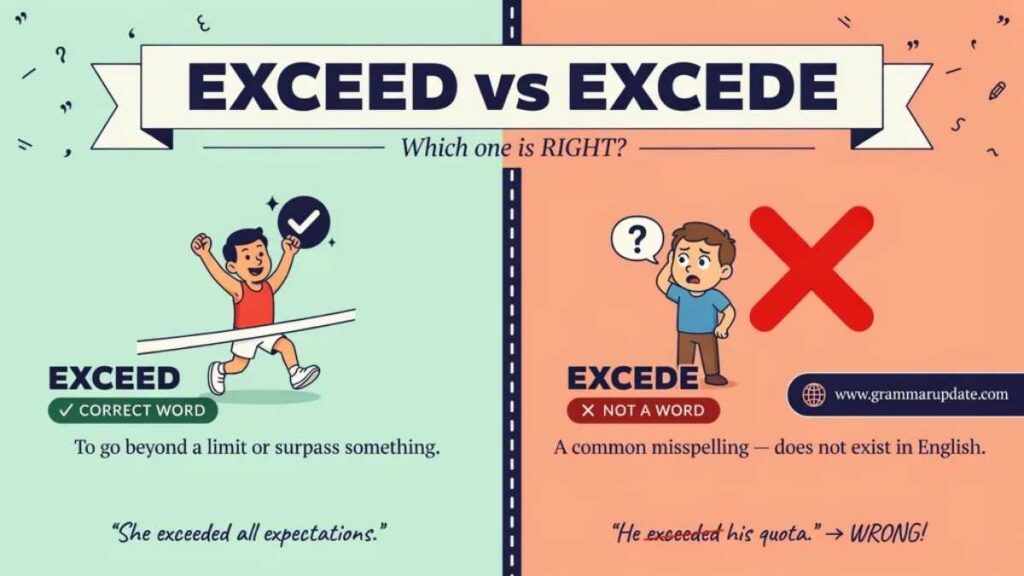
The confusion between exceed vs excede is easy to understand. Both spellings look almost the same, so it is easy to lose one little e along the way. However, only exceed is the correct English spelling. It means to go beyond a limit, amount, target, standard, or expectation. Excede is simply a spelling mistake. This mix-up can happen because English has words like concede and recede, which follow a similar spelling pattern. In this guide, you’ll learn what exceed means, how to use it correctly, and how to remember its spelling. Once you spot the double e, choosing the right word becomes much easier.
quick answer
If you are wondering whether to use exceed vs excede, choose exceed.
Exceed is the correct English spelling. Excede is an incorrect spelling when you are trying to use the verb that means to go beyond something.
| Word | Correct? | Meaning | Example |
|---|---|---|---|
| Exceed | Yes | To go beyond a limit, amount, standard, or expectation | The costs may exceed the budget. |
| Excede | No | Incorrect spelling of exceed | The costs may exceed the budget. |
The exceed vs excede spelling difference is small, but it matters. Writing excede in a sentence creates a spelling error even when the meaning of the sentence is clear.
So, if you are searching for exceed vs excede which is correct, the answer is exceed.
Learn the difference between commonly mixed-up more words
Atheist Vs Athiest Which Spelling Is Correct?
What Does Exceed Mean?
The basic exceed meaning is to go beyond something.
The word can describe an amount that becomes greater than a limit, a number that rises above a certain point, or a result that is better than an expected standard.
For example:
The repair cost exceeded $2,000.
This means the repair cost was more than $2,000.
Consider another sentence:
The students exceeded the required score.
Here, the students achieved a score higher than the required level.
Exceed can describe both measurable things and more general ideas. You can exceed a budget, exceed a speed limit, exceed a target, or exceed expectations.
Exceed Definition in English
A simple exceed definition in English is to go beyond a particular amount, limit, level, standard, or expectation.
Exceed is a verb, and it commonly appears when one thing becomes greater than another.
For example:
The temperature exceeded 100°F.
The final bill exceeded our estimate.
The number of visitors exceeded 10,000.
Her performance exceeded expectations.
In each sentence, something went beyond a particular point.
What Is the Meaning of Exceed?
If you are asking what is the meaning of exceed, think of phrases such as go beyond, be greater than, or surpass.
For example:
The number of applicants exceeded 500.
This means the number of applicants was greater than 500.
The word does not automatically describe something good or bad. The context determines how the result should be understood.
For example:
The athlete exceeded the previous record.
This usually describes a positive achievement.
However:
The driver exceeded the speed limit.
This describes going beyond a legal limit.
The basic meaning remains the same in both sentences. Something went beyond an established point.
Learn the difference between commonly mixed-up more words
Acquire Vs Aquire Which one Is Correct?
Is Excede Ever Correct?
A common question is is excede a word?
When you mean the English verb that means to go beyond something, excede is not the standard spelling. The correct word is exceed.
For example:
Incorrect: The expenses may excede the budget.
Correct: The expenses may exceed the budget.
The incorrect spelling can look believable because English contains many words ending in -cede. Words such as concede, precede, and recede follow that pattern. However, exceed does not.
The correct spelling is exceed.
That is why an excede spelling mistake should be corrected to exceed.
Is Exceed a Word?
Yes. Exceed is a standard English word and a commonly used verb.
If you are wondering is exceed a word, there is no need to hesitate. It appears in everyday English as well as business, education, mathematics, finance, science, law, and many other areas.
You can exceed a limit, exceed a target, exceed an amount, exceed expectations, or exceed a requirement.
For example:
The company exceeded its sales target.
The package must not exceed 50 pounds.
The final cost exceeded the original estimate.
Her work exceeded the required standard.
Each sentence uses exceed to show that something went beyond a particular point.
Learn the difference between commonly mixed-up more words
Extreme vs Extreem difference and usage?
Exceed Meaning With Examples
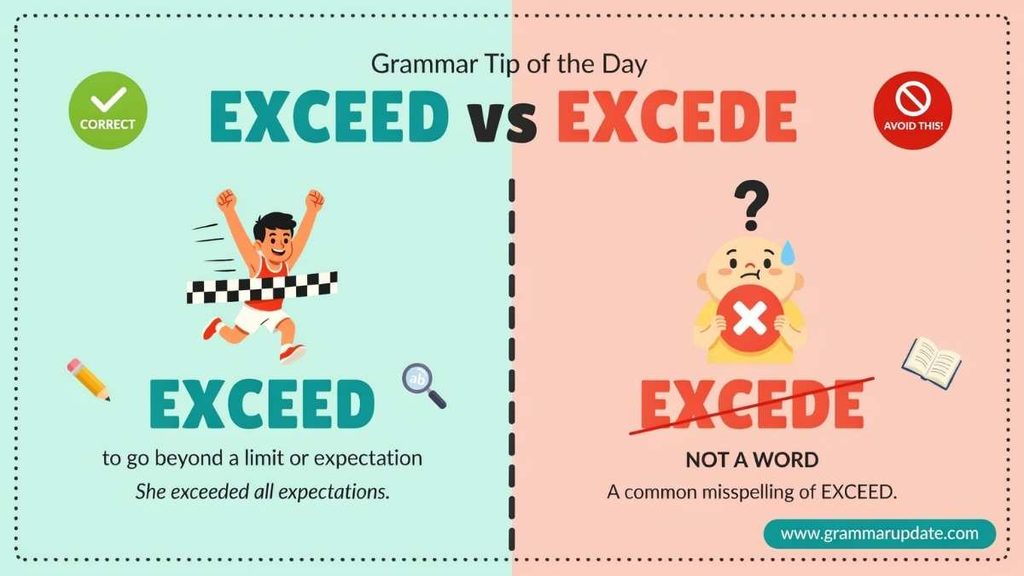
The easiest way to understand the word is to see how it works in different situations.
Exceeding a Limit
When something goes beyond an established boundary, exceed is a natural choice.
The vehicle exceeded the speed limit.
The package must not exceed the maximum weight.
In the first sentence, the vehicle traveled faster than the legal speed limit. In the second, the package cannot go above the stated weight.
This explains the exceed a limit meaning clearly. Something moves beyond a defined boundary.
Exceeding an Amount
Exceed also works with money and other quantities.
The repair bill exceeded $3,000.
The project costs exceeded the original budget.
In both examples, the final amount became greater than the amount that had been stated or planned.
Exceeding a Number
You can use exceed when one number is greater than another.
The audience exceeded 5,000 people.
The number of applications exceeded 2,000.
Here, exceed simply means that the final number was higher than the stated figure.
Learn the difference between commonly mixed-up more words
Conscious vs Conscience Difference and which is correct?
Exceeding Expectations
Exceed is also common when talking about performance.
The new employee exceeded expectations.
The restaurant exceeded our expectations.
The phrase exceed expectations meaning is to perform better than someone expected or to produce a result beyond the expected standard.
For example, if a customer expects an average experience but receives excellent service, the service may exceed expectations.
Exceed Meaning in Maths
The phrase exceed meaning in maths usually refers to one quantity being greater than another.
For example:
15 exceeds 10 by 5.
This means that 15 is greater than 10 and the difference between the two numbers is 5.
The same idea can appear in practical mathematical problems.
Suppose a budget is $1,000 and the final cost is $1,250. The final cost exceeds the budget by $250.
Exceed is useful when comparing quantities, measurements, totals, values, percentages, or limits.
For example:
The actual measurement exceeds the expected measurement.
The final total exceeds the maximum allowed amount.
The number of students exceeds the classroom capacity.
In each case, one value goes beyond another.
Learn the difference between often confused words
Caught vs Cauhgt difference and usage?
How to Use Exceed Correctly
Exceed commonly works as a transitive verb. That means it can take a direct object.
For example:
The company exceeded its sales target.
The word exceeded is the verb, while its sales target is the object.
Other natural examples include:
The costs exceeded the budget.
The temperature exceeded 90°F.
The student exceeded the required score.
The results exceeded expectations.
The demand exceeded supply.
These sentence patterns are useful because they show how exceed normally fits into everyday grammar.
Common Phrases With Exceed
Certain expressions appear frequently with exceed. Learning them can make the word easier to use naturally.
1.Exceed expectations is common when describing performance.
2.Exceed the limit is used when something goes beyond an established boundary.
3.Exceed the budget is common in financial and business contexts.
4.Exceed the target is often used when discussing goals and results.
5.Exceed the maximum describes something that goes above the highest permitted level.
6.Exceed the amount refers to going beyond a stated quantity.
7.Exceed the number describes a quantity that becomes greater than a particular figure.
8.Exceed the speed limit describes traveling faster than the legally permitted speed.
These phrases all share the same central idea: something goes beyond a known point.
Learn the difference between often confused words
Exhilarate vs Exhilirate difference and usage?
Exceed Word Forms
Exceed has several common grammatical forms. Knowing them can help prevent additional spelling mistakes.
| Form | Use | Example |
|---|---|---|
| Exceed | Base form | Costs may exceed the estimate. |
| Exceeds | Present tense with a singular subject | Demand exceeds supply. |
| Exceeded | Past tense and past participle | Sales exceeded the target. |
| Exceeding | Present participle or gerund | Exceeding the limit may cause problems. |
Exceeds Meaning
Exceeds means goes beyond or is greater than. It is the third-person singular present form of exceed.
For example:
The cost exceeds the budget.
The demand exceeds supply.
The temperature exceeds 100°F.
The subject in each sentence is singular, so exceeds is used.
With a plural subject, use exceed instead:
The costs exceed the budget.
The temperatures exceed 100°F.
Learn the difference between often confused words
Apparent Vs Aparent Which one Is Correct?
Exceeded Meaning
Exceeded is the past tense and past participle of exceed.
For example:
The final cost exceeded the estimate.
The company exceeded its sales target last year.
The athlete exceeded the previous record.
If you are wondering how to spell exceeded, the correct form is exceeded.
The base word is exceed, and the past form is exceeded.
Exceeding Meaning
Exceeding is the present participle of exceed. It describes something that is going beyond a particular point.
For example:
The company is exceeding its monthly target.
Exceeding the speed limit can result in a penalty.
The project is exceeding the original budget.
The exceeding meaning is closely connected to going beyond or surpassing something.
Learn the difference between often confused words
Becoming vs Becomeing Which one Is Correct?
Exceed vs Excede in Real-Life Contexts
Exceed appears in many areas of everyday and professional English.
In business, companies often use the word when discussing budgets, sales, revenue, costs, and targets.
The company exceeded its quarterly sales target.
In education, exceed can describe scores, requirements, and academic expectations.
The student exceeded the minimum score required for admission.
In sports, the word can describe records and performance.
The runner exceeded the previous record.
In everyday conversation, exceed can describe expenses, limits, or expectations.
The grocery bill exceeded my budget.
Although go over is often more casual, exceed remains completely natural in everyday writing and speech.
Common Mistakes With Exceed
The most common mistake is writing excede instead of exceed.
Incorrect:
The cost may excede $500.
Correct:
The cost may exceed $500.
Another common spelling error is removing the c.
Incorrect:
The cost may exeed $500.
Correct:
The cost may exceed $500.
The word needs both the c and the double e.
The past tense can cause another problem.
Incorrect:
The expenses exceded the budget.
Correct:
The expenses exceeded the budget.
If you remember the base word exceed, the past form becomes easier to recognize.
Exceed becomes exceeded.
Learn the difference between confusing word pairs
Controversy vs Contraversy which one is correct?
Exceed vs Exceeding vs Exceeded
These forms express the same basic idea, but grammar determines which one you need.
I exceed the required amount.
This uses the base form in the present tense.
She exceeds the required amount.
The subject is singular, so exceeds is used.
She exceeded the required amount.
This describes something that happened in the past.
She is exceeding the required amount.
This uses exceeding to describe an action in progress.
The meaning remains connected throughout: something goes beyond a particular amount, limit, or standard.
Exceed and Similar Words
Exceed has several synonyms, including surpass, outdo, go beyond, and be greater than.
Surpass often works when something performs better than another thing.
The new record surpassed the old one.
Go beyond is a more conversational expression.
The project went beyond the original requirements.
Be greater than is useful in straightforward comparisons.
The final amount is greater than the estimate.
Outdo often describes someone doing better than another person or doing better than a previous performance.
She outdid her previous score.
These words can overlap with exceed, but they do not work in every sentence. Choosing the right word depends on the context.
How to Remember the Spelling of Exceed
If the spelling keeps slipping away, focus on the middle of the word.
The correct form is:
exceed
Notice the double e after the c.
A simple memory trick is to connect exceed with the phrase see the double e.
Think of it as:
ex + ceed
That spelling remains visible in related forms such as exceeds, exceeded, and exceeding.
The important point is simple. Do not change exceed into excede just because other English words use the -cede pattern.
Learn the difference between confusing word pairs
Daiquiri Vs Dacquiri Which one Is Correct?
Practice Session Exceed vs Excede
Fill in each blank with the correct form of the word: exceed, exceeds, exceeded, or exceeding.
- The final cost may ______ our original budget.
- The company ______ its sales target last month.
- The package must not ______ the maximum weight limit.
- The number of visitors ______ 10,000 last year.
- She is ______ expectations with her excellent performance.
- The temperature ______ 100°F yesterday.
- The repair bill could ______ $2,000.
- The athlete ______ the previous record.
- The demand ______ the available supply.
- The project is ______ the original budget.
- The vehicle was stopped for ______ the speed limit.
- The student ______ the required score.
- Costs can ______ the estimated amount.
- The number of applicants ______ our expectations.
- The new model ______ the older version in performance.
- The expenses ______ the approved budget.
- The company is ______ its monthly target.
- The final amount may ______ the maximum allowed limit.
- The results ______ what the researchers expected.
- The number of people at the event ______ 5,000.
- The driver was fined for ______ the speed limit.
- Her performance ______ the required standard.
- The total cost ______ the original estimate by $500.
- The demand for the product continues to ______ supply.
- The final score ______ the previous record by several points.
Answers
- exceed
- exceeded
- exceed
- exceeded
- exceeding
- exceeded
- exceed
- exceeded
- exceeds
- exceeding
- exceeding
- exceeded
- exceed
- exceeded
- exceeded
- exceeded
- exceeding
- exceed
- exceeded
- exceeded
- exceeding
- exceeded
- exceeded
- exceed
- exceeded
Here’s a trusted source for clear word meanings:
FAQs
Can exceed be used for numbers and amounts?
Yes. Exceed can describe numbers, amounts, costs, limits, targets, and other measurable values. For example, “The expenses exceeded the budget.”
Is exceed a standard English verb?
Yes. Exceed is a standard English verb that means to go beyond a particular amount, level, limit, standard, or expectation.
Why does exceed have two e’s?
The correct spelling is exceed, with two e’s after the c. Remembering the double e can make the spelling easier and help you avoid writing excede by mistake.
Can you use exceed to describe performance?
Yes. Exceed can describe performance that goes beyond an expected level or standard. For example, “Her performance exceeded the required standard.”
What does it mean when expenses exceed a budget?
It means the expenses are higher than the amount planned for the budget. For example, if your budget is $1,000 but you spend $1,200, your expenses exceed the budget.
Can exceed be followed by a noun?
Yes. Exceed commonly takes a direct object, such as a limit, target, amount, or expectation. For example, “The company exceeded its sales target.”
Is exceed suitable for formal writing?
Yes. Exceed is widely used in formal and professional English. You’ll often see it in business, education, finance, science, and official documents.
Can exceed refer to a physical limit?
Yes. Exceed can describe something that goes beyond a measurable physical limit. For example, “The truck exceeded the weight limit.”
What is the difference between exceed and surpass?
Both words can mean “go beyond” or “be greater than.” Exceed is often used with limits, amounts, expectations, and standards, while surpass often emphasizes doing better than a previous result or another person.
Can you say exceed expectations?
Yes. “Exceed expectations” means to perform better than someone expected. For example, “The new service exceeded customer expectations.”
What is the difference between exceed and excel?
Exceed means to go beyond a limit, amount, or standard. Excel means to perform exceptionally well in a particular area. For example, “The costs exceeded the budget,” but “She excels at mathematics.”
What does it mean to exceed a target?
To exceed a target means to achieve a result higher than the planned goal. For example, if a company sets a sales target of 500 units and sells 600, it exceeded the target.
Can exceed be used with percentages?
Yes. Exceed can describe a percentage that goes beyond a stated level. For example, “The annual increase exceeded 10 percent.”
Can exceed describe time or duration?
Yes. Exceed can describe something that lasts longer than the allowed or expected time. For example, “The meeting exceeded its scheduled duration.”
Is excede ever an acceptable spelling?
No. When you mean “to go beyond,” the standard English spelling is exceed. Excede is a spelling mistake, not an accepted alternative spelling.
How can you remember the spelling of exceed?
Remember that exceed contains two e’s after the c. A simple trick is to think of exceed as having an “extra e.” This makes it easier to avoid the common spelling mistake excede.
Learn the difference between confusing word pairs
Category vs Catagory Which one Is Correct?
Conclusion
The confusion between exceed vs excede is easy to clear up once you remember one simple rule: exceed is the correct spelling. If you’re comparing exceed vs excede, remember that exceed means to go beyond a limit, amount, target, standard, or expectation. Excede is a common spelling mistake, not an alternative form of the word.
When you come across exceed vs excede in your writing, the double e in exceed is the little detail that keeps the spelling on track. So, whether you’re writing about a budget, speed limit, sales target, or someone’s performance, use exceed when something goes beyond a set point. In short, exceed vs excede has a simple answer: choose exceed.

Jhon AJS, the creative mind behind Grammar Update, is an experienced blogger passionate about simplifying English grammar. He focuses on explaining confusing word vs word differences, grammar rules, punctuation, and sentence structure in a clear and practical way. Through easy to understand guides and examples, Jhon helps readers improve their writing and communicate with confidence. With years of blogging experience, he continues to share helpful insights that make learning grammar simple, useful, and accessible for everyone.