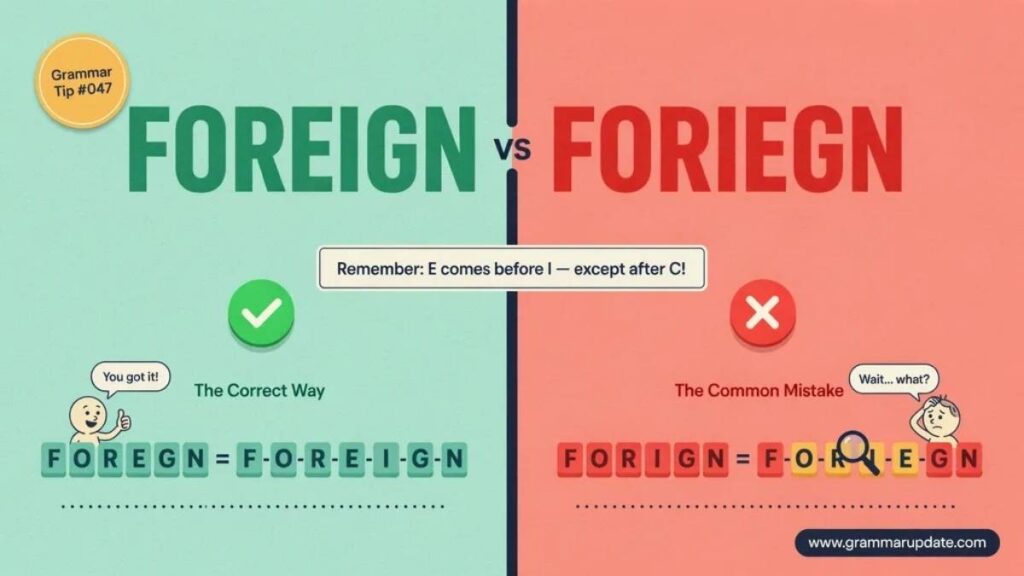
Foreign vs foriegn may look like a tiny spelling puzzle, but one misplaced vowel can trip up even careful writers. The word foreign has an unusual spelling, and its pronunciation does not make every letter easy to remember. That is why foriegn appears so often as a spelling mistake. The good news is that the confusion is easy to clear up: foreign is correct, while foriegn is not. In this guide, you will learn the correct foreign spelling, meaning, pronunciation, grammar, and everyday uses. You will also see examples that make the difference easier to remember, so you can use foreign confidently in your writing.
quick comparison
| Word | Correct? | Meaning | Example |
|---|---|---|---|
| Foreign | Yes | From another country or unfamiliar | She speaks a foreign language. |
| Foriegn | No | Common misspelling of “foreign” | Foriegn language |
| Foreigner | Yes | A person from another country | He is a foreigner living abroad. |
| Abroad | Yes | In or to another country | She works abroad. |
Learn the difference between tricky grammar more words
Argument vs Arguement Which one Is Correct?
Foreign vs Foriegn Which Spelling Is Correct?
Foreign is the correct spelling.
Foriegn is an incorrect spelling and does not belong in standard English. Although you may see foriegn in online posts, messages, comments, or informal writing, it is still considered a misspelling.
The correct spelling is:
Foreign
The incorrect spelling is:
Foriegn
The difference comes down to the position of the letters e and i. In foreign, the sequence is ei. In foriegn, those letters are reversed.
A simple way to remember the foreign correct form is to focus on the middle of the word:
foreign = f-o-r-e-i-g-n
foriegn = f-o-r-i-e-g-n
If you are writing an email, school assignment, article, application, or professional document, always use foreign.
How to Spell Foreign Correctly
If you often type foriegn by accident, break the word into smaller parts rather than relying on pronunciation.
The correct spelling of foreign is:
f-o-r-e-i-g-n
The important part to remember is ei.
Think of the word as:
for + eign
The unusual-looking ending is what makes foreign tricky. Once you become familiar with the spelling, however, it becomes much easier to recognize.
If you are wondering, “How do you spell foreign correctly?” the answer is simply foreign.
Learn the difference between tricky grammar more words
Airplane vs Aeroplane difference and usage?
Why Do People Spell Foreign as Foriegn?
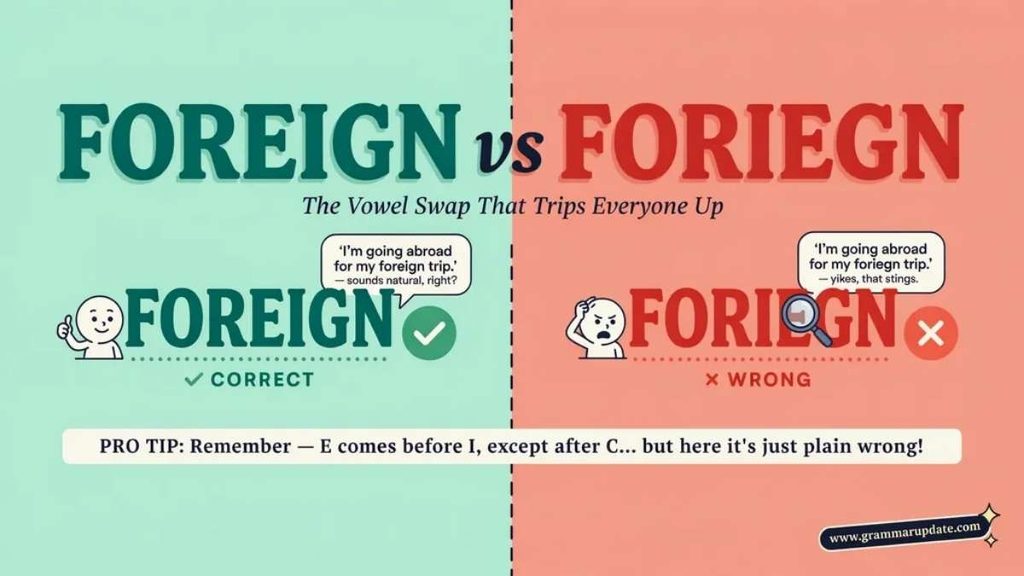
The foriegn misspelling usually happens because the letters e and i are reversed.
English contains many words in which vowel combinations create spelling confusion. When you pronounce foreign, you do not clearly hear every written letter. Your brain may therefore rely on a familiar spelling pattern and produce foriegn instead.
Typing quickly can make the problem even easier to repeat. If you have written foriegn several times, your fingers may eventually type the misspelling automatically.
This does not mean foriegn is an alternative spelling. It is simply a common spelling mistake.
Foreign Meaning and Definition
The word foreign generally describes something connected with another country or something outside a particular place, group, or system.
A dictionary definition of foreign commonly includes the idea of belonging to or coming from another country.
For example:
She speaks three foreign languages.
The company imports foreign products.
He enjoys learning about foreign cultures.
The government changed its foreign policy.
In each example, foreign describes something connected with a country or culture outside the speaker’s own country or familiar setting.
However, foreign does not always mean “from another country.” It can also describe something unfamiliar, unrelated, or outside a particular system.
For example:
The doctor found a foreign object in the patient’s eye.
Here, foreign object does not mean an object from another country. It means something that does not naturally belong there.
Foreign as an Adjective
Foreign is primarily an adjective.
An adjective describes a noun, and foreign usually appears directly before the noun it modifies.
For example:
1.foreign country
2.foreign language
3.foreign currency
4.foreign culture
5.foreign company
6.foreign policy
7.foreign student
8.foreign object
In these expressions, foreign tells you something about the noun that follows it.
This is an important point when learning foreign meaning in English grammar. You can usually ask, “What kind of country, language, currency, or object?” The answer can be foreign.
Learn the difference between tricky grammar more words
Dumbbell vs Dumbell difference and usage?
Foreign in a Sentence
Seeing a word in context often makes its meaning much easier to understand.
Here are some foreign sentence examples:
I enjoy listening to foreign music.
She moved to a foreign country for work.
The hotel accepts several types of foreign currency.
Learning a foreign language can open new opportunities.
He became interested in foreign culture after traveling abroad.
The scientist noticed a foreign object inside the machine.
The country is reviewing its foreign policy.
These examples show that foreign can describe countries, languages, money, cultures, objects, and government matters.
Foreign Country
A foreign country is a country other than your own or one being discussed as an outside country.
For example:
She moved to a foreign country after graduating from college.
For someone living in the United States, France may be described as a foreign country. For someone living in France, the United States may be described as a foreign country.
The meaning depends on the speaker’s point of reference.
Foreign Language
A foreign language is a language that is not the native or primary language of the person or community being discussed.
For example:
Spanish is a foreign language for many English speakers in the United States.
However, the same language can be a native language for millions of people elsewhere.
This distinction matters because “foreign” is relative to the speaker, listener, or community. A language is not inherently foreign everywhere.
Learn the difference between tricky grammar more words
Guarantee vs Guarentee difference and usage ?
Foreign Currency
Foreign currency refers to money from another country.
For example:
The traveler exchanged dollars for foreign currency.
If you are in the United States, euros may be foreign currency. If you are in a country that uses the euro, US dollars may be considered foreign currency.
Again, the meaning depends on location and context.
Foreign Culture
Foreign culture generally refers to the customs, traditions, beliefs, arts, social practices, and ways of life associated with another country or community.
For example:
Traveling can help you understand a foreign culture more deeply.
However, the phrase can sometimes sound broad because cultures are diverse and do not always fit neatly within national borders. In more specific writing, naming the particular culture can make the meaning clearer.
Foreign Object
Foreign object has a different meaning from many common expressions containing foreign.
It can refer to something that has entered a place where it does not belong.
For example:
The doctor removed a foreign object from the patient’s ear.
The technician found a foreign object inside the machine.
In these examples, foreign means unfamiliar or not belonging to the normal environment. It has nothing to do with nationality.
Foreign Pronunciation
Foreign is pronounced differently from the way its spelling might suggest.
In American English, the word has two syllables, with the stress on the first syllable.
The final g is not pronounced as a separate hard g sound. This is one reason the written form can feel less obvious than the spoken form.
When learning foreign pronunciation in English, it helps to hear the word and see its spelling together rather than trying to spell it purely from sound.
Learn the difference between tricky grammar more words
Existence vs Existance which one is correct?
Foreign vs Foreigner
The Foreign and foreigner are related words, but they do different jobs.
Foreign is an adjective.
Foreigner is a noun that traditionally refers to a person from another country.
Compare these examples:
She speaks a foreign language.
She met a foreigner while traveling.
1.In the first sentence, foreign describes language.
2.In the second sentence, foreigner refers to a person.
3.In modern English, it is often more natural and precise to say “a person from another country” or name the person’s nationality when appropriate.
Foreign vs Abroad
The Foreign and abroad are sometimes confused because both can relate to other countries.
Foreign is generally an adjective that describes a noun.
Abroad commonly functions as an adverb meaning in or to another country.
Compare:
She studied abroad.
She studied a foreign language.
The first sentence tells you where she studied. The second tells you what she studied.
You would not normally replace foreign with abroad in these expressions.
Foreign country is correct.
Abroad country is not standard English.
Likewise:
He traveled abroad.
He visited a foreign country.
Both sentences are correct, but they emphasize different ideas.
Foreign vs Overseas
The Foreign and overseas can overlap, but they are not always interchangeable.
Foreign generally means connected with another country or outside one’s own country.
Overseas often refers to another country, especially one separated by a sea or ocean.
For example:
The company sells foreign products.
The company has overseas offices.
The first sentence focuses on products from outside the speaker’s country. The second emphasizes offices located in other countries.
In everyday American English, overseas is also commonly used more broadly for international locations, even when the literal sea-crossing idea is not important.
Learn the difference between confusing word pairs
Bougie vs Boujee which one is correct?
Foreign vs International
The Foreign and international have related meanings, but they emphasize different relationships.
Foreign often means coming from or connected with another country.
International usually involves two or more countries.
For example:
The company imports foreign products.
The company operates an international business.
Foreign focuses on something outside a particular country. International highlights activity or relationships involving multiple countries.
You can also see the difference in these phrases:
foreign policy
international cooperation
foreign currency
international trade
Both words relate to countries beyond a single domestic setting, but they are not exact substitutes.
Foreign vs Native
The Foreign and native often express opposite ideas when discussing language, people, places, or things.
Foreign generally refers to something from outside a particular country or community.
Native refers to something originating naturally in a particular place or being associated with that place.
For example:
English is her native language.
French is a foreign language for her.
The meaning depends on the person’s background and context.
A language that is foreign to one person may be native to another. That is why these terms should be used with care.
Learn the difference between confusing word pairs
Colleague vs Colleage which one is correct ?
Foreign vs Domestic
The Foreign and domestic are often used as contrasting terms in business, economics, and government.
Foreign usually refers to something connected with another country.
Domestic generally refers to something within one’s own country.
For example:
The company sells both domestic and foreign products.
The government is considering changes to domestic and foreign policy.
Here, domestic points inward toward the country itself, while foreign points outward toward other countries.
Is Foriegn a Word?
No. Foriegn is not the standard English spelling of the word.
It is a misspelling of foreign.
You may find foriegn in online writing, social media posts, informal messages, or other user-generated content. Its appearance does not make it an accepted spelling.
If you are checking your English spelling, replace foriegn with foreign.
Is Foriegn Correct Spelling?
No. Foriegn is not the correct spelling.
Foreign is the standard spelling.
If you are asking, “Is foriegn correct spelling?” the answer is no.
Use foreign in formal and informal standard English:
Correct: foreign language
Incorrect: foriegn language
Correct: foreign country
Incorrect: foriegn country
Correct: foreign currency
Incorrect: foriegn currency
Learn the difference between confusing word pairs
Changeable vs Changable Which one Is Correct?
Foreign Spelling Mistake An Easy Way to Avoid It
The easiest way to avoid this foreign spelling mistake is to remember the order of the vowels.
Foreign contains ei:
f-o-r-e-i-g-n
Foriegn contains ie:
f-o-r-i-e-g-n
The incorrect version simply switches the two vowels.
When proofreading, look specifically at the middle of the word. If you see ie after “for,” check it again.
You can also connect the spelling with familiar expressions such as foreign language, foreign country, and foreign policy. Seeing the word repeatedly in correct contexts helps build stronger spelling memory.
Foreign Word Meaning in English
The word foreign can have several closely related meanings.
It can describe something from another country:
She bought foreign currency before her trip.
It can describe something unfamiliar:
The technical terminology was foreign to me.
It can describe something that does not belong in a particular place:
The doctor removed a foreign object.
It can also describe relationships between countries:
The president discussed foreign policy.
The central idea is usually “outside” something familiar, whether that means outside a country, culture, system, or expected environment.
Learn the difference between confusing word pairs
Acknowledge Vs Acknowlege Which one Is Correct?
Common Mistakes With Foreign
The most obvious mistake is writing foriegn instead of foreign.
Another common problem is using foreign and foreigner as if they were interchangeable.
For example:
Incorrect: She is a foreign.
Correct: She is a foreigner.
Better in many contexts: She is from another country.
Foreign describes something. Foreigner refers to a person.
Another mistake is confusing foreign with abroad.
For example:
Incorrect: He lives in an abroad country.
Correct: He lives in a foreign country.
Correct: He lives abroad.
Understanding the grammatical role of each word makes these differences much easier to remember.
Learn the difference between often confused words
Definite vs Definitive difference and usage?
Practice Session Foreign vs Foriegn
Fill in each blank with the correct word or form. Foreign vs Foriegn
- She is learning a ______ language at school.
- The traveler exchanged dollars for ______ currency.
- He moved to a ______ country for work.
- The doctor removed a ______ object from the patient’s ear.
- The company imports ______ products from several countries.
- She enjoys learning about ______ cultures.
- English is his native language, but Spanish is a ______ language for him.
- The government announced changes to its ______ policy.
- We met several people from ______ countries during our trip.
- The technical subject was completely ______ to me.
- She studied ______ for two years before returning home.
- The company has several ______ offices around the world.
- Which spelling is correct: ______ or foriegn?
- The correct spelling is f-o-r-e-i-g-n, so the word is ______.
- Many students make the spelling mistake ______ instead of foreign.
- The word ______ is an adjective, while foreigner is a noun.
- He bought some ______ currency before leaving the country.
- The children were excited to hear a ______ language for the first time.
- The scientist found a ______ object inside the machine.
- The country maintains strong ______ relations with its neighbors.
- If something comes from another country, it can be described as ______.
- She became interested in ______ literature while studying at university.
- The word “foriegn” is an incorrect ______ of the word foreign.
- He had never experienced such a ______ culture before.
- Remember that the correct spelling of the word is ______, not foriegn.
Answers
- foreign
- foreign
- foreign
- foreign
- foreign
- foreign
- foreign
- foreign
- foreign
- foreign
- abroad
- overseas
- foreign
- foreign
- foriegn
- foreign
- foreign
- foreign
- foreign
- foreign
- foreign
- foreign
- spelling
- foreign
- foreign
Here’s a trusted source for clear word meanings:
FAQs
What is the correct spelling of foreign?
The correct spelling is foreign. Foriegn is a misspelling. The word is spelled f-o-r-e-i-g-n, with e before i.
Is foriegn an acceptable spelling?
No. Foriegn is not an accepted spelling in standard English. It is simply a common misspelling of foreign.
Why do people spell foreign as foriegn?
The spelling can be tricky because the pronunciation of foreign does not make every letter obvious. People often reverse the e and i and accidentally write foriegn instead of foreign.
How can I remember how to spell foreign?
Remember the vowel order: foreign contains ei, not ie. You can also practice the word in familiar phrases such as foreign language, foreign country, and foreign currency.
Is foreign an adjective?
Yes. Foreign is primarily an adjective. It describes something connected with another country or something outside a particular place, group, or system.
Can foreign mean something unfamiliar?
Yes. Foreign can describe something unfamiliar or outside your experience. For example, “The subject was foreign to me” means the subject was unfamiliar.
Can foreign describe a person?
Yes, foreign can appear before a noun referring to a person, such as foreign student or foreign visitor. However, a person’s specific nationality or “person from another country” may provide clearer information when relevant.
Does foreign have a plural form?
No. Foreign is normally an adjective, so it does not have a plural form. The related noun foreigner can be pluralized as foreigners.
What is the noun related to foreign?
Foreigner is the related noun traditionally used for a person from another country. Depending on the context, “person from another country” or a specific nationality may be more precise.
Can foreign be used as a noun?
Foreign is not normally used as a noun in standard everyday English. It is mainly used as an adjective, as in foreign language, foreign company, or foreign currency.
What is the difference between foreign and foreigner?
Foreign is an adjective that describes something, while foreigner is a noun referring to a person from another country. For example, “foreign language” describes a language, while “foreigner” refers to a person.
How is foreign different from international?
Foreign usually describes something connected with another country from a particular country’s point of view. International generally refers to activities, relationships, or situations involving two or more countries.
Does foreign always mean “from another country”?
No. Foreign often refers to another country, but it can also mean unfamiliar or outside a particular system or environment. The context determines the meaning.
Is “foreign language” correct?
Yes. Foreign language is a standard English phrase. It generally refers to a language that is not the native or primary language of the person or community being discussed.
Is “foreign country” correct?
Yes. Foreign country is a standard phrase for a country other than the one being used as the point of reference.
Is “foreign people” correct?
Yes, foreign people is grammatically possible. However, it can sound vague because it does not explain where the people are from. “People from other countries” or a specific nationality is often clearer.
What is the difference between foreign and abroad?
Foreign is generally an adjective that describes a noun, while abroad usually functions as an adverb meaning in or to another country. You can say “a foreign country” but “travel abroad.”
What is the difference between foreign and overseas?
Foreign generally describes something connected with another country. Overseas often refers to another country, especially one across a sea or ocean. The two words overlap in some contexts but are not always interchangeable.
What does “foreign to me” mean?
“Foreign to me” means unfamiliar or outside your knowledge or experience. It does not necessarily mean that something comes from another country.
Can foreign describe an object?
Yes. Foreign can describe something that does not normally belong in a particular place or system. For example, “The technician found a foreign object inside the machine.”
What does “foreign object” mean?
A foreign object is something that is not supposed to be in a particular place or environment. The phrase is commonly used for objects that enter the body, machinery, or another system where they do not belong.
Is “foreign currency” correct?
Yes. Foreign currency means the currency of another country from the speaker’s or user’s point of reference. For example, US dollars can be foreign currency for someone traveling in Europe.
What does “foreign policy” mean?
Foreign policy refers to a country’s plans, decisions, and approach to dealing with other countries and international affairs.
What is a simple sentence with foreign?
A simple example is: “She is learning a foreign language.” In this sentence, foreign describes the language and indicates that it is not her native or primary language.
How can I avoid the foreign spelling mistake?
Focus on the middle of the word. The correct form is foreign, with ei. If you write foriegn, you have reversed the e and i.
Why can foreign be difficult to spell?
Foreign can be tricky because its pronunciation does not clearly reveal its spelling. The unusual ei sequence also makes it easy to reverse the vowels and write foriegn.
Can foreign have different meanings?
Yes. Foreign can refer to something from another country, something outside a particular system, or something unfamiliar. The words surrounding it usually make the intended meaning clear.
Why is foreign correct instead of foriegn?
Foreign is the established standard spelling in English. Foriegn is a misspelling caused by reversing the e and i. When writing in standard English, use foreign.
Learn the difference between often confused words
Dilemma vs Dilema which one is correct ?
Conclusion
The foreign vs foriegn confusion is easy to clear up once you remember one small detail: foreign is correct, and foriegn is not. The mistake happens when the e and i are switched around.
Foreign is mainly an adjective. It can describe something from another country, such as a foreign language, foreign country, or foreign currency. It can also describe something unfamiliar or something that does not belong in a particular place, such as a foreign object.
So, if you are wondering how to spell foreign, keep the vowel order in mind: foreign has ei. Write foreign, not foriegn, and this common spelling mistake will stay out of your writing.

Jhon AJS, the creative mind behind Grammar Update, is an experienced blogger passionate about simplifying English grammar. He focuses on explaining confusing word vs word differences, grammar rules, punctuation, and sentence structure in a clear and practical way. Through easy to understand guides and examples, Jhon helps readers improve their writing and communicate with confidence. With years of blogging experience, he continues to share helpful insights that make learning grammar simple, useful, and accessible for everyone.