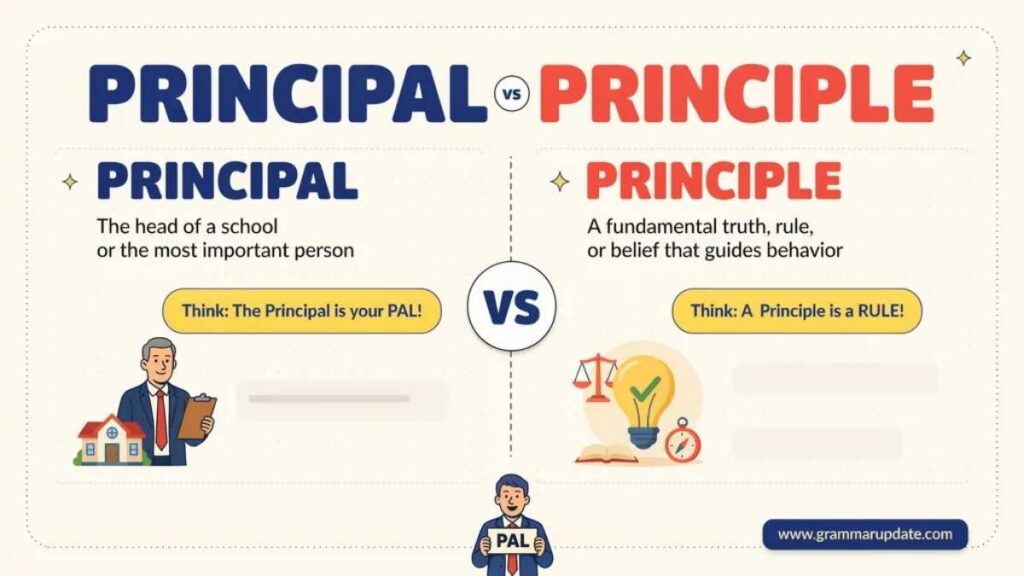
Principal vs principle can be confusing because these two words sound the same but have different meanings. Principal can mean a school leader, something that is most important, or the original amount of money borrowed or invested. Principle, on the other hand, means a rule, belief, value, or standard that guides your actions. That one extra “e” can make a big difference in your sentence. However, there is no need to let these look-alike words cause a grammar headache. This guide explains the principal vs principle difference in simple terms, with clear examples and easy memory tricks. By the end, you’ll know exactly which word to use.
Quick Answer
| Word | Meaning | Common Use | Example |
|---|---|---|---|
| Principal | Main, most important, a person in charge, or money borrowed/invested | School, finance, business | The school principal addressed the students. |
| Principle | A rule, belief, value, or fundamental idea | Morality, law, science, everyday life | Honesty is an important principle. |
Learn the difference between confusing more English words
Lose vs Loose difference and usage?
Principal vs Principle The Key Difference
Principal can function as both a noun and an adjective. As a noun, it can refer to a person in a position of authority, such as a school principal, or to the original amount of money borrowed or invested. As an adjective, it means main, chief, or most important.
Principle is a noun. It refers to a rule, belief, standard, or fundamental idea that guides behavior, decisions, or a system.
The easiest distinction is this:
Principal means a person, money, or something main.
Principle means a rule, belief, or fundamental idea.
For example, the principal spoke to the students. In this sentence, principal refers to the head of a school.
By contrast, honesty is an important principle. Here, principle refers to a belief or moral standard.
This basic distinction answers many common questions about principal or principle, but the details matter when you move into finance, education, business, law, and academic writing.
Principal Meaning and Definition
The principal definition changes slightly according to its grammatical role, but the central idea remains connected to something primary, leading, or important.
As a noun, principal can refer to a person who has authority or holds a leading position. The most familiar example in U.S. English is the principal of a school.
For example:
The school principal met with the teachers before the new semester began.
Here, principal means the person who leads the school.
Principal can also refer to a person or organization with a leading role in a business or legal relationship. In agency law, for example, a principal can be the person or organization that authorizes an agent to act on its behalf.
The word has another important noun meaning in finance. Principal refers to the amount of money borrowed or invested, apart from interest. The Consumer Financial Protection Bureau explains that the amount borrowed on a mortgage is called the principal or mortgage balance, while interest represents the cost of borrowing the money.
As an adjective, principal means main, chief, or most important.
For example:
The principal reason for the delay was a technical problem.
The principal concern was customer safety.
In both sentences, principal means the main or most important one.
Principal as a Noun
The principal noun has several established uses, but three are especially useful in everyday English.
First, it can mean a person in charge. A school principal is the clearest example.
Second, it can refer to money. In a loan, the principal is the amount borrowed or the amount of debt that remains.
Third, it can refer to a person or entity with a leading role in a business, legal, or agency relationship.
The surrounding words usually make the intended meaning obvious.
Consider these examples:
The principal called the students into the office.
The borrower paid an additional amount toward the principal.
The agent acted on behalf of the principal.
Although the same spelling appears in all three sentences, the context changes the meaning.
Principal as an Adjective
Principal also works as an adjective. In this form, it means main, chief, or primary.
For example:
The principal objective is to improve customer safety.
Cost was the principal concern.
The principal reason for the change was efficiency.
The principal investigator presented the results.
In each example, principal identifies something that has primary importance or a leading role.
This explains why phrases such as principal reason, principal concern, principal objective, and principal role are correct.
If you can replace principal with main, chief, or primary without changing the basic meaning, principal is usually the word you need.
Learn the difference between confusing more English words
Fluorescent vs Flourescent difference and usage ?
Principle Meaning and Definition
The principle definition is much more focused.
Principle is a noun that refers to a basic rule, belief, standard, or fundamental idea. It can describe a moral belief, a scientific concept, a legal rule, or an underlying idea that explains how something works.
For example:
Honesty is an important principle.
The machine operates according to a basic scientific principle.
The decision was based on a well-established principle of law.
Although these examples come from different areas, the underlying idea remains the same. A principle provides a rule, standard, or fundamental basis for thinking or acting.
That is the key principle meaning to remember.
Principle as a Rule or Belief
A principle can describe a rule that guides behavior.
For example:
She refused to accept the offer on principle.
In this sentence, principle refers to a belief or standard that influences her decision.
The word can also describe a general rule within a field of study.
For example:
The experiment demonstrates a fundamental principle of physics.
Here, principle does not mean a personal moral belief. Instead, it refers to an underlying scientific idea.
Therefore, principle can appear in moral, legal, scientific, academic, professional, and everyday contexts.
Learn the difference between confusing more English words
Guidance vs Guidence difference and usage ?
Principal vs Principle Difference at a Glance
The difference between principal and principle becomes clearer when you compare their meanings directly.
| Word | Part of speech | Main meaning | Example |
|---|---|---|---|
| Principal | Noun | Person in charge | The principal addressed the students. |
| Principal | Noun | Loan or investment amount | She paid down the principal. |
| Principal | Adjective | Main or most important | Safety was the principal concern. |
| Principle | Noun | Rule or standard | Fairness is an important principle. |
| Principle | Noun | Fundamental idea | The device works on a scientific principle. |
This comparison also explains why the words are not interchangeable.
If the sentence refers to a person, money, or something primary, principal usually fits.
If it refers to a rule, belief, standard, or fundamental idea, principle fits.
Principal vs Principle in School
The school context creates one of the most common mistakes.
The correct phrase is school principal, not school principle.
A school principal is the person who leads a school. The position commonly involves responsibilities such as overseeing staff, managing school operations, supporting students, enforcing policies, and working with families and the wider school community.
For example:
The elementary school principal welcomed the new students.
The high school principal announced the updated attendance policy.
The principal of the school met with the teachers after class.
In contrast, a school can have principles.
For example:
The school follows the principle that every student should receive fair treatment.
Here, principle refers to a guiding belief or standard.
This gives you a simple way to understand principal vs principle in school. The principal is the person. The principle is the rule or belief.
Learn the difference between confusing more English words
Guarantee vs Guarentee difference and usage ?
Principal vs Principle in Finance
Finance provides another important area where the distinction matters.
When you discuss borrowed money, the correct word is principal.
A loan principal is the amount of money borrowed. As you make payments, the portion applied to principal reduces the amount you owe.
The Consumer Financial Protection Bureau explains that mortgage payments generally include amounts applied to principal and interest. The principal portion reduces the loan balance, while the interest represents the cost of borrowing.
For example, suppose you borrow $30,000.
The original $30,000 represents the principal amount of the loan. If you later reduce the debt to $22,000, that remaining amount represents the principal balance.
A payment might look like this:
| Payment component | Amount |
|---|---|
| Principal | $550 |
| Interest | $250 |
| Total payment | $800 |
These figures are simply an illustration. Actual loan payments depend on the loan amount, interest rate, term, payment schedule, and other contractual details.
The important point is the terminology. The amount that reduces your debt is applied toward principal.
Writing principle payment when you mean a payment toward a loan is incorrect.
Principal and Interest
The phrase principal and interest appears frequently in loan and mortgage documents.
Principal represents the borrowed amount. Interest represents the cost charged for borrowing that money.
As the principal balance decreases, the amount of interest charged on a typical amortizing loan can also decrease because interest is generally calculated using the outstanding balance. The CFPB explains that with a typical fixed-rate mortgage, the total principal-and-interest payment can remain the same while the portions allocated to principal and interest change over time.
That is why the phrase principal interest payment can be confusing for new borrowers.
A principal and interest payment is not the same thing as a principle payment. The correct spelling in financial terminology is principal.
Learn the difference between confusing word pairs
Exhilarate vs Exhilirate difference and usage?
Principal Payment and Principal Balance
A principal payment is the portion of a loan payment that reduces the amount borrowed.
For example:
The borrower made an extra principal payment on the mortgage.
The phrase principal balance refers to the amount of loan principal that remains unpaid.
For example:
The borrower checked the statement to see the remaining principal balance.
The CFPB also explains that paying down principal reduces the amount owed on a mortgage and can affect how much interest accrues over time.
So, when you see terms such as loan principal, mortgage principal, principal amount, principal payment, or principal balance, the spelling is always principal when you mean the financial amount.
Principal vs Principle in Professional Writing
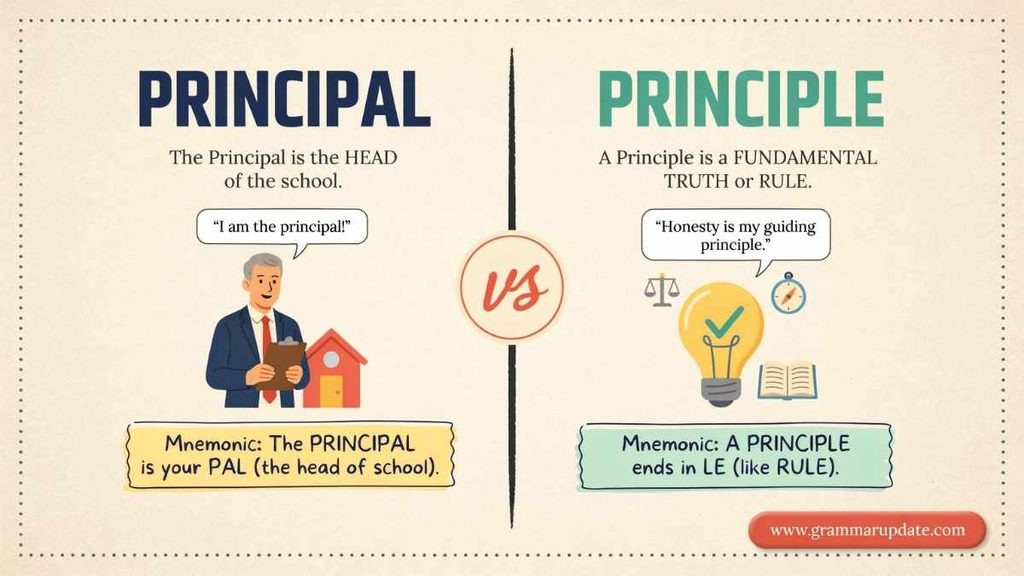
Both words appear regularly in professional writing, and sometimes they appear in the same sentence.
Consider this example:
The principal investigator followed the ethical principles established for the study.
Principal investigator refers to the person who leads the research.
Ethical principles refers to the standards that guide the research.
Another example makes the contrast even clearer:
The principal party agreed to the contract based on established legal principles.
Here, principal party refers to the main party involved in the transaction. Legal principles refers to fundamental rules or standards.
The distinction becomes easier when you stop looking at the spelling and ask what the word represents.
Principal Investigator
The phrase principal investigator is common in academic and scientific writing.
A principal investigator is the person responsible for leading a research study or project.
For example:
The principal investigator reviewed the research data before publication.
The word principal works because the investigator holds the leading role.
Writing principle investigator would be incorrect because principle means a rule, belief, or fundamental idea.
The same pattern appears in other professional expressions. Principal can describe something that is primary or leading.
Principal Office and Principal Party
The Principal also appears in formal business and legal language.
A principal office can refer to the main office of an organization.
For example:
The company moved its principal office to a larger building.
A principal party can refer to a main party involved in a transaction or legal arrangement.
For example:
The principal party signed the agreement after reviewing the terms.
In contrast, a principle of law refers to a fundamental legal rule or doctrine.
For example:
The court considered an established principle of law when interpreting the statute.
Notice the difference. Principal identifies something or someone with a leading role. Principle identifies the underlying rule.
Learn the difference between confusing word pairs
Extreme vs Extreem difference and usage?
Principal vs Principle Pronunciation
The principal vs principle pronunciation is another reason these words cause confusion.
In standard U.S. English, principal and principle are homophones. In other words, they are words that sound the same but have different spellings and meanings. Established grammar references such as Cambridge and the MLA Style Center identify the two words as commonly confused and distinguish them by meaning and grammatical function.
Because the pronunciation does not normally help you choose the spelling, context does the heavy lifting.
If you hear someone say that the principal approved a policy, you need the surrounding meaning to know that the speaker means a school leader.
Likewise, if someone says the policy follows an important principle, you need the meaning to choose the spelling principle.
Therefore, learning the pronunciation alone will not solve the spelling problem.
Principal vs Principle Examples in Sentences
The best principal vs principle examples show how the meaning changes with context.
The principal spoke to the students after the assembly.
The school follows the principle of treating students fairly.
The borrower made an additional payment toward the principal.
The company operates according to a strict principle of transparency.
The principal reason for the delay was bad weather.
The decision violated a basic principle of fairness.
The principal investigator presented the research findings.
The researchers followed several established scientific principles.
The principal party signed the agreement.
The agreement was based on an established principle of law.
These examples show why context matters. The spelling changes because the meaning changes.
Principal vs Principle in a Sentence
When you see principal vs principle in a sentence, look at the words around it.
Consider:
The principal approved the new rule.
The word refers to a person in authority.
Now compare:
The new rule reflects an important principle.
The word refers to an idea or standard.
Here is another pair:
The borrower made a large principal payment.
The borrower follows the principle of paying debts on time.
The first sentence deals with money. The second deals with a personal rule.
This simple context test can solve most spelling decisions quickly.
Learn the difference between confusing word pairs
Exceed vs Excede difference and usages?
Common Principal vs Principle Mistakes
One common mistake is writing school principle when you mean the head of a school.
The correct sentence is:
The school principal announced the new policy.
Another common mistake occurs in financial writing.
The correct sentence is:
The borrower made an extra principal payment.
Not principle payment.
A third mistake involves moral beliefs.
The correct sentence is:
Honesty is an important principle.
Not principal.
There is also confusion when writers mean main or most important.
The correct sentence is:
The principal reason for the change was cost.
Here, principal means main.
These mistakes happen because the two words sound alike. However, once you identify the intended meaning, the correct spelling becomes much easier to select.
How to Remember Principal vs Principle
The most useful answer to how to remember principal vs principle is to connect each spelling with a small group of meanings.
For principal, remember three ideas: person, money, and primary.
A principal can be a person in charge. A principal can be money in a loan or investment. Principal can also mean main or primary.
The familiar memory phrase “the principal is your pal” can help with the school meaning because a principal is a person.
You can also connect principal with primary. Both words can describe something that comes first in importance.
For principle, think about rules and beliefs.
A principle can be a moral belief, a guiding standard, a scientific rule, or a fundamental idea.
For example:
Honesty is a principle.
Fairness is a guiding principle.
The experiment demonstrates a scientific principle.
This approach works better than memorizing a single trick because it connects the spelling to the actual meaning.
When to Use Principal vs Principle
The answer to when to use principal vs principle depends on what you want the sentence to say.
Use principal when you mean a person in charge.
The principal met with the parents.
Use principal when you mean money borrowed or invested.
The borrower reduced the loan principal.
Use principal when you mean main or primary.
Safety is the principal concern.
Use principle when you mean a rule or standard.
The company follows a strict safety principle.
Use principle when you mean a moral belief.
She refused to compromise her principles.
Use principle when you mean a fundamental idea in science, law, or another field.
The theory is based on a fundamental principle.
This gives you a reliable decision process without requiring you to memorize dozens of phrases.
Learn the difference between confusing word pairs
Grateful vs Greatful difference and Usage?
Principal vs Principle Which Is Correct?
The answer depends entirely on context.
1.If you mean a school leader, use principal.
2.If you mean borrowed money, use principal.
3.If you mean something main or primary, use principal.
4.If you mean a rule, belief, standard, or fundamental idea, use principle.
Therefore, neither word is universally correct. The correct word depends on the meaning you intend.
That is the most useful answer to the question principal or principle which is correct.
Principal vs Principle Usage in Everyday English
The spelling difference may look small, but the meaning difference can be significant.
Imagine writing:
The principal reason for the decision was fairness.
The sentence says fairness was the main reason.
Now change the word:
The principle reason for the decision was fairness.
That version is incorrect because principle does not mean main or primary.
Consider another example:
The principal refused the request.
This sentence identifies a person.
The principle refused the request.
That sentence does not make sense if you are trying to identify a person because a principle is not a person.
Now consider:
The decision violated a principle.
That sentence works because the word refers to a rule or standard.
Once again, meaning determines spelling.
What Does “In Principle” Mean?
The phrase in principle has a specific meaning.
It generally means that something works or seems acceptable as a general idea, even though practical details may still need attention.
For example:
In principle, the proposal sounds reasonable.
This means the basic idea appears reasonable.
Another example is:
The two groups agree in principle but disagree about how to implement the plan.
They share agreement about the general idea, although they may disagree about practical details.
Because in principle refers to an idea or general rule, principle is the correct spelling.
Can Principal Be an Adjective?
Yes.
Principal can function as an adjective when it means main, chief, or primary.
For example:
1.The principal objective is to reduce costs.
2.The principal concern is safety.
3.The principal reason for the change was efficiency.
4.The principal difference between the two systems is their design.
In each case, principal describes a noun.
This is an important part of the principal definition because writers sometimes remember only the school meaning and forget that principal has a broader grammatical role.
Can Principle Be an Adjective?
No. Principle is a noun.
It names a rule, belief, standard, or fundamental idea.
For example:
The principle of fairness is important.
The scientific principle is well established.
Her principles guide her decisions.
You would not normally use principle as an adjective to mean main.
If you mean main reason, write principal reason.
If you mean a fundamental rule, write basic principle.
The parts of speech therefore provide another useful clue when you are deciding between these commonly confused English words.
Learn the difference between confusing word pairs
Beginning vs Beggining difference and usage?
Principal vs Principle A Simple Decision Test
When you are unsure, replace the word with a simpler word in your head.
If you can use person in charge, chief, main, or primary, choose principal.
If you can use rule, belief, standard, or fundamental idea, choose principle.
For example:
The principal reason for the change was cost.
Replace principal with main:
The main reason for the change was cost.
The meaning remains intact, so principal is correct.
Now consider:
Honesty is an important principle.
Replace principle with rule:
Honesty is an important rule.
The exact nuance changes slightly, but the basic idea remains close. That tells you principle is the right word.
This quick test can prevent many spelling mistakes.
Principal vs Principle Final Rule
The principal vs principle difference is easier than it first appears.
Principal can mean a person in charge, money, or something main or primary.
Principle means a rule, belief, standard, or fundamental idea.
So remember:
Principal = person, money, or main.
Principle = rule, belief, or fundamental idea.
The distinction works across school writing, financial documents, business communication, academic papers, legal language, and everyday English.
When you are unsure, do not rely on pronunciation because the words are homophones in standard U.S. English. Instead, look at the sentence context and identify the meaning.
If the word refers to a school leader, loan principal, principal payment, principal investigator, or something of primary importance, use principal.
If it refers to a moral principle, guiding principle, scientific principle, legal principle, or fundamental rule, use principle.
Once you make that meaning-based connection, principal vs principle stops being a guessing game and becomes a straightforward choice.
Learn the difference between confusing word pairs
Hierarchy vs Heirarchy difference and usage?
Principal vs Principle Practice Session
Choose the correct word, principal vs principle, to complete each sentence.
- The school ________ welcomed the new students on their first day.
- Honesty is an important ________ in a healthy relationship.
- The borrower made an extra ________ payment on the mortgage.
- Safety was the ________ concern during the construction project.
- The teacher discussed the basic ________ of gravity with the class.
- The ________ investigator reviewed all the research findings.
- The company follows the ________ of treating customers fairly.
- The original loan ________ was $40,000.
- The ________ reason for the delay was a technical problem.
- The students met with the school ________ after the incident.
- Respect is a guiding ________ in the organization.
- The borrower checked the remaining ________ balance.
- The scientist explained the fundamental ________ behind the experiment.
- The ________ party signed the agreement.
- She refused to compromise her moral ________.
- The ________ objective of the project is to reduce costs.
- The monthly payment includes both ________ and interest.
- The machine works according to a basic scientific ________.
- The high school ________ announced the new attendance policy.
- The ________ office of the company is located in Chicago.
- Fairness is a fundamental ________ of the organization.
- The extra payment helped reduce the loan ________.
- The ________ difference between the two plans is their cost.
- The researchers followed several ethical ________ during the study.
- The ________ spoke with the parents after the meeting.
Answers
- principal
- principle
- principal
- principal
- principle
- principal
- principle
- principal
- principal
- principal
- principle
- principal
- principle
- principal
- principles
- principal
- principal
- principle
- principal
- principal
- principle
- principal
- principal
- principles
- principal
Here’s a trusted source for clear word meanings:
FAQs
What is the main difference between principal and principle?
Principal usually refers to a person in charge, something that is most important, or the original amount of money borrowed or invested. Principle refers to a rule, belief, standard, or fundamental idea that guides behavior or thinking.
Can principal describe something other than a person?
Yes. Principal can also work as an adjective meaning “main,” “chief,” or “most important.” For example, “The principal reason for the change was cost.”
What does principal mean in business?
In business, principal can refer to a person or organization that authorizes someone else to act on its behalf. It can also describe the main party involved in a business transaction.
What does principal mean in an investment?
In finance, principal is the original amount of money invested or borrowed, separate from the interest earned or charged. For example, if you invest $5,000, that $5,000 is the principal.
What does principal mean in a mortgage?
Mortgage principal is the amount of money borrowed to purchase a home or the portion of that loan that remains unpaid. Monthly mortgage payments typically go toward both principal and interest.
What is a principal party in a contract?
A principal party is a person or organization that has a direct and primary role in a contract or transaction. The exact meaning can vary depending on the legal or business context.
What does principal investigator mean?
A principal investigator is the person who leads and oversees a research study or scientific project. The word principal indicates that this person has primary responsibility for the research.
Can principle be used for a person?
No. Principle is a noun that normally refers to a rule, belief, standard, or fundamental idea. When you mean a person who leads or manages something, use principal.
Can principle refer to a rule?
Yes. A principle can describe a rule or standard that guides someone’s actions or decisions. For example, honesty may be an important principle for someone who values truthful behavior.
What does principle mean in science?
In science, a principle is a fundamental idea, rule, or relationship that helps explain how something works. Scientific principles provide a foundation for understanding natural processes and relationships.
What does principle mean in law?
In law, a principle is a fundamental rule or concept that helps guide legal reasoning and decisions. A legal principle can provide a general standard for handling particular situations.
Can principal mean “most important”?
Yes. Principal can mean “main,” “chief,” or “most important.” For example, “The principal goal of the project is to reduce costs.”
What is the difference between a principal amount and a principal payment?
The principal amount is the money originally borrowed or invested. A principal payment is an amount paid toward reducing the outstanding principal on a loan.
Does paying principal reduce interest?
Generally, yes. When you reduce the outstanding principal on an amortizing loan, future interest is usually calculated on a smaller balance. However, the exact effect depends on the terms of the loan.
Why is the school leader called a principal?
The word principal has a meaning connected with being chief or primary. A school principal is therefore the person who holds the primary leadership role in a school.
Can principal be plural?
Yes. The plural of principal is principals. For example, “Several school principals attended the education conference.”
Can principle be plural?
Yes. The plural form is principles. For example, “The organization follows several important principles.”
What is the easiest way to choose between principal and principle?
Use principal when you mean a person in charge, something main or primary, or money borrowed or invested. Use principle when you mean a rule, belief, standard, or fundamental idea.
Why are principal and principle easy to confuse?
Principal and principle are easy to mix up because they sound the same in standard English. However, their meanings and spellings are different, so the surrounding context helps you choose the correct word.
Can principal be used as an adjective?
Yes. Principal can function as an adjective when it means main, chief, or most important. For example, “The principal cause of the problem was a lack of planning.”
What is a sentence using principal as an adjective?
“The principal objective of the project is to improve customer service.” In this sentence, principal means the main or most important objective.
What is a sentence using principle correctly?
“Fairness is an important principle in the workplace.” Here, principle refers to a belief or standard that guides behavior.
What is a sentence using principal correctly?
“The school principal spoke to the parents after the meeting.” Here, principal refers to the person who leads the school.
Learn the difference between confusing word pairs
Possession vs Posession difference and usage?
Conclusion
The difference between principal and principle is simple once you focus on the meaning. Principal can mean a school leader, something main or most important, or the original amount of money in a loan or investment. Principle means a rule, belief, value, or standard that guides your actions or decisions.
A quick memory trick can make the difference easier to remember. Think of a school principal as the person in charge. For rules, values, and beliefs, use principle. Also, remember the common phrase “in principle,” not “in principal.”
These words may sound the same, but they do very different jobs. Check what you mean before choosing the spelling, and the confusion disappears. Once the meaning is clear, choosing between principal vs principle becomes much easier.

Jhon AJS, the creative mind behind Grammar Update, is an experienced blogger passionate about simplifying English grammar. He focuses on explaining confusing word vs word differences, grammar rules, punctuation, and sentence structure in a clear and practical way. Through easy to understand guides and examples, Jhon helps readers improve their writing and communicate with confidence. With years of blogging experience, he continues to share helpful insights that make learning grammar simple, useful, and accessible for everyone.