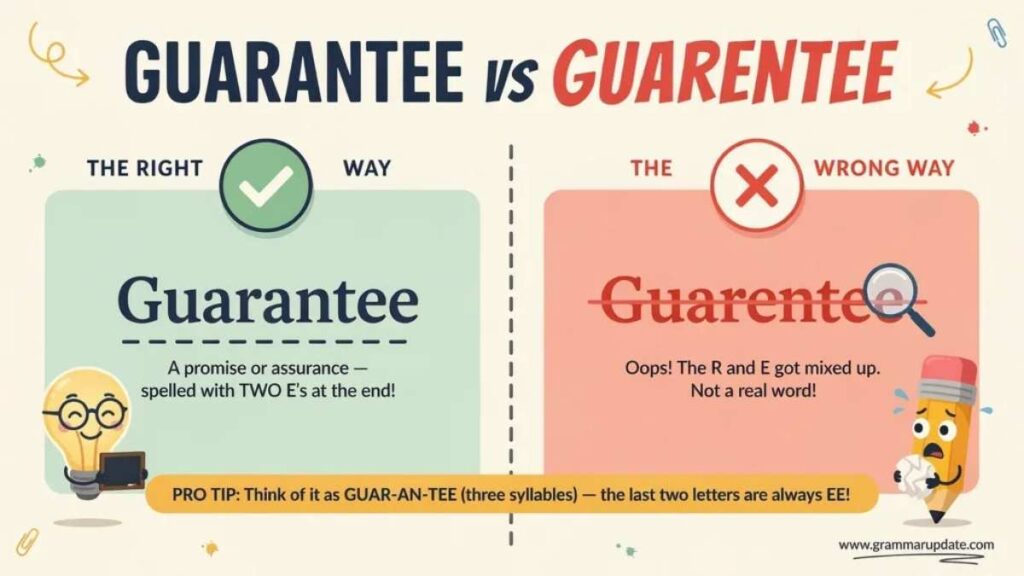
Guarantee vs guarentee is an easy spelling mistake to make, but the correction is simple. Guarantee is the correct spelling, while guarentee is incorrect. The confusion gets a little trickier because guaranty is also a real word, although it’s mainly used in legal and financial contexts. So, which word should you use? In most everyday writing, guarantee is the word you want. In this guide, you’ll learn the guarantee spelling, what guarantee means, why guarentee is wrong, and how guaranty differs from guarantee. By the end, you’ll know exactly which word fits your sentence, without letting one sneaky extra “e” cause trouble.
Quick Answer
Guarantee is the correct spelling.
Guarentee is not a standard English word. It is a common spelling mistake that occurs when people try to spell guarantee based on its pronunciation.
| Word | Correct or incorrect | Basic meaning |
|---|---|---|
| guarantee | Correct | A promise, assurance, or commitment |
| guarentee | Incorrect | A misspelling of guarantee |
| guaranty | Correct | A formal promise, especially in legal or financial contexts |
| guarantor | Correct | A person or organization that provides a guarantee or guaranty |
For example:
The company offers a money-back guarantee.
Not:
The company offers a money-back guarentee.
If the question is guarantee vs guarentee which is correct, the answer is simple: guarantee.
Learn the difference between confusing word pairs
Apparent Vs Aparent Which one Is Correct?
Guarantee vs Guarentee at a Glance
The Guarantee vs guarentee are not two different English words with different meanings. Guarantee is the standard word, while guarentee is a spelling error.
Guarantee can work as both a noun and a verb.
As a noun, it refers to a promise, assurance, or commitment.
The product comes with a two-year guarantee.
As a verb, it means to promise, assure, or make something certain.
The company guarantees fast delivery.
Guarentee does not have a separate meaning. If you see it in an email, article, advertisement, or other piece of writing, the writer most likely intended to write guarantee.
What Does Guarantee Mean?
The guarantee meaning centers on the idea of a promise or assurance.
A guarantee can tell someone that something will happen, that something is true, or that a particular condition will be met. The word can describe a casual promise, a business commitment, product protection, or a formal financial obligation.
A simple guarantee definition is a promise or assurance that something will happen, be provided, or meet certain conditions.
For example:
There is no guarantee that the plan will succeed.
The company gave a guarantee of payment.
The appliance comes with a five-year guarantee.
These examples show why guarantee has such a broad range of uses. It can describe certainty in everyday English or a formal responsibility in business and finance.
Guarantee as a Noun
When guarantee functions as a noun, it names the promise, assurance, or commitment itself.
Consider this sentence:
The laptop comes with a two-year guarantee.
Here, guarantee refers to the protection or promise provided by the manufacturer.
A guarantee can also describe an assurance about an outcome:
There is no guarantee that prices will remain the same.
It can refer to a business commitment:
The company provides a guarantee of quality.
It can also relate to a financial obligation:
The lender requested a guarantee of payment.
The surrounding context determines the exact sense.
Guarantee as a Verb
Guarantee also works as a verb. In this form, it means to promise, assure, or make something certain.
For example:
We guarantee fast delivery.
The manufacturer guarantees the quality of every product.
Hard work does not guarantee success.
Nothing can guarantee a positive result.
The first two examples involve a direct promise. The last two show that guarantee can also describe certainty or the lack of certainty.
The guarantee noun and verb distinction is therefore straightforward. As a noun, guarantee is the promise or assurance. As a verb, guarantee describes the act of making that promise or assurance.
Learn the difference between confusing word pairs
Possession vs Posession difference and usage?
Why Guarantee Is the Correct Spelling
The correct spelling is guarantee.
The spelling contains the sequence antee near the end:
guarantee
The incorrect form changes that internal vowel pattern:
guarentee
The pronunciation helps explain why people make this mistake. The ending sounds like “tee,” but English pronunciation does not always reveal every letter in a word. When people spell guarantee from sound alone, they may naturally insert an e where the word actually contains an a.
The safest approach is to remember the written form rather than trying to build it from pronunciation.
A useful visual reminder is this:
guarantee contains antee, not entee.
That small difference is what separates the correct spelling from the common error.
Why Guarentee Is Incorrect
Guarentee is not an alternative spelling of guarantee.
It is a misspelling.
For example:
Wrong: We guarentee your satisfaction.
Correct: We guarantee your satisfaction.
Wrong: The product includes a money-back guarentee.
Correct: The product includes a money-back guarantee.
Wrong: Nothing can guarentee success.
Correct: Nothing can guarantee success.
The mistake can also appear in related forms.
Wrong: The company guarenteed delivery.
Correct: The company guaranteed delivery.
Wrong: The company is guarenteeing the result.
Correct: The company is guaranteeing the result.
Learning the base spelling makes these related forms much easier to handle.
Learn the difference between confusing word pairs
Definite vs Definitive difference and usage?
Why Do People Misspell Guarantee as Guarentee?
Pronunciation is one major reason.
The word does not clearly reveal every letter when spoken aloud. The final sound can make people think of a spelling ending in tee, while the vowels in the middle are easy to rearrange.
Another source of confusion comes from related words. Guarantee, guaranty, and guarantor look similar, but they do not serve exactly the same grammatical or contextual purpose.
Fast typing can make the problem worse. When a familiar word feels almost right, people often write the first spelling that comes to mind instead of checking the internal vowel sequence.
The easiest memory trick is to focus on the middle of guarantee.
Remember:
guarantee = antee
Do not change that an into en.
Guarantee Pronunciation and Spelling
The pronunciation of guarantee can make its spelling difficult to predict.
In US English, the word is commonly pronounced with the stress toward the final syllable. The spoken form does not correspond neatly to every written letter, which explains why people sometimes write guarentee.
This is a useful reminder about English spelling: pronunciation can help you recognize a word, but it does not always tell you how to spell it.
That is especially important with words containing unusual vowel combinations.
The correct forms are:
guarantee
guarantees
guaranteed
guaranteeing
The incorrect forms are based on the same spelling mistake:
guarentee
guarentees
guarenteed
guarenteeing
If you remember the base word, the rest of the word family becomes much easier.
Learn the difference between confusing word pairs
Dilemma vs Dilema which one is correct ?
Guarantee vs Guarentee Examples
A simple comparison makes the spelling difference clear.
| Incorrect | Correct |
|---|---|
| We guarentee your satisfaction. | We guarantee your satisfaction. |
| The product has a lifetime guarentee. | The product has a lifetime guarantee. |
| Nothing can guarentee success. | Nothing can guarantee success. |
| The store offers a money-back guarentee. | The store offers a money-back guarantee. |
| They guarenteed delivery by Friday. | They guaranteed delivery by Friday. |
| The company is guarenteeing the result. | The company is guaranteeing the result. |
The pattern is consistent. If you mean the standard word for a promise or assurance, use guarantee.
Common Phrases With Guarantee
Guarantee appears in many familiar expressions.
| Phrase | Meaning |
|---|---|
| money-back guarantee | A promise to refund a customer under stated conditions |
| product guarantee | A promise concerning a product |
| lifetime guarantee | A guarantee that applies for a specified lifetime period |
| satisfaction guarantee | A promise connected with customer satisfaction |
| guarantee of quality | An assurance concerning quality |
| guarantee of payment | A commitment concerning payment |
| guarantee success | To promise or make success certain |
| guarantee delivery | To promise that delivery will occur |
| no guarantee | An acknowledgment that an outcome is not certain |
| under guarantee | Covered by a guarantee |
For example, a retailer might say:
The product comes with a 30-day money-back guarantee.
Someone discussing an uncertain result might say:
There is no guarantee that the project will finish on time.
Both sentences use guarantee correctly, but the word serves a different purpose in each one.
Learn the difference between confusing more English words
Acknowledge Vs Acknowlege Which one Is Correct?
Guarantee vs Guaranty What Is the Difference?
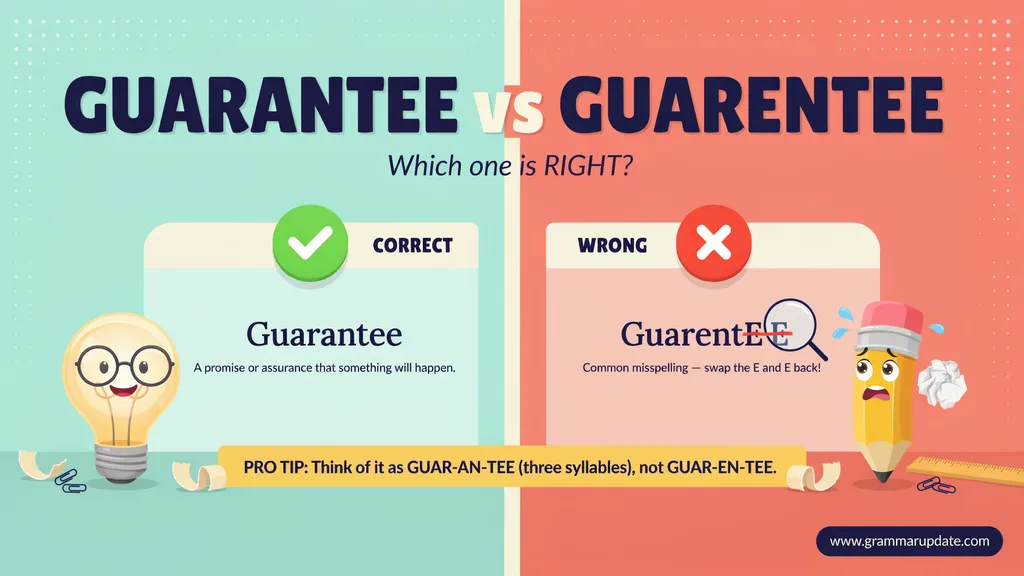
The guarantee vs guaranty question is different from guarantee vs guarentee.
Guarentee is a misspelling.
Guaranty is a real English word.
That distinction is important because people sometimes see guaranty and assume it is simply another incorrect version of guarantee. It is not.
The guaranty spelling is G-U-A-R-A-N-T-Y.
The guarantee spelling is G-U-A-R-A-N-T-E-E.
Both are legitimate words, but their typical uses differ.
Guarantee is the broader and more familiar word. It appears in everyday conversation, business writing, product descriptions, customer service, and discussions about certainty.
Guaranty is a noun that appears more often in legal and financial contexts. It commonly refers to a formal promise connected with another person’s obligation, especially a debt or payment obligation.
Guarantee vs Guaranty Difference
The guarantee vs guaranty difference is mainly about usage and context.
Guarantee can function as both a noun and a verb.
Guaranty is primarily used as a noun.
Guarantee has broad everyday usage.
Guaranty has a more specialized legal and financial usage.
| Guarantee | Guaranty |
|---|---|
| Common in everyday English | More specialized |
| Works as a noun and verb | Primarily a noun |
| Used for promises and assurances | Often used for formal undertakings |
| Common in product protection | Common in legal and financial contexts |
| Can refer to certainty | Often relates to another party’s obligation |
The difference does not mean that guarantee belongs only to ordinary English or that guaranty belongs exclusively to lawyers. Guarantee can certainly appear in legal documents, while guaranty can appear in formal business and financial communication.
The context determines which term fits.
Is Guaranty a Word?
Yes. Guaranty is a correct English word.
The word has a particularly strong connection with legal and financial terminology. It can refer to a formal promise involving another party’s obligation.
For example:
The lender required a personal guaranty before approving the loan.
Here, guaranty does not mean a simple everyday promise. It refers to a formal undertaking related to a financial obligation.
That is why you may encounter guaranty in loan documents, credit agreements, business contracts, banking materials, and other financial documents.
Guaranty Meaning and Definition
The guaranty meaning is closely connected with responsibility for another party’s obligation.
A practical guaranty definition is a formal promise or legal undertaking in which a guarantor agrees to answer for another party’s obligation under specified conditions.
Imagine a business takes out a loan.
The business is the borrower.
The bank is the lender.
The person who agrees to support the borrower’s obligation can be the guarantor.
The formal undertaking can be described as a guaranty.
This relationship is common in financial terminology and helps explain expressions such as personal guaranty, financial guaranty, bank guaranty, and guaranty agreement.
The exact rights and obligations depend on the wording of the agreement and the applicable law.
Learn the difference between confusing more English words
Changeable vs Changable Which one Is Correct?
Guarantee vs Guaranty in Legal Terms
The question of guarantee vs guaranty in legal terms requires more care because legal terminology can vary depending on jurisdiction and the language of a particular contract.
In US legal usage, guaranty commonly describes a secondary obligation in which one party agrees to answer for another party’s debt or obligation.
For example, a business owner might sign a personal guaranty connected to a business loan.
Guarantee has a broader meaning. It can refer to a general promise, a product commitment, an assurance of payment, or another formal undertaking.
This means it would be misleading to say that guarantee is never legal or that guaranty is always legal.
Both words can appear in legal documents. Guaranty simply has a more specialized association with formal financial obligations.
Guarantee vs Guaranty in Banking
The guarantee vs guaranty in banking distinction becomes particularly useful when discussing loans and financial obligations.
Suppose a company wants to borrow money from a bank.
The company is the borrower.
The bank is the lender.
A third party agrees to accept responsibility for the obligation if the borrower fails to meet the required conditions.
That third party may provide a guaranty.
For example:
The business owner signed a personal guaranty for the company loan.
The word guarantee can also appear in banking because it has a broader meaning.
For example:
The agreement included a guarantee of payment.
The two terms overlap, but guaranty often carries a more specialized financial and legal sense.
Personal Guaranty vs Guarantee
A personal guaranty usually involves an individual formally agreeing to answer for another party’s obligation.
This situation often appears when a business seeks financing.
For example, a bank may approve a loan for a company but require the owner to sign a personal guaranty.
The owner then becomes the guarantor.
The personal guaranty represents the formal undertaking.
This is different from saying:
I guarantee the company will succeed.
The second sentence is an ordinary assurance. It does not automatically create the same legal relationship as a signed financial document.
That distinction matters when reading contracts because everyday meanings and legal meanings can differ.
Guarantee vs Guarantor
Guarantee and guarantor are related words, but they refer to different things.
A guarantee is the promise, assurance, or undertaking.
A guarantor is the person or organization that provides that promise.
| Term | Meaning | Example |
|---|---|---|
| guarantee | The promise or assurance | The agreement includes a guarantee of payment. |
| guarantor | The person or organization making the promise | Maria is the guarantor for the loan. |
A simple way to remember the difference is:
The guarantor gives the guarantee.
This distinction becomes especially useful when reading financial documents because the contract may refer to the debtor, creditor, guarantor, and underlying obligation separately.
Learn the difference between confusing more English words
Colleague vs Colleage which one is correct ?
Guarantee vs Guaranty vs Guarantor
These three words are closely related, but each has a distinct role.
Guarantee generally refers to a promise or assurance.
Guaranty commonly refers to a formal undertaking, particularly in legal and financial contexts.
Guarantor refers to the person or organization making the undertaking.
Consider this simplified example:
A business receives a loan from a bank. The business is responsible for repaying the debt. The owner signs a personal guaranty. The owner is the guarantor.
The relationship can be summarized as:
Guarantee = promise or assurance
Guaranty = formal undertaking
Guarantor = person or entity providing the undertaking
Real contracts can use these terms in more specific ways, so the wording of the actual agreement matters.
Guarantee vs Warranty
Guarantee and warranty often appear together when people discuss products, but they are not identical in every situation.
A warranty generally provides specific assurances concerning a product, service, or condition. It may explain what a manufacturer or seller will do if a covered problem occurs.
A guarantee can also provide product protection. A money-back guarantee is a familiar example.
For instance:
The washing machine comes with a two-year warranty.
The retailer offers a money-back guarantee.
Both terms can involve customer protection, but their exact meaning depends on the wording and context.
The guarantee vs warranty difference becomes even more important in legal settings because contracts and consumer laws can define these rights and obligations in specific ways.
For everyday writing, remember that guarantee has a broader meaning. It can describe a promise, assurance, certainty, financial responsibility, or product protection.
Guarantee vs Assurance vs Promise
Guarantee, assurance, and promise share similar meanings, but they are not always interchangeable.
A promise usually describes a commitment to do something.
An assurance gives someone confidence that something is true or will happen.
A guarantee can express a stronger assurance or a formal commitment, depending on the context.
Compare these examples:
She promised to call tomorrow.
She assured me that everything was fine.
The company guaranteed delivery by Friday.
The first sentence focuses on a personal commitment. The second provides confidence. The third expresses a specific business commitment.
The right choice depends on what you are trying to communicate.
Learn the difference between confusing more English words
Bougie vs Boujee which one is correct?
Guarantee Meaning and Usage in Everyday English
The guarantee meaning changes slightly with the situation, but the central idea remains a promise or assurance.
In everyday conversation, you might say:
I guarantee that I will be there.
Here, guarantee means promise or assure.
In business writing:
We guarantee delivery within seven days.
Here, it describes a business commitment.
In product descriptions:
The camera comes with a two-year guarantee.
Here, it refers to product protection.
In discussions about uncertain outcomes:
Good preparation does not guarantee success.
Here, it means make certain.
The same word handles all four situations without changing its spelling.
Guaranty Meaning and Usage in Finance
Guaranty is more likely to appear when the subject involves a formal financial obligation.
Common expressions include personal guaranty, bank guaranty, financial guaranty, loan guaranty, and guaranty agreement.
For example:
The lender requested a personal guaranty from the business owner.
The company provided a guaranty for the payment obligation.
These examples involve more than an informal promise. They describe formal financial relationships in which responsibility can become important if the primary debtor fails to meet an obligation.
That is why guaranty appears frequently in financial terminology.
Guarantee vs Guaranty With Examples
The following examples show how the words can differ in ordinary and formal contexts.
| Situation | Natural term | Example |
|---|---|---|
| Everyday promise | guarantee | I guarantee that I will call tomorrow. |
| Product protection | guarantee | The product comes with a one-year guarantee. |
| Customer refund offer | guarantee | The company offers a money-back guarantee. |
| Business commitment | guarantee | We guarantee delivery within five days. |
| General certainty | guarantee | Planning does not guarantee success. |
| Formal financial undertaking | guaranty | The owner signed a personal guaranty. |
| Loan documentation | guaranty | The lender required a guaranty before approving the loan. |
| Person providing the undertaking | guarantor | The owner became the guarantor for the debt. |
The table shows the usual pattern, but it should not be treated as a rigid legal rule. Contracts can use terminology differently, and the applicable law can affect the precise meaning.
A Practical Example A Business Loan
Imagine that a small company applies for a bank loan.
The company becomes the borrower.
The bank becomes the lender.
The loan creates a financial obligation that the company must repay.
The bank may ask the company’s owner to sign a personal guaranty.
If the owner signs it, the owner acts as the guarantor.
The terminology now has a clear relationship:
The borrower receives the loan.
The lender provides the loan.
The guarantor provides the formal undertaking.
The guaranty documents that undertaking.
The underlying debt remains the company’s obligation, although the guaranty can create additional responsibility for the guarantor if the relevant conditions occur.
This example explains why guaranty is common in banking and finance. It also shows why guaranty and guarantor should not be treated as alternative spellings of guarantee.
Learn the difference between confusing more English words
Existence vs Existance which one is correct?
Common Spelling Mistakes Related to Guarantee
The main spelling mistake is guarentee.
However, the same error often carries into other forms of the word.
| Correct | Incorrect |
|---|---|
| guarantee | guarentee |
| guarantees | guarentees |
| guaranteed | guarenteed |
| guaranteeing | guarenteeing |
The best strategy is to remember the base form first.
Guarantee is the foundation.
From there, the related forms become easier to recognize:
Guarantee → guarantees → guaranteed → guaranteeing
The incorrect spelling usually results from carrying the original mistake into each new form.
How to Remember the Spelling of Guarantee
The easiest memory trick is to focus on the middle.
Guarantee contains antee.
Guarentee contains entee.
So when you hesitate, look at the vowels:
Guarantee: antee
Guarentee: entee
The correct word has an a before the n.
Another useful trick is to connect guarantee with the word guarantor. Both begin with guar-an. The spelling pattern can help you remember that the middle should not change to guaren.
Most importantly, do not spell the word only by sound. The pronunciation can lead you toward guarentee even though the standard spelling is guarantee.
When to Use Guarantee in Professional Writing
Guarantee appears frequently in professional communication.
You may use it in business emails, product descriptions, customer-service messages, reports, agreements, and marketing copy.
For example:
The manufacturer guarantees the product against defects for the stated period.
The company offers a money-back guarantee under the conditions listed in the agreement.
The supplier guarantees delivery within five business days.
There is no guarantee that the requested result will occur.
In professional writing, correct spelling matters because even a small error can distract readers from the information you are trying to communicate.
Writing guarantee correctly is especially important when the word appears repeatedly in a business document or product description.
Learn the difference between confusing more English words
Argument vs Arguement Which one Is Correct?
Practice Session Guarantee vs Guarentee
Fill in each blank with the correct word or form: Guarantee vs Guarentee, guaranteed, guaranteeing, guaranty, or guarantor.
- The company offers a money-back __________ if you are not satisfied with the product.
- We __________ that your order will arrive within five business days.
- There is no __________ that the project will finish on time.
- The manufacturer __________ the product for two years.
- The bank asked the business owner to sign a personal __________.
- A __________ may become responsible for another party’s debt under the terms of an agreement.
- The seller __________ a full refund under the stated conditions.
- The new policy does not __________ better results.
- The company is __________ fast delivery for all orders.
- The appliance comes with a five-year __________.
- The lender required a personal __________ before approving the business loan.
- The owner became the __________ for the company’s financial obligation.
- The contract includes a __________ of payment.
- The store __________ customer satisfaction.
- Good preparation does not always __________ success.
- The bank required the borrower to provide a __________ before releasing the funds.
- The company __________ that every product meets its quality standards.
- The business owner signed the document as the __________.
- The product description includes a lifetime __________.
- The agreement contains a financial __________ related to the loan.
- Nothing can __________ that the plan will succeed.
- The manufacturer is __________ the quality of every item it sells.
- The lender explained that the __________ created a formal obligation for the signer.
- The company __________ delivery by Friday, so the customer placed the order.
- Remember that “guarentee” is incorrect. The correct spelling is __________.
Answers
- guarantee
- guarantee
- guarantee
- guarantees
- guaranty
- guarantor
- guarantees
- guarantee
- guaranteeing
- guarantee
- guaranty
- guarantor
- guarantee
- guarantees
- guarantee
- guaranty
- guarantees
- guarantor
- guarantee
- guaranty
- guarantee
- guaranteeing
- guaranty
- guaranteed
- guarantee
Here’s a trusted source for clear word meanings:
FAQs
What is the plural of guarantee?
The plural of guarantee is guarantees. For example, a company may offer several guarantees for different products or services.
What is the plural of guaranty?
The plural of guaranty is guaranties. This form commonly appears in legal and financial documents involving multiple formal undertakings.
Can guarantee be used in a legal contract?
Yes. Guarantee can be used in legal contracts and agreements. Its exact meaning and legal effect depend on the wording of the document and the applicable law.
Can guaranty be used in everyday English?
Yes, but guaranty is much less common in everyday English than guarantee. You are more likely to encounter guaranty in banking, lending, finance, and legal writing.
Is guarantee a countable noun?
Yes. When guarantee refers to a specific promise or assurance, you can use it as a countable noun. For example, you can say “a guarantee” or “several guarantees.”
Can guarantee describe certainty?
Yes. Guarantee can describe something that makes an outcome certain or provides strong assurance about what will happen. For example, “This approach does not guarantee success.”
What does guaranteed mean?
Guaranteed is the past tense and past participle of guarantee. It means that someone promised or assured something, or that something was presented as certain.
How do you use guaranteed in a sentence?
Use guaranteed when you want to describe something that someone has promised or assured. For example, “The seller guaranteed a full refund if the product arrived damaged.”
Can guaranteed be used as an adjective?
Yes. Guaranteed can function as an adjective when it describes something that has been promised or assured. Common examples include “guaranteed delivery” and “guaranteed results.”
Can guarantee refer to a person?
Usually, no. In ordinary English, guarantee refers to a promise, assurance, or undertaking. The person who provides that promise is generally called a guarantor.
What is the difference between a guarantee and a guarantor in a contract?
A guarantee is the promise or undertaking made under the agreement. A guarantor is the person or organization that provides that guarantee.
What can a guarantee cover?
A guarantee can cover different things depending on its terms. A product guarantee may cover defects or repairs, while a money-back guarantee may provide a refund when certain conditions are met.
Can a guarantee have conditions?
Yes. Many guarantees come with specific conditions, exclusions, deadlines, or coverage requirements. Always check the terms to understand exactly what the guarantee includes.
What is a limited guarantee?
A limited guarantee provides protection only under specific conditions. It may apply for a particular period, cover certain problems, or exclude certain types of damage.
What is an unconditional guarantee?
An unconditional guarantee generally describes a commitment with fewer conditions or restrictions. However, the precise meaning depends on the wording of the agreement and the applicable law.
Can a guarantee expire?
Yes. A guarantee can have an expiration date or a defined coverage period. For example, a product may come with a guarantee that remains valid for one year.
What is a guarantee period?
A guarantee period is the length of time during which a guarantee applies. The period varies depending on the product, service, contract, or stated terms.
How is guarantee used in business?
Businesses use guarantee to describe commitments involving products, services, quality, delivery, refunds, or customer satisfaction. A well-written guarantee should clearly explain what the business promises to do.
What is a performance guarantee?
A performance guarantee is a commitment related to the expected performance of a person, company, project, service, or contractual obligation. The exact requirements depend on the relevant agreement.
What is a payment guarantee?
A payment guarantee is a commitment related to the payment of a specific financial obligation. It can provide additional assurance in commercial or financial transactions.
Can guarantee and guaranty appear in the same document?
Yes. A legal or financial document can use both words when they serve different purposes. Guarantee may describe a broader commitment, while guaranty may refer to a specific formal undertaking.
Why does guaranty end in “y” instead of “ee”?
Guaranty is an established English noun with its own spelling and usage. It is not a misspelling of guarantee. Although the words are closely related, they commonly appear in different contexts.
Is “guarentee” acceptable in formal writing?
No. Guarentee is a misspelling and is not the standard form. Use guarantee when you mean the common English word for a promise, assurance, or commitment.
How can you avoid confusing guarantee and guaranty?
Think about the context. Guarantee is the broader word and works naturally in everyday, business, and product-related writing. Guaranty is a more specialized noun that commonly appears in legal and financial contexts. Guarantor refers to the person or organization providing the undertaking.
What is the easiest way to remember the spelling of guarantee?
Remember the exact spelling: guarantee. Pay special attention to the “an” in the middle. Writing “guarentee” changes that part of the word and creates a spelling error.
Learn the difference between confusing more English words
Cemetery vs Cemetary Which one Is Correct?
conclusion
The confusion between guarantee vs guarentee comes down to one simple spelling mistake. Guarantee is the correct spelling, while guarentee is incorrect. When you mean a promise, assurance, product protection, or business commitment, use guarantee.
Guaranty is different. It is a real word, but you will usually see it as a noun in legal and financial contexts. A guarantor is the person or organization that provides the guarantee or guaranty.
The easiest way to remember the difference is simple: guarantee is the common word, guaranty is the specialized legal or financial term, and guarantor is the person behind the promise. Keep those three straight, and guarentee will have no reason to sneak into your writing again.

Jhon AJS, the creative mind behind Grammar Update, is an experienced blogger passionate about simplifying English grammar. He focuses on explaining confusing word vs word differences, grammar rules, punctuation, and sentence structure in a clear and practical way. Through easy to understand guides and examples, Jhon helps readers improve their writing and communicate with confidence. With years of blogging experience, he continues to share helpful insights that make learning grammar simple, useful, and accessible for everyone.